

According to Mordor Intelligence, a global market research firm, Saudi e-commerce is estimated at USD 31.29 billion in 2026, up from USD 27.96 billion in 2025, with a projection of USD 54.87 billion by 2031. What does that mean if you own a business? It means more of your customers are already buying online, and they’re buying from the stores that make it easy.
From a business point of view, an online store is a sales system, not a website with a cart. A customer finds your product, pays the way they prefer, receives a valid invoice, gets the order at their door, and your team can see every step from one dashboard. When that system runs smoothly, you spend your week on products, offers and customers. When it doesn’t, you spend it fixing things.
That’s also the point where many Saudi owners get confused. Two names come up in every conversation about starting a store: Salla and Shopify. One was built in Saudi Arabia, and the other is used worldwide, including in Saudi Arabia. So owners end up comparing what they can see, like themes and monthly plans, because the rest stays hidden until the store is live.
Here’s what makes the choice easier to understand. Either platform can run a store in any industry, whether you sell electronics, food or wholesale supplies. What decides which one suits you sits in the background: how payments connect (mada, Tabby and Tamara), how ZATCA e-invoices are issued, how Arabic and right-to-left layouts work, and how orders reach Saudi shipping carriers. Each of those pieces has to be set up and tested.
Both platforms need professional development to get that right. A store configured correctly from the start lets you work on your business. A store left half-configured turns you into its repair person, fixing one component after another while orders wait.
This guide compares Shopify vs Salla for Saudi business owners who are launching a first store or wondering whether to switch. It explains who each platform suits, how each handles payments, cost, ZATCA e-invoicing, Arabic, shipping, themes and apps, and how each supports different industries. By the end, you’ll know whether it’s Salla or Shopify for your store, and what to ask before anyone builds it.
What Is Salla, and Who Is It Built For?
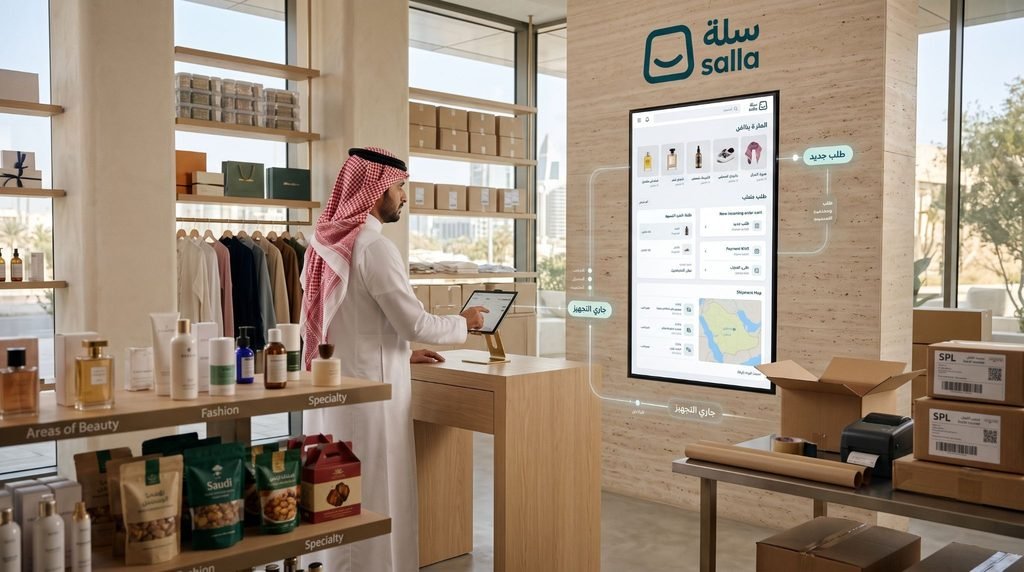
Salla is a Saudi e-commerce platform that lets you launch and run an online store without writing code. It’s built for Saudi sellers, and you can see it in what arrives with every store. Salla’s own documentation lists mada, Tabby and Tamara, ZATCA e-invoicing that doesn’t need a third-party app, direct links to Saudi shipping carriers, an Arabic right-to-left storefront and round-the-clock Arabic support as part of the platform. If you’re selling mostly to Saudi customers, that’s most of your setup list already done.
Our Salla development service builds on that foundation. We set up the theme, store structure, payment methods and shipping around how you sell, and we work inside what Salla offers instead of fighting it.
What Is Shopify, and Does It Work for Saudi Brands?

Shopify is a global platform, and a Shopify online store runs in any country and currency. For a Saudi store, that means you connect four things on top of it: a local payment gateway, a ZATCA e-invoicing app, an Arabic storefront and your Saudi shipping carriers. Each one is a solved problem. Each one is also a setup task with its own monthly cost and its own thing that can break.
So who is it for? Brands that plan to sell beyond Saudi, stores that need custom features, and owners who want the largest app and theme ecosystem. Is Shopify good for beginners and small businesses? The dashboard is easy to learn. The Saudi setup behind it isn’t, and a small team without developer help tends to stall right there. Our Shopify development services handle that setup, so your store launches with payments, invoices, Arabic and shipping already working.
How Do Salla and Shopify Handle Payments in Saudi Arabia?
Payment is where Saudi stores win or lose the sale. A customer who reaches checkout and can’t pay the way she pays everywhere else doesn’t email you about it. She leaves.
Both platforms can take every payment method Saudi shoppers expect. The difference is who does the work to switch them on.
How Do You Accept Mada, STC Pay and Apple Pay?
On Salla, mada is part of the platform, and other local methods like STC Pay and Apple Pay sit in the same payment settings. You switch them on and test them before you open.
On Shopify, you connect a Saudi payment gateway such as Moyasar, HyperPay, Tap Payments or PayTabs, and that gateway supplies mada, STC Pay and Apple Pay. Gateway approval needs your commercial registration and takes time, so start it before the store is built, not after.
How Do Tabby and Tamara Work on Each Platform?
Installments matter in Saudi because baskets run large. A customer who’d hesitate over a SAR 1,800 order will often say yes to four payments of SAR 450.
Salla supports Tabby and Tamara inside the platform. On Shopify, you add each through the provider’s own integration, and each approves your store separately. Apply to both before launch, not after your first abandoned-cart report.
What About Shopify Payments, Stripe and Afterpay?
Shopify Payments is the cheapest route where it’s offered, but merchants in the GCC need a third-party gateway. That has a cost. Shopify charges its own transaction fee on top of the gateway’s fee whenever you don’t use Shopify Payments.
Stripe and Afterpay come up in plenty of Shopify guides, but those guides are written for other markets. Check whether Stripe is available for your business registration before you plan around it. Where a guide says Afterpay, use Tabby and Tamara, because those are the instalment options your customers already know.
How Much Do Salla and Shopify Development Cost in Saudi Arabia?
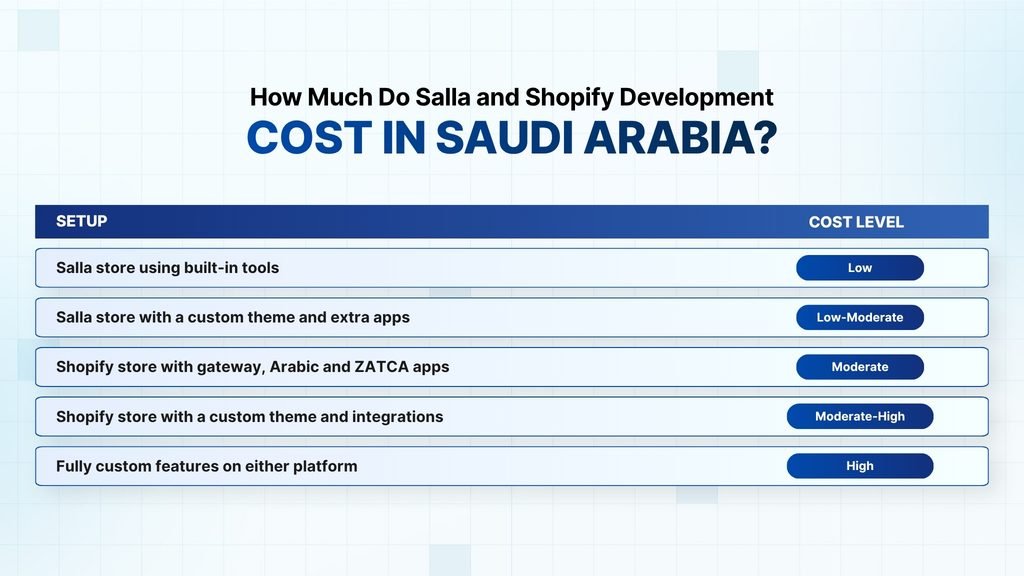
| Setup | Cost Level |
| Salla store using built-in tools | Low |
| Salla store with a custom theme and extra apps | Low-Moderate |
| Shopify store with gateway, Arabic and ZATCA apps | Moderate |
| Shopify store with a custom theme and integrations | Moderate-High |
| Fully custom features on either platform | High |
Start with the plan. Finish with everything stacked on top of it.
Both platforms charge a monthly plan, and both change their plans and prices, so check each current pricing page before you budget. We’ve kept this section to cost levels for that reason. What the pricing pages don’t show is the rest of your bill.
What Do Salla Pricing and Salla Plans Include?
Salla sells tiered plans, and higher tiers add features and capacity. Because payments, ZATCA e-invoicing and shipping links are already inside the platform, there’s less to add on top. Your question when comparing Salla plans is which tier covers the volume and features you need, not which extras you’ll have to buy.
What Is the Real Shopify Cost Per Month?
Shopify also sells tiered plans, and the plan is only the first line. Your Shopify cost per month is the plan, plus your gateway’s fees, plus Shopify’s own transaction fees, plus every app you add.
The line most owners miss is the transaction fee. Shopify transaction fees apply to every sale that doesn’t run through Shopify Payments, and in Saudi, that’s every sale. A fee that looks small on 50 orders matters on 5,000.
What Drives Your Cost Up or Down
- Number of apps: every app adds a monthly charge, and three small ones cost more than one good one
- Translation and RTL work: Arabic done properly is its own production task, and it costs more on Shopify than on Salla
- Theme customisation: a standard theme costs little, and a brand-specific layout adds design and development time
- Integrations: connecting an ERP, inventory system or courier adds build time and ongoing support
- Order volume: gateway and Shopify transaction fees grow with every sale, which you’ll feel most in Ramadan and White Friday
Which Platform Handles ZATCA E-Invoicing Better for Online Stores?
Every invoice your store issues has to meet ZATCA rules, and that’s a compliance matter, not a technical detail.
ZATCA’s Phase Two (the integration phase) requires your e-invoicing solution to connect to its FATOORA platform and issue invoices in a set format. ZATCA brings taxpayers in gradually, in waves, and tells each wave at least six months before its integration date. So if your wave hasn’t been called yet, it will be, and your store needs to be ready when it is.
Salla includes e-invoicing compliance inside the platform, so you don’t buy a separate tool. On Shopify, you add a ZATCA-approved e-invoicing app and have a developer connect it to your orders. Test it with real orders before launch. Then ask the provider for proof of ZATCA approval before you pay, because a tool that looks right but isn’t approved leaves you with the same problem you were trying to avoid.
Does Arabic Work Properly on Shopify and Salla?
Arabic is a layout requirement. An Arabic customer reading a left-to-right store sees buttons, menus and product pages on the wrong side, and she reads that as a store that wasn’t built for her.
On Salla, Arabic starts as the default. The storefront is right-to-left, the themes are built for it, and your customer gets a native experience from the first page.
On Shopify, you get there in two steps. First, you pick a theme with real RTL support (an RTL ecommerce theme, not a left-to-right one with translated text). Second, you translate the storefront using an app such as Langify or Weglot, or Shopify’s own translation tools. Running Arabic and English together? Add hreflang tags, so Google shows each customer the right version.
Both routes lead to a good Arabic store. One starts there, and the other has to build its way there.
How Does Shipping Work in Saudi Arabia on Each Platform?
On Salla, direct integrations with Saudi shipping carriers are already part of the platform. Labels, tracking and rates sit next to your orders. On Shopify, you connect carriers like Aramex, SMSA and Naqel through apps or a custom integration. That gives you more control over rules and rates, and it also means someone has to set it up and keep it running.
Why does it matter? Routes through sparsely populated areas can double the cost per package compared with deliveries inside a city. If you ship to Riyadh and Jeddah only, either platform copes. If you ship across the Kingdom, test your rates by city on both before you commit, and decide who covers the extra cost, you or the customer.
What Do Themes and App Stores Offer on Each Platform?
Your theme decides how your store looks. Your apps decide what it can do. Neither choice is permanent, but both cost money to change.
What Should You Know About Salla Themes and the Salla App Store?
Salla themes are built for the market, with RTL layouts ready and categories like fashion already covered. You get less variety than on Shopify, and less to fix. The Salla app store is smaller, and it’s built around what Saudi stores need: local shipping, payment and marketing tools.
What Should You Know About Shopify Themes, the Shopify App Store?
Shopify themes give you far more variety, and the Shopify app store is far larger. The best Shopify apps for a Saudi store cover Saudi payments, ZATCA e-invoicing, translation, shipping and reviews, and there’s more than one option for each job.
Bigger isn’t always better, though. Every app adds a monthly bill, a little loading time and one more thing to keep updated. Check each theme for real RTL support before you buy it, because many popular themes are left-to-right by default.
Which Saudi Industries Fit Salla and Which Fit Shopify?
Either platform can run a store in any Saudi industry. What changes from one industry to the next is which of each platform’s strengths you lean on most, and how much of it comes ready versus how much you connect yourself.
So read the table as a feature check for your own store. Find your industry, then see what each platform brings to it.
| Industry | What Salla and Shopify Offer |
| Fashion and abayas | Salla: Saudi payments, instalments, Saudi carriers and Arabic themes ready for Eid and Ramadan launches. Shopify: a wide range of themes and apps for custom product pages, variants and seasonal promotions. |
| Beauty, skincare and fragrance | Salla: local payments, instalments and carrier links that keep repeat orders moving. Shopify: apps for reviews, bundles, loyalty and email marketing around repeat buyers. |
| Electronics and mobile accessories | Salla: instalments, Saudi carriers and ZATCA invoices already in place for high-value orders. Shopify: apps and developers for large catalogues, specification tables and links to inventory systems. |
| Home, furniture and décor | Salla: Saudi payment and delivery links for bulky orders, with Arabic themes. Shopify: wider design freedom, plus apps for large catalogues and product configurators. |
| Food, dates, coffee and sweets | Salla: ZATCA invoicing, local payments and carrier links that hold up in peak weeks. Shopify: apps for delivery dates, repeat orders and subscriptions, with carriers connected through integrations. |
| Gifts, flowers and occasions | Salla: local payments, instalments and quick setup for occasion-led campaigns. Shopify: apps for gift messages, scheduled delivery and personalised products. |
| Health, supplements and wellness | Salla: local payments, instalments, ZATCA invoicing and Arabic product pages. Shopify: apps for subscriptions, bundles and customer reminders. |
| Jewellery and watches | Salla: local payments and instalments for high-value orders, with Saudi carriers. Shopify: themes and apps for rich product pages, size guides and custom builds. |
| Kids, toys and baby products | Salla: Arabic storefront, local payments and carrier links for fast family orders. Shopify: apps for bundles, wish lists and loyalty programmes. |
| Sports, fitness and outdoor | Salla: local payments, instalments for equipment and Saudi carriers. Shopify: apps for variants, bundles and memberships. |
| Auto parts and accessories | Salla: Saudi carrier links for bulky parts and local payments at checkout. Shopify: apps and developers for large catalogues and make, model and year search. |
| Books, stationery and education | Salla: local payments, ZATCA invoices and an Arabic storefront for mixed catalogues. Shopify: apps for digital downloads, bundles and course delivery. |
| Wholesale and B2B suppliers | Salla: ZATCA invoicing and Saudi payments for business orders, with customer-pricing tools to confirm in your plan and app store. Shopify: dedicated wholesale features, including separate pricing for business buyers, and links to ERP systems. |
What Are the Best Alternatives to Shopify and Salla?
Is anything better than Shopify? For a Saudi store, it depends on what you need, and websites like Shopify exist that fit specific cases better. The same goes in reverse for anyone looking for Salla alternatives.
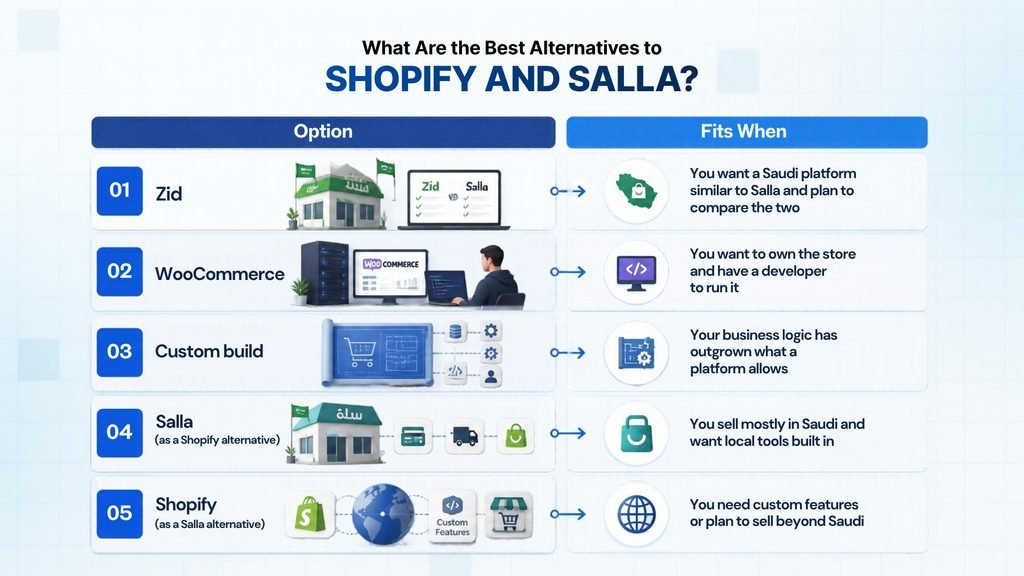
| Option | Fits When |
| Zid | You want a Saudi platform similar to Salla and plan to compare the two |
| WooCommerce | You want to own the store and have a developer to run it |
| Custom build | Your business logic has outgrown what a platform allows |
| Salla (as a Shopify alternative) | You sell mostly in Saudi and want local tools built in |
| Shopify (as a Salla alternative) | You need custom features or plan to sell beyond Saudi |
Our Zid development guide and WooCommerce development guide cover the first two in full. The best Shopify alternative for you is the one that matches your market, your team and your next two years of growth, not the one that ranks first in a list.
Can You Migrate From Shopify to Salla?
Yes, and the move works in the other direction too.
You can export products, customers and order history from Shopify and import them into Salla, usually as spreadsheet files. Your theme, apps and settings don’t come with them. You rebuild those. Your old product URLs also need redirects to the new ones, or you lose the rankings those pages earned.
Before you switch, set up payments and ZATCA on the new platform and place real test orders. Keep the old store live until the new one passes. A store that switches on launch day, with nothing tested, is the one that loses a week of orders.
What Mistakes Do Saudi Sellers Make When Choosing a Platform?
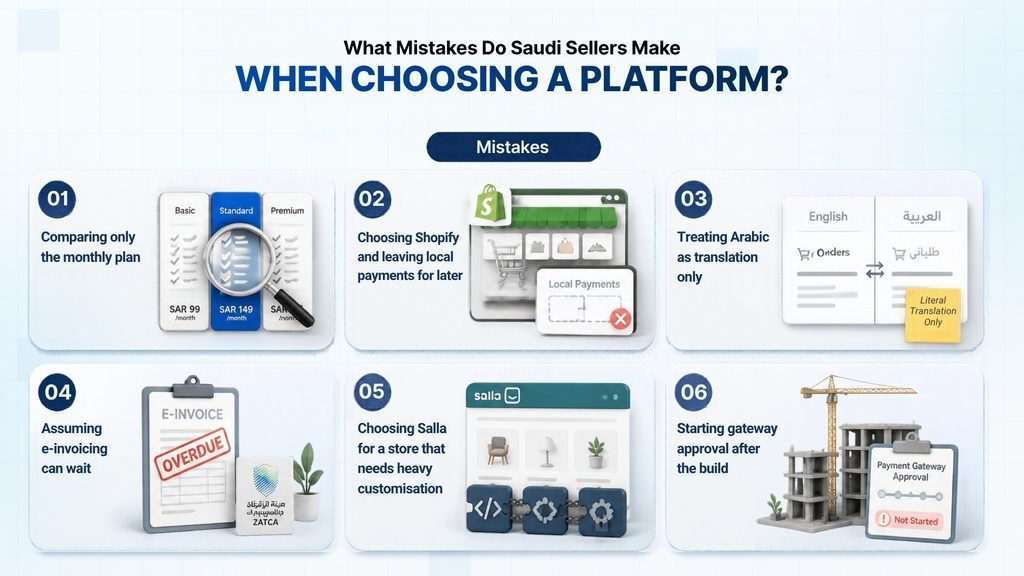
| Mistakes |
| Comparing only the monthly plan |
| Choosing Shopify and leaving local payments for later |
| Treating Arabic as translation only |
| Assuming e-invoicing can wait |
| Choosing Salla for a store that needs heavy customisation |
| Starting gateway approval after the build |
So, Salla or Shopify, which one to choose?
Ask yourself three questions, and keep one fact in view while you answer them. Both platforms need a development team. A store that sells well on either one has developers behind it.
Where will most of your customers be? If they’re in Saudi, Salla gives you the shortest road, because Saudi payments, ZATCA invoicing and carriers are already inside the platform. If they’re in several countries, Shopify fits better, since you set up markets, currencies and languages around each one.
What does your store need to do that a standard store doesn’t? Custom logic, wholesale pricing and large catalogues point toward Shopify. A clean retail store points toward Salla. Both still need developers. On Salla, they set up the theme, store structure and integrations around what the platform offers. On Shopify, they build and connect what it doesn’t include.
What will your team and your developers each do? Your team runs the store day to day: adding products, changing prices, running offers. Your developers do the work behind it: launch setup, integrations, fixes and updates. Salla asks for less of that work. Shopify asks for more, mostly at the start, when the gateway, ZATCA app, Arabic and shipping get connected, and again each time you add something custom. Plan for that team before you pick, whether it’s in-house or an agency.
If your answers split between the two, that’s normal. It’s also the best reason to talk it through before anything is built.
Why Work With Etihad Falcon Tech For Your Salla or Shopify Store?

Maybe you’re launching your first store and can’t tell which platform to trust. Maybe you’re on Shopify, and mada checkout keeps failing or your ZATCA invoices aren’t passing. Maybe you’re on Salla, and you’ve outgrown it. These are the situations we work in.
Platform Advice That Doesn’t Depend on Which One We Build
We don’t start with a platform, we start with your customers, your product and what the store has to do in six months. Then we tell you which platform fits, even when it isn’t the one that gives us more work.
Arabic and Compliance From Day One
On Salla, we set up the store structure, theme, payments and shipping around how you sell. On Shopify, we handle the Saudi side: the local gateway, ZATCA e-invoicing, Arabic and RTL, and your shipping carriers. None of it is left for you to discover after launch.
One Team, Start to Finish
If you’re moving between platforms, we plan the redirects, rebuild the theme and test the checkout before your old store goes offline. You deal with one team from the first decision to the first order.
If you’re stuck between Shopify and Salla, or your current store isn’t converting at the rate your traffic should support, message us on WhatsApp and tell us what you sell, where your customers are and what you need the store to do. We will tell you honestly which platform fits and what the build involves.
Frequently Asked Questions
Is Salla better than Shopify?
Neither wins for everyone. Salla suits Saudi-focused stores that want local tools built in, and Shopify suits stores that need custom features or sell across borders.
Does Shopify work in Saudi Arabia?
Yes. You’ll connect a local payment gateway, set up ZATCA e-invoicing, and configure Arabic and shipping yourself, or have a developer do it.
Can I accept mada on Shopify?
Yes, through a Saudi payment gateway that supports mada. Shopify Payments isn’t available to Saudi merchants, so your gateway does that job.
How much does Shopify cost per month?
It depends on your plan, your gateway, Shopify’s transaction fee and the apps you add. Check the current pricing page, then add the extras before you compare it with Salla.
Does Salla support ZATCA e-invoicing?
Yes, e-invoicing compliance is part of the platform. Confirm your store’s setup is active and test a real order before you launch.
Can I run an Arabic and English store on Shopify?
Yes. Use a theme with real RTL support, translate the storefront with an app like Langify or Weglot, and add hreflang tags.
Is Shopify good for dropshipping in Saudi Arabia?
It has the larger set of dropshipping apps. Confirm your suppliers can deliver into Saudi within a window your customers will accept.
Can I move my store from Shopify to Salla?
Yes. Products and customers can be exported and imported, but you rebuild the theme and apps and set up redirects for your old URLs.
How does Etihad Falcon Tech help me choose between Salla and Shopify?
We look at your products, customers and growth plan, then recommend the platform that fits, even if it’s not the one we’d build more on. Message us on WhatsApp with what you sell and where your customers are, and we’ll walk you through the right platform, the right setup, and the right next step.