
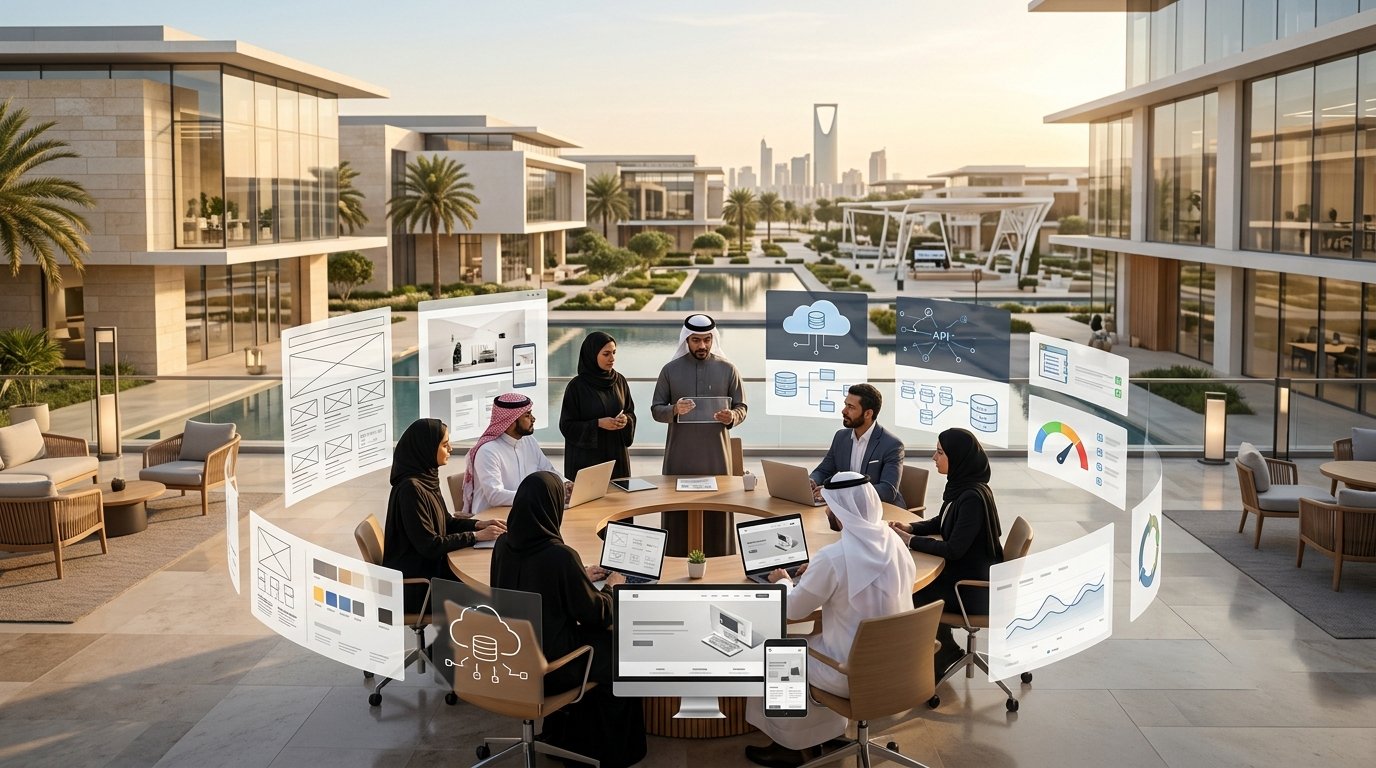
67 percent of businesses globally say they have lost revenue directly because of how their website performs. Not because of their product. Not because of their pricing. Because of the website itself. That’s the reality behind web development in Saudi Arabia today: more competition online, less room for a website that doesn’t perform.
Most Saudi businesses already have a website. Few of them ask what it’s actually supposed to do beyond exist. A well-built one answers a customer’s questions before they’re asked and walks someone from “What is this business?” to “I want to book this” without a phone call in between. It shows what you offer, builds trust before the first real conversation, and makes the next step obvious: a call, a purchase, or a form filled out at midnight after your office has closed.
A website that does this is not a digital brochure. It is a sales tool that works around the clock, even when you are not.
How Saudi Buyers’ Behavior Has Made a High-Performing Website Non-Negotiable

Saudi buyers do not start with conversations anymore. They start with validation.
Before a call, before a WhatsApp message, before a site visit, they check your website. Not casually, but critically. They are looking for signals that reduce uncertainty fast: what you do, how clearly you explain it, whether your business feels structured enough to trust, and whether someone like them has worked with you before.
Vision 2030’s digitization push across sectors has only sharpened this. Buyers compare faster, switch faster, and drop off faster. The window between landing on your site and forming a judgment has narrowed to seconds.
Your website is now the filter. Not the support.
What A Saudi Buyer Expects To See In The First Ten Seconds
Mobile load speed is the first test. Most Saudi traffic is mobile. If your site takes more than a few seconds to stabilize on a mid-range Android device, which represents a significant portion of Saudi smartphone usage, the user leaves before the content registers. Design quality is irrelevant if the page has not loaded.
The Arabic language is the second test. English-only sites create immediate friction for the majority of Saudi users. Bilingual sites that treat Arabic as a translation layer rather than a primary experience create a different kind of friction, one that signals the business does not fully understand its own market.
Trust signals are the third test. Clear service descriptions, real project references, location clarity, and structured information hierarchy. If these are missing or buried, the site feels unreliable regardless of how well it looks on a desktop.
Why Saudi Businesses Without A Strong Web Presence Are Losing Clients
Not dramatically. Quietly.
Competitors with faster, clearer, and better-structured websites capture buyer intent earlier in the decision process. They do not necessarily have better services. They remove friction faster. In a market where the buyer’s first move is digital validation, that friction gap is enough to shift demand consistently over time.
What Questions Every Saudi Business Should Answer Before Starting Web Development
Every business owner must ask three important questions before starting website development for their business. If you skip these questions, you will end up with the most expensive kind of project there is. You will pay for it once when it gets built and launched, then again when it has to be redesigned or rebuilt because you never understood the core purpose of your business website.
So here are the three most important questions you need to keep in mind when you plan your web development project:
What is the primary job of this website?
Credibility and brand presence, lead generation, or direct transactions. These are three different jobs with three different build priorities. Trying to serve all three equally without a clear hierarchy produces a site that does none of them well enough to move the needle.
Who manages the site after launch?
Most websites degrade not because of poor development but because no one owns them after handover. Content goes stale. Security patches get missed. Performance drops. The answer to this question should be clear before development starts, not six months after launch.
What does success look like in twelve months?
Traffic volume, lead quality, conversion rate, operational efficiency, or ranking position. If this is not defined before the build, the project has no measurable direction and no baseline against which to judge whether the investment worked.
Which Type of Website Does Your Business Actually Need?
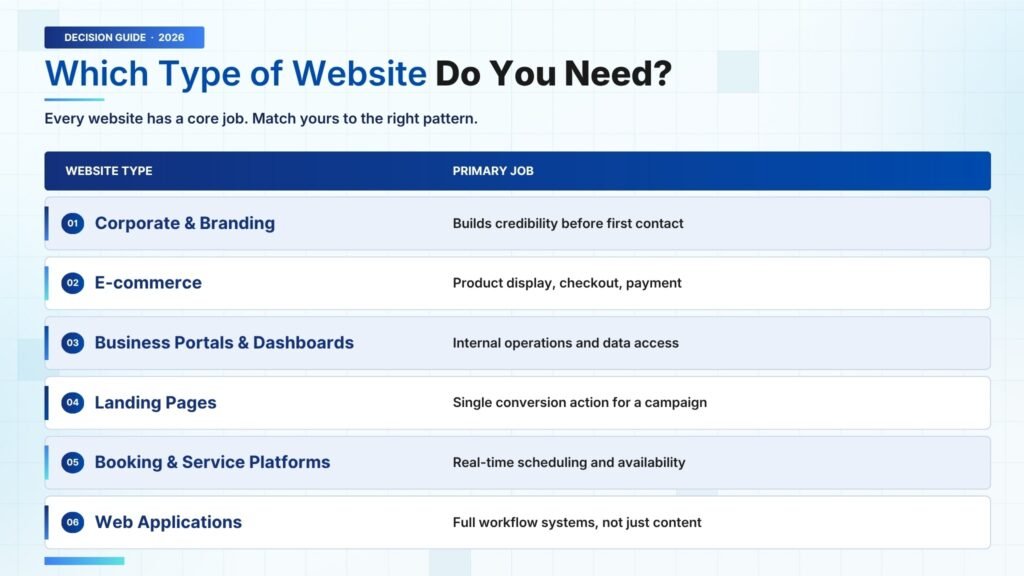
| Website Type | Primary Job |
| Corporate & Branding | Builds credibility before first contact |
| E-commerce | Product display, checkout, payment |
| Business Portals & Dashboards | Internal operations and data access |
| Landing Pages | Single conversion action for a campaign |
| Booking & Service Platforms | Real-time scheduling and availability |
| Web Applications | Full workflow systems, not just content |
The answer to this important question decides the technology, the build process, the maintenance model, and what you’ll pay. Get it wrong, and you end up with something that technically works but fails the business because it is not serving your customers well.
Corporate and branding website
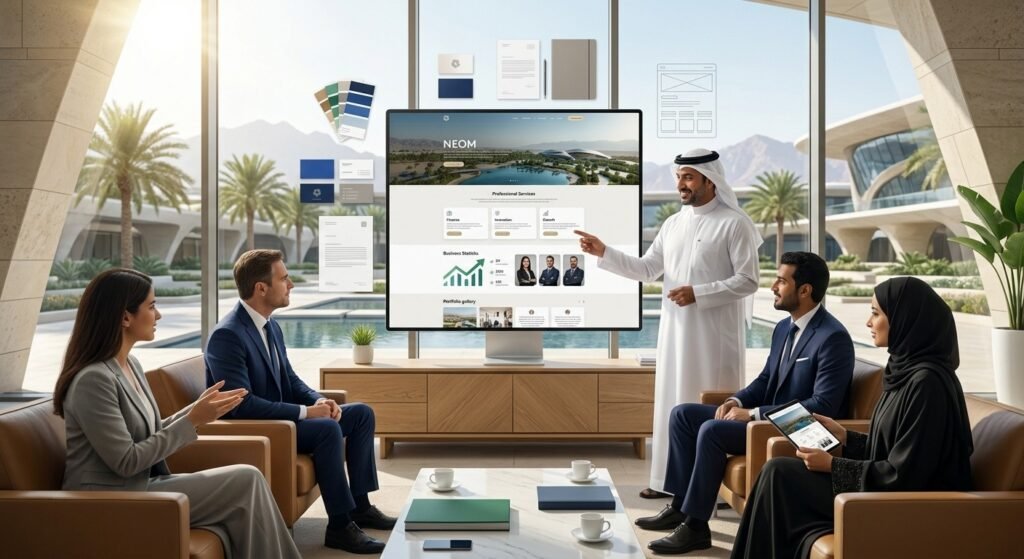
Built to establish credibility and communicate services clearly to buyers who are evaluating you before making contact. The primary job is reducing uncertainty and building enough confidence for the buyer to take the next step.
E-commerce website
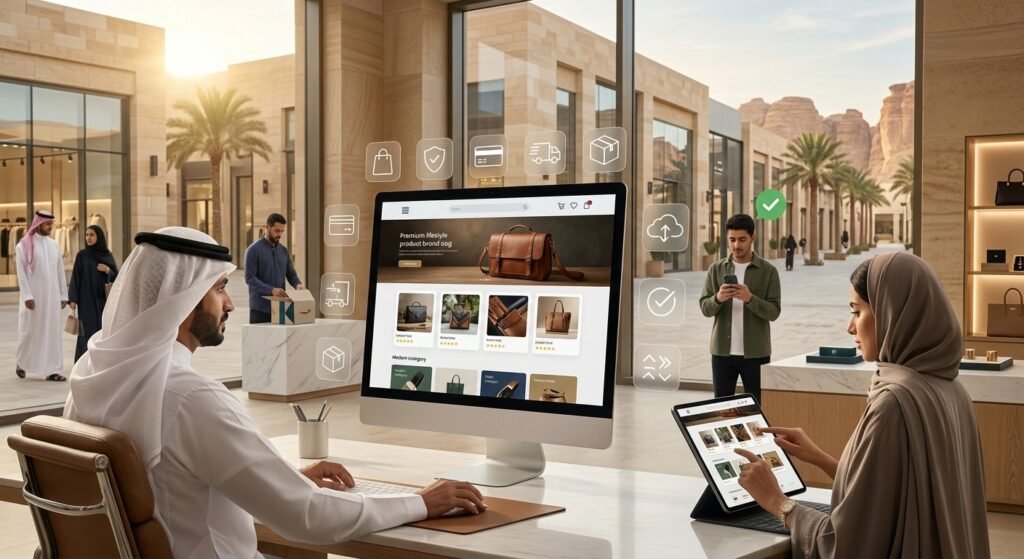
Focused on product display, checkout flow, and payment integration. Performance and mobile usability directly determine conversion. Every second of load time and every unnecessary checkout step costs transactions.
Which E-Commerce Platform Is Right for Your Saudi Business?
E-commerce covers a lot of ground, and the platform you build on decides how much of the Saudi-specific work is done for you versus how much you have to build yourself. This is one of the first decisions you’ll make in your ecommerce business setup, and getting it wrong usually means migrating everything later, at a real cost.
Salla
If you want to launch fast with local payment, ZATCA compliance, and Arabic support already built in, Salla is usually the starting point. It’s a Saudi-built platform, so the compliance and payment groundwork most businesses spend weeks scoping is already handled. The trade-off is customization. You’re working within what Salla allows, not outside it.
Zid
Zid sits in the same category as Salla, another Saudi-built platform with local payment and compliance covered from day one. The two are close competitors, and the right choice usually comes down to which feature set and pricing structure fits how you actually plan to run your store, not a fundamental difference in what either platform can do for you.
Shopify
If you’re planning to sell beyond Saudi Arabia, or you need the scale and app ecosystem that comes with a global platform, Shopify makes more sense. What you give up is the native Saudi groundwork Salla and Zid come with. Mada, STC Pay, and ZATCA compliance still need to be integrated, not assumed.
WooCommerce
If you already want a WordPress site for its content flexibility and you don’t want to run a separate platform just for your store, WooCommerce lets you build e-commerce directly into WordPress. It gives you more control over structure and design than Salla, Zid, or Shopify, but that control comes with more setup work and more of the compliance and payment integration falling on you to get right.
Whichever platform fits your business, the decision should follow how you plan to sell and where, not which platform is easiest to set up this week.
Business portals and dashboards

Used for internal operations, client access, or data handling. These are functional systems that happen to have a web interface; the build requirements are closer to web application development than standard website design and development.
Landing page and lead generation site
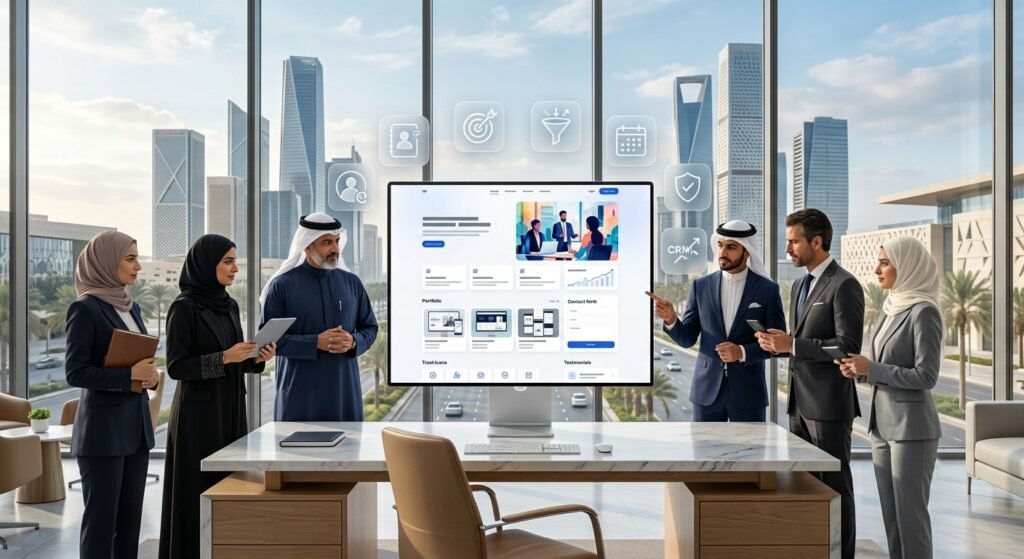
Built around one campaign and one conversion action. Speed and simplicity beat comprehensiveness here every time. Try to cram a landing page with everything a homepage covers, and you get the same drop-off a bloated homepage produces.
Booking website
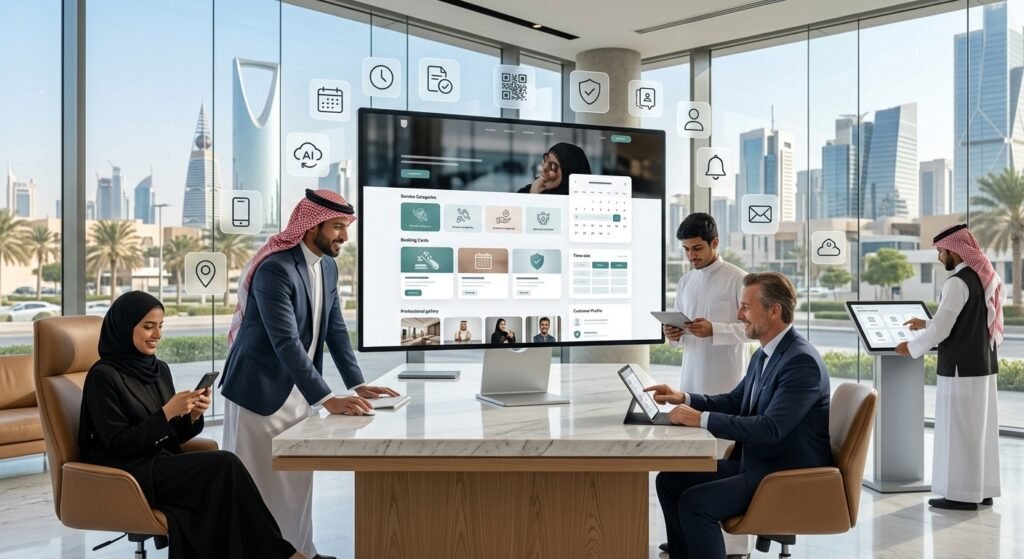
Availability, scheduling, and real-time interaction carry these builds. Reliability matters more here than how polished the interface looks.
Web application
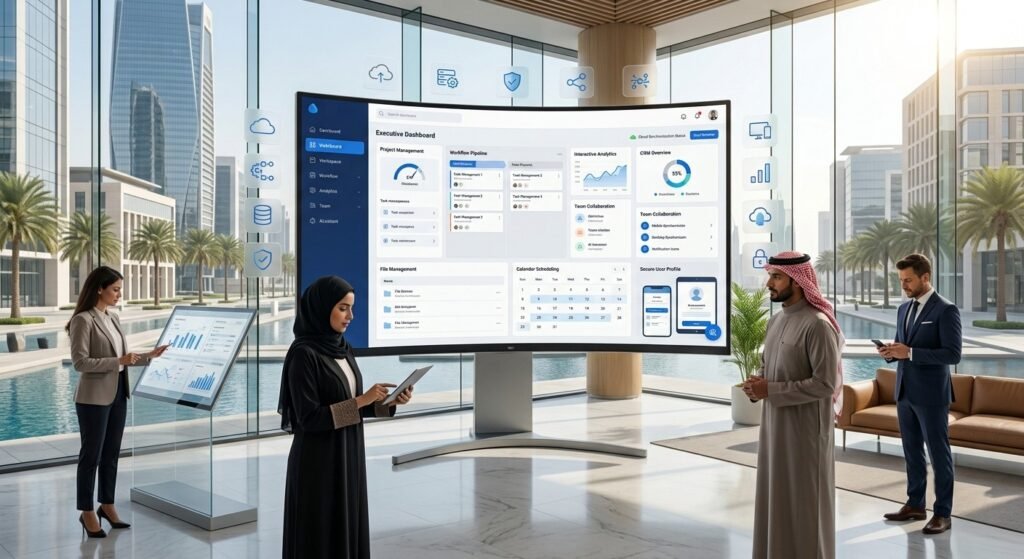
Full systems built to handle workflows, not display content. Custom web development at this level requires backend architecture, user role management, and integration with external systems. The build process and cost structure are significantly different from a standard website.
Industries in Saudi Arabia That Require a High-Performing Website
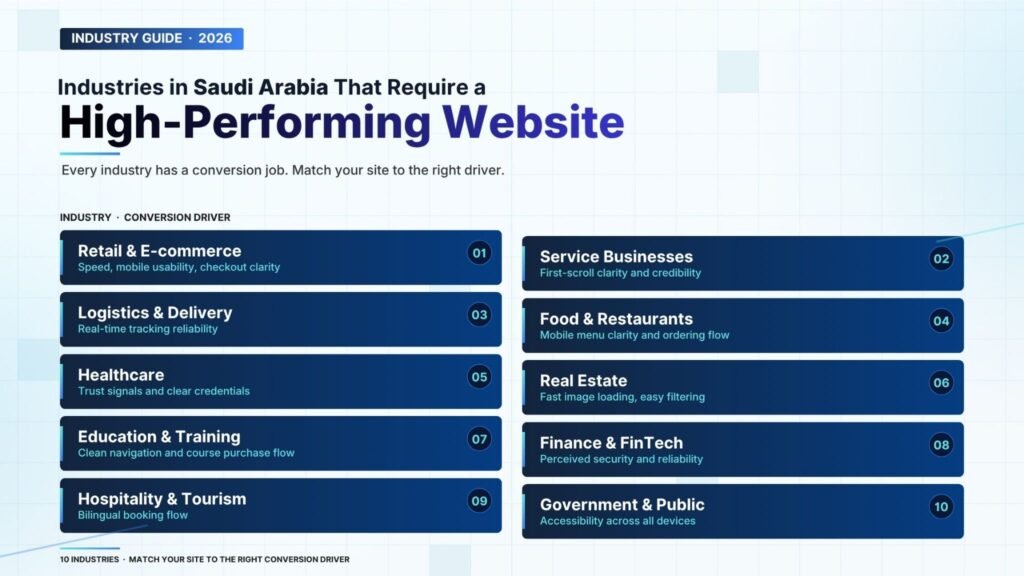
| Industry | What Drives Conversion |
| Retail & E-commerce | Speed, mobile usability, checkout clarity |
| Service Businesses | First-scroll clarity and credibility |
| Logistics & Delivery | Real-time tracking reliability |
| Food & Restaurants | Mobile menu clarity and ordering flow |
| Healthcare | Trust signals and clear credentials |
| Real Estate | Fast image loading, easy filtering |
| Education & Training | Clean navigation and course purchase flow |
| Finance & FinTech | Perceived security and reliability |
| Hospitality & Tourism | Bilingual booking flow |
| Government & Public | Accessibility across all devices |
Retail and E-Commerce

For retail and e-commerce, conversion depends on site speed, mobile usability, and how clear the checkout is. For the Saudi market specifically, that means Mada, STC Pay, and Tabby integration plus an Arabic-first interface, not extras bolted on later, but baseline requirements from day one.
Service Businesses
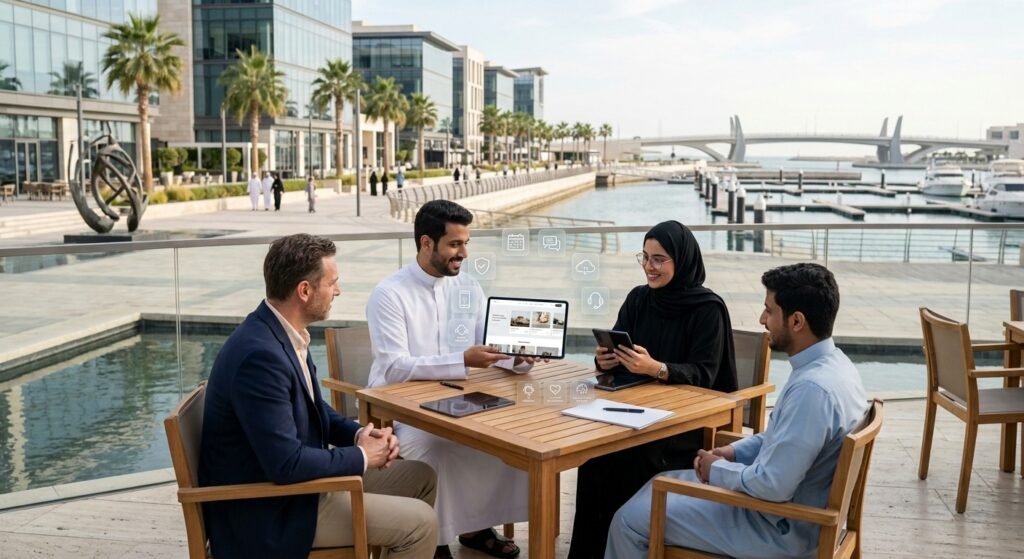
For service businesses, if you fail to communicate what you do, who you serve, and why you’re credible within the first scroll, the lead is gone before they reach your contact form.
Logistics and Delivery
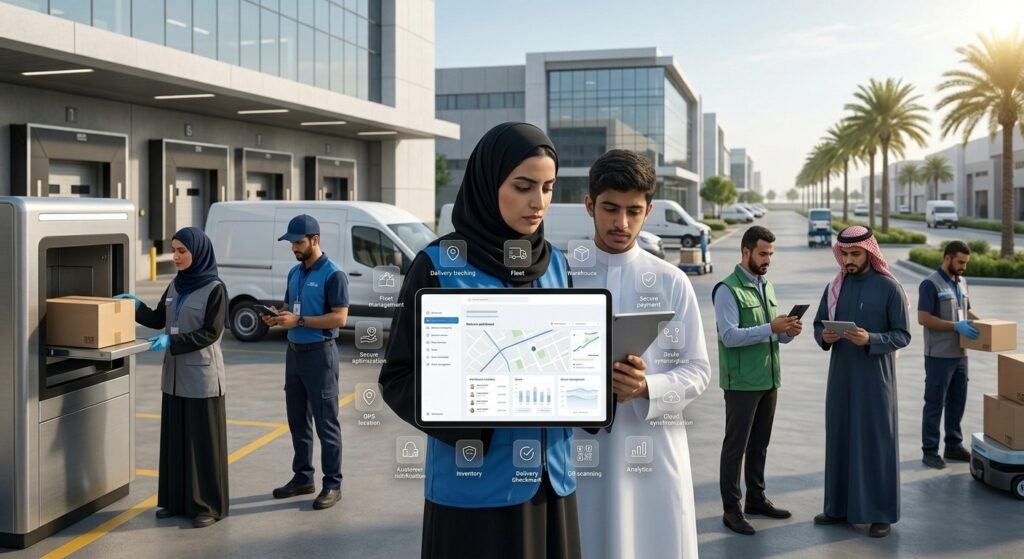
Operational visibility and real-time tracking matter more than design. The website needs to handle functional user interactions reliably, not just look presentable.
Food and Restaurant Businesses

Customers make their decisions based on menu clarity, mobile usability, and how smooth the ordering flow is. A slow or clunky mobile site pushes customers straight to a delivery app instead, even when the restaurant would much rather take the order directly.
Healthcare and Medical Services
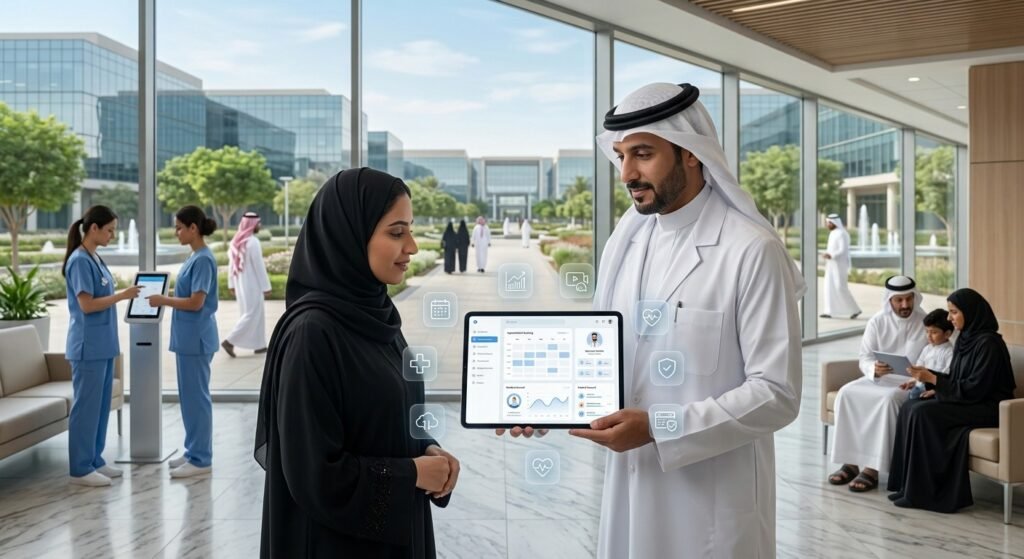
Trust and clarity determine whether a patient proceeds. Unclear service descriptions, missing credentials, or a site that feels outdated produce drop-off at the exact moment the patient is making a decision about care.
Real Estate and Property Management

Listings, filtering, and visual presentation shape engagement. A real estate developer website that handles large image assets slowly, or that makes filtering by location and price unnecessarily complicated, loses enquiries to portals that do both better.
Education and Training Platforms

Prospective students research programs online before ever contacting an institution. Without a website that clearly structures courses, credentials, and enrollment steps, the institution is invisible at the exact stage where the decision gets made.
Finance and FinTech Industry

Security perception and system reliability are what the user is evaluating in finance or a fintech company. An unpolished FinTech site, or one that loads inconsistently, plants doubt about the product before the user has looked at a single feature.
Hospitality and Tourism

Booking flow and visual trust signals drive conversion. Under Vision 2030 tourism expansion, hospitality businesses that cannot convert international visitors through a clean English and Arabic booking experience are leaving occupancy on the table.
Government and Public Services

Clarity and accessibility at scale. Government-facing websites need to work correctly for the full range of users and devices across Saudi Arabia, not just the premium end.
Standard Web Development Process for Businesses: Step-by-Step Process
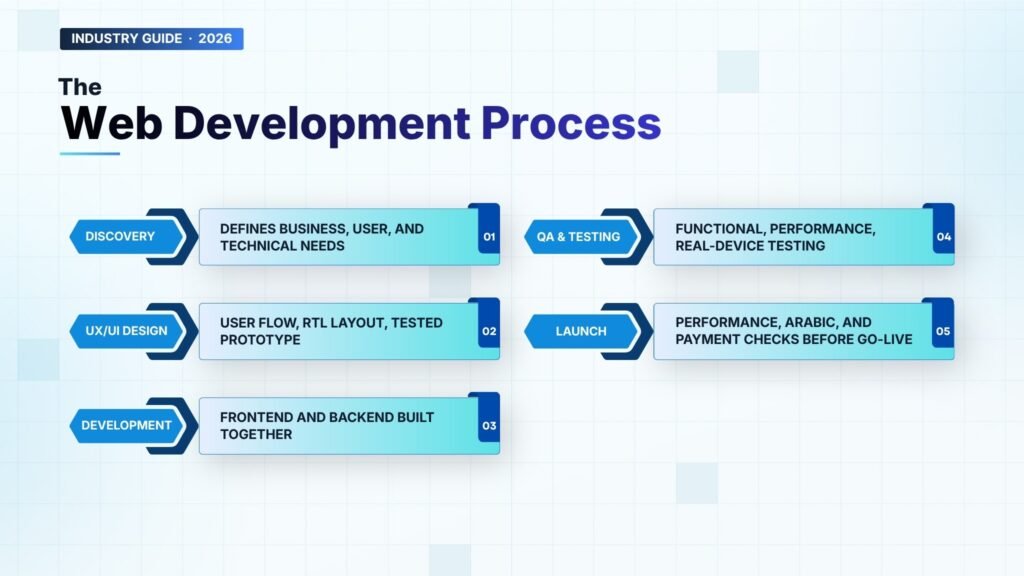
| Stage | What Happens |
| 1. Discovery | Defines business, user, and technical needs |
| 2. UX/UI Design | User flow, RTL layout, tested prototype |
| 3. Development | Frontend and backend built together |
| 4. QA & Testing | Functional, performance, real-device testing |
| 5. Launch | Performance, Arabic, and payment checks before go-live |
Discovery and requirement gathering
This stage produces a single document that aligns with what the business needs, what users expect, and what the technical build requires. Hard decisions made here are cheap. The same decisions made during development are expensive. Businesses that skip discovery do not save time; they move disagreements to a later stage, where resolving them costs significantly more.
UX & UI design and prototyping
User flow is structured before any visual design work begins. For Saudi websites, the Arabic right-to-left layout must be planned at this stage; it is a structural decision that affects layout, navigation, and component design throughout the entire build. Adding it after the fact requires rebuilding large portions of the interface. A working prototype tested with real Saudi users before development starts costs a fraction of what design changes cost once code is written.
Frontend and backend development
Users see and touch the frontend. Everything else, data storage, logic, connections to outside systems, happens on the backend, invisibly. A back-end developer building on weak architecture produces a site that works at low traffic and breaks when usage grows. Getting backend structure right at this stage avoids expensive rebuilds later.
QA and testing
Functional testing confirms features work as intended. Performance testing checks behavior under load. Device testing confirms the site runs correctly across the actual range of devices Saudi users own, Android across a wide price range, iOS concentrated at the premium end. Browser simulators do not fully replicate real device behavior. Physical device testing is non-negotiable before launch.
Launch and deployment
Going live is not the end of the project. It’s the start of the maintenance cycle. Before any traffic gets routed to the new site, a launch checklist needs to run: performance benchmarks, Arabic interface checks, payment gateway tests, and analytics verification.
Technology Decisions That Affect Your Website Long-Term
Custom Development vs WordPress vs Page Builders
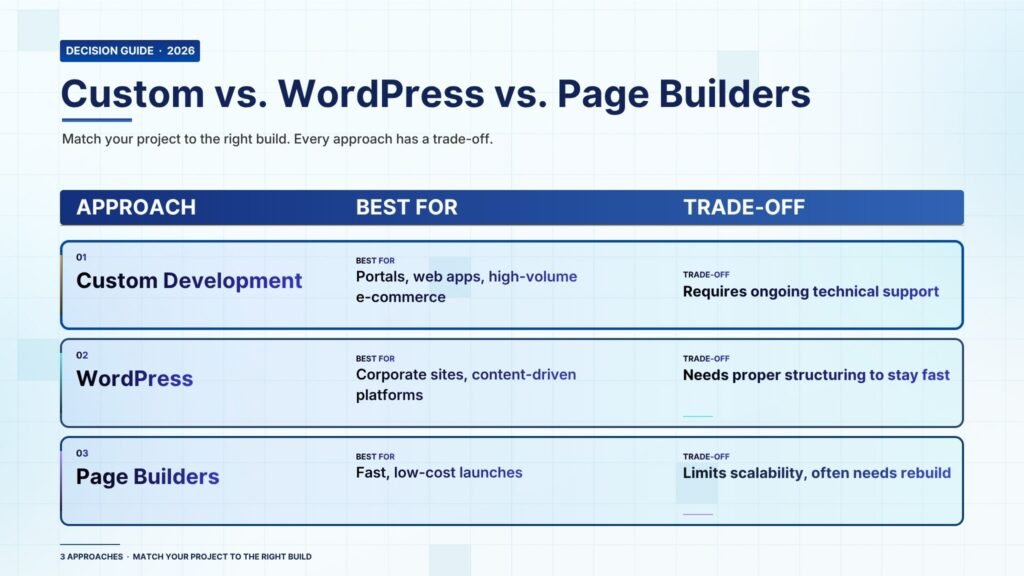
| Approach | Best For | Trade-Off |
| Custom Development | Portals, web apps, high-volume e-commerce | Requires ongoing technical support |
| WordPress | Corporate sites, content-driven platforms | Needs proper structuring to stay fast |
| Page Builders | Fast, low-cost launches | Limits scalability, often needs rebuild |
Custom web development hands you full control over architecture, performance, and functionality, at the cost of needing technical support for every change afterward. It earns that cost back on complex systems: portals, web applications, and high-volume e-commerce operations built to scale.
WordPress sits in the middle, flexible enough and accessible enough for most everyone else. It is appropriate for most corporate sites, service businesses, and content-driven platforms where the client needs to manage content independently without developer involvement for every update. A WordPress web development build, properly structured, can produce a maintainable, performant site at a significantly lower cost than custom development.
Page builders reduce upfront cost but limit scalability. They produce sites that are fast to launch and difficult to grow. Businesses that start on page builders and later need custom functionality typically absorb the cost of a rebuild rather than an extension.
The decision should follow business complexity and growth trajectory, not trend or budget alone.
Frontend Frameworks
React web development and Next.js are appropriate when performance, interactivity, and dynamic content are priorities, complex dashboards, real-time data displays, and high-traffic platforms where server-side rendering produces measurable speed advantages.
For most Saudi corporate sites and service businesses, a simpler stack delivers the same user outcome at lower build cost and lower long-term maintenance overhead. Overengineering a site increases cost without adding value the user can actually experience.
PHP web development remains appropriate for a wide range of business websites, particularly WordPress-based builds and custom backend systems where the codebase is well-structured and the maintenance model is clear.
Hosting and KSA Data Residency
Local hosting in Saudi Arabia reduces latency for Saudi users and simplifies compliance for businesses in regulated sectors. International cloud hosting, AWS, Google Cloud, and similar, offers more robust infrastructure and global CDN coverage, which can offset the latency difference for most use cases.
Certain sectors in Saudi Arabia are subject to data residency requirements that affect where user data can be stored and processed. Healthcare, financial services, and government-adjacent platforms should assess data residency obligations during the discovery phase, not after the hosting decision is made.
CMS Choice and Post-launch Control
How much control a business retains over its own site after handover comes down to CMS choice. Pick wrong and you’re stuck depending on the original development team for changes that should take five minutes internally.
WordPress puts most updates directly in the content manager’s hands, no developer needed. A headless CMS splits content management from frontend presentation, useful for high-performance builds where a separate frontend framework handles rendering. Custom admin panels, built specifically for bespoke projects, offer the most tailored experience of the three. They also cost the most to maintain. At that point, custom software development should be the framing you’re using rather than “website,” since a custom admin panel connected to internal workflows is closer to a business system than a content-managed site.
Which one fits depends on who’s managing the site day to day, how often content changes, and how technical that internal team actually is.
KSA-Specific Features Every Saudi Business Website Needs
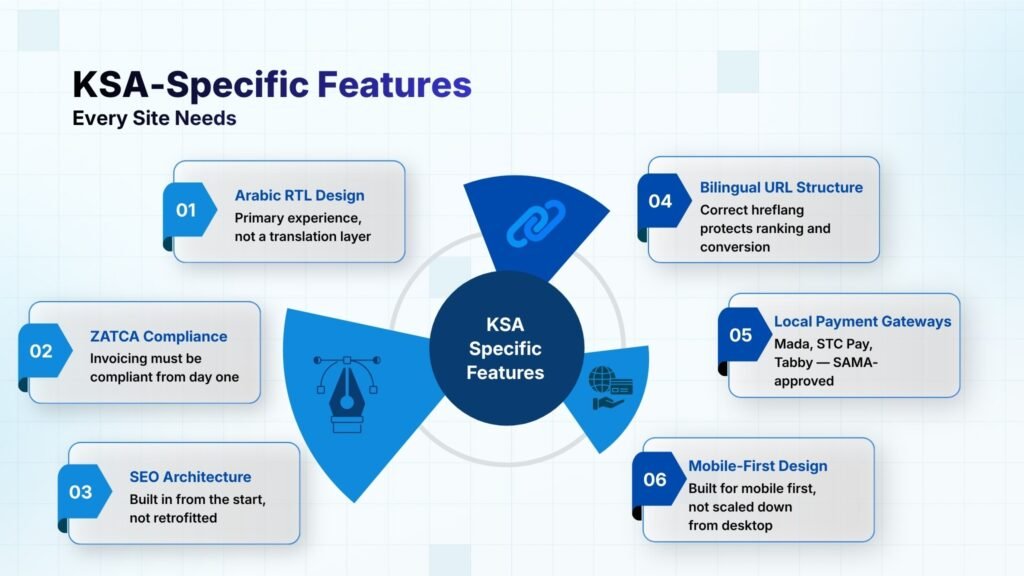
| Feature | Why It Matters |
| Arabic RTL Design | Primary experience, not a translation layer |
| Bilingual URL Structure | Correct hreflang protects ranking and conversion |
| Local Payment Gateways | Mada, STC Pay, Tabby — SAMA-approved |
| ZATCA Compliance | Invoicing must be compliant from day one |
| SEO Architecture | Built in from the start, not retrofitted |
| Mobile-First Design | Built for mobile first, not scaled down from desktop |
Arabic Language Support and RTL Design
A right-to-left layout is a development decision, not a design one. It affects component structure, spacing logic, navigation behavior, and how content reflows across screen sizes. Websites where Arabic has been added as an afterthought, with reversed text in an otherwise left-to-right layout, break in predictable ways: misaligned buttons, reversed icon placement, and degraded readability on mobile.
Arabic must be planned into the build from the first wireframe. For Saudi businesses, it is not a localization layer. It is a primary user experience.
Bilingual Site Architecture
URL structure for the Arabic and English versions affects usability and search visibility both. Separate subdirectories, /ar/ and /en/, paired with correct hreflang tags tell search engines exactly which version to serve which audience. Skip hreflang and Google guesses. It gets the guess wrong often enough to hurt ranking and conversion at the same time.
Building it correctly during development costs a fraction of fixing it after the site is live and already indexed.
Local Payment Gateway Integration
Mada, STC Pay, and Tabby are the payment methods Saudi users expect. An e-commerce site that does not support local payment options loses transactions at the final step after the user has already committed to a purchase. Integration is not only technical; it directly affects checkout trust and completion rates. All payment integrations must go through SAMA-approved gateways for compliant operation.
ZATCA Compliance for E-commerce Sites
ZATCA e-invoicing requirements affect how Saudi online businesses generate, format, and transmit invoices for VAT reporting. For e-commerce sites, this means the checkout and invoice architecture must produce compliant output from day one, not be retrofitted for compliance after the site is already processing orders.
Non-compliance creates both operational risk, manual reconciliation of non-compliant invoice records, and legal exposure. ZATCA requirements should be scoped during the discovery phase so they are built into the system rather than bolted on later.
SEO Architecture Built into the Build
Site structure, URL hierarchy, page speed, schema markup, and internal linking are decided during development, not after. Retrofitting SEO architecture into a site that’s already live always costs more and takes longer than building it right the first time.
For Saudi businesses targeting Arabic and English search visibility simultaneously, technical SEO decisions, including hreflang, canonical tags, and structured data, need to be part of the development brief, not an afterthought added after launch when rankings are already being determined.
Mobile-first Development
Saudi smartphone penetration is among the highest globally, and mobile accounts for the majority of web traffic across most business categories. Mobile-first means the mobile experience gets designed first and scaled up to desktop, not the other way around.
In practice, this affects image compression, font sizing, touch target dimensions, navigation structure, and how the site performs on mid-range devices with variable network conditions. A site that looks correct on mobile but performs slowly is not a mobile-first site.
Website Performance and Why It Determines Everything
Performance is the foundation on which everything else sits on. A slow website makes good design irrelevant, strong content invisible, and Arabic UX improvements undetectable, because users have already left.
Core Web Vitals, Google’s set of page experience metrics covering load speed, interactivity, and visual stability, directly affect both search ranking and user behavior. Saudi mobile users on variable network conditions are more sensitive to performance failures than desktop users on fixed connections. Pass Core Web Vitals on desktop and fail on mobile, and the site is failing most of the traffic it actually gets.
Performance doesn’t get fixed after launch, not really. Image formats, caching strategy, code splitting, server response time, third-party script management—these decisions get made during development, or they don’t get made well at all. Fixing a poorly performing site after launch requires going back into the build, not adjusting settings on the surface.
For Saudi businesses where the website is the primary lead generation or conversion channel, page speed is a commercial variable, not a technical metric.
Website Development for Businesses: A Quick Decision Guide
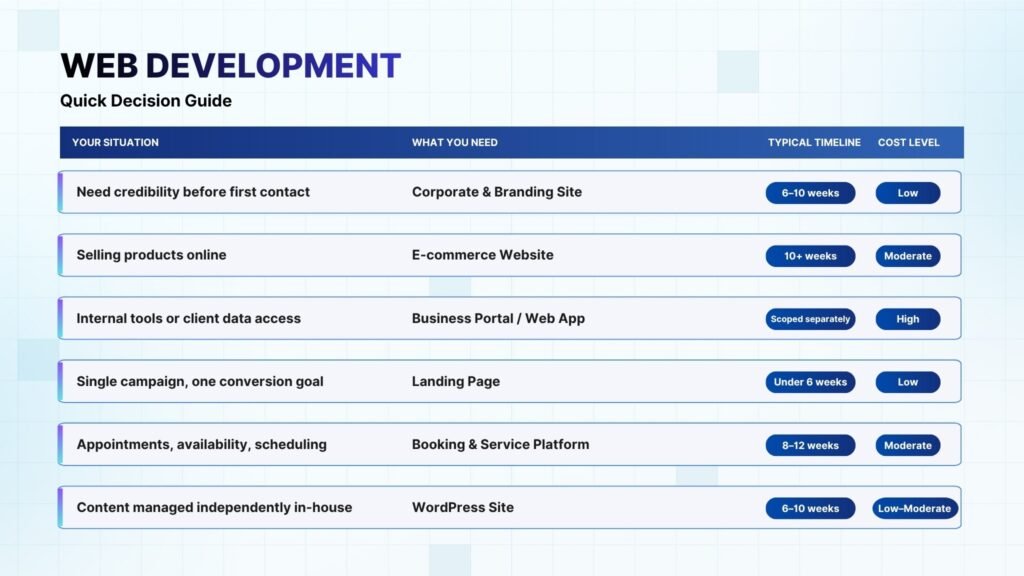
| Your Situation | What You Need | Typical Timeline | Cost Level |
| Need credibility before first contact | Corporate & Branding Site | 6–10 weeks | Low |
| Selling products online | E-commerce Website | 10+ weeks | Moderate |
| Internal tools or client data access | Business Portal / Web App | Scoped separately | High |
| Single campaign, one conversion goal | Landing Page | Under 6 weeks | Low |
| Appointments, availability, scheduling | Booking & Service Platform | 8–12 weeks | Moderate |
| Content managed independently in-house | WordPress Site | 6–10 weeks | Low–Moderate |
What Web Development in Saudi Arabia Actually Costs
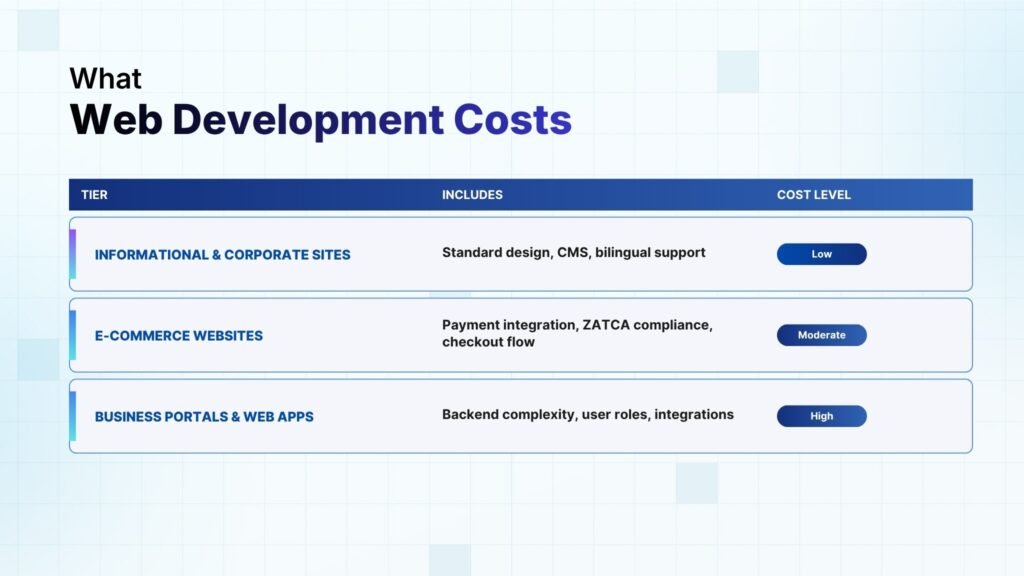
| Tier | Includes | Cost Level |
| Informational & Corporate Sites | Standard design, CMS, bilingual support | Low |
| E-commerce Websites | Payment integration, ZATCA compliance, checkout flow | Moderate |
| Business Portals & Web Apps | Backend complexity, user roles, integrations | High |
Web development cost is not fixed to a feature list. Two sites with similar page counts can cost very differently depending on what is happening in the backend, how many systems need to connect, and what compliance or localization requirements are in scope. Scope drives cost more than any other single variable.
Informational and Corporate Sites
The lowest cost tier in web development. Standard design, CMS integration, bilingual Arabic-English support, basic contact or lead capture. This tier fits service businesses that need to look credible and organized online without any transactional complexity behind it.
E-commerce Websites
More expensive than corporate sites due to product management systems, payment gateway integration, checkout flow development, ZATCA compliance, and the performance optimization required to keep conversion rates stable at volume. Build an e-commerce website correctly at this tier, and the infrastructure supports significant growth without a rebuild.
Business Portals and Web Applications
The highest cost tier. Backend complexity, user role management, system integrations, and custom workflow logic drive cost significantly above standard website builds. These are systems that happen to have a web interface, and they are scoped and built accordingly.
What Drives Cost Up
Custom features added during development without adjusting the scope. A multilingual setup that was not planned from the start. Third-party integrations with poorly documented APIs. Compliance requirements, ZATCA, SAMA, and data residency that surface late in the project. A clearly defined scope document before development starts is the most effective cost control available on any web project.
Local Agency vs Freelancer vs International Firm
A freelancer offers flexibility and lower day rates but limited capacity for complex builds and no structured project management. An international firm offers scale and process, but a limited understanding of Saudi market requirements, Arabic UX, local payment integration, and KSA compliance are learned on your project rather than brought to it.
A local web development agency with Saudi market experience costs more than a freelancer and less than a large international firm, and brings direct knowledge of how Saudi buyers interact with websites, what local compliance requires, and what the build needs to do to perform in this specific market. If you want a clearer estimate for your specific project, contact us on WhatsApp and we’ll scope it out with you before you commit to a number.
Common Mistakes Saudi Businesses Make When Building a Website
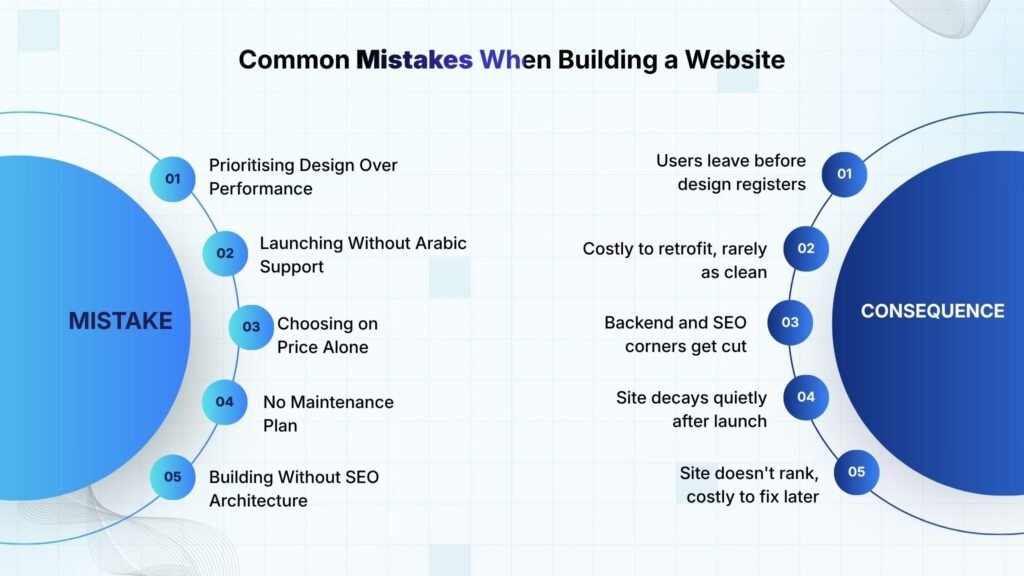
| Mistake | Consequence |
| Prioritising Design Over Performance | Users leave before design registers |
| Launching Without Arabic Support | Costly to retrofit, rarely as clean |
| Choosing on Price Alone | Backend and SEO corners get cut |
| No Maintenance Plan | Site decays quietly after launch |
| Building Without SEO Architecture | Site doesn’t rank, costly to fix later |
Prioritising Design Over Performance
A visually impressive site that loads slowly loses users before design makes any impression. Performance is what the user experiences first. Design is what they notice if they stay.
Launching Without Arabic Support Built-in
Adding Arabic after launch requires restructuring layout, navigation, and component logic across the entire site. It is significantly more expensive than building for it from the start, and the result is rarely as clean as a build where Arabic was the primary language from the first wireframe.
Choosing a Web Development Company Based on Price Alone
Low-cost builds usually cut corners on backend architecture, SEO structure, and performance optimisation, exactly the parts a client can’t see during review and exactly the parts that determine how the site holds up a year later. Rebuilding something that was underbuilt the first time almost always costs more than building it right once.
Handing Off Without a Maintenance Plan
Without defined ownership of post-launch maintenance, sites decay quietly. Security vulnerabilities accumulate. Performance drops. Content becomes outdated. By the time the problem is visible, it has been compounding for months.
Building Without SEO Architecture
A website that search engines cannot correctly interpret does not rank. SEO decisions made at the build stage, URL structure, page speed, schema, and hreflang for bilingual sites are the foundation of organic visibility. They are cheaper to build correctly than to retrofit after the site is live and indexed incorrectly.
What Saudi Businesses With High-Performing Websites Do Differently
They define what the site needs to do before they brief any web development agency in Saudi Arabia. They build for Arabic and English from the first wireframe, not the last sprint. They treat SEO as a build requirement rather than a post-launch task. They budget for maintenance alongside the build, not as a separate future decision. And they work with partners who already understand Saudi users, local compliance, and what the market expects, so they are not paying for market education during their own project.
Why Saudi Businesses Work With Etihad Falcon Tech for Web Development

Performance and Structure as the Starting Point

Etihad Falcon Tech builds for how the site performs, not just how it looks. Core Web Vitals, mobile load speed, backend architecture, and SEO structure are scoped at the start of every project, not optimized after the fact when problems are already affecting users and rankings.
Built for the Saudi Arabia Market
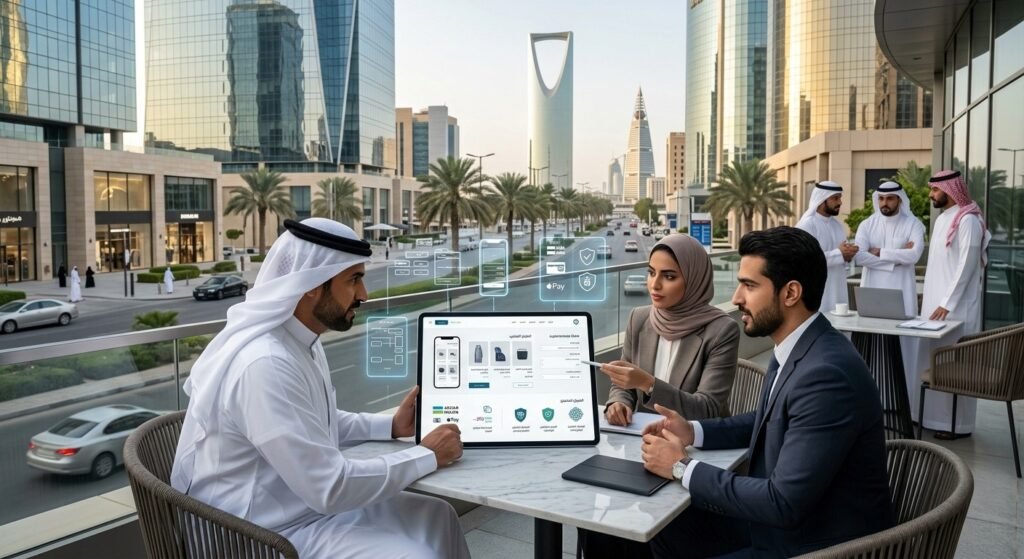
Arabic RTL design, Mada and STC Pay integration, ZATCA compliance, hreflang implementation, and KSA data residency requirements are part of every relevant build. Etihad Falcon Tech is a web and app development company that works exclusively in this market; these are not additions learned on your project.
Full-spectrum Web Development Services
From discovery and requirement gathering through UX design, custom website development, QA, deployment, and ongoing website management services, we manage the full lifecycle. You are not coordinating between a design agency, a back-end developer, and a separate QA team that has no shared accountability for the outcome.
Proven Experience with Saudi Businesses
We have built web and digital systems for Saudi businesses across retail, logistics, healthcare, financial services, and real estate. That experience means faster decisions on architecture, fewer mistakes on compliance, and websites that hold up when traffic grows and operational requirements change.
If your current website is not converting, not performing, or not aligned with how Saudi buyers behave today, that is not a design problem. It is a system problem for web development in Saudi Arabia, and fixing it starts with understanding exactly where it is breaking.
Frequently Asked Questions
Timeline depends on project type and scope. A corporate site with Arabic and English support typically takes six to ten weeks from discovery to launch. E-commerce builds with payment gateway integration and ZATCA compliance take longer. Web application development with custom backend logic and system integrations is scoped separately based on functional requirements.
From the start. A right-to-left layout reaches into component structure, navigation logic, and how the site reflows across screen sizes. Add it after the fact, and you’re rebuilding significant portions of the interface—at a cost well above what it would’ve taken to build it right on day one.
Scope, complexity, and compliance requirements drive the number more than anything else. Corporate sites sit at the lower end of the range. E-commerce platforms with local payment integration and ZATCA compliance sit in the middle. Custom portals and web applications with backend complexity sit at the higher end. A scoping session with defined requirements produces a reliable cost estimate, vague briefs produce vague numbers.
A website presents information and points users toward one defined action, contact, purchase, or booking. A web application does more: it runs workflows, manages user roles, and processes data. The line between them blurs for complex e-commerce and portal builds, which is why defining the primary job of the system during discovery matters.
Yes. The technology choice is made based on project requirements, what the site needs to do, who manages it after launch, and what the long-term maintenance model looks like. We recommend the approach that fits the business requirement, not the one that is easiest to build.
Through API integration with SAMA-approved payment gateways. The integration touches checkout flow design, error handling, and how payment confirmation gets handled inside the order management system. All of it gets scoped during discovery and built into the checkout architecture from day one, not patched in after.
Security updates, performance monitoring, CMS and plugin updates, bug fixes, SSL renewal, and content changes. Skip it, and vulnerabilities pile up quietly, performance slips as third-party scripts update around the site, and layout issues start appearing every time a new device or browser ships. For a website that is a primary commercial channel, maintenance is operational continuity, not optional upkeep.
Judge the capability against your specific requirements. Portfolio quality in general tells you less than you’d think. Ask how they handle Arabic RTL builds, what their approach to ZATCA compliance is, and what post-launch support looks like.
Etihad Falcon Tech handles web development in Saudi Arabia with this exact context built in from day one, RTL layouts, ZATCA-aligned e-invoicing, and Mada and STC Pay-ready checkout flows are already part of its build process. A company that has built in the Saudi market brings knowledge that directly affects the quality of the final product.