

AI adoption among businesses in Saudi Arabia reached 33.1 percent in 2025, according to the General Authority of Statistics of Saudi Arabia (GASTAT). One in three Saudi businesses is actively using AI in daily operations right now, which means successful businesses aren’t experimenting with AI anymore. AI runs in their daily operations, helping them make better decisions, improve productivity, and reduce repetitive tasks.
The question for Saudi business owners has moved on from whether to use AI. Now it’s about applying it correctly: integrating it into the systems and making sure it is implemented effectively to generate better results.
This guide covers what artificial intelligence actually means for your business, how it is already being used across industries, what the implementation process looks like in practice, and what Saudi law requires when your AI system processes real business data.
What Saudi Arabia’s National AI Strategy Means for Businesses
The Saudi Data and Artificial Intelligence Authority (SDAIA) is shaping how Saudi businesses use AI to operate, report, and make decisions.
Government-led digitization has increased the requirements for every business, not only the ones working directly with government contracts. For example, a logistics company bidding for work with a large enterprise now gets asked for real-time delivery data before the contract is signed. Or a clinic applying for MOH accreditation needs digital patient records, not paper files.
The digitization in most sectors is now powered by AI, and it is no longer optional. It is what gets your business chosen over your competitors who are offering the same services. Businesses that haven’t implemented AI yet are going to lose contracts, clients, and deals to the ones who already have.
What Business Owners Get Wrong About AI Implementation
AI is not a product you buy; it is a capability you build. Most people get this wrong early, treating AI the way they would treat any other piece of software: pay for it, log in, and expect results from day one.
AI on its own doesn’t know your business. It has no idea what your inventory system looks like, how your approval chain works, or which numbers actually signal a problem. That gap only closes through proper AI development, connecting it to your systems, training it on your actual data, and building it around how your business runs.
What Kind of AI Solution Does Your Business Actually Need?
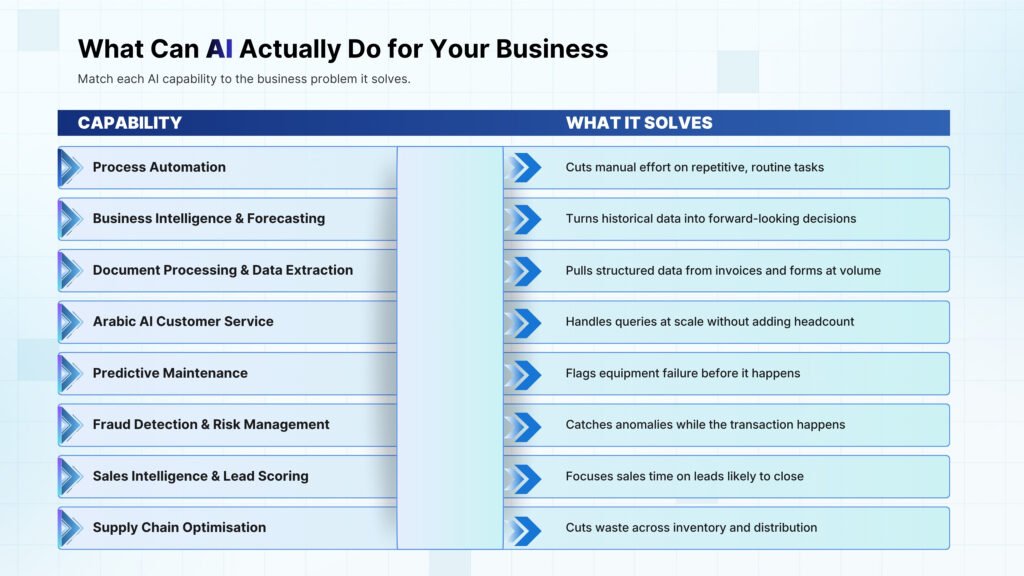
| Capability | What It Solves |
| Process Automation | Cuts manual effort on repetitive, routine tasks |
| Business Intelligence & Forecasting | Turns historical data into forward-looking decisions |
| Document Processing & Data Extraction | Pulls structured data from invoices and forms at volume |
| Arabic AI Customer Service | Handles queries at scale without adding headcount |
| Predictive Maintenance | Flags equipment failure before it happens |
| Fraud Detection & Risk Management | Catches anomalies while the transaction happens |
| Sales Intelligence & Lead Scoring | Focuses sales time on leads likely to close |
| Supply Chain Optimisation | Cuts waste across inventory and distribution |
Most businesses ask “Should we use AI?” when the real question is which AI capability fits which problem. A chatbot doesn’t fix a forecasting problem. A fraud detection model doesn’t speed up document processing. Match the wrong capability to the wrong problem, and you’ve spent money on complexity, not results.
Here’s a breakdown of what each AI capability actually does, so you can match it to what your business needs:
Process Automation & Operational Efficiency
Automating the repetitive stuff cuts manual effort, takes human error out of routine tasks, and frees people up for work that actually needs judgment. If your team is burning hours on data entry, document processing, approval routing, or status updates, this is usually where AI pays off first and fastest.
AI-Powered Business Intelligence & Demand Forecasting
Feed AI your historical and real-time data, and it spots patterns no human analyst could catch at that speed. Retail and FMCG businesses get demand forecasting that moves with actual sales velocity instead of relying on last year’s averages. For service businesses, it means capacity planning based on actual booking patterns. This is one of the clearest applications of machine learning, since forecasting accuracy improves as the model processes more historical data over time. AI for business intelligence converts operational data into forward-looking decisions rather than backward-looking reports.
Intelligent Document Processing & Data Extraction
Extracting structured data from invoices, contracts, delivery notes, and forms: automatically, at volume, with high accuracy. For businesses where significant operational time is spent manually processing paperwork, intelligent document processing reduces that overhead and feeds clean data into downstream systems without manual re-entry.
AI Customer Service & Arabic Language Chatbots
Answer Arabic and English queries in real time, at whatever volume, without hiring more support staff to keep up. Arabic language AI customer service is not a simple translation of English-language chatbot technology; it requires dedicated NLP models trained on Arabic, handling of dialect variations across Saudi and broader Gulf Arabic, and RTL-compatible interface design. Done correctly, it significantly extends customer service capacity without the same increase in cost.
Fraud Detection & Financial Risk Management
Catch the anomaly, flag the unusual pattern, score the risk, all while the transaction’s still happening, not after. For Saudi financial services, FinTech businesses, and large retail operations processing high transaction volumes, AI-based fraud detection identifies risks that rule-based systems miss.
Sales Intelligence & Lead Prioritisation
Scoring leads based on behavioral and demographic signals to identify high-probability conversions. AI for business leaders running sales-driven operations produces better allocation of sales team time, more focus on leads that are likely to close, less time on those that are not.
Supply Chain Optimization & Inventory Management
Cut waste in inventory holding, tighten logistics, and get distribution running efficiently across multiple locations at once. FMCG distributors and retailers juggling wide SKU ranges across several cities run into the exact demand-matching problem that manual planning keeps failing at; this is where AI closes that gap.
Which Saudi Industries Are Integrating AI Right Now
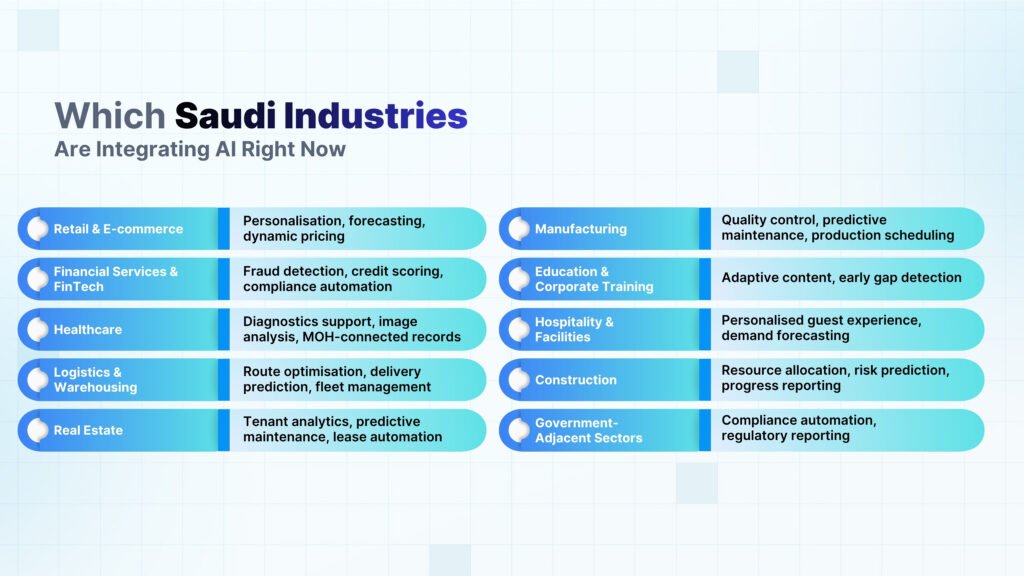
| Industry | Core Use Case |
| Retail & E-commerce | Personalisation, forecasting, dynamic pricing |
| Financial Services & FinTech | Fraud detection, credit scoring, compliance automation |
| Healthcare | Diagnostics support, image analysis, MOH-connected records |
| Logistics & Warehousing | Route optimisation, delivery prediction, fleet management |
| Real Estate | Tenant analytics, predictive maintenance, lease automation |
| Manufacturing | Quality control, predictive maintenance, production scheduling |
| Education & Corporate Training | Adaptive content, early gap detection |
| Hospitality & Facilities | Personalised guest experience, demand forecasting |
| Construction | Resource allocation, risk prediction, progress reporting |
| Government-Adjacent Sectors | Compliance automation, regulatory reporting |
Retail and E-commerce
Personalization, demand forecasting, automated support, pricing that adjusts on its own, that’s the toolkit here. Retail AI operates on transaction data that most Saudi retailers already have but are not currently using for forward-looking decisions.
Financial Services, Banking, & FinTech
Catching fraud, scoring credit risk, automating compliance reports, and reading customer behavior—this is where financial AI earns its keep. Artificial intelligence in business management of financial workflows must meet SAMA requirements. Compliance is the most important feature in any financial AI system.
Healthcare & Medical Operations
Diagnostics support, medical image analysis, patient data management, and clinical workflow automation: artificial intelligence in medicine touches all of it. In Saudi Arabia specifically, that means handling Arabic-language patient data, connecting to MOH systems, and meeting PDPL requirements at every step. Custom healthcare AI development is one of the fastest-growing application areas in the Saudi market under Vision 2030 healthcare expansion.
Logistics, Warehousing, & Supply Chain
Route optimization, warehouse picking efficiency, delivery time prediction, and fleet management. AI in logistics produces measurable output in cost per delivery and on-time rate, two metrics that logistics operators compete on directly.
Real Estate & Property Management
Tenant analytics, predictive maintenance for building systems, demand forecasting for property portfolios, and automated document processing for lease management. Real estate businesses using AI for business operations reduce the manual overhead of portfolio management significantly at scale.
Manufacturing & Industrial Operations
AI in manufacturing covers process optimization, quality control automation, predictive equipment maintenance, and production scheduling. Saudi Vision 2030 industrial expansion programs are accelerating AI adoption in manufacturing as production scale increases and manual oversight limitations become more visible.
Education & Corporate Training
Content that adjusts difficulty and pacing to the person learning it, and assessment tools that catch knowledge gaps before they turn into real performance problems.
Hospitality & Facilities Management
Personalized guest experiences, demand forecasting, and tighter energy use, hotels are using AI to run all three at once, something a front desk team managing bookings by hand never could. Under Vision 2030, tourism volume is only going up. Hotels running on manual systems now will be the ones turning away guests during peak season because nobody could keep up.
Construction & Project Management
Resource allocation, risk prediction based on project data, and automated progress reporting. Construction AI in Saudi Arabia is particularly relevant for giga-project environments where the data volume from multiple concurrent workstreams exceeds what manual project management can process reliably.
Government-Adjacent & Regulated Industries
Compliance automation, regulatory reporting, and document processing for businesses with high-volume interactions with Saudi government systems.
Across every one of these industries, the pattern is the same: the businesses seeing results are the ones matching a specific AI capability to a specific operational problem, not adopting AI as a general upgrade. See full guide on AI business intelligence for a deeper look at how forecasting and decision-support tools apply across these same sectors.
The AI Implementation Process: Stage by Stage
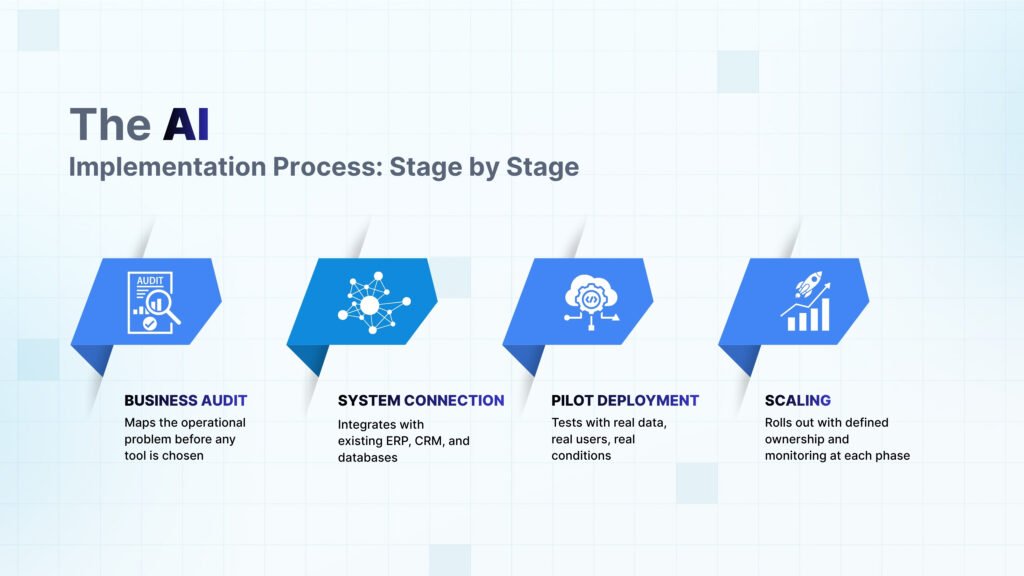
| Stage | What Happens |
| 1. Business Audit | Maps the operational problem before any tool is chosen |
| 2. System Connection | Integrates with existing ERP, CRM, and databases |
| 3. Pilot Deployment | Tests with real data, real users, real conditions |
| 4. Scaling | Rolls out with defined ownership and monitoring at each phase |
1. Business Audit and Problem Definition
Every AI implementation that delivers real results starts the same way: mapping the operational problem before picking any technology. Start by finding where the workflow is actually breaking down: the inefficiency, the error, the decision that’s taking too long. Map what data exists, where it sits, and how good it actually is. If you skip this step and jump straight to tool selection, you get a system that technically works but never solves the actual problem.
2. System Integration and Data Connection
AI does not replace existing systems. It integrates with them, connecting to your ERP, your CRM, and your internal databases and giving those systems the intelligence they weren’t built with. The quality of that integration decides the quality of the output. An AI forecasting system connected to incomplete inventory data produces bad forecasts. An AI customer service system that can’t see live order status gives answers that sound right but are useless.
Bad data is the most common reason AI projects underperform. Fix data quality before you go live, not after. That’s what separates AI that actually delivers from AI that needs months of cleanup once it’s already running.
3. Pilot Deployment and Validation
Start with a controlled pilot before scaling. It lets you measure real performance against the success criteria you defined during scoping, with real data, real users, and real operating conditions, not the clean environment of a demo. The pilot shows you where the system breaks in production versus how it looked in testing. Fix those gaps at the pilot stage. It costs far less than fixing them after you’ve rolled the system out to the whole business.
4. Scaling and Rollout
Most AI implementations don’t fail because the technology can’t keep up; they fail because nobody planned the scale-up properly. What worked well for one workflow in one department runs into different data quality, different edge cases, and different user habits once it’s rolled out across the whole business. Scaling it properly takes a real expansion plan: a defined rollout order, clear ownership at each phase, data standards that hold across every system involved, and monitoring that tracks how things are actually going at each stage instead of just assuming the pilot’s results will repeat themselves.
Saudi AI Regulatory Requirements Every Business Must Meet
SDAIA and PDPL: What the Saudi Data Protection Law Means for AI
Saudi Arabia’s Personal Data Protection Law (PDPL), administered by SDAIA, defines how personal data can be collected, stored, processed, and used by AI systems. For any AI application handling customer data, employee data, or patient data, PDPL compliance is not optional.
Compliance requirements affect how data is sourced and consented to, how long it is retained, how it is secured, and what rights individuals have over how their data is used.
AI systems that weren’t built for PDPL compliance from the start need structural changes later, and those changes can be expensive.
ZATCA, SAMA, and SFDA: Where AI Touches Regulated Functions
AI systems that interact with financial transactions, healthcare data, or food and pharmaceutical processes operate within regulatory frameworks that carry specific technical requirements.
ZATCA e-invoicing compliance affects any AI system that processes or generates financial documents: invoice extraction, automated billing, and financial workflow automation all need to produce ZATCA-compliant output.
SAMA requirements govern AI systems used in financial services, FinTech applications, and banking: transaction logic, fraud detection systems, and customer data handling must all meet SAMA’s regulatory standards.
SFDA touchpoints apply to AI systems used in pharmaceutical and food sector operations where regulatory reporting is required.
These requirements need to be built into the system architecture from the start. Retrofitting compliance into a live AI system is expensive, time-consuming, and disruptive to operations that are already depending on the system.
Data Residency and Cloud Infrastructure for AI
NDMO data residency requirements affect where certain categories of Saudi data can be stored and processed. For AI systems handling personal data, financial data, or data classified under Saudi national data frameworks, the hosting infrastructure needs to be selected with data residency compliance in mind.
Major cloud providers, including AWS and Microsoft Azure, operate Saudi regional infrastructure that satisfies data residency requirements for most business AI applications. The right infrastructure choice depends on the data classification requirements of the specific AI use case, the latency requirements of the application, and the compliance obligations of the industry sector.
What AI Integration Actually Costs in Saudi Arabia
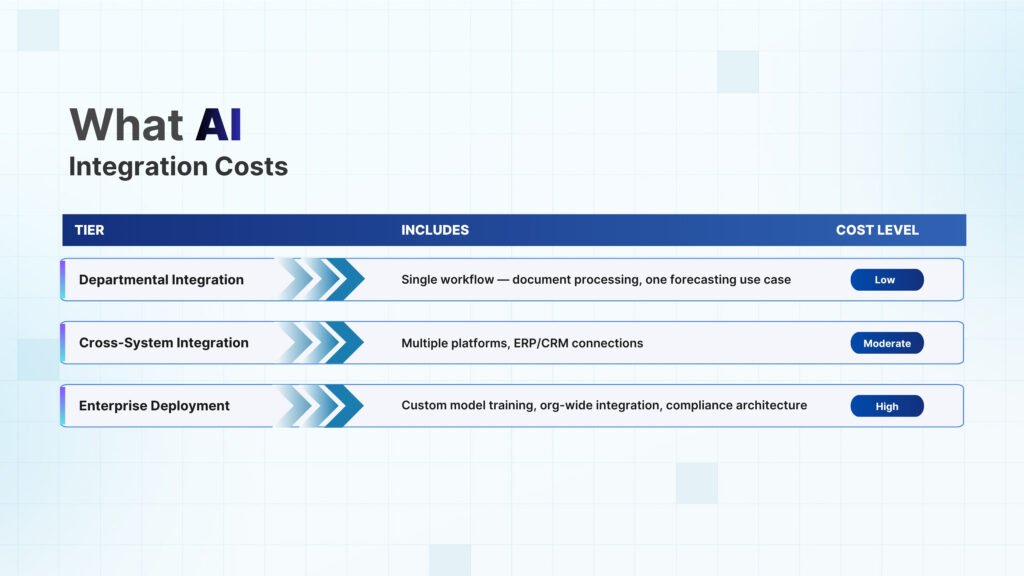
Cost in artificial intelligence development is driven by the complexity of the operational problem, the quality and accessibility of the data the system needs to work with, and the number of existing systems the AI needs to integrate with. There is no fixed price for AI, and any quote produced without a detailed operational audit is not a reliable number.
Departmental AI Integration
The lowest cost tier in AI development services. A focused implementation targeting one workflow, document processing, customer query handling, demand forecasting for a single product category. Appropriate for Saudi businesses starting with a defined, bounded problem before committing to broader AI transformation.
Cross-System AI Integration
More expensive due to the integration complexity involved in connecting AI across existing ERP, CRM, and operational systems. The data preparation and system integration work often exceeds the AI model development work at this tier. This is where most mid-sized Saudi businesses sit when implementing AI for business operations at scale.
Enterprise AI Deployment
The highest cost tier. Custom model training on proprietary business data, integration across multiple enterprise systems, Arabic language model development, and compliance architecture for regulated industries. Enterprise artificial intelligence development for Saudi businesses in financial services, healthcare, and large-scale retail sits at this level. If you want an accurate estimate based on your specific operational setup, message us on WhatsApp and we’ll walk through it with you before any number gets attached.
Should You Build, Buy, or Integrate AI Into Your Business?
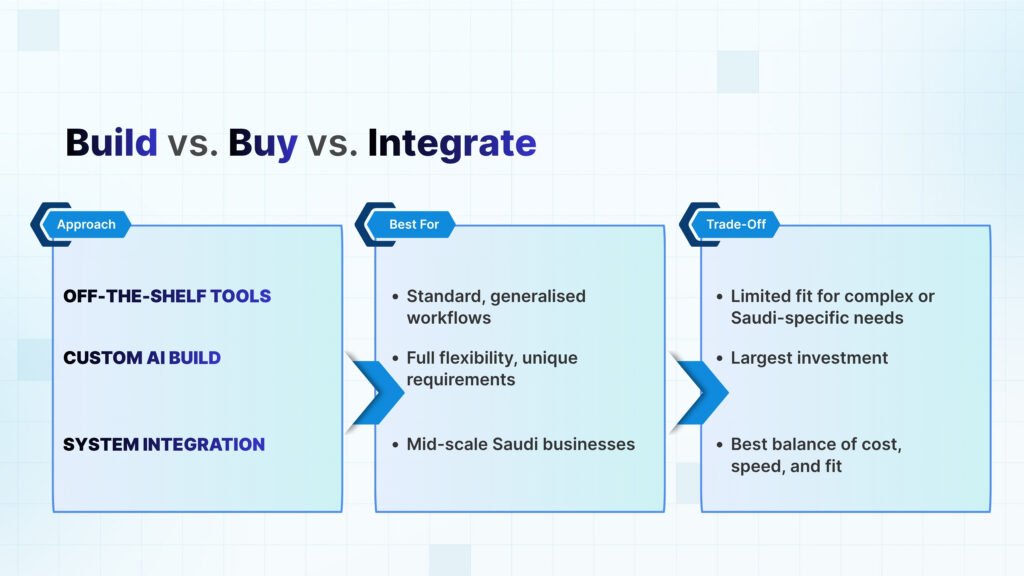
| Approach | Best For | Trade-Off |
| Off-the-Shelf Tools | Standard, generalised workflows | Limited fit for complex or Saudi-specific needs |
| Custom AI Build | Full flexibility, unique requirements | Largest investment |
| System Integration | Mid-scale Saudi businesses | Best balance of cost, speed, and fit |
Off-the-shelf AI tools deploy faster and cost less upfront, but are built for generalized use cases. They produce acceptable results for standard workflows and significant limitations for complex or Saudi-specific ones.
Custom AI builds offer complete flexibility but require the largest investment. System integration, connecting existing AI platforms to the business’s specific data and workflows through custom integration work, often delivers the best balance of cost, speed, and fit for Saudi businesses at mid-scale.
Quick Decision Guide for AI Integration
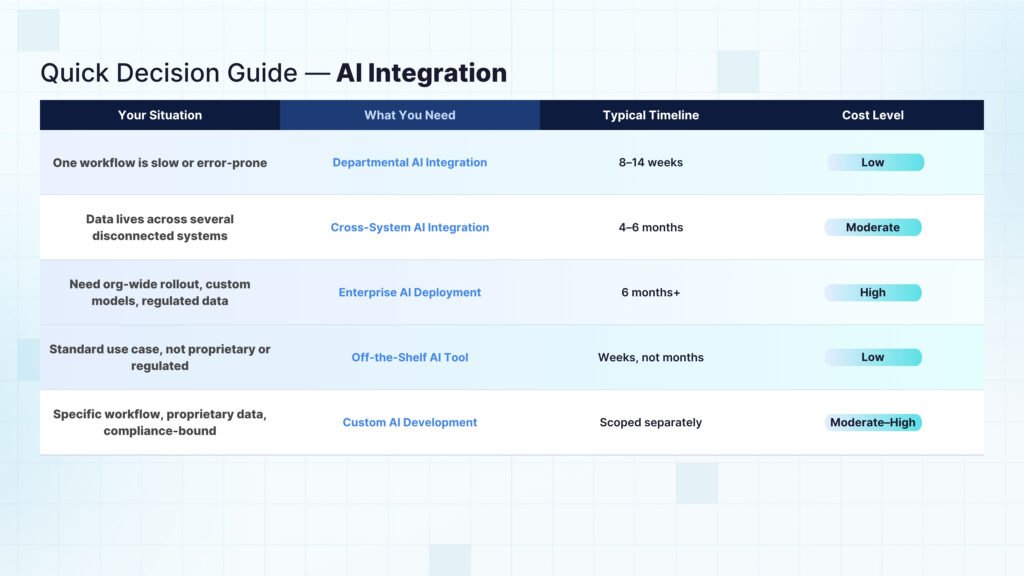
| Your Situation | What You Need | Typical Timeline | Cost Level |
| One workflow is slow or error-prone | Departmental AI Integration | 8–14 weeks | Low |
| Data lives across several disconnected systems | Cross-System AI Integration | 4–6 months | Moderate |
| Need org-wide rollout, custom models, regulated data | Enterprise AI Deployment | 6 months+ | High |
| Standard use case, not proprietary or regulated | Off-the-Shelf AI Tool | Weeks, not months | Low |
| Specific workflow, proprietary data, compliance-bound | Custom AI Development | Scoped separately | Moderate–High |
Common Mistakes Saudi Businesses Make When Implementing AI
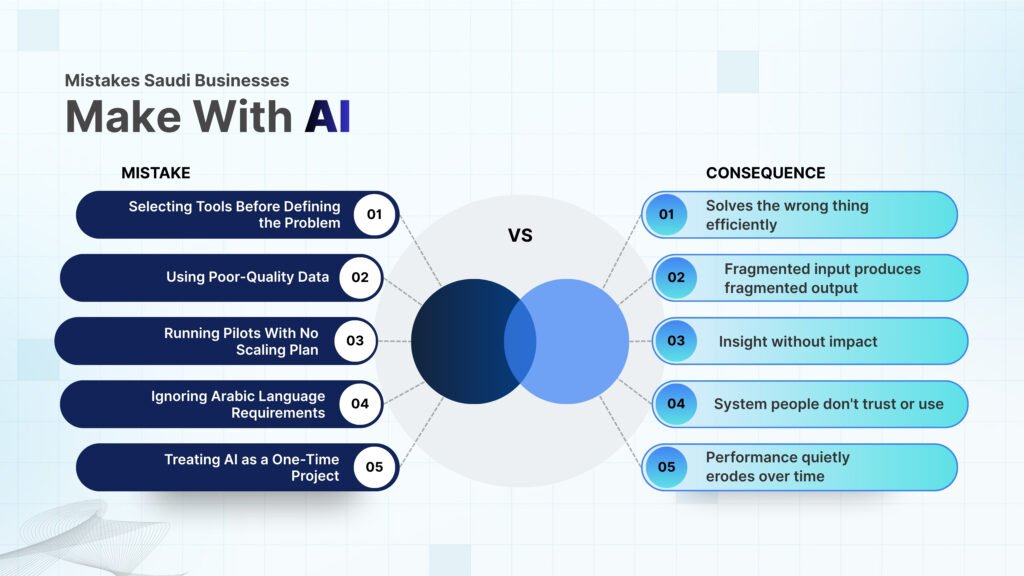
Selecting Tools Before Defining the Problem
Tools selected before problems are defined consistently produce implementations that solve the wrong thing efficiently. The AI works as specified. The specification was wrong. Restarting after go-live costs more than getting the brief right.
Using Incomplete or Poor-Quality Data
AI output quality is a direct function of input data quality. Businesses that deploy AI on top of fragmented, inconsistent, or incomplete data get fragmented, inconsistent, and incomplete outputs, and often blame the AI rather than the data infrastructure underneath it.
Running Pilots With No Scaling Plan
A successful pilot that was never intended to scale is a demonstration, not an implementation. AI for business processes only delivers commercial return when it operates at scale. Pilots without defined scaling criteria and expansion plans produce insight without impact.
Ignoring Arabic Language Requirements
Roll out AI for a Saudi workforce or Saudi customers without real Arabic language capability, dedicated NLP, not a translation layer stapled on, and you end up with a system the people it’s meant for don’t trust and won’t use.
Treating AI as a One-Time Project
Data shifts, business processes evolve, regulations change, and the AI needs to keep pace with all of it. Treat a deployment as finished the day it goes live, and performance quietly erodes as the system falls further out of step with what’s actually happening in the business.
Why Etihad Falcon Tech is a Leading AI Development Company in Saudi Arabia
Operational Problem-Solving as the Starting Point
Etihad Falcon Tech does not start with AI tools. We start wherever the business is losing time, accuracy, or control. Every engagement opens with an operational audit, mapping current workflows, finding where AI can actually make a difference, and turning that into a ranked implementation plan before a single line of development starts.
KSA Regulatory Familiarity: SDAIA, PDPL, ZATCA, SAMA
Compliance with Saudi data and AI regulations is built into every system Etihad Falcon Tech delivers, not added as a review step after the system is already built. PDPL data handling, ZATCA integration, SAMA requirements for financial applications, and NDMO data residency obligations are understood and addressed at the architecture stage.
End-to-End AI Development Services
From initial business audit and problem definition through system architecture, development, pilot deployment, performance validation, scaling, and ongoing support, Etihad Falcon Tech manages the full AI integration lifecycle. The same team that scoped the problem is accountable for the outcome.
Proven Experience With Saudi Businesses Across Industries
Etihad Falcon Tech has delivered AI for business implementations for Saudi businesses across various industries. That cross-industry experience means faster recognition of where similar problems have been solved, fewer architecture mistakes, and AI systems built for real operational environments rather than controlled demonstration conditions.
If you are considering AI and the first step feels unclear, that is exactly where the conversation starts, with understanding where AI can deliver measurable impact in your specific operation before any technology decision is made.
Frequently Asked Questions
What is artificial intelligence and how is it being used by Saudi businesses in 2026?
At its core, AI analyses data, spots patterns, automates decisions, and handles complex judgment calls at a scale no human team could keep up with manually. Across Saudi Arabia, that shows up in retail, financial services, healthcare, logistics, manufacturing, and government-adjacent work — everything from demand forecasting and fraud detection to Arabic-language customer service and predicting when a piece of equipment is about to fail.
Does my business need custom AI development or can I use existing AI tools?
Comes down to how well an off-the-shelf tool actually fits your workflow and your data. Off-the-shelf AI tools work well for standard use cases — basic automation, generic analytics, and common document processing tasks. When your workflow is specific, your data is proprietary, or your compliance requirements are regulated by SAMA, PDPL, or ZATCA, custom AI development services produce better results than configuring a generic tool to fit a purpose it was not designed for.
How does AI integration work with systems my business already uses?
AI connects to existing ERP, CRM, and operational databases through API integration — enhancing what those systems do with analytical and automation capabilities they were not built with. The integration quality determines the output quality. An AI system with access to clean, structured, real-time data from your existing systems produces reliable outputs. One connected to incomplete or inconsistent data does not.
What does Saudi Arabia’s PDPL mean for businesses using AI?
The Personal Data Protection Law requires that personal data used by AI systems is collected with consent, stored securely, used only for defined purposes, and subject to individual access and deletion rights. For AI systems handling customer data, patient data, or employee data, PDPL compliance must be built into the data architecture from the start — it is not a compliance review conducted after the system is already processing data.
Does Etihad Falcon Tech build AI that works in Arabic?
Yes. Arabic language capability is built into EFT’s AI systems from the development stage — dedicated NLP models trained on Arabic text, RTL interface design, and handling of Gulf dialect variations. Arabic is not a translation layer added to an English-first system.
How long does an AI integration project take in Saudi Arabia?
Departmental AI integrations covering a single workflow typically take eight to fourteen weeks from scoping to go-live. Connecting AI across several platforms at once runs four to six months. Full enterprise rollouts — custom model training, compliance architecture, the whole organisation — take anywhere from six months to over a year, depending on scope and how ready the data actually is.
How do I know if my business is ready for AI integration?
Three things need to be true. You’ve got an operational problem your current systems genuinely can’t solve. You’ve got data that’s actually accessible and reflects that problem. And someone internally owns the implementation — a person or team who’ll be accountable for whether it gets adopted and whether it works. Businesses that have all three are ready to move. Those missing one of the three should address the gap before starting development.
What is the difference between using AI for business intelligence and standard business reporting?
Standard business reporting tells you what happened. AI powered business intelligence tells you what is likely to happen next and why. The difference is not just speed — it is the ability to identify non-obvious patterns across large datasets that inform decisions before outcomes occur rather than after. For Saudi businesses where demand is seasonal, customer behavior is variable, and operational complexity is high, that forward-looking capability is the practical value of AI business intelligence over standard reporting.