

Saudi Arabia’s AI in healthcare market was valued at USD 87.52 million in 2025 and is projected to reach USD 638 million by 2034, according to IMARC Group. In May 2025, the Kingdom went further and opened the world’s first AI-powered medical clinic, where an AI system diagnoses patients and proposes treatment plans for doctors to review before a decision is made.
So what does AI in healthcare actually mean for the person running a hospital or a private clinic? AI in healthcare means closing the gap between the data your facility already collects and the decisions your staff is already trying to make, just faster and earlier than a person reviewing charts manually. It’s fewer empty appointment slots, less time spent on paperwork after hours, and high-risk patients getting noticed before a small issue turns into a bigger one.
None of that happens with a generic AI chatbot layered on top of a website, or a tool that only sees one part of the patient record in isolation. It takes AI connected to your actual clinical and administrative data, built and validated against Saudi compliance obligations, and designed around how your specific hospital or clinic actually operates, not a demo environment.
This guide covers the major Artificial Intelligence in healthcare applications available to Saudi facilities today, how each one works in practice, what PDPL and SDAIA require before any patient data touches an AI system, what implementation actually involves stage by stage, and what to look for in an AI development partner for your facility.
What AI in Healthcare Actually Covers for Saudi Health Facilities
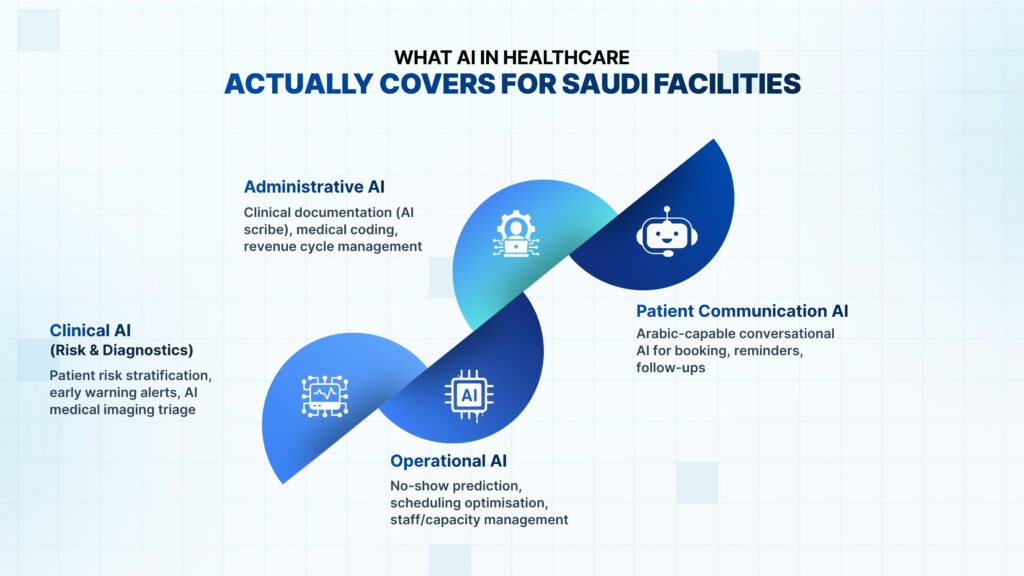
| Category | What It Does |
| Clinical AI (Risk & Diagnostics) | Patient risk stratification, early warning alerts, AI medical imaging triage |
| Administrative AI | Clinical documentation (AI scribe), medical coding, revenue cycle management |
| Operational AI | No-show prediction, scheduling optimisation, staff/capacity management |
| Patient Communication AI | Arabic-capable conversational AI for booking, reminders, follow-ups |
What you actually need depends on where your facility is losing the most time or money right now. If you run a private specialist clinic, that’s usually appointment no-shows and physicians finishing documentation after hours. If you run a hospital, it’s more likely fragmented data across departments, your Electronic Medical Record (EMR), your imaging systems, and your bed management running as separate systems instead of one. Start with the problem that’s costing you the most in terms of resources.
There are four types of AI that work well in the healthcare industry: clinical AI, administrative AI, operational AI, and patient communication AI. Each one solves a different problem, and each breaks down into a few specific applications you can implement on their own; you don’t need all of them at once to see a result.
1. Clinical AI: Supporting Your Clinical Team’s Decisions
Your clinical team already reviews patient data constantly. Clinical AI surfaces the data they need faster, so they can act on it sooner, it doesn’t replace their judgment or make the call for them.
Catching High-Risk Patients Early
- Surfaces a patient’s vitals trending in the wrong direction to your nursing team as it happens, instead of waiting for the next routine check
- Flags chronic care patients who’ve missed follow-ups, so your team can reach out before a routine issue becomes an emergency admission
Helping Your Team Prioritise What to Review First
- Reorders a radiology or lab queue based on urgency indicators your team defines, so higher-priority cases surface before routine ones instead of waiting in line
- Surfaces relevant patient history alongside a new result, so your clinician has context without digging through the record manually
- Every finding and every diagnosis still goes through your qualified clinical staff. AI’s job is getting the right case in front of them sooner, not deciding what’s wrong with the patient.
2. Administrative AI: Getting Time Back from Your Clinical and Admin Staff
Not every AI investment needs to touch a clinical decision. Some of your fastest wins are entirely administrative.
Writing Clinical Notes for Your Physicians
- Listens to the consultation and drafts a structured note, discharge summary, and suggested code, ready for your physician to review and sign off
- Saving five minutes per patient across a twenty-five-patient day gets your physicians roughly two hours back, every day
Getting Your Billing Codes Right
- Reads the documentation and suggests ICD (International Classification of Diseases) and CPT (Current Procedural Terminology) codes for your coding staff to review, instead of working through each chart by hand
- Helps keep coding accuracy steady as patient volume grows, instead of your error rate climbing with it
Catching Insurance Claims Before They’re Denied
- Flags patterns, like a specific insurer rejecting a specific procedure code, so your billing team can fix the submission before it’s denied
- Usually where the cash flow leak is if delayed or rejected claims are a recurring problem
3. Operational AI: Running Your Facility More Efficiently
This is the part of your facility AI touches without going near a clinical decision, your schedule, your waiting room, your staff roster. It’s usually where you see a return the fastest, because the cost of the problem is easy to put a number on.
Filling Empty Appointment Slots
- Scores each booking on how likely that patient is to no-show, based on their own attendance history
- Sends high-risk bookings an escalating reminder instead of the same generic text everyone gets
- Offers a cancelled slot to the next waitlisted patient automatically, instead of it sitting empty
- Usually the fastest-paying AI investment for a private clinic
Staffing for the Patients You Actually Have
- Tracks demand patterns, Ramadan, seasonal illness, local population trends, against your actual patient flow
- Helps you staff up ahead of a surge instead of scrambling once it hits, and cut coverage you don’t need during a lull
- Some facilities go further with sensor data showing which rooms and equipment are actually in use right now
4. Patient Communication AI: Handling Routine Contact With Patients
A large share of what your front desk handles every day isn’t clinical; it’s confirming, reminding, and answering the same questions. AI takes that off your staff’s plate, but only if it can actually talk to your patients the way they expect.
Talking to Patients in Arabic, Automatically
- Handles booking confirmations, reminders, routine questions, and follow-up check-ins directly in Arabic, including Gulf dialect variations
- Escalates anything beyond routine straight to your staff
- Has to be built for Arabic, not translated from an English script. A system that defaults to English for an Arabic-speaking patient tells them it wasn’t built for them, which does more damage than not having the tool at all.
Saudi Healthcare AI Compliance: What AI in Healthcare Actually Requires
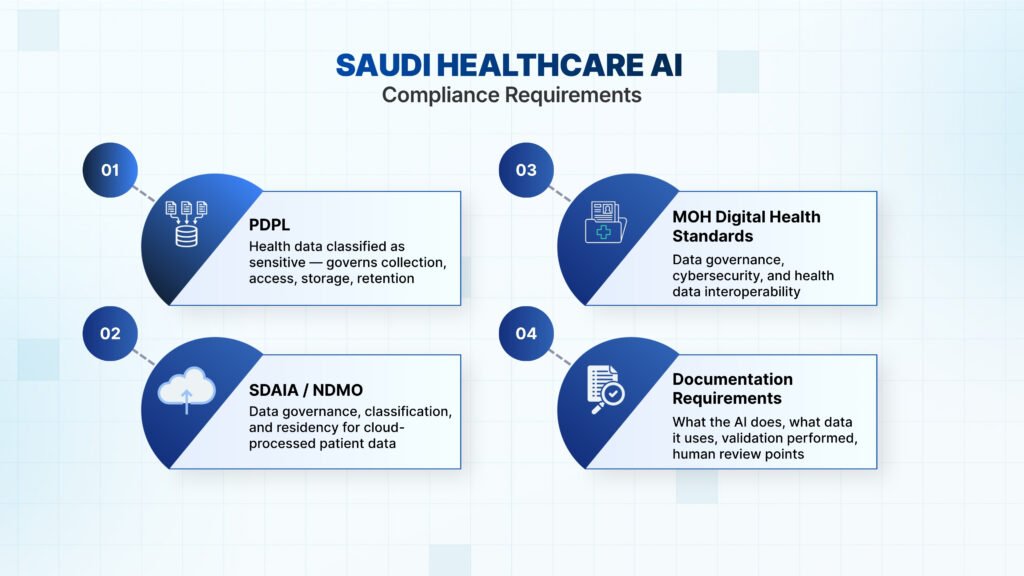
| Requirement | What It Covers |
| PDPL | Health data classified as sensitive — governs collection, access, storage, retention |
| SDAIA / NDMO | Data governance, classification, and residency for cloud-processed patient data |
| MOH Digital Health Standards | Data governance, cybersecurity, and health data interoperability |
| Documentation Requirements | What the AI does, what data it uses, validation performed, human review points |
You can’t treat a healthcare AI project like a standard software purchase. The patient data it touches is some of the most sensitive information Saudi law recognises, and that puts specific obligations on you as the facility, not just on whoever builds the system.
PDPL and Your Patient Data
If the AI system you’re evaluating uses patient data for anything, training a model, generating a prediction, running an automated reminder, PDPL applies to it. Before you sign off on any vendor, you need clear answers to four questions: who can access this data, where is it stored, how long is it retained, and does any of it leave your organisation to a third party. If your vendor can’t answer these clearly in the first conversation, that’s a sign the system wasn’t designed with PDPL in mind from the start, and you’ll be the one dealing with the consequences, not them.
Get this assessed while you’re still planning the project. Facilities that leave it until two weeks before go-live end up either delaying launch or accepting compliance gaps they can’t see yet.
SDAIA and NDMO: Where Your Data Actually Lives
If your AI system runs on cloud infrastructure, and most do, NDMO’s data residency and governance rules apply to how that data is classified, where it’s processed, and where it’s stored. This matters most if you’re comparing an international vendor against a Saudi one. Ask directly whether patient data is processed and stored inside the Kingdom, and get that answer in writing before you commit.
A vendor who has actually done this before should be able to explain, without hesitation, where your data goes, how it’s secured, what systems it connects to, and how access is logged. If you’re getting vague answers or being told “it’s all handled,” that’s the moment to push harder, not move forward.
MOH Digital Health Standards
If your AI system is going to exchange data with other clinical platforms, check that it aligns with the interoperability and clinical coding standards the National Health Information Center maintains. This isn’t just a compliance checkbox. A system that doesn’t follow these standards will struggle to exchange data cleanly with your other clinical systems down the line, which turns into your staff manually reconciling records that should have synced automatically.
Documentation Requirements for Clinical AI Systems
For any AI system supporting a clinical decision, don’t accept a verbal walkthrough. Get documentation covering what the system is designed to do, what data it uses, who can access that data, how it generates its outputs, what validation was performed, where a human is required to review before action is taken, and how errors get handled when something goes wrong.
Build this requirement into your planning stage, not your go-live checklist. If a Saudi health authority audits your use of a clinical AI system later, this is exactly the documentation they’ll ask for, and assembling it retroactively, after the system is already live, is far harder than requiring it from your vendor upfront.
How AI Implementation in Healthcare Actually Works for Saudi Facilities
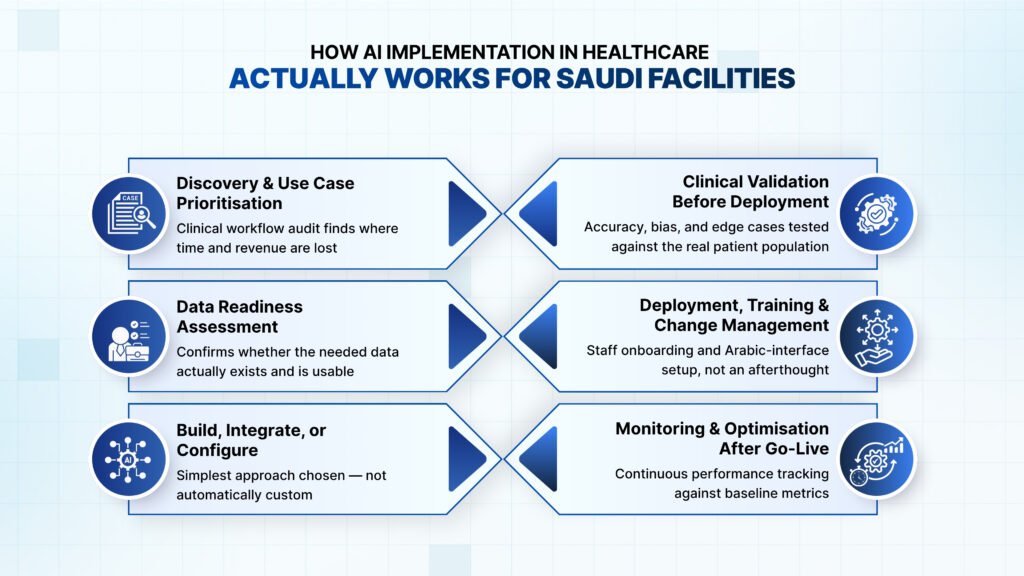
| Stage | What Happens |
| 1. Discovery & Use Case Prioritisation | Clinical workflow audit finds where time and revenue are lost |
| 2. Data Readiness Assessment | Confirms whether the needed data actually exists and is usable |
| 3. Build, Integrate, or Configure | Simplest approach chosen — not automatically custom |
| 4. Clinical Validation Before Deployment | Accuracy, bias, and edge cases tested against the real patient population |
| 5. Deployment, Training & Change Management | Staff onboarding and Arabic-interface setup, not an afterthought |
| 6. Monitoring & Optimisation After Go-Live | Continuous performance tracking against baseline metrics |
Discovery and Use Case Prioritisation
AI implementation in healthcare should not begin with development. It should begin with understanding the facility.
A clinical workflow audit maps where time, money, and clinical capacity are being lost. A hospital may discover that its largest immediate opportunity is no-show reduction, not diagnostic AI. That is a better starting point — a more bounded problem, a faster implementation, and a measurable return that builds confidence and data for the next phase.
Use case prioritisation should also produce an ROI estimate before any development commitment is made. Implementing AI in healthcare without a baseline measurement framework means there is no reliable way to evaluate whether the investment delivered its intended value.
Data Readiness Assessment
AI is only as useful as the data supporting it. For Saudi healthcare facilities where patient information exists across multiple systems, an Electronic Medical Record (EMR) for clinical records, a separate Hospital Information System (HIS) for billing, and paper-based documentation for some specialties, a data readiness assessment identifies whether the information needed to support a specific AI application is actually available, structured, and sufficient in volume.
If patient information is fragmented, inconsistent, or poorly structured, the first phase of an AI in healthcare project may need to focus on data quality and consolidation before model development begins. This is not a failure. It is the honest starting point for an implementation that will actually work.
Build, Integrate, or Configure
Not every AI in healthcare use case needs a custom model. A good implementation partner should recommend the simplest approach that can deliver the required outcome — recommending configuration where an existing tool fits, integration where an existing AI capability needs to connect to facility data, and custom development only where the workflow is genuinely specific enough to require it.
Clinical Validation Before Deployment
Healthcare AI should be tested against real-world conditions in the specific facility before it is trusted with production workflows. Clinical accuracy testing, bias review, edge case handling, and physician sign-off are all components of validation that technical testing alone does not cover.
Clinicians should be involved in validation because an AI system that is technically accurate but does not fit how the clinical team actually works will not be adopted, regardless of its performance metrics in isolation.
Deployment, Training, and Change Management
Even a technically excellent AI in healthcare system fails if clinical and administrative staff do not understand when and how to use it. Staff onboarding, workflow integration training, and Arabic-language interface setup are implementation components — not optional add-ons. The system should fit the workflow rather than requiring staff to create an entirely new routine around the AI.
Monitoring and Optimisation After Go-Live
AI implementation in healthcare does not end at deployment. Patient populations change. Workflows evolve. Regulatory requirements update. Data patterns shift as the facility grows.
Model performance should be monitored continuously after go-live — with clear thresholds for review, retraining schedules based on performance drift indicators, and outcome tracking against the baseline metrics established during discovery.
The discovery-to-monitoring sequence above follows the same core process used across other Saudi industries adopting AI, just adapted for clinical workflows and healthcare-specific compliance. See our guide on AI business intelligence for how this same process applies in retail, logistics, and other sectors.
How AI in Healthcare Works for Different Types of Facilities
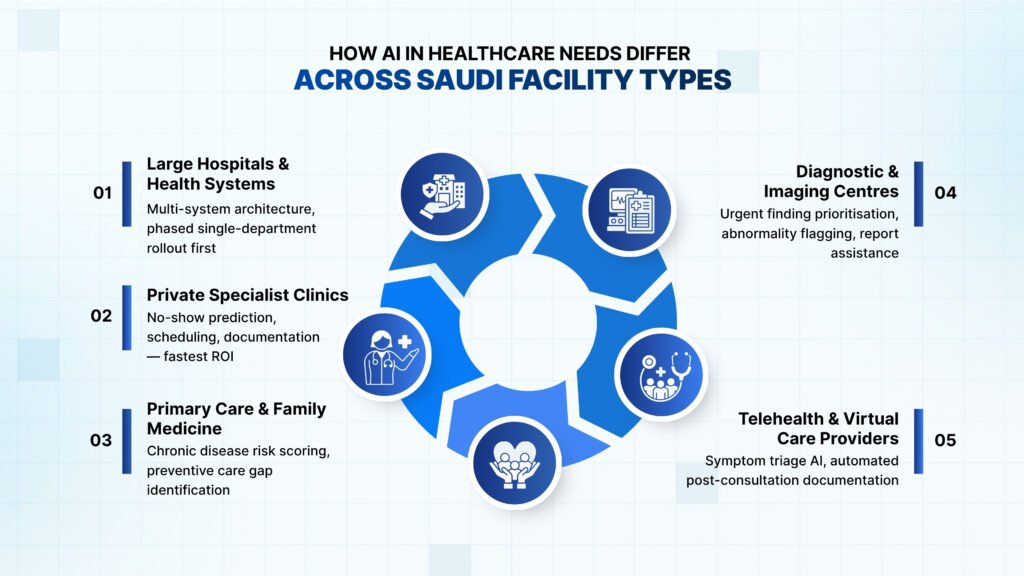
| Facility Type | Key AI Application |
| Large Hospitals & Health Systems | Multi-system architecture, phased single-department rollout first |
| Private Specialist Clinics | No-show prediction, scheduling, documentation — fastest ROI |
| Primary Care & Family Medicine | Chronic disease risk scoring, preventive care gap identification |
| Diagnostic & Imaging Centres | Urgent finding prioritisation, abnormality flagging, report assistance |
| Telehealth & Virtual Care Providers | Symptom triage AI, automated post-consultation documentation |
Large Hospitals & Health Systems
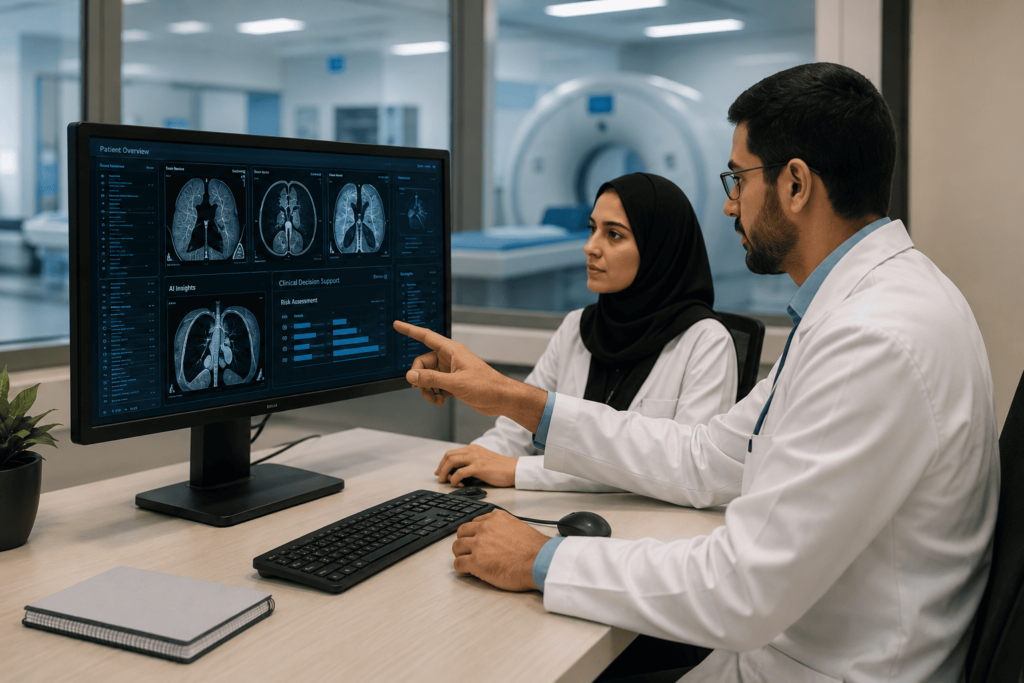
Large Saudi hospitals run on multiple departments, multiple systems, and patient data volumes a smaller facility never sees. Multi-specialty hospitals, academic medical centres, and regional health systems running several facilities under one administration are the ones building AI architecture that connects EMR, HIS, imaging, and operational databases at once, while keeping strict access controls and audit trails across every department that touches it.
What AI handles for large hospitals and health systems:
- A single department, radiology or a busy outpatient clinic, rolled out first so staff trust and results build before a facility-wide expansion
- Risk stratification and early warning alerts running across multiple wards from one connected data source, not a separate tool per department
- Imaging triage integrated into the radiology department’s existing PACS queue, not a standalone dashboard staff have to check separately
- Audit trails and access logs that satisfy your compliance team without departments manually compiling records for each review
Private Specialist Clinics
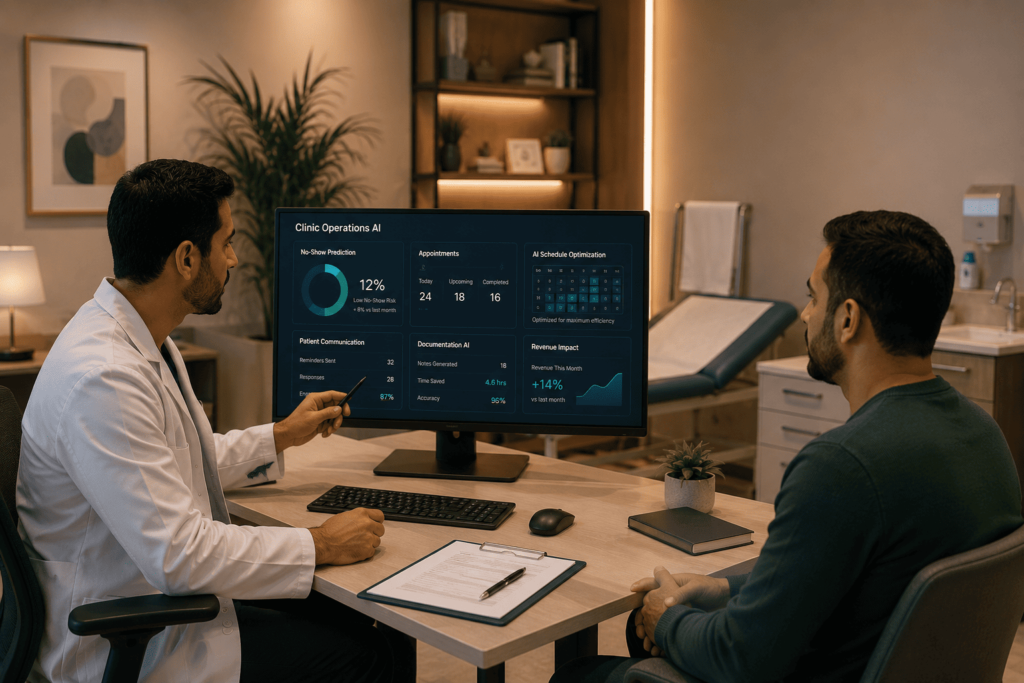
A private specialist clinic rarely needs an enterprise AI platform. Dermatology, dental, orthopaedic, and single-physician or small group practices get more value, faster, from operational AI than from complex clinical tools built for hospital-scale volume.
What AI handles for private specialist clinics:
- No-show prediction flagging your highest-risk bookings so reminders go out before a slot sits empty
- AI scribe drafting your physician’s clinical notes during the consultation instead of after hours
- Automated waitlist filling the moment a patient cancels, without your front desk chasing it manually
- WhatsApp-based booking and reminders handling routine contact so your receptionist isn’t on the phone all day confirming appointments
Primary Care & Family Medicine
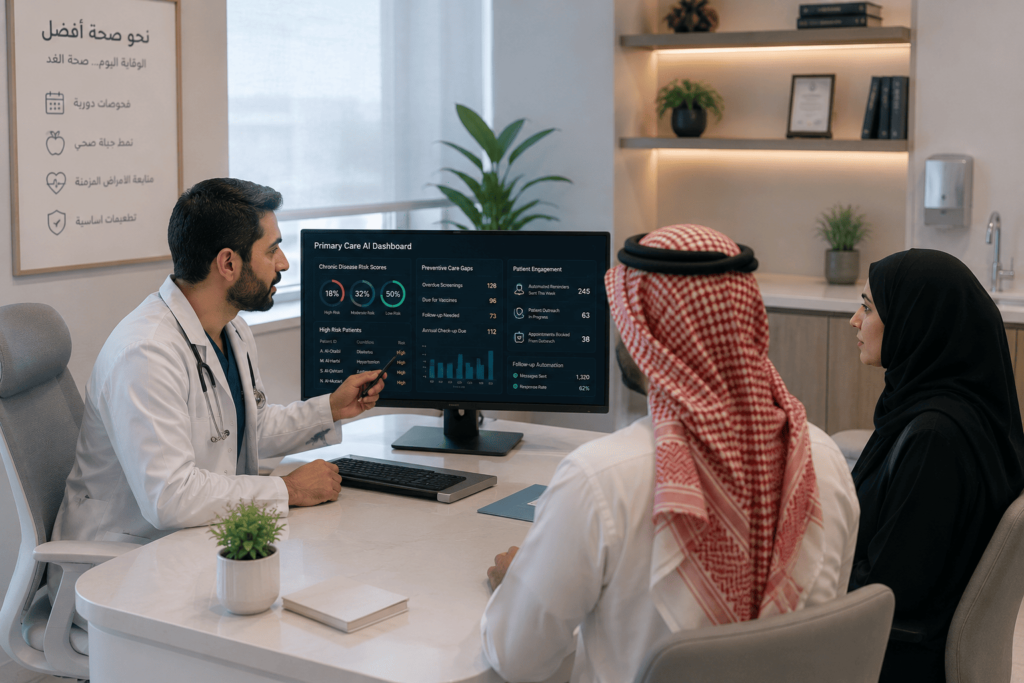
Primary care in Saudi Arabia has a strong preventive focus, and that is exactly where AI adds the most value here. Family medicine clinics, corporate health centres, and multi-physician primary care practices use AI to catch the patients who are due for something before they fall through the cracks.
What AI handles for primary care and family medicine:
- Preventive screening reminders triggered automatically when a patient becomes due, rather than relying on staff to track it manually
- Chronic disease patients flagged when they’ve gone longer than expected without a visit, so someone follows up before a manageable condition becomes a complication
- Risk scoring that helps your physicians prioritise which patients need a closer look during a busy clinic day
- Routine follow-up communication automated in Arabic, freeing your staff to focus on patients who need more than a check-in message
Diagnostic & Imaging Centres
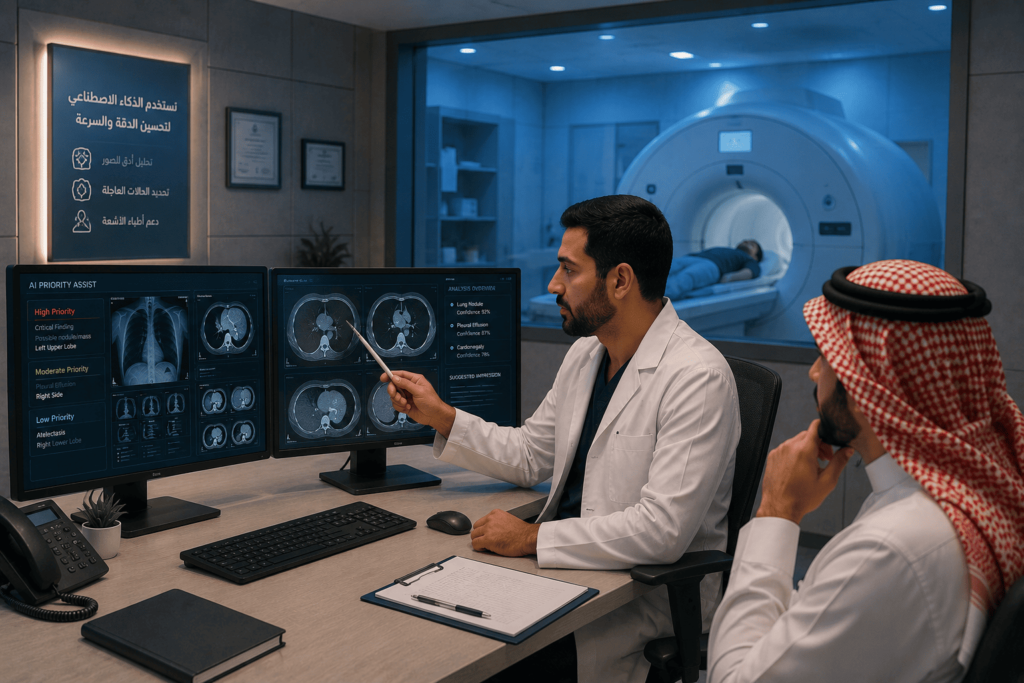
Imaging centres run on volume, and that is where AI’s biggest advantage shows up fastest. Radiology centres, pathology labs, and diagnostic imaging chains running high daily scan counts are the ones seeing the clearest throughput gains from AI triage.
What AI handles for diagnostic and imaging centres:
- Urgent findings, a suspected stroke, a fracture, moved to the top of your radiologist’s queue instead of waiting behind routine studies
- Abnormality flagging on pathology slides surfaced for review before a technician would otherwise catch it during manual sorting
- Report generation assistance drafting structured findings for your radiologist to review and finalise, cutting turnaround time on high-volume days
- Validation tested against your own patient population and imaging equipment, not a generic benchmark that doesn’t reflect who actually walks through your door
Telehealth & Virtual Care Providers

Saudi Arabia’s virtual healthcare infrastructure, Seha Virtual Hospital alone delivered over 16 million consultations in 2025, generates exactly the kind of structured digital interaction AI performs best in. Telehealth platforms, virtual clinic operators, and remote consultation providers are where conversational AI and automated documentation fit most naturally into the workflow.
What AI handles for telehealth and virtual care providers:
- Symptom triage AI directing a patient to the right type of consultation before they even connect with a physician
- Post-consultation documentation generated automatically from the virtual visit, without your physician typing notes between calls
- Remote patient monitoring data flowing into the same system flagging risk elsewhere in this guide, so a wearable device reading becomes a clinical alert instead of raw data no one reviews
- Follow-up scheduling and reminders handled in Arabic across the same channel patients used for their consultation, so the experience stays consistent end to end
What Does It Actually Cost to Implement AI in Healthcare in Saudi Arabia?
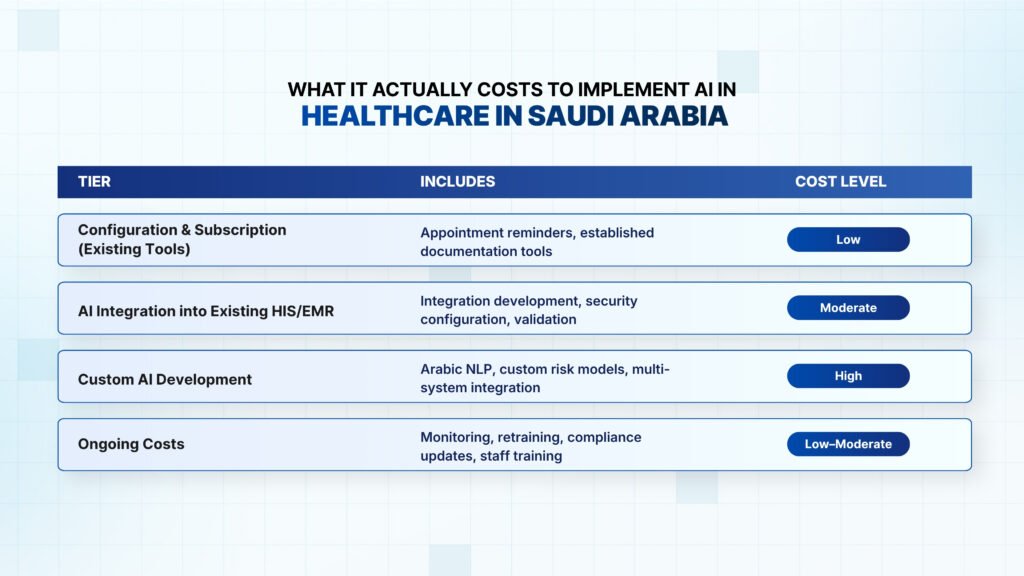
| Tier | Includes | Cost Level |
| Configuration & Subscription (Existing Tools) | Appointment reminders, established documentation tools | Low |
| AI Integration into Existing HIS/EMR | Integration development, security configuration, validation | Moderate |
| Custom AI Development | Arabic NLP, custom risk models, multi-system integration | High |
| Ongoing Costs | Monitoring, retraining, compliance updates, staff training | Low–Moderate |
AI in healthcare implementation cost is driven by the scope of the problem being solved, the number of systems being connected, the quality of available data, and the level of Arabic language capability required.
Configuration and subscription costs for existing AI tools
The lowest cost tier. A healthcare facility configuring an existing appointment reminder system or an established AI documentation tool pays for configuration, integration, and ongoing subscription. Appropriate when the requirement is common enough that a capable existing solution covers it.
AI integration into existing HIS or EMR
The mid-range cost tier. Connecting an AI capability to the facility’s existing clinical systems, where the AI accesses patient data, generates outputs, and surfaces those outputs within the existing clinical workflow, requires integration development, security configuration, and validation work beyond standard configuration.
Custom AI development
The highest cost tier. Building AI systems around the facility’s specific workflow, patient population, and data characteristics, including Arabic NLP (Natural Language Processing) for documentation or patient communication, custom risk models, and multi-system integration across clinical and operational platforms.
Ongoing costs Saudi healthcare facilities typically underestimate
Model monitoring, retraining as patient population and workflow data changes, compliance documentation updates as regulations evolve, integration maintenance when existing systems update, and staff training for new users or workflow changes. These are recurring operational costs of implementing AI in healthcare, not one-time project costs.
Common Mistakes in AI Implementation in Healthcare for Saudi Facilities
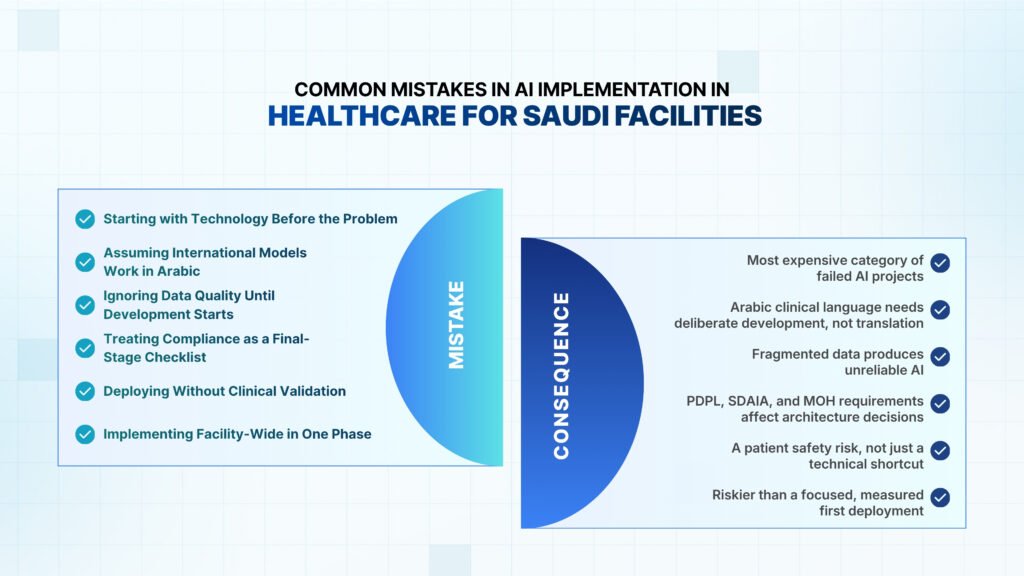
| Mistake | Consequence |
| Starting with Technology Before the Problem | Most expensive category of failed AI projects |
| Assuming International Models Work in Arabic | Arabic clinical language needs deliberate development, not translation |
| Ignoring Data Quality Until Development Starts | Fragmented data produces unreliable AI |
| Treating Compliance as a Final-Stage Checklist | PDPL, SDAIA, and MOH requirements affect architecture decisions |
| Deploying Without Clinical Validation | A patient safety risk, not just a technical shortcut |
| Implementing Facility-Wide in One Phase | Riskier than a focused, measured first deployment |
What to Look for When Choosing an AI Development Partner for Saudi Healthcare
Healthcare AI experience
The partner should demonstrate specific experience with clinical workflows, patient data, validation requirements, and the practical consequences of incorrect AI outputs in healthcare contexts. Generic enterprise AI experience does not transfer automatically.
Saudi compliance knowledge
PDPL, SDAIA frameworks, NDMO data governance requirements, and MOH digital health standards should be part of the partner’s standard architecture conversation, not raised as issues after the project is underway.
Arabic language AI capability
Arabic clinical documentation, Arabic conversational AI for patient communication, and bilingual interface design are requirements that need to be built into the system during development and tested against actual Arabic clinical use before deployment. Ask specifically how Arabic capability is implemented and validated — not just whether it is supported.
Integration experience with healthcare systems
The partner should be able to explain precisely how the AI system will exchange information with the facility’s existing HIS or EMR, how access will be controlled, and how integration will be maintained as underlying systems update.
Etihad Falcon Tech: AI Development Company for Healthcare in Saudi Arabia

We build AI in healthcare for Saudi facilities the way it should be built: around your actual workflow, your compliance obligations, and Arabic as a core requirement, not an add-on. This combination is where most AI vendors fall short, and it’s where we’ve focused our practice.
Clinical and Operational AI Built Around Your Workflow
We start with your specific problem, not a product we’re trying to sell. That covers clinical risk and early warning support, documentation and coding automation, scheduling and capacity planning, revenue cycle workflows, and Arabic patient communication. We find where automation delivers a measurable result in your facility, then build for that outcome.
Saudi Compliance Built Into the Architecture from Day One
PDPL, SDAIA, and MOH digital health requirements go into your system’s architecture at the design stage. Access controls, audit trails, and data handling protocols are decisions we make while designing.
Arabic Language AI That Works in Your Clinical Context
Arabic isn’t a translation layer we add at the end. We build it into the system during development and validate it against how your staff and patients actually speak, not against a benchmark dataset with no connection to a Saudi clinic floor.
Starting With the Right Problem
We assess your workflows, identify where AI actually fits, and define a practical roadmap. Your first project doesn’t need to transform the whole facility. It needs to solve one problem well and prove the case for the next one.
If your facility is losing time to no-shows, documentation, or systems that no longer scale, that’s where we start. Message our team on WhatsApp to talk through what AI implementation would look like for your facility.
Frequently Asked Questions
An AI tool is an existing product you configure, the fastest and cheapest option if one fits your need. AI integration connects that capability to your EMR or HIS so it works inside your existing workflow instead of sitting apart from it. Custom development is what we build when your workflow, patient population, or Arabic language needs don’t match anything already on the market.
Yes, if the system touches patient data in any way, and almost every clinical or operational AI application does. Health information is classified as sensitive personal data under Saudi law. Get this assessed while you’re still planning, not after the system is built.
It depends on scope. Configuring an existing tool for scheduling or documentation costs far less than a custom risk model integrated across multiple departments. Either way, budget for ongoing costs too: monitoring, retraining, compliance updates, and staff training don’t stop after go-live.
A focused build, no-show prediction, a single-specialty AI scribe, usually takes eight to fourteen weeks from discovery to deployment. A multi-department clinical implementation with EMR integration takes four to eight months. The biggest factor in your timeline is how clean your data already is, not how complex your ask is.
Yes, if it’s built for Arabic from the ground up, not translated over English logic. We validate it against the specific terminology and documentation style your physicians actually use. A human should still review every AI-assisted note.
There’s no fixed number. A smaller, clean dataset is usually more useful than a large, messy one. We assess your data during discovery so you know what’s realistic before committing to anything.
Your doctor. AI gives you risk scores, flagged findings, and draft notes for review, not decisions made without a clinician. Every output stays a recommendation until a qualified professional signs off on it.
Measure your baseline before you start, no-show rate, documentation time, diagnostic turnaround, whatever the AI is meant to improve, then track the same number after launch. No baseline means no real way to tell if it worked.