

Artificial intelligence is projected to contribute USD 133 billion to Saudi Arabia’s GDP by 2030, according to the Saudi Data and Artificial Intelligence Authority, SDAIA, as reported by Arab News. A significant share of that contribution is not coming from robots or science fiction technology. It is coming from businesses that figured out how to use the data they already have to make faster, more accurate decisions than their competitors.
That is what AI business intelligence does. It takes the data your business generates every day and turns it into something you can act on. Not a report you read at the end of the month. Live insight that reaches you when the decision still matters.
For a Saudi business owner or manager, this is practical. Your sales figures, your customer behaviour, your inventory levels, your operational costs; all of it is already being recorded somewhere. The problem is that it sits in different systems, gets pulled together manually, and arrives too late to change anything. Artificial Intelligence business intelligence connects those systems, reads the data continuously, and tells you what is happening right now and what is likely to happen next.
The applications are wide. A retail business uses it to know which products are about to run out before they actually do. A logistics company uses it to spot delivery delays before they affect clients. A financial services firm uses it to identify which customers are at risk of leaving before they cancel. A healthcare clinic uses it to predict appointment no-shows and fill the gaps before the day starts. The technology is the same. The outcome in each case is the same too: better decisions, made faster, with less guesswork.
This guide covers what AI business intelligence actually involves for Saudi businesses, which use cases deliver the clearest value, how implementation works, what it costs, and what to look for in a development partner who builds systems that produce real decisions, not just better-looking dashboards.
What’s the difference between AI Business Intelligence & Standard Business Intelligence (BI)
Standard business intelligence tells you what already happened. AI business intelligence tells you what’s about to happen, and what to do about it. That’s the whole difference.
You already have a dashboard. It shows you last quarter’s sales, last month’s costs, last week’s numbers. That’s standard BI, and it’s useful, but it’s a photo of the past. It can’t warn you about anything; it can only report on what’s already over.
AI business intelligence works on the same data, but it doesn’t stop at showing you what happened. It looks at where things are heading and tells you before it becomes a problem.
Here is what AI Business Intelligence does better than standard BI.
Predicts What’s Coming
- A normal report tells you sales dropped 12% last quarter. That’s already happened, there’s nothing left to do about it
- AI business intelligence tells you sales are on track to drop another 8% in the next six weeks if nothing changes
- Six weeks of warning is the difference between fixing it and explaining it
Spots Hidden Patterns
- You have thousands of data points moving every day, no person can hold all of them in their head at once
- AI can find that one type of customer is quietly your most loyal repeat buyer, or that one operational habit is behind most of your late deliveries
- These patterns already exist in your data, you just never had a way to see them
Answers Plain Questions
- No dashboard to learn, no report to build, you type or say the question
- “Which product categories had the highest returns in Riyadh last Ramadan?” Ask that and get a sourced answer straight from your own data in seconds
- No analyst, no waiting on a custom report
Alerts You Instantly
- Watches your numbers continuously, not once a month
- Your customer acquisition cost jumps overnight, your inventory for a fast-mover drops too low, your revenue starts drifting from forecast
- You find out the second it happens, not in next week’s meeting
Core Capabilities of AI Business Intelligence
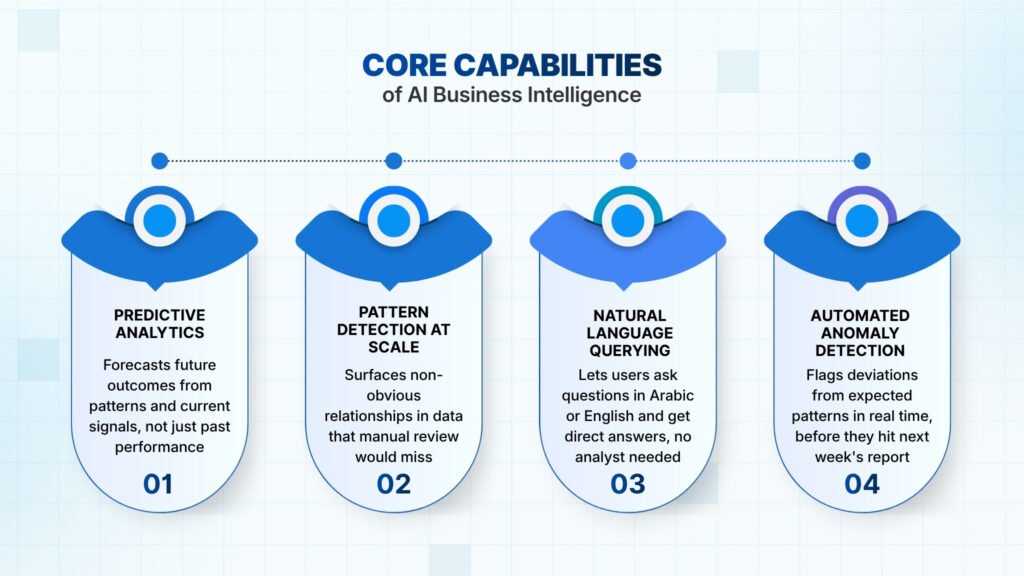
| Capability | What It Adds |
| Predictive Analytics | Forecasts future outcomes from patterns and current signals, not just past performance |
| Pattern Detection at Scale | Surfaces non-obvious relationships in data that manual review would miss |
| Natural Language Querying | Lets users ask questions in Arabic or English and get direct answers, no analyst needed |
| Automated Anomaly Detection | Flags deviations from expected patterns in real time, before they hit next week’s report |
Key AI Business Intelligence Applications for Saudi Businesses
Not every business needs all of this at once. What you actually need depends on where you’re losing the most money or time right now. Here’s what AI business intelligence actually does, broken down by the part of your business it touches.
Sales & Revenue Intelligence
This is about knowing where your revenue is heading before the month closes, not after. It replaces the monthly forecast your sales team builds from memory and gut feel with one that updates itself using your actual pipeline and market data, and it shows you exactly which customers and price points are actually making you money.
- A sales forecast that updates daily instead of once a month
- Customer segments based on real buying behaviour, not just age or location
- Pricing opportunities your standard margin report doesn’t show you
Operations & Supply Chain Intelligence
This is where AI touches your day-to-day running of the business, your stock, your suppliers, your delivery routes. It’s usually the fastest place to see a return, because the cost of a stockout or a late delivery is easy to put a number on, and easy to see improve once you fix it.
- Inventory positioned ahead of demand, not restocked after you run out
- Delivery delays and underperforming suppliers flagged before they cost you a customer
- Slow points in your workflow identified before they become a scaling problem
Financial Intelligence
This is about catching a financial problem while it’s still small enough to fix. Instead of finding out at month-end that a cost center is bleeding or a client’s payment is overdue, you find out the day it starts happening.
- Unusual revenue, cost, or cash flow patterns flagged the moment they appear
- Your cash position forecasted ahead of time, not discovered at month-end
Customer Intelligence
This is about understanding your customers well enough to keep them, and to sell to them better. It tells you who’s about to stop buying from you while you still have time to act, and what actually makes each customer buy, instead of guessing from a generic segment.
- Customers likely to walk away flagged while you still have time to win them back
- Offers and messaging matched to what each customer actually responds to
How AI Business Intelligence Works for Different Industries
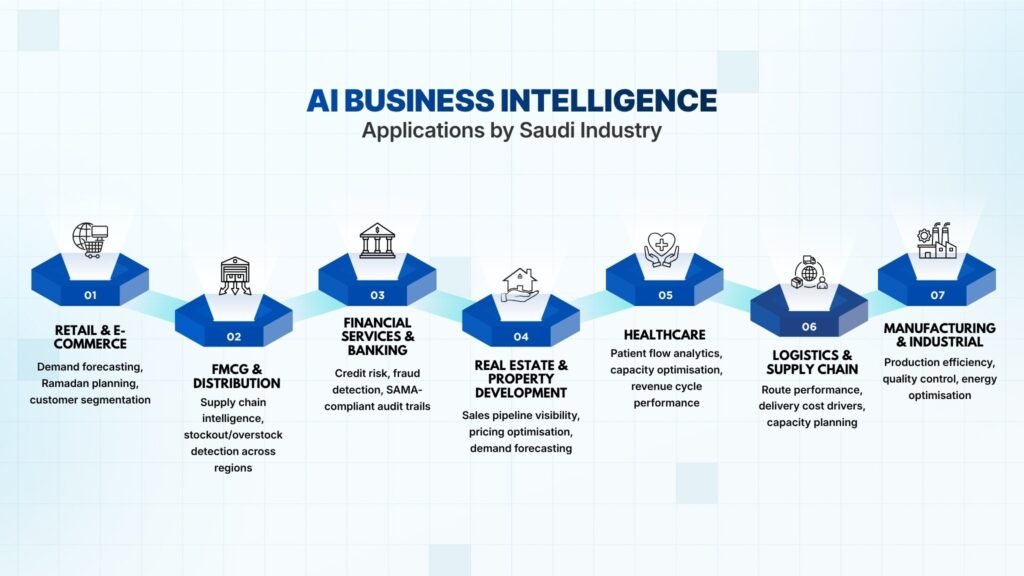
| Industry | Key AI Application |
| Retail & E-commerce | Demand forecasting, Ramadan planning, customer segmentation |
| FMCG & Distribution | Supply chain intelligence, stockout/overstock detection across regions |
| Financial Services & Banking | Credit risk, fraud detection, SAMA-compliant audit trails |
| Real Estate & Property Development | Sales pipeline visibility, pricing optimisation, demand forecasting |
| Healthcare | Patient flow analytics, capacity optimisation, revenue cycle performance |
| Logistics & Supply Chain | Route performance, delivery cost drivers, capacity planning |
| Manufacturing & Industrial | Production efficiency, quality control, energy optimisation |
What you need depends entirely on what kind of business you’re running. Here’s how it plays out by industry.
Retail & E-commerce
Saudi demand doesn’t move steadily through the year, it spikes hard around Ramadan, sometimes two to three times a normal week, and that is exactly where AI adds the most value for retail. Fashion retailers, grocery chains, and e-commerce businesses use it to plan for that spike months before it hits, instead of scrambling once it arrives.
What AI handles for retail and e-commerce:
- Category-level Ramadan demand curves modelled from your own historical data, adjusted for this year’s signals, not last year’s guesswork
- Your inventory positioned by category and location before the peak hits, not restocked once your shelves are already empty
- Customer segments built from actual purchase behaviour, so your marketing spend goes toward the buyers who actually convert
- Your real-time sales performance tracked against target, without waiting for a weekly report to know where you stand
FMCG & Distribution
Running large SKU counts across multiple cities means inventory error costs you twice, once in wasted stock, once in the sale you missed. That is exactly where AI adds the most value for distribution. FMCG distributors, wholesalers, and regional distribution businesses use it to catch both problems before either one hits your bottom line.
What AI handles for FMCG and distribution:
- Stockouts and overstock flagged simultaneously across your different locations, so you catch both before either costs you a sale
- Supplier performance issues flagged before they hit your customer fill rates
- Forward demand signals generated by category and by region, not one blanket forecast for your whole business
- Working capital freed up as inventory error drops, while service levels to your customers improve
Financial Services & Banking
Every AI-generated output in your business needs to be explainable to a regulator, not just accurate, and that is exactly where AI adds the most value here. Banks, insurance providers, and financial services firms operating under SAMA oversight use it to get ahead of risk while keeping a clear audit trail.
What AI handles for financial services and banking:
- Credit risk assessed using patterns your standard scoring model doesn’t catch
- Fraud flagged the moment a transaction pattern deviates from normal, not after a batch review
- Customer lifetime value modelled per account, so your retention efforts go where they actually pay off
- Audit trails and explainability built in, so every AI-generated output can be shown to a SAMA compliance review, not just kept for your own team
Real Estate & Property Development
Running multiple active projects at once means no single project report gives you the full picture, and that is exactly where AI adds the most value here. Developers, asset managers, and large-scale property groups use it to see sales, construction, and finances as one connected view instead of three separate updates.
What AI handles for real estate and property development:
- Your sales pipeline performance tracked in real time, not reconstructed at the end of the month
- Pricing signals surfaced across unit types, using comparable transaction data and market indicators
- Demand forecasted for your new developments before launch, based on real market data instead of a general assumption
- Sales, construction progress, and financial performance connected in one view, instead of three separate reports you have to reconcile manually
Healthcare
Patient flow and capacity matter here more than revenue alone, and that is exactly where AI adds the most value for healthcare. Hospitals, private clinic groups, and healthcare networks use it to plan for demand before it hits their waiting rooms, not after.
What AI handles for healthcare:
- Scheduling patterns identified that predict your next high-demand period, so staffing is planned ahead of it, not during it
- Staffing requirements modelled against your actual patient volumes instead of a fixed roster
- Claims and revenue cycle performance tracked at a level of detail your monthly management accounts don’t provide
- Patient flow monitored continuously, so capacity issues are caught before they turn into longer wait times
See our guide on AI implementation in healthcare for more detailed insights into how these systems get built and deployed across Saudi facilities.
Logistics & Supply Chain
Running multiple routes and vehicles means your operational picture is usually spread across separate systems that don’t talk to each other, and that is exactly where AI adds the most value here. Delivery fleets, freight companies, and third-party logistics providers use it to bring that picture into one place.
What AI handles for logistics and supply chain:
- Route performance and delivery cost drivers monitored continuously, not reviewed after the fact
- Customer service risk flagged as soon as an operational delay starts forming, before it reaches your customer
- Capacity planning modelled against demand changes, so you’re not caught short during a volume spike
- Vehicle performance, delivery completion, and order data connected into one operational view instead of three disconnected systems
Manufacturing & Industrial
Small inefficiencies on the production line compound fast, and that is exactly where AI adds the most value for manufacturing. Manufacturers expanding under Vision 2030’s industrial push use it to protect margin before a small issue becomes a costly one.
What AI handles for manufacturing and industrial:
- Production line efficiency monitored in real time, so slowdowns are caught while they’re still small
- Quality control patterns flagged before they turn into a defect rate you have to explain
- Supplier and materials data tracked alongside production, so a materials issue doesn’t surprise you on the line
- Operational sensor data connected with your financial and quality data, giving you visibility into what’s actually driving margin, not just the number it produces at the end
Saudi Data Considerations for AI Business Intelligence
AI business intelligence for Saudi businesses has compliance and data governance requirements that affect how systems are built and where data is stored.
PDPL and sensitive business data
Saudi Arabia’s Personal Data Protection Law applies to personal data about customers, employees, and other individuals processed by Saudi businesses. For AI business intelligence systems that analyse customer transaction data, employee performance data, or other personal data categories, PDPL compliance requirements affect how data is collected, how it is used within the AI system, and how long it is retained. These obligations are architectural decisions — they need to be built into the system design, not added as post-launch configuration.
SDAIA data governance and NDMO data residency
For Saudi businesses in regulated sectors or those interacting with government systems, NDMO data residency requirements affect where business data can be stored and processed. Cloud infrastructure choices for AI business intelligence platforms — whether to use Saudi-region cloud availability zones, local hosting, or international cloud providers — need to be assessed against the specific data categories the system handles and the regulatory obligations of the industry sector.
Arabic data and Saudi-market data sources
AI business intelligence systems built for Saudi businesses need to handle Arabic language data accurately — Arabic product names, Arabic customer communication data, Arabic operational records — without the translation overhead that adds latency and reduces accuracy. Systems that connect to Saudi-market data sources, including Mada transaction data, Saudi ERP implementations, and Saudi-specific logistics APIs, require integration work that understands the specific data formats and structures these systems produce.
What Does AI Business Intelligence Cost for Businesses in Saudi Arabia?
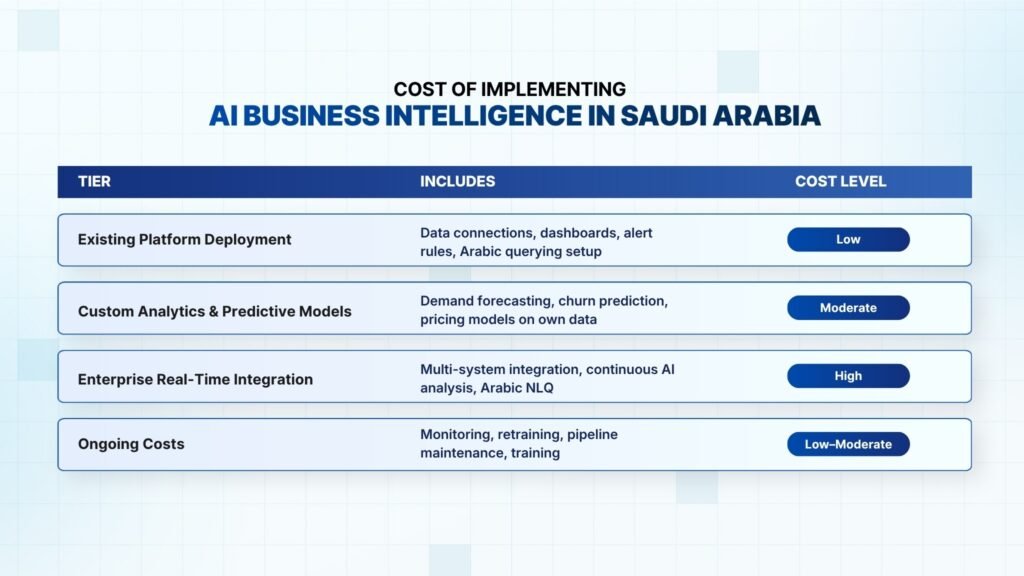
| Tier | Includes | Cost Level |
| Existing Platform Deployment | Data connections, dashboards, alert rules, Arabic querying setup | Low |
| Custom Analytics & Predictive Models | Demand forecasting, churn prediction, pricing models on own data | Moderate |
| Enterprise Real-Time Integration | Multi-system integration, continuous AI analysis, Arabic NLQ | High |
| Ongoing Costs | Monitoring, retraining, pipeline maintenance, training | Low–Moderate |
AI powered business intelligence cost is driven by data complexity, the number of connected systems, the analytical capabilities required, and whether the business needs custom model development or deployment of existing AI analytics tools.
Existing AI analytics platform deployment and configuration
The lowest cost entry point. Deploying an existing AI business intelligence platform — configuring data connections, building dashboards and alert rules, setting up Arabic language querying, and integrating with existing Saudi business systems. Appropriate when the business’s analytical requirements are covered by an existing platform’s capabilities and the primary work is integration and configuration rather than custom model development.
Custom AI analytics and predictive model development
The mid-range cost tier. Building custom predictive models — demand forecasting, customer churn prediction, pricing optimisation — trained on the business’s own historical data and connected to its specific operational systems. More expensive than platform configuration because the models need to be built for the specific data characteristics, market conditions, and business logic of the Saudi business rather than applied from a generic template.
Enterprise AI business intelligence with real-time data integration
The highest cost tier. A full AI driven business intelligence system connecting real-time data from multiple operational sources — ERP, CRM, logistics, financial systems, and external market data — with continuous AI analysis, natural language querying in Arabic, predictive analytics across multiple business functions, and executive dashboard delivery. Cost at this tier is driven primarily by integration complexity and the sophistication of the analytical models required.
Ongoing costs Saudi businesses typically underestimate
Model monitoring and retraining as business conditions change. Data pipeline maintenance as source systems update. Infrastructure costs for real-time data processing. Arabic language model updates. User training and adoption support. These are operational costs of running AI business intelligence, not one-time project costs.
These are operational costs of running AI business intelligence, not one-time project costs. If you want a clearer picture of what your specific setup would cost, message our experts on WhatsApp and we’ll walk you through the whole process and what it will cost you based on your needs.
Common Mistakes Saudi Businesses Make With AI Business Intelligence
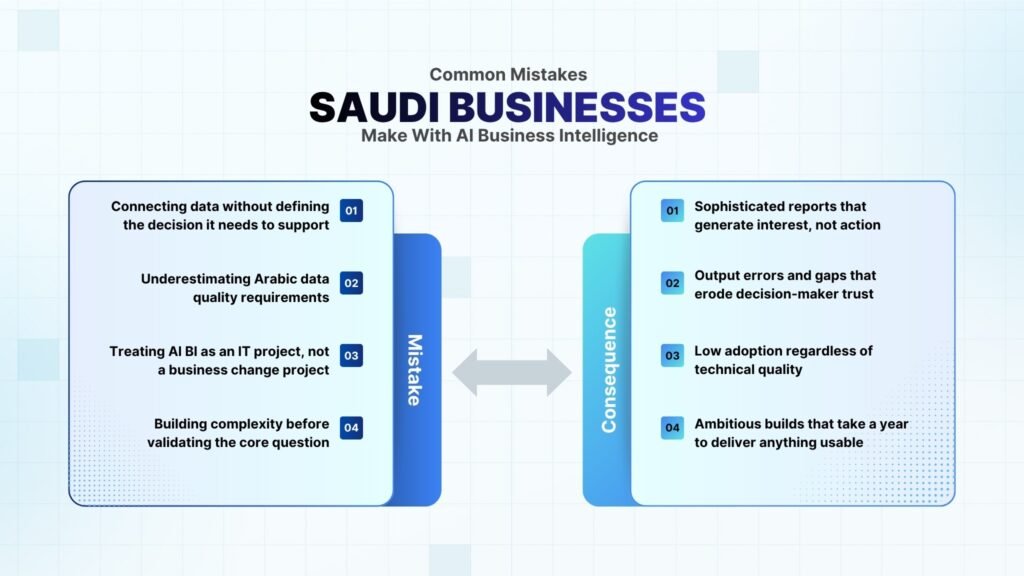
| Mistake | Consequence |
| Connecting data without defining the decision it needs to support | Sophisticated reports that generate interest, not action |
| Underestimating Arabic data quality requirements | Output errors and gaps that erode decision-maker trust |
| Treating AI BI as an IT project, not a business change project | Low adoption regardless of technical quality |
| Building complexity before validating the core question | Ambitious builds that take a year to deliver anything usable |
What to Look for When Choosing an AI Business Intelligence Partner in Saudi Arabia
Business domain understanding alongside technical capability
The most useful AI for business intelligence is built by people who understand how Saudi businesses actually operate — what Ramadan demand planning looks like for a FMCG distributor, how Saudi B2B sales cycles work, what a Saudi retail finance team needs from a cash flow forecast. Technical AI capability without this business context produces systems that are analytically sophisticated but commercially disconnected.
Arabic language AI capability
Natural language querying in Arabic, Arabic data handling, and bilingual dashboard interfaces are requirements for AI business intelligence deployed in Saudi organisations. Ask specifically how Arabic is implemented in the system and whether it has been validated against actual Saudi business data rather than generic Arabic language benchmarks.
Saudi data compliance experience
PDPL compliance, SDAIA data governance frameworks, and sector-specific regulatory requirements should be part of the partner’s standard design conversation. A partner that raises these considerations during architecture planning rather than as a compliance checklist before launch is building the system correctly from the start.
Integration track record with Saudi business systems
Saudi businesses run on a specific ecosystem of ERP systems, CRM platforms, Saudi logistics APIs, and banking data connections. A partner with demonstrated integration experience with this ecosystem reduces the risk and timeline of connecting AI business analytics to the data sources that matter.
How Etihad Falcon Tech Builds AI Business Intelligence for Saudi Businesses

Everything above is what AI business intelligence can do for you. This is how we actually build it.
We don’t start with your data, we start with the decision you need to make better and faster. Before we touch any architecture, we work out which decisions in your business, pricing, inventory, retention, operations, would move the needle most if you had better intelligence and tighter timing. That’s what shapes your first phase, so the first capability you get solves a real problem in your business, not a generic data strategy.
Built for How Saudi Markets Actually Move
We build your forecasting models around Ramadan and seasonal demand patterns from the start, calibrate your customer behaviour analytics to real Saudi purchase data, and design pricing intelligence that accounts for how your specific market category actually competes. We’re not configuring generic AI for a Saudi business, we’re building it around Saudi market data from the ground up.
Arabic, Not as an Afterthought
Every system we build for you comes with Arabic natural language querying, Arabic data handling across every connected source, and bilingual dashboards as standard. If you or your team think and work in Arabic, you get direct access to your own data, not a translated interface routed through someone else.
Compliant From Day One
We address PDPL compliance and SDAIA alignment at the architecture stage, not after your system is built. Access controls, audit trails, and retention policies are decisions we make upfront, not fixes bolted on later.
One Team, Start to Finish
We handle the full lifecycle ourselves: use case scoping, data assessment, architecture, model development or platform deployment, integration with your existing systems, Arabic configuration, training, and ongoing monitoring. The same team accountable for your outcome delivers all of it.
Frequently Asked Questions
Standard analytics shows you what already happened, your sales, your costs, your customer data. AI business intelligence adds forecasting, flags problems before they happen, lets you ask questions in Arabic or English instead of building reports, and surfaces patterns you wouldn’t know to look for. In short, it helps you look forward instead of just reviewing the past.
A focused first phase, connecting two or three data sources and deploying one capability like demand forecasting, usually takes ten to eighteen weeks. A full enterprise system connecting multiple systems with real-time analytics and Arabic querying takes four to eight months, depending on your data readiness. How clean your data is going in is the biggest factor in whether that timeline holds.
Yes, your output is only as good as the data feeding it. If your data is fragmented or inconsistent across systems, the results won’t be reliable. That’s why a data readiness assessment comes before anything else, especially if you’re running on multiple legacy systems.
Yes, but only when it’s built for Arabic from the start, not translated on top of an English system. We build Arabic natural language processing, Arabic data handling, and bilingual dashboards into the architecture from day one, so you or your Arabic-speaking team get direct access to your data.
An existing platform works if your needs fit what it already supports, and it gets you running faster. Custom development makes sense when you need something specific, forecasting calibrated to Saudi seasonality, customer models trained on your own purchase data, or pricing analytics built around your actual market, that an off-the-shelf platform can’t give you without heavy rework.
PDPL, SDAIA governance, and NDMO data residency requirements all apply if your system processes Saudi personal or business data. These affect how data is handled, who can access it, and where it’s stored. We build for these requirements at the design stage, not as a compliance check after the system is already built.
Operations and supply chain, demand forecasting, inventory, and logistics, usually shows the fastest measurable return because the cost of getting it wrong is easy to put a number on. Sales forecasting and customer retention follow close behind, especially if acquiring a new customer costs you more than keeping one. Finance teams also save significant time using it for variance analysis and catching anomalies in real time.