
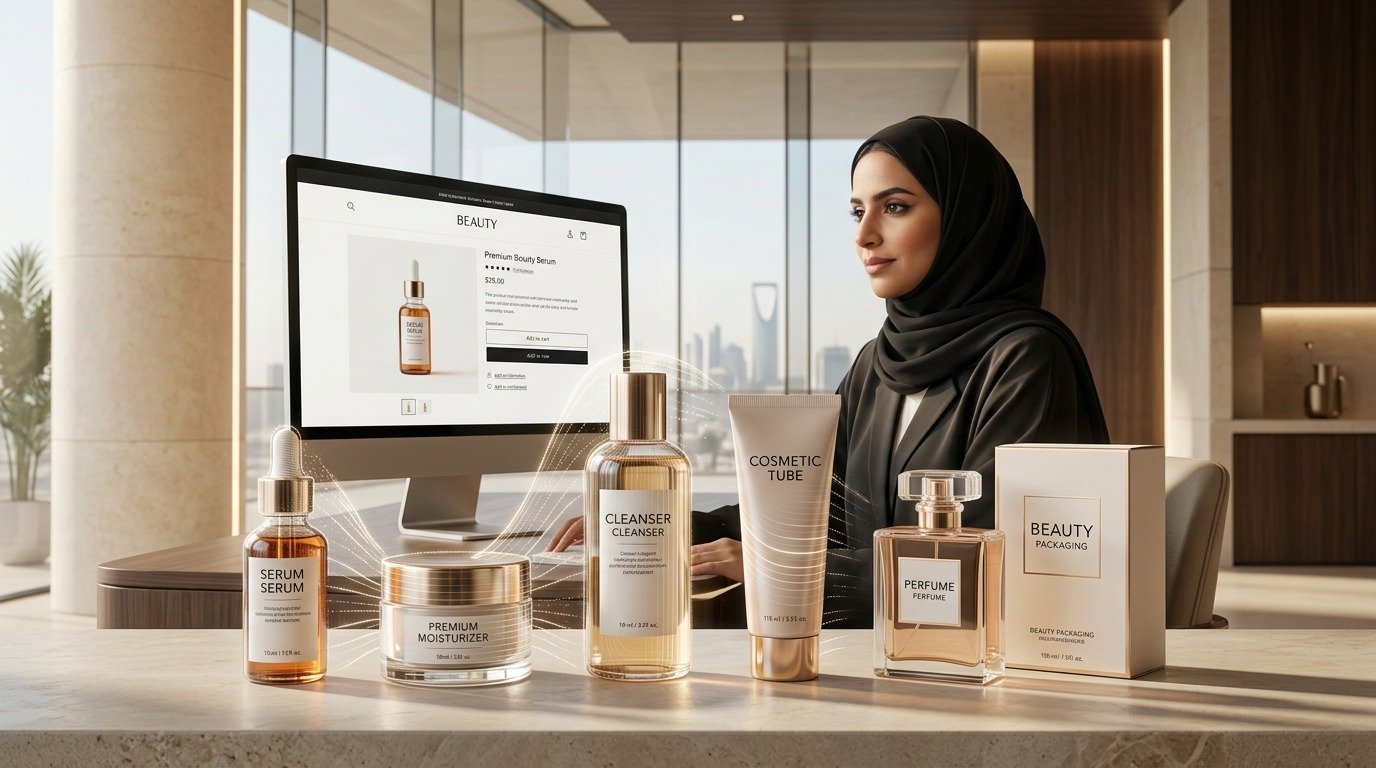
Saudi Arabia’s beauty and personal care market is projected to grow from about USD 7 billion in 2025 to over USD 10 billion by 2032, according to Ken Research, a market research and consulting firm, with e-commerce platforms the fastest-growing sales channel.
Saudi Arabia’s beauty market is growing, but a growing market doesn’t send orders to every beauty store. It sends them to the stores built to take them, and that comes down to how your Shopify store is developed.
Shopify development for beauty stores means building the store around the way beauty products are bought. That covers an Arabic and English theme that reads right to left, product pages with shades and full ingredient lists, Mada, Apple Pay, Tabby and Tamara connected at checkout, shipping and ZATCA invoicing linked in, and the apps that handle reviews and reorders.
If you’re planning to launch one of the Shopify beauty stores that actually gets orders, the platform is the easy part. The hard part is everything around it: SFDA rules for cosmetics, Arabic-first design, local payments, shipping and ZATCA invoicing. This guide covers how selling beauty products on Shopify works in Saudi Arabia, step by step, what each level of build costs in relative terms, which mistakes sink new stores, and how to decide between building it yourself and handing it to a team.
Is Shopify the Right Platform for Selling Beauty Products in Saudi Arabia?
Shopify suits beauty because beauty is a catalogue-heavy, content-heavy, repeat-purchase business, and Shopify was built for exactly that.
Think about what a beauty store actually carries. One foundation comes in twelve shades. One serum sells as a single bottle, a routine bundle and a monthly refill. Shopify handles those variants, bundles and subscriptions without custom code, and its app store covers reviews with photos, shade finders and loyalty points. You also own your customer list and your brand experience, which matters when your growth depends on people coming back every few weeks.
Salla and Zid are strong choices too. Which one fits depends on what you need first:
| Your Priority | Better Fit |
| Live fast with local tools pre-connected | Salla or Zid |
| Full control over design and brand | Shopify |
| Selling across the GCC and beyond | Shopify |
| Custom integrations (ERP, loyalty, inventory) | Shopify or custom build |
So ask yourself what the store needs to do in 18 months, not just on launch day. If the answer includes a distinctive brand, multiple markets or heavy integrations, Shopify development services are where you start.
What Do You Need to Sort Out Before You Launch a Beauty Store?
Cosmetics are the one category where a perfect website can’t rescue a product that isn’t compliant.
Every cosmetic product marketed in Saudi Arabia has to be notified through the Saudi Food and Drug Authority’s online system. The regulator doesn’t only watch shelves. SFDA inspectors check online stores as well, and cosmetic advertising is closely monitored. Classification matters too, because a product treated as a cosmetic elsewhere can be classed as a health product or a medical device in Saudi Arabia. Check your specific products with the SFDA or a regulatory consultant before you build anything around them.
Before you design a single page, confirm these:
- Every product notified with the SFDA before it’s listed, not after the first complaint
- Labels and ingredient lists checked against Saudi requirements before the photoshoot, not reprinted after
- Product claims worded as cosmetic benefits, not treatments
- Supplier or importer paperwork saved where your team can find it in minutes
- Business registration and tax details ready for invoicing
Customer data comes next. Your store will collect names, phone numbers and addresses, so your privacy policy and marketing consent need to follow the PDPL (Saudi Arabia’s Personal Data Protection Law) from day one.
How Do You Launch a Beauty Store on Shopify, Step by Step?
Seven steps. Skip one and you’ll feel it within the first month.
Step 1: Decide what you’re actually selling, and to whom
Sensitive-skin skincare? Halal-certified makeup? Oud-based body care? A narrow range makes every product page, photo and ad work harder. A catalogue of 200 products from ten brands gives a new store nothing to be known for.
Write one sentence describing your buyer and the problem your range solves. Everything after this step gets easier.
Step 2: Set up your store and pick an Arabic-ready theme
Create your Shopify account and choose a theme (the design template your whole store is built on). Pick one that supports Arabic and RTL from the start. RTL means right-to-left, and it isn’t a translation setting. It changes how menus, product grids, buttons and checkout read.
If you’ll run Arabic and English together, add hreflang tags, which tell Google which language version to show each visitor.
Step 3: Build product pages that do the selling
Your customer can’t touch, smell or swatch anything. The product page has to do all of it.
For makeup, that means shade swatches on real skin tones, not just a colour dot. For skincare, it’s the full ingredient list in Arabic and English, who it’s for, and how to use it. For fragrance, scent notes and a sample size. Add reviews with photos wherever you can.
Would you buy a foundation online without seeing it on skin like yours?
Step 4: Connect the payment methods Saudi shoppers expect
Your checkout should take Mada, Apple Pay, STC Pay and cards, plus buy-now-pay-later through Tabby and Tamara. You connect these through a payment gateway approved for Saudi merchants, such as Moyasar, HyperPay or Tap, and add the BNPL options as Shopify integrations. Confirm current availability and fees with each provider before you commit.
Test every method on a phone. That’s where most of your checkouts will happen.
Step 5: Set up shipping, returns and cash on delivery
Choose your carriers (Aramex, SMSA and Naqel are the usual names), set rates by city, and decide early whether you’ll offer cash on delivery. Riyadh, Jeddah and Dammam will carry most of your orders, so check delivery times to those first.
Returns need a rule written before launch. Opened cosmetics are a hygiene issue, so state plainly what you’ll accept back and put it on every product page.
Step 6: Get invoicing and data privacy right
If you’re VAT-registered, your store needs a way to produce ZATCA-compliant e-invoices for every order. Connect Shopify to your invoicing or accounting system now. Retrofitting it after 500 orders is painful.
Step 7: Test everything, then launch quietly
Place real orders in Arabic and English, on iPhone and Android, with Mada, with a discount code, and then return one. Open a soft launch to friends, existing customers or your Instagram followers first. Fix what breaks. Then start spending on ads.
What Types of Beauty Products Can You Sell on Shopify?
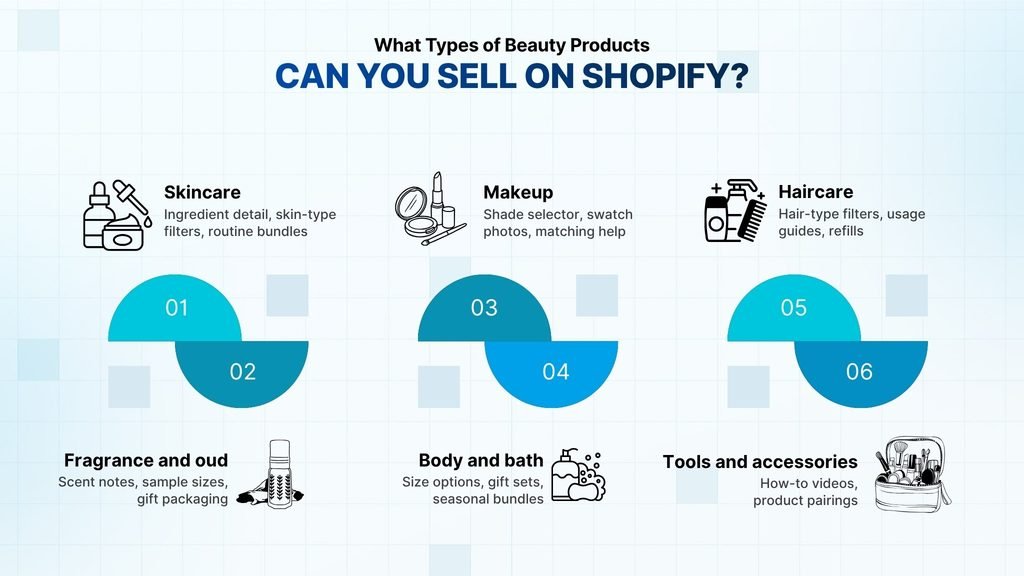
| Product Type | What Your Store Needs |
| Skincare | Ingredient detail, skin-type filters, routine bundles |
| Makeup | Shade selector, swatch photos, matching help |
| Haircare | Hair-type filters, usage guides, refills |
| Fragrance and oud | Scent notes, sample sizes, gift packaging |
| Body and bath | Size options, gift sets, seasonal bundles |
| Tools and accessories | How-to videos, product pairings |
A Shopify skincare store lives on trust and repeat orders. Buyers want to know exactly what’s in the bottle and how it fits a routine, and a refill subscription turns one purchase into a monthly one.
A Shopify makeup store lives on shade confidence. Get that wrong and you’re paying for returns.
Shopify cosmetics stores that sell across categories have a different job: keeping the catalogue easy to browse. Collections, filters and bundles do that work.
How Should You Design a Shopify Beauty Website That Converts?
A lot of your visitors will land on a single product page from a social ad or a creator’s video and never see your homepage. Design for that visitor first.
Product pages carry the weight. Large images, a clear price, delivery information and reviews should all sit above the fold on a phone. Speed matters more than animation. A beauty site full of heavy video that loads slowly loses the shopper before the first swatch appears. Trust signals belong near the buy button: your return policy, accepted payment logos and a WhatsApp chat link, since many Saudi buyers like to ask a question before they pay.
Most Shopify beauty websites fail on the basics, not the extras. Fix those before adding a quiz, a loyalty tier or a pop-up.
What Do the Best Shopify Beauty Stores Do Differently?
Look at the beauty brands on Shopify that keep growing and the pattern is plain.
- They sell a point of view, not a catalogue. Every page tells you who the products are for and why. A store that sells “everything for your skin” gives a shopper no reason to pick it over a marketplace.
- They remove doubt before the buyer has to ask. Shade help, ingredient detail, real reviews and clear return terms answer the questions that stall a purchase.
- They bring customers back. Refill reminders, routine bundles and loyalty points are planned from the start, because winning a second order costs less than winning a first.
- They treat content as stock. Tutorials, routines and creator videos sit on product pages and in emails, so the store keeps selling between ad campaigns.
Which Shopify Apps Does Your Beauty Store Actually Need?
Shopify gives you a store. Apps give it the tools a beauty business runs on.
A Shopify app is a piece of software, built by Shopify or an outside developer, that plugs into your store and adds one specific job to it. Think of your phone: it comes with calls and messages, and you install apps for everything else. Shopify works the same way. The core platform handles products, carts, checkout and orders. Everything beyond that, from collecting reviews to running a refill subscription to sending order updates on WhatsApp, usually comes from an app. You install the app from the Shopify App Store, it connects to your store’s data, and it either adds a feature your customers see or a tool only your team uses.
Why does a beauty store need them more than most? Because the business depends on repeat orders and buyer trust. A customer can’t swatch a lipstick or test a serum, so she relies on other buyers’ reviews. A moisturiser runs out in six weeks, so the store that reminds her at week five wins the reorder. A single product comes in twelve shades and three sizes, so browsing has to be easy. None of those problems are solved by the base platform alone.
Ask yourself which of these problems your store will hit first. That’s the app you install first.
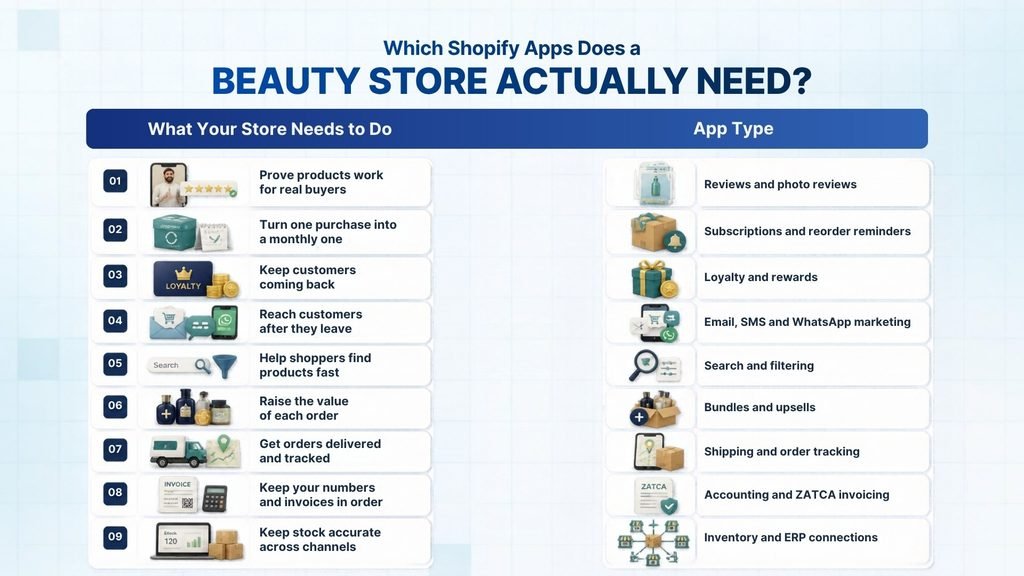
| What Your Store Needs to Do | App Type |
| Prove products work for real buyers | Reviews and photo reviews |
| Turn one purchase into a monthly one | Subscriptions and reorder reminders |
| Keep customers coming back | Loyalty and rewards |
| Reach customers after they leave | Email, SMS and WhatsApp marketing |
| Help shoppers find products fast | Search and filtering |
| Raise the value of each order | Bundles and upsells |
| Get orders delivered and tracked | Shipping and order tracking |
| Keep your numbers and invoices in order | Accounting and ZATCA invoicing |
| Keep stock accurate across channels | Inventory and ERP connections |
Installing an app is the easy part. Making it work properly in a Saudi beauty store isn’t. Every app adds code to your store, and too many apps slow your pages down, which costs you sales on mobile. Some apps clash with each other or with your theme. Many are built for English-first stores, so they break or look wrong in right-to-left Arabic layouts. And apps that touch orders, payments or invoices need to connect correctly to your gateway, your carriers and your ZATCA setup, or the data stops lining up.
Apps need professional setup, and the more of them you run, the more that matters. A developer picks the few that earn their place, checks they work in Arabic, connects them to your other systems, and tests the full checkout before launch. Our Shopify development for business guide explains how apps, themes and custom development fit together, and when an off-the-shelf app stops being enough and a custom feature makes more sense.
Start with the apps that solve your first three problems.
How Much Does It Cost to Launch a Beauty Store on Shopify?
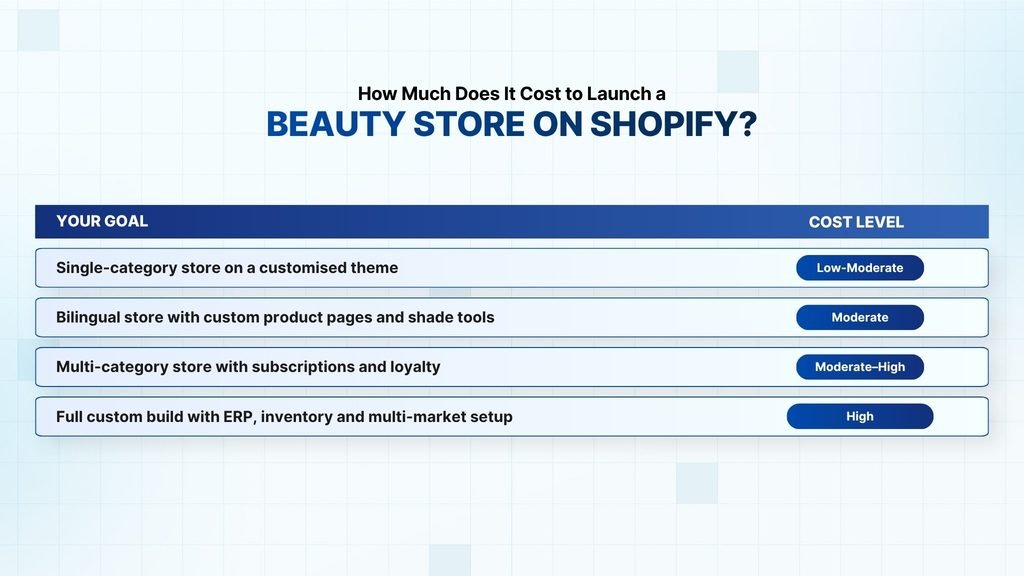
| Your Goal | Cost Level |
| Single-category store on a customised theme | Low-Moderate |
| Bilingual store with custom product pages and shade tools | Moderate |
| Multi-category store with subscriptions and loyalty | Moderate-High |
| Full custom build with ERP, inventory and multi-market setup | High |
What Drives Your Cost Up or Down
- Arabic and RTL depth: a fully Arabic-first design costs more than a translated theme, and it earns that back in conversion.
- Products and variants: every shade, size and bundle needs images, copy and setup.
- Integrations: ERP, shipping carriers and ZATCA invoicing each add build time.
- Custom features: shade quizzes, bundle builders and subscription logic need more than an off-the-shelf app.
- Content production: photography and video for beauty are real work, and they decide how the store looks.
Budget for what first-time founders forget: product documentation for the SFDA, monthly app fees, payment gateway fees, and ad spend after launch.
Mistakes to Avoid When Selling Beauty Products on Shopify?
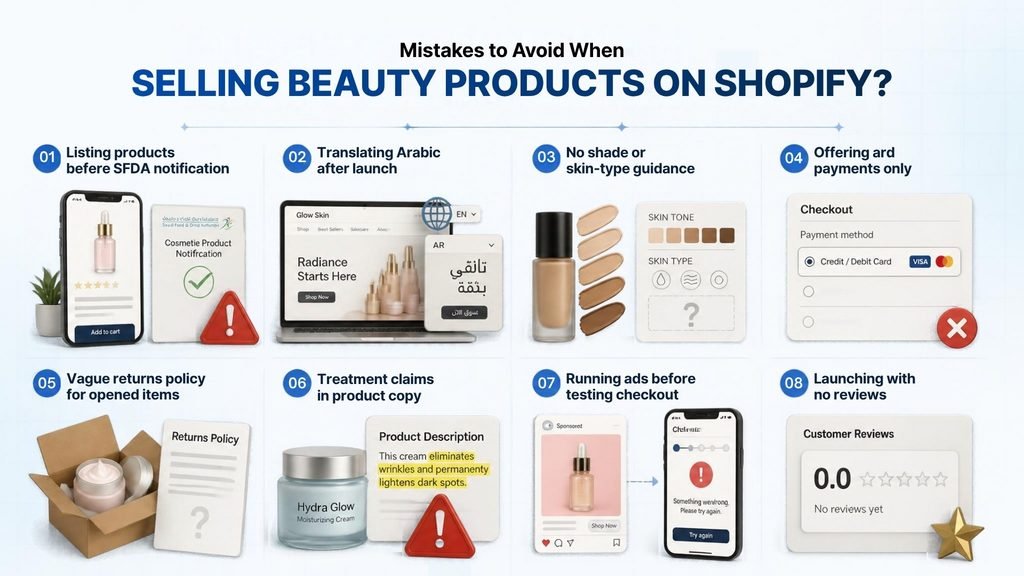
| Mistakes |
| Listing products before SFDA notification |
| Translating Arabic after launch |
| No shade or skin-type guidance |
| Offering card payments only |
| Vague returns policy for opened items |
| Treatment claims in product copy |
| Running ads before testing checkout |
| Launching with no reviews |
Why Choose Etihad Falcon Tech for Your Shopify Beauty Store in Saudi Arabia?
Maybe you’ve got a product range and no website. Maybe you’re selling through Instagram DMs and you’re ready for a real store. Maybe your Shopify store gets traffic but not orders. These are the situations we build Shopify beauty stores for.
Built for How Saudi Beauty Shoppers Actually Buy
We don’t start with a theme, we start with your buyer. Which products she’s comparing you against, which payment she trusts, and how fast she expects delivery in Riyadh versus Jeddah. Then we build the store around those answers, with Mada, Apple Pay, Tabby and Tamara connected and tested before you launch.
Compliant From Day One
We don’t file your SFDA notification, and no developer should claim to. We build the store so your approved products, labels and claims display correctly, your customer data follows PDPL, and your orders flow into ZATCA-compliant invoicing.
One Team, Start to Finish
Design, development, integrations, launch and the marketing that follows all come from one team, so nobody’s waiting on a handoff. Our Shopify development services cover the full build, from product pages to shipping and payment setup.
If you’re sitting on a product range and a launch date but no store that takes Mada properly and reads like Arabic was the plan from the start, that’s the conversation to have. Message us on WhatsApp with your product categories, your target launch date and where you sell today. We will tell you honestly whether Shopify is the right fit and what your store needs to launch properly.
Frequently Asked Questions
How long does it take to launch a beauty store on Shopify?
A few weeks for a standard store, longer for custom features or a large catalogue. Your product paperwork can take longer than the build itself.
Do I need SFDA clearance before selling beauty products online?
Yes. Every cosmetic product has to be notified with the SFDA before it’s marketed in Saudi Arabia, online or in a shop.
Can I accept Mada and Tabby on a Shopify store?
Yes. You connect a gateway approved for Saudi merchants for Mada and cards, then add Tabby, Tamara and Apple Pay alongside it.
Is Shopify better than Salla or Zid for selling beauty products?
It depends on what you need. Shopify gives you more design control and room to grow beyond Saudi Arabia, while Salla and Zid get you live faster with local tools built in.
Does my store need to be in Arabic?
Yes, if you’re selling to Saudi customers. Build it Arabic-first with right-to-left design, then add English as a second language.
Can I sell makeup and skincare in the same store?
Yes. Use clear collections, filters by skin type and shade, and separate product page layouts so each buyer finds her category fast.
How should I handle returns on opened beauty products?
Set the rule before launch and put it on every product page. A common approach is accepting returns on unopened items and handling damaged or wrong-item cases separately.
Does my Shopify store need ZATCA e-invoicing?
If you’re VAT-registered in Saudi Arabia, yes. Your store needs a way to produce compliant e-invoices for each order, and we connect Shopify to your invoicing system so it runs without manual work.
How does Etihad Falcon Tech build Shopify beauty stores?
We start with your products and your buyer, build Arabic-first, connect Saudi payments, shipping and invoicing, then test every path before launch. Message us on WhatsApp and tell us what you’re selling.