

Saudi Arabia’s e-commerce market is projected to grow from USD 24.67 billion in 2025 to USD 69.02 billion by 2034, according to Renub Research. E-commerce in Saudi Arabia is no longer a digital extension of retail. It is now the primary growth channel for businesses that want to reach more customers, operate more efficiently, and scale beyond the limits of a physical location.
The demand is already there, and it is growing fast. E-commerce sales via Mada cards in Saudi Arabia exceeded SAR 69.3 billion in the first quarter of 2025 alone, with over 370 million transactions processed, according to the Saudi Central Bank. Saudi consumers are buying online, paying digitally, and doing most of it from their phones. The infrastructure Vision 2030 has been building is not coming. It is already here, and it is already being used.
Most businesses that struggle with e-commerce in Saudi Arabia do not struggle because of demand. Demand has already been increasing significantly. They struggle because they launched an online store when they needed to build an e-commerce business. An online store is just a website with products. A business is a system: with logistics, payment flexibility, customer retention, and a mobile experience that does not lose the buyer between landing and checkout.
This guide covers what e-commerce development in Saudi Arabia actually involves in 2026, which platform fits which business model, what the technical requirements are for a Saudi market store, what the build process looks like, and what separates e-commerce businesses that scale from ones that fail.
Why 2026 is a Defining Year for E-Commerce in Saudi Arabia
E-commerce in Saudi Arabia has moved from adoption to competition. Earlier years were driven by Saudi consumers discovering online shopping. The growth question was simple: get online before your competitors do. That window is closed.
The businesses winning in 2026 are not winning because they have an online store. They are winning because their store converts better, delivers faster, retains customers more effectively, and operates with fewer manual steps than competitors who built for speed and are now rebuilding for performance.
Three structural shifts define the current Saudi e-commerce environment:
- Saudi mobile commerce has become the dominant purchasing channel. Over 70% of Saudi e-commerce transactions happen on mobile. A store that is responsive but not genuinely mobile-first, with checkout flows designed around how mobile users actually navigate and pay, is structurally disadvantaged in its largest channel.
- Buy Now Pay Later (BNPL) adoption through services like Tabby and Tamara has changed checkout conversion economics. Saudi consumers who hesitate on full-price purchases convert at significantly higher rates when BNPL options are presented clearly at checkout. Stores without BNPL integration are leaving transactions on the table in every product category where hesitation is a factor.
- ZATCA e-invoicing compliance has moved from a future requirement to a present operational reality. Saudi businesses above the mandatory threshold need e-invoicing integrated into their order processing flow. Stores that launched without this built in are managing compliance manually, which does not scale and carries regulatory exposure.
How Vision 2030 is Reshaping E-commerce
Vision 2030 is accelerating e-commerce through:
- Investment in logistics and smart cities
- Digital payment ecosystem expansion
- SME enablement programs
- Regulatory frameworks like ZATCA compliance
- Infrastructure for large-scale digital businesses
This creates a landscape where e-commerce is not optional; it is foundational.
What is the Difference Between Online Store and E-commerce Business
An e-commerce business is an operational system where product strategy, pricing logic, fulfilment, customer retention, and marketing all work together. An online store is just a website with products on it. The store is one component. The business is what surrounds it.
Saudi businesses that launch a store without building the system around it do not succeed. Here is what their failure looks like: sales come in, fulfilment cannot keep up, customer service becomes overwhelmed, returns have no structured process, and repeat purchase rates are low because there is no retention mechanism. That’s why most online stores fail.
The businesses that succeed in Saudi e-commerce are the ones that planned the business model alongside the store, not after it started breaking.
E-Commerce Business Models That Work in Saudi Arabia
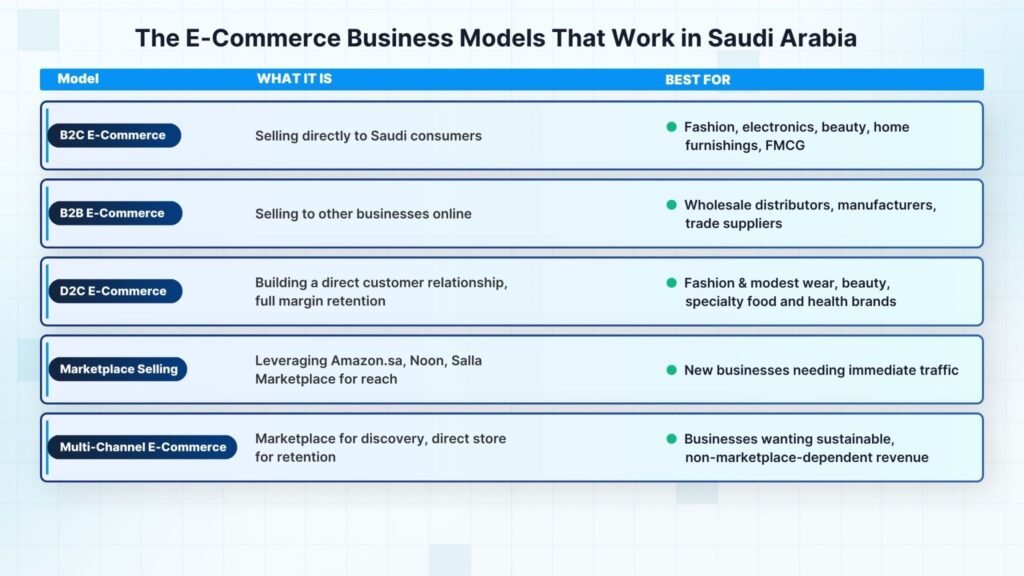
| Model | What It Is | Best For |
| B2C E-Commerce | Selling directly to Saudi consumers | Fashion, electronics, beauty, home furnishings, FMCG |
| B2B E-Commerce | Selling to other businesses online | Wholesale distributors, manufacturers, trade suppliers |
| D2C E-Commerce | Building a direct customer relationship, full margin retention | Fashion & modest wear, beauty, specialty food and health brands |
| Marketplace Selling | Leveraging Amazon.sa, Noon, Salla Marketplace for reach | New businesses needing immediate traffic |
| Multi-Channel E-Commerce | Marketplace for discovery, direct store for retention | Businesses wanting sustainable, non-marketplace-dependent revenue |
B2C E-commerce: selling directly to Saudi consumers
B2C (business to client) ecommerce is the most established model in Saudi Arabia and the most competitive. Fashion, electronics, beauty, home furnishings, and FMCG all have established Saudi players and active international competition from Amazon.sa and Noon.
The competitive advantage in Saudi B2C ecommerce development comes from three places: Arabic-first user experience that international platforms consistently underdeliver, category-specific features that generic platforms require custom development to provide, and customer retention systems that turn first-time buyers into repeat customers rather than losing them to the next promotion on a marketplace.
B2B ecommerce: selling to other businesses online
B2B (business to business) ecommerce in Saudi Arabia is significantly underdeveloped relative to B2C, which means the competitive opportunity is higher. Saudi wholesale distributors, manufacturers, and trade suppliers that move B2B ordering online remove the friction from procurement processes that currently run on phone calls, WhatsApp, and emailed purchase orders.
B2B ecommerce website development has specific technical requirements that B2C platforms were not designed for: tiered pricing by customer account, minimum order quantities, credit account management, quote request workflows, and approval processes before orders are placed. An online store configured for B2C retail cannot serve a wholesale distributor without significant custom development, or a platform built specifically for B2B ecommerce.
D2C e-commerce: building a direct customer relationship
D2C means the brand that makes the product is also the one selling it, with no retailer or distributor in between. A Saudi abaya brand selling only through its own site is D2C. That same abaya sold on Noon or through a multi-brand boutique is B2C, the retailer is a different company from the brand.
D2C matters most in categories where people are buying the brand, not just the product: fashion and modest wear, beauty, specialty food and health. Because there’s no middleman, the brand keeps the full margin and owns every bit of customer data, purchase history, preferences, who bought what and when.
The cost of that is acquisition. A multi-brand retailer gets customers through footfall and marketplace search. A D2C brand has to build its own audience from scratch, its own ads, its own email list, its own loyalty program, because there’s no marketplace bringing traffic to it.
Marketplace selling: leveraging existing platforms
Amazon.sa, Noon, and Saudi-native Salla Marketplace provide immediate reach that a new direct store cannot match. For Saudi businesses launching in competitive categories, marketplace presence provides traffic while the direct store builds its audience.
A business that runs entirely through marketplace channels does not own its customer relationships. Marketplace algorithms and fee structures change. Competition for visibility increases. The businesses that survive marketplace fee changes and algorithm shifts are the ones that built their own customer base alongside marketplace revenue — not instead of it.
The multi-channel ecommerce solutions approach — marketplace presence for discovery, direct store for retention — is what produces sustainable Saudi e-commerce revenue rather than marketplace revenue that is permanently at risk of margin compression.
Multi-channel ecommerce
E-commerce businesses that run on multiple channels, they are the ones with better success rate. Their marketplace presence brings new customers, who are already browsing Amazon.sa or Noon, and would never have found the brand otherwise. Their direct store keeps those customers, with full customer data, no algorithm dependency, and margins that are not shared with a marketplace fee.
Running both channels only works when they support each other. Inventory needs to sync in real time, so a sale on one channel does not oversell the other. Pricing needs to stay the same across channels, so customers are not punished for buying direct. And the direct store needs its own way to bring in customers, not just wait for marketplace traffic to trickle over.
Saudi businesses that depend only on marketplace revenue, they stay exposed to fee increases and algorithm changes they cannot control. Businesses that treat the marketplace as one channel among several, they build something that survives those changes. That is the difference between marketplace revenue and sustainable Saudi e-commerce revenue.
Which Industries Are Driving Saudi E-Commerce Growth
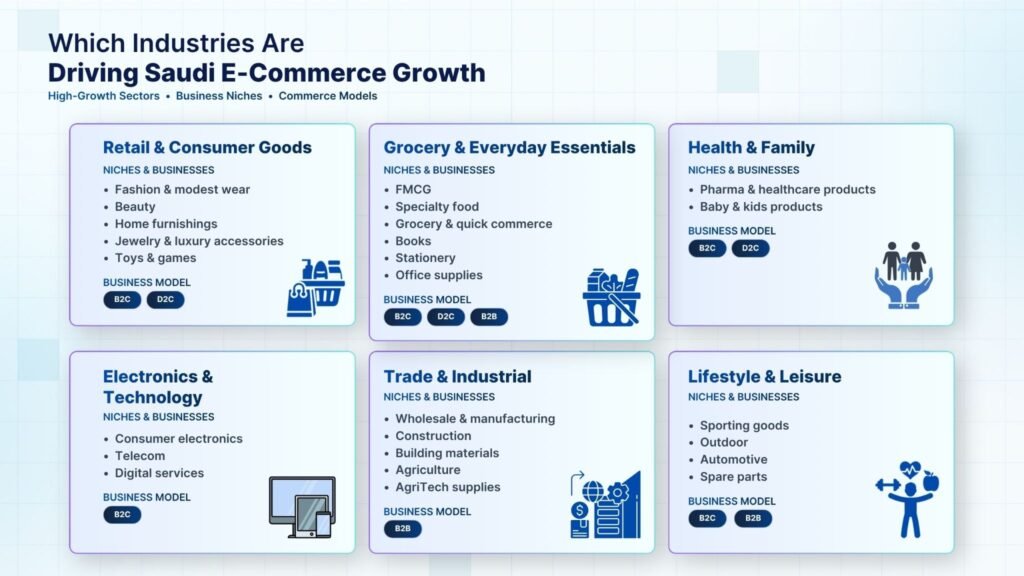
| Industry | Niches & Businesses | Common Model |
| Retail & Consumer Goods | Fashion & modest wear, beauty, home furnishings, jewelry & luxury accessories, toys & games | B2C, D2C |
| Grocery & Everyday Essentials | FMCG, specialty food, grocery & quick commerce, books, stationery & office supplies | B2C, D2C, B2B |
| Health & Family | Pharma & healthcare products, baby & kids products | B2C, D2C |
| Electronics & Technology | Consumer electronics, telecom & digital services | B2C |
| Trade & Industrial | Wholesale & manufacturing, construction & building materials, agriculture & AgriTech supplies | B2B |
| Lifestyle & Leisure | Sporting goods & outdoor, automotive & spare parts | B2C, B2B |
Which E-Commerce Platform is Right for Your Saudi Business?
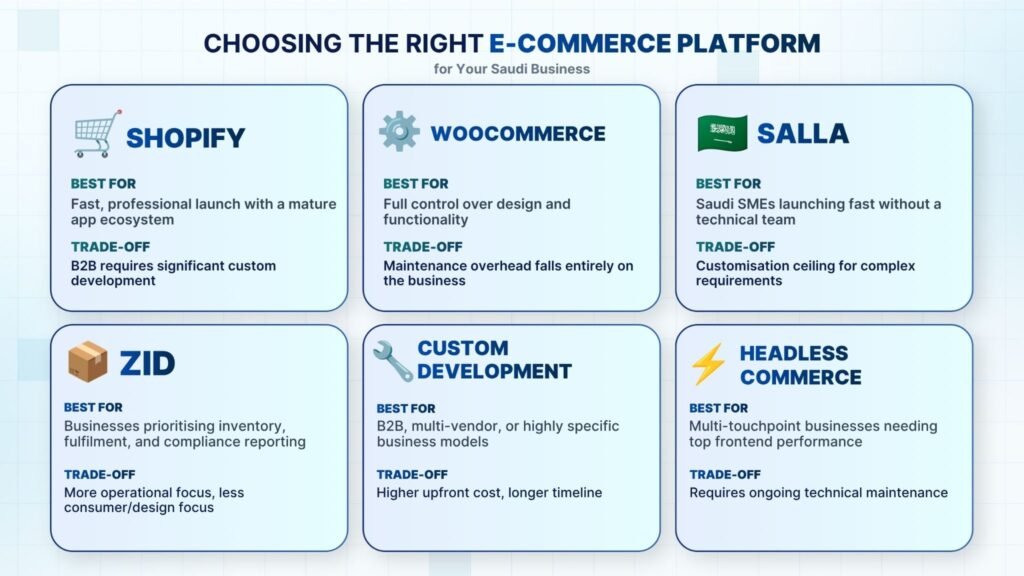
| Platform | Best For | Trade-Off |
| Shopify | Fast, professional launch with a mature app ecosystem | B2B requires significant custom development |
| WooCommerce | Full control over design and functionality | Maintenance overhead falls entirely on the business |
| Salla | Saudi SMEs launching fast without a technical team | Customisation ceiling for complex requirements |
| Zid | Businesses prioritising inventory, fulfilment, and compliance reporting | More operational focus, less consumer/design focus |
| Custom E-Commerce Development | B2B, multi-vendor, or highly specific business models | Higher upfront cost, longer timeline |
| Headless E-Commerce | Multi-touchpoint businesses needing top frontend performance | Requires ongoing technical maintenance |
Platform selection is the decision that everything else is built on. The wrong choice means rebuilding in eighteen months. The right choice means the platform grows with the business rather than constraining it.
Shopify
Shopify ecommerce is the right choice for Saudi retail brands that need a professional store live quickly with access to a mature app ecosystem. Managed hosting, continuous platform updates, and a development ecosystem that has solved most standard e-commerce problems mean that Shopify stores can launch faster and more reliably than custom builds.
Shopify ecommerce store development for the Saudi market requires specific implementation: Mada and STC Pay gateway integration, Arabic RTL theme development (not a translation plugin over an English-first theme), ZATCA-compliant invoicing built into the order flow, and BNPL integration for Tabby and Tamara at checkout.
Shopify Plus is appropriate when standard Shopify’s checkout customisation limits, automation capabilities, or multi-store architecture start constraining the business, typically at significant monthly transaction volume or when running B2B wholesale operations alongside retail.
Where Shopify falls short for Saudi businesses: B2B ecommerce on Shopify requires significant custom development because the platform was designed for B2C retail. Businesses with complex wholesale pricing, quote workflows, or ERP integration requirements at the core of their model may find Shopify’s B2B capabilities insufficient without substantial custom work.
WooCommerce
WordPress ecommerce through WooCommerce is appropriate for Saudi businesses that need complete control over their store’s design, functionality, and hosting infrastructure. WooCommerce’s flexibility allows any e-commerce requirement to be built — but that flexibility requires ongoing development investment to maintain and extend.
Saudi fashion brands with highly specific design requirements, content-heavy e-commerce businesses where SEO is the primary customer acquisition channel, or businesses that already run on WordPress and want to add e-commerce without migrating — these are the use cases where WooCommerce makes sense.
The trade-off is maintenance overhead. WooCommerce does not manage hosting, security, or plugin compatibility centrally. A poorly maintained WooCommerce store accumulates technical debt that eventually requires significant remediation.
Salla
Salla is a Saudi-native e-commerce platform built specifically for the Saudi market. ZATCA compliance, Arabic-first UX, Mada and STC Pay integration, and domestic logistics connections are core features rather than additions requiring custom development.
For Saudi SME businesses launching their first e-commerce operation without a technical team, Salla reduces the complexity of getting a locally compliant store live. The trade-off is customisation ceiling; Salla’s platform constraints limit what is possible for businesses with specific design, functionality, or integration requirements beyond what the platform supports natively.
Zid
Zid’s positioning is similar to Salla with a stronger emphasis on operational structure, inventory management, fulfilment integration, and ZATCA compliance reporting. Saudi businesses in categories where operational complexity and compliance documentation are priorities find Zid’s built-in structure more useful than Salla’s more consumer-focused approach.
Custom Ecommerce Website Development
Custom development makes sense when you’re building a marketplace with multiple sellers, running B2B ordering with approval workflows and credit terms, or need one catalog powering a website, app, and in-store system together, not just when a normal platform is hard to configure.
Custom development costs more upfront and takes longer to launch than a configured platform. In return, the business gets a platform with no built-in limits, one that does exactly what it needs and keeps working that way as it grows, instead of hitting a ceiling that a template was never designed to go past.
Headless Ecommerce
Headless ecommerce sounds technical, but the idea behind it is simple. Take a restaurant as an example. The kitchen is where the food actually gets made, and the dining room is where customers sit and eat. Normally these two are joined together as one place, but they don’t have to be. A ghost kitchen works exactly this way: one kitchen cooks the food, and that same food gets served through completely different fronts, a delivery app, a food truck, a stall, each looking and working totally differently, while the same kitchen supplies all of them.
Headless ecommerce is the same idea applied to a store. The “kitchen” is the backend: product data, inventory, checkout, and payments. The “dining room” is the frontend: the actual pages and screens a customer sees and taps through. Normally a platform like Shopify gives you both stuck together as one package. Headless separates them, so a business can build its own custom frontend, on a website, an app, an in-store screen, each one built exactly the way it wants, while all of them pull from the same backend underneath for stock, pricing, and orders.
Essential Features Every Saudi E-Commerce Business Must Have
Local Payment Gateway Integration
Mada is the dominant payment method for Saudi online transactions and is a baseline requirement. STC Pay has significant adoption among younger Saudi consumers. Apple Pay is growing among iPhone users. BNPL through Tabby and Tamara is increasingly expected in fashion, electronics, and home furnishings categories.
A Saudi e-commerce store that does not present local payment methods prominently at checkout loses transactions at the final step — after the entire customer acquisition cost has already been spent. All payment processing for Saudi stores must route through SAMA-approved gateways.
ZATCA E-invoicing Compliance
Saudi businesses above the mandatory threshold need every e-commerce transaction to generate a ZATCA-compliant e-invoice — signed, formatted to ZATCA specification, and transmitted to the Fatoorah platform. This is not a plugin that can be added after launch. It is order processing logic that needs to be built into the checkout and order management flow from the start. Saudi e-commerce stores operating without ZATCA compliance are accumulating regulatory exposure with every transaction.
E-commerce Order Management System
An ecommerce order management system connects order placement to fulfilment, inventory, and customer communication. For Saudi businesses handling significant order volume, manual order management — checking each order, updating inventory records, triggering courier collection — does not scale. A properly integrated order management system automates these steps and provides the operational visibility to identify fulfilment problems before they become customer complaints.
Ecommerce ERP Integration
For Saudi businesses with existing ERP systems — SAP, Oracle, Microsoft Dynamics, or local Saudi ERP implementations — ecommerce ERP integration connects the online store to the operational infrastructure the business already runs on. Orders flow from the store into the ERP automatically. Inventory is updated in real time. Financial records are created without manual entry. Ecommerce ERP integration is what makes an online store an operational channel rather than a separate system requiring parallel management.
Ecommerce Shipping Integration and Logistics
Saudi last-mile delivery operates differently from the delivery infrastructure most global e-commerce platforms assume. City-to-city delivery times vary significantly. Cash on delivery is still relevant in secondary cities and among older consumer segments. Same-day and next-day delivery expectations in Riyadh and Jeddah are different from what is achievable in smaller Saudi cities.
Ecommerce shipping integration with Saudi logistics providers — Aramex, SMSA, Naqel, and others — needs to connect delivery cost calculation, tracking, and courier collection triggering to the order management system. Saudi businesses that manage logistics manually — arranging courier pickup by phone, updating customers on shipment status through individual messages — hit an operational ceiling that grows more expensive and more error-prone with every order.
Ecommerce fulfillment services and ecommerce logistics solutions for Saudi businesses also need to account for Ramadan and seasonal peak demand, when order volume increases significantly and delivery timelines are affected by changes in working hours and logistics capacity across the Kingdom.
Mobile-first Checkout and E-commerce Mobile App
Saudi e-commerce checkout must be designed for mobile as the primary device, not as a responsive adaptation of a desktop design. One-tap checkout with saved payment credentials, minimal form fields in Arabic and English, and checkout progress indicators that work within mobile viewport constraints all affect completion rates.
For Saudi businesses where repeat purchase frequency justifies the investment, an ecommerce mobile app development company can build a dedicated app that provides push notification capability, faster repeat checkout, and personalised content delivery that the mobile web experience cannot match.
E-Commerce Business Development Process
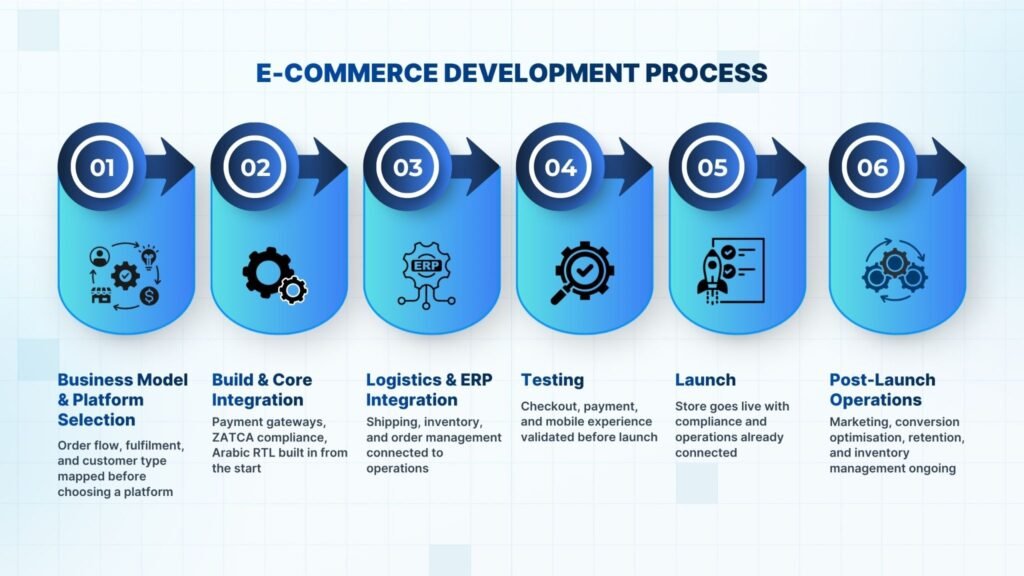
| Stage | What Happens |
| 1. Business Model & Platform Selection | Order flow, fulfilment, and customer type mapped before choosing a platform |
| 2. Build & Core Integration | Payment gateways, ZATCA compliance, Arabic RTL built in from the start |
| 3. Logistics & ERP Integration | Shipping, inventory, and order management connected to operations |
| 4. Testing | Checkout, payment, and mobile experience validated before launch |
| 5. Launch | Store goes live with compliance and operations already connected |
| 6. Post-Launch Operations | Conversion optimisation, retention, and inventory management ongoing |
Post-Launch: Running the E-Commerce Business After Launch
Marketing
Post-launch marketing is different from pre-launch marketing. Before launch, the goal was awareness. After launch, the goal is return on spend. You need to know which channels bring in customers who actually buy, not just visitors who click. This means shifting budget toward the channels that convert and cutting the ones that only generate traffic.
SEO
Rankings earned before launch need to be protected after launch. Product pages get added, removed, and changed constantly once real operations start, and each change is a chance to break a redirect or lose an indexed page. Post-launch SEO is about monitoring what is already ranking and making sure store updates do not undo that work.
AI Optimisation
Customers now find products through AI-generated answers, not just search result pages. If your product pages and category pages are not structured clearly, AI tools skip over them when building their answers. Post-launch AI optimisation means checking whether your store is being cited or recommended by these tools, and fixing the pages that are not.
Conversion rate optimisation
Traffic without conversion is a wasted marketing budget. Once real order data starts coming in, you can see exactly where customers drop off and fix those specific points instead of redesigning the whole store.
Button Placement
Where a button sits on the page changes whether it gets clicked. Buttons placed below the fold, buried under other content, or competing with too many other actions on the same screen get ignored. Post-launch, you test button position using real click data instead of guessing.
Content Placement
The order in which information appears on a product page affects buying decisions. Price, delivery time, and trust signals like return policy need to appear where the customer is looking at the moment they are deciding, not further down the page after they have already lost interest.
Upselling Products
Showing a related or upgraded product at the right moment increases order value without extra ad spend. This only works if the suggested product is genuinely relevant. Random product suggestions get ignored or annoy the customer.
Grouping Products
How products are grouped into categories affects how easily a customer finds what they want. Groupings based on how customers actually shop, not how the store owner organises inventory internally, reduce the number of clicks needed to reach checkout.
Basket Cost Analysis and Increase
Average basket value tells you whether customers are buying one item or several. Once you know the current average, you can test specific tactics, bundling, minimum order incentives, free delivery thresholds, to increase it. Each tactic should be tested on its own so you know what actually worked.
Customer retention and repeat purchase
The customer acquisition cost in Saudi e-commerce is high. A business that acquires customers at significant cost and loses them after one purchase to a competitor or marketplace is running an unsustainable economics model. Retention mechanics — loyalty programs, post-purchase email and SMS sequences, personalised offers based on purchase history — are the ecommerce management platform features that determine whether acquisition cost becomes lifetime value or a one-time expense.
Ecommerce analytics and inventory management
Ecommerce inventory management software that tracks stock levels in real time across all sales channels prevents the most avoidable Saudi e-commerce problem: selling a product that is out of stock and then failing to fulfil. For multi-channel ecommerce solutions where inventory is shared between a direct store and marketplace channels, real-time synchronisation is operationally critical.
Which E-commerce Platform Suits Your Product Range
Product count is one of the simplest ways to narrow down a platform choice, and it lines up closely with how much the business actually needs to spend and build.
If the catalog is around 50 products, WooCommerce is usually enough. At this size, a business doesn’t need heavy platform infrastructure, and WooCommerce gives full control over design and functionality at a lower cost, without the overhead that bigger catalogs eventually run into.
Once the catalog crosses 100 products, Shopify or Salla become the better fit. Both platforms are built to handle larger inventories, more categories, and more order volume without the manual maintenance a growing WooCommerce store starts to demand.
At 1,000 or more products, the business is usually better served by Shopify Plus or a custom build. At this scale, checkout customisation, automation, and multi-store management start to matter, and standard platform tiers begin to feel restrictive rather than sufficient.
And if the business needs a fully dynamic website with multiple interactive features, custom category structures, or functionality that goes beyond what a template can offer, custom development is the right path regardless of product count, because the requirement at that point isn’t catalog size, it’s flexibility.
What Does It Actually Cost to Build an E-Commerce Business in Saudi Arabia?
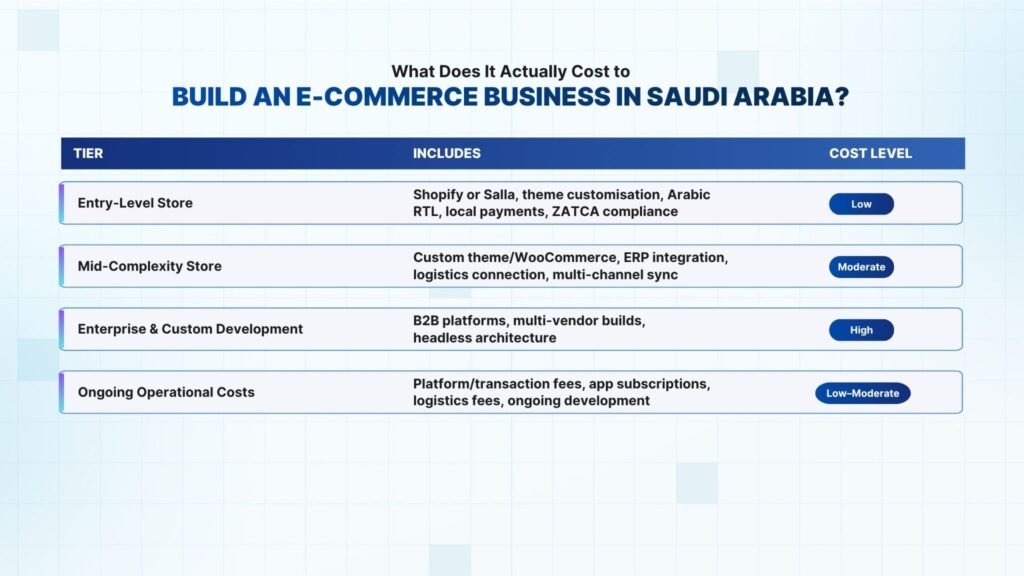
| Tier | Includes | Cost Level |
| Entry-Level Store | Shopify or Salla, theme customisation, Arabic RTL, local payments, ZATCA compliance | Low |
| Mid-Complexity Store | Custom theme/WooCommerce, ERP integration, logistics connection, multi-channel sync | Moderate |
| Enterprise & Custom Development | B2B platforms, multi-vendor builds, headless architecture | High |
| Ongoing Operational Costs | Platform/transaction fees, app subscriptions, logistics fees, ongoing development | Low–Moderate |
E-Commerce Platform: A Quick Decision Guide
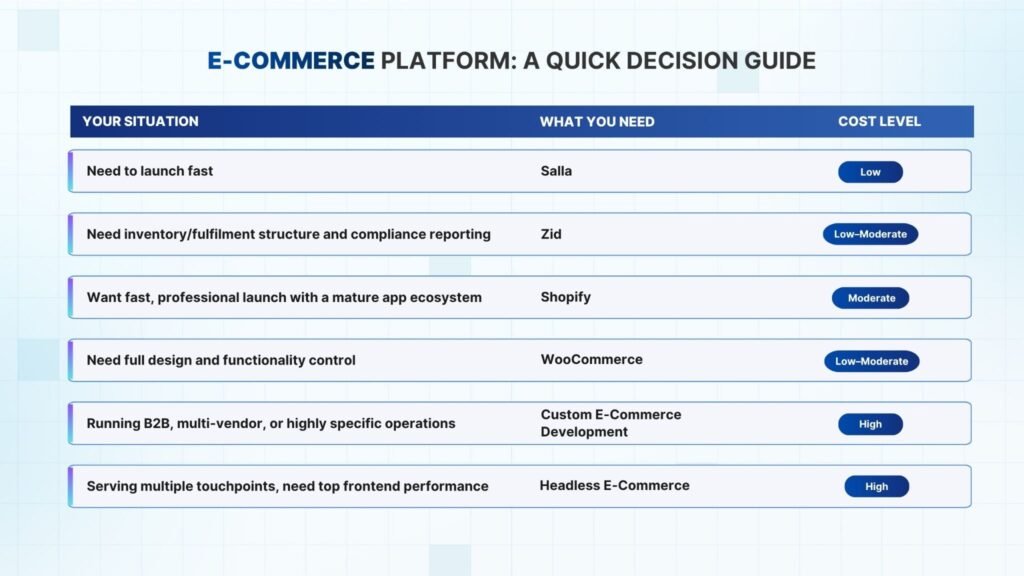
| Your Situation | What You Need | Cost Level |
| Need to launch fast | Salla | Low |
| Need inventory/fulfilment structure and compliance reporting | Zid | Low–Moderate |
| Want fast, professional launch with a mature app ecosystem | Shopify | Low–Moderate |
| Need full design and functionality control | WooCommerce | Moderate |
| Running B2B, multi-vendor, or highly specific operations | Custom E-Commerce Development | High |
| Serving multiple touchpoints, need top frontend performance | Headless E-Commerce | High |
Common Mistakes E-Commerce Business Mistakes to Avoid
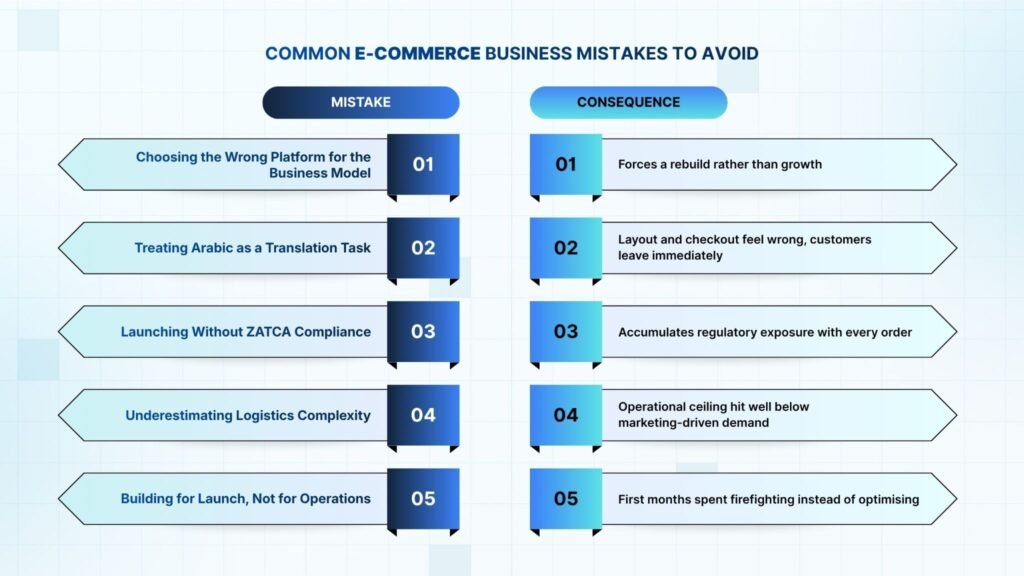
| Mistake | Consequence |
| Choosing the Wrong Platform for the Business Model | Forces a rebuild rather than growth |
| Treating Arabic as a Translation Task | Layout and checkout feel wrong, customers leave immediately |
| Launching Without ZATCA Compliance | Accumulates regulatory exposure with every order |
| Underestimating Logistics Complexity | Operational ceiling hit well below marketing-driven demand |
| Building for Launch, Not for Operations | First months spent firefighting instead of optimising |
Etihad Falcon Tech: Leading E-commerce Development Company in Saudi Arabia
Etihad Falcon Tech’s e-commerce development starts with the business model, not the platform. Before any platform recommendation, the order flow, fulfilment requirements, customer type, Arabic and bilingual architecture needs, integration scope, and compliance requirements are mapped. That mapping determines which platform is appropriate, what custom development is required, and what the operational infrastructure needs to look like before the first order is placed.
Platform capability across the Saudi market
Etihad Falcon Tech builds on Shopify, Shopify Plus, WooCommerce, Salla, Zid, and custom ecommerce platforms depending on what the business model requires. The platform recommendation follows from the business requirement — not from a preferred technology. Saudi businesses that need Salla’s local compliance for rapid launch get Salla. Businesses that need Shopify Plus for automation and multi-store management get Shopify Plus. Businesses with B2B complexity that no platform serves adequately get custom ecommerce development.
Arabic and Saudi market built in from the start
Arabic RTL design, bilingual SEO architecture with correct hreflang implementation, Mada and STC Pay integration, ZATCA e-invoicing compliance, and BNPL integration for Tabby and Tamara are part of every Saudi e-commerce build EFT delivers — not additions requested at the end of a build that was designed for a different market.
Integration scope
We scope ERP integration, shipping integration with Saudi logistics providers, order management system configuration, and inventory management connections as part of the core build, not as post-launch additions. Saudi e-commerce businesses that connect their store to their operations from day one scale more cleanly than those that add integration after the manual processes have already broken down.
Post-launch support
We define the post-launch support arrangement before development begins on every Etihad Falcon Tech e-commerce project: update schedules, response times for critical issues, and how ongoing development requests are scoped. Saudi e-commerce businesses that plan for ongoing development services alongside the build avoid the reactive costs that come from treating a live e-commerce operation as a completed project.
If your e-commerce operation is not converting at the rate the traffic should support, or you are rebuilding because the original platform cannot handle where the business has grown, that is the problem Etihad Falcon Tech starts with.
Frequently Asked Questions
What is the best e-commerce platform for Saudi Arabia?
It depends entirely on the business model. Shopify ecommerce works well for Saudi retail brands that need fast deployment and a mature app ecosystem. Salla and Zid are strong for Saudi SME businesses that need local compliance without custom development. WooCommerce suits businesses that need maximum design and functionality flexibility. Custom ecommerce development is appropriate when no platform serves the business model without significant compromise — particularly for B2B ecommerce or multi-vendor ecommerce website builds.
How much does it cost to build an e-commerce website in Saudi Arabia?
Cost depends on platform, custom development scope, and integration requirements. A Shopify or Salla store with Arabic support and local payment integration costs significantly less than a custom B2B ecommerce platform with ERP integration. Ongoing costs — platform fees, app subscriptions, logistics costs, and ecommerce development services — should be factored into total cost of ownership from the planning stage, not discovered after launch.
Do I need Arabic language support for my online store?
Yes, and it needs to be built in from the start — not added as a translation plugin after an English-first store is built. Arabic RTL design affects every component of the store: navigation, product grids, checkout flow, and cart interfaces. Saudi customers identify a poorly localised Arabic store immediately. Trust drops before a product page is viewed. For bilingual stores, correct hreflang implementation and separate URL structures for Arabic and English content also affect how search engines index and rank the store.
How long does it take to launch an e-commerce store in Saudi Arabia?
A standard Shopify or Salla store with Arabic support, local payment integration, and ZATCA compliance takes three to six weeks if product content is ready when development starts. A custom Shopify theme with ERP integration and logistics connection takes eight to fourteen weeks. Custom ecommerce development services for B2B platforms or headless ecommerce builds take three to six months depending on integration scope. Content readiness — Arabic and English product descriptions, photography, and structured data — is the most common cause of timeline extension.
Can I sell on marketplaces instead of building my own store?
Marketplace selling on Amazon.sa, Noon, and Salla Marketplace provides immediate traffic reach that a new direct store cannot match. The limitation is that marketplace channels do not build customer relationships — the customer belongs to the platform, not to the brand. The most effective Saudi e-commerce strategy combines marketplace presence for discovery and new customer acquisition with a direct store for retention, customer data ownership, and margin preservation. Relying entirely on marketplace channels means every fee increase and algorithm change directly affects the business’s profitability.
What payment methods should a Saudi e-commerce store include?
Mada is non-negotiable for the Saudi market. STC Pay has strong adoption particularly among younger consumers. Apple Pay is growing among iPhone users. Credit and debit cards cover international and bank card holders. BNPL through Tabby and Tamara significantly improves conversion in categories where full-price hesitation is a factor — fashion, electronics, and home furnishings particularly. All payment processing must route through SAMA-approved gateways. Cash on delivery should be offered for secondary city audiences and consumer segments without digital payment access.
What is the difference between Salla and Shopify for Saudi businesses?
Salla is built specifically for the Saudi market — Arabic-first, ZATCA-compliant, and locally integrated by default. The trade-off is platform flexibility. Salla’s customisation ceiling limits what is possible for businesses with specific design requirements or complex operational needs. Shopify is a global platform with a more mature app ecosystem and greater design flexibility, but Saudi-specific requirements — Mada integration, Arabic RTL, ZATCA compliance — require custom development rather than being built in. For Saudi SMEs launching quickly without a technical team, Salla reduces complexity. For Saudi brands that need custom design and operational integration, Shopify or a custom platform is typically more appropriate.
What is B2B ecommerce and how is it different from standard online retail?
B2B ecommerce involves selling to other businesses through an online channel. The technical requirements are different from B2C retail: tiered pricing by customer account, minimum order quantities, quote request workflows, credit account management, and approval processes before orders are placed. B2B ecommerce website development for Saudi wholesalers and distributors also typically requires ecommerce erp integration to connect online orders to existing operational systems — the manual re-entry that works for low order volume fails when B2B e-commerce starts generating real transaction volume.