
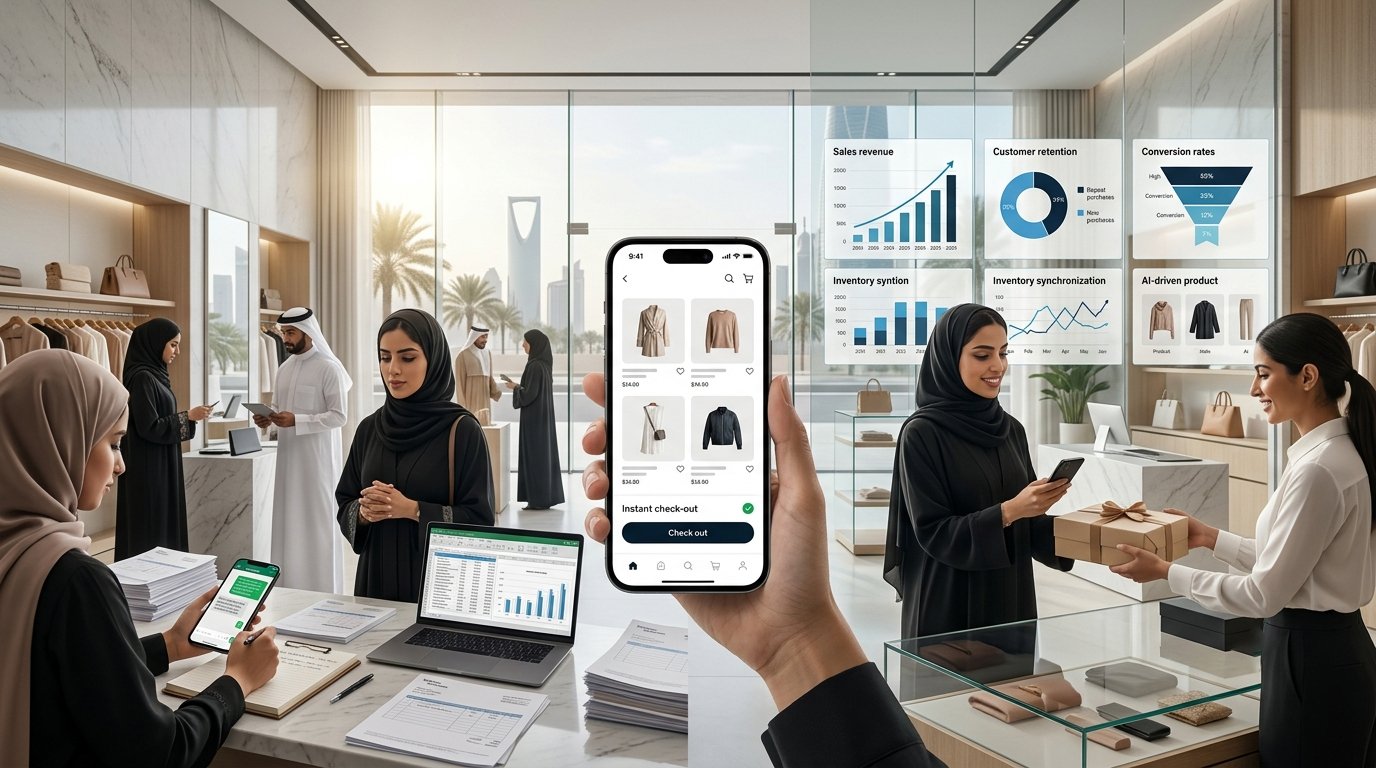
According to Saudi Arabia’s Communications, Space, and Technology Commission (CST), 99.4% of Saudi internet users access the internet through their smartphones. Nearly half of them spend more than seven hours on their phone daily. That is not an estimate; it was reported by Saudi Arabia’s CST in 2025.
It’s very easy to target your potential customers on mobile phones while they are spending hours online if you are on the right platform at the right time. The businesses capturing the most customers’ attention are the ones with smartphone apps that make it easy to stay, easy to buy, and easy to come back. Getting mobile app development right from the start is what decides which category your business falls into.
This guide is for Saudi businesses that want to build a mobile application and build it right. It will help you understand what type of app you actually need, how the development process works, what it costs, and what separates apps that grow a business from apps that get uninstalled right after the first interaction.
How Mobile Apps Are Changing the Way Saudi Businesses Operate in 2026

Think about a retail business relying only on WhatsApp orders and a slow mobile website. It barely survives. Meanwhile, a competitor’s app lets customers browse, pay, and track delivery in under three minutes. Same business. One of them is building a customer base. The other is just processing orders.
The difference between those two businesses is not technology for its own sake. It comes down to data, reach, and what it actually costs to stay in front of customers.
When you have an app, you know who ordered last Tuesday, what they bought, and exactly where people drop off before checkout. Without one, you are making decisions based on guesswork. A business without one is guessing all of that.
Apps also change the economics of customer communication. One push notification reaches thousands of people at near-zero cost. The same reach without an app requires paid advertising spend. Over a year, that difference compounds into a high cost and data disadvantage that grows harder to close the longer it continues.
Businesses with apps are not just more convenient. They grow faster, spend less to retain customers, and make better decisions because they have the data to make them.
Why Saudi Businesses Are Investing in Mobile Apps Right Now

Saudi mobile usage is not a trend. It is the baseline behavior of your customer base, built over years and not reversing.
Importance of Mobile Apps for SME Digitization as per Vision 2030
The main agenda of the Saudi government’s Vision 2030 is to set a target of raising the private sector’s contribution to Saudi GDP from 40% to 65%. SME digitization is a direct part of how that target is met. The government has introduced funding programs, digital infrastructure investment, and simplified licensing for businesses moving online.
As SMEs grow, customer acquisition becomes more competitive. Businesses adopt new technology to keep up and win more customers in the market. But this only works if you reach your customers where they already are, on their phones, on their terms.
This is not only market pressure pushing toward mobile. National economic policy is actively pulling in the same direction. Businesses that build digital infrastructure now are positioning themselves inside that growth trajectory, not watching it from the outside.
Which Types of Saudi Businesses Should Have a Mobile App
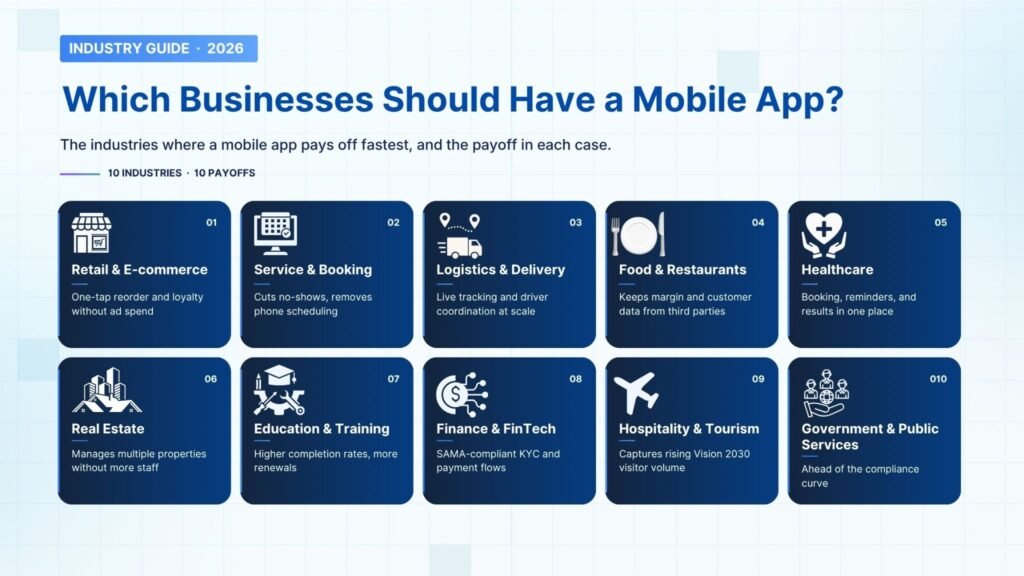
| Industry | Why an App Pays Off |
| Retail & E-commerce | One-tap reorder and loyalty without ad spend |
| Service & Booking Businesses | Cuts no-shows, removes phone scheduling |
| Logistics & Delivery | Live tracking and driver coordination at scale |
| Food & Restaurants | Keeps margin and customer data from third parties |
| Healthcare | Booking, reminders, and results in one place |
| Real Estate | Manages multiple properties without more staff |
| Education & Training | Higher completion rates, more renewals |
| Finance & FinTech | SAMA-compliant KYC and payment flows |
| Hospitality & Tourism | Captures rising Vision 2030 visitor volume |
| Government & Public Services | Ahead of the compliance curve |
Most Saudi businesses with a repeat customer base benefit from an app. The right question is whether the app will do a specific job well enough to justify the investment.
Retail & E-commerce

Saudi customers browse on mobile first. An app with saved preferences, one-tap reorder, and a fast checkout converts better than any mobile website. Loyalty programs built into the app bring customers back without paid advertising, which changes the unit economics of customer retention significantly at scale.
Q-commerce/Quick commerce
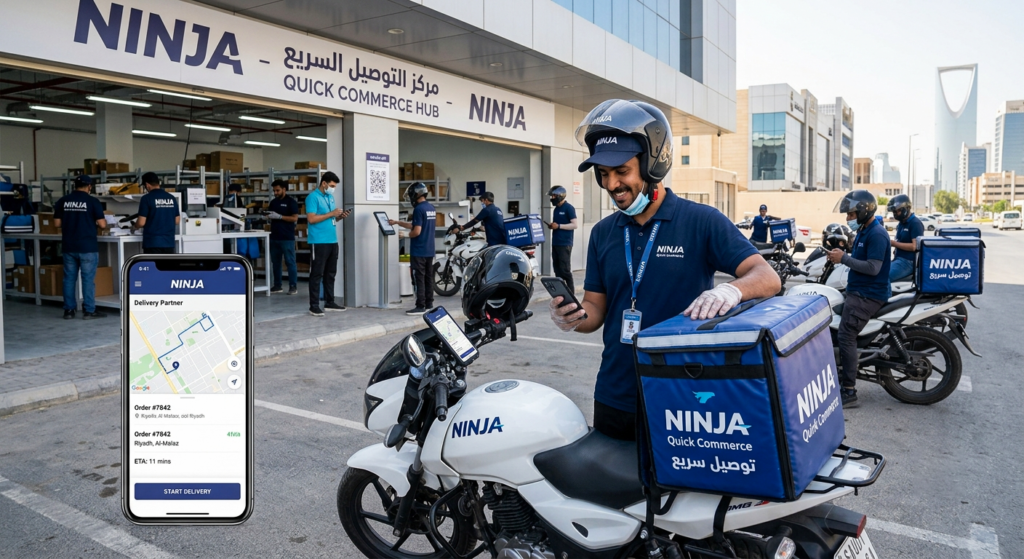
Saudi customers now expect groceries and daily essentials delivered in under 30 minutes, not next-day. That promise only holds with an app built for speed: live inventory, instant checkout, and real-time rider routing all working together. Without that, delivery windows become guesses instead of guarantees, and one missed window is enough to lose a customer to a competitor who did not. Businesses entering quick commerce without this infrastructure are competing on delivery times they cannot actually hit.
Service businesses and booking platforms
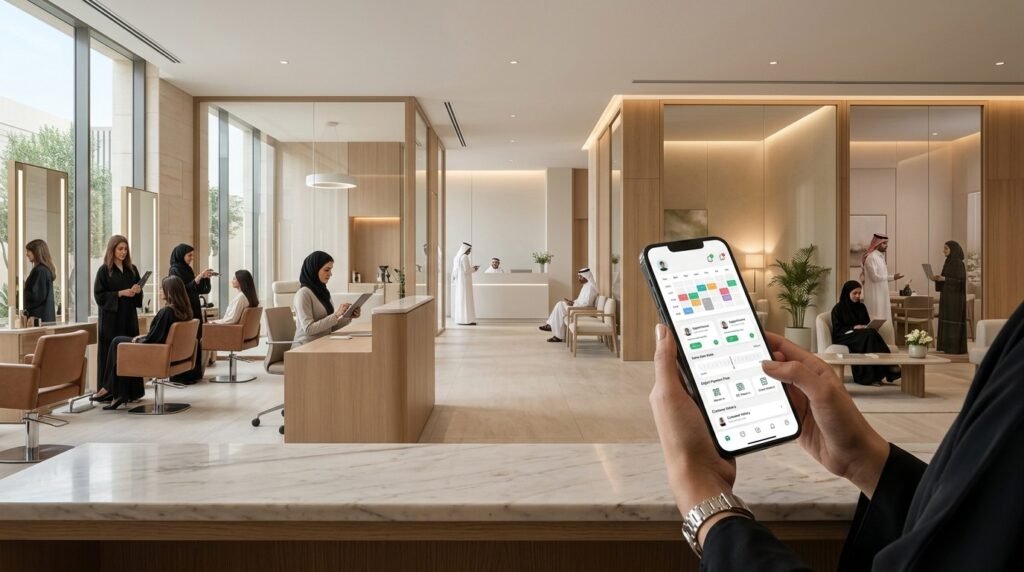
Salons, clinics, home maintenance businesses, consultancies, and appointments are the entire operation. When an app handles the booking, sends the reminder, and manages the cancellation, your front desk stops being a phone-answering service. Staff time goes back to actual work. For service businesses with high appointment volume, this operational saving alone justifies the development cost.
Logistics and delivery operations

Delivery operations need live tracking, driver coordination, and customer updates running together in one system. Without an app, that coordination happens over WhatsApp and phone calls. It holds together at a small volume. At scale, it fails, and it fails publicly, in front of customers. Custom software development can also be used by logistics businesses that need the same tracking and coordination built into their internal systems, not just the customer-facing app.
Food and restaurant businesses
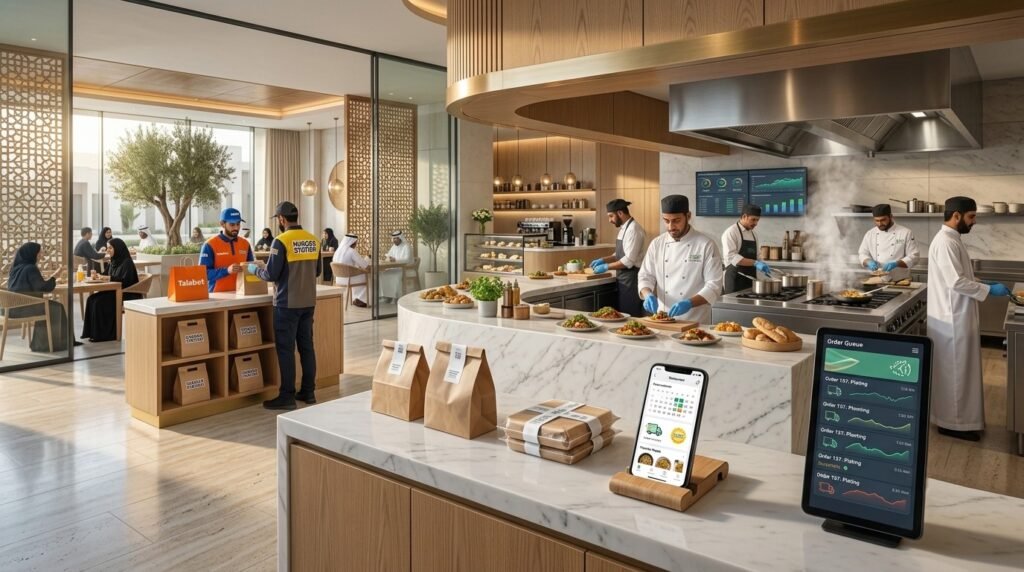
Every order through Talabat or HungerStation costs the restaurant 20 to 30 percent before food costs, packaging, or staff are even considered. Restaurants with their own ordering app stop paying for that altogether. They also know who those customers are, what they order, and when, which is what actually builds a business over time, not just processes transactions. See how food delivery app development works in our guide for what goes into building one that actually replaces third-party platforms.
Healthcare and medical services
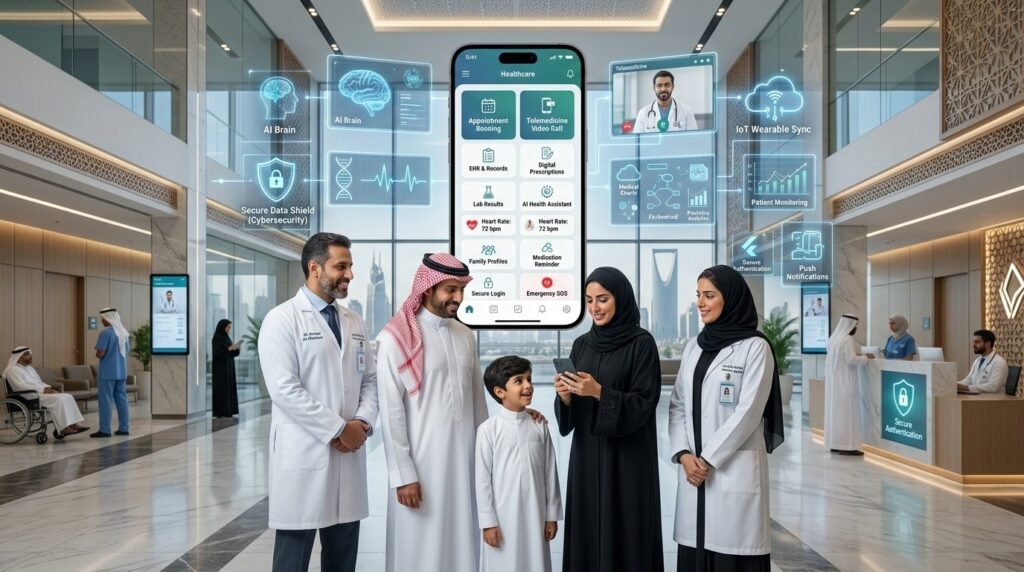
Calling a clinic to book an appointment feels outdated to most patients now. They want to open an app, pick a slot, get a reminder the day before, and check their results when they come in, without a single phone call in either direction. The clinics delivering that retain patients. The ones that do not are making it easy to switch.
Healthcare apps in Saudi Arabia also carry MOH compliance obligations, specific data handling standards, and security requirements that have to be built into the architecture from day one. These are not features you add later. Getting them wrong at the build stage is significantly more expensive than getting them right the first time.
Real estate and property management
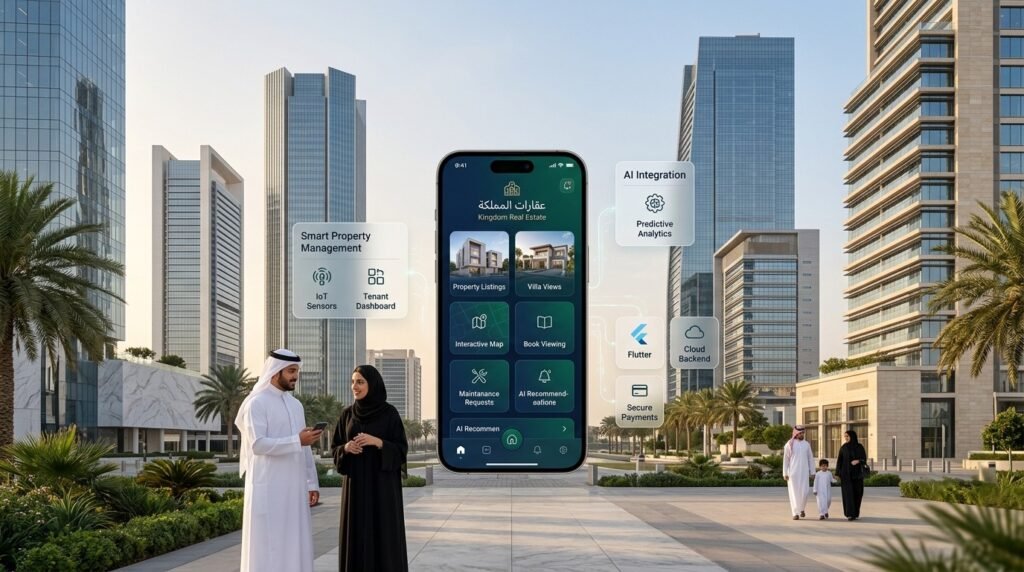
When listings, lease agreements, maintenance requests, and rent payments all live in separate places, property management at scale becomes an admin problem as much as a real estate one. An app pulls those into one place, and a portfolio that would require three extra staff members to coordinate manually becomes manageable without adding headcount.
Education and training platforms
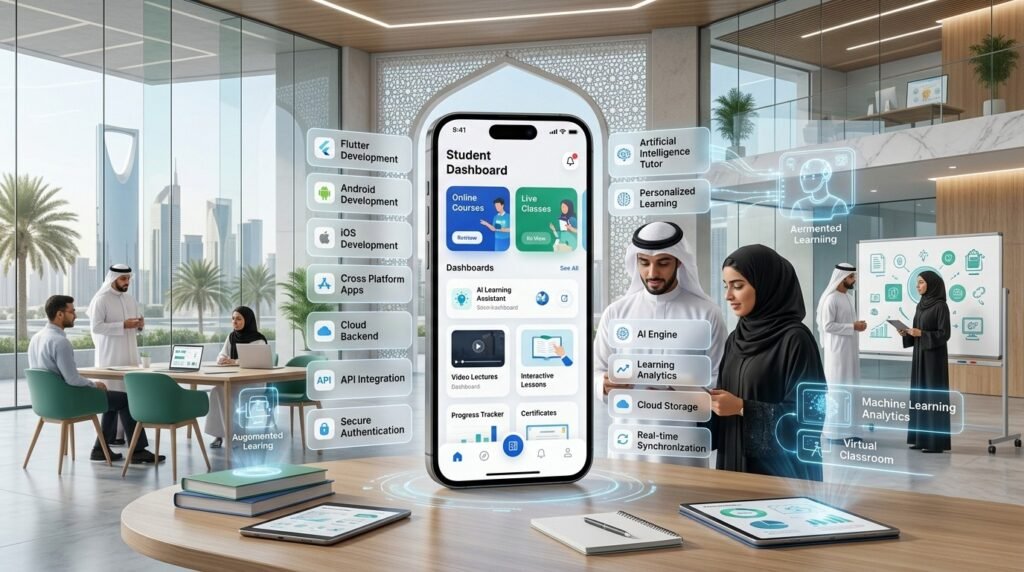
Online learning in Saudi Arabia has grown so much in last couple of years. When the course is on someone’s phone, they actually finish it. Accessibility removes the excuse not to engage. And when learners complete courses, they renew. That completion rate is not a vanity metric, it is directly tied to subscription revenue. For training businesses, that completion rate difference directly affects subscription revenue.
Finance and FinTech
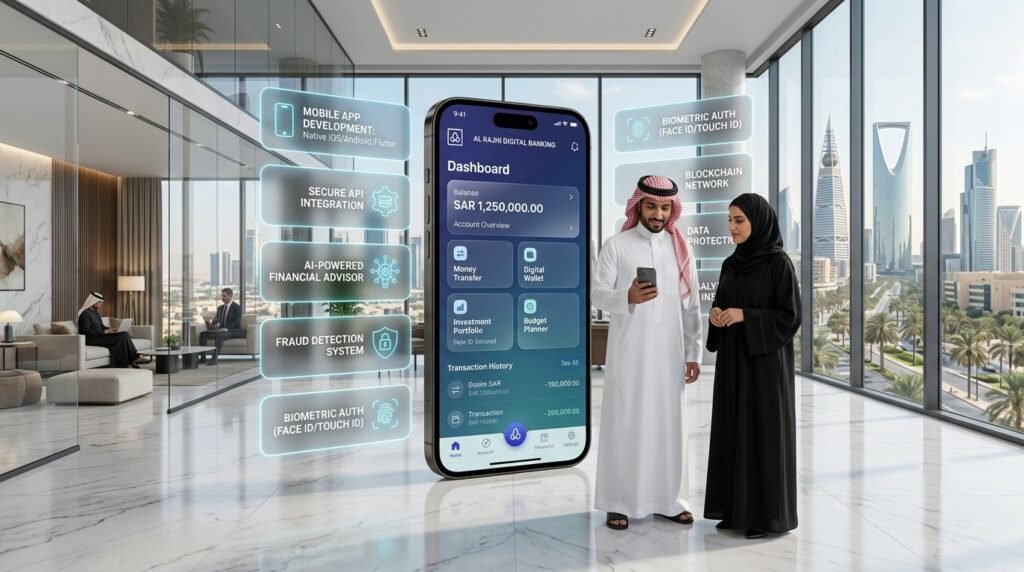
Financial apps in Saudi Arabia operate under SAMA compliance requirements. Security architecture, KYC flows, and payment processing must meet regulatory standards from the first line of code. Getting this right at the architecture stage is significantly less expensive than rebuilding it after launch under regulatory pressure.
Hospitality and tourism

Vision 2030 is bringing significantly more international visitors into Saudi Arabia. The hotels and experience providers with apps that handle the full guest journey, booking, pre-arrival communication, in-stay requests, upsells, are ready for that. The ones managing it over phone and email are not built for the volume that is coming. Those still relying on phone calls and email threads are not, and the window to build before that traffic arrives is getting shorter. And the window for building before that volume arrives is narrowing.
Government and public services
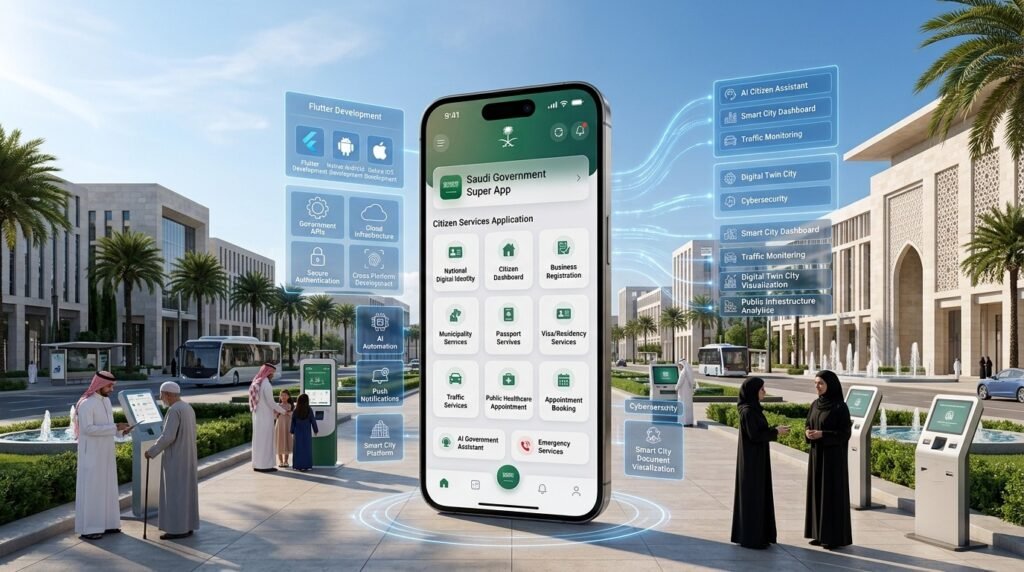
Licensing, municipal services, and citizen-facing platforms are moving to mobile across Saudi Arabia. Public sector entities building mobile applications now are ahead of the compliance curve rather than scrambling to meet it when the requirement becomes mandatory.
What Kind of App Does Your Business Actually Need?
This is the question most businesses skip, and it causes the most expensive mistakes in mobile app development. Before budget, before vendor selection, before any other decision, you need to know what job the app is doing.
The difference between a marketing app, a service app, and a transaction app
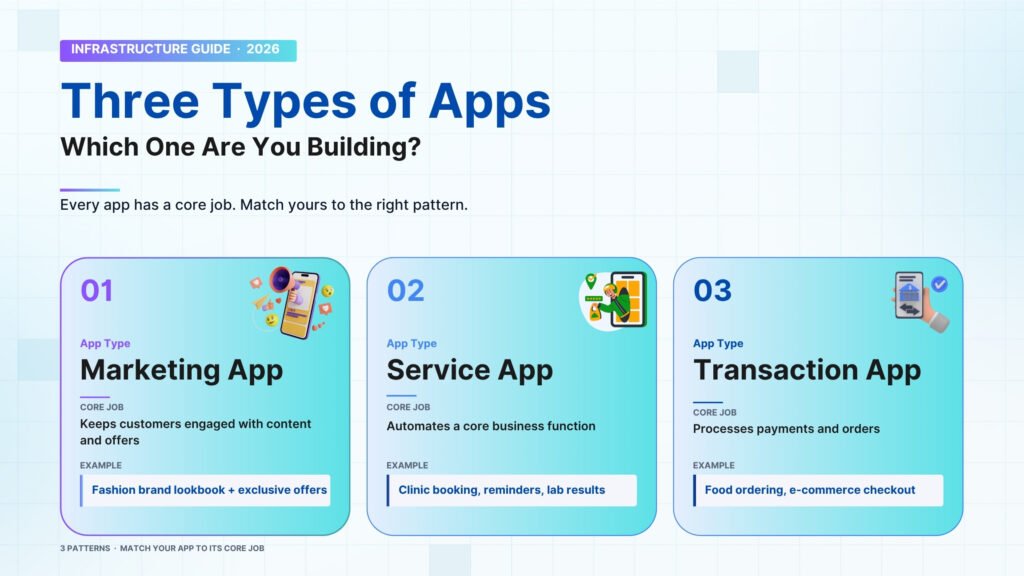
| App Type | Core Job | Example |
| Marketing App | Keeps customers engaged with content and offers | Fashion brand lookbook + exclusive offers |
| Service App | Automates a core business function | Clinic booking, reminders, lab results |
| Transaction App | Processes payments and orders | Food ordering, e-commerce checkout |
A marketing app’s job is to keep your brand in front of people between purchases, content, offers, early access, loyalty points. A Saudi fashion brand pushing seasonal lookbooks and exclusive member discounts through an app is doing exactly that.
A service app automates a core business function. A clinic app that handles appointment booking, sends prescription reminders, and delivers lab results is a service app, the app is doing operational work that previously required staff time.
A transaction app processes payments and manages orders. A food ordering app or an e-commerce platform is a transaction app, the primary purpose is completing a commercial exchange.
Most failed app projects tried to build all three simultaneously without deciding which one actually mattered. The result is an app that does none of them well enough to justify regular use.
How to define your app’s core job
One question resolves most of the confusion: what is the single action this app should make easier for your customer? A clear answer means the app has a purpose. Five equally weighted answers mean the scope is already broken before development starts.
Native, Hybrid, or Cross-Platform: Which Is Right for Your Business?
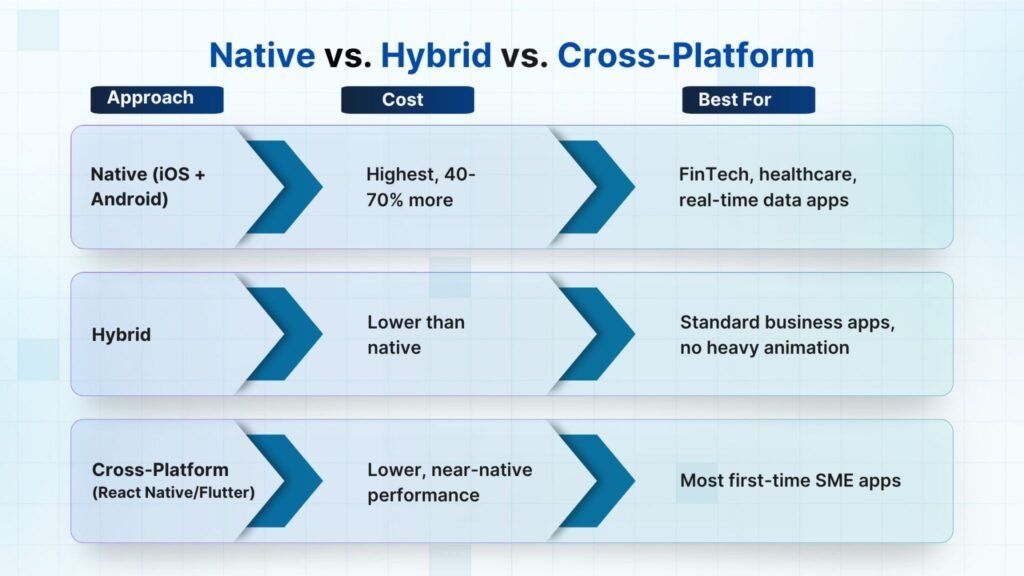
| Approach | Cost | Best For |
| Native (iOS + Android) | Highest, 40-70% more | FinTech, healthcare, real-time data apps |
| Hybrid | Lower than native | Standard business apps, no heavy animation |
| Cross-Platform (React Native/Flutter) | Lower, near-native performance | Most first-time SME apps |
This decision has consequences that stretch well past launch day. Get this wrong and you are either overpaying for performance you do not need, or you are rebuilding in eighteen months because the original choice cannot handle where the business went. The decision is worth understanding before you make it.
Native iOS and Android development
Two separate apps, one for each platform. Maximum performance and full access to device hardware features. Fintech, healthcare, anything that needs to work fast and integrate deeply with device hardware, native earns that premium. But go in with clear eyes: you are spending 40 to 70% more than a cross-platform build for the same features, and it takes longer to get to market.
Hybrid development
One codebase wrapped for both platforms. Faster to build and lower cost than native. Performance is acceptable for most standard business applications. Where it falls short is anything that needs heavy animations or real-time processing. Anything that needs to react instantly, real-time processing, heavy animation, hybrid starts to struggle. That is where its lower cost starts to have a visible trade-off.
Cross-platform development: React Native and Flutter
One codebase covers iOS and Android. The performance gap between this and native exists, but for most business applications, it is not a gap users ever notice or care about. Flutter app development and react native app development both fall here. Most SME apps sit in this category. Faster to build, easier to maintain, and lower cost than native without a meaningful performance trade-off for the majority of business applications.
For most businesses building their first app, cross-platform is the right starting point. Native development makes sense once the app is validated and the business needs performance optimization at high usage volume. Whatever approach you choose for the app, your web development should always be at par with it, since customers moving between your website and app expect the same speed, design, and functionality on both.
The Mobile App Development Process: Stage by Stage
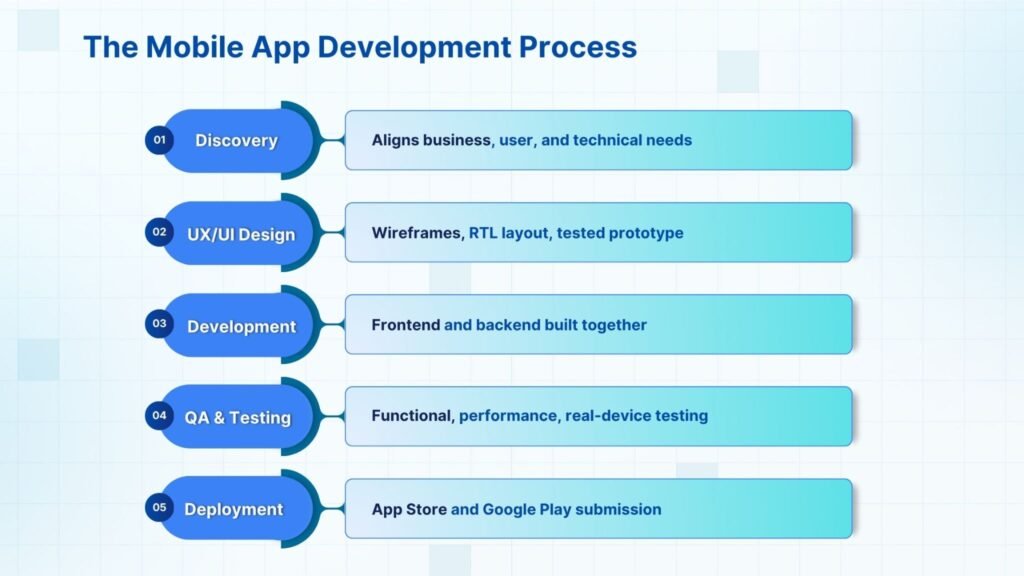
| Stage | What Happens |
| 1. Discovery | Aligns business, user, and technical needs |
| 2. UX/UI Design | Wireframes, RTL layout, tested prototype |
| 3. Development | Frontend and backend built together |
| 4. QA & Testing | Functional, performance, real-device testing |
| 5. Deployment | App Store and Google Play submission |
Most budget overruns and missed deadlines in app development are not bad luck. They are what happens when a business does not understand what each stage of development should produce. Know the process and you will spot a problem vendor before they cost you months. Each stage has a clear output. If a vendor cannot tell you what you will receive at the end of each phase, which is worth paying close attention to.
1. Discovery and requirement gathering
This stage produces a single document aligning what the business needs, what users expect, and what the technical build requires. It forces hard decisions early, before they become expensive mid-project changes.
Businesses that skip discovery do not save time. They move disagreements to later stages where resolving them costs significantly more.
2. UX and UI design and prototyping
Every screen, every user action, mapped out before any design work touches it. And if your app is serving Saudi users, which it is, Arabic right-to-left layout has to be planned here. Not later. Not as a fix after launch. The interface architecture depends on it, and retrofitting it costs significantly more than building for it from the start.
Before a single line of code gets written, a working prototype goes in front of real users. What you learn in that session is far cheaper to act on than the same discovery made three months into development. Design changes at the prototype stage cost a fraction of what they cost during development.
3. Frontend and backend development
The frontend is everything the user touches.The backend is everything users never see, data storage, processing logic, connections to payment gateways and external systems. Users do not think about it. They just feel it as whether the app is fast and reliable or slow and broken. A solid backend architecture built correctly from the start avoids expensive structural rebuilds when the business grows and usage increases.
4. QA and testing
Testing covers three things: does it work, does it hold up under load, and does it run properly on the phones your actual customers use. In Saudi Arabia, that last point matters more than people expect. Android dominates at mid and lower price points. iOS is strong at the premium end. A simulator does not show you what happens on a two-year-old mid-range Android. Physical device testing does. Insist on physical device testing before any launch, across both platforms and a range of device generations.
5. Deployment and App Store submission
Apple and Google run completely different review processes. Apple takes one to three days and will reject for reasons that are not obvious until they come back with them. Build a revision cycle into your launch timeline; do not plan a specific launch date, assuming first submission approval. Your Arabic app store listing, screenshots, and description must be complete and accurate before submission. Budget for one revision cycle before final approval is confirmed.
Features Saudi Businesses Should Prioritise in Their First App
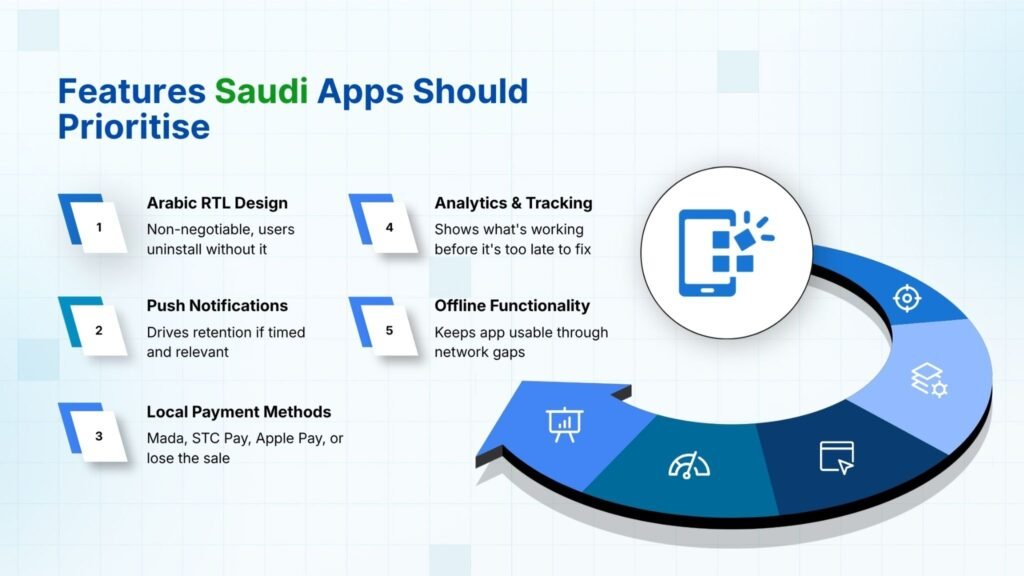
| Feature | Why It Matters |
| Arabic RTL Design | Non-negotiable, users uninstall without it |
| Push Notifications | Drives retention if timed and relevant |
| Local Payment Methods | Mada, STC Pay, Apple Pay, or lose the sale |
| Analytics & Tracking | Shows what’s working before it’s too late to fix |
| Offline Functionality | Keeps app usable through network gaps |
Building for the Saudi market is not the same as building a generic app. There is no Arabic checkbox. Building for Saudi users means making decisions throughout the entire build: payment methods, interface structure, and notification behavior that a generic app template does not account for.
Arabic language support and RTL design
Arabic is the primary language for most Saudi users. An app without proper Arabic support, meaning a full right-to-left layout, not just translated text, signals a poor product immediately. Users will uninstall. This is not optional and cannot be added correctly after development is complete.
Push notifications and customer retention
Push notifications are one of the most effective retention tools available in ios and android app development. Used well, relevant messages at the right frequency, they drive measurably higher return rates. Used poorly, they get the app uninstalled. The difference is in how the feature is designed and what logic governs when notifications are sent.
In-app payments and local payment methods
Saudi customers pay through Mada, STC Pay, Apple Pay, and major credit cards. An app that does not support local payment methods loses transactions at the final step after you have already paid to acquire that customer. All payment processing must go through SAMA-approved gateways for compliant operation.
Analytics and user behavior tracking
Without analytics you have no idea what is working. Which features users actually use. Where they abandon before buying. What brings them back. Build tracking in from day one, because the data from your first week of users is data you cannot get back if you add it later. Adding it after launch means missing months of behavioral data you cannot recover.
Offline functionality
Saudi mobile networks are generally strong, but gaps exist. Apps that go blank without an internet connection lose users. Core features, product browsing, saved information, recent order history, should function offline and sync automatically when connection returns.
Mobile App Development Quick Decision Guide for Businesses
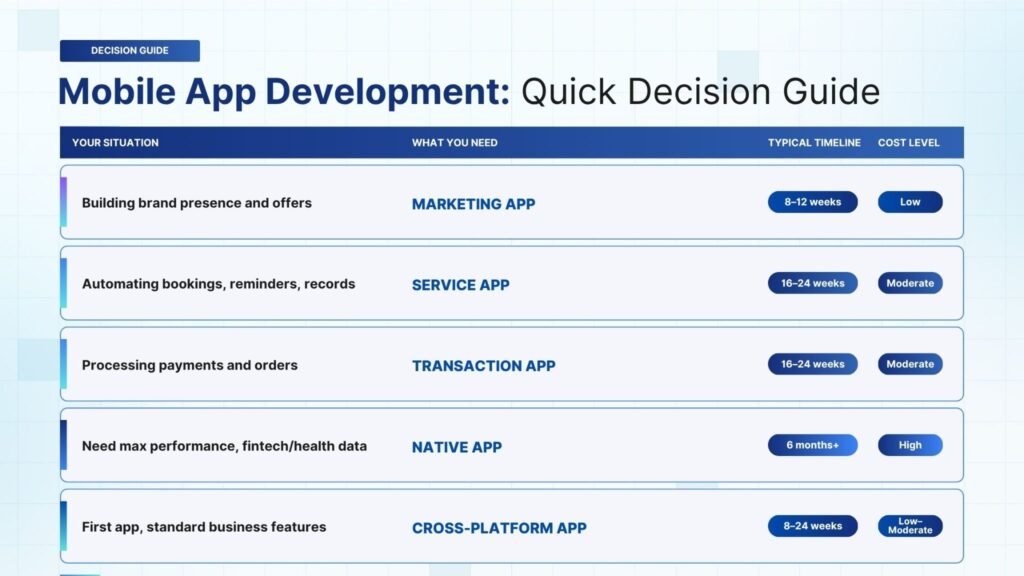
| Your Situation | What You Need | Typical Timeline | Cost Level |
| Building brand presence and offers | Marketing App | 8–12 weeks | Low |
| Automating bookings, reminders, records | Service App | 16–24 weeks | Moderate |
| Processing payments and orders | Transaction App | 16–24 weeks | Moderate |
| Need max performance, fintech/health data | Native App | 6 months+ | High |
| First app, standard business features | Cross-Platform App | 8–24 weeks | Low–Moderate |
What Mobile App Development Actually Costs in Saudi Arabia
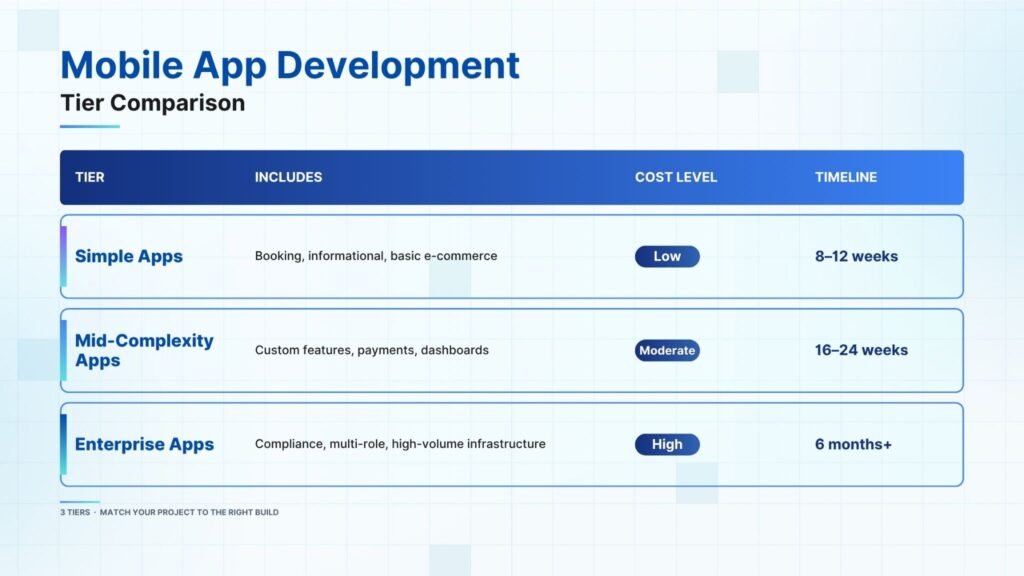
| Tier | Includes | Cost Level | Timeline |
| Simple Apps | Booking, informational, basic e-commerce | Low | 8–12 weeks |
| Mid-Complexity Apps | Custom features, payments, dashboards | Moderate | 16–24 weeks |
| Enterprise Apps | Compliance, multi-role, high-volume infrastructure | High | 6 months+ |
Cost in mobile app development is not fixed to a feature list. Two apps with the same number of screens can cost very differently depending on what is happening in the backend, how many systems need to connect, and what compliance requirements the app has to meet.
Scope drives cost more than any other single variablem, and scope changes during development are where most budgets expand unexpectedly.
Simple apps: informational, booking, basic e-commerce
One or two core functions, standard design, basic backend. The lowest cost tier in mobile app development. A good starting point for service businesses launching their first digital product before committing to a more complex build.
Mid-complexity apps: custom features, integrations, dashboards
Custom design, payment gateway integration, user dashboards, and admin panel. More expensive than simple apps due to the backend complexity and integration work involved. This is where most retail, logistics, and booking apps sit.
Custom app developers working at this level should be able to show you comparable completed projects, not just a feature list.
Enterprise applications: multi-platform, compliance-heavy, high-volume
At this level, the complexity is in the architecture: advanced security, layered user permissions, compliance obligations, and infrastructure built to handle significant transaction volume. The most expensive tier. FinTech, healthcare, and government applications typically fall here because cost is driven primarily by compliance architecture and integration complexity, not interface design.
What drives cost up
Adding features during development without adjusting the timeline or budget is the single largest cost driver on most projects. Custom design costs more than template-based UI. Third-party integrations add both development time and ongoing licensing fees. A clearly defined scope document before development starts is the most effective cost control available.
In-house vs. outsourcing vs. local tech partner
Building in-house means full control, and full hiring responsibility, salary overhead, and the months it takes to assemble the right team. Offshore outsourcing cuts the day rate but introduces delays you will feel every time a decision needs a fast answer across a six-hour time difference.
A local Saudi agency costs more than offshore rates. What you get for that difference is a team that already knows SAMA requirements, Arabic UX behavior, and local compliance, none of which they are figuring out on your timeline and your budget. If you want a clearer picture of what your project would actually cost, contact us on WhatsApp and book a free meeting and we’ll walk through your scope before you commit to a budget.
Post-Launch: What the First 90 Days Actually Require
Launch is not where the work ends. Launch day tells you what real users actually do, which is usually different from what you planned for. The apps that grow are the ones where someone is watching that data closely in the first week and acting on it fast. The ones that die quietly are usually the ones where nobody was watching.
Structure the first 90 days around three questions. What are users actually using? Where are they leaving? And when they uninstall, why?
Analytics answer the first two. User feedback, direct reviews, support tickets, and if possible short user interviews, answers the third. Put that together and you know what the first update needs to fix. That update should be live within four to six weeks of launch, not sitting in a backlog for half a year.
Maintenance is not a one-time cost you settle at handover. OS updates break things. Security patches need to go out. Users report bugs. Feature requests pile up. Budget around 15 to 20% of your original build cost annually to keep the app running properly. The businesses that skip this budget line go quiet after launch, and quiet apps lose users to apps that keep showing up.
Common Mistakes Saudi Businesses Make During App Development
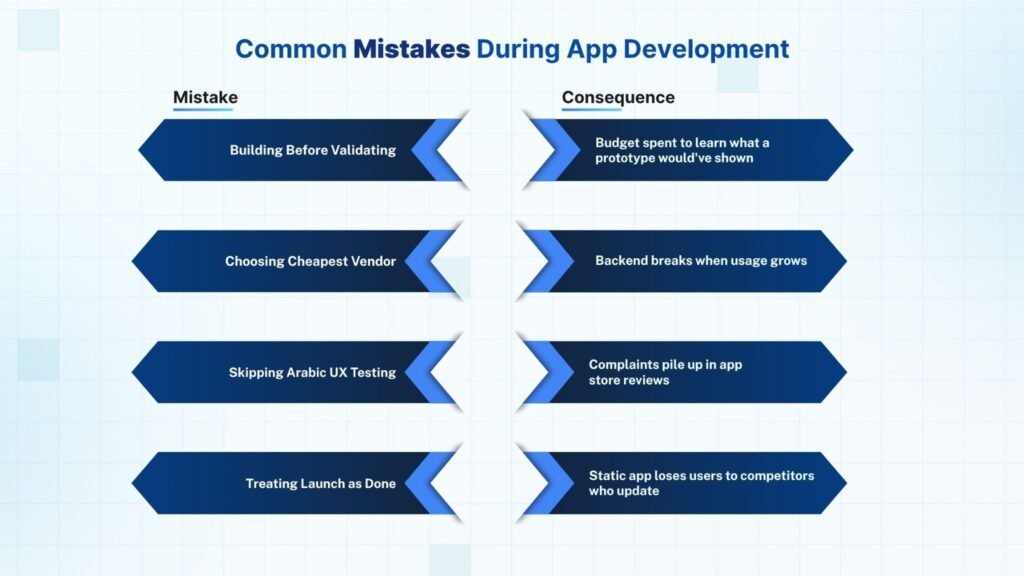
| Mistake | Consequence |
| Building Before Validating | Budget spent to learn what a prototype would’ve shown |
| Choosing Cheapest Vendor | Backend breaks when usage grows |
| Skipping Arabic UX Testing | Complaints pile up in app store reviews |
| Treating Launch as Done | Static app loses users to competitors who update |
Building before validating the idea
The app gets built. Users do not engage with it. That is a significant amount of money to spend confirming a hypothesis. Two weeks of prototype testing with real users would have shown the same thing at a fraction of the cost. Test the idea before you build the product.
Going with the lowest quote without understanding what got cut to get there
Low-cost development teams often reduce scope on the backend. The app works at launch. It breaks when usage grows. Rebuilding backend architecture after launch costs more than building it correctly the first time, and it happens while users are already experiencing problems.
Skipping Arabic UX testing with real users
An Arabic speaker navigates an interface differently than an English speaker does. RTL layout, where buttons sit, how the eye moves through a screen, none of this maps cleanly onto what works in English. If you have not tested with actual Saudi users before launch, your first round of real feedback will be one-star reviews you cannot unpublish.
Treating the app as done at launch
An app that receives no updates after launch sends a clear signal to users that the product is not being maintained. In a market where competitors are releasing regular improvements, a static app loses users gradually but consistently.
Why Saudi Businesses Choose Etihad Falcon Tech for Mobile App Development
A structured process with clear deliverables at every stage
Every stage of the process has a defined output and a clear timeline. You know what you are getting at each milestone before we reach it, not after.There are no ambiguous milestones or scope changes that appear without explanation.
Built specifically for the Saudi market
Arabic RTL design, Mada and STC Pay integration, SAMA compliance, MOH requirements for healthcare, and Vision 2030 context are built into the development process from the start. These are not additions made at the end of the project because someone remembered them.
End-to-end services
From the first scoping conversation to App Store submission and everything after, EFT handles the full build. There is no coordination overhead on your side, no chasing three separate vendors who each own a piece of the project and none of whom are responsible for the whole thing.
Experience with Saudi businesses at scale
Etihad Falcon Tech has built mobile solutions for Saudi businesses across retail, logistics, healthcare, and financial services. Working across those industries means EFT has already encountered most of the problems that show up in a Saudi market build. That shortens the decision cycle, reduces the structural errors that surface months after launch, and produces apps that scale, rather than apps that need a rebuild the moment they gain traction.
Frequently Asked Questions
Simple apps land between 8 and 12 weeks. Add custom features, payment integrations, and an admin panel and you are looking at 16 to 24 weeks. Enterprise builds with compliance requirements and multiple system integrations run 6 months and beyond. The honest answer is that scope drives the timeline more than anything else, and scope is something that gets defined properly during discovery, not estimated from a feature list.
Budget depends on what the app needs to do. Simple apps with core functions cost significantly less than mid-complexity builds with custom design, local payment integrations, and an admin dashboard. Enterprise applications with compliance requirements sit at the higher end. A scoping session with defined requirements is what produces a reliable number, not a feature wishlist.
Yes. Arabic is not something you add to an app. It is something the app is built around from the start. RTL layout affects the entire interface structure, not just the text. Get to launch without it and you are looking at significant rebuild work, plus the users you already lost who uninstalled in the first week.
Mada, STC Pay, Apple Pay, and major credit cards cover the majority of Saudi users. All payment processing must go through SAMA-approved gateways. Saudi customers expect Mada and STC Pay. Leave those out and you lose the sale at the last step, after the customer already decided to buy.
Native is two separate builds, one for iOS, one for Android. More performant, more expensive, longer to ship. Cross-platform is one codebase that covers both through React Native or Flutter, lower cost, faster to market, and performance that is close enough to native for the vast majority of business applications. Most Saudi SMEs start there. If the app grows and the business needs to squeeze more performance out of it, that is the right time to consider native, not before you have validated the product.
If your app handles payments, health data, or financial services, you are operating under SAMA, MOH, or CITC requirements depending on what the app does. EFT maps those obligations during discovery, before architecture decisions are made, not after they have already locked in the wrong structure.
After launch, the work does not stop. The app needs attention after launch. Every OS update is a potential breaking change. Security patches are not optional. Bugs come in from real usage that testing never surfaced. Set aside around 15 to 20% of your original build cost annually for maintenance. Then beyond that, actually use what your analytics are telling you. An app that stops releasing updates signals to users that nobody is home, and they find somewhere else to go.
Two to four weeks of structured discovery and prototype testing with real Saudi users will tell you whether the core idea holds. Compare that to six months of development followed by a launch that confirms the same thing, and the math on which one to do first becomes straightforward.
Yes, ERP, CRM, payment systems, third-party platforms, integration is part of the standard build. Scope and complexity get assessed during discovery so there are no surprises in the timeline or budget once development starts.
Get in touch with Etihad Falcon Tech and tell us what type of business you have and what mobile app you require. We will go through your requirements and come back with a clear cost, a plan, and a timeline for you mobile app development project.