

Saudi Arabia’s digital transformation market stands at USD 55 billion in 2025 and is forecast to reach USD 90 billion by 2030, according to Mordor Intelligence, a market research firm specializing in industry market-sizing reports and forecasts. Businesses across Saudi Arabia are now replacing outdated systems with custom software and more advanced workflows necessary to improve work efficiency and outcomes in the modern digital world.
Businesses running on generic or pre-built software end up managing multiple tools, losing time and money. But the successful businesses are the ones moving toward custom software built around their actual operations. Where workflows, data, and reporting are all connected in one place.
However, every industry runs differently, and software built for one does not automatically work for another. What a logistics company needs from custom software is not what a hospital needs, or a real estate firm or a manufacturer. This guide breaks down what custom software development actually looks like for your industry, what it costs, and how to know if your business is ready for it. That readiness starts with understanding the new digital standard Vision 2030 is setting for every business.
Why Saudi Businesses Must Meet Vision 2030’s New Digital Standards

Vision 2030 was built for government transformation. But private businesses are not exempt from it. No matter the size or industry of your business, you are now expected to run on a solid digital infrastructure.
Custom software development is how businesses build structures like this, often by integrating directly with Saudi regulatory systems like ZATCA, SAMA, and Nitaqat. Most businesses do not start there; they start with pre-built software, and that is usually where the real problems begin.
The Limitations of Pre-Built Software for Saudi Businesses

Pre-built or generic software comes with a fixed set of features, and if your workflow doesn’t match those features, you have to change how you work to fit the software.
Most businesses deal with this by adding workarounds. You keep a spreadsheet on the side for the reports the software can’t generate. Someone manually checks and approves things the system can’t handle on its own. You buy a second tool because the first one is not enough for your operations. And that’s how you start losing efficiency in your business.
What Your Business Needs to Decide Before Building Custom Software
Before going for software development for your business, you need to settle a few things first. If you skip this step, you’ll end up with software that doesn’t solve your business’s actual problems.
Here are the three questions every business should be able to answer clearly before reaching out to a software development company:
What problem is this software actually solving?
Software only works in your favor when it is built around your actual problems, not a general idea of what your business needs. Before you start the process, write down the specific operations that are slowing you down, what they are costing you in time, staff hours, or missed revenue, and where the breakdown actually happens. A clear brief like this gives you something exact to build from.
Who owns the software after delivery?
Ownership is not just who has the login. It is who controls updates, who decides what changes when your business changes, and who you call when something breaks at 9pm on a Thursday. Get this wrong, and six months from now you are stuck waiting on the same vendor for changes that should take a day, paying premium rates because nobody else knows the system.
What does success look like six months after go-live?
Decide this before development starts, not after. Write down the actual outcomes you expect: faster order processing, fewer manual reconciliation steps, real-time visibility across branches, whatever applies to your operations. These need to be measurable, not general impressions. Without defined outcomes, you have no way to check if the software actually worked, and no way to catch it early if it didn’t.
What Kind of Software Does Your Business Actually Need?
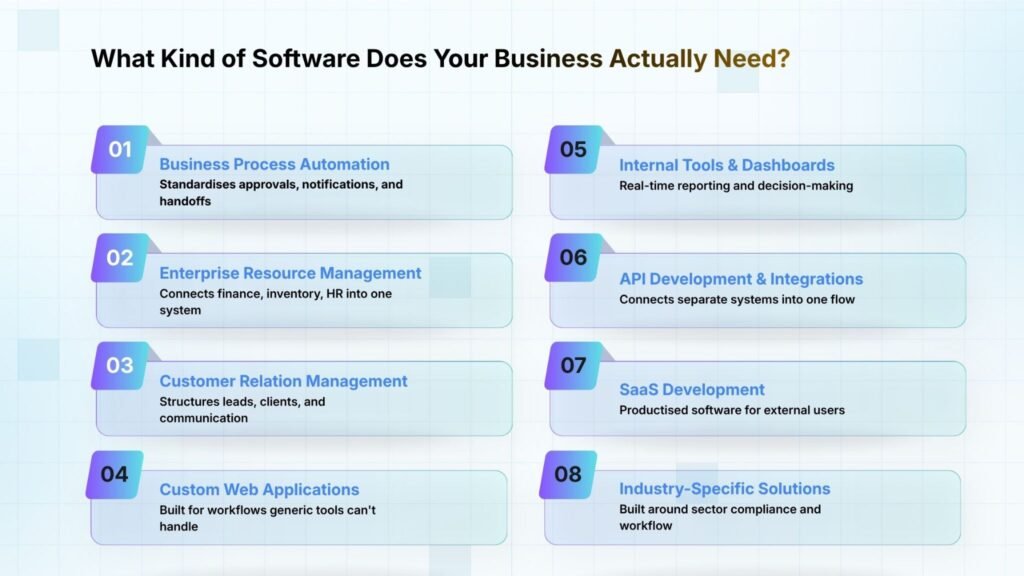
| Software Type | What It Does |
| Business Process Automation | Standardises approvals, notifications, and handoffs |
| Enterprise Resource Management | Connects finance, inventory, HR into one system |
| Customer Relation Management | Structures leads, clients, and communication |
| Custom Web Applications | Built for workflows generic tools can’t handle |
| Internal Tools & Dashboards | Real-time reporting and decision-making |
| API Development & Integrations | Connects separate systems into one flow |
| SaaS Development | Productised software for external users |
| Industry-Specific Solutions | Built around sector compliance and workflow |
Business Process Automation Software

Reduces manual tasks and standardizes workflows across departments or locations. The right starting point for Saudi businesses, where the primary problem is human-dependent coordination, approvals, notifications, status updates, and handoffs between teams that currently happen over WhatsApp or email.
Enterprise Resource Planning (ERP) System

Connects departments, finance, inventory, procurement, HR, and operations, into a single operational system with shared data. An enterprise resource planning system eliminates the version-of-truth problem that fragmented tools create. For mid-to-large Saudi businesses managing multiple functions simultaneously, this is where custom enterprise software development delivers the highest return on operational investment.
Customer Relationship Management (CRM) Software
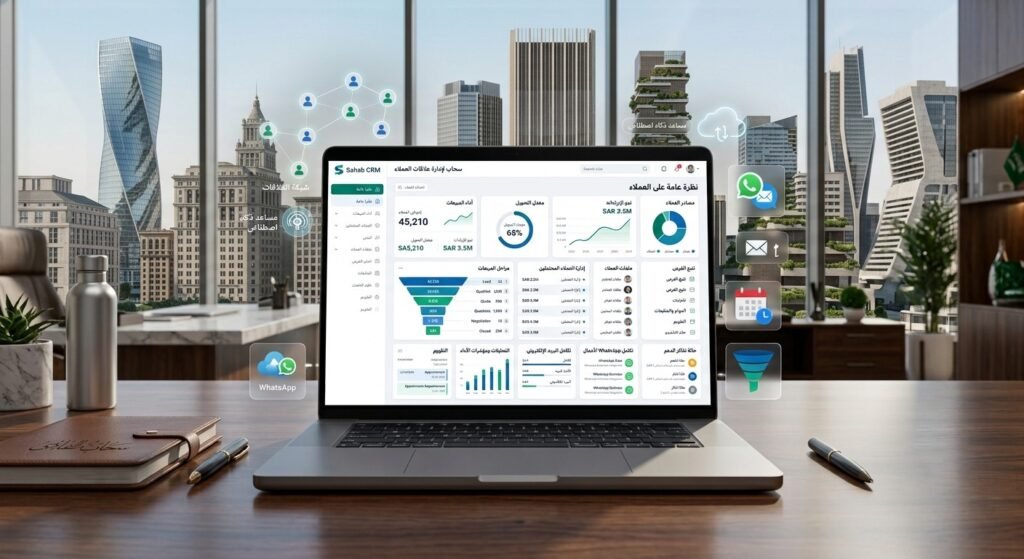
Structures how leads, clients, and communication are tracked and managed. Customer relation management software built for a specific Saudi business workflow, rather than a generic CRM configured to fit, handles local relationship management patterns, Arabic language requirements, and the specific sales cycle of the industry without requiring teams to adapt their behavior to the tool’s limitations.
Custom Web Applications
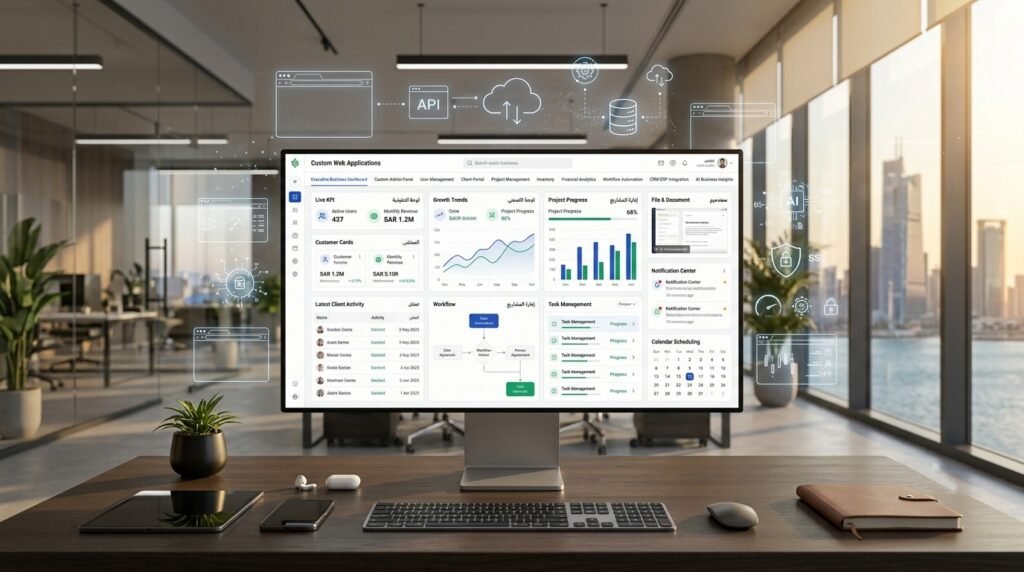
A web application isn’t a website with extra steps — the difference is function. It processes logic, manages user roles, and handles data in ways a content site was never built to. Custom development at this level makes sense once the business process is specific enough that nothing off-the-shelf can serve it without real compromise. It’s a different scope of work from standard web development, and businesses often need both: a site for the public-facing side and a web application for the internal processes running behind it.
Internal Tools and Dashboards
Used for reporting, monitoring, and internal decision-making. A dashboard that consolidates data from multiple operational systems into one real-time view eliminates the manual reporting cycle that most Saudi businesses rely on and allows decisions to be made on current data rather than last week’s spreadsheet.
API Development and System Integrations
Connects separate systems into one operational flow. Many Saudi businesses have the right tools in individual parts of the operation but no connection between them. That’s the gap API development closes — ERP talking to e-commerce, POS talking to inventory, CRM talking to billing — so data moves on its own instead of getting copied by hand between systems.
SaaS Development

Software built as a product for external users, not just an internal tool. SaaS development applies when a business has identified a workflow problem that is common across its industry and wants to productise the solution. Multi-tenancy, subscription billing, uptime obligations — a SaaS product carries architecture, security, and scalability demands that internal software simply doesn’t.
Industry-specific Software Solutions
Tailored systems built around sector-specific requirements. Healthcare software development must handle patient data, MOH compliance, and clinical workflows. Fintech software development must meet SAMA requirements and handle financial transaction logic. Real estate development software must manage listings, contracts, and tenant relationships in ways that generic property tools do not. Custom software for small business in these sectors needs the same compliance architecture as enterprise software, the scale is different but the regulatory requirements are not. If these systems also need a customer-facing layer, look into mobile app development built with the same compliance requirements baked in from the start.
Which Saudi Industries Are Investing in Custom Software Development Right Now
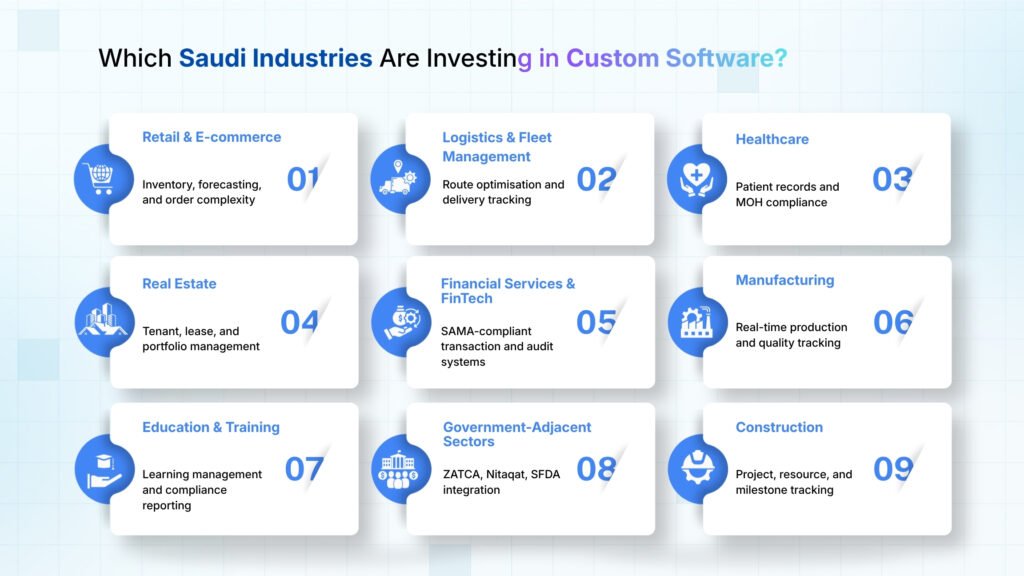
| Industry | Primary Driver |
| Retail & E-commerce | Inventory, forecasting, and order complexity |
| Logistics & Fleet Management | Route optimisation and delivery tracking |
| Healthcare | Patient records and MOH compliance |
| Real Estate | Tenant, lease, and portfolio management |
| Financial Services & FinTech | SAMA-compliant transaction and audit systems |
| Manufacturing | Real-time production and quality tracking |
| Education & Training | Learning management and compliance reporting |
| Government-Adjacent Sectors | ZATCA, Nitaqat, SFDA integration |
| Construction | Project, resource, and milestone tracking |
Retail and E-commerce Operations

Inventory management, demand forecasting, and order processing complexity are the primary drivers. Saudi retail businesses managing multiple SKUs across multiple locations find that generic inventory tools break down at the point where stock movement, supplier lead times, and sales velocity need to be managed together in real time.
Logistics, Supply chain, and Fleet management

Route optimisation, driver tracking, delivery confirmation, visibility across the whole distribution network — that’s what custom logistics software is built to handle. Riyadh, Jeddah, Dammam: regional routes and last-mile delivery in these dense urban environments need systems built for that specific geography, not a generic template stretched to fit.
Healthcare and Medical Practice Management
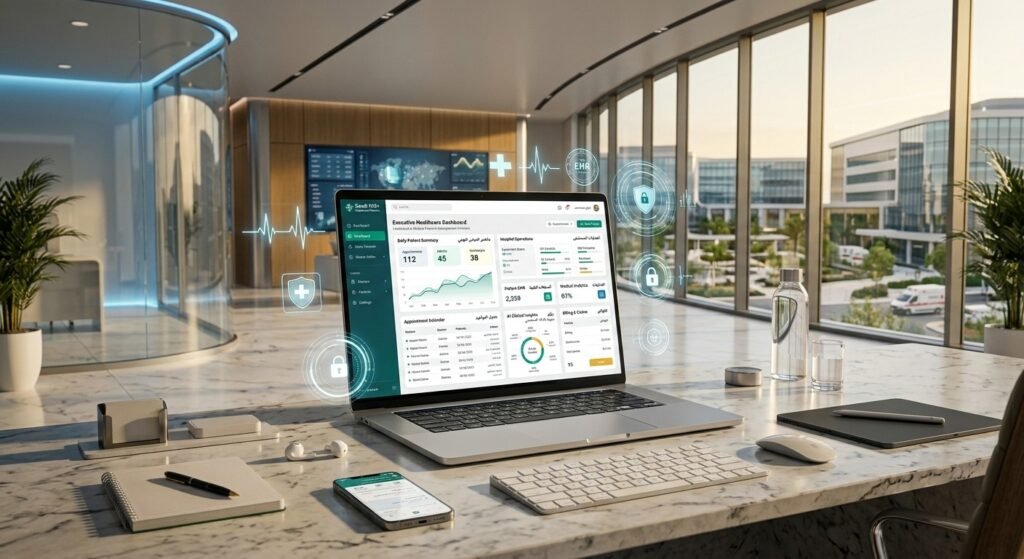
Healthcare software development companies building for Saudi facilities address patient record management, appointment scheduling, clinical workflow, and MOH compliance reporting. Custom healthcare software development is necessary when the facility’s workflow, specialty mix, patient volume, integration with national health systems, is specific enough that generic practice management software requires too many workarounds to function correctly.
Real Estate and Property Portfolio Management

Real estate development software covers tenant management, lease tracking, maintenance coordination, and financial reporting across property portfolios. For Saudi property managers handling mixed-use developments or large residential compounds, a custom software solution built around their specific portfolio structure outperforms generic property management tools that were built for different market structures.
Financial Services and FinTech
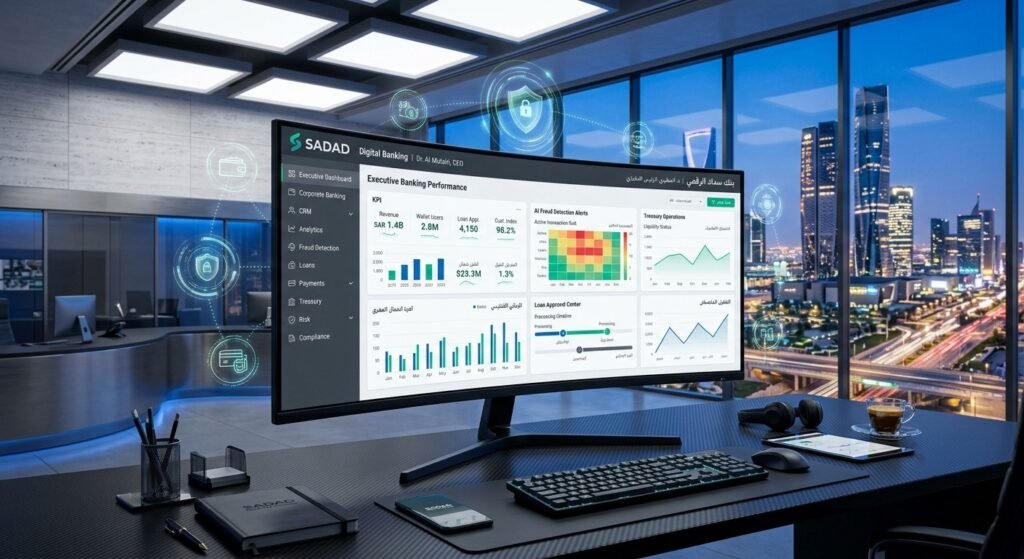
Fintech software development in Saudi Arabia operates under SAMA compliance requirements that affect transaction logic, audit trail architecture, and reporting systems. Fintech software built without these requirements in the core architecture fails regulatory review regardless of its functional quality. Custom software development services for financial businesses in Saudi Arabia must address compliance from the system design stage.
Manufacturing and Industrial Operations

Production tracking, equipment maintenance scheduling, quality control logging, and supply chain coordination are the primary requirements. Saudi manufacturing operations scaling under Vision 2030 industrial programs need systems that handle production data in real time rather than through end-of-shift manual reporting.
Education and Training Institutions

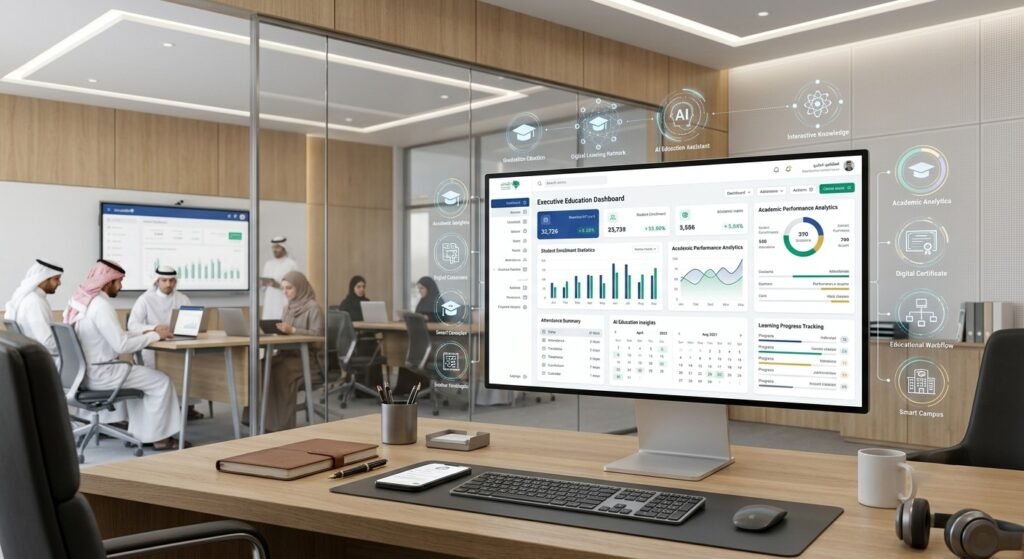
Saudi education providers need learning management, student performance tracking, and compliance reporting built for how they actually assess and certify students. The shift to online and hybrid learning after 2020 pushed demand for platforms built around those specific requirements — generic LMS tools weren’t cutting it.
Government-adjacent and Regulated Industries
Compliance-driven system requirements dominate. Businesses interacting with government systems, ZATCA, Nitaqat, SFDA, SAMA, need software that produces the correct output formats and integrates with the relevant regulatory platforms. Building that compliance after the system is live is significantly more expensive than architecting for it from the start.
Construction and Project-based Businesses

Core requirements here are project tracking, resource allocation, subcontractor management, and milestone-based billing. Saudi construction firms running multiple active sites need field updates flowing into financial reporting without manual reconciliation — the same gap that quietly eats margin on every project.
The Software Development Process: From Problem to Production
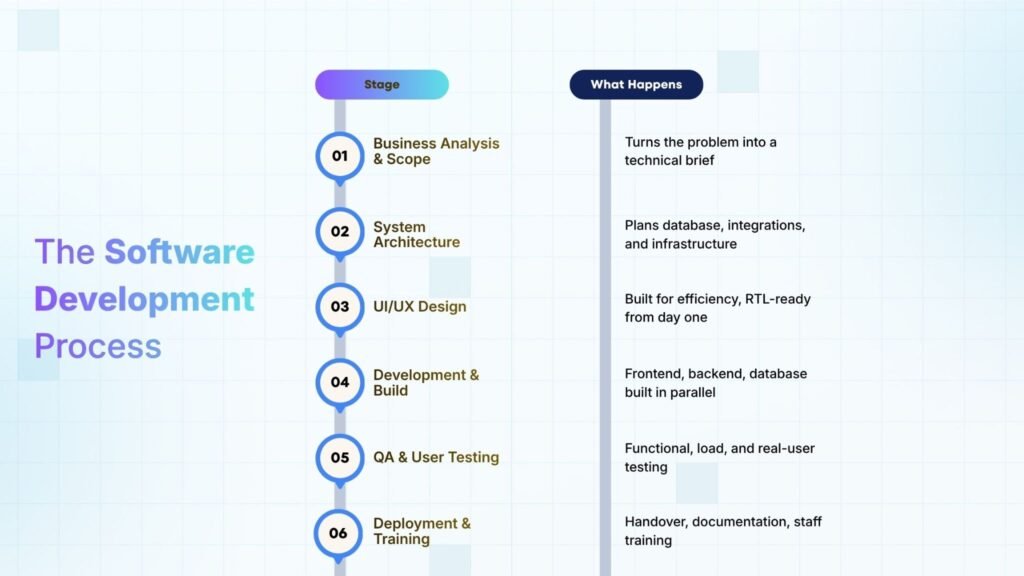
| Stage | What Happens |
| 1. Business Analysis & Scope | Turns the problem into a technical brief |
| 2. System Architecture | Plans database, integrations, and infrastructure |
| 3. UI/UX Design | Built for efficiency, RTL-ready from day one |
| 4. Development & Build | Frontend, backend, database built in parallel |
| 5. QA & User Testing | Functional, load, and real-user testing |
| 6. Deployment & Training | Handover, documentation, staff training |
Business analysis and scope definition
This stage translates a business problem into a technical brief — a document defining what the system needs to do, what it doesn’t need to do, and how success gets measured. The budget gets protected or lost right here. Decisions at this stage decide whether the build stays in scope or slowly accumulates revisions that inflate cost and timeline without adding proportional value.
Software development consulting at this stage is what separates a project that delivers from one that gets delivered but not used. An experienced analyst working through the brief with the business surfaces the requirements that the internal team did not know to specify, the edge cases, the integration dependencies, and the compliance requirements that seem minor in planning and become expensive mid-build.
System architecture and technical planning
What gets decided here isn’t really about launch day. It’s about how the system holds up under real load six months later, once usage has grown and the business has shifted underneath it. Database structure, integration points, API design, infrastructure — all locked in at this stage.
Poor architecture is invisible during development and becomes visible only when it starts limiting the system. A custom software development agency that skips detailed architecture planning in favour of faster development is creating a technical debt problem that the client inherits at handover.
UI and UX design for business software
Enterprise software UX is a different discipline from consumer app design. The priority is efficiency, how quickly a trained user can complete a task, rather than visual impression on first contact. Saudi builds need Arabic interface design and RTL layout locked in from the first wireframe — retrofit it later and you get the exact same failure mode websites have: alignment breaks, navigation degrades, and the whole system signals it wasn’t built with its actual users in mind.
Development and build
Frontend, backend, and database layers are built in parallel against the architecture plan. Frontend is what the user touches. Backend is where logic runs, business rules get enforced, data gets managed. The database holds and retrieves everything in the structure the architecture stage already defined.
Milestone-based delivery gives the client visibility and control during the build. Each milestone produces a testable output — not just a progress update. Nobody wants to find out at the end of a six-month build that what got shipped doesn’t match what was agreed at the start; this is what prevents that.
Quality assurance and user acceptance testing
Functional testing confirms that each feature works as specified. Load testing checks system behavior under the volume of simultaneous users the business actually expects. Edge case testing identifies how the system handles inputs and conditions that fall outside standard workflow, because those conditions always occur in real operations.
Technical testing catches technical problems. It doesn’t catch the workflow that looks fine on paper but breaks against how the team actually works day to day — that’s what user acceptance testing is for. Running UAT with real users before go-live is where that particular gap gets found and closed.
Deployment, handover, and staff training
A proper handover includes access credentials, system documentation, and structured training for the teams who will use the system daily. Software that is deployed but not adopted delivers no operational return regardless of build quality.
Staff training is not a courtesy at the end of the project. It is what determines whether the investment produces the outcomes it was built to produce. For Saudi businesses where the workforce may include mixed Arabic and English users, training materials and system interfaces need to reflect both.
Technical Decisions That Affect Your Software for Years
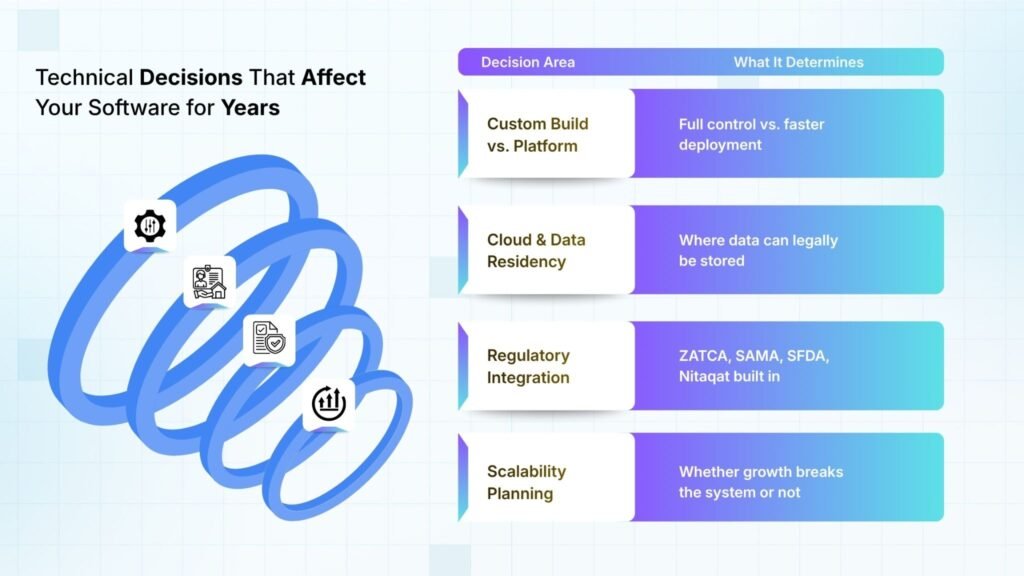
| Decision Area | What It Determines |
| Custom Build vs. Platform | Full control vs. faster deployment |
| Cloud & Data Residency | Where data can legally be stored |
| Regulatory Integration | ZATCA, SAMA, SFDA, Nitaqat built in |
| Scalability Planning | Whether growth breaks the system or not |
Custom build vs configuring an existing platform
Building from scratch means owning the architecture, the workflow, every direction the system can grow in. That level of control earns its cost when the business process is too specific for any existing platform, or when compliance demands more than a configurable tool can give.
Configuring an existing platform — an ERP, a CRM, a workflow tool — is the faster, cheaper route, and it works fine when the business workflow is close enough to the platform’s standard model that configuration covers the gap. The catch: the platform’s limitations become the business’s limitations, and that becomes more obvious the bigger the business gets.
Bespoke development earns its place when the workflow is genuinely one-of-a-kind, when compliance gets specific, or when working around a platform’s ceiling would eventually cost more than just building past it.
Cloud infrastructure and KSA data residency
Saudi Arabia’s National Data Management Office (NDMO) has established data residency requirements that affect where certain categories of data — particularly personal data and data related to critical national infrastructure — can be stored and processed. Businesses in healthcare, financial services, and government-adjacent sectors need to assess these requirements during architecture planning, not after the system is built and hosted.
Local hosting within Saudi Arabia reduces latency for Saudi users and simplifies compliance for regulated sectors. International cloud infrastructure — AWS, Google Cloud, Microsoft Azure — offers more robust global infrastructure with Saudi regional availability zones that satisfy data residency requirements for most business use cases. The right choice depends on the data classification requirements of the specific system being built.
Integration with Saudi regulatory systems
ZATCA e-invoicing integration is a requirement for Saudi businesses above the mandatory threshold. The system must generate, sign, and transmit e-invoices in the format ZATCA specifies — which affects financial workflow architecture, invoice generation logic, and how the system connects to ZATCA’s Fatoorah platform. Building this integration into the financial system from the start is significantly less expensive than retrofitting it into a live system.
SAMA compliance for fintech software and financial applications defines security architecture, audit trail requirements, reporting standards, and data handling obligations. A financial system that does not meet SAMA requirements at the architecture level fails regulatory review regardless of its functional quality.
SFDA system touchpoints are relevant for healthcare and pharmaceutical businesses that need to integrate with Saudi Food and Drug Authority reporting requirements. Nitaqat system integration is relevant for businesses with workforce reporting obligations under Saudi labour regulations.
These are not add-on features. They are architectural requirements that determine how the system is built from the ground up.
Scalability planning from day one
Software built only for current operational load fails when the business grows — not dramatically, but gradually. Response times slow. Data queries take longer. The system that handled fifty concurrent users starts struggling at two hundred. By the time it breaks, the fix isn’t a patch — it’s going back and rebuilding architecture decisions that should’ve been right the first time.
Get scalability right at the architecture stage and you’ve covered database structure that handles volume growth, modular design that adds features without touching core components, infrastructure that scales horizontally as load increases. Under Vision 2030’s growth targets, that’s not a nice-to-have for Saudi businesses with any ambition.
What Custom Software Development Actually Costs in Saudi Arabia
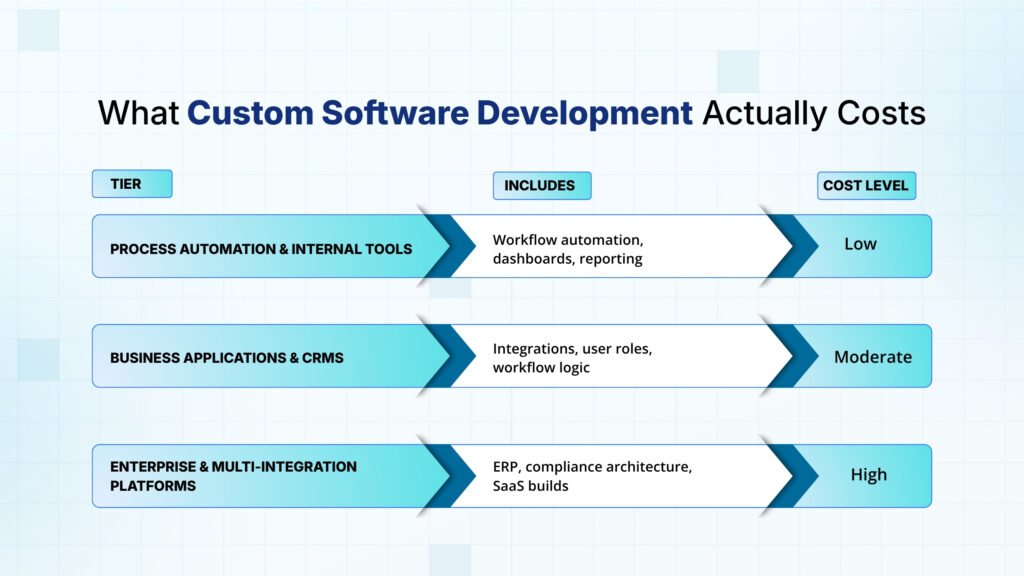
| Tier | Includes | Cost Level |
| Process Automation & Internal Tools | Workflow automation, dashboards, reporting | Low |
| Business Applications & CRMs | Integrations, user roles, workflow logic | Moderate |
| Enterprise & Multi-Integration Platforms | ERP, compliance architecture, SaaS builds | High |
Cost is driven by what the system needs to do, how many systems it needs to connect to, and what compliance requirements it must meet. Scope clarity is the single most reliable cost control available — and the most commonly underinvested part of the project.
Process automation and internal tools
The lowest cost tier in custom software development. Workflow automation, internal dashboards, and reporting tools built around a defined set of processes. Appropriate for Saudi businesses where the primary problem is manual coordination rather than complex system integration.
Mid-complexity business applications and CRMs
Custom application development at this level covers customer relation management software, booking and service platforms, operational dashboards with multi-system data, and web applications with defined user roles and workflow logic. More expensive than process automation due to the integration work and the user experience requirements involved.
Enterprise systems and multi-integration platforms
The highest cost tier. Custom enterprise software development covering ERP systems, multi-branch operational platforms, compliance-heavy financial systems, and SaaS products. Cost at this level is driven primarily by integration complexity, compliance architecture, scalability requirements, and the depth of the system’s business logic.
What drives the final number up or down
Scope clarity reduces cost. Every missing requirement discovered during development becomes a revision, and revisions compound. Integration complexity increases cost — the more external systems the software needs to connect to, the more development and testing time is involved. Compliance requirements add cost in proportion to how many Saudi regulatory systems the software must integrate with or produce output for. Custom software development for startups with aggressive timelines also adds cost — compressed timelines require more parallel development resources.
In-house development vs outsourcing vs local technology partner
Building in-house gives full control but requires hiring, retaining, and managing a technical team — which is a significant operational commitment alongside running the core business. Offshore outsourcing reduces day rates but introduces communication friction, time zone delays, and a lack of Saudi market context that affects how the system is designed.
A local bespoke software development company with Saudi market knowledge brings direct understanding of ZATCA, SAMA, Arabic interface requirements, and how Saudi business workflows actually operate. That context is embedded in every architectural decision rather than learned on the client’s project.
For Saudi businesses where regulatory compliance and local market fit are requirements rather than preferences, a local partner is not a premium option; it is the practical choice. If you want a clearer estimate for your specific system, message us on WhatsApp, and we’ll scope it out before you commit to a number.
Common Mistakes Saudi Businesses Make When Building Custom Software
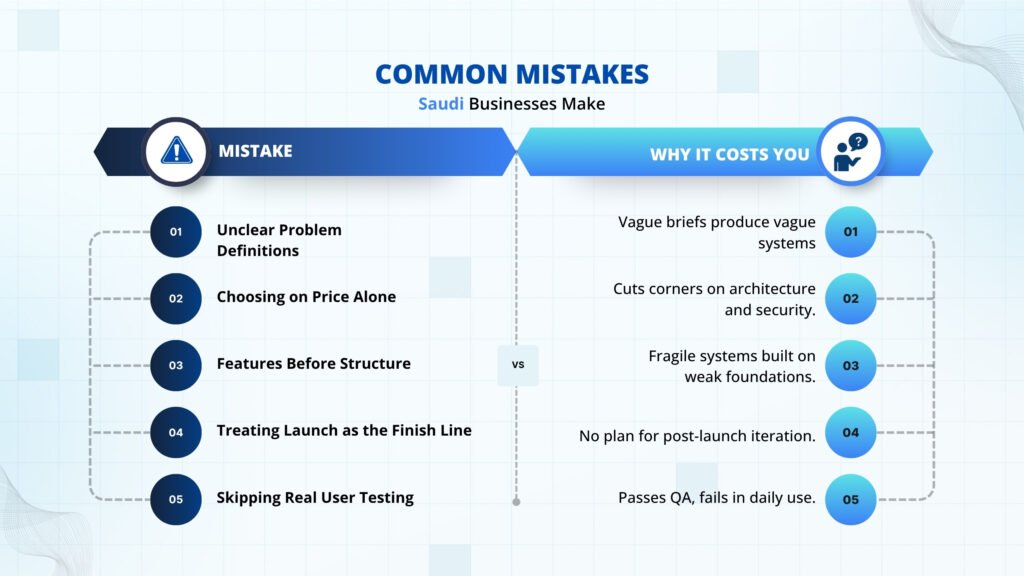
| Mistake | Why It Costs You |
| Unclear Problem Definitions | Vague briefs produce vague systems |
| Choosing on Price Alone | Cuts corners on architecture and security |
| Features Before Structure | Fragile systems built on weak foundations |
| Treating Launch as the Finish Line | No plan for post-launch iteration |
| Skipping Real User Testing | Passes QA, fails in daily use |
Signing off on unclear problem definitions
A vague brief produces a system that is technically delivered but operationally ineffective. The development team built what was specified. The specification did not capture what the business actually needed. The difference between those two things is expensive to close after go-live.
Choosing custom software development companies based on price alone
Low-cost development frequently cuts scope on system architecture, security, and compliance — the components that are invisible during development review but determine how the system performs under real operational conditions. Rebuilding a system that was underbuilt costs more than building it correctly once, and it happens while the business is already depending on the system.
Building features before building system infrastructure
Starting with the interface before the architecture is defined produces a system where the structure is shaped by the visible features rather than the operational requirements underneath them. Structure built to support features is fragile. Features built on solid structure are maintainable.
Treating launch as the end of the project
Deployment is not completion. It is the point at which real usage begins and the gap between specification and reality becomes visible. Businesses that do not budget for post-launch iteration and maintenance absorb those costs reactively — at higher cost and under worse conditions than if the support relationship had been defined from the start.
Skipping real user testing before go-live
A system that passes technical QA but has not been tested by the people who will use it daily goes live with usability problems that affect adoption. Low adoption produces low ROI regardless of build quality. User acceptance testing with actual Saudi business users — in Arabic, on the devices they actually use — is not a courtesy step. It is what determines whether the software works in practice.
Why Saudi Businesses Choose Etihad Falcon Tech for Software Development

Operational problem-solving as the starting point
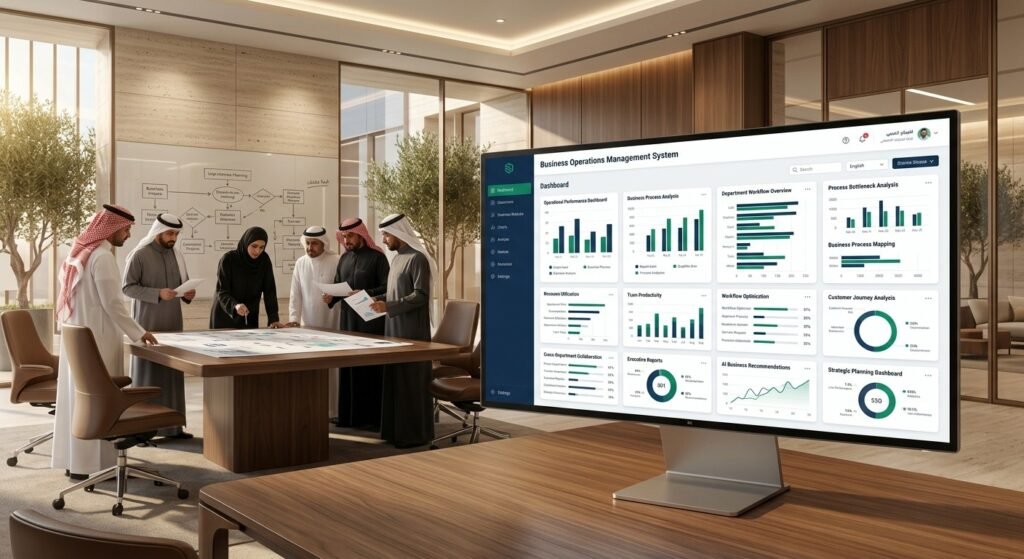
Etihad Falcon Tech does not start with technology. It starts with the operational problem the business needs to solve. The scoping process maps how work actually moves through the business before any architecture decision is made. That mapping determines what the system needs to do, what it does not need to do, and how success will be measured after go-live.
KSA regulatory and market familiarity
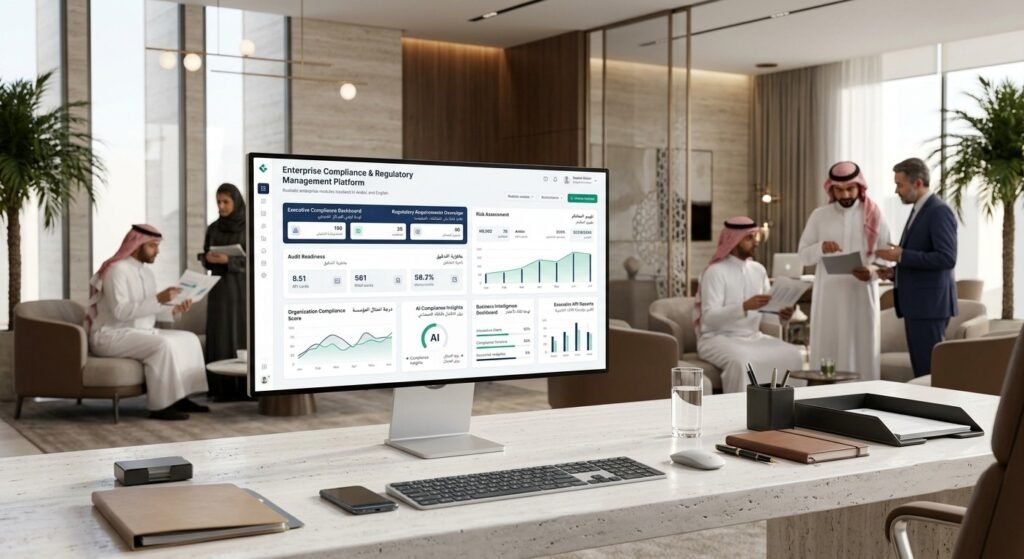
ZATCA e-invoicing, SAMA compliance, NDMO data residency, Arabic RTL interface requirements, and how Saudi business workflows operate across industries — these are embedded in EFT’s development process, not learned on the client’s project. Custom software development services built with this context produce systems that work correctly in the Saudi regulatory environment from day one.
End-to-end delivery from brief to post-launch support
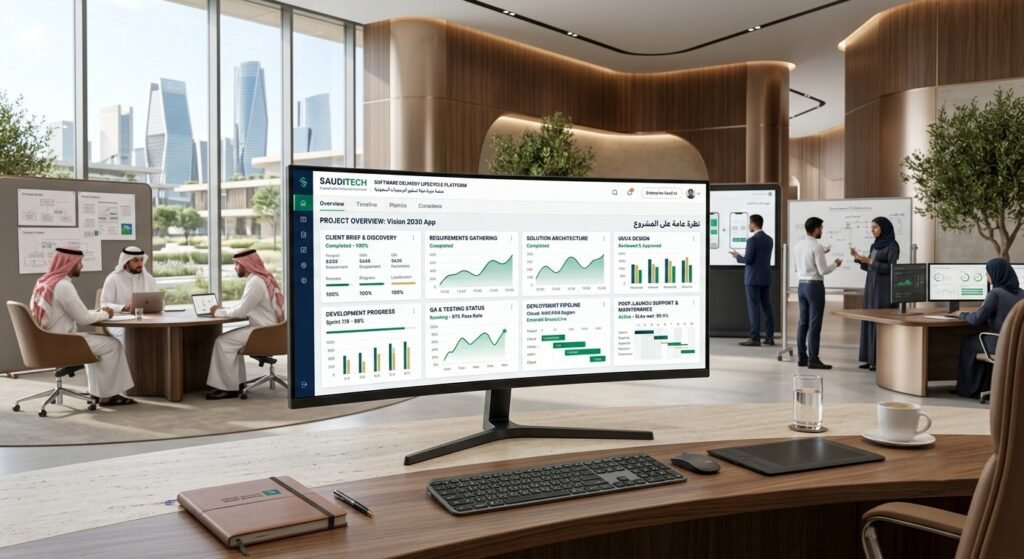
From business analysis and scope definition through architecture, development, QA, deployment, and ongoing maintenance, we manage the full lifecycle of the software. Clients are not coordinating between separate analysis, development, and support vendors with no shared accountability for the outcome.
Proven experience with Saudi businesses across industries
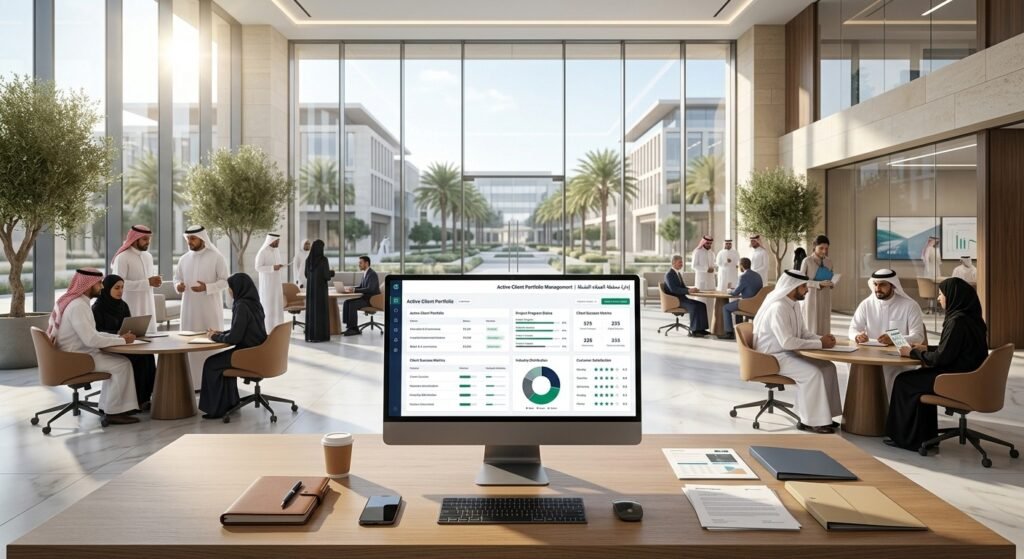
Retail, logistics, healthcare, financial services, real estate, construction — EFT has built bespoke software across all of it for Saudi businesses. That range means faster recognition of where a similar problem’s already been solved, fewer architecture mistakes, and systems built for how operations actually run rather than some idealised version of them.
If your operations are slowing down as your business grows, the issue is not effort. It is the structure. Software fixes structure — but only when it is built around the right problem from the start.
Frequently Asked Questions
What is the difference between custom software and off-the-shelf software?
Custom software is built around your specific workflow, compliance requirements, and operational structure. Off-the-shelf software is built for a generalised version of your workflow and requires your business to adapt to its limitations. The right choice depends on how unique your workflow is and how expensive the workarounds become when a generic tool cannot fully serve it.
How long does software development take in Saudi Arabia?
Timeline depends on system complexity. Internal tools and process automation systems can be delivered in eight to twelve weeks. Mid-complexity business applications with integrations typically take four to six months. Enterprise systems and multi-integration platforms with compliance requirements take six months to over a year depending on scope. Compressed timelines increase cost — parallel development requires more resources.
Does EFT build software that integrates with ZATCA e-invoicing?
Yes. ZATCA e-invoicing integration is built into the financial architecture from the start — not added as a module after the system is live. This covers e-invoice generation, cryptographic signing, transmission to the Fatoorah platform, and the audit trail requirements ZATCA mandates for compliant operation.
What happens after the software is delivered — who handles maintenance?
Post-launch maintenance is defined as part of the project scope before development begins. EFT provides ongoing software development services covering security updates, bug fixes, performance monitoring, compliance updates as regulatory requirements change, and feature development as business requirements evolve. The support model and response times are agreed upfront.
How do I know if my business actually needs custom software?
When your current systems require manual workarounds to function, when data exists in multiple places without a single source of truth, when reporting is consistently behind real operational status, or when every new branch or product line strains the systems you already have — those are the signals that generic tools have reached their limit and a custom software solution is the right next step.
Can EFT build software that works in both Arabic and English?
Yes. Arabic RTL interface design gets built in starting from the first wireframe, not bolted on as a translation layer afterward. Businesses with a mixed Arabic-English user base get an interface, documentation, and training materials that reflect both languages from day one.
What is the minimum budget for a custom software project in Saudi Arabia?
Budget depends on scope and complexity. Process automation tools and internal dashboards sit at the lower end of the range. Mid-complexity business applications with integrations sit higher. Enterprise systems with compliance requirements and multi-system integration sit at the top. A properly scoped brief is the only reliable basis for a realistic budget estimate — vague requirements produce inaccurate numbers in both directions.
How do I choose the right software development company in Saudi Arabia?
Evaluate based on three things: their ability to define the problem clearly before writing a line of code, their familiarity with Saudi regulatory requirements relevant to your industry, and their track record with systems of similar complexity in comparable operational environments. A bespoke software development company that asks the right questions during scoping is more likely to deliver a system that works than one that moves quickly to proposal without fully understanding the brief.