
The Saudi digital health market reached USD 4.4 billion in 2024, according to IMARC Group, a global market research firm.
That figure covers telehealth, electronic records, medical apps and the systems that connect them. Every one of those starts the same way: a patient looks for a provider online, and the first thing they meet is your website.
Behind that website, a healthcare business runs on a chain of connected work. A patient finds a doctor, books a time, shares insurance details, pays, receives results and comes back for a follow-up. Each step that the website can’t handle lands on your reception desk or your call center instead.
This is where owners get stuck. A template site, a plugin-based site and a custom-built site can all look the same on launch day. The difference shows up later, when you need the site to read real doctor schedules, show a patient their own results or pass a booking into your hospital system.
Any healthcare business can go custom, from a single clinic to a multi-branch hospital group. What decides the build sits in the background: PDPL rules for patient data, NPHIES insurance exchange, payments through mada, Apple Pay, Tabby and Tamara, Arabic and RTL layouts, and the connection to your HIS or EMR system. Each of these needs professional development, because a correctly built site lets your team care for patients instead of fixing the website one broken piece at a time.
This guide explains what healthcare website development involves in Saudi Arabia and what a custom build can do for your clinic or hospital. It also covers the rules you build around, the cost, and how we build it at Etihad Falcon Tech. If you want the service itself first, start with our custom website development page.
What Is Healthcare Website Development, and What Makes It Custom?
Healthcare website development is the work of building a website for a clinic, hospital, lab, pharmacy or health service that does real jobs for patients and staff. It covers the pages people see, the booking and patient systems behind them, and the links to the software you already run.
Custom doesn’t mean a custom look. It means custom functionality: the site is built around how your practice actually works, with its own logic, its own connections to other systems and its own rules. A template gives you pages. A custom build gives you working systems.
For a single clinic, that might be a booking system that reads each doctor’s real calendar. For a hospital group, it can be one platform serving ten branches, each with its own doctors, departments and insurance panels.
So the question isn’t how the site should look. It’s which tasks your team still does by hand that the site could do for them.
Who Needs a Custom Healthcare Website?
Not every healthcare business needs one. Those that do share a pattern: patients, staff or other systems depend on the site to get something done.
| Business | What it needs from the site |
| Hospitals and hospital groups | Multi-branch structure, department pages, patient portal |
| Clinic chains and polyclinics | Live doctor schedules, shared booking across branches |
| Specialty centers (dental, dermatology, fertility, eye care) | Procedure-based booking, payment plans, follow-up flows |
| Labs and imaging centers | Test booking, secure result delivery |
| Pharmacies and health stores | Online ordering, prescription checks, delivery |
| Telehealth providers | Video consultations, scheduling, visit records |
| Home healthcare services | Service requests, staff scheduling, visit tracking |
If you’re running a clinic chain, you already know the pattern: patients call to ask whether Dr. Huda is at the Riyadh branch on Thursday, and your reception answers the same question twenty times a day. Clinic chains, polyclinics, specialty centers, and diagnostic labs use custom builds to move those repeat questions onto the site, where the answer is always current.
If you’re a smaller practice, the same logic applies at a smaller size. You may only need booking and a patient login, and that is a perfectly good reason to go custom on those two features alone.
What Can a Custom Healthcare Website Actually Do?
A template site informs. A custom healthcare website works. Here is what that means in practice, feature by feature.
Online Appointment Booking Tied to Real Doctor Schedules
Online booking lets a patient pick a doctor, a branch and a time without calling you. In a custom build, the site reads each doctor’s actual calendar, so every slot a patient sees is a slot that exists.
It also handles rules that plugins can’t: follow-up visits that open only after a first consultation, procedures that need a longer slot, and doctors who split their week between two branches. When booking runs on a plugin, someone at the front desk ends up fixing double bookings by phone.
A Patient Portal for Records, Reports and Repeat Visits
A patient portal is a secure login where patients see their appointments, lab results, prescriptions and invoices. It suits any practice that fields the same calls every day. “Are my results ready?” “Can you resend my report?”
Each of those calls costs staff time. The portal answers them without anyone picking up a phone. It only works safely if login, access levels and record permissions are built in from the start, not added after launch.
Connection to Your HIS, EMR and Lab Systems
Your hospital information system (HIS) or electronic medical record (EMR) holds the real patient and scheduling data. Either the website talks to it, or someone retypes every online booking into it each morning.
The connection runs through an API, which is the access point that lets two programs exchange data. When it’s in place, a booking made at midnight is waiting in the system by the time your team arrives. What’s possible depends on what your system vendor allows, so we check this before anything else gets designed.
Telehealth and Video Consultations
Telehealth lets a patient see a doctor by video instead of travelling to a branch. It fits follow-up visits, routine specialist reviews and patients who live far from your nearest location.
The site has to handle booking, a waiting room, the video call, payment and the visit note, all in one flow. Video quality and privacy settings matter as much as the pages around them. Telehealth also falls under Ministry of Health rules, so the build starts with confirming which ones apply to your service.
Insurance Details and Online Payments
Most patients arrive with insurance. The site can collect insurance details at booking, so your team checks eligibility before the visit instead of at the counter. Claims themselves normally run through NPHIES, the national health insurance exchange, by way of your HIS. The website feeds that process instead of replacing it.
For self-pay patients, the site takes mada, Apple Pay and STC Pay, and can offer Tabby or Tamara for larger treatments such as dental or cosmetic work.
Online Ordering for Pharmacies and Health Stores
If you sell medicines, supplements or medical devices online, the site works as a store with extra rules. Prescription items need a prescription check, and some products can’t be sold online at all.
A custom build handles those rules inside the checkout instead of leaving them to staff. Delivery connects to Aramex, SMSA or Naqel, and every order produces a ZATCA-compliant invoice.
One Site for Many Branches and Doctors
A hospital group with eight branches and two hundred doctors can’t manage that on hand-edited pages. A custom build keeps doctors, departments and branches as structured records. Add a doctor once, assign them to a branch, and every relevant page updates.
That structure also helps patients find the right doctor, and it helps each branch rank for its own local searches.
Should You Build Custom, Use WordPress, or Pick a Template?
A fair answer is that it depends on what the site has to do. If your site only needs to show your doctors, services, location and a contact form, a WordPress or template build does that well and costs less.
Once the site has to book against live schedules, show private records, connect to your HIS or serve many branches, a template starts working against you. Plugins stack up, each one is another thing that can break, and none of them were built for patient data.
| Your need | Right starting point |
| Information site for one clinic | WordPress or template |
| Booking form with manual follow-up | WordPress with booking plugin |
| Live booking, patient login, HIS link | Custom build |
| Multi-branch platform with telehealth | Custom build |
| Online pharmacy or health store | E-commerce platform or custom build |
Our web development services cover WordPress, e-commerce platforms and custom builds, so we recommend the one that fits, not the one that’s easiest to sell.
What Rules Does a Healthcare Website Have to Follow in Saudi Arabia?
A healthcare website handles some of the most sensitive data a business can hold. Saudi rules treat it that way, and the site has to be built around them from the first day, not patched afterwards.
| Rule or body | What it means for your website |
| PDPL (Personal Data Protection Law) | Health data is sensitive personal data, so consent, access limits and secure storage are built in |
| Ministry of Health | Rules on licensing, online services and telehealth apply to what the site offers |
| SFDA | Applies when the site promotes or sells medicines and medical devices |
| NPHIES and CCHI | Insurance exchange and coverage rules shape how insurance details are collected |
| ZATCA | E-invoicing applies to online payments and orders |
Where patient data is hosted matters as much as how it’s protected. Hosting, backups and access logs all have to match what the rules expect for health data, and that is decided before development starts, not after.
This is the part of a build where cutting corners costs the most. A missed consent step or an open patient record isn’t a design flaw. It’s a legal and trust problem for your practice.
Why Does Arabic Matter So Much on a Healthcare Website?
Most of your patients will read the site in Arabic, many on a phone, often while worried about a symptom. If the Arabic is a translated afterthought, they notice, and some will pick the clinic whose site feels written for them.
Arabic-first means the layout is built right to left (RTL) from the start. Doctor names, specialties, forms and booking steps all read naturally in Arabic, with English alongside for patients who prefer it. A bilingual site also needs hreflang tags, which tell Google which language version to show each searcher.
Mobile speed matters just as much. A booking page that takes eight seconds to load on a phone loses the patient before they pick a slot.
How Is a Healthcare Website Built, Step by Step?
The process runs in a fixed order, because each stage decides what the next one can do. If you skip the early stages, the late ones get expensive.
| Stage | What happens |
| Discovery | We map the patient journey and your current manual tasks |
| Systems check | We confirm what your HIS, EMR and payment tools allow |
| Design | Arabic and English layouts for mobile first |
| Build | Booking, portal, payments and integrations developed and connected |
| Testing | Real patients and front desk staff try it before launch |
| Launch and support | Go-live, monitoring and fixes as real usage begins |
Testing with your own front desk team is the stage owners skip most, and it’s where the most useful problems turn up. A receptionist will find in ten minutes what a developer misses in ten days.
How Much Does Healthcare Website Development Cost?
Cost depends on what the site does, not how many pages it has. An information site and a multi-branch patient platform are different projects, and they’re priced that way.
| Type of site | Cost level |
| Information site with contact form | Low |
| Clinic site with online booking and doctor profiles | Low-Moderate |
| Site with patient portal and online payments | Moderate-High |
| Multi-branch platform with HIS integration and telehealth | High |
What Drives Your Cost Up or Down
- Integrations: every system the site connects to adds development and testing work, and some vendors make access harder than others.
- Branches and doctors: more locations and schedules mean more rules to build and test.
- Patient portal depth: a simple login costs less than records, reports and role-based access.
- Telehealth: video, waiting rooms and visit notes add a full feature set.
- Language and content: full Arabic and English builds take more work than a single language.
If you already know which features you need, message us on WhatsApp with the list. We will tell you which cost level it falls into and what would move it up or down.
Which Mistakes Do Healthcare Websites Make?
Most problems come from decisions made in the first weeks, not from the code.
| Mistakes |
| Choosing a template for a booking-heavy practice |
| Ignoring HIS integration at the start |
| Treating patient data like ordinary form data |
| Translating Arabic from English |
| Skipping mobile testing |
| Launching without staff testing |
Why Work With Etihad Falcon Tech on Your Healthcare Website?
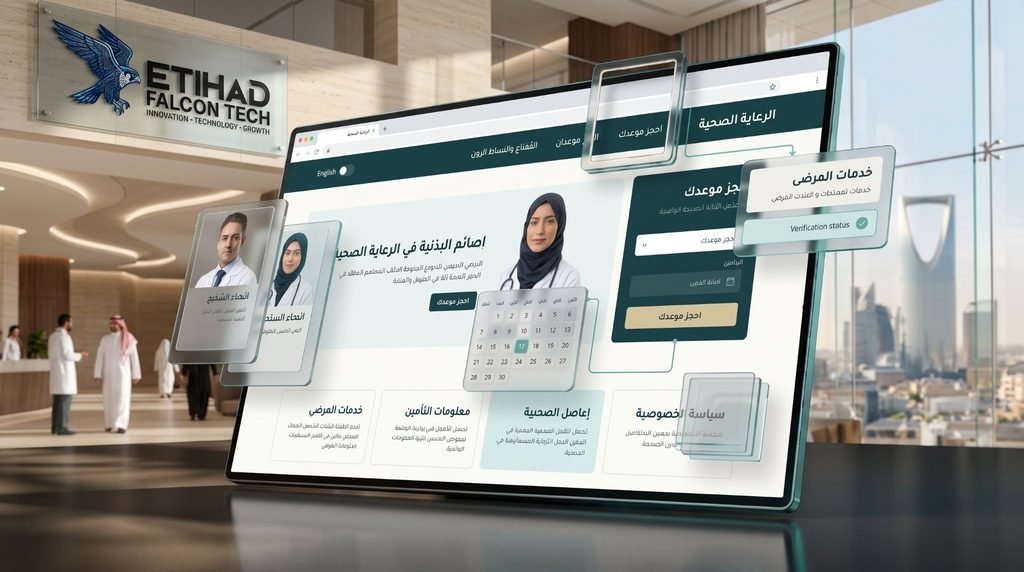
Maybe you run a clinic whose booking still happens over WhatsApp and phone calls. Maybe your hospital group has a site that looks fine but doesn’t connect to anything. Or you’re opening a new branch and want the site built right before the first patient arrives. These are the situations we build healthcare websites for.
Built Around How Your Practice Actually Runs
We don’t start with a template, we start with your patient journey. Where do patients call instead of clicking? Which tasks does your reception repeat all day? The site is built to take those on.
Arabic, Not as an Afterthought
Arabic layouts, Arabic forms and Arabic content are designed first, with English added for the patients who want it. That’s how a Saudi patient expects a healthcare site to read.
Compliant From Day One
PDPL, hosting, consent steps and insurance handling are planned before development begins. We don’t build first and ask about compliance later.
One Team, Start to Finish
Design, development, integrations and support sit under one roof, so nobody hands your project to a stranger halfway through.
If your current site is live but your reception still does what the site should be doing, tell us about it. Message us on WhatsApp with your branches, the systems you use today and the tasks you want off your team’s plate. We will tell you honestly whether a custom build is the right move.
FAQs
What does healthcare website development include?
It covers design, patient-facing features like booking and portals, and connections to your internal systems. It also covers the security and compliance work that patient data requires.
How long does a healthcare website take to build?
It depends on how many systems the site connects to. A clinic site with booking takes weeks, while a multi-branch platform with a portal takes months.
Can the website connect to our HIS or EMR?
Yes, if your system offers an API or another integration route. We check this first, because it decides what the site can automate.
Does a healthcare website need to follow PDPL?
Yes. Patient information is sensitive personal data, so consent, access control and secure storage have to be built into the site.
Can the site handle insurance and NPHIES?
The site can collect insurance details and pass them to your system. Claims exchange through NPHIES normally runs through your HIS, not the website.
Will the site work in Arabic and English?
Yes. We build Arabic-first with RTL layouts and add English as a full second version, not a translated copy.
Can a small clinic afford a custom build?
Yes, if the custom part is limited to what the clinic needs, such as live booking and a patient login. The cost levels above show how features move the price.
Where can I learn more about custom websites in general?
Our custom website development guide explains how custom builds work across industries, with healthcare as one of the strongest fits.