
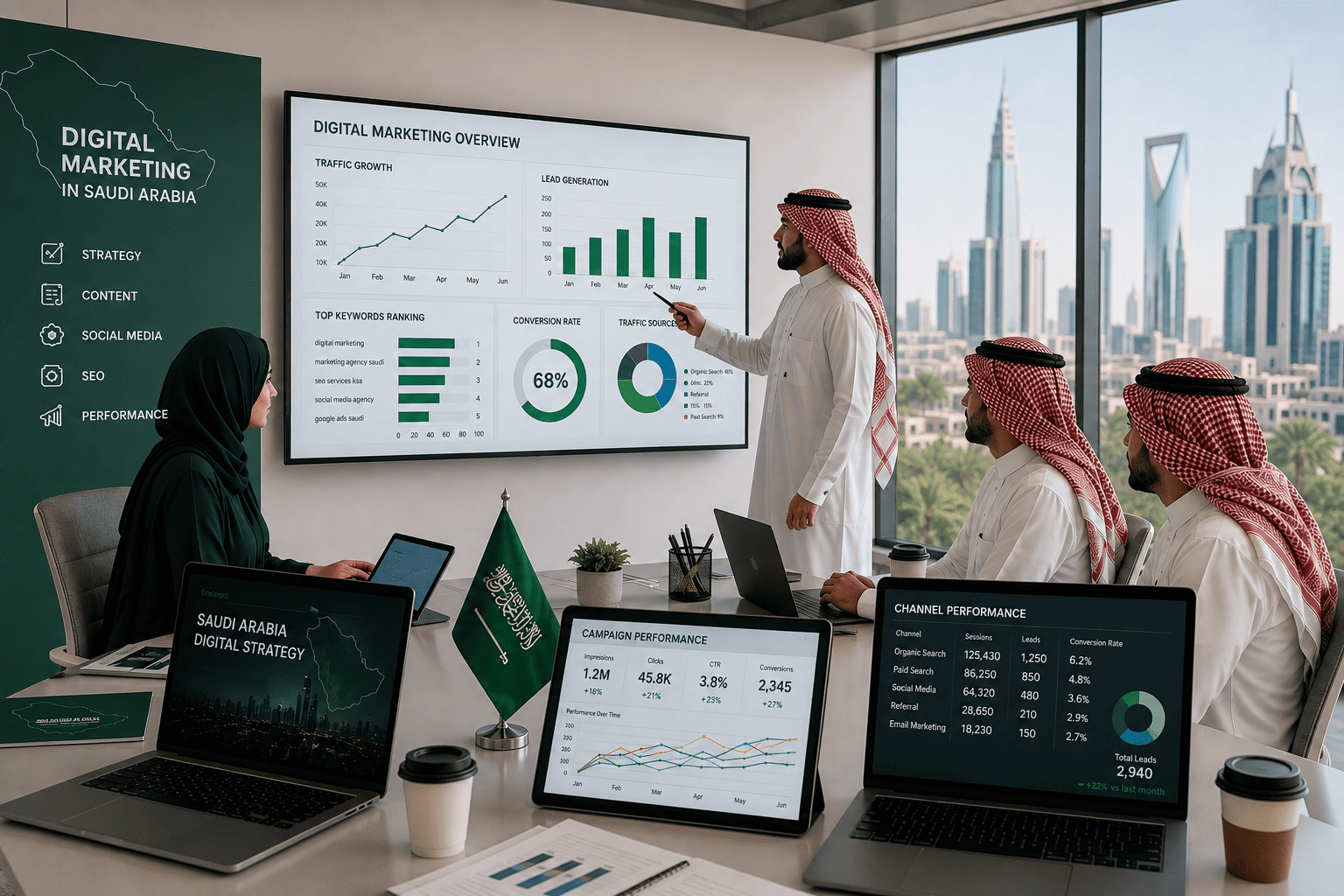
Did you know Saudi Arabia is among the countries with the highest internet adoption in the world? According to DataReportal’s Digital 2025 report, Saudi Arabia has 33.9 million active internet users. That is not a trend. That is the entire country online, on their devices, searching, comparing, and making decisions, including decisions about which businesses to trust, visit, or buy from.
The way businesses show up in Saudi users’ search results, feeds, and purchase decisions is through digital marketing. For Saudi businesses, online presence is no longer optional. But presence alone is not enough. Many businesses are spending on digital marketing without a strategy behind it. Ads running without a clear conversion goal. Social media posts going out without a purpose. Money being spent on activity that feels productive but produces nothing traceable at the end of the month.
This guide covers what digital marketing actually means for Saudi businesses, which channels produce results in different niches, how strategies are built and measured, what it costs, and what separates businesses generating consistent leads from those spending consistently without knowing why it is not working.
How Vision 2030 Has Made Digital Marketing Necessary for Saudi Businesses
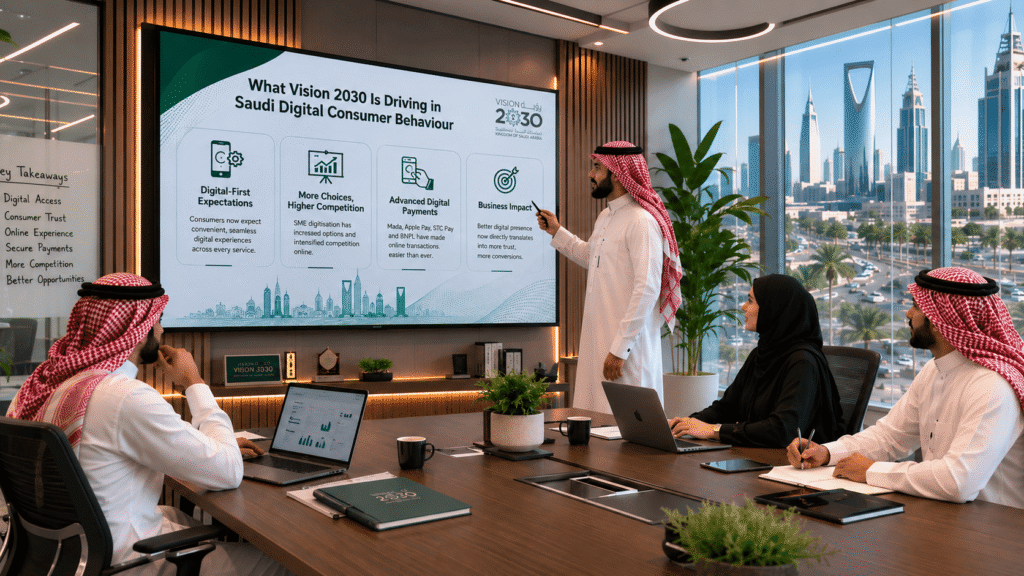
Vision 2030 has not just changed how Saudi businesses operate. It has changed what they are competing for, and who they are competing against. Three shifts define what that means right now.
Saudi consumers now hold every business to the same standard as government services. When government transactions moved to apps, the expectation transferred to private businesses as well. Booking, payment, information, follow-up, all of it should happen digitally without a phone call. Businesses that cannot be found, contacted, or transacted with online are not seen as traditional. They are seen as inconvenient, and a competitor who built the digital experience already takes more customers.
The local competitive field has permanently widened. The SME digitization programs under Vision 2030 brought thousands of Saudi businesses online. Consumers who had three visible options in a category three years ago now have thirty in the same search. Being online is no longer the advantage. How high you rank in search results, how well your content speaks to the right audience, and how effectively your pages turn visitors into customers — that is what separates the businesses winning from the ones spending without knowing why it is not working.
Saudi Arabia has opened to a global audience that searches digitally before anything else. According to the Saudi Ministry of Tourism, Saudi Arabia welcomed 122 million visitors in 2025 and is targeting 150 million by 2030, including 70 million international tourists. That audience starts on Google and Instagram. A Saudi business without structured digital marketing is invisible to every international visitor. That is why the businesses that will capture that opportunity are the ones investing in their digital presence today, not after the market gets even more competitive.
Which Digital Marketing Channels Actually Work for Saudi Businesses?
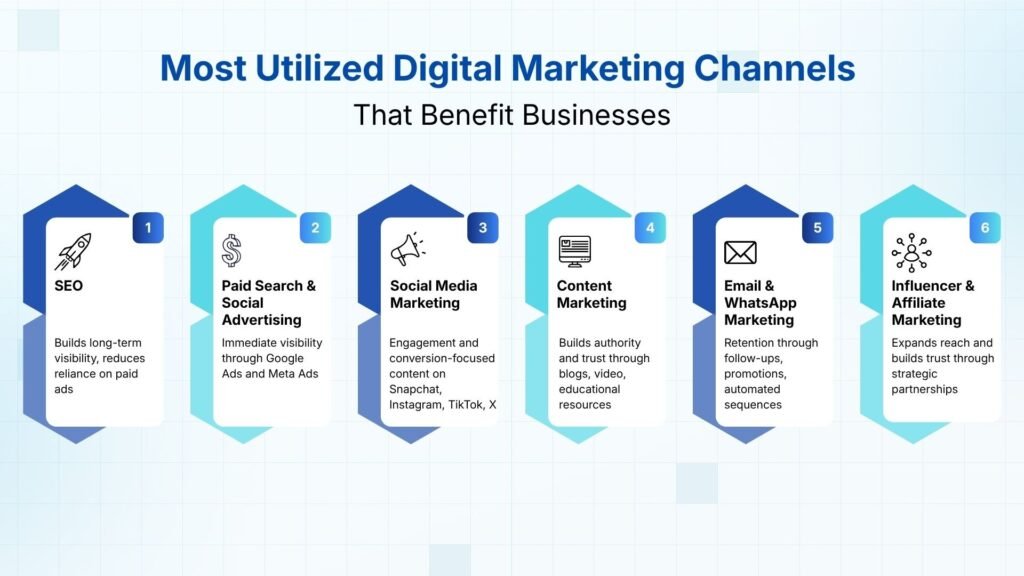
| Channel | What It Does |
| SEO | Builds long-term visibility, reduces reliance on paid ads |
| Paid Search & Social Advertising | Immediate visibility through Google Ads and Meta Ads |
| Social Media Marketing | Engagement and conversion-focused content on Snapchat, Instagram, TikTok, X |
| Content Marketing | Builds authority and trust through blogs, video, educational resources |
| Email & WhatsApp Marketing | Retention through follow-ups, promotions, automated sequences |
| Influencer & Affiliate Marketing | Expands reach and builds trust through strategic partnerships |
Search Engine Optimisation (SEO)
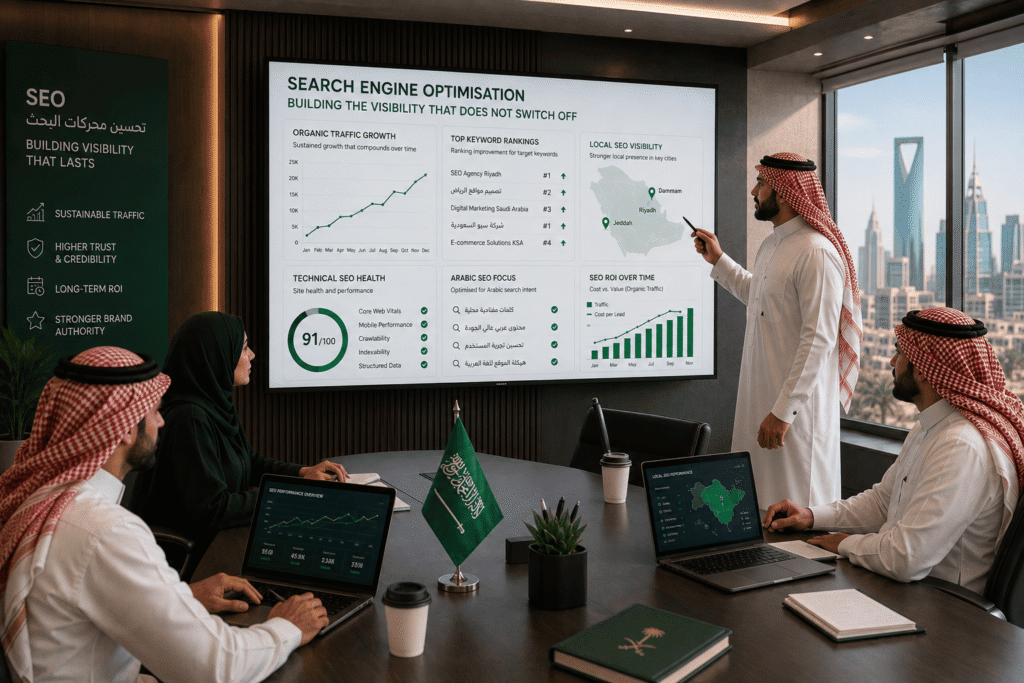
SEO is the only channel where work done today keeps generating leads six months from now without additional spend. Every competitor you outrank organically is a lead they are paying per click for and you are not.
Arabic SEO is not translating your English pages. Saudi consumers search in Arabic with specific terminology, regional phrasing, and colloquial patterns. If your Arabic pages were built by translating English content, they are not ranking for how your customers actually search. They are ranking for nothing.
If your business has a physical location, local SEO is a separate effort from national SEO. Appearing in Riyadh search results requires Google Business Profile optimisation, local citations, and location-specific content. A national SEO strategy does not cover this. If a customer in your city cannot find you in local search, a competitor two streets away with better local SEO is taking that customer.
Google Ads and PPC (Pay-Per-Click)
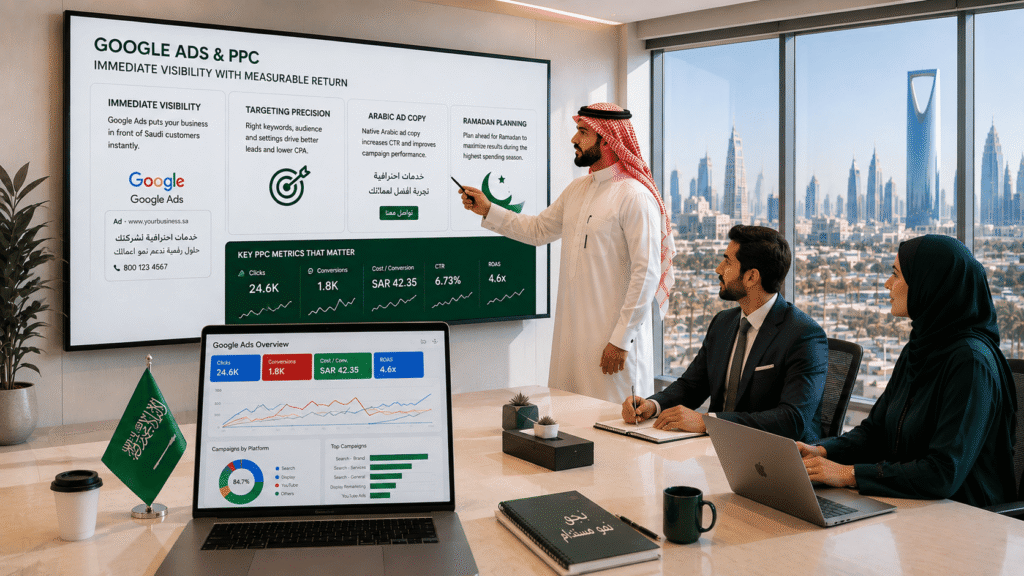
If you need leads now, Google Ads is where you get them. SEO builds over time. Paid search produces results from the first campaign.
The gap between a campaign that generates qualified leads and one that burns budget is targeting. Broad targeting fills your dashboard with clicks from people who will never buy. The right Arabic keywords, the right audience, the right device and time configuration – that is what produces enquiries at a cost that makes commercial sense for your business.
If you are running Arabic ads with translated English copy, your click-through rate is lower than it should be. Saudi consumers search in their own language and phrase their intent in ways a translator does not capture. Ad copy written by a native Arabic speaker performs differently, and that difference shows up directly in your cost per lead.
Social Media Marketing
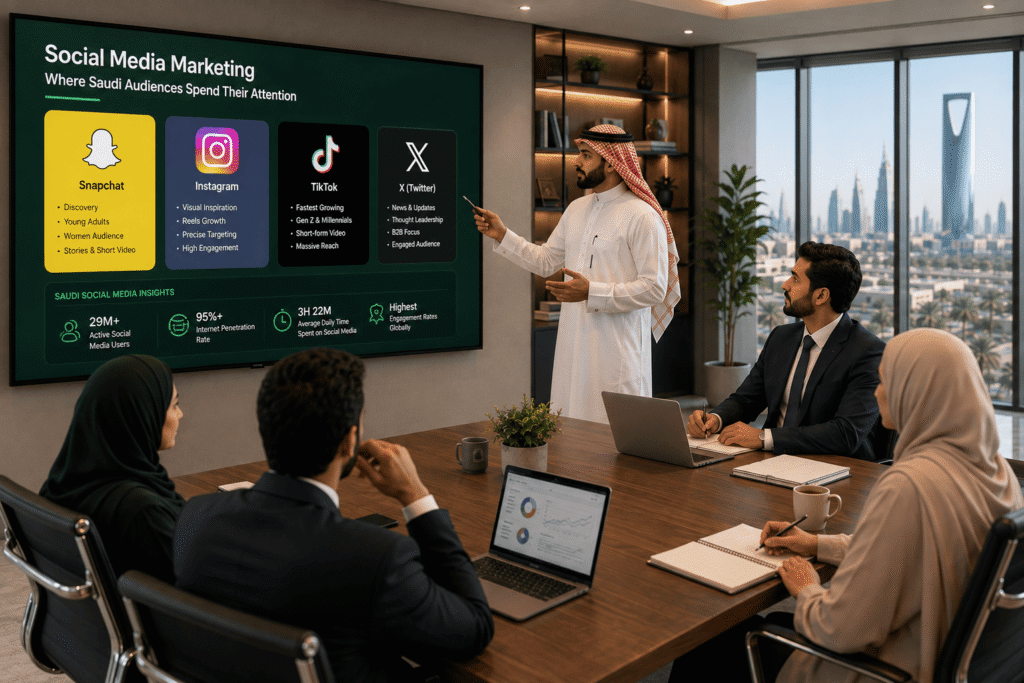
Saudi Arabia has some of the highest social media engagement rates in the world. That does not mean every platform works for every business, and posting the same content across all of them is not a strategy.
If your audience is Saudi women and young adults, Snapchat is where they are. But posting your Instagram content on Snapchat and expecting results is not using Snapchat; it is occupying it. Native short video and Stories built specifically for the platform are what perform. Repurposed content does not.
If you are in fashion, food, beauty, or lifestyle, Instagram is where your paid social budget produces the most measurable return. The targeting precision, Saudi location, age, interest, behaviour, makes it the strongest paid social platform for consumer brands in those categories.
If you are trying to reach Saudi consumers between 18 and 34, TikTok reaches that demographic at a scale no other platform matches. The content has to be built for TikTok. Content adapted from Instagram performs poorly because Saudi users can tell immediately that it was made for somewhere else.
If you are a B2B company or professional services firm, X is the platform your competitors are not using well. It is where Saudi business decision-makers engage with industry content, thought leadership, and sector commentary. Instagram and TikTok do not serve that environment.
Content Marketing
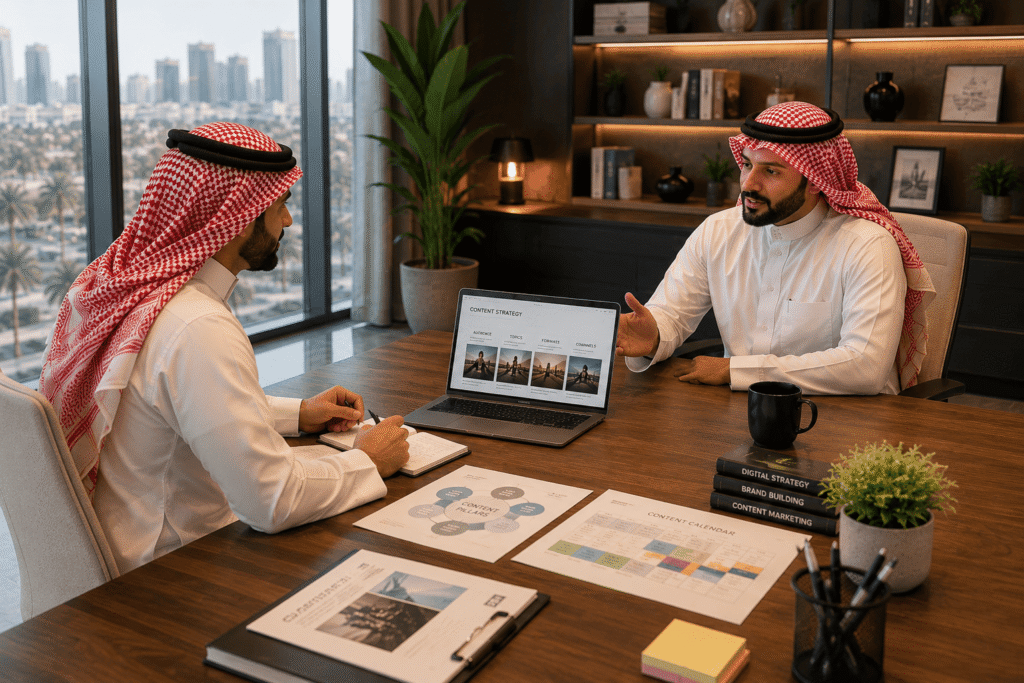
Every article, guide, or resource your business publishes in Arabic does two things. In the short term, it builds the organic search visibility that brings inbound leads without per-click cost. In the long term, it builds the authority that makes a Saudi consumer trust your business before they have ever spoken to you.
If your Arabic content is translated from English, it is underperforming. Saudi consumers know the difference between content written for them and content adapted for them. The phrasing is off. The cultural context is missing. Engagement drops, and so do rankings. Arabic-first content is not a preference, it is what the data shows works in this market
WhatsApp Marketing
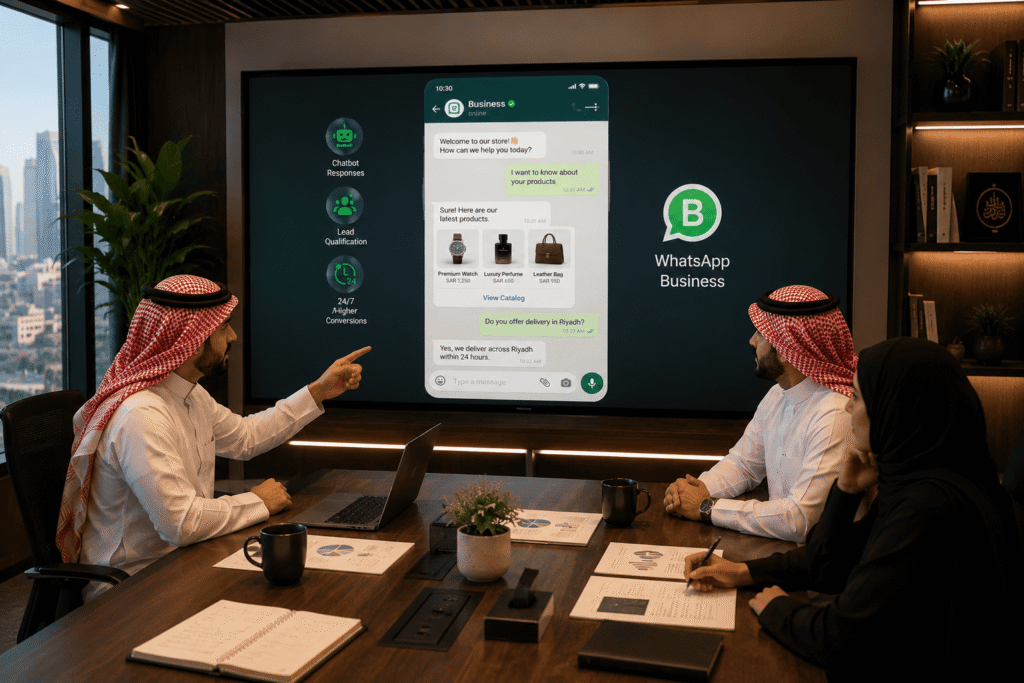
A Saudi customer who has given you their WhatsApp number and opted in to hear from you has shown more intent than any social media follower you have. They made a deliberate choice. That audience is more valuable than your entire Instagram following if you are not converting that following into enquiries.
WhatsApp automation handles the enquiries your team cannot respond to fast enough. A Saudi customer who messages you at midnight and gets an instant, relevant response is more likely to still be interested when you open in the morning. One who gets nothing until 9am has already messaged a competitor.
Influencer & Affiliate Marketing
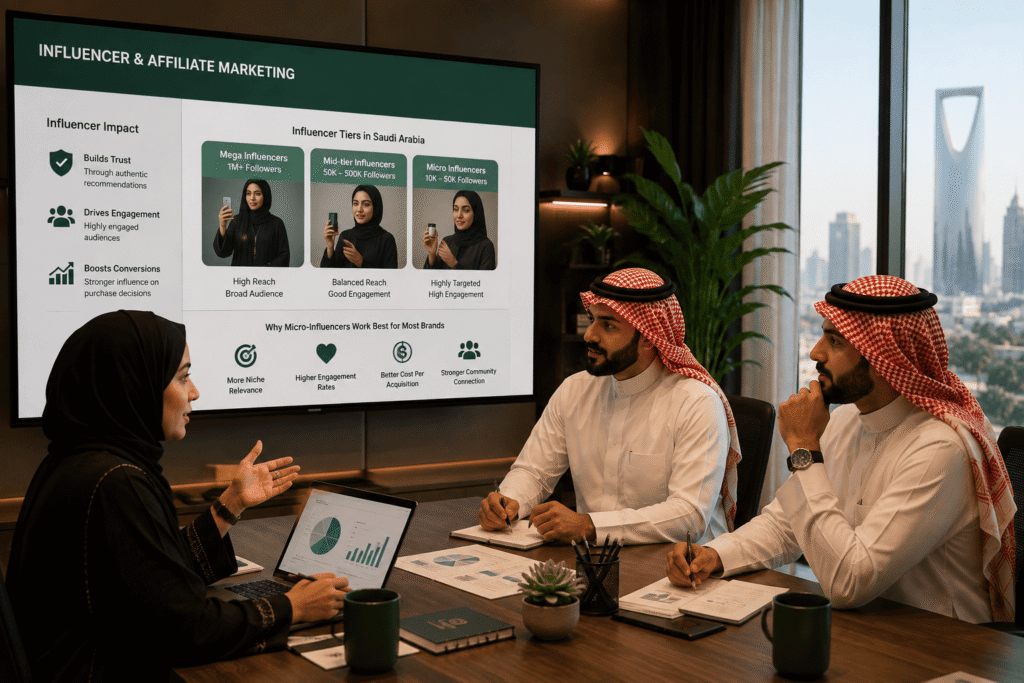
When a Saudi influencer recommends your product to their audience, the trust that audience has in that person transfers partially to your brand. That is something a paid ad cannot buy. A paid Instagram ad from your brand is an ad. The same product recommended by someone their audience chose to follow is a trusted opinion.
For most Saudi businesses, micro-influencers, ten to fifty thousand followers in a specific category, produce better results than one mega-influencer campaign. The audience is more precisely matched to what you sell, the engagement rate is higher, and the budget goes across multiple relevant partnerships instead of one high-reach placement where most of the audience has no interest in buying what you offer.
How to Build a Digital Marketing Strategy for Your Business
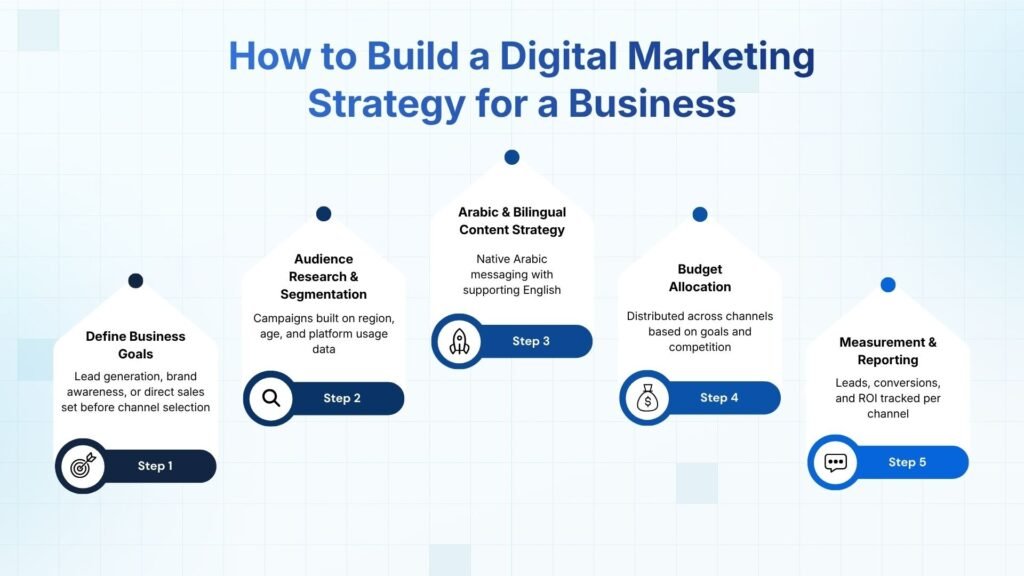
| Stage | What Happens |
| 1. Define Business Goals | Lead generation, brand awareness, or direct sales set before channel selection |
| 2. Audience Research & Segmentation | Campaigns built on region, age, and platform usage data |
| 3. Arabic & Bilingual Content Strategy | Native Arabic messaging with supporting English |
| 4. Budget Allocation | Distributed across channels based on goals and competition |
| 5. Measurement & Reporting | Leads, conversions, and ROI tracked per channel |
Define the business goal before selecting channels
A Saudi business that starts a digital marketing strategy by asking “which channels should we use” is starting in the wrong place. The channels follow from the goal. A business that needs to generate leads for a high-value service has different channel requirements than one building e-commerce sales volume or establishing brand awareness in a new Saudi market.
The goal needs to be specific, not “more leads” but “twenty qualified leads per month from Saudi businesses in the manufacturing sector at a cost per lead below SAR X.” Specificity is what makes it possible to design a strategy, set a budget, and evaluate whether the marketing is working.
Audience research and market segmentation
Saudi audiences are not uniform. Consumer behavior in Riyadh differs from Jeddah. The Saudi consumer in their thirties buying a family car has different platform habits, different content preferences, and different decision triggers than the Saudi consumer in their twenties buying fashion online. A digital marketing strategy built on real Saudi audience research outperforms one built on assumptions about what Saudi consumers want.
For B2B Saudi marketing, the segmentation is different again — which industries, which decision-maker roles, which company sizes, and what their specific pain points are in 2026 determines which channels reach them and which messages move them.
Arabic and bilingual content strategy
Arabic-first content consistently outperforms in Saudi digital marketing. Saudi consumers searching in Arabic, engaging with Arabic social content, and reading Arabic website content are served more effectively by content written for them than by content adapted from English.
A digital content strategy for a Saudi business defines what content is produced in Arabic, what is produced bilingually, what the publication cadence is across channels, and how content production connects to the SEO targets and social media calendar. Content strategy is not a content calendar. It is the plan that determines what content gets produced, for whom, on which platform, toward which commercial objective.
Budget allocation across channels
Digital marketing budget in Saudi Arabia should be distributed based on business goal, market competition, and channel maturity within the specific business. A new Saudi business establishing brand presence has different allocation requirements than an established business optimising lead generation in a competitive category.
The principle is not to be present everywhere but to be effective in the channels where the target Saudi audience actually is and where the budget is large enough to produce results rather than just activity. A SAR 10,000 monthly budget split across six channels produces nothing measurable in any of them. Concentrated into two or three channels where it is sufficient to generate real data, it produces optimisable results.
Measurement and reporting that connects to revenue
Digital marketing for Saudi businesses should produce reports that connect channel activity to business outcomes — leads generated by channel, cost per lead, lead-to-customer conversion rate, and revenue attributed to marketing. Vanity metrics — follower counts, impressions, engagement rate — are useful as diagnostic data within channel performance. They are not the metrics that justify marketing investment to a Saudi business owner or CFO.
The measurement infrastructure needs to be set up before campaigns run, not built retrospectively when the question “what did we get from this?” arrives. UTM tracking, conversion tracking on forms and WhatsApp clicks, and CRM integration for lead attribution are technical requirements that determine whether the marketing is measurable or just active.
Which Saudi Businesses Need a Stronger Digital Marketing Strategy Right Now
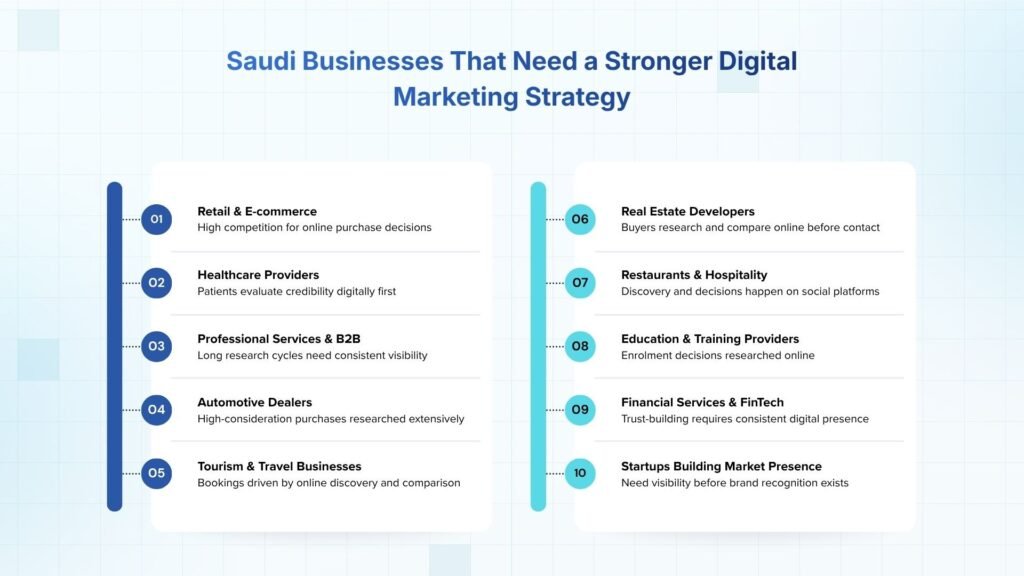
| Industry | Why It Applies |
| Retail & E-commerce | High competition for online purchase decisions |
| Real Estate Developers | Buyers research and compare online before contact |
| Healthcare Providers | Patients evaluate credibility digitally first |
| Restaurants & Hospitality | Discovery and decisions happen on social platforms |
| Professional Services & B2B | Long research cycles need consistent visibility |
| Education & Training Providers | Enrolment decisions researched online |
| Automotive Dealers | High-consideration purchases researched extensively |
| Financial Services & FinTech | Trust-building requires consistent digital presence |
| Tourism & Travel Businesses | Bookings driven by online discovery and comparison |
| Startups Building Market Presence | Need visibility before brand recognition exists |
Digital marketing is not equally urgent across all Saudi businesses. For some, the absence of a structured strategy is a missed opportunity. For others, it is the primary reason growth has stalled while competitors with the same product and the same pricing are capturing the demand they should be.
Retail & E-commerce Brands
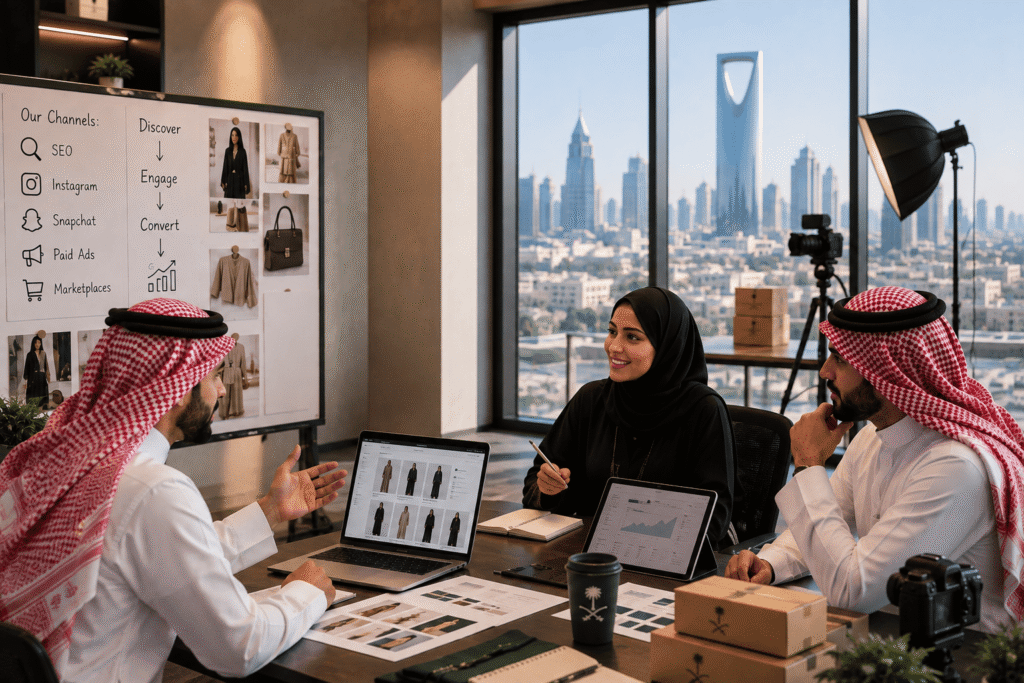
Your Saudi customer has already decided what they want before they open your store. They searched for it, saw it on Instagram, compared prices on Noon, and are now one tap away from buying. From you or from a competitor. If your product pages are not ranking for the terms they searched, a competitor’s page is. If your paid social is not running on the platforms where Saudi consumers discover products, you are not in that conversation.
The specific problem for most Saudi retail brands is single-channel dependency. If your traffic comes primarily from one source, whether marketplace listings, one social platform, or paid ads alone, a fee increase or an algorithm change stops your revenue. A structured multi-channel strategy means no single platform owns your customer acquisition. Alongside that strategy, e-commerce solutions development should be considered if your current store can’t support the channels or checkout flow the strategy actually needs.
Real Estate Developers & Agencies
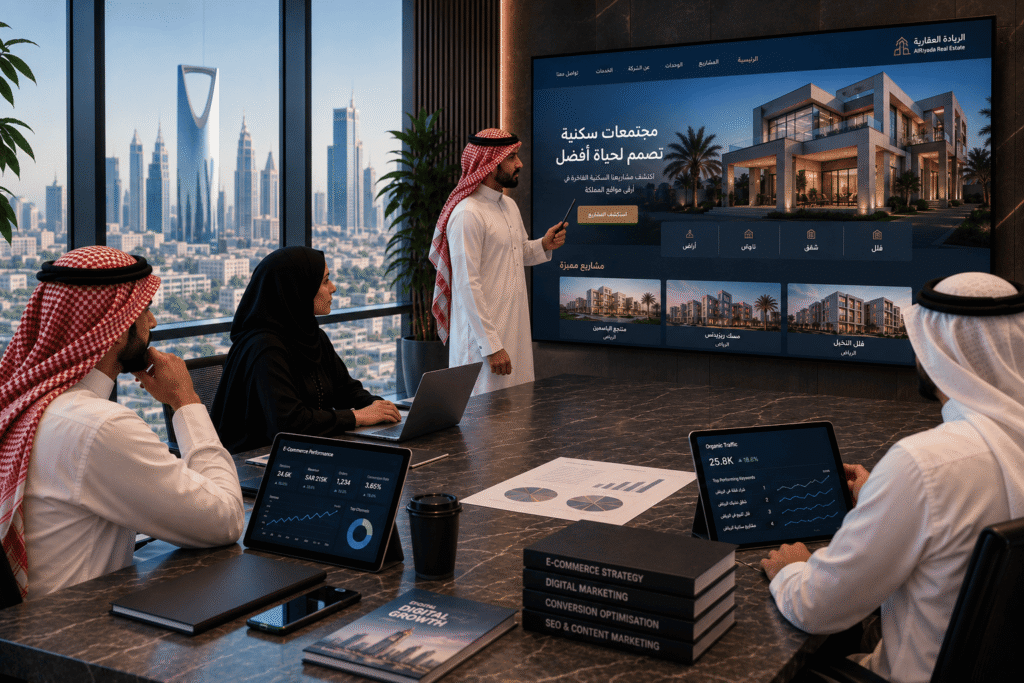
A Saudi buyer researching a SAR 1.5 million apartment does not call until they have already decided who they trust. That research happens on Google, on Instagram, and on YouTube, months before contact. If your search presence is weak, you are not in consideration during the phase that actually determines who gets the enquiry.
Real estate is also one of the most competitive categories in Saudi Google Ads. If you are running broad keywords without conversion-optimised landing pages behind them, you are paying for traffic that has no path to an enquiry form. The cost per lead reflects that. The fix is not more budget. It is correct keyword targeting, ad copy written for intent, and landing pages built around the specific development, not a generic company page.
Healthcare Providers
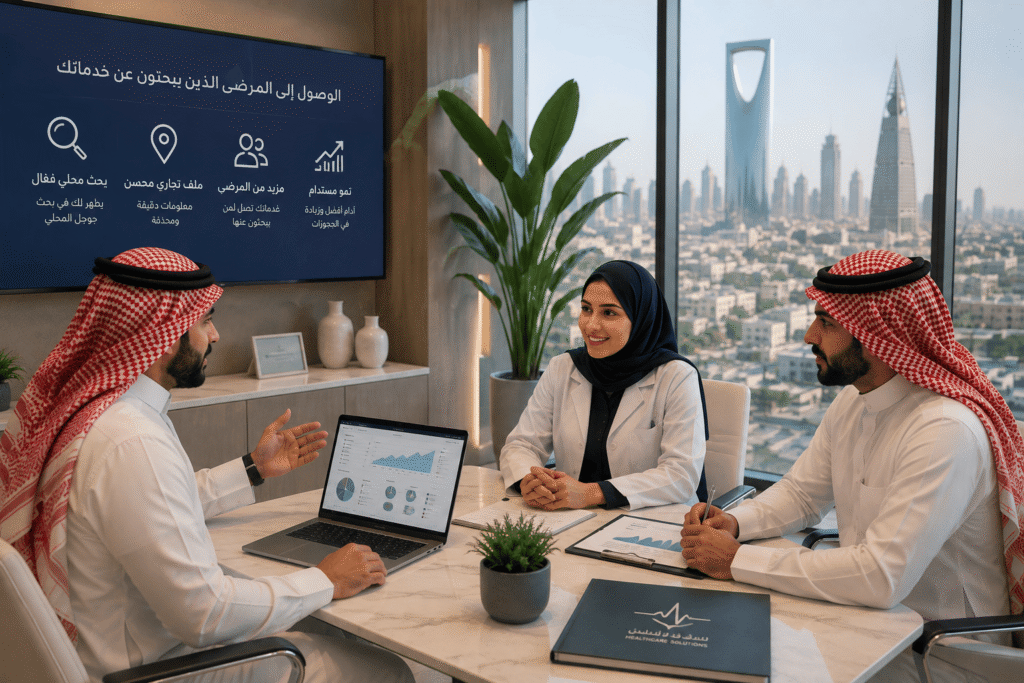
Your patients are searching for exactly what you offer, and they are choosing between the results on the first page. If your clinic is not there, they are booking with someone who is. That is not a brand awareness problem. It is a local SEO problem with a direct fix.
For clinics and specialist practices in Riyadh and Jeddah, Google Business Profile optimisation and local SEO are the highest-return digital marketing investments available. They capture patients who are already searching for your service, in your city, ready to book. What you are losing by not appearing there is not impressions. It is booked appointments.
Restaurants & Hospitality Businesses
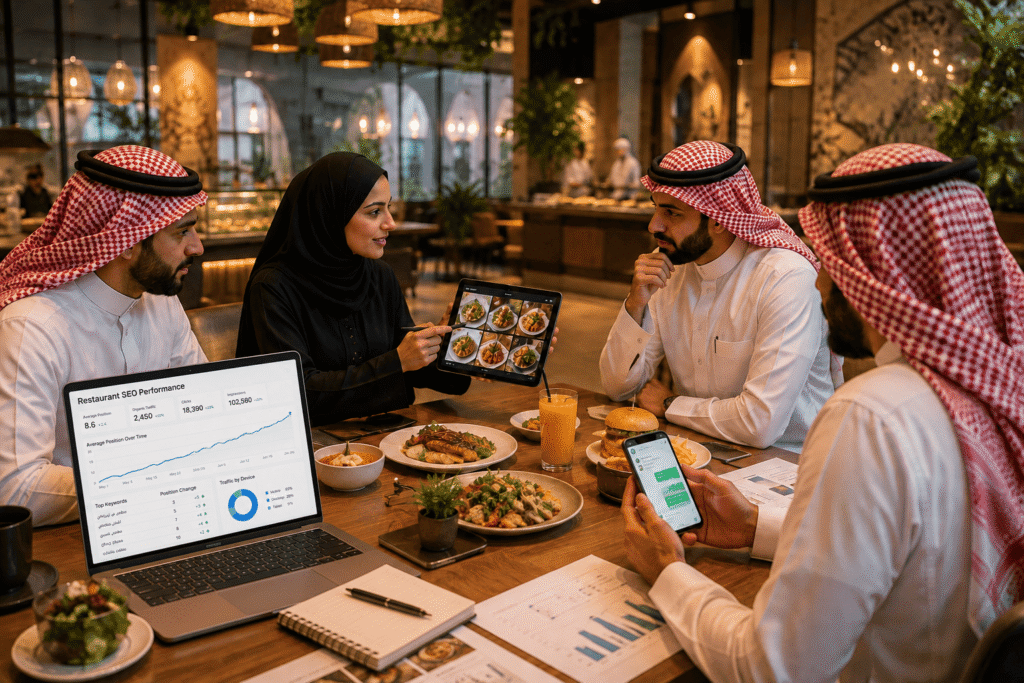
Saudi diners do not discover restaurants on Google first. They find them on Instagram, TikTok, and Snapchat, through a video of the food, a story from someone they follow, or a reel that showed up on their feed. If your restaurant does not have a consistent visual presence on those platforms with content built specifically for each one, you are not part of that discovery process.
The second problem most Saudi restaurants have not solved is retention. A customer who visited once and enjoyed the experience is a repeat customer if you stay in front of them. WhatsApp follow-up after a reservation, a thank-you message, a Ramadan promotion, a weekend offer, is the channel that turns a first visit into a regular. Most Saudi restaurants are not using it.
Professional Services & B2B Companies
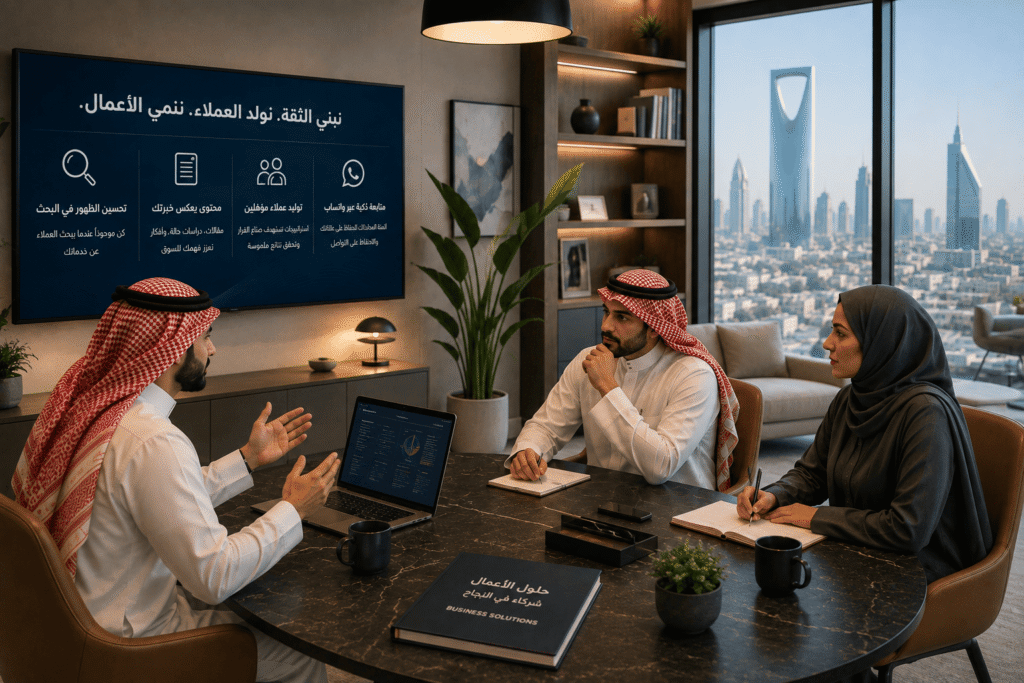
A Saudi procurement manager evaluating three consulting firms does not make that shortlist based on a sales call. They make it based on what they found when they searched your company name, read your case studies, and assessed whether your content demonstrates expertise in their sector. If that search returns a thin website with no demonstrated work, you are off the list before the conversation starts.
B2B digital marketing in Saudi Arabia requires a longer lead cycle than B2C. The content that builds your credibility, sector-specific guides, client results, thought leadership, takes time to produce and rank. WhatsApp automation is what keeps warm leads engaged during that cycle, so a prospect who showed intent three weeks ago does not go cold before your sales team follows up.
Education & Training Providers
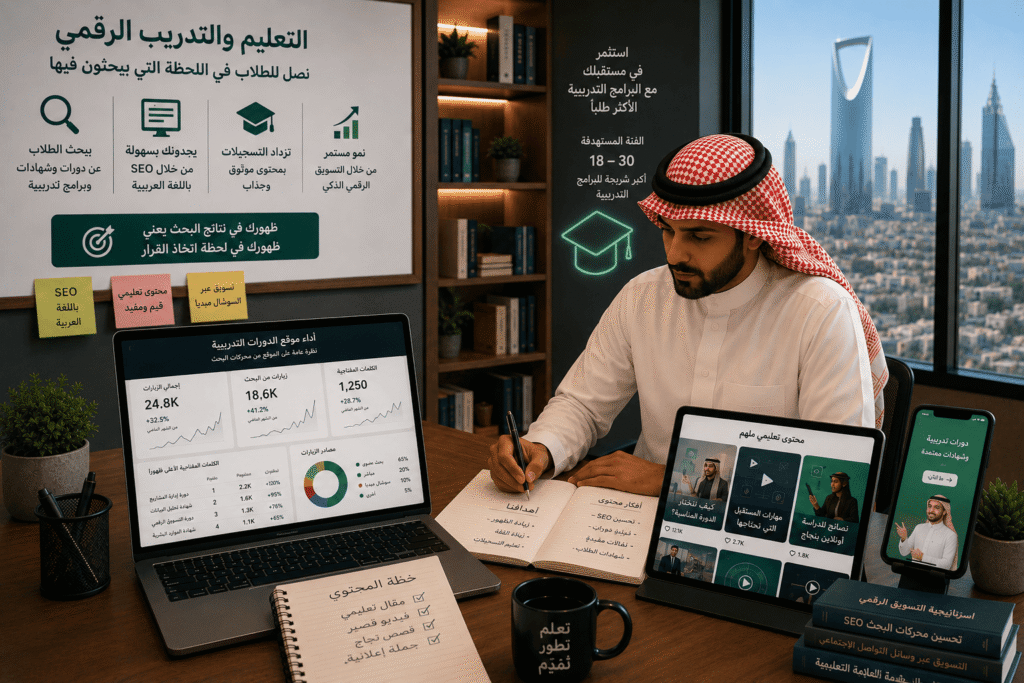
A Saudi professional looking for a certification or a training program starts with a Google search. If your institution is not appearing for the specific qualification terms they are searching, not generic “training programs” but the exact course or credential name, you are not being found at the moment of highest intent.
For younger Saudi audiences between 18 and 30, course discovery also happens on Snapchat and TikTok before it happens on search. If your social presence on those platforms is not building awareness of your programs among that demographic, you are dependent entirely on search and missing the audience that represents the majority of enrolment enquiries for professional training.
Automotive Dealers & Related Businesses
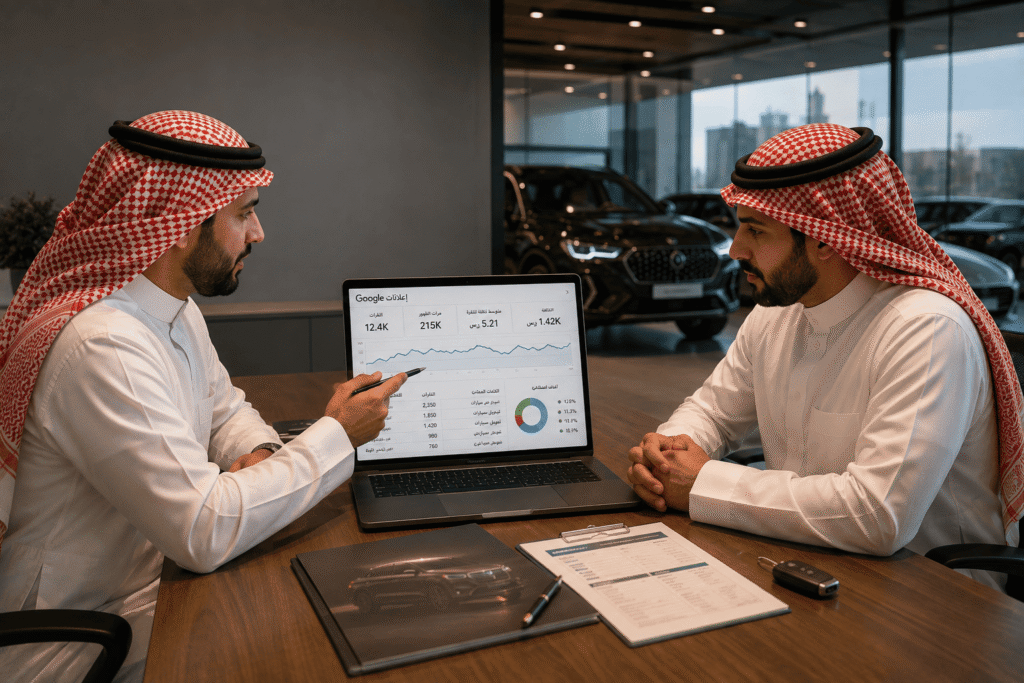
A Saudi buyer researching a new car starts that process six to twelve months before they walk into a showroom. During that time they are searching model names, watching comparison videos on YouTube, and following automotive content on Instagram. The dealer they buy from is almost always one they encountered during that research phase, not one they discovered at the point of decision.
If your Google Ads are only running on high-intent purchase terms and your content presence is weak during the earlier research phase, you are entering the conversation too late. The dealers capturing Saudi automotive buyers are visible across the full research cycle: search ads for buyers close to deciding, and content on YouTube and Instagram for buyers still forming their preference.
Financial Services & FinTech Companies
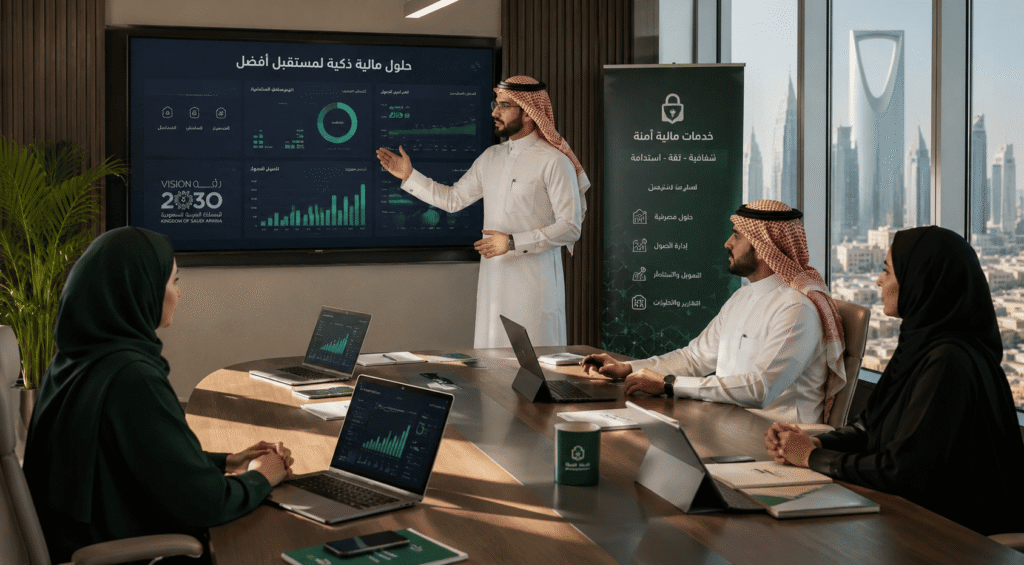
Saudi consumers do not trust a financial product they found once in a paid ad. Trust in financial services is built through repeated visibility, appearing in search results for the financial questions they are asking, producing content that explains your product clearly, and maintaining a consistent presence that makes your brand familiar before they are ready to convert.
SAMA content guidelines affect what you can say and how you can say it. That constraint makes organic content more important, not less, because educational content that answers real financial questions builds the trust that a promotional ad cannot, and it does so within the boundaries that govern your category.
Tourism & Travel Businesses
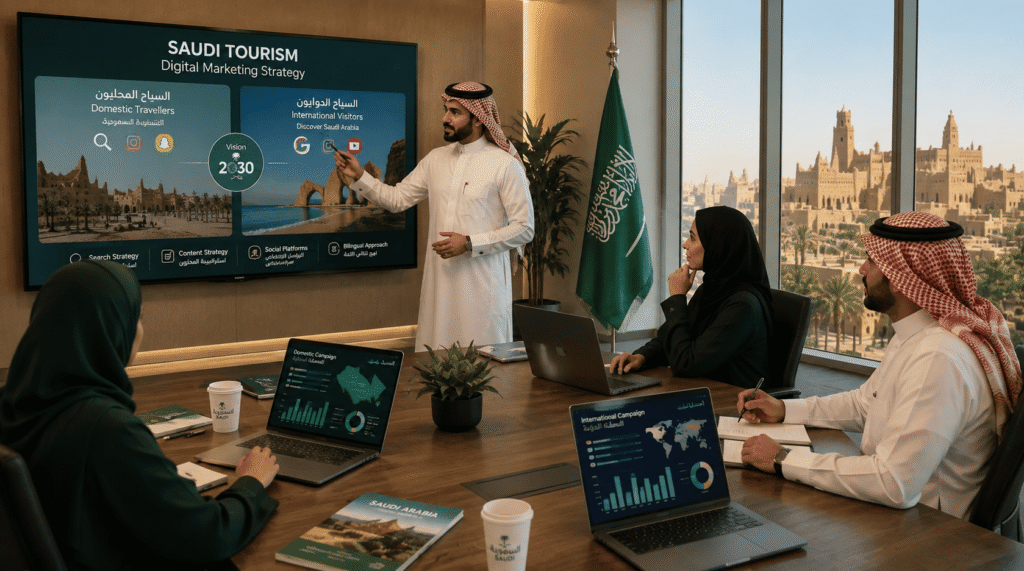
Your domestic Saudi audience and your international audience are not the same search, not the same platform, and not the same content. A Saudi family planning a domestic holiday discovers destinations on Snapchat and Instagram and searches on Google. An international visitor planning a trip to Saudi Arabia searches in English, uses TripAdvisor and Google, and makes decisions based on English-language content that does not exist for most Saudi tourism businesses.
Running one content strategy and expecting it to serve both audiences produces results for neither. A bilingual digital marketing strategy for domestic and international travellers needs to be planned as one coherent program, not two unconnected efforts managed separately.
Digital Marketing for Saudi Startups
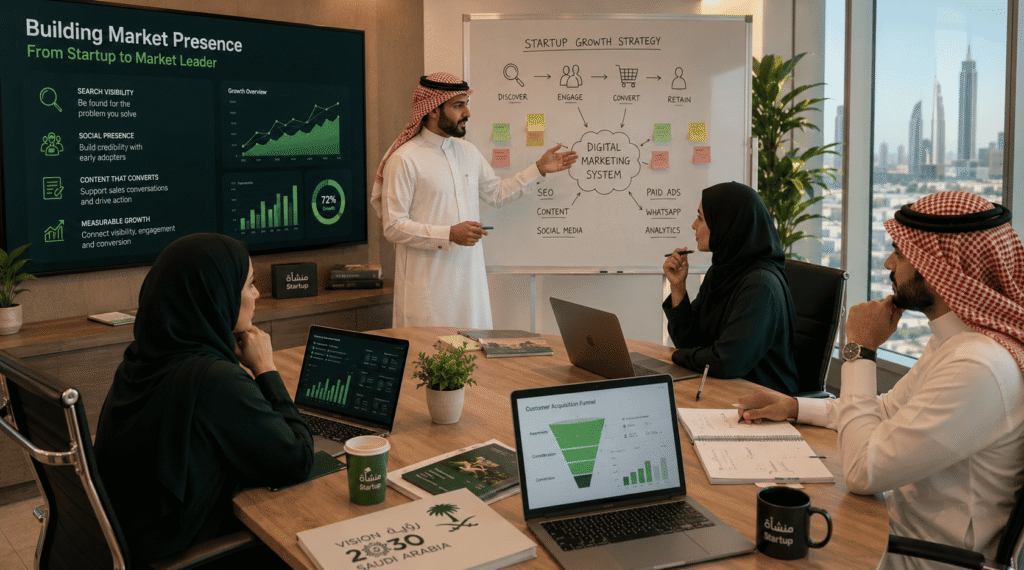
If you are a Saudi startup, your competitors with more brand recognition are getting the organic traffic and the search visibility you need. Every month you operate without structured SEO, the gap widens. Every month your paid ads are carrying all your acquisition cost without organic channels being built in parallel, your cost per customer stays high.
The priority at early stage is not to be everywhere. It is to be visible for the specific problem you solve, for the Saudi audience most likely to be your first customers, and to build the content that supports the sales conversations your team is having manually before digital marketing can scale those conversations.
The pattern across every sector is the same. The businesses capturing Saudi digital demand are not outspending their competitors. They are visible in the right channels, at the right stage of the customer’s decision, with content built for how Saudi customers actually search and decide.
If you want to figure out where your business fits into that pattern, book a free consultation with our experts, contact us on WhatsApp, leave a message, and we will get back to you.
What Does Digital Marketing Cost in Saudi Arabia?
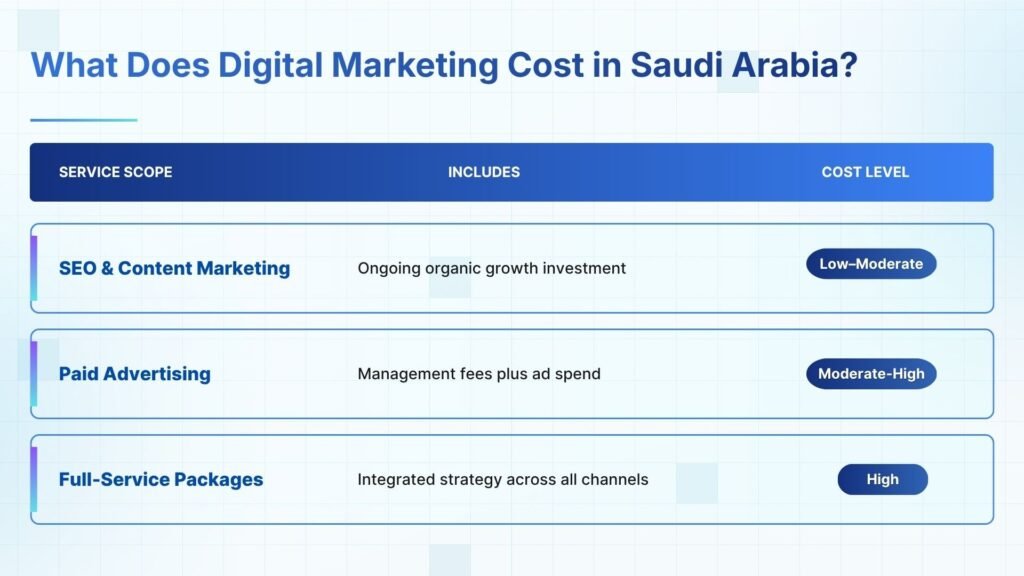
| Service Scope | Includes | Cost Level |
| SEO & Content Marketing | Ongoing organic growth investment | Low–Moderate |
| Paid Advertising | Management fees plus ad spend | Moderate–High |
| Full-Service Packages | Integrated strategy across all channels | High |
Digital marketing cost in Saudi Arabia is driven by scope, channel mix, competitive intensity in the target category, and whether the service covers strategy, execution, or both.
SEO and content marketing
The lowest cost per lead of any digital channel over time — and the slowest to produce initial results. A Saudi SEO program covering Arabic keyword research, technical optimisation, and ongoing Arabic content production requires a monthly development investment that typically produces measurable organic ranking improvements within three to six months and compounding return beyond that.
Paid advertising management
Two cost components: the management fee for the agency or consultant running the campaigns, and the ad spend going to Google or Meta. Management fee scales with campaign complexity and the number of platforms being managed. Ad spend in Saudi Arabia varies significantly by category — competitive categories like real estate, automotive, and financial services have higher cost-per-click in Arabic Google Ads than less competitive categories.
Social media marketing
Social media management cost covers content creation, community management, and paid social media advertising. For Saudi brands requiring Arabic content production, the content creation cost is higher than English-only social management because Arabic copywriting and Arabic video production require specific capability.
Full-service digital marketing
The highest cost tier — an integrated digital marketing services engagement covering SEO, paid advertising, social media, content marketing, and WhatsApp marketing together. Appropriate for Saudi businesses that need all channels managed as a coherent strategy rather than as separate activities. The cost is higher but the absence of coordination gaps between channels — where inconsistent messaging or timing conflicts reduce overall effectiveness — produces better results per riyal spent than managing channels with separate providers.
Digital Marketing Quick Decision Guide
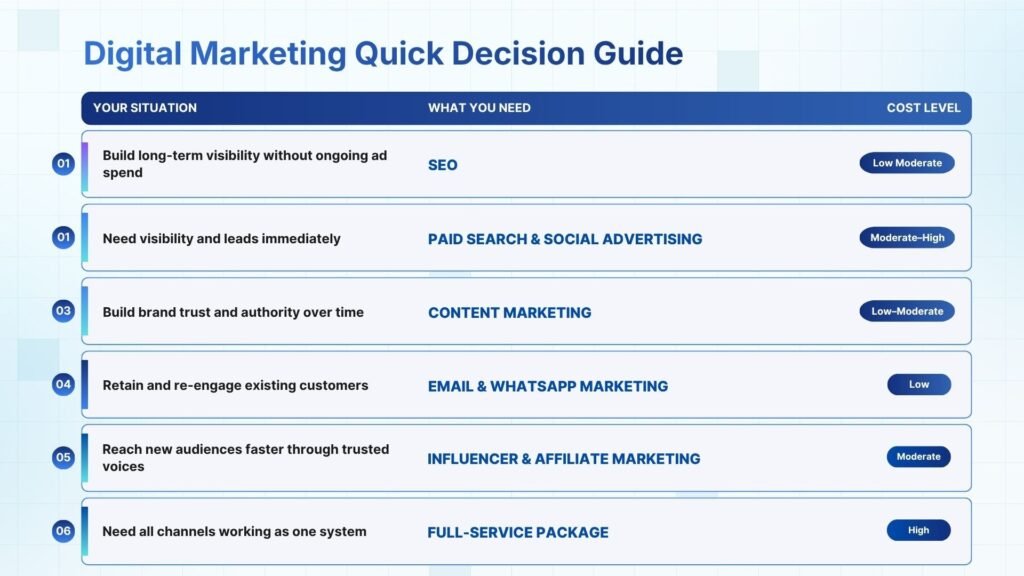
| Your Goal | What You Need | Cost Level |
| Build long-term visibility without ongoing ad spend | SEO | Low–Moderate |
| Need visibility and leads immediately | Paid Search & Social Advertising | Moderate–High |
| Build brand trust and authority over time | Content Marketing | Low–Moderate |
| Retain and re-engage existing customers | Email & WhatsApp Marketing | Low |
| Reach new audiences faster through trusted voices | Influencer & Affiliate Marketing | Moderate |
| Need all channels working as one system | Full-Service Package | High |
Common Mistakes Saudi Businesses Make With Digital Marketing
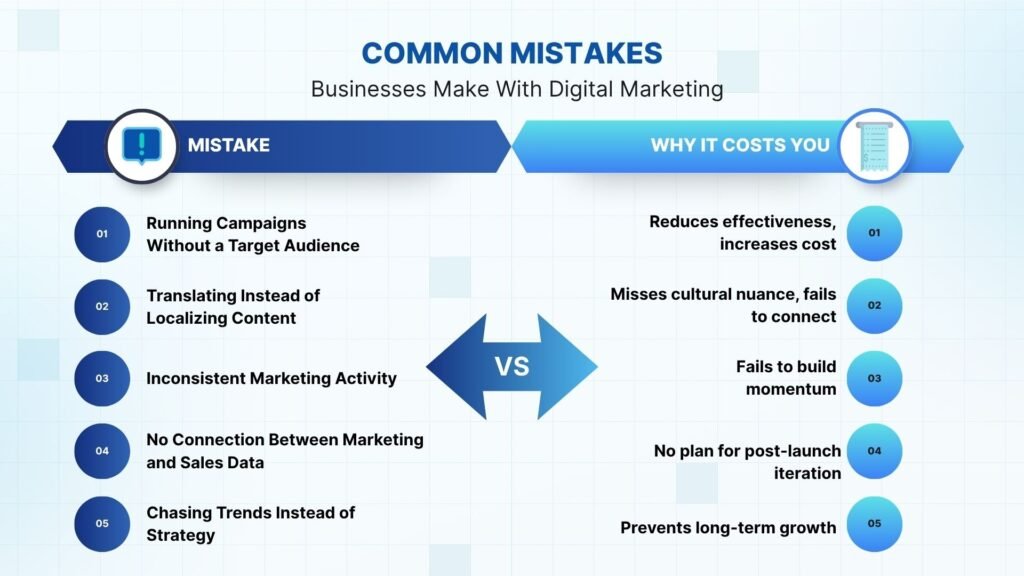
| Mistake | Consequence |
| Running Campaigns Without a Target Audience | Reduces effectiveness, increases cost |
| Translating Instead of Localizing Content | Misses cultural nuance, fails to connect |
| Inconsistent Marketing Activity | Fails to build momentum |
| No Connection Between Marketing and Sales Data | Can’t measure true ROI |
| Chasing Trends Instead of Strategy | Prevents long-term growth |
Why Etihad Falcon Tech is the Leading Digital Marketing Company in Saudi Arabia
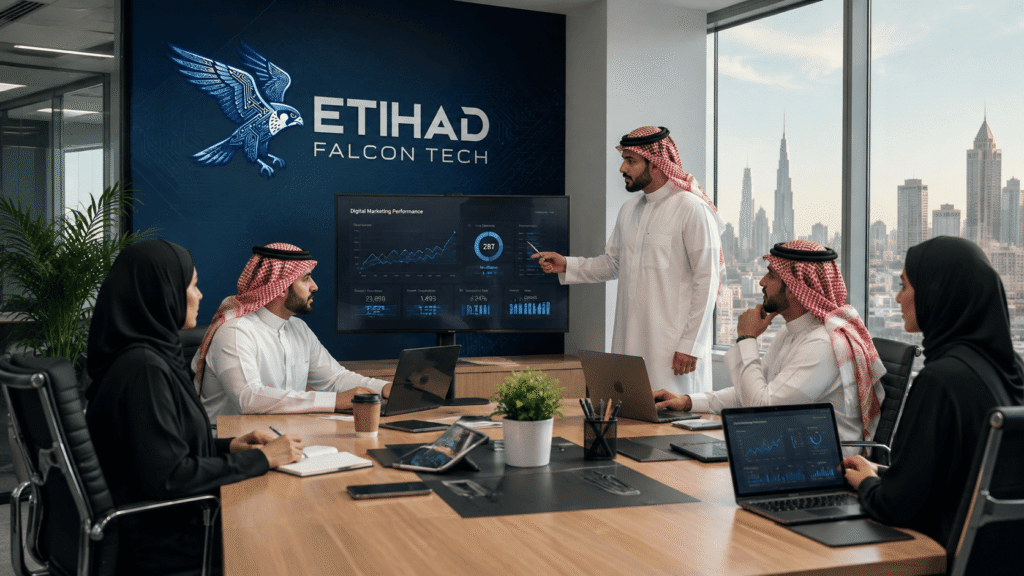
Etihad Falcon Tech’s digital marketing engagements start with the commercial objective. Before any campaign is built or any content is produced, the business goal, the target Saudi audience, and the measurement framework are defined. The channel mix follows from that definition rather than being proposed as a standard package.
Arabic-first strategy and execution
Arabic keyword research, Arabic ad copy, Arabic social content, and Arabic SEO, these are not translation tasks in Etihad Falcon Tech’s process. They are original Arabic-language work produced by team members who understand Saudi consumer language, cultural context, and platform-specific communication norms. The difference between translated content and native Arabic digital marketing content shows up in engagement rates and conversion rates within the first campaign cycle.
Saudi market channel expertise
Snapchat audience behavior in Saudi Arabia, Ramadan campaign timing for Saudi Google Ads, local SEO for Riyadh and Jeddah versus national Saudi search, and WhatsApp Business API setup for Saudi lead management, these are not generic digital marketing capabilities. They are Saudi-market-specific knowledge that a digital marketing agency riyadh or Jeddah focused business has built through operating specifically in this market. Etihad Falcon Tech has delivered digital marketing campaigns for Saudi businesses across retail, healthcare, real estate, professional services, and B2B sectors.
Full-spectrum digital marketing services
SEO, paid search and social advertising, social media management, content marketing, WhatsApp marketing, and influencer campaign management, we manage the full digital marketing services stack internally rather than coordinating between separate specialist providers with no shared accountability for the overall result. The consistency in strategy, messaging, and measurement that comes from one team managing all channels produces better results than the coordination overhead of multiple separate agency relationships.
Measurement built in from the start
Every Etihad Falcon Tech digital marketing engagement includes the measurement infrastructure, conversion tracking, attribution setup, CRM integration, and reporting framework, before campaigns run. Saudi business owners and marketing directors receive reports that connect channel activity to leads generated, lead quality, and revenue attributed to marketing rather than activity reports that show impressions and engagement without connecting them to commercial outcomes.
Frequently Asked Questions
What does digital marketing include for a Saudi business?
SEO in Arabic and English, Google Ads, social media marketing across Snapchat, Instagram, TikTok, and X, Arabic content marketing, WhatsApp automation, and influencer partnerships. The channels depend on your audience and commercial objective — not a standard package.
How much does digital marketing cost in Saudi Arabia?
It depends on scope, channel mix, and how competitive your category is. SEO has ongoing monthly costs with compounding return over time. Paid advertising splits into management fees and ad spend. Full-service costs more but removes the coordination gaps that hurt results when channels are managed separately.
Which digital channel works best in Saudi Arabia?
There is no single best channel. SEO builds long-term organic visibility. Google Ads and PPC generate leads immediately. Snapchat, Instagram, and TikTok build discovery and familiarity. WhatsApp converts the leads other channels generate. A structured strategy uses them together.
Should content be in Arabic or English?
Arabic-first. Saudi consumers searching and buying in Arabic are better served by content written for them than translated from English. English works where your audience is bilingual or international. For most Saudi businesses, a bilingual strategy with Arabic as the primary language outperforms either alone.
How long does it take to see results from digital marketing in Saudi Arabia?
Paid advertising produces leads from the first campaign. SEO takes three to six months for measurable ranking improvement, with compounding return after that. Social media builds audience over months, with conversion results depending on how it connects to a defined path. Your starting position affects the timeline significantly.
What is the difference between SEO and paid ads for Saudi businesses?
SEO builds organic visibility over time and generates leads without per-click cost once rankings are established. Paid ads deliver immediate visibility at a cost that continues as long as campaigns run. Most effective strategies use both — paid for immediate leads, SEO to reduce paid dependency over time.
How do I measure whether digital marketing is working for my Saudi business?
By connecting channel activity to business outcomes — leads by channel, cost per lead, and revenue attributed to marketing. This requires conversion tracking, UTM parameters, and CRM integration set up before campaigns run. Follower counts and engagement rates are diagnostic signals, not the measures that justify marketing spend.
How does Etihad Falcon Tech approach digital marketing for Saudi businesses?
We start with your commercial objective and target audience before selecting any channel or producing any content. Arabic-first strategy, Saudi-market platform expertise, and measurement infrastructure are standard in every engagement. The full channel stack is managed internally by one team, and every report connects activity to leads and revenue — not just impressions.