
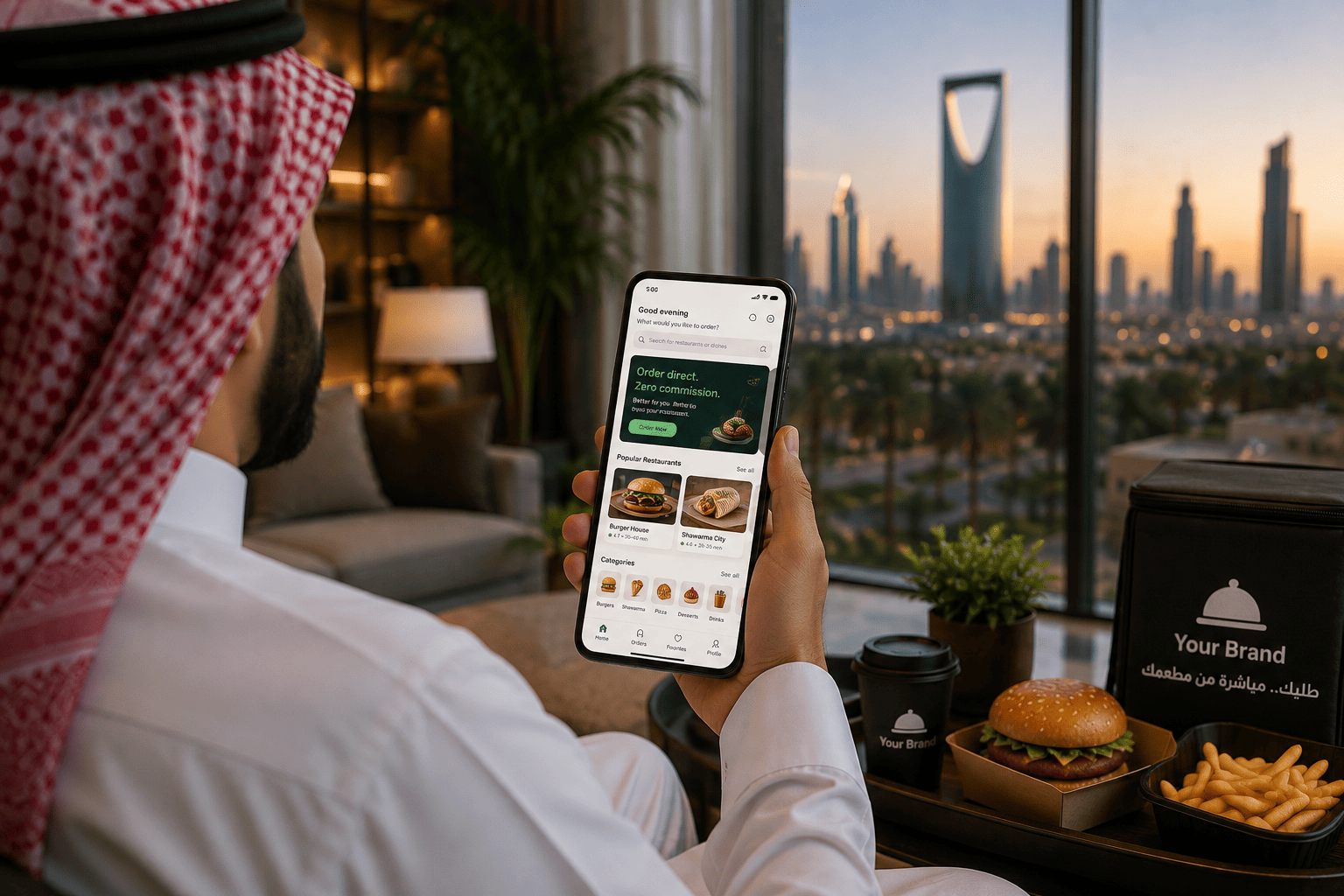
Saudi Arabia’s online food delivery market is projected to grow from USD 7.98 billion in 2024 to USD 12.98 billion by 2030, according to Grand View Research, at a compound annual growth rate of 9 percent. Restaurants across the Kingdom are feeling that demand directly: more orders, more delivery volume, more customers discovering them through an app instead of a phone call.
So why are more Saudi restaurants building their own delivery app instead of just riding the demand platforms are already bringing them? Because the order and the customer are not the same thing. A platform brings you the order. It does not bring you the customer, their number, their order history, or any reason to come back to you specifically instead of whichever restaurant the app shows them next.
Fifteen to thirty percent of every order goes to the platform before your food cost, packaging, or labour is even accounted for. Revenue grows. Margin does not follow it. And the relationship that should be getting stronger with every repeat order sits inside a system you do not control and cannot export. A delivery app is one part of a bigger shift happening across the Kingdom; more restaurants are treating mobile app development as core infrastructure rather than a side project.
This guide covers what food delivery app development actually takes for a Saudi restaurant or chain: how a direct app differs from Talabat and HungerStation, what it needs to work for the Saudi market, what it costs, and how it connects to the POS and kitchen systems you already run on.
How Does a Direct Food Delivery App Differ From Talabat or HungerStation?
Third-party platforms sit between the restaurant and the customer. That position gives them control over three things that matter to your business: visibility, order flow, and the customer relationship itself.
On a platform, your ranking depends on their algorithm. Your repeat customer is their repeat user. When that customer orders again next week, the platform decides whether they see you or a competitor first.
A direct restaurant mobile app removes that layer entirely. Orders come straight into your system. You own the customer record — their order history, preferences, and contact details. You decide when to reach out, what to offer, and how to bring them back.
One model rents you demand. The other lets you build ownership of it. The operational difference between those two is what determines whether delivery actually grows your business long term or just adds transaction volume at compressed margins.
Why Are Saudi Restaurants and F&B Chains Moving Away From Third-Party Platforms?
Restaurants are not leaving delivery platforms completely. Most continue using them for discovery and new customer acquisition. The shift is about reducing dependency on them for revenue that should already be coming back directly.
That shift usually starts when order volume grows but margins do not follow.
How commission fees affect restaurant profit margins
Third-party platforms in Saudi Arabia typically charge between 15 and 30 percent commission per order depending on the platform, your agreement, and the category you operate in.
On a 50 SAR order, that is 7 to 15 SAR per transaction going to the platform before your food cost, packaging, or labour is accounted for. As delivery volume increases, that deduction scales with it. Revenue grows on paper. Profit stays under pressure.
For high-volume operations or chains running significant delivery numbers, this is not a small inefficiency. It is a structural drag on the business model.
Why owning your customer data matters for repeat orders
On third-party platforms, the customer belongs to the platform. You see the order details. You do not see the relationship behind it.
You cannot identify which customers order most frequently. You cannot run a direct promotion to bring someone back after a gap. You cannot build a loyalty program around actual ordering behavior because the behavior data sits in someone else’s system.
Direct food ordering app development solves this at the foundation. Every order builds a customer profile you control. That profile is what repeat revenue is actually built on.
What Can a Direct Food Delivery App Actually Do for a Saudi Restaurant or Chain?
Direct restaurant app development turns delivery from a marketplace dependency into a controlled revenue channel.
Orders arrive directly into your system. Customer data stays inside your business. Promotions run without platform approval or commission implications. Pricing decisions are yours.
For chains, this also means consistent control across all branches from a single dashboard, instead of managing fragmented listings across multiple platform accounts with no unified view of performance.
What Does a Food Delivery App Need to Work Well in Saudi Arabia?
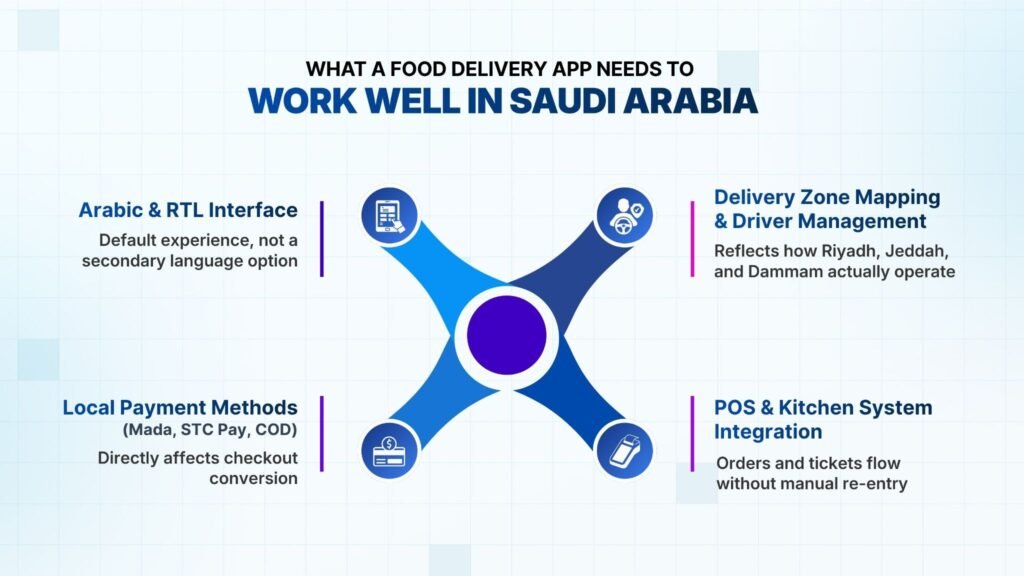
| Requirement | Why It Matters |
| Arabic & RTL Interface | Default experience, not a secondary language option |
| Local Payment Methods (Mada, STC Pay, COD) | Directly affects checkout conversion |
| Delivery Zone Mapping & Driver Management | Reflects how Riyadh, Jeddah, and Dammam actually operate |
| POS & Kitchen System Integration | Orders and tickets flow without manual re-entry |
Restaurant mobile app development for Saudi Arabia is not a global template with Arabic added on top. The market has specific requirements that affect whether customers actually complete orders or drop off before checkout.
Arabic language and right-to-left interface support
The app must work naturally in Arabic as the default experience, not as a secondary language option. Right-to-left structure affects layout, navigation, menu display, and checkout flow. An app that handles this poorly signals to Arabic-speaking customers that it was not built for them.
Local payment methods: Mada, STC Pay, and cash on delivery
Payment options directly affect conversion at checkout. Saudi customers expect Mada and STC Pay as standard options. Cash on delivery remains relevant in many customer segments. If the payment options feel foreign or limited, orders drop at the final step, after you have already paid to acquire that customer.
Delivery zone mapping and driver management for Saudi cities
Riyadh, Jeddah, and Dammam each have distinct delivery patterns — traffic conditions, neighbourhood density, and customer distribution vary significantly. The system needs accurate zone mapping, driver assignment logic, and delivery time management that reflects how these cities actually operate, not a generic radius-based model.
Food Delivery Apps for Different F&B Business Types
| Business Type | Key App Requirement |
| Single-Location Restaurants | Clean ordering, reliable local delivery, direct repeat customer base |
| Multi-Branch Chains | Centralised menu/pricing control with branch-level performance visibility |
| Cloud Kitchens & Delivery-Only Brands | Order volume control, dispatch speed, kitchen load management |
Not every restaurant operates the same way. The right app structure depends on how your business runs.
Single-location restaurants
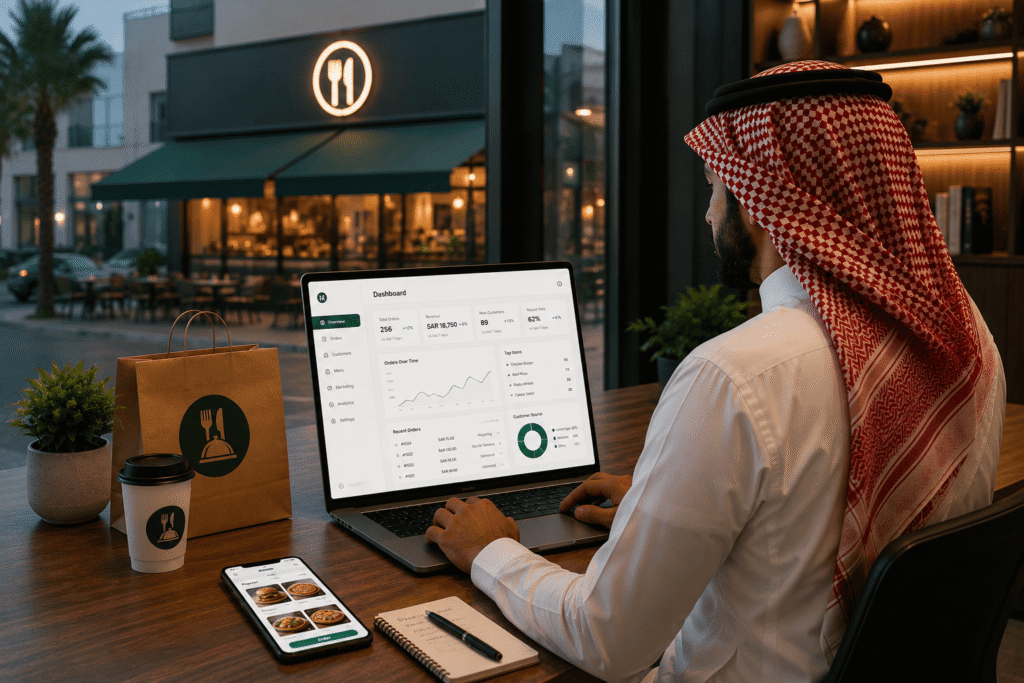
The focus is on clean ordering, reliable local delivery, and building a direct repeat customer base. The system does not need to be complex, but it needs to work without friction at every step.
Multi-branch chains
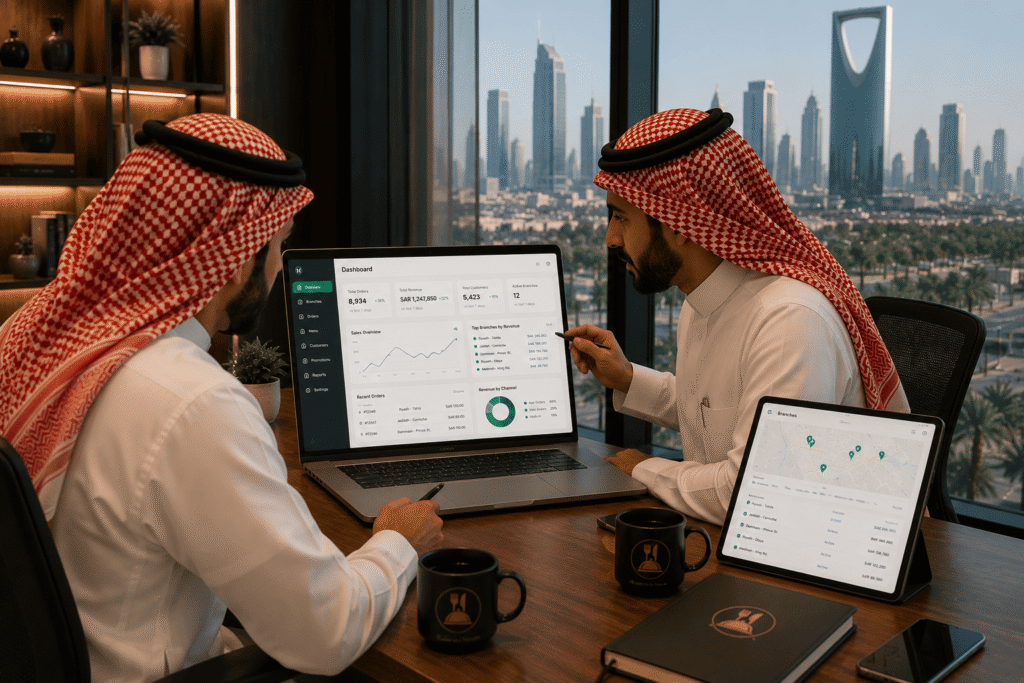
Chains need centralised control over menus, pricing, and promotions across all locations, with branch-level visibility into performance. A custom food delivery application development approach matters here because off-the-shelf solutions rarely handle Saudi multi-branch operations cleanly.
Cloud kitchens and delivery-only brands
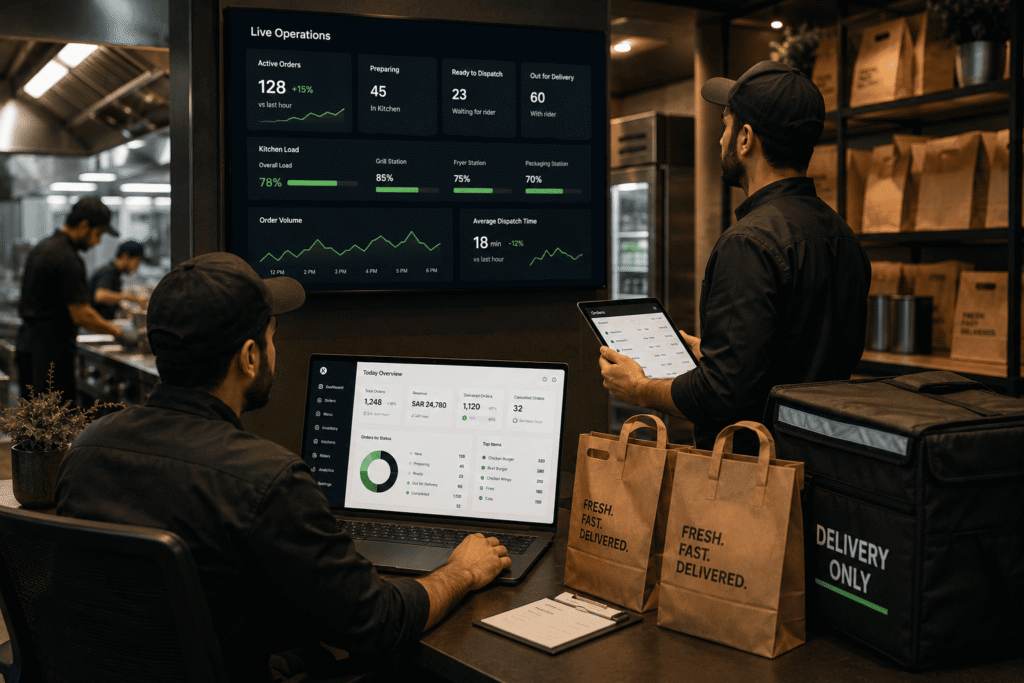
These operations live or die on delivery efficiency. Order volume control, dispatch speed, and kitchen load management are the critical variables. The app structure needs to prioritise these over features designed for dine-in contexts.
How Does a Food Delivery App Integrate With Your Existing POS and Kitchen Systems?
For most Saudi restaurants and chains, a new delivery app does not replace your existing operations infrastructure. It needs to connect to it.
POS integration means orders placed through the app flow directly into your existing system without manual re-entry. That removes a significant source of error and delay, particularly during high-volume periods.
Kitchen management integration means order tickets reach the kitchen in the right format and sequence, matching how your kitchen already works rather than creating a parallel workflow your team has to manage separately.
For chains running multiple POS configurations across branches, this integration layer requires careful scoping. The app needs to communicate correctly with each branch setup, which is one of the reasons restaurant app development cost at chain level is higher than single-location builds.
The scoping conversation around integration is often where the real system requirements become clear. What looks like a simple ordering app on the surface frequently connects to four or five operational systems underneath. Custom software development is also often needed alongside the app itself, since off-the-shelf integrations rarely cover every POS and kitchen system configuration a chain runs across its branches.
What Does It Actually Cost to Build a Food Delivery App for a Saudi Restaurant?
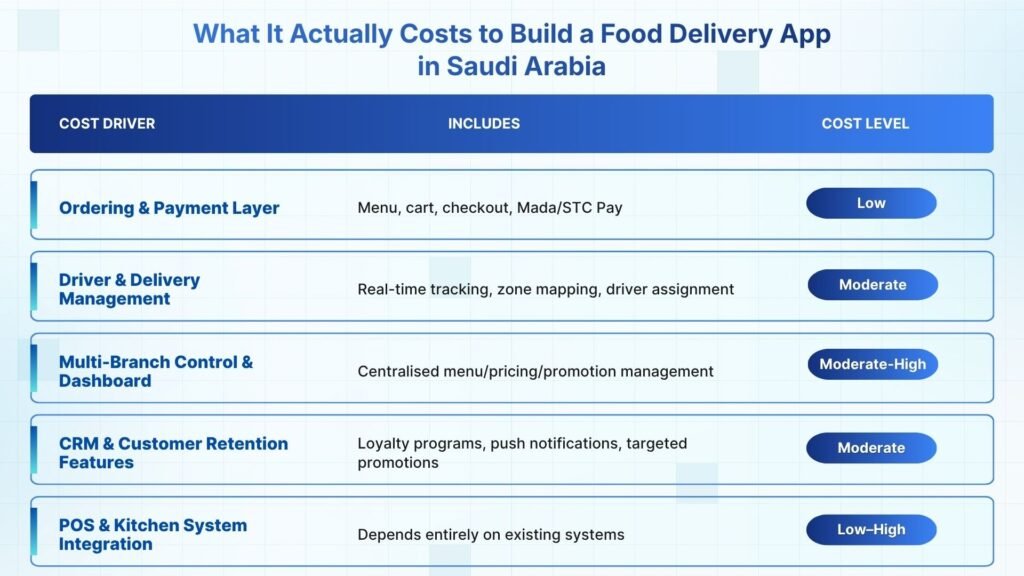
| Cost Driver | Includes | Cost Level |
| Ordering & Payment Layer | Menu, cart, checkout, Mada/STC Pay | Low |
| Driver & Delivery Management | Real-time tracking, zone mapping, driver assignment | Moderate |
| Multi-Branch Control & Dashboard | Centralised menu/pricing/promotion management | Moderate–High |
| CRM & Customer Retention Features | Loyalty programs, push notifications, targeted promotions | Moderate |
| POS & Kitchen System Integration | Depends entirely on existing systems | Low–High |
Restaurant app development cost depends on what the system needs to do, not just how many screens it has.
The main cost drivers are:
Ordering and payment layer — Core functionality covering menu display, cart, checkout, and local payment methods including Mada and STC Pay. This is the baseline of any build.
Driver and delivery management — Real-time tracking, zone mapping, driver assignment, and delivery status updates. This adds significant complexity compared to a basic ordering system.
Multi-branch control and centralised dashboard — Chains need a management layer that handles menus, pricing, and promotions across locations from one place. This is a separate system layer from the customer-facing app.
CRM and customer retention features — Loyalty programs, push notifications, order history, and targeted promotions. This is where the long-term revenue value of a direct app actually comes from, but it adds to the development scope.
POS and kitchen system integration — Custom integration work depends entirely on your existing systems. Some setups are straightforward. Others require significant custom development.
Most online food order app development projects are scoped and built in phases. Ordering and payments launch first. Driver management, CRM, and advanced analytics are added in subsequent phases. This approach reduces initial investment while getting the direct ordering channel live early.
Common Mistakes Saudi F&B Businesses Make When Building a Food Delivery App
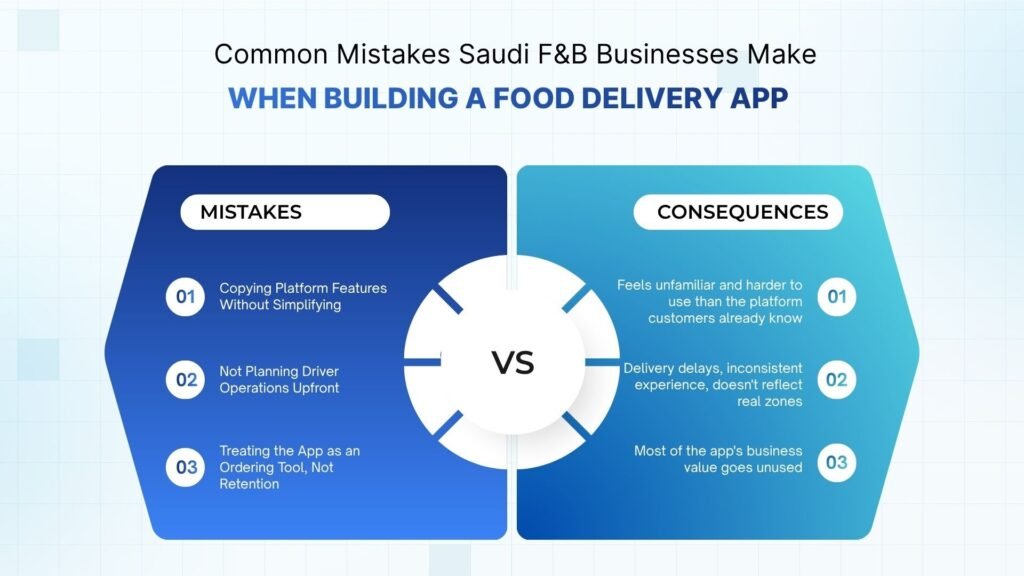
| Mistake | Consequence |
| Copying Platform Features Without Simplifying | Feels unfamiliar and harder to use than the platform customers already know |
| Not Planning Driver Operations Upfront | Delivery delays, inconsistent experience, doesn’t reflect real zones |
| Treating the App as an Ordering Tool, Not Retention | Most of the app’s business value goes unused |
How Does Etihad Falcon Tech Build Food Delivery Apps for Saudi Restaurants and Chains?
We start with your operations, not the app screens.
We Map Your Operations End-to-End
How you receive orders today. How your kitchen processes them. How delivery is managed and where the friction actually is. What your POS setup looks like and what it needs to connect to. That mapping is what tells us what your system actually needs to do, which is the only reliable basis for scoping a build that works in practice, not just on paper.
We Build in Phases
Your direct ordering channel goes live first. Driver management, CRM, loyalty features, and advanced analytics get layered in based on your operational readiness and priorities, not a fixed rollout schedule that ignores where your business actually is.
If you run a chain, we scope branch-level control and centralised management from the start. Retrofitting multi-branch architecture into a system built for one location is expensive and disruptive, so we build for it up front.
Saudi Market Standards, Included as Standard
Arabic language support, local payment integration including Mada and STC Pay, and Saudi-specific delivery zone logic go into every build we deliver. Not as add-ons you request later.
Built for Saudi F&B Operators
We’ve built food delivery app development solutions for single-location restaurants, multi-branch chains, and cloud kitchen brands across Saudi Arabia. The consistent pattern: the operators who grow direct order volume fastest are the ones who treat their app as a retention system from day one, not just a way to dodge platform commission.
If you’re running significant delivery volume through third-party platforms and want to know what a direct channel would actually cost and deliver for your operation, message us on WhatsApp and we’ll walk you through what your build would look like.
Frequently Asked Questions
How long does it take to build and launch a food delivery app?
We build in phases, with core ordering and payment launching first. Initial deployment typically takes eight to sixteen weeks, depending on complexity, integrations, and whether multi-branch control is included from the start.
Can the app connect to our existing POS system?
Yes. We scope POS integration based on your current system. Most major POS platforms used in Saudi Arabia support integration. Custom setups need additional development work, which we assess during scoping.
Can customers track their order in real time?
Yes. Live tracking covers kitchen confirmation, driver assignment, and delivery status. Accuracy depends on the driver management setup included in your build.
Is the app available in both Arabic and English?
Yes. We build every app bilingual as standard. Arabic right-to-left is the default experience, not a secondary layer added to an English-first build.
Can we manage multiple branches from one dashboard?
Yes. We scope multi-branch management as a core system layer for chain-level builds, covering centralised menu control, branch-level pricing, promotion management, and consolidated performance reporting.
What makes a custom build better than an existing food ordering app platform?
White-label platforms charge ongoing subscription or commission fees and limit what you can customise. A custom build gives you full ownership of the system, no per-order fees, and the retention and loyalty features your operation actually needs, without platform restrictions.