
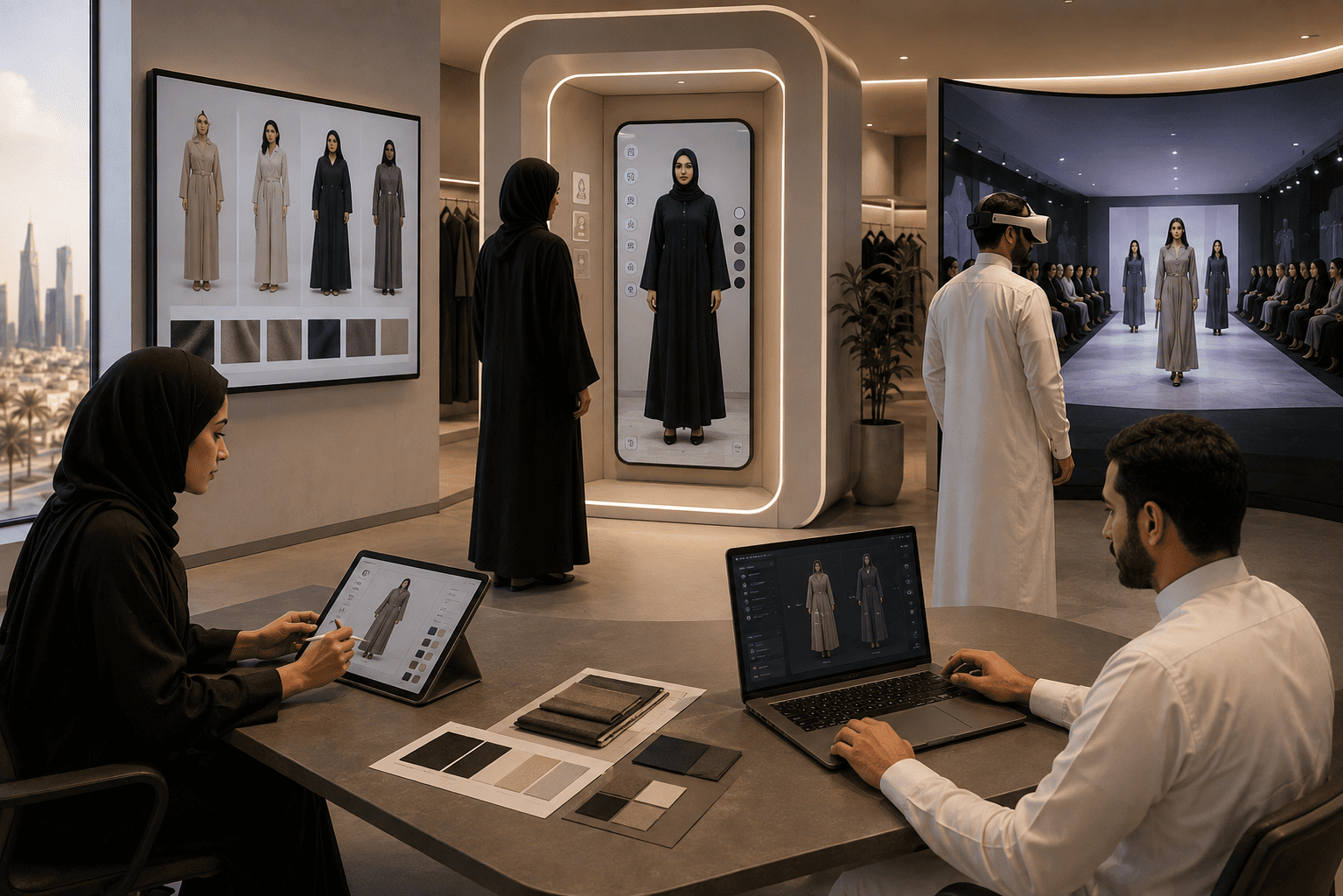
Saudi Arabia’s e-commerce apparel market is projected to grow from USD 8.59 billion in 2025 to USD 16.74 billion by 2034, a compound annual growth rate of 7.69 percent, according to Renub Research. Modest wear, luxury accessories, sportswear, and fast fashion are all scaling online at once, and AR and VR are becoming the standard tools Saudi fashion brands are turning to in order to sell into that growth without absorbing the returns that come with it.
AR and VR close the gap between what a product photo promises and what a customer receives. A photo shows a garment on a model, in studio light, at a size and proportion that isn’t the customer’s own. Augmented Reality and Virtual Reality replace that with the real thing: the abaya draped on the customer’s own body, the necklace sitting against their own neckline, the collection walked through at true scale in a virtual showroom rather than scrolled past on a product grid. The customer stops guessing and starts deciding.
The commercial case is already proven elsewhere. Shopify reports that fashion brands using 3D and AR product experiences cut returns by up to 40 percent, and 3DLOOK’s research shows conversion rates climbing by as much as 65 percent once shoppers can preview fit before buying. For Saudi fashion brands, where modest wear and abaya returns are driven overwhelmingly by fit and drape uncertainty, that gap between guessing and deciding is exactly where the revenue is being lost right now.
This guide covers where Augmented Reality and Virtual Reality are being applied across Saudi fashion, from mobile try-on to in-store fitting rooms to VR catwalks, what each solves at a different stage of the customer journey, what implementation actually takes, and what it costs to deploy in a way that produces measurable outcomes for your brand.
Why Saudi Fashion Brands Are Investing in AR and VR Right Now
AR and VR deliver value through four channels, each solving a different problem in how you sell fashion online in Saudi Arabia.
Answer the Question Your Product Photo Can’t
A product image shows a garment styled on a model, in ideal light, at a size and shape that isn’t your customer’s own. It answers “what does this look like?” It never answers what actually stalls your customer at checkout: “What will this look like on me?”
AR try-on lets your customer answer that themselves, before they commit. It doesn’t replace your product photography. It adds the personal relevance a photo can’t.
Give Customers a Brand Experience
VR takes this further. Your customer walks through a virtual showroom, attends a virtual catwalk, or explores your collection in three dimensions, at their own pace, wherever they are.
That’s not a gimmick bolted onto your website. It’s the difference between a customer scrolling past your brand and a customer spending time inside it.
Close the Gap Before It Becomes a Return
Most of your returns aren’t happening because the product is defective. A garment runs smaller than your size chart suggested. A colour that reads warm under studio lighting reads cool in your customer’s own room. An abaya that looks fluid in a campaign photo sits differently on a different body.
Each of these is a perception gap, and each one costs you: reverse logistics, restocking, customer service, and a customer less likely to order from you again.
AR and VR close that gap before the purchase happens, not after it’s already failed to meet expectations.
Capture Growth Without Absorbing the Returns That Come With It
The Saudi fashion market is growing in size and competitive intensity at once. Vision 2030 has accelerated domestic fashion consumption, supported the rise of Saudi labels, and brought international luxury and high-street brands into the Kingdom.
Your e-commerce volume is rising with it. But volume growth has brought return rate growth too, because the same uncertainty that stalls a purchase also drives what comes back after delivery. Customers who can’t assess fit before buying will buy more from you, and return more too.
That’s the growth you’re capturing right now, and the cost quietly attached to it.
How AR and VR Are Used in Saudi Fashion Industry
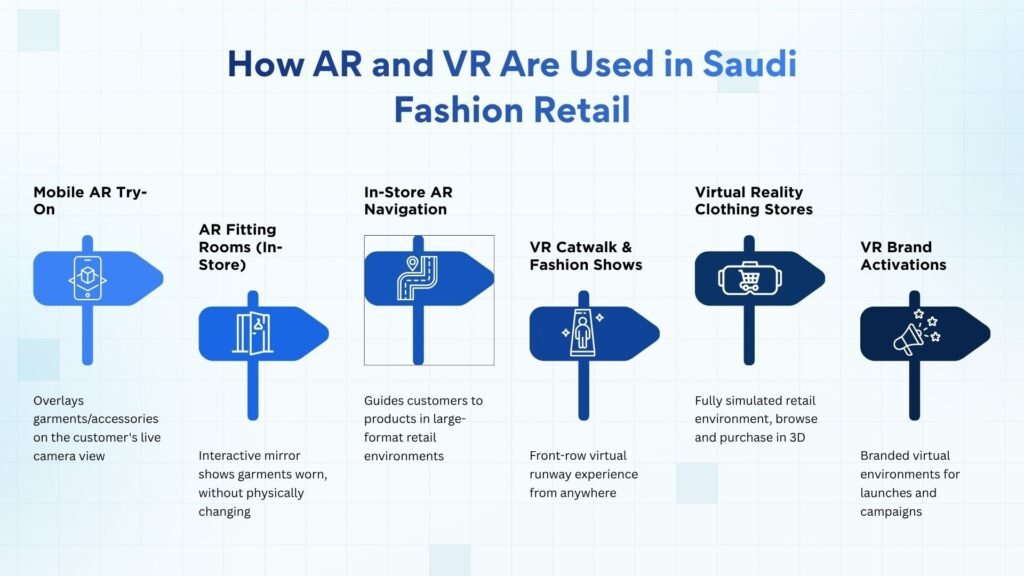
| Format | What It Does |
| Mobile AR Try-On | Overlays garments/accessories on the customer’s live camera view |
| AR Fitting Rooms (In-Store) | Interactive mirror shows garments worn, without physically changing |
| In-Store AR Navigation | Guides customers to products in large-format retail environments |
| VR Catwalk & Fashion Shows | Front-row virtual runway experience from anywhere |
| Virtual Reality Clothing Stores | Fully simulated retail environment, browse and purchase in 3D |
| VR Brand Activations | Branded virtual environments for launches and campaigns |
AR and VR aren’t one feature you switch on. They’re a set of distinct applications, and each one solves a different problem depending on where your customer is in the buying journey. Here’s what each one does and how it actually works.
Mobile AR Try-On
This is the highest-priority deployment for most Saudi fashion brands, and it runs directly on your product page.
- Customer opens the AR feature, their camera activates, and the garment or accessory overlays onto their live camera feed at the correct scale and position
- For abayas, this shows silhouette, drape, and fit against your customer’s own proportions, the exact judgment call a product photo can’t make for them
- For jewellery, this shows the piece against their actual neckline, wrist, or ear, at true scale, in their own lighting
- Runs on standard mid-range smartphones. No specialist hardware, no separate app required
Zara’s in-app AR proved this works at scale for large SKU counts. The lesson for you isn’t the technology choice, it’s the integration decision. AR connected to your add-to-cart button converts. AR sitting as a separate brand experience gets engagement and nothing else.
AR Fitting Rooms and In-Store AR
If you run physical retail in Riyadh or Jeddah, this brings the same try-before-you-buy logic into your store.
- An interactive mirror lets customers see garments on themselves without physically changing
- Customers cycle through colours and styles without taking a single item off a hanger
- Removes the effort barrier that keeps customers from trying anything on in the first place
- Offers a privacy-respectful option for customers who prefer not to change clothes in a public retail space
- In-store AR navigation guides customers to a specific item through their phone camera, cutting search time and giving you data on how customers actually move through your store
VR Catwalks and Virtual Showrooms
This goes beyond try-on into a full brand experience your product page can’t replicate.
- A VR catwalk puts buyers, press, and wholesale partners front-row at your runway show, at full scale, from anywhere they are
- A buyer who can’t travel to your Riyadh presentation experiences the collection in full without leaving Jeddah
- A VR showroom lets customers browse, interact with, and buy from a fully simulated store with no physical location behind it
- Signals brand positioning at the level of labels that invest in this kind of production, which matters if you’re building regional or international credibility
Each of these solves a different point of hesitation. Which ones make sense for you depends on whether your business is losing sales online, in-store, or at the brand-perception level, and most Saudi fashion brands need more than one.
How AR and VR Requirements Differ Across Saudi Fashion Categories
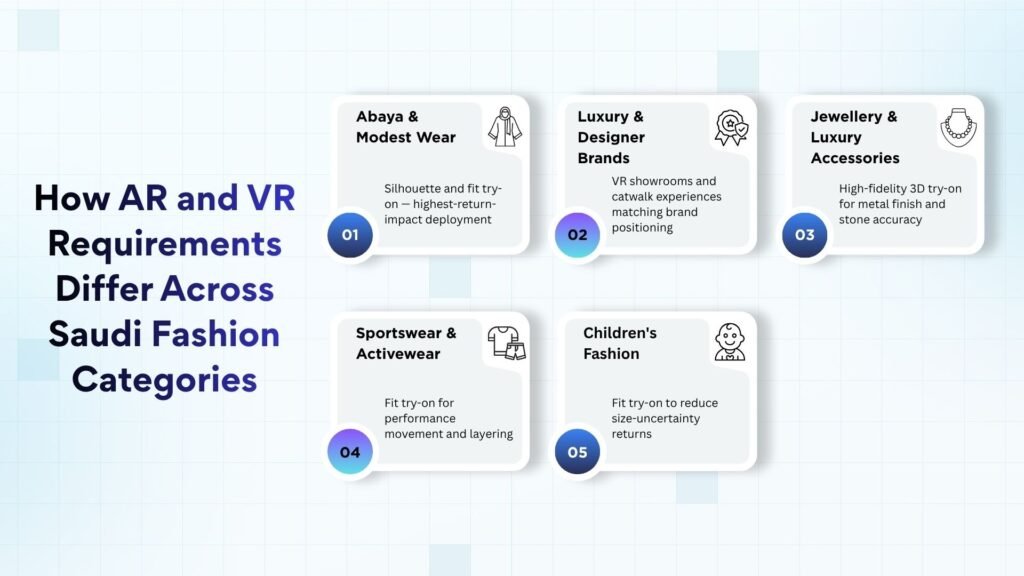
| Category | Key AR/VR Requirement |
| Abaya & Modest Wear | Silhouette and fit try-on — highest-return-impact deployment |
| Luxury & Designer Brands | VR showrooms and catwalk experiences matching brand positioning |
| Jewellery & Luxury Accessories | High-fidelity 3D try-on for metal finish and stone accuracy |
| Sportswear & Activewear | Fit try-on for performance movement and layering |
| Children’s Fashion | Fit try-on to reduce size-uncertainty returns |
Not every fashion category sells the same way, and AR and VR shouldn’t be built the same way for all of them either. What convinces a luxury buyer is different from what gets an abaya order placed with confidence, and what a jewellery store needs from AR is different from what an activewear brand needs.
Here’s how AR and VR change depending on what you’re actually selling.
Abaya & Modest Wear
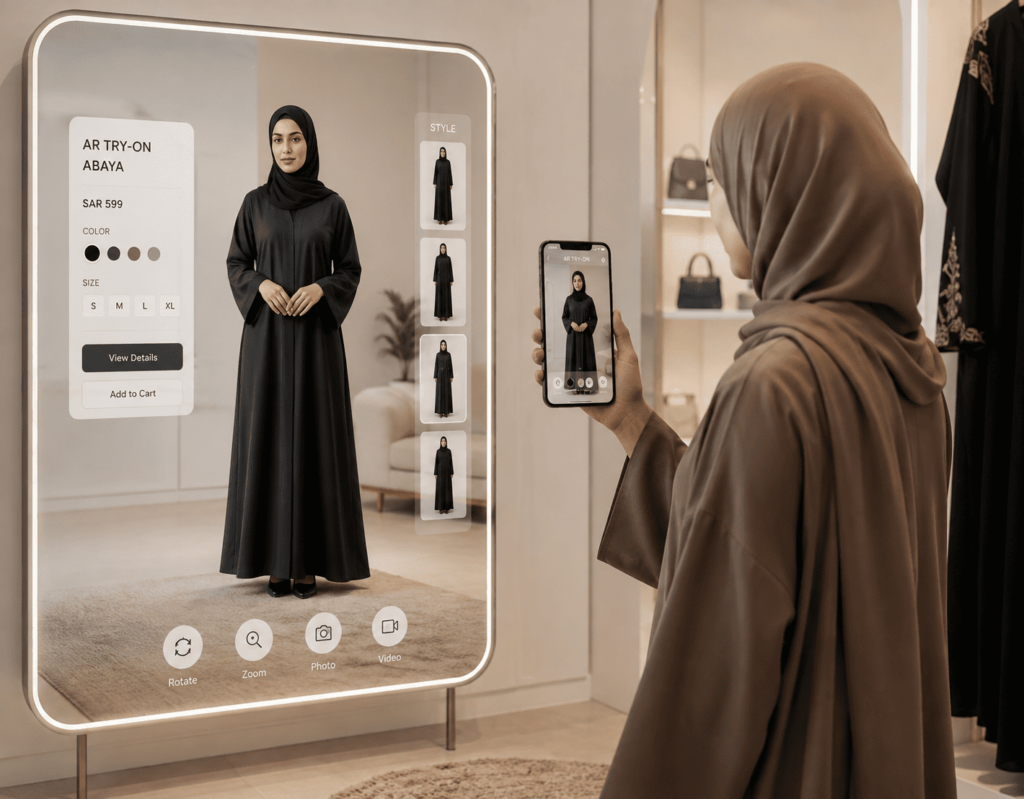
AR try-on shows a customer how an abaya’s silhouette, drape, and sleeve length sit on their own body before they order, instead of on a model with different proportions. Abaya e-commerce stores, modest wear boutiques, and multi-brand modest fashion platforms are the businesses this fixes the fastest, since fit and drape uncertainty is the single biggest driver of returns in this category.
What to build:
- Mobile AR try-on embedded directly on the product page, not a separate app
- Body-scale overlay calibrated for abaya cuts, layering, and sleeve length
- Fabric and colourway rendering that reflects the customer’s own lighting, not studio lighting
See guide on Augmented Reality (AR) for retail to understand how AR try-on applies across other retail categories beyond fashion, from furniture placement to beauty and jewellery.
Luxury Fashion & Designer Brands
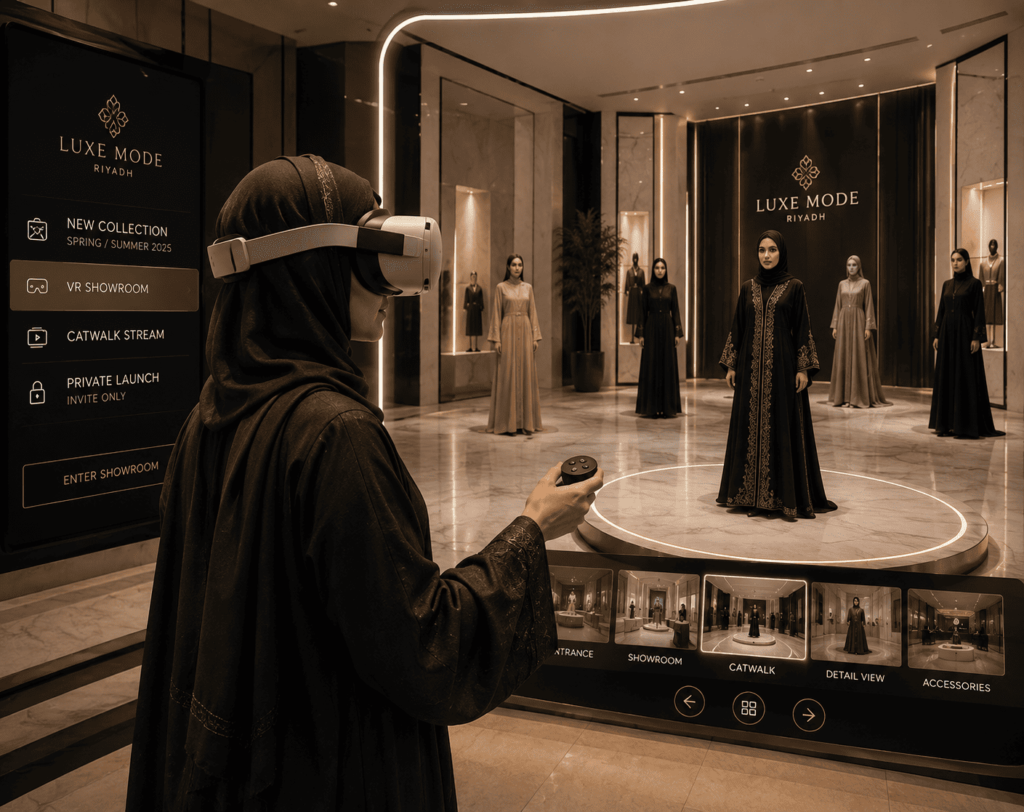
VR gives your customer a browsing experience that matches what they’re paying, instead of the same product grid a mass-market brand uses. Luxury abaya houses, designer boutiques, and high-end multi-brand fashion retailers need this because a generic digital experience undersells a purchase at this price point before the customer even sees the product.
What to build:
- A VR showroom built to match your physical boutique’s design standard
- A VR catwalk stream so buyers and press experience the new collection before it hits stores
- An invite-only VR launch event for top clients, positioned as access rather than advertising
Jewellery & Luxury Accessories
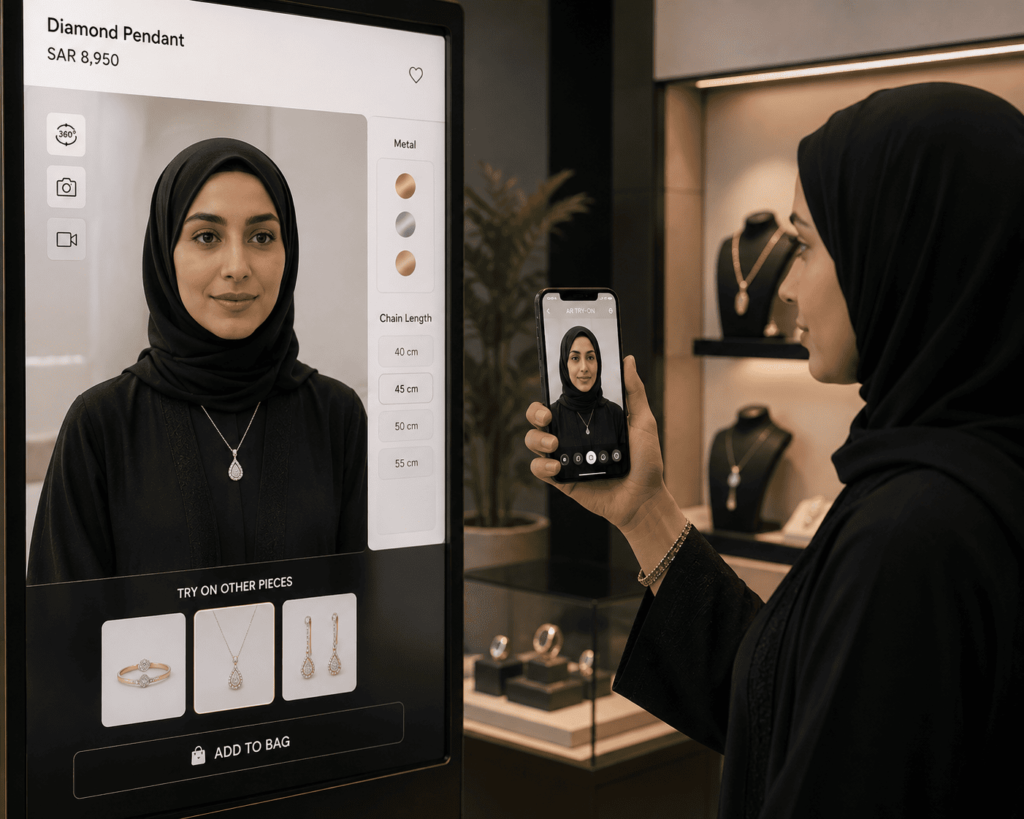
AR try-on shows a piece against a customer’s actual neckline, wrist, or ear at true scale, which settles the one question a photo can’t: does it work on me. Fine jewellery retailers, jewellery e-commerce stores, and watch and accessory brands get the clearest return here, since the transaction value makes a wrong guess expensive for both sides.
What to build:
- High-fidelity 3D models per SKU that match true metal finish and stone characteristics
- Accurate scale calibration so the AR overlay reflects the piece’s real size, not an approximation
- Try-on positioned as a decision tool on the product page, not a standalone feature
Sportswear & Activewear
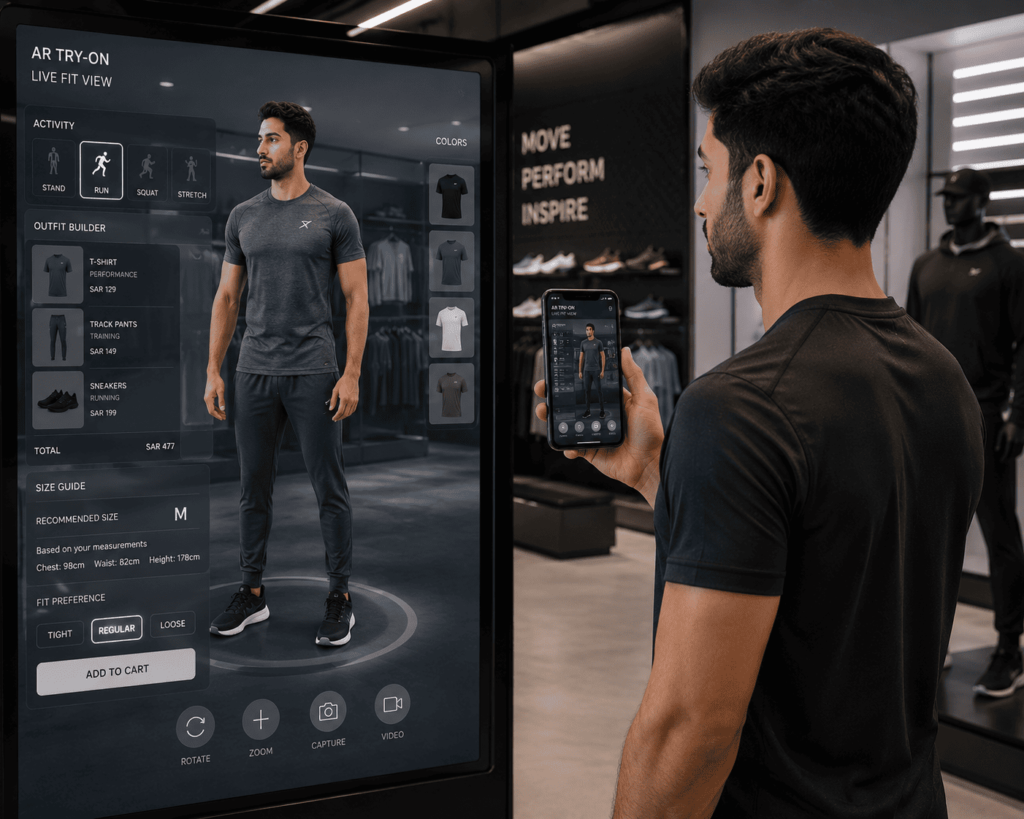
AR try-on shows whether a piece holds its fit in motion and how it layers with the rest of a kit, which static product shots can’t demonstrate. Activewear brands, sports retailers, and athleisure e-commerce stores need this because performance sizing varies enough between brands that customers routinely order the wrong size.
What to build:
- AR try-on that shows fit during movement, not just a static standing pose
- Layering visualisation for customers building a full outfit rather than a single item
- Size-matching guidance that accounts for how sizing runs differently across brands
- AR content tied to sport and fitness campaigns that extends engagement past the sale
Children’s Fashion
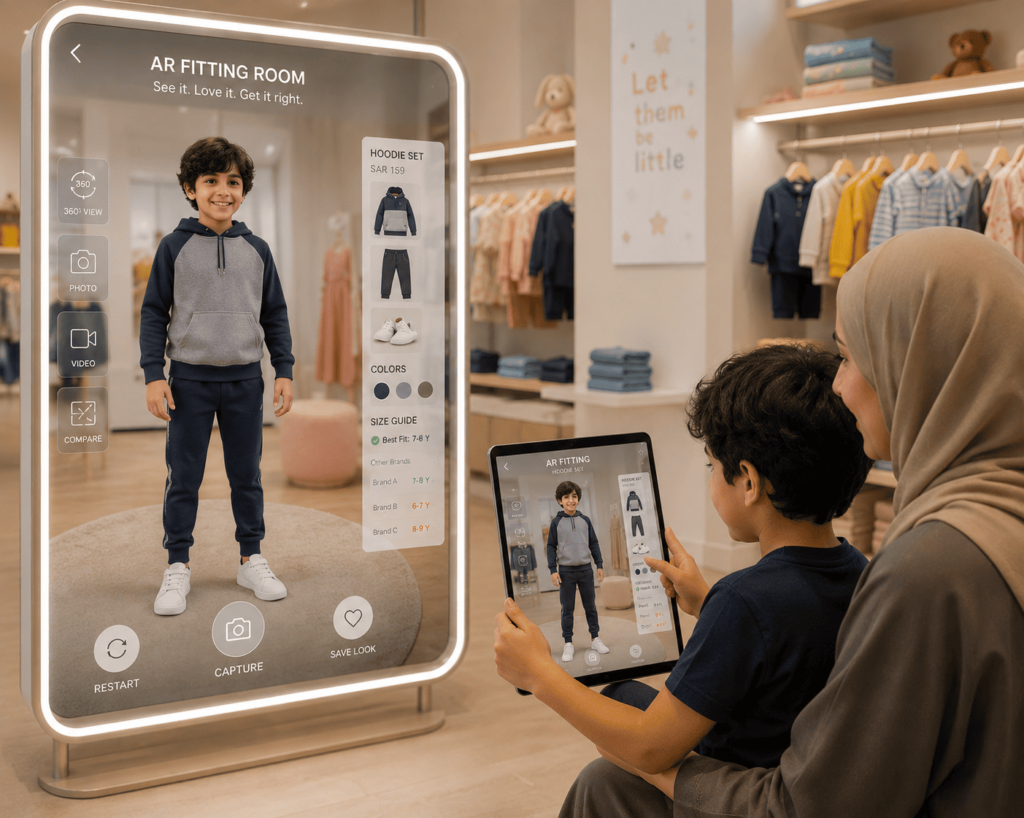
AR fitting solves two guesses at once for a parent shopping online: whether the size is right, and how that specific brand’s sizing runs. Children’s clothing retailers and family apparel e-commerce stores benefit most here, since kids’ sizing standards vary far more between brands than adult sizing does.
What to build:
- AR fitting calibrated to a child’s actual measurements, not a generic age-based size chart
- Cross-brand size guidance built into the try-on experience
- An interactive AR feature parents and kids can use together, which builds brand recall beyond the purchase
Other Fashion Categories
Abaya, luxury, jewellery, activewear, and children’s fashion are the biggest slices of the Saudi fashion market, but they’re not the whole pie. Footwear brands, eyewear and sunglasses retailers, beauty and cosmetics brands, and fashion resale and rental platforms are all using AR and VR to solve the same core problem in their own segment: helping a customer commit to something they haven’t physically tried.
What AR and VR does across these categories:
- Footwear brands use AR to show shoe fit and sizing on the customer’s own foot, cutting the size-exchange rate that eats into footwear margins more than almost any other category
- Eyewear and sunglasses retailers use AR to let customers try on frames virtually and see how they sit against their own face shape before ordering
- Beauty and cosmetics brands use AR to let customers preview makeup shades, skincare results, and colour matches against their own skin tone before buying
- Fashion resale and rental platforms use AR try-on to solve the trust gap that comes with buying or renting a piece they can’t inspect in person first
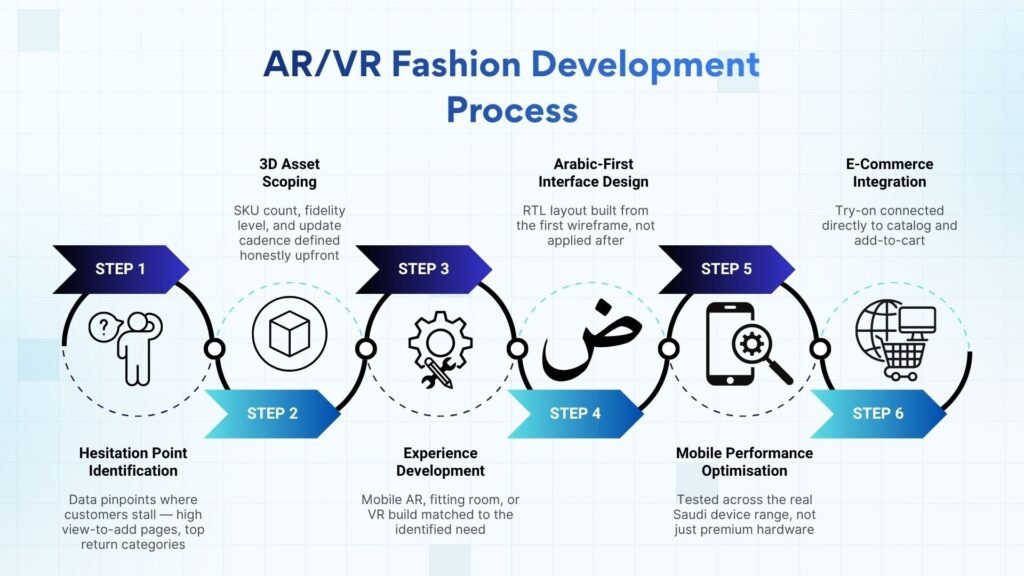
AR & VR Fashion Industry Development Process
| Stage | What Happens |
| 1. Hesitation Point Identification | Data pinpoints where customers stall — high view-to-add pages, top return categories |
| 2. 3D Asset Scoping | SKU count, fidelity level, and update cadence defined honestly upfront |
| 3. Experience Development | Mobile AR, fitting room, or VR build matched to the identified need |
| 4. Arabic-First Interface Design | RTL layout built from the first wireframe, not applied after |
| 5. Mobile Performance Optimisation | Tested across the real Saudi device range, not just premium hardware |
| 6. E-Commerce Integration | Try-on connected directly to catalog and add-to-cart |
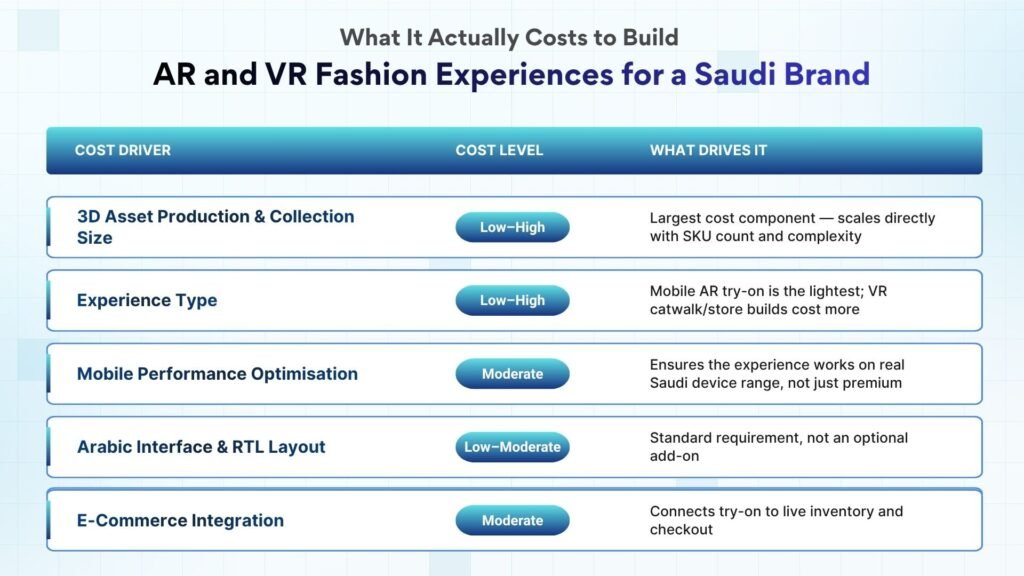
What Does It Actually Cost to Build AR and VR Fashion Experiences for a Saudi Brand?
| Cost Driver | Cost Level | What Drives It |
| 3D Asset Production & Collection Size | Low–High | Largest cost component — scales directly with SKU count and complexity |
| Experience Type | Low–High | Mobile AR try-on is the lightest; VR catwalk/store builds cost more |
| Mobile Performance Optimisation | Moderate | Ensures the experience works on real Saudi device range, not just premium |
| Arabic Interface & RTL Layout | Low–Moderate | Standard requirement, not an optional add-on |
| E-Commerce Integration | Moderate | Connects try-on to live inventory and checkout |
Five variables drive cost here, and you need to understand all five before you scope a project, not after.
3D Asset Production and Collection Size
This is your largest cost, and it scales with what you’re selling. Every garment, accessory, or jewellery piece needs a high-quality 3D model, so a twenty-piece abaya collection costs far less to build than a two-hundred-piece multi-category catalogue.
Experience Type
Mobile AR try-on, AR fitting mirrors, VR catwalks, and VR store builds each cost differently and take different timelines. Start with one. Most Saudi fashion brands begin with mobile AR try-on and expand once it’s proven.
Mobile Performance
If your AR experience runs well on flagship phones but stutters on mid-range Android devices, you’re excluding a large share of your own customer base. Build for the devices your customers actually carry, not the one on your desk.
Arabic Interface and RTL Layout
Full Arabic support with correct right-to-left layout isn’t a nice-to-have for a Saudi launch. It’s a baseline requirement across navigation, product labelling, and try-on controls.
E-Commerce Integration
AR try-on that doesn’t connect to your live inventory and checkout is incomplete. If your customer tries on a piece and then has to navigate back to the product page to buy it, you’ve already lost the momentum the try-on created. If you want a clearer estimate for your specific collection, message us on WhatsApp and book a free meeting with our experts.
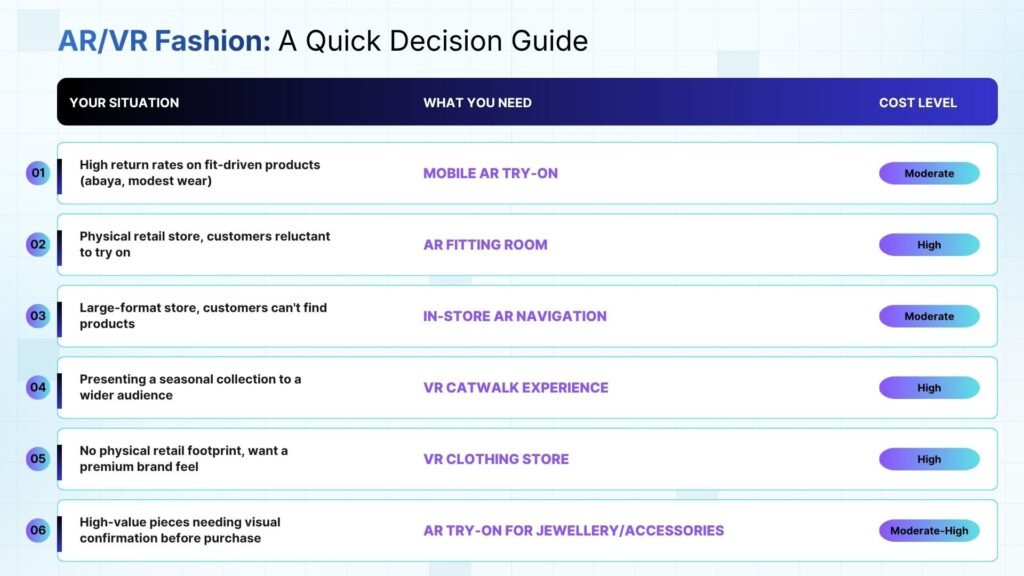
AR/VR Fashion: A Quick Decision Guide
| Your Situation | What You Need | Cost Level |
| High return rates on fit-driven products (abaya, modest wear) | Mobile AR Try-On | Moderate |
| Physical retail store, customers reluctant to try on | AR Fitting Room | High |
| Large-format store, customers can’t find products | In-Store AR Navigation | Moderate |
| Presenting a seasonal collection to a wider audience | VR Catwalk Experience | High |
| No physical retail footprint, want a premium brand feel | VR Clothing Store | High |
| High-value pieces needing visual confirmation before purchase | AR Try-On for Jewellery/Accessories | Moderate–High |
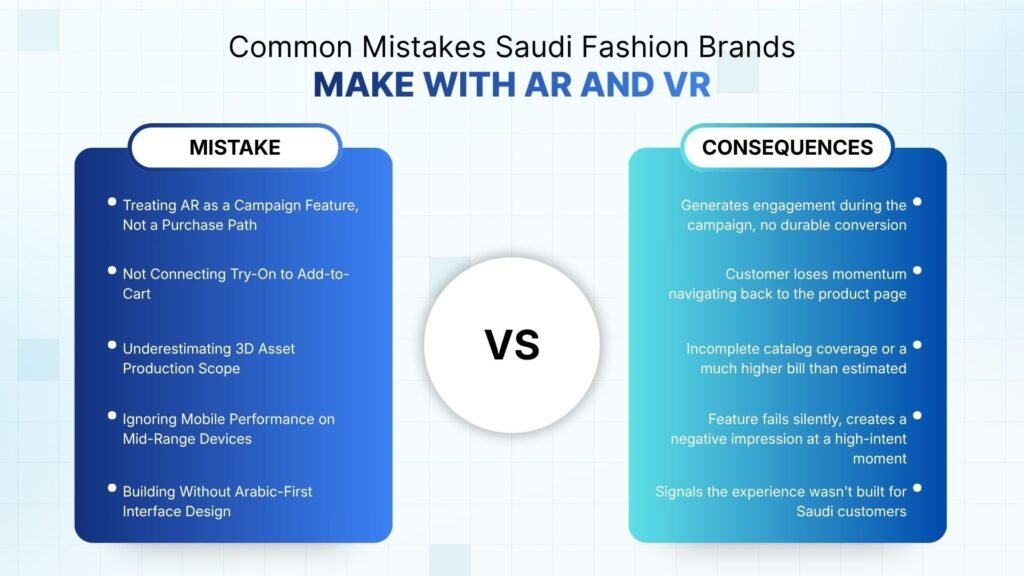
Common Mistakes Saudi Fashion Brands Make With AR and VR
| Mistake | Consequence |
| Treating AR as a Campaign Feature, Not a Purchase Path | Generates engagement during the campaign, no durable conversion |
| Not Connecting Try-On to Add-to-Cart | Customer loses momentum navigating back to the product page |
| Underestimating 3D Asset Production Scope | Incomplete catalog coverage or a much higher bill than estimated |
| Ignoring Mobile Performance on Mid-Range Devices | Feature fails silently, creates a negative impression at a high-intent moment |
| Building Without Arabic-First Interface Design | Signals the experience wasn’t built for Saudi customers |
How Etihad Falcon Tech Builds the Best AR/VR Fashion Experiences in Saudi Arabia
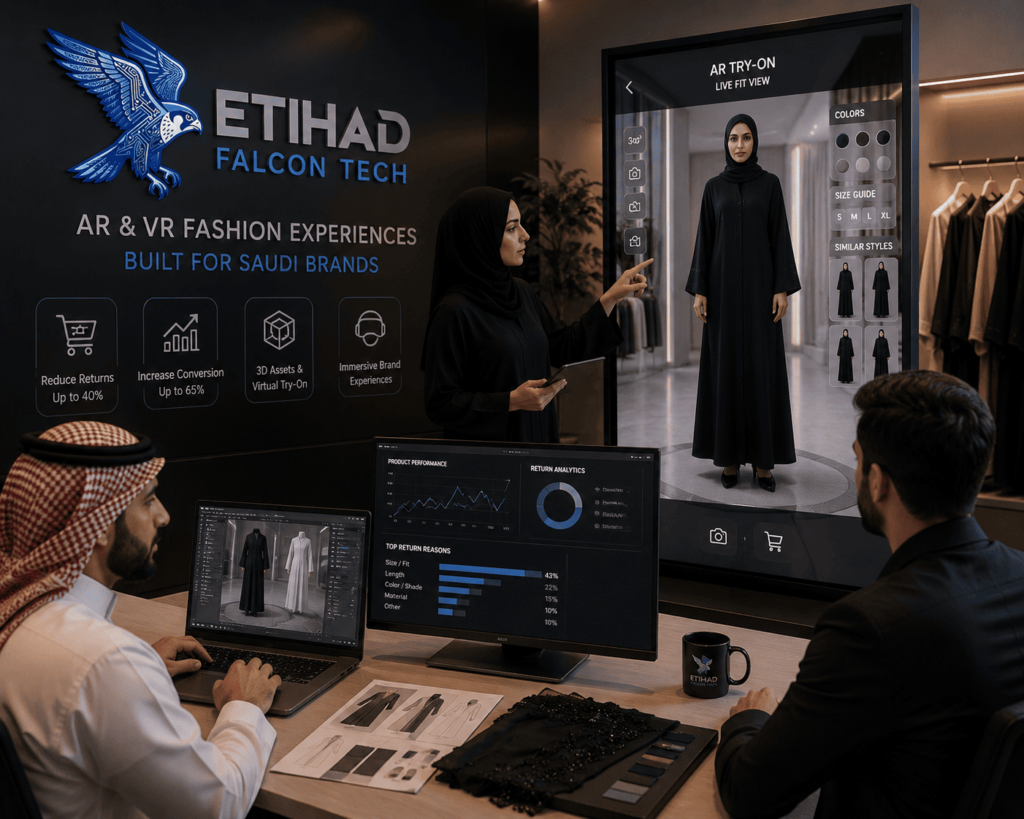
Most AR and VR studios build experiences. Etihad Falcon Tech builds sales tools. That’s a commercial distinction, not a technical one.
A visually polished try-on feature that doesn’t move your customer from hesitation to checkout isn’t delivering value, no matter how good it looks in a pitch deck. We scope every AR and VR fashion deployment around the outcome you actually need, whether that’s cutting returns in a specific category, lifting conversion on high-value pieces, or giving your brand a showroom experience that matches what your customers expect at that price point.
Arabic-First, Built for the Saudi Customer
We build every AR and VR experience Arabic-first: interface language, navigation, product labelling, and every piece of try-on instruction. The visual experience reflects what Saudi customers expect, from abaya silhouettes to modest wear layering, rather than an adaptation of a template built for a different market. Your customization options reflect what your specific customer segment actually values.
One Build, Every Channel
Your mobile AR try-on, your in-store fitting mirror, and your VR content for campaigns and social channels are structured to come from a single production process. That means more commercial value per riyal spent than commissioning each channel as a separate project.
Your Team, Trained to Convert
We don’t hand over the technology and walk away. Every deployment includes training your team, not just how the AR feature works, but how to use it to guide a hesitant customer toward checkout, whether that’s in-store staff or the people running your product pages. The system only works when the technology and the people using it are both doing their part.
Experience Across Every Fashion Category
Etihad Falcon Tech has built AR try-on, VR showrooms, VR catwalk productions, and AR fitting room implementations for Saudi brands across modest wear, luxury accessories, activewear, and multi-category retail. That range means faster, more accurate scoping and a clear read on what your specific category needs before a customer is ready to buy.
Frequently Asked Questions
It activates your customer’s phone camera and overlays the garment or accessory onto their live camera feed, so they see themselves wearing it in real time. We build this to solve your fit and appearance uncertainty, the biggest driver of both hesitation and returns.
Not always. We can build web-based AR that runs in a browser with no download, or app-based AR for stronger performance and tighter checkout integration. Which one you need depends on your existing app setup.
Accurate enough to answer silhouette, proportion, and colour questions, which is what actually drives your customer’s hesitation. It’s not a replacement for physical fitting when a customer needs precise sizing, but it’s not meant to be.
AR try-on runs on your customer’s phone at home. An AR fitting room uses an in-store mirror or screen so customers try items on without changing. Both solve the same uncertainty at different points in your customer’s journey.
Every piece in your AR or VR experience needs a full 3D model, not a photograph, with accurate shape, texture, and lighting response. If you’re running a large or frequently updated collection, that’s your primary ongoing cost, and it’s the one brands most often underestimate at scoping stage.
It puts your customer inside a fully 3D virtual store or runway using a headset or a 360° browser experience, where they can walk through collections, view garments from every angle, and shop the space directly. We build this to extend your brand experience beyond a flat product page, particularly for seasonal launches or flagship collections.
No headset required for most of what we build. We typically deliver browser-based 360° experiences that work on any phone or desktop, and reserve headset-based VR for in-store activations, trade shows, or premium brand experiences where the immersion itself is the point.
For fashion, VR’s real value is experiential: virtual runway shows, immersive lookbooks, and showroom walkthroughs that let you reach customers who can’t attend in person. It doesn’t solve fit uncertainty the way AR does, so we usually recommend it alongside AR, not instead of it, depending on whether your goal is conversion or brand experience.
VR experiences generally take longer and cost more, since you’re building an entire 3D environment, not just a garment overlay. If your priority is reducing returns and hesitation at the product level, AR gets you there faster and cheaper. If your priority is a flagship brand moment or event activation, VR is worth the extra investment.