
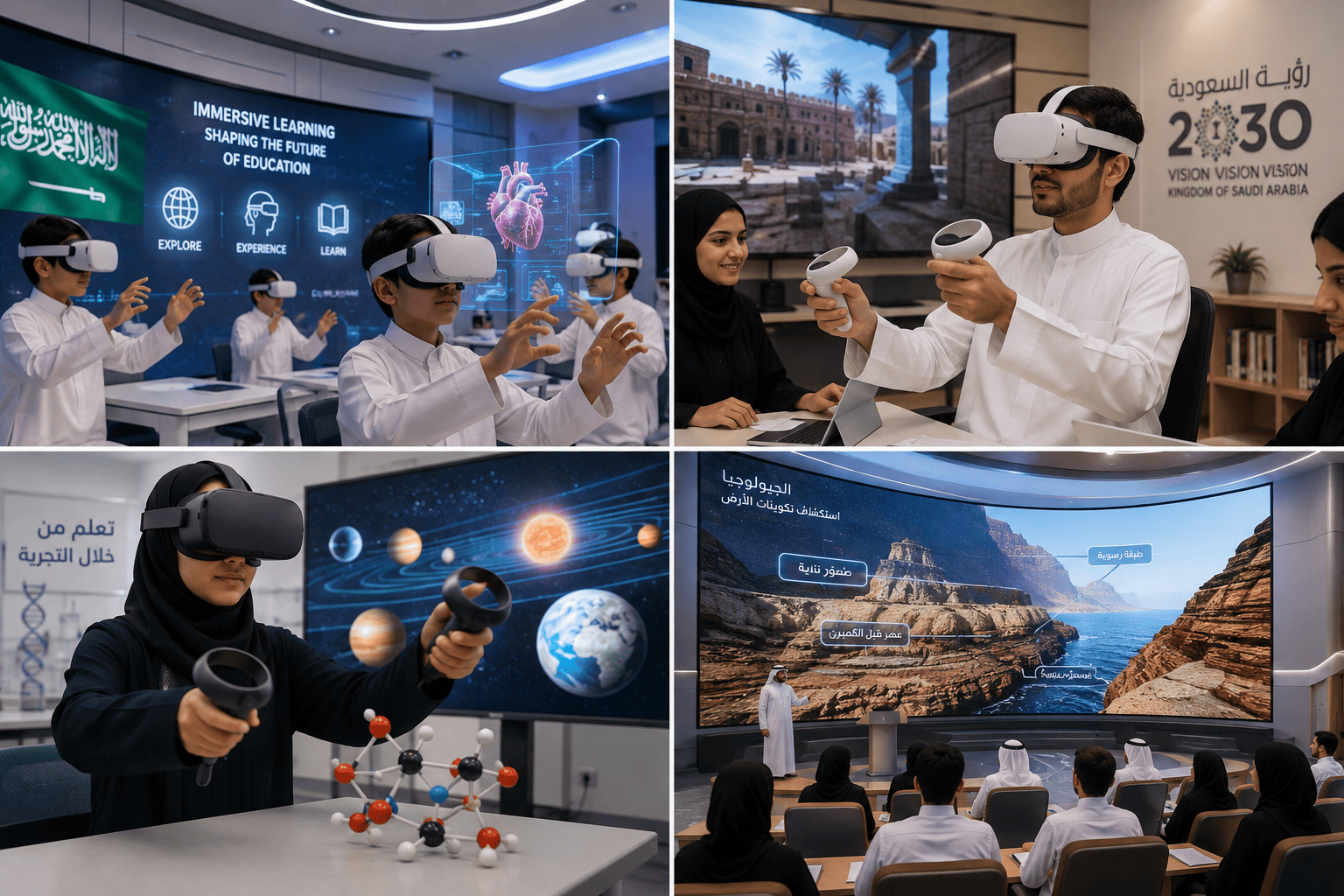
Saudi Arabia’s virtual reality market reached USD 147.57 million in 2024 and is projected to grow to USD 828.43 million by 2033, according to IMARC Group, a global market research firm. Education is one of the sectors driving that growth, alongside many other industries like construction, healthcare, gaming, and retail.
Virtual reality development in education puts a student inside the subject instead of in front of it. A biology class walks through a cell instead of labelling one on a page. An engineering class watches a structural model fail under load instead of reading about why it failed.
Some Saudi institutions have already moved VR past the demo stage. They run it as scheduled coursework, with content mapped to real learning outcomes and staff who can operate a session without technical support standing by. Others are still deciding whether to adopt it, while enrollment and outcome data at institutions that moved first keeps building.
This guide covers what virtual reality in education actually involves for your institution: what it can do across schools, universities, and technical institutes, what it costs, where implementations typically go wrong, and what to look for in a development partner that builds a programme your staff will actually use.
What Can Virtual Reality Actually Do for Saudi Educational Institutes?
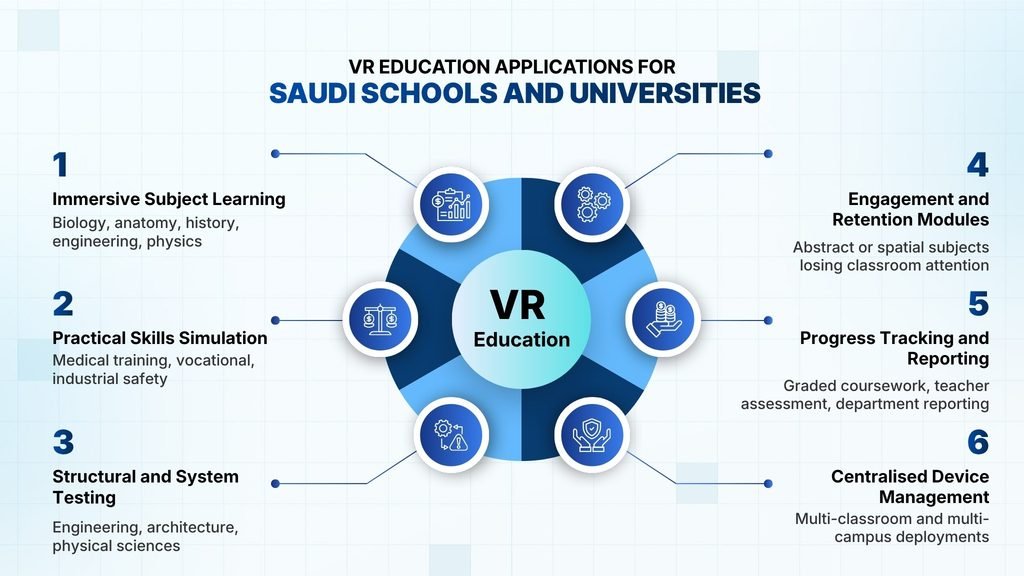
| VR Application | Best Used For |
| Immersive Subject Learning | Biology, anatomy, history, engineering, physics |
| Practical Skills Simulation | Medical training, vocational, industrial safety |
| Structural and System Testing | Engineering, architecture, physical sciences |
| Engagement and Retention Modules | Abstract or spatial subjects losing classroom attention |
| Progress Tracking and Reporting | Graded coursework, teacher assessment, department reporting |
| Centralised Device Management | Multi-classroom and multi-campus deployments |
Virtual reality in education does not sit apart from what you already teach. It plugs into your curriculum, your lesson plans, and your class schedule. Your biology teacher opens a cell-division module and students are not watching a slide. They are standing inside a cell, watching it divide. Your engineering students are not reading about where a beam fails under load. They load the model, change one variable, and watch it fail again, differently.
No lab booking. No waiting for a slot that never opens up this term. Here is what that looks like once VR moves past the demo stage and into your actual timetable.
Immersive Subject Exploration
Some subjects cannot be taught from a seat. Anatomy, chemical reactions, historical sites, and structural engineering all ask a student to understand something moving in three dimensions, and a textbook diagram flattens exactly the part that matters.
Put a headset on one of your biology students and she is not labelling a heart anymore. She is standing inside one, watching valves open and close. Your engineering students do not read about a structural failure. They cause one, on purpose, then run it again with a different variable until the pattern makes sense to them. None of this needs a functioning lab, a field trip budget, or a piece of equipment you can only afford to break once.
A student who has walked through a structural failure five times in VR walks into your physical lab with a different level of intuition than one who has only read the chapter.
Practical Skills Rehearsal
Your medical students rehearse a procedure dozens of times before they are anywhere near a patient. Your vocational students run a safety protocol until it stops being something they memorised and becomes something they just do. In both cases, VR moves the first mistake out of the real world and into a simulation where it costs nothing.
What does that change at the point a student actually performs the task for real? They are not attempting it for the first time under pressure. They have already done it wrong, then right, inside an environment built for exactly that.
Collaborative Learning Sessions
VR does not have to isolate a student inside a headset. Multiple students can enter the same environment at the same time, from different headsets in the same room, working through a shared task together.
A group of your students can walk through the same reconstructed historical site and discuss what they are seeing as they move through it. A team of engineering students can stand around the same structural model, each pointing at a different stress point, arguing about which one fails first. That is group work your classroom could not run before, because there was nothing physical to gather around.
Virtual Field Trips & Career Exposure
Not every student in Riyadh can walk through a hospital operating theatre, an aviation hangar, or a working construction site. Most institutions cannot arrange that access at scale, and even when they can, one field trip covers one class, once.
VR removes that ceiling. Your students step into an operating theatre, a cockpit, or a factory floor as many times as the curriculum calls for it, without a bus, a permission slip, or a liability form. A student deciding between medicine and engineering gets to stand inside both before they commit to either.
Engagement & Retention
Attention rarely fails because a student is incapable. It fails when a subject gives them nothing to do. Reading about a chemical reaction and running one, even a simulated one, are two different cognitive experiences, and your classroom loses engagement fastest on exactly the subjects where that gap is widest: physics, chemistry, anything spatial or abstract.
VR requires a response. Students move, decide, and act inside the material instead of absorbing it from a seat. That response is the actual mechanism behind the retention gains institutions report, not simplified content, but content a student had to do something with.
Teacher & Institution Management
A single headset in a supply closet is a demo. A programme you can run across multiple classrooms, multiple grade levels, and a full academic year needs infrastructure behind it: content mapped to your curriculum, student progress visible to your teachers, headsets managed and updated centrally, and scheduling that fits inside a normal class period instead of requiring a special trip.
Skip that layer, and VR becomes exactly the kind of pilot that gets used once, photographed for the school’s social media, and quietly stops appearing on the timetable.
How Virtual Reality in Education Works for Different Institutions?
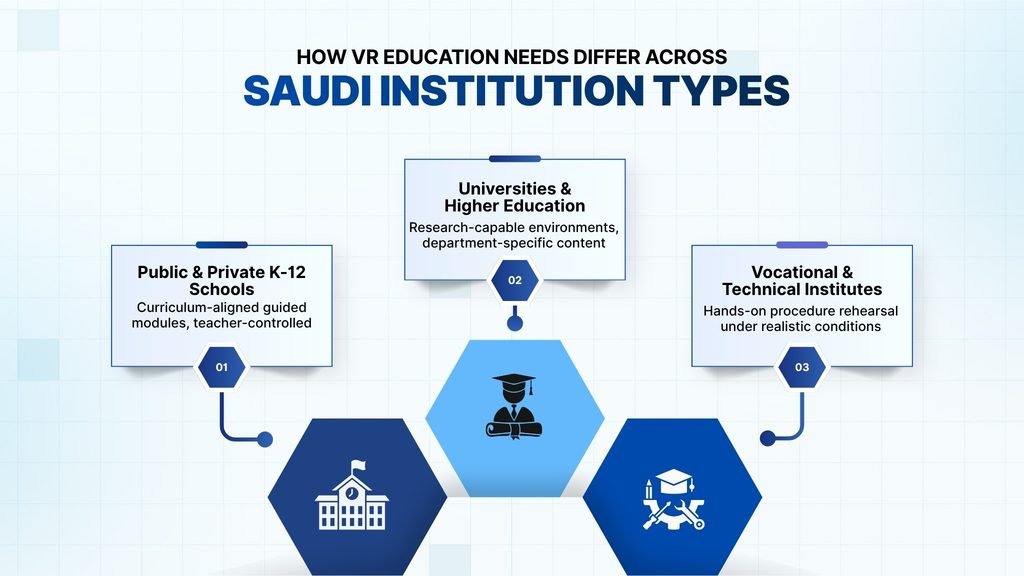
| Institution Type | VR Priority |
| Public & Private K-12 Schools | Curriculum-aligned guided modules, teacher-controlled |
| Universities & Higher Education | Research-capable environments, department-specific content |
| Vocational & Technical Institutes | Hands-on procedure rehearsal under realistic conditions |
VR does not need the same build twice. What a K-12 classroom needs from a VR programme and what a university engineering department needs from one are two different systems, even though both run on the same underlying technology. Here is how that plays out across the institutions actually deploying VR in Saudi education right now.
Public & Private K-12 Schools
Your schools need clarity, not complexity. A biology teacher managing thirty students in a forty-minute period is not trying to troubleshoot hardware between bells. She wants a module that opens, runs the lesson, and reports back who engaged with what and who did not.
What a VR programme needs to deliver for K-12:
- Curriculum-aligned modules mapped to the Ministry of Education syllabus, not generic science content
- Teacher-controlled sessions a non-technical staff member can run without IT standing by
- Headset management simple enough to fit inside a normal forty-minute period
- Progress reporting a teacher can check between classes, not after the semester ends
Universities & Higher Education Institutions
Your engineering department is not looking for a guided tour. It wants a research-capable environment where graduate students build and test their own simulations, and where the content reflects your programme’s actual specialisation, structural engineering, pharmacology, or architecture, rather than a generic science template pulled off a shelf.
What a VR programme needs to deliver for higher education:
- Department-specific content built to your programme’s actual specialisation, not a general-purpose module
- A research-capable environment graduate students can build and modify themselves
- Integration into coursework and assessment, not a supplementary activity outside the syllabus
- Support for advanced, decision-based simulations rather than guided walkthroughs
Vocational & Technical Training Institutes
This is where VR tends to pay off fastest for you, because vocational training already depends on hands-on repetition, the exact thing VR is built to provide safely and repeatedly. Your students rehearse industrial safety scenarios, mechanical and electrical systems, and medical procedures under realistic pressure before they ever touch the real equipment.
What a VR programme needs to deliver for vocational institutes:
- High-repetition scenario design built around the exact procedures your trainees will perform on the job
- Realistic pressure and consequence modelling, not a simplified walkthrough
- Safety-critical scenarios rehearsed without real equipment risk or material cost
- Measurable readiness data your institute can show employers and internship partners
Medical & Nursing Colleges
Your medical and nursing students need more than a single anatomy demo. They need a rehearsal environment they return to across a full academic year, where a procedure gets performed dozens of times before a real patient is anywhere near it.
What a VR programme needs to deliver for medical education:
- Procedure-specific simulations covering the exact clinical skills your curriculum requires
- Anatomy modules built for detail and repeatability, not a one-time visual demo
- Assessed simulation sessions that count toward coursework, not extracurricular practice
- Progress tracking that shows a supervising instructor exactly where a student hesitates or errs
Augmented Reality (AR) is also useful in this domain since it overlays anatomical guidance directly onto a physical mannequin or model during hands-on practice, letting students train on real equipment while digital cues confirm they’re following the correct steps in real time.
International & Bilingual Private Schools
Your school is answering to parents and accreditation bodies with different expectations than a public K-12 institution. Content needs to run in both Arabic and English at a standard that matches your school’s existing bilingual instruction, not a translated afterthought bolted onto an English-first build.
What a VR programme needs to deliver for international schools:
- Full Arabic and English delivery built in parallel, not one language added after the other
- Content benchmarked against the international curriculum standards your school already follows
- Teacher onboarding that fits a bilingual, often higher-turnover teaching staff
- Reporting formats your school can present to accreditation reviewers directly
Corporate & Professional Training Academies
Your training academy is not running a school term. You are compressing onboarding and certification timelines, and every day a new hire spends unproductive is a cost your client feels directly.
What a VR programme needs to deliver for corporate training:
- Compressed, high-intensity modules built for onboarding timelines measured in days, not semesters
- Compliance and safety certification tracking your academy can hand directly to client employers
- Scenario libraries reusable across cohorts without rebuilding content for every new intake
- Reporting your academy can use as proof of training completion, not just attendance
How Virtual Reality in Education Gets Built and Deployed
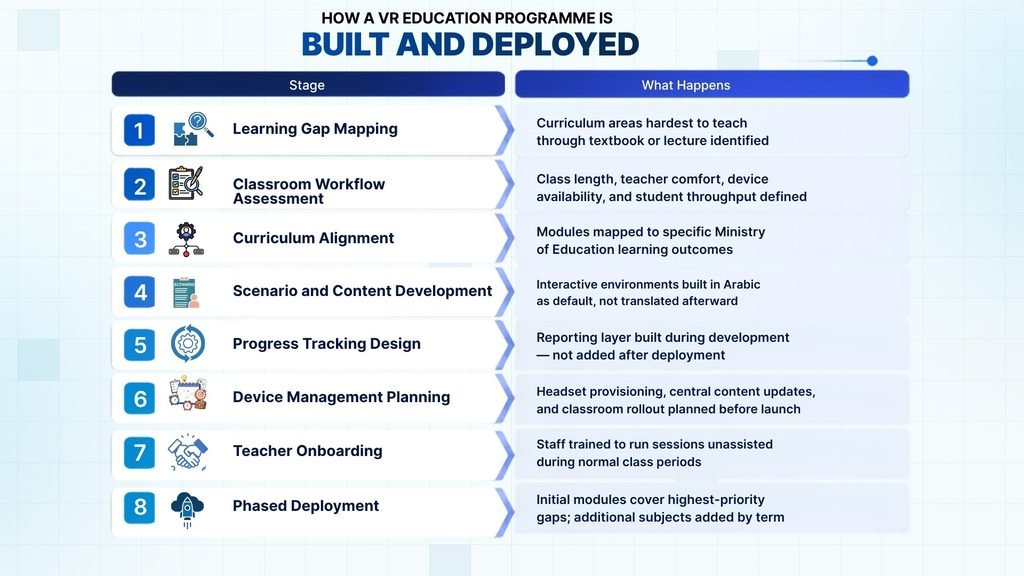
| Stage | What Happens |
| 1. Learning Gap Mapping | Curriculum areas hardest to teach through textbook or lecture identified |
| 2. Classroom Workflow Assessment | Class length, teacher comfort, device availability, and student throughput defined |
| 3. Curriculum Alignment | Modules mapped to specific Ministry of Education learning outcomes |
| 4. Scenario and Content Development | Interactive environments built in Arabic as default, not translated afterward |
| 5. Progress Tracking Design | Reporting layer built during development — not added after deployment |
| 6. Device Management Planning | Headset provisioning, central content updates, and classroom rollout planned before launch |
| 7. Teacher Onboarding | Staff trained to run sessions unassisted during normal class periods |
| 8. Phased Deployment | Initial modules cover highest-priority gaps; additional subjects added by term |
Cost Breakdown for Development of Virtual Reality in Education
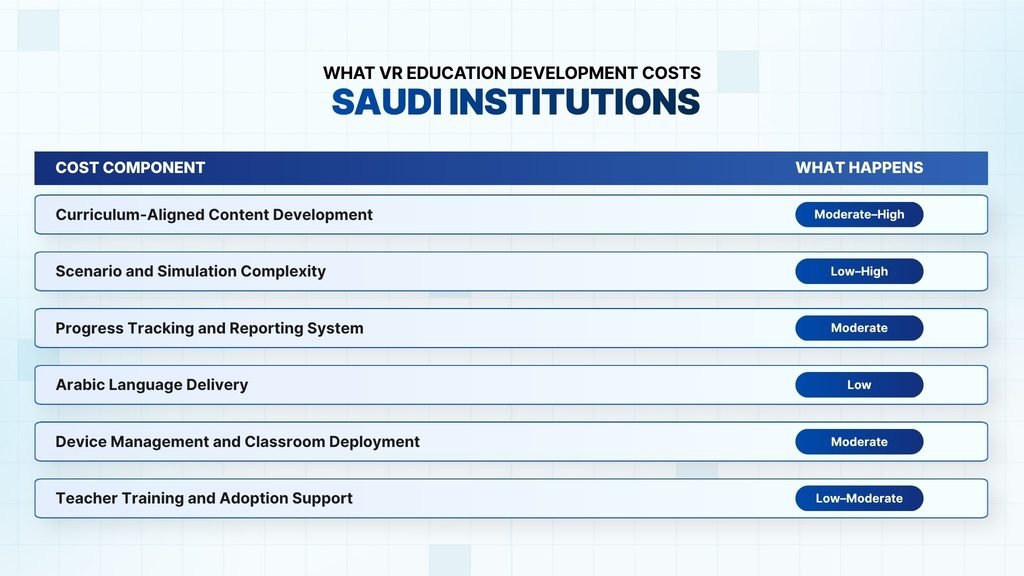
| Cost Component | Cost Level |
| Curriculum-Aligned Content Development | Moderate–High |
| Scenario and Simulation Complexity | Low–High |
| Progress Tracking and Reporting System | Moderate |
| Arabic Language Delivery | Low |
| Device Management and Classroom Deployment | Moderate |
| Teacher Training and Adoption Support | Low–Moderate |
The headset is rarely the real cost. Devices are a fixed, comparatively small line item. What determines total investment is everything the headset is running.
Content development & curriculum alignment
Building a module that maps to a specific Ministry of Education learning outcome, rather than adapting generic off-the-shelf VR content, is the single largest driver of scope. Institutions consistently underestimate this step and then wonder why a purchased content library does not actually match what teachers are required to teach.
Scenario & simulation complexity
A guided walkthrough of a historical site costs less to build than a branching medical procedure with decision points and consequence modelling. The more realistic the decision-making required, the more development time it takes to build correctly.
Progress tracking & reporting systems
A VR module without a reporting layer tells a teacher nothing beyond who put on a headset. Building individual student progress tracking, aggregated by classroom or department, adds development scope but is what makes VR gradeable coursework instead of an activity.
Device management & classroom deployment
Provisioning headsets across multiple classrooms or campuses, keeping content updated centrally, and managing device health over an academic year is an infrastructure cost separate from content, and one institutions often plan for only after deployment problems have already started.
Arabic language delivery
Full Arabic interface, narration, and instructional design is a standard requirement for Saudi institutional deployment, not an add-on layered onto English-first content after the fact.
Teacher training & adoption support
A VR system a teacher cannot run confidently in front of a class will not survive past the first semester, regardless of how well it was built.
Most Common Mistakes to Avoid in Virtual Reality Development for Education
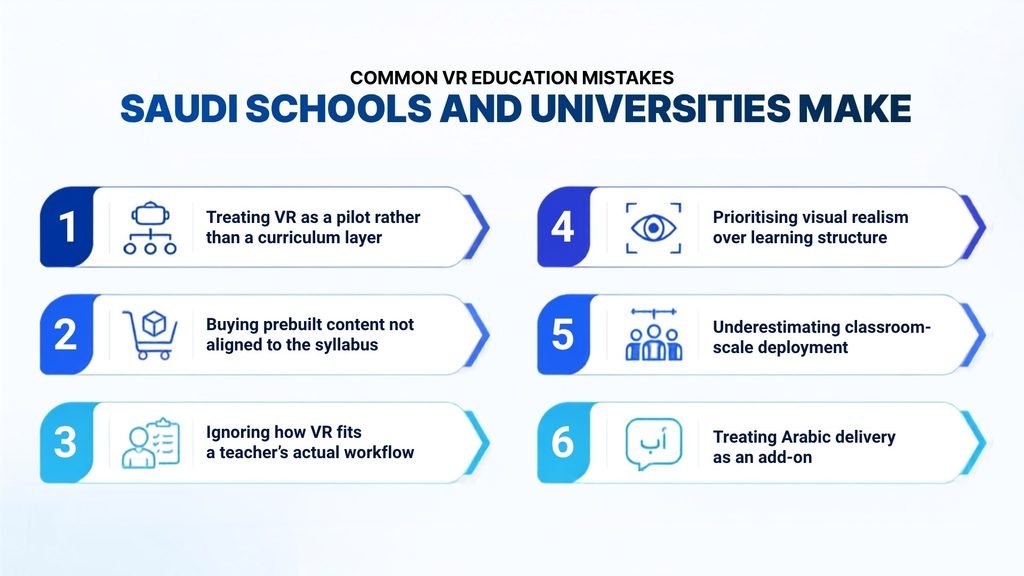
| Mistakes |
| Treating VR as a pilot rather than a curriculum layer |
| Buying prebuilt content not aligned to the syllabus |
| Ignoring how VR fits a teacher’s actual workflow |
| Prioritising visual realism over learning structure |
| Underestimating classroom-scale deployment |
| Treating Arabic delivery as an add-on |
Treating VR as a pilot instead of a curriculum layer. A single demo lesson in one classroom generates enthusiasm and a good photo for the school’s social media. It does not change learning outcomes, because outcomes only shift when VR appears consistently across a term, tied to actual assessment, not as a one-off event disconnected from the rest of the course.
Buying prebuilt content that is not aligned to your learning outcomes. Generic VR science content looks impressive in a demo and then sits unused because it does not map to what the syllabus actually requires that week. If a teacher has to work around the content instead of through it, the content will stop getting scheduled by the second term.
Ignoring how the technology fits a teacher’s actual workflow. A system designed around what looks impressive to an administrator, rather than what a teacher can operate unassisted during a normal class period, ends up requiring IT support for every session — and IT support does not scale to every classroom, every week.
Prioritising visual realism over learning structure. A beautifully rendered environment with no clear learning objective, no assessment point, and no progress tracking is a demo, not a lesson. Students remember that it looked impressive. They do not necessarily learn more from it than they would from a well-designed diagram.
Underestimating classroom-scale deployment. What works with one headset in a controlled demo does not automatically work across fifteen classrooms sharing a device pool, with different teachers, different schedules, and different levels of technical comfort. That gap is where most VR education budgets get spent twice — once to build it, and again to fix the deployment plan that was never built in the first place.
Why Etihad Falcon Tech is a Leading VR Development Company in Saudi Arabia
Starting With Your Learning Outcomes
We start with the learning outcome your institution is required to hit, not the headset. Before anything gets built, we map which parts of your curriculum are hardest to teach from a textbook or a lecture, the topics where your students consistently underperform because the subject needs experience, not description. A structural failure, a surgical procedure, a chemical reaction: these do not teach well from a slide, and that is where we start mapping the build.
Designing Around How You Actually Operate
From there, we design around how your institution actually runs. Session length, staff technical comfort, device availability, and how many students need to move through a session in one sitting all shape the build before we design a single scenario. A module that assumes unlimited time or a dedicated technician on standby is a module your staff uses once and quietly stops scheduling.
Building to Your Curriculum, in Arabic, With Tracking Built In
We build content to your specific curriculum, not adapted from a generic template pulled off a shelf, with Arabic delivery standard across every module rather than translated in afterward. We define progress tracking during design, not bolt it on at the end, so from your first session, an instructor can see who completed a module, who engaged with it, and exactly where a student got stuck.
Planning Rollout and Onboarding Before Deployment
We plan device management and rollout as part of the build itself, not as a problem to solve after deployment day when issues have already started. Every institution gets a staff onboarding process built in, because a system your team cannot run confidently will not survive past its first term, however well we engineered the back end.
If your institution is investing in curriculum reform but the teaching methods behind it have not caught up, that is the gap we start with. Message our experts on WhatsApp to walk through what your institution actually needs to teach, and what a VR programme built around it would look like.
FAQs
Yes. Modules can be built around specific curriculum learning outcomes and subject requirements rather than generic science or history content, so what students experience in VR maps directly to what they are assessed on in class.
Yes. Full Arabic interface, scenario narration, instructions, and assessment feedback are standard across every module. For Saudi institutional deployment, Arabic is the default build, not a translation layer applied to English content afterward.
Most deployments use standalone VR headsets paired with a managed device system, so IT staff can update content and monitor headset health across multiple classrooms without visiting each one individually. Hardware recommendations depend on classroom count, budget, and how many students need to cycle through a session per period.
Yes. Existing curriculum materials and lab procedures can be used as the foundation for scenario design. The conversion process maps what a teacher already teaches onto an interactive VR module, preserving the learning objective while adding the hands-on layer a textbook or slide deck cannot provide.
Each VR session records performance data — not just whether a module was completed, but where a student hesitated, made an error, or needed repetition. That data consolidates into reporting teachers and administrators can view by student, classroom, or institution, giving visibility a completion checklist alone cannot provide.
Most institutional deployments are phased around the academic calendar. An initial set of modules covering the highest-priority learning gaps typically deploys within one academic term, with additional subjects and classroom rollout planned around subsequent terms based on how the first phase performs.