
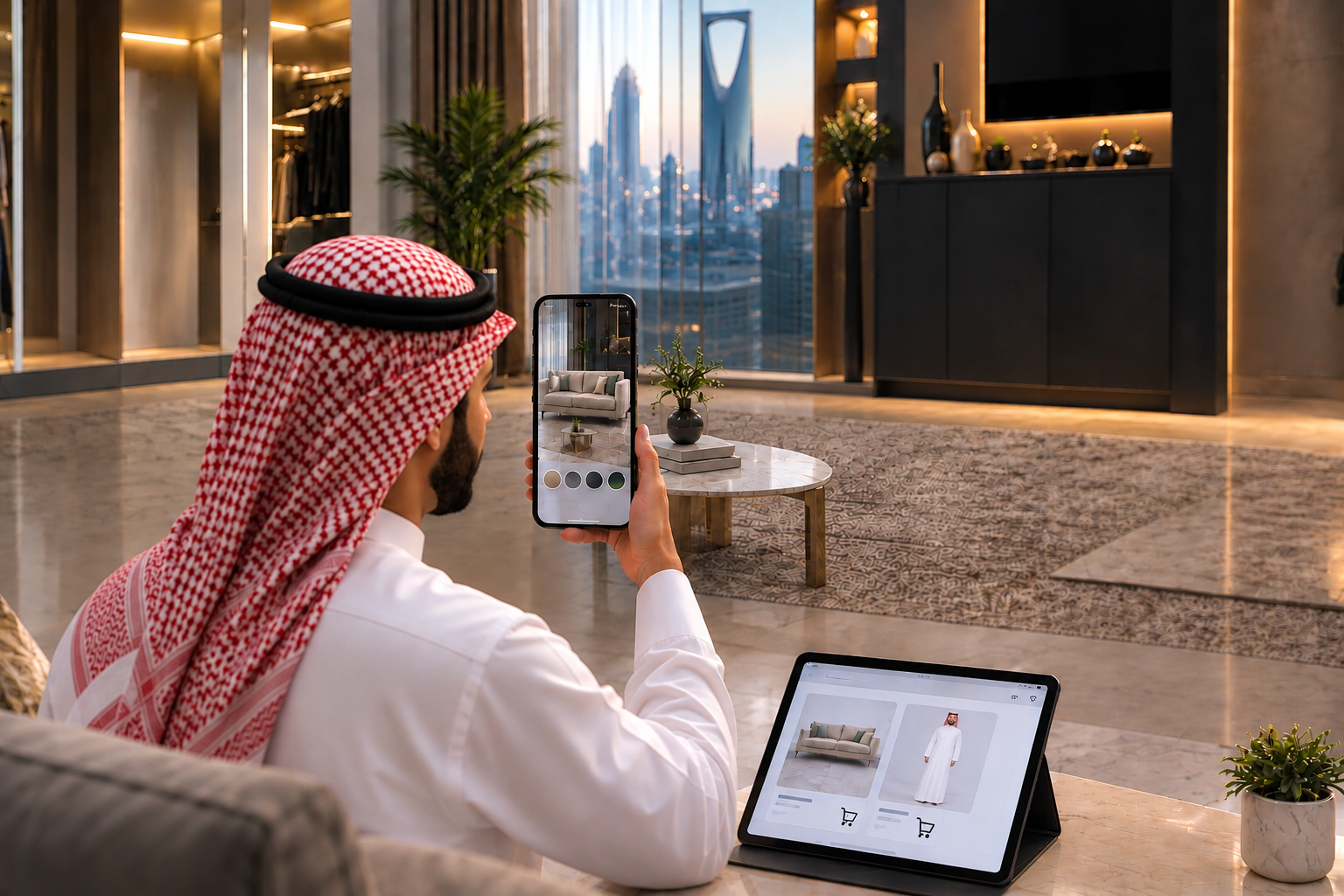
Saudi Arabia’s immersive technology market generated USD 166.5 million in 2024 and is projected to reach USD 754.5 million by 2030, according to Grand View Research, a global market research firm. Several industries are adopting immersive technology like AR and VR into their operations, which is why the market is growing this fast right now.
In the retail industry that includes fashion, home and décor, beauty, and electronics brands, all now adopting augmented reality to improve the customer experience. So how does augmented reality actually work in retail, and why are retailers using it to sell products online? Augmented reality in retail means giving your customer a way to see the product in their own context before they buy. With a simple smartphone camera, a customer can see the sofa they want to buy placed in their actual living room, or see what a piece of clothing looks like on their own body before they buy it. Augmented reality is a combination of your phone’s live camera feed and a digital 3D overlay placed on top of it in real time, so the product appears in front of the customer as if it were physically there.
This guide covers what augmented reality in retail actually involves for your business: what virtual try-on means for fashion and modest wear, what product visualisation looks like for home and furniture brands, when web AR is the right starting point versus a native app, what 3D asset production actually costs, and how to scope a launch that produces measurable return
Why Saudi Retailers Are Investing in AR Right Now
Product photography has a limit that most Saudi retailers are already paying for. If you’re selling fashion or home products, you’re already dealing with returns where the item wasn’t defective, it just didn’t match what the customer expected from the photo. This is the cost AR is built to reduce.
The conversion problem in high-consideration Saudi retail
Hesitation on a high-ticket item is usually a fit or scale problem, not a price problem. If you’re selling an SAR 3,000 sofa, your customer is stuck on whether it will actually work for their room, and no product photo answers that. AR does.
This is why AR delivers the most return on your highest-value SKUs, not your lowest. A 1% conversion lift on a high-ticket product is worth more than a 3% lift on a low-value one. Augmented Reality development doesn’t just cut returns for businesses but it also shortens the time a customer spends deciding, because they stop guessing and start seeing.
What global AR retail adoption proved
Zara and Sephora didn’t run AR as a campaign. Zara built it into the same app customers already use to browse and buy. Sephora built shade try-on into the same flow customers use to pick a product, and its return rate in beauty dropped as a result.
If you’re already running an app or a checkout flow your customers use regularly, adding AR to it is a product feature you’re extending, not a separate system you’re building from scratch. AR placed outside that flow, on a campaign page or a microsite, gets attention and produces nothing measurable.
What Augmented Reality in Retail Actually Covers
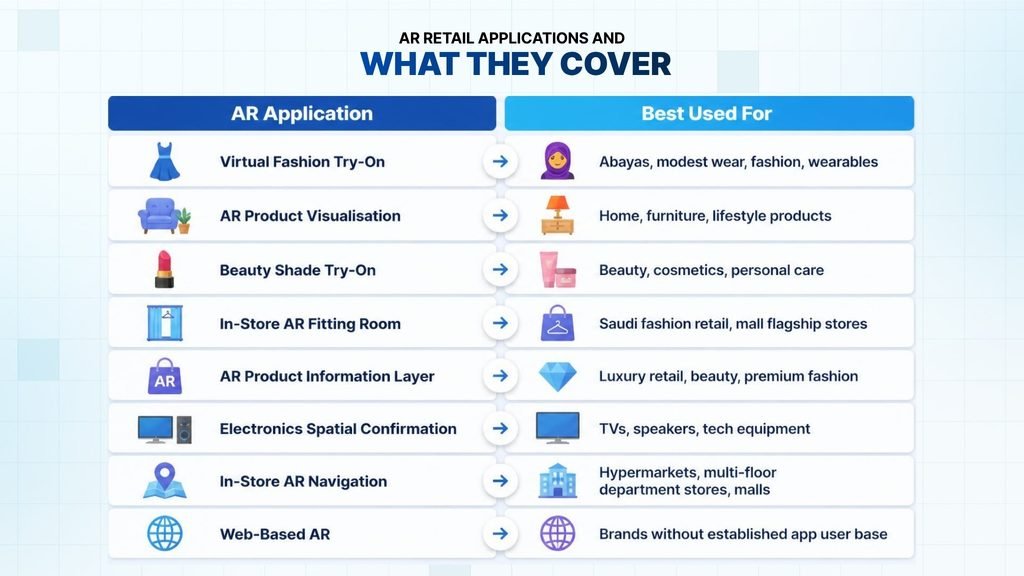
| AR Application | Best Used For |
| Virtual Fashion Try-On | Abayas, modest wear, fashion, wearables |
| AR Product Visualisation | Home, furniture, lifestyle products |
| Beauty Shade Try-On | Beauty, cosmetics, personal care |
| In-Store AR Fitting Room | Saudi fashion retail, mall flagship stores |
| AR Product Information Layer | Luxury retail, beauty, premium fashion |
| Electronics Spatial Confirmation | TVs, speakers, tech equipment |
| In-Store AR Navigation | Hypermarkets, multi-floor department stores, malls |
| Web-Based AR | Brands without established app user base |
Augmented reality in retail is not one tool. It is a set of distinct applications that each address a specific point in the customer decision journey. Understanding which application addresses which problem is what determines whether your AR investment produces commercial return or just positive reactions in a demo.
Virtual Try-on for Fashion & Wearables
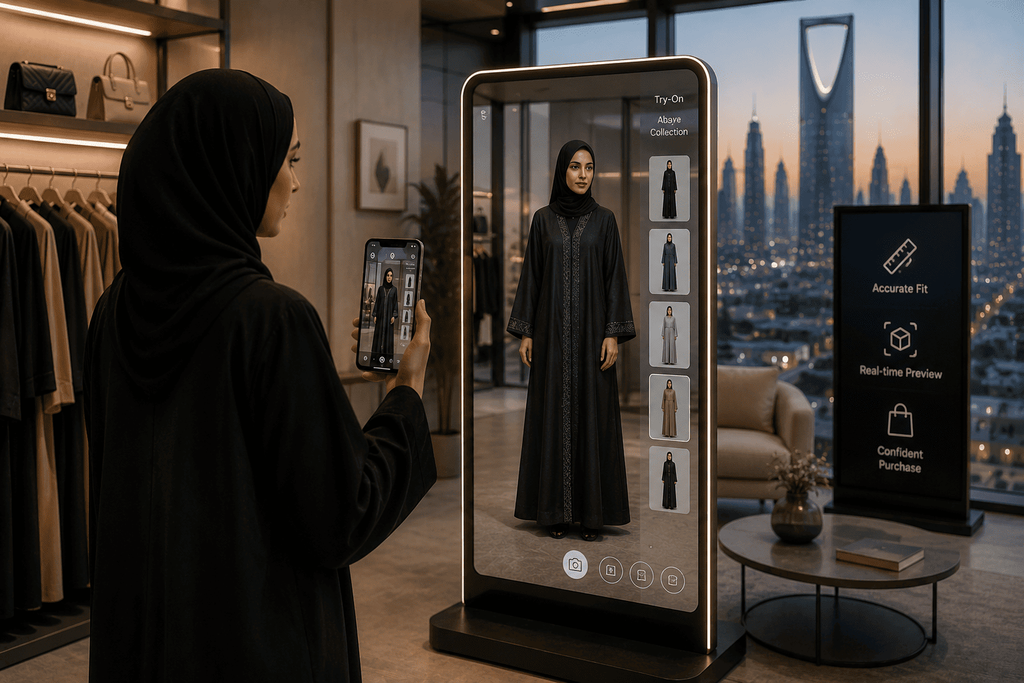
AR try-on overlays garments, accessories, or wearables onto the customer’s live camera view — on their body, in real time, at accurate scale. The customer sees the product on themselves before they purchase. This is the augmented reality online shopping application with the most direct impact on fashion return rates, because it closes the primary cause of fashion returns: the garment does not look the way the customer expected based on product imagery.
For Saudi modest fashion specifically, try-on needs to be designed around the specific garment categories — abayas, modest wear, full-coverage clothing — not adapted from generic fashion try-on templates built for fitted Western clothing. The drape, coverage, and silhouette of modest wear requires category-specific AR development.
Product Visualisation for Home & Décor
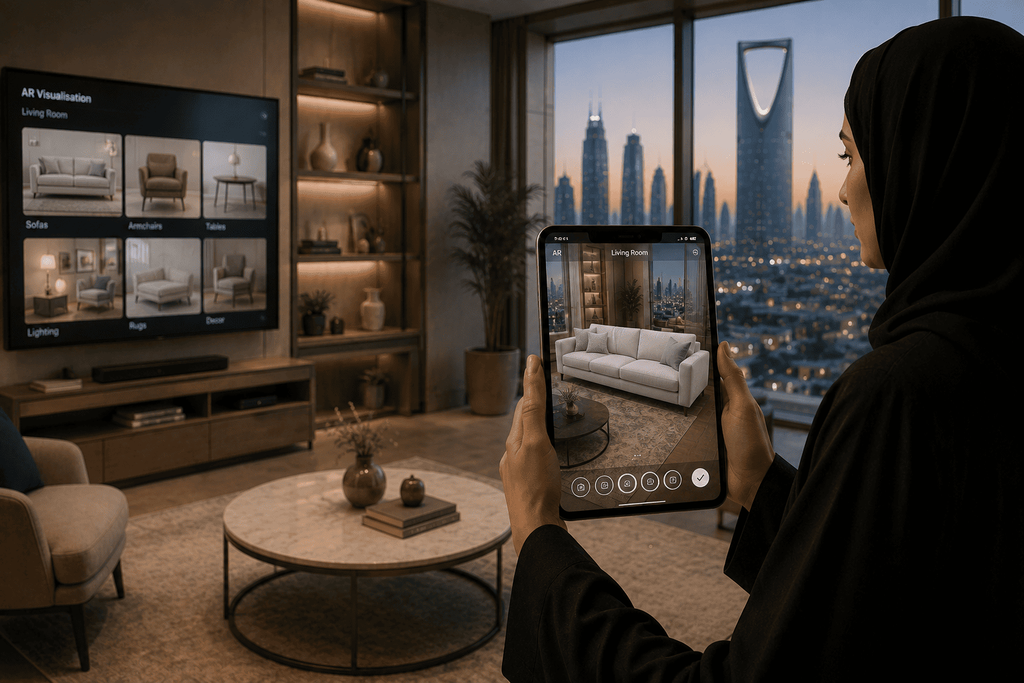
AR product visualisation places furniture, lighting, and décor items into the customer’s actual physical space through their phone camera. The sofa appears at its actual dimensions in the actual room. The lamp sits on the actual side table. The rug covers the actual floor area. The customer can see whether the product fits the space, works with the existing décor, and reads correctly in the room’s actual lighting — before committing to a purchase that will be difficult and expensive to return.
Augmented reality in shopping for home products is the category with the highest return rate reduction potential because the primary cause of home décor returns — the product looked different in the room than it did in the product image — is exactly what AR visualisation resolves.
In-store AR Experiences
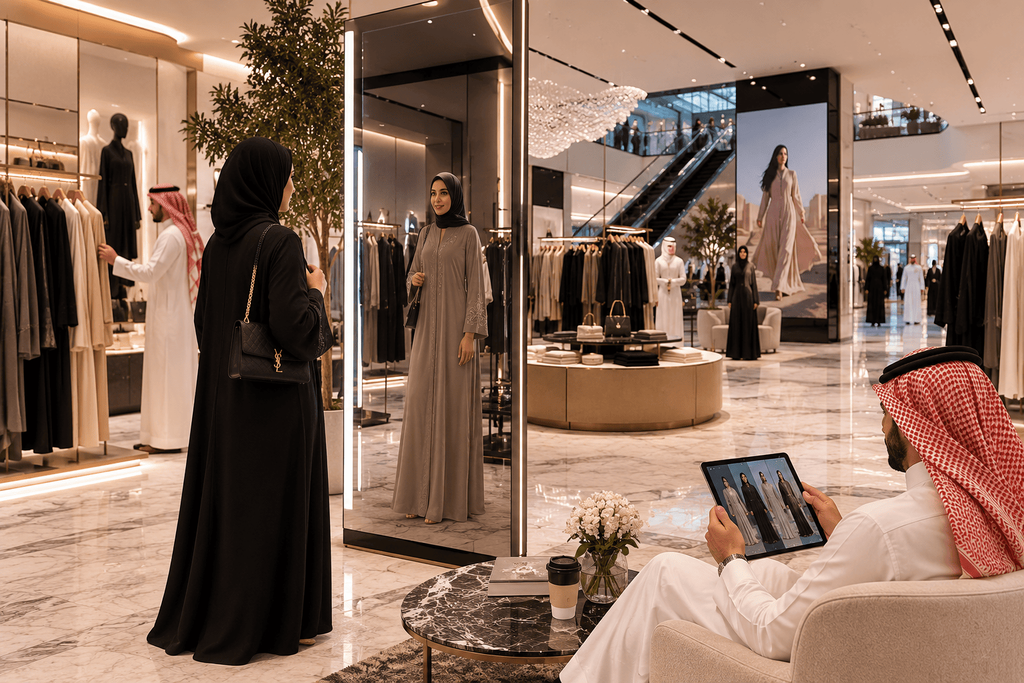
Augmented reality in retail stores serves a different function from e-commerce AR. The customer is already physically present — the challenge is not giving them spatial context, it is deepening their engagement with the product and the brand.
In-store AR can show how a garment looks in different colours without requiring multiple physical samples. It can provide product information, ingredient details, or pairing suggestions without requiring packaging space or printed materials. In large Saudi retail environments — mall flagship stores, multi-floor fashion retailers — AR navigation guides customers directly to the products they are looking for rather than requiring them to search through extensive floor areas.
Augmented reality in shopping malls as a discovery tool — AR-enabled store directories, promotion discovery, and brand experience activation — extends the technology beyond individual products into the physical retail environment itself.
Beauty & Cosmetics AR
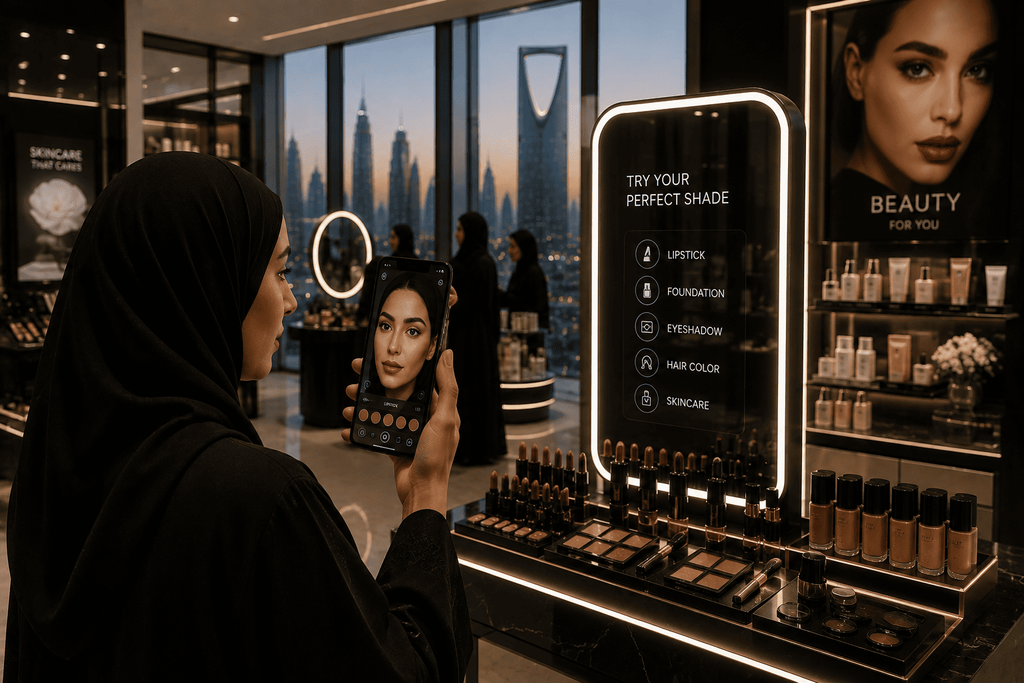
Virtual shade try-on for makeup, skincare simulation, and hair colour visualisation are the primary augmented reality retail applications for Saudi beauty brands. The purchase uncertainty in beauty is distinct from fashion — it is not about fit or scale; it is about how a specific shade or product performs on the customer’s specific complexion in their specific lighting. AR beauty try-on resolves this in real time, which explains why Sephora AR technology for virtual try-on produced measurable return rate reductions in beauty categories.
In-Store Augmented Reality Retail: What It Does in a Physical Saudi Store
The in-store augmented reality shopping experience serves fundamentally different objectives from e-commerce AR, and requires different thinking about what success looks like.
In an e-commerce context, AR is a conversion tool. It resolves the uncertainty that stops an online customer from completing a purchase. In a physical retail context, the customer is already there. AR is an experience enhancement tool; it deepens engagement, provides information in a richer format, and extends the time the customer spends meaningfully interacting with the brand.
AR Fitting Rooms in Saudi Fashion Retail
AR fitting rooms use interactive mirror or screen-based overlay to let customers see how garments look without physically changing. For Saudi fashion retailers where the conventional fitting room process creates friction — the effort of undressing and redressing for each item, the limited number of fitting rooms during peak periods — AR fitting rooms allow customers to evaluate more products in less time.
For Saudi customers who observe conservative dress, AR fitting rooms offer a way to assess fit and appearance without undressing in a shared retail environment. The privacy and convenience advantages of AR fitting rooms are directly relevant to the Saudi retail context in a way that generic global retail AR guides do not address.
AR Product Information & Experience Layers
Pointing a phone camera at a product activates additional information — ingredient details for beauty products, care instructions for fashion, room pairing suggestions for home products, brand storytelling content. This is augmented reality in store experience that adds value to the physical browsing journey without requiring the retailer to increase packaging or printed materials.
For Saudi luxury retail, this information layer can be used to tell provenance and craftsmanship stories that justify premium pricing — the customer points their phone at a piece and accesses content about the materials, the making process, and the heritage that supports the brand’s positioning.
Mixed reality retail for large-format Saudi environments
In Saudi hypermarkets, large furniture showrooms, and multi-floor department stores, mixed reality retail navigation reduces the search friction that causes customers to give up before finding what they came for. A customer opens an app, describes or searches for what they need, and AR overlays guide them through the physical store environment to the specific product location. For Saudi retail environments where scale can be overwhelming, this navigation layer improves the customer’s likelihood of finding and purchasing what they came for.
Web-Based AR vs App-Based AR: The Decision Saudi Retailers Get Wrong
Most Saudi retailers default to one of these without thinking through the trade-offs. The wrong choice limits your AR reach before a single customer uses the feature.
Web AR: broader reach, no download required
Web-based augmented reality for online shopping runs directly in a mobile browser. Your customer sees the “Try in your space” or “Try on” button on the product page. They tap it. The camera opens. The AR experience loads — no app download, no installation, no App Store approval required.
For Saudi e-commerce brands where customers arrive through Instagram, TikTok, or direct browser sessions, web AR reaches significantly more of your actual customer base than app-based AR. The barrier to use is a single tap.
The limitation is performance. Web AR cannot match the tracking precision or visual fidelity of a native app. For categories where the accuracy of the try-on is critical to the purchase decision — precise furniture dimensions, accurate garment drape on modest wear — web AR’s performance limitations may reduce rather than increase purchase confidence if the overlay is not convincing.
App-based AR: better performance, direct checkout integration
An AR feature built natively into your retail app delivers better visual quality, more accurate tracking, and — most importantly — direct connection to your checkout flow. The customer completes a try-on and adds to cart from inside the AR experience without navigating back to the product page.
That direct checkout path is where the conversion impact is strongest. The momentum of seeing a product look right in context should convert immediately into a purchase action. Requiring navigation steps between the AR experience and the checkout loses some of that momentum.
For Saudi retailers with an established app and an active user base, app-native AR is typically the higher-converting deployment. For retailers without that user base, web AR is the more practical starting point because it reaches more customers without a download barrier.
How Saudi Retailers Should Think About 3D Asset Production
This is the part of augmented reality retail planning that causes the most surprises, the most budget overruns, and the most delayed launches — and it is consistently underaddressed in early project conversations.
Every product that appears in your AR experience needs a high-quality 3D model. Not a product photograph. Not a 360-degree spin. A three-dimensional digital asset built with accurate dimensions, correct material textures, and realistic lighting response.
For a Saudi fashion retailer with a seasonal abaya collection of thirty styles across multiple colourways, that is a significant 3D production commitment. For a Saudi furniture brand with hundreds of SKUs and seasonal inventory changes, maintaining an accurate 3D library is an ongoing production discipline, not a one-time project.
The practical implication: your AR launch scope should be determined by what 3D production you can realistically complete, not by the full breadth of your product range. Saudi retailers who scope their AR launch around their highest-return-rate categories or their highest-consideration products — where the AR impact is most commercially significant — get to market faster, validate the commercial case with real data, and build the 3D library from there.
Trying to launch AR across your full catalog simultaneously delays launch by months and produces a 3D library of mixed quality, because the production resources are spread too thin to maintain consistent quality across every asset. Start focused. Expand based on what the data shows.
How Augmented Reality in Retail Needs Differ Across Saudi Business Categories
Abaya & Modest Fashion Brands
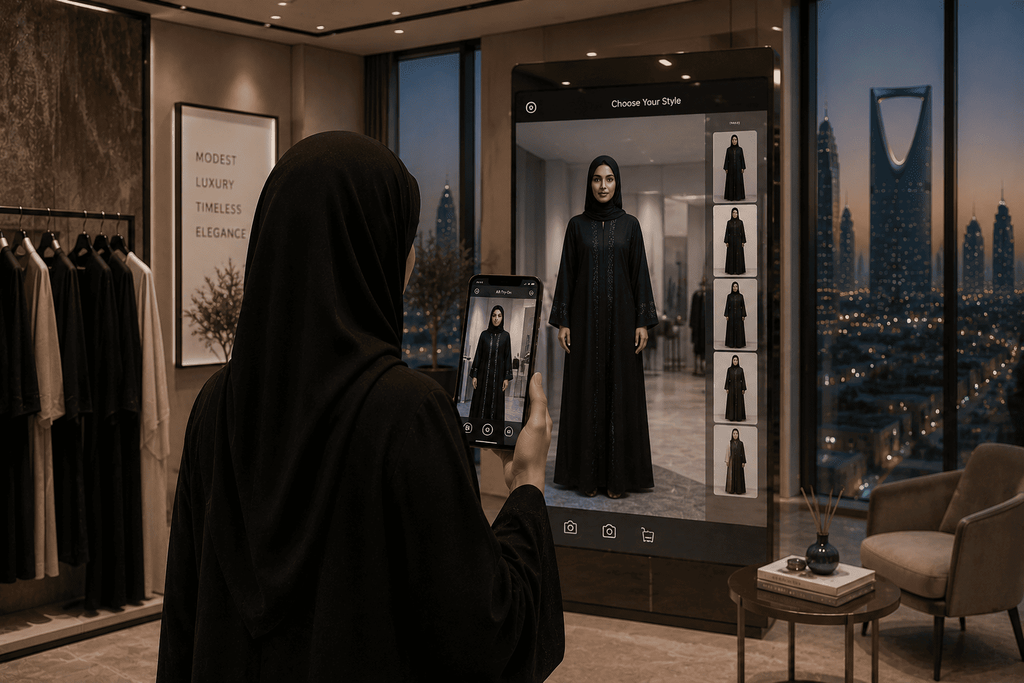
The return and hesitation problem in Saudi abaya retail is specific: customers cannot assess silhouette, drape, and fit from product photography because the garment’s relationship to the body is the entire purchase decision. AR try-on that shows the garment on the customer’s body — at their proportions, in their actual lighting — answers the question that photography cannot.
The development requirement is equally specific: the AR system must be built around how abayas and modest wear garments actually behave, not adapted from a Western fashion try-on template. Generic augmented retail try-on systems that model fitted silhouettes do not translate to full-coverage modest wear without significant reworking of the tracking model and drape simulation.
Luxury Fashion & Designer Saudi Brands
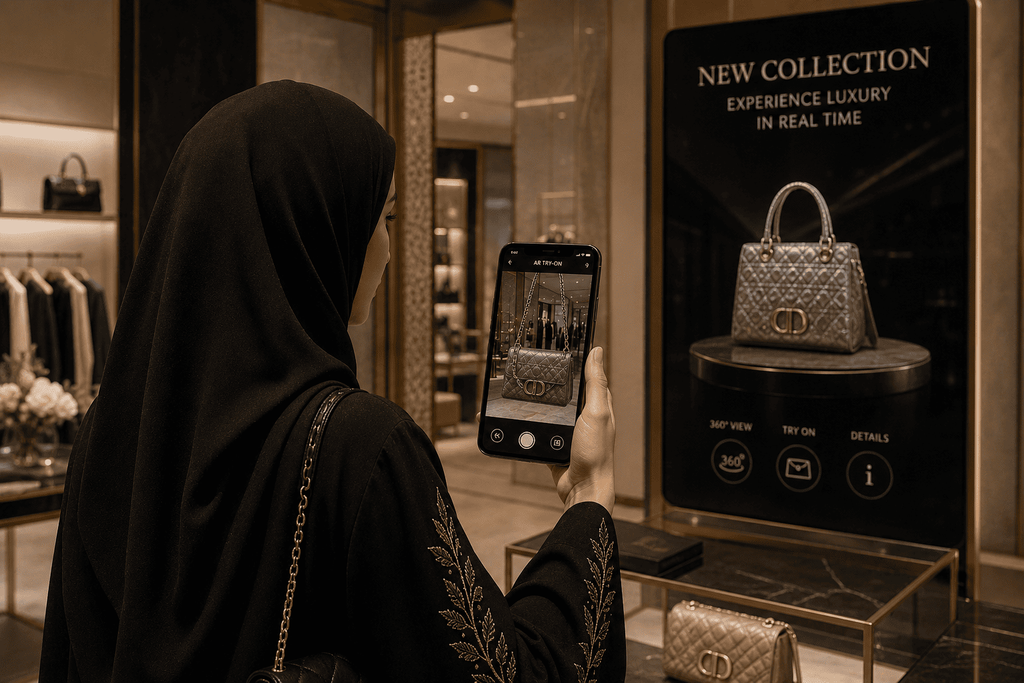
At this price point, AR is not just a try-on tool — it is a brand experience signal. A poorly produced AR overlay on a SAR 5,000 handbag or a SAR 3,000 designer abaya communicates the opposite of what the brand stands for. For Saudi luxury retail, the production quality of the AR experience needs to reflect the quality of the product it represents. High-fidelity material textures, accurate proportions, and refined interaction design are non-negotiable — not premium additions.
Furniture, Home, & Lifestyle Retail
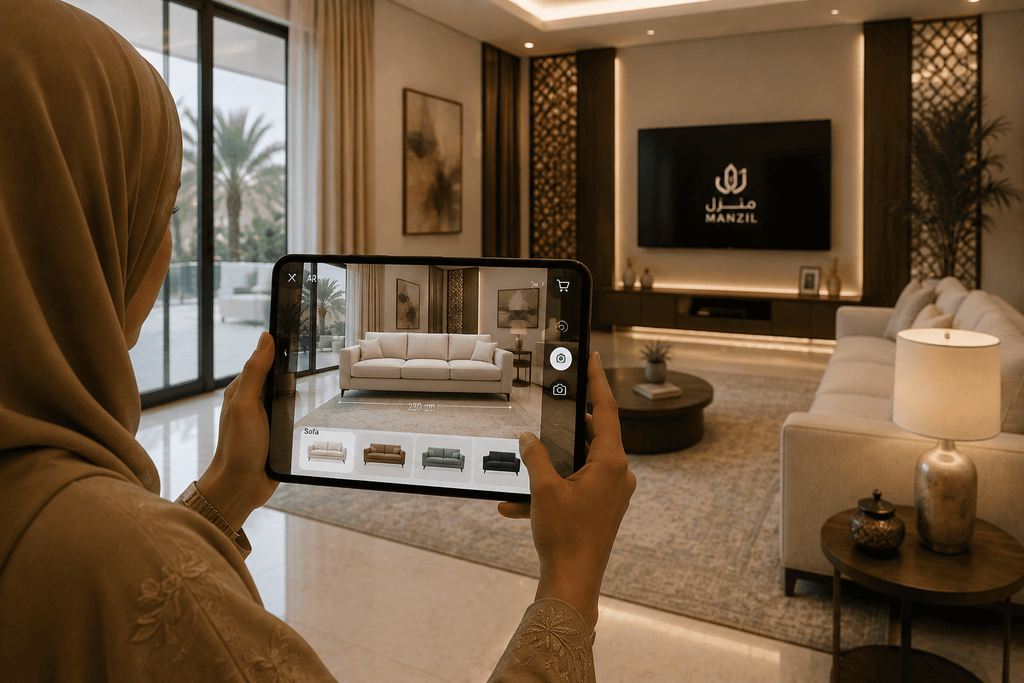
Augmented reality in retail for Saudi home products addresses the scale and fit uncertainty that drives this category’s high return rate. The customer who can place your sofa in their actual living room and confirm it fits the space before ordering eliminates the primary cause of returns in this category. Our AR shopping app development guide for retail explains how to prioritise which products to build first when your catalog is too large to convert all at once. Saudi home retailers with large SKU counts should prioritise 3D asset production for their highest-value and most-returned product lines first.
Beauty & Personal Care
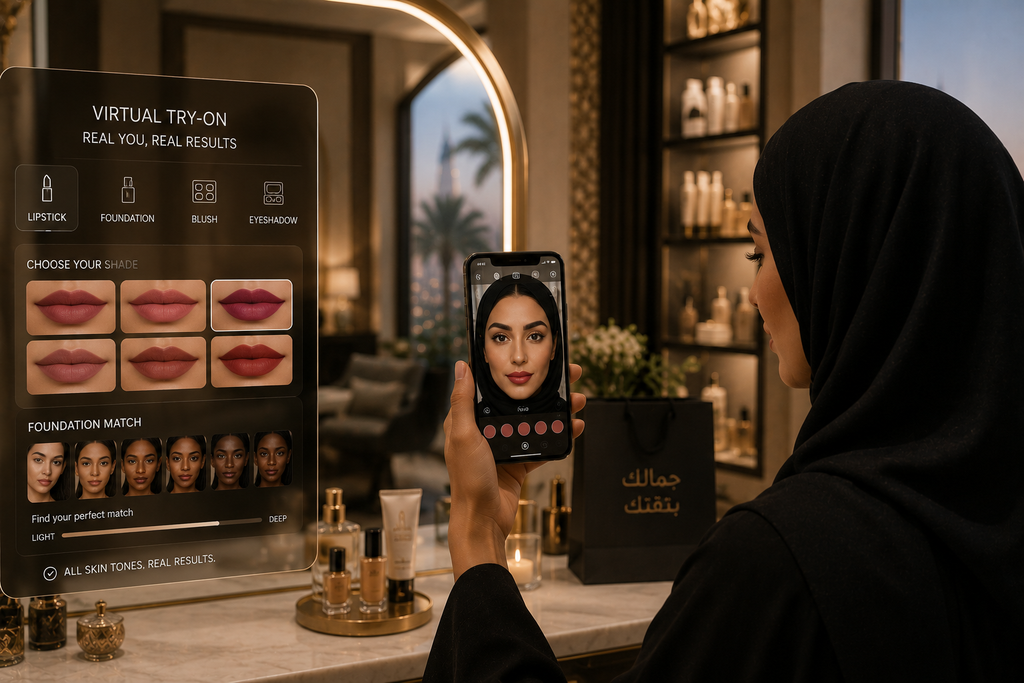
Virtual shade matching and product simulation reduce the return rate in Saudi beauty categories where the gap between how a product looks on a model and how it performs on the customer’s specific complexion is the recurring purchase disappointment. AR beauty try-on for Saudi brands needs to handle the range of complexions present in the Saudi customer base — not calibrated only to light skin tones as many global beauty AR tools are.
Electronics & Technology Retail
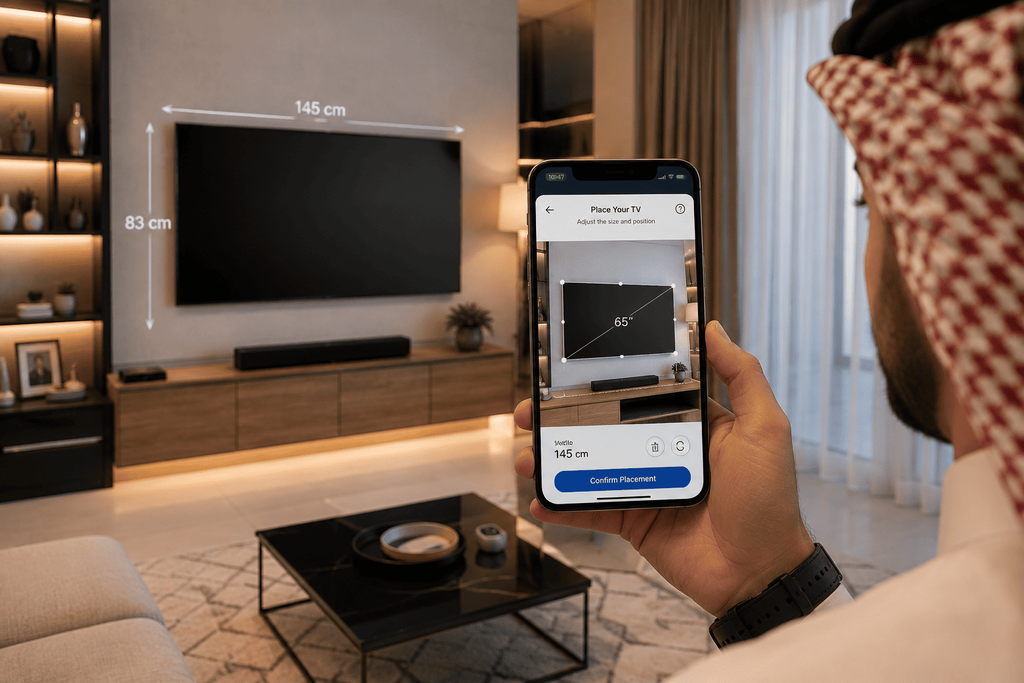
AR product visualisation for Saudi electronics retail serves a spatial confirmation function — confirming that a television will fit the wall, that a speaker system has the physical presence the customer expected, that the proportions of a device match what was imagined from product photography. This is a lower technical complexity AR application than fashion try-on and can be deployed via web AR effectively.
Across these categories, Virtual Reality (VR) development can also help you where the goal shifts from trying on a single product to experiencing a full space, a furniture showroom, a luxury boutique layout, or a home renovation preview, before the customer ever visits in person.
Arabic Language and Cultural Alignment in Saudi AR Retail
Getting this wrong costs more than getting it right costs.
Arabic interface design in an AR retail experience is not adding Arabic text to an English-first layout. It is building the interface — navigation, controls, product labels, interaction prompts — so that it flows correctly for an Arabic-reading user. Saudi customers using an AR shopping experience with reversed Arabic labels and English-logic interaction design identify it immediately as something not built for them. That impression affects their assessment of the brand, not just the technology.
Product information within the AR environment — pricing, product names, material descriptions, sizing — needs to be presented in Arabic where appropriate and displayed correctly in 3D space. Text rendering in augmented reality environments has different constraints than text on a product page. Arabic text needs to be integrated into the 3D rendering pipeline to display correctly, not added as a flat text overlay on top of the 3D experience.
For Saudi modest fashion specifically, the cultural alignment goes beyond language. The AR try-on experience — how the garment is presented, how the model or avatar behaves, what the styling context looks like — needs to reflect Saudi modest fashion conventions rather than generic global fashion presentation. A try-on experience that shows an abaya in a styling context that does not align with how Saudi women actually wear and think about modest fashion loses credibility with the customer it is supposed to serve.
How a Saudi Retail AR Experience Is Built and Deployed
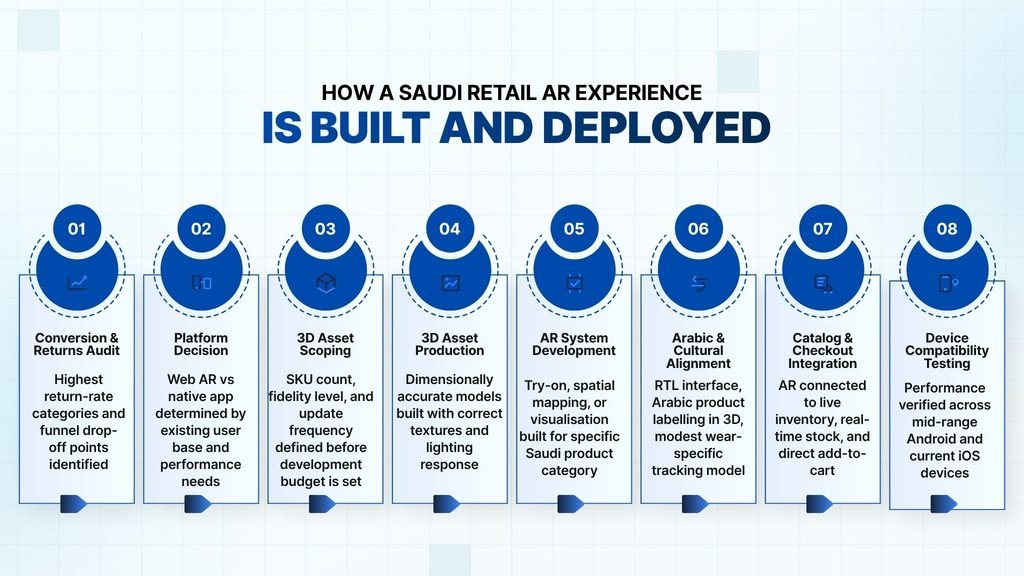
| Stage | What Happens |
| 1. Conversion & Returns Audit | Highest return-rate categories and funnel drop-off points identified |
| 2. Platform Decision | Web AR vs native app determined by existing user base and performance needs |
| 3. 3D Asset Scoping | SKU count, fidelity level, and update frequency defined before development budget is set |
| 4. 3D Asset Production | Dimensionally accurate models built with correct textures and lighting response |
| 5. AR System Development | Try-on, spatial mapping, or visualisation built for specific Saudi product category |
| 6. Arabic & Cultural Alignment | RTL interface, Arabic product labelling in 3D, modest wear-specific tracking model |
| 7. Catalog & Checkout Integration | AR connected to live inventory, real-time stock, and direct add-to-cart |
| 8. Device Compatibility Testing | Performance verified across mid-range Android and current iOS devices |
What Does Augmented Reality in Retail Cost for Saudi Brands?
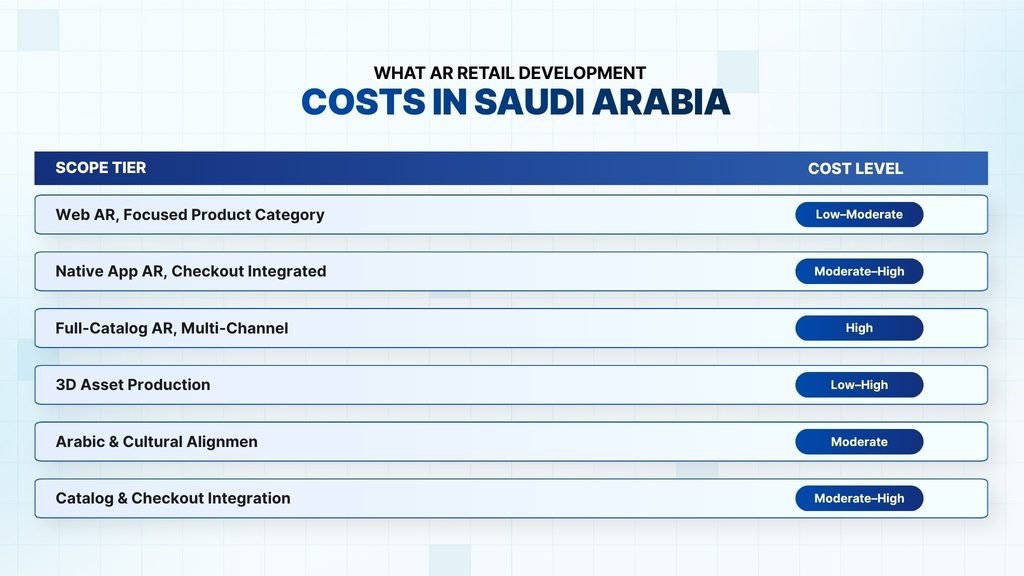
| Scope Tier | Cost Level |
| Web AR, Focused Product Category | Low–Moderate |
| Native App AR, Checkout Integrated | Moderate–High |
| Full-Catalog AR, Multi-Channel | High |
| 3D Asset Production | Low–High |
| Arabic & Cultural Alignment | Moderate |
| Catalog & Checkout Integration | Moderate–High |
AR retail deployment cost is driven by three variables: the scale and complexity of 3D asset production, the platform choice (web AR vs native app), and the depth of integration required with your e-commerce catalog and checkout.
Lower Cost Starting Point
Web-based AR covering a defined product selection is the lowest cost entry point for Saudi retailers. The 3D asset production is scoped to the initial launch category, the technical development is lighter than a native app, and no App Store approval is required. This is where most Saudi retailers validating the commercial case should begin — narrow scope, clear metrics, expandable from there.
Mid to High Cost
Building AR natively into a retail app with direct checkout connection, accurate try-on tracking, and a 3D library covering a meaningful SKU range is the mid-to-high cost tier. The commercial justification is the direct conversion path from AR experience to purchase — which produces stronger conversion impact than web AR for Saudi retailers with an established app user base.
Highest Investment
Covering a large product catalog with consistently maintained 3D assets, deployed across both web and app channels with live inventory integration, is the highest investment tier. Most Saudi retailers reach this through phased expansion rather than attempting it as an initial deployment. The per-channel cost is lower than commissioning separate deployments for each channel, but the total investment is significant and should be validated through the earlier phases before commitment.
What Drives Cost Up Within Any Tier
3D asset complexity — garments with complex drape behaviour and material texture cost more to model accurately than rigid objects. The number of SKUs in scope. Platform scope — iOS and Android native development requires separate optimisation for each. Integration depth — connecting to a complex ERP or a large e-commerce catalog adds development scope. Arabic language and cultural alignment requirements for Saudi market deployment. If you want a clearer estimate for your specific product range, contact us on WhatsApp and we’ll scope it out before any number gets attached.
Common Mistakes Saudi Retailers Make With Augmented Reality
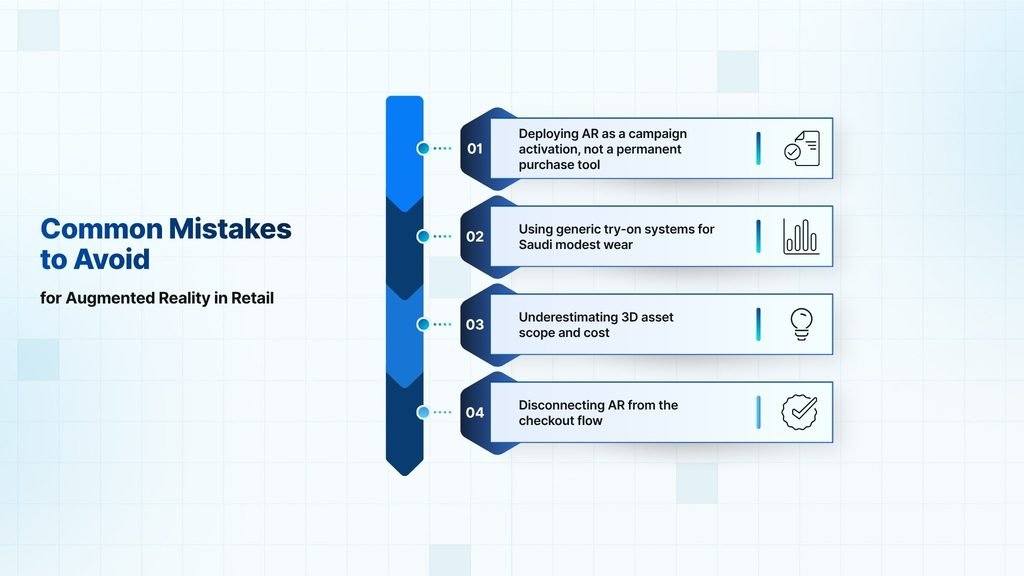
| Mistakes |
| Deploying AR as a campaign activation, not a permanent purchase tool |
| Using generic try-on systems for Saudi modest wear |
| Underestimating 3D asset scope and cost |
| Disconnecting AR from the checkout flow |
| Ignoring performance on mid-range Android devices |
| Treating Arabic as a translation layer on English-first design |
How Etihad Falcon Tech Builds Augmented Reality Retail Experiences for Saudi Brands

We start with your conversion and return data. Which categories have the highest return rates? Where in your purchase funnel are customers dropping off? Those data points tell us where AR will produce measurable commercial impact, and equally, where it will not. We do not recommend AR for every product category because it is not the right tool for every product category.
From there, we scope the 3D asset production requirement honestly before anything else. How many SKUs, at what fidelity, updated at what frequency as your inventory changes. That scope is where most of your budget is going, and getting it right at the start prevents the overruns that happen when asset production is discovered mid-project.
For Saudi modest fashion, abayas, and conservative clothing categories, we build try-on systems designed around how these garments actually look and behave, not adapted from global templates that were not built with Saudi modest wear in mind. Arabic-first interface design, RTL layout, and cultural alignment in how the AR experience is presented are standard in every Saudi retail AR project we deliver.
Frequently Asked Questions
Augmented reality in retail lets your customers see products in their own context before they purchase: clothing on their body, furniture in their room, beauty products on their face.
Fashion, modest wear, and abayas benefit most from try-on AR because the fit and silhouette uncertainty that drives purchase hesitation and returns is exactly what AR resolves. Home and furniture benefit most from spatial visualisation AR because scale uncertainty is the primary return driver. Beauty benefits from shade matching and product simulation AR.
The categories where AR produces the weakest return are commodity and low-consideration products where customers are not experiencing meaningful uncertainty before purchase.
Both options exist. Web-based AR runs in a mobile browser without requiring an app download, broader reach, lower barriers, but limited performance. App-based AR delivers better visual quality and connects directly to the checkout flow, but requires installation.
For Saudi retailers without an established app user base, web AR is usually the more practical starting point because it reaches more customers without the download barrier.
You do not need your full catalog. Most Saudi retailers start with their highest-return or highest-consideration category, the products where AR has the most direct impact on purchase decisions.
Yes, but only when the system is built specifically for these garment categories. Generic AR try-on technology designed for Western fashion does not translate correctly to abaya and modest wear without significant rethinking of the tracking model and drape simulation.
If you are building AR try-on for Saudi modest fashion, the development needs to start with your specific garment category.
A focused web AR deployment covering a defined product category takes eight to twelve weeks if 3D asset production runs in parallel with development. A native app AR feature with checkout integration takes fourteen to twenty weeks.
The 3D asset production timeline is the variable that most affects total launch time. Retailers who can provide complete product specifications and reference materials at the project start move significantly faster.
Define your baseline before launch. Current return rate in the target category. Current conversion rate on the product pages where AR will be deployed. After launch, compare the same metrics for customers who engage with AR against those who do not. The commercial case for augmented reality in retail is built on those two numbers: return rate reduction and conversion rate improvement. Conversion rate tells you AR is working.