
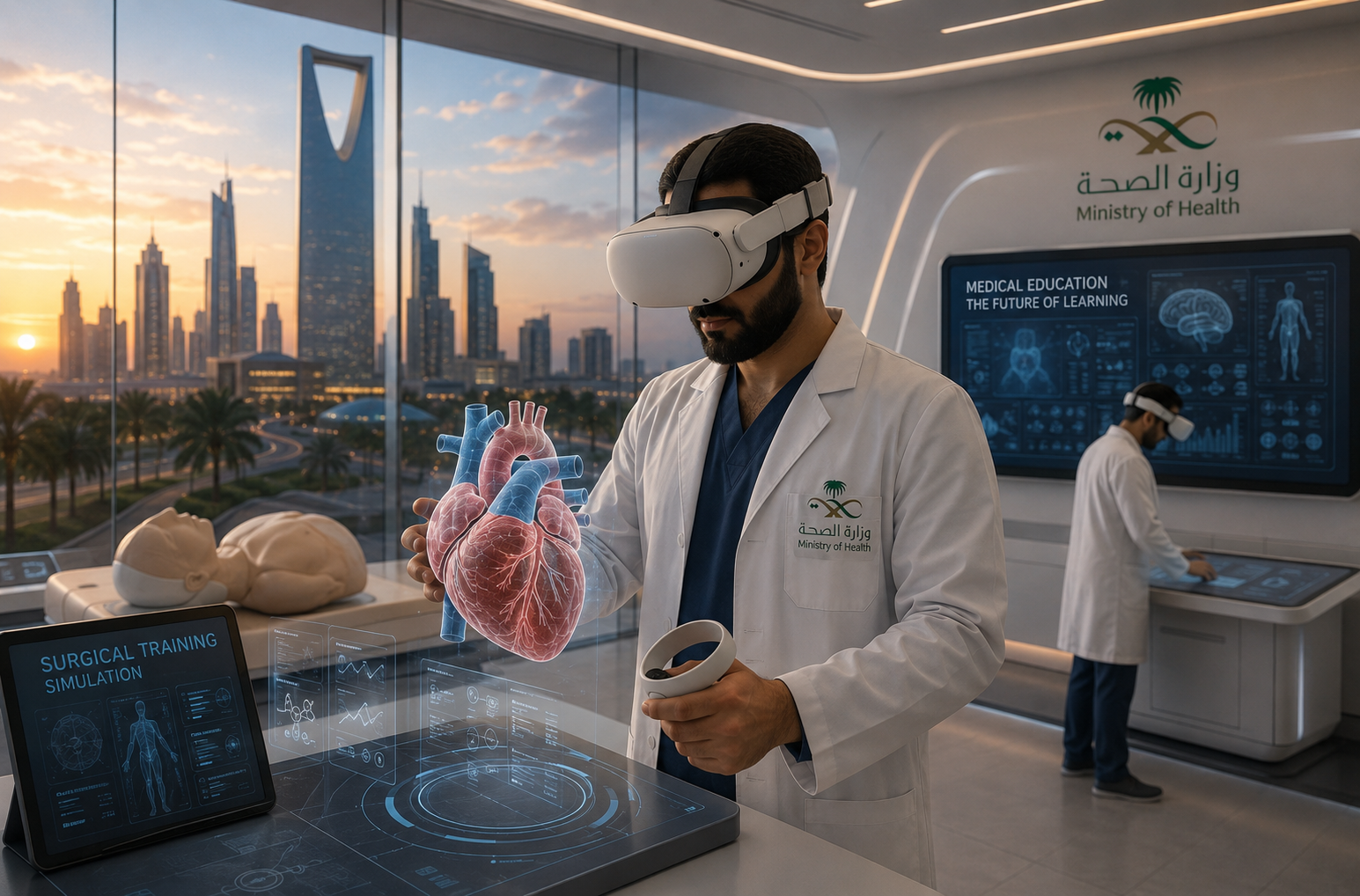
Virtual reality in healthcare has moved well beyond simulation labs and research pilots. In Saudi Arabia, healthcare institutions have already explored VR for medical education, surgical skills, patient comfort, rehabilitation and emergency preparedness. The Ministry of Health, for example, has previously used VR to help children manage anxiety during vaccinations and blood draws, while Saudi medical institutions have explored VR simulation for surgical and clinical training. More recently, the Ministry of Health’s Global Health Exhibition has highlighted VR-driven medical education as part of the Kingdom’s broader healthcare innovation agenda.
For hospitals and medical institutions, the question in 2026 is no longer whether VR is interesting. It is where Virtual Reality development in healthcare can solve a real training, treatment or patient-experience problem.
A surgeon can practise a complex procedure repeatedly without putting a patient at risk. A medical student can explore anatomy in three dimensions instead of relying only on a textbook. A rehabilitation patient can complete exercises inside an interactive environment rather than repeating the same movements in a conventional setting.
That is where virtual reality in healthcare becomes practical.
What Does Virtual Reality in Healthcare Actually Cover?
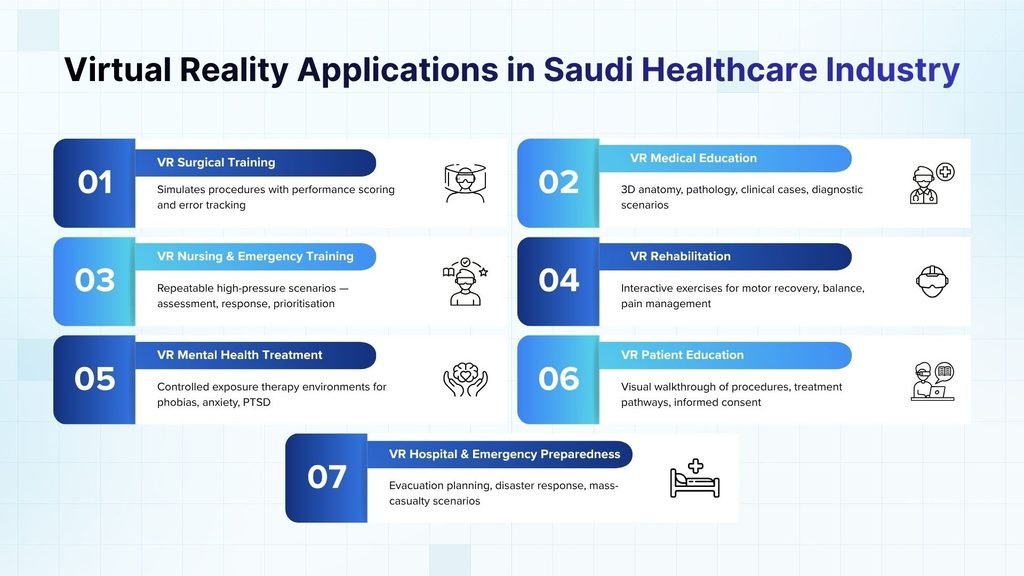
| Application | What It Does |
| VR Surgical Training | Simulates procedures with performance scoring and error tracking |
| VR Medical Education | 3D anatomy, pathology, clinical cases, diagnostic scenarios |
| VR Nursing & Emergency Training | Repeatable high-pressure scenarios — assessment, response, prioritisation |
| VR Rehabilitation | Interactive exercises for motor recovery, balance, pain management |
| VR Mental Health Treatment | Controlled exposure therapy environments for phobias, anxiety, PTSD |
| VR Patient Education | Visual walkthrough of procedures, treatment pathways, informed consent |
| VR Hospital & Emergency Preparedness | Evacuation planning, disaster response, mass-casualty scenarios |
Virtual reality in healthcare is not one product.
A VR surgical simulator, a rehabilitation application and a medical student anatomy platform may all use headsets, but they solve completely different problems.
VR Medical Training & Simulation
Medical training is one of the strongest use cases for VR.
Instead of learning only from lectures, videos or demonstrations, trainees can enter simulated clinical environments and practise specific tasks.
VR medical training can cover:
- Medical procedure simulation
- Clinical case scenarios
- Anatomy education
- Patient assessment
- Decision-making exercises
- Emergency response
- Medical equipment training
- Communication scenarios
This makes VR particularly useful for institutions that need repeatable training environments.
VR Surgical Training
Surgical training requires repetition, precision and controlled exposure to increasingly difficult scenarios.
VR can simulate procedures and allow trainees to practise specific steps before performing them in an operating environment.
A recent 2026 systematic review covering 235 studies found that most studies reported improvements in surgical performance, procedure time, errors or trainee confidence following VR surgical simulation. Importantly, the evidence supports VR as a training tool or adjunct — not as a replacement for supervised clinical experience.
VR Nursing & Emergency Medical Training
Nurses and emergency teams regularly deal with situations where timing matters.
VR can simulate:
- Patient assessment
- Emergency response
- Critical care situations
- Mass-casualty events
- Medication-related scenarios
- Pre-hospital emergency care
- Hospital evacuation procedures
The advantage is repeatability. A team can practise the same scenario, review its performance and repeat it until the response becomes more consistent.
VR Patient Therapy & Rehabilitation
VR is also being used as an adjunct to rehabilitation.
Patients recovering from neurological injuries, musculoskeletal conditions or other physical limitations can perform exercises inside interactive environments designed to make repetitive movements more engaging.
The evidence is promising but should be interpreted carefully.
A 2025 umbrella review led by a researcher from Taif University found that VR showed short-term benefits for patient-reported pain outcomes in chronic musculoskeletal pain, but the certainty of the underlying evidence varied from moderate to very low, and results for disability and fear of movement were inconsistent.
So the right message for a healthcare institution is not “VR replaces physiotherapy.”
It is:
VR can become another tool inside a clinically supervised rehabilitation programme.
VR Mental Health Treatment
VR can create controlled environments for psychological interventions such as exposure therapy.
For example, a clinician may use a virtual environment to expose a patient to a specific trigger gradually rather than relying entirely on imagination or real-world exposure.
Potential applications include:
- Phobia treatment
- Anxiety programmes
- PTSD-related exposure therapy
- Relaxation environments
- Cognitive behavioural therapy support
Clinical protocols and professional supervision remain essential. VR should not be treated as a standalone replacement for qualified mental health care.
VR Patient Education
Patients often struggle to understand what is going to happen during a medical procedure.
VR can make the explanation visual.
A patient could explore a virtual model of the body, see where a procedure will take place or walk through the stages of treatment before arriving at the hospital.
That can make complex medical information easier to understand than a printed diagram alone.
Mixed Reality in Healthcare
Mixed reality combines digital content with the physical environment.
Unlike fully immersive VR, the clinician can continue seeing the real world while digital information is placed into it.
This can be useful for:
- Procedural guidance
- Medical anatomy overlays
- Surgical planning
- Equipment guidance
- Clinical collaboration
- Training with physical equipment
The right choice depends on whether the institution needs a fully controlled virtual environment or digital information layered onto a real clinical environment.
What Is the Difference Between VR, Mixed Reality and AR in Healthcare?
The easiest way to separate the three is to ask one question:
Does the user need to leave the real environment or work inside it?
Virtual Reality replaces the user’s visual environment with a virtual one. It works particularly well for simulation, training and therapeutic experiences.
Augmented Reality (AR) adds digital information to the real world. A clinician might see information or visual markers while still seeing the patient and physical environment.
Mixed reality goes further by allowing digital objects and information to interact more naturally with the physical environment.
For a medical college teaching anatomy, VR may be the strongest starting point.
For a hospital training surgical teams, VR simulation may be appropriate.
For a clinical procedure requiring real-world visual guidance, mixed reality may make more sense.
The technology should follow the training or clinical objective — not the other way around.
What Can VR Actually Deliver for a Saudi Hospital or Medical Institution?
VR Surgical Training
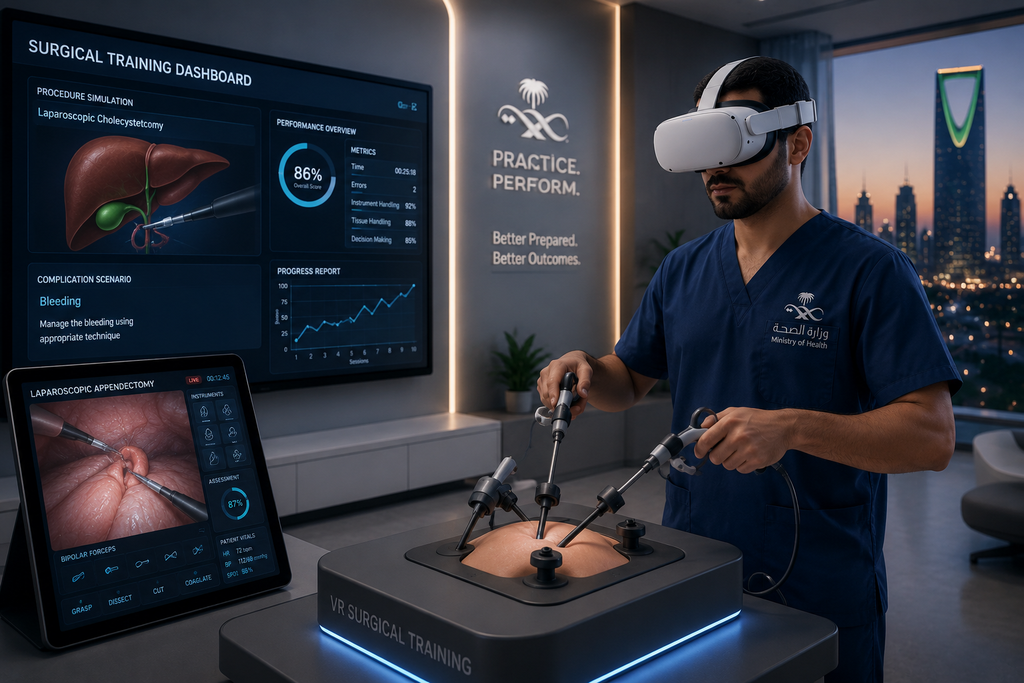
Surgical trainees can repeat simulated procedures and practise decision-making around complications.
A VR surgical training platform can include:
- Procedure simulation
- Operative decision-making
- Complication scenarios
- Instrument interaction
- Performance scoring
- Time tracking
- Error tracking
- Progress reports
The goal is not to turn VR into a substitute for the operating room.
The goal is to make the trainee better prepared before entering it.
Recent evidence supports this role. A 2026 systematic review of VR training and surgical performance found a positive effect across several surgical domains, although the studies showed substantial variation.
VR Medical Education
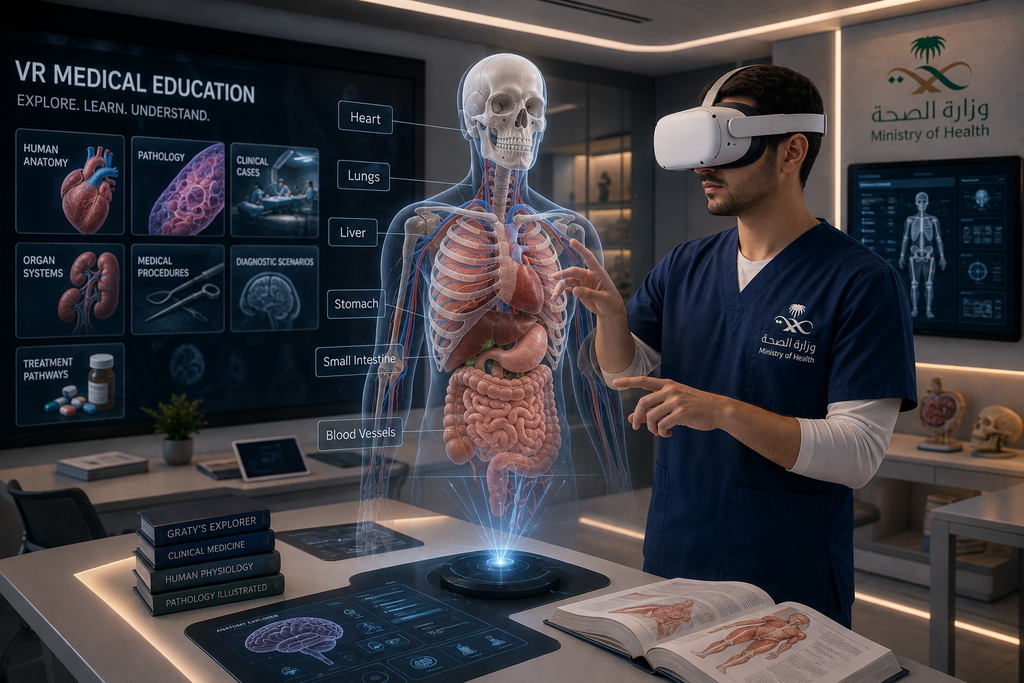
A three-dimensional anatomy model can show students relationships that are difficult to understand from a flat image.
Medical colleges can build VR modules around:
- Human anatomy
- Pathology
- Clinical cases
- Organ systems
- Medical procedures
- Diagnostic scenarios
- Treatment pathways
This is particularly useful for institutions looking to supplement conventional teaching rather than replace it.
VR Nursing & Emergency Care Training
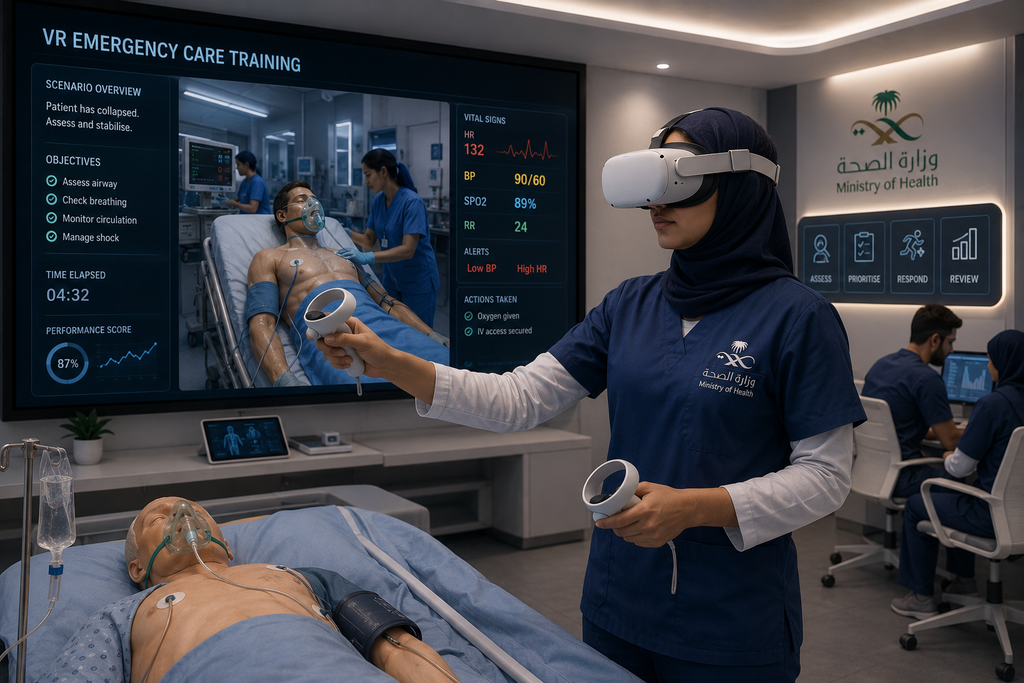
Emergency training is difficult to standardise because real emergencies are unpredictable.
VR creates a controlled alternative.
A hospital can create scenarios where a nurse or emergency responder has to assess a patient, prioritise actions and respond as the situation develops.
The same scenario can then be repeated with different decisions and outcomes.
VR Therapy & Rehabilitation
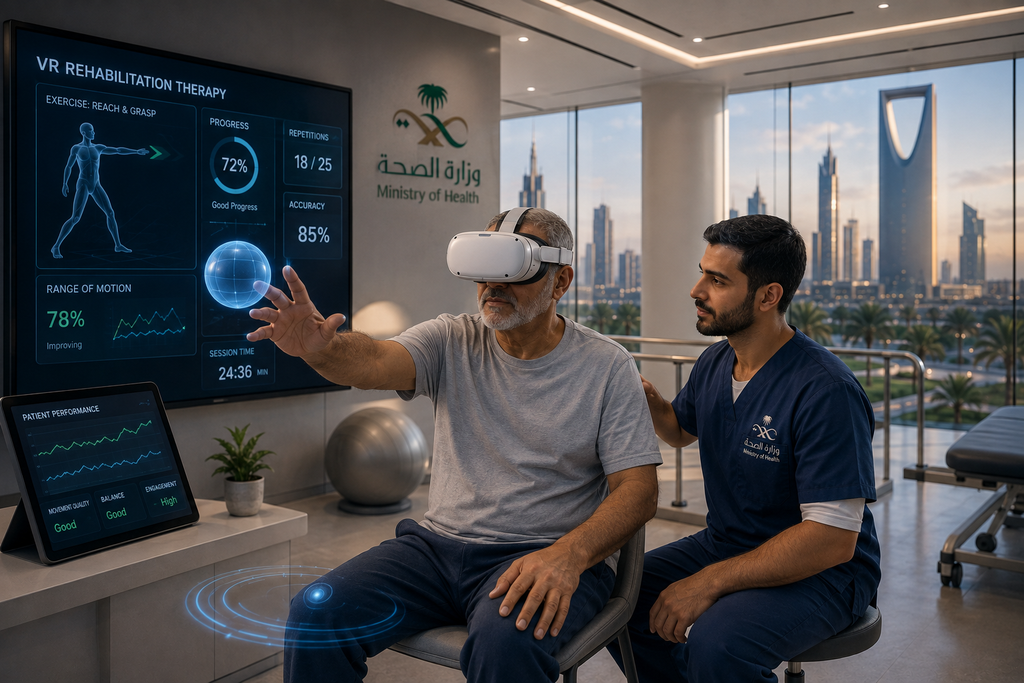
VR rehabilitation can make repetitive exercises more interactive while giving clinicians another way to track engagement and performance.
Applications can include:
- Stroke rehabilitation
- Motor recovery
- Balance training
- Physical therapy exercises
- Neurological rehabilitation
- Pain management
- Movement training
Evidence for pain reduction is encouraging in several areas. A systematic review and meta-analysis of 11 studies involving 1,761 participants found moderate-quality evidence that VR-based rehabilitation produced a small-to-medium improvement in pain for people with low-back pain.
But healthcare providers should still evaluate each application against the patient population, clinical protocol and quality of evidence available.
VR Mental Health Treatment
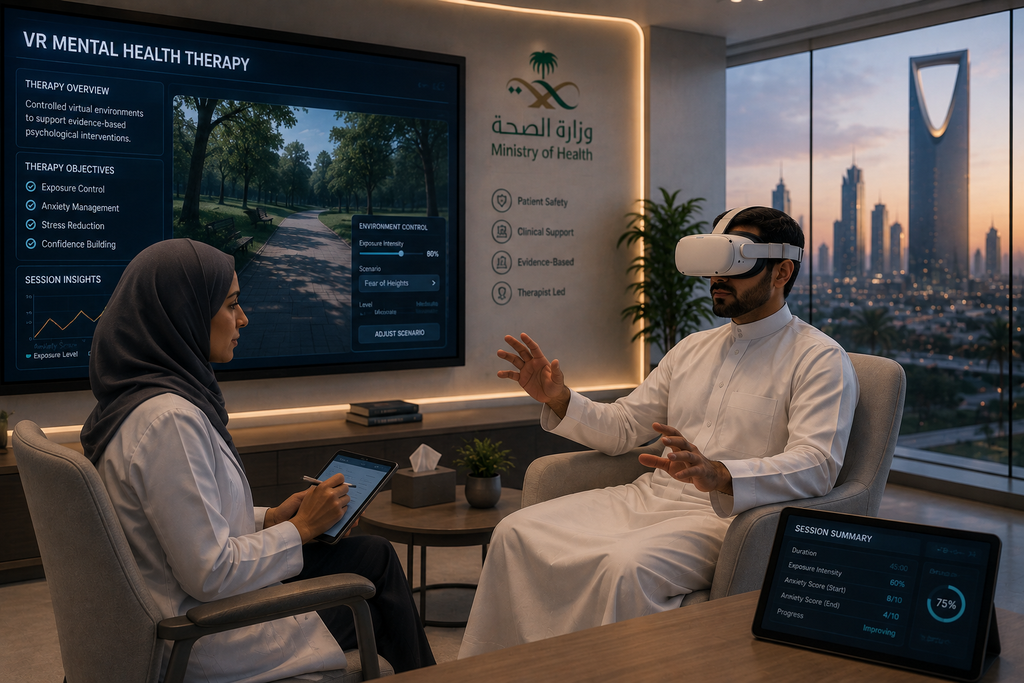
VR can give therapists controlled environments that would otherwise be difficult or expensive to reproduce.
For example, a therapist working with a patient with a specific phobia could control the intensity of exposure within a virtual environment.
The important point is that the technology supports the clinician.
It does not replace clinical assessment or professional judgement.
VR Patient Education
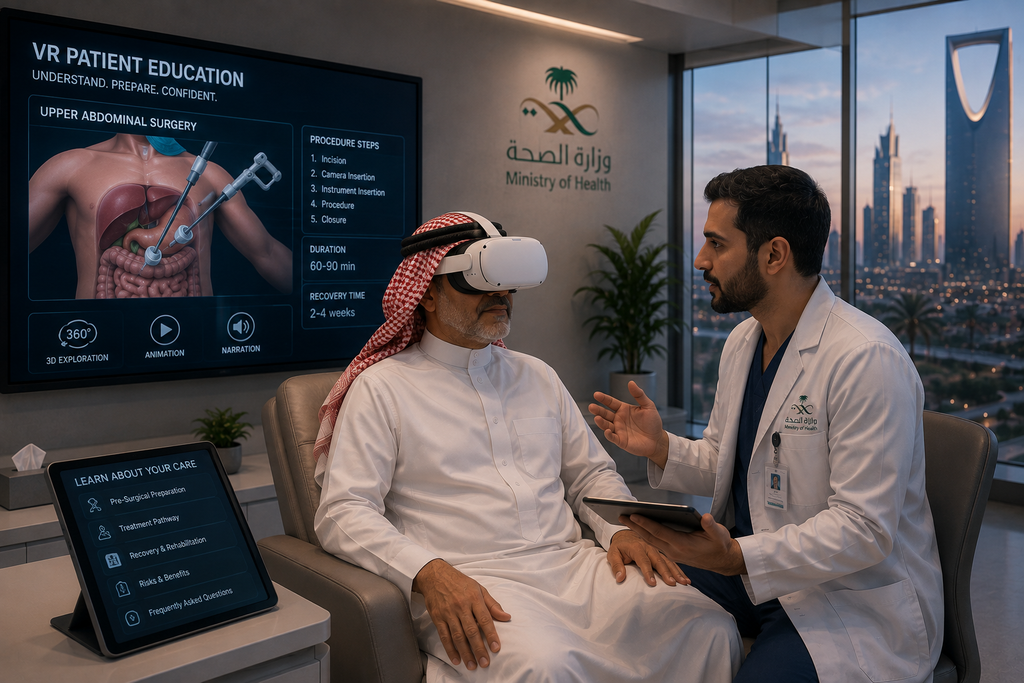
Imagine a patient preparing for surgery.
Instead of receiving only a verbal explanation, the patient can put on a headset and see a simplified visual representation of the procedure.
The same approach can be used for:
- Pre-surgical preparation
- Chronic disease education
- Rehabilitation instructions
- Treatment pathway explanation
- Patient orientation
- Informed-consent support
This can be particularly valuable when the subject is difficult to explain using conventional materials.
Everything above covers what VR delivers on its own, but many Saudi hospitals are pairing it with AR for tasks where the physical environment still needs to stay in view, guided surgery, equipment training, and in-room patient education. See our guide on Augmented Reality in Healthcare for a closer look at how those applications work and where they differ from what VR covers here.
How Do VR Healthcare Needs Differ Across Saudi Medical Institution Types?
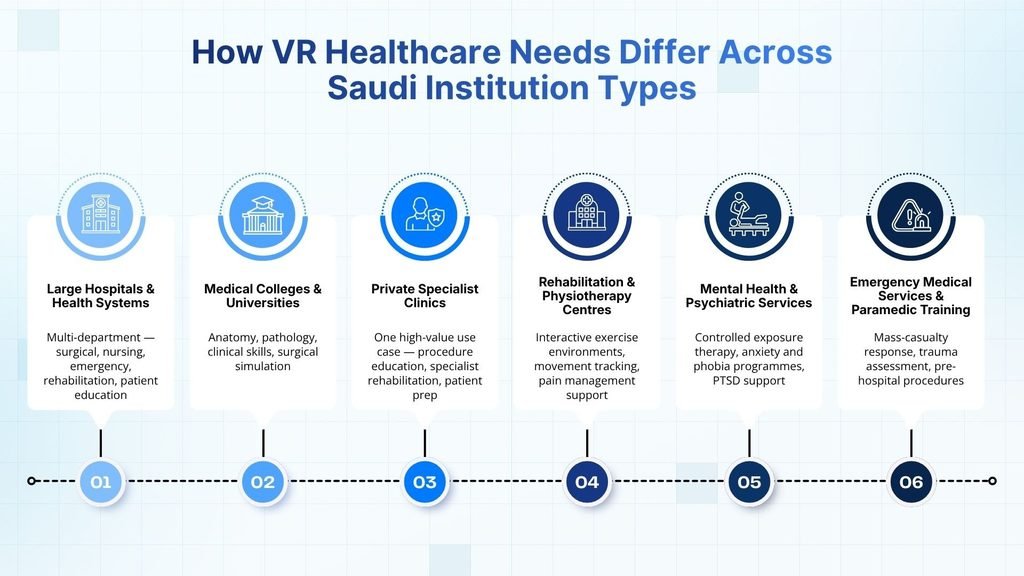
| Institution Type | Primary VR Application |
| Large Hospitals & Health Systems | Multi-department — surgical, nursing, emergency, rehabilitation, patient education |
| Medical Colleges & Universities | Anatomy, pathology, clinical skills, surgical simulation |
| Private Specialist Clinics | One high-value use case — procedure education, specialist rehabilitation, patient prep |
| Rehabilitation & Physiotherapy Centres | Interactive exercise environments, movement tracking, pain management support |
| Mental Health & Psychiatric Services | Controlled exposure therapy, anxiety and phobia programmes, PTSD support |
| Emergency Medical Services & Paramedic Training | Mass-casualty response, trauma assessment, pre-hospital procedures |
Large Hospitals & Health Systems
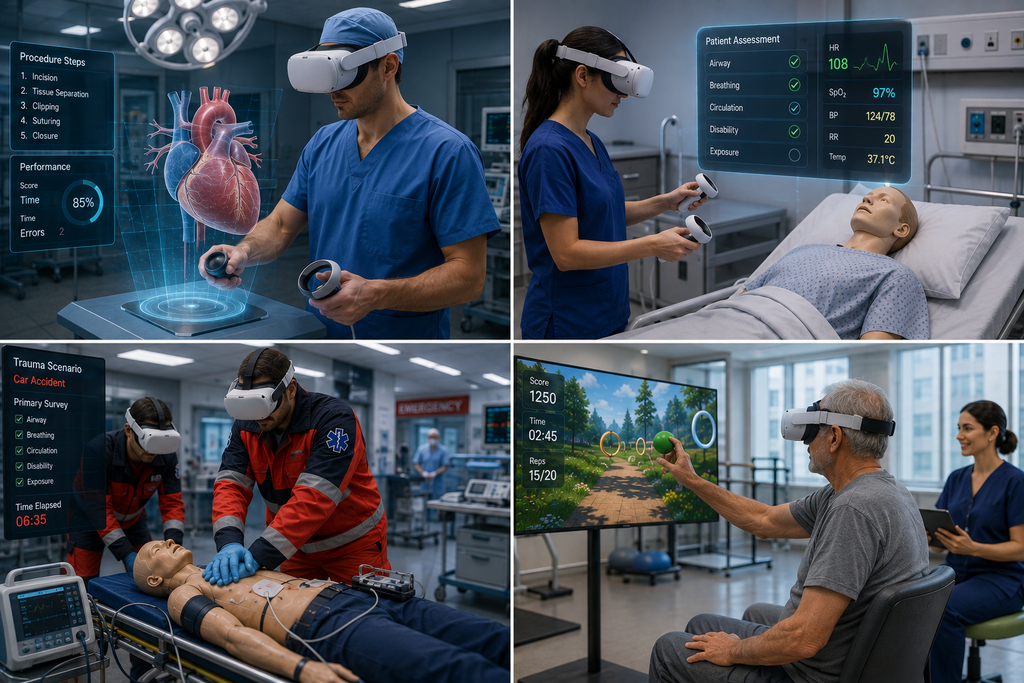
Large hospitals can use VR across multiple departments.
Possible deployments include:
- Surgical simulation
- Nursing training
- Emergency scenarios
- Patient rehabilitation
- Medical education
- Hospital evacuation training
- Patient education
The challenge is integration and governance. A hospital-wide VR programme needs hardware management, user accounts, content governance, clinical review and performance reporting.
Medical Colleges & Universities
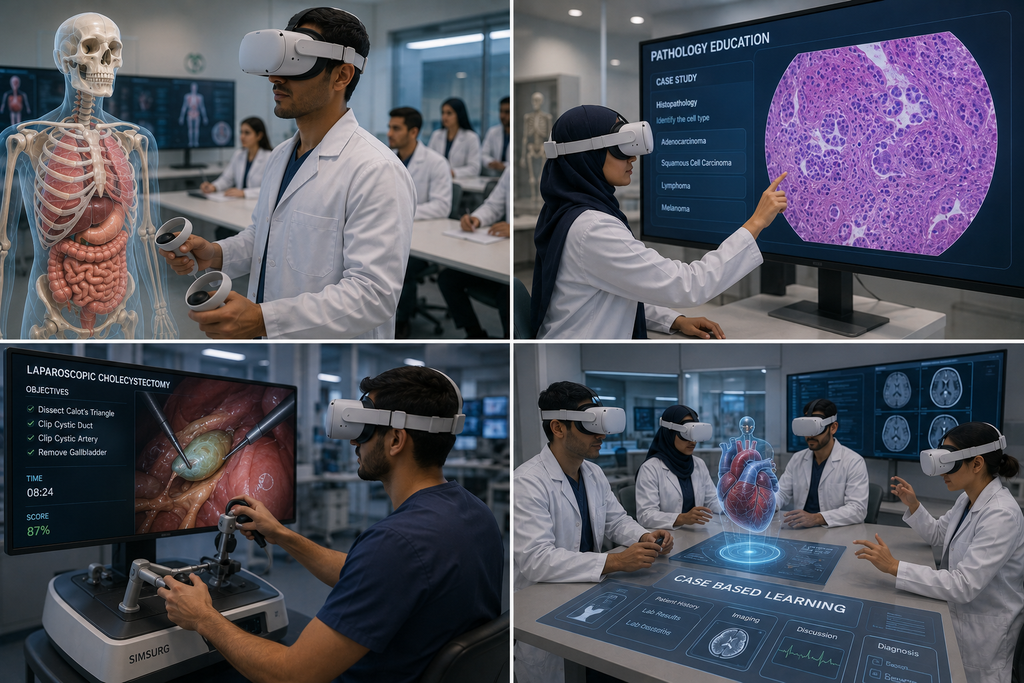
Medical colleges can use VR to supplement:
- Anatomy teaching
- Pathology education
- Clinical skills
- Surgical training
- Case-based learning
- Simulation laboratories
Saudi universities are already exploring VR-based learning. King Saud University, for example, has documented VR-related simulation work across medical and dental education.
Private Specialist Clinics
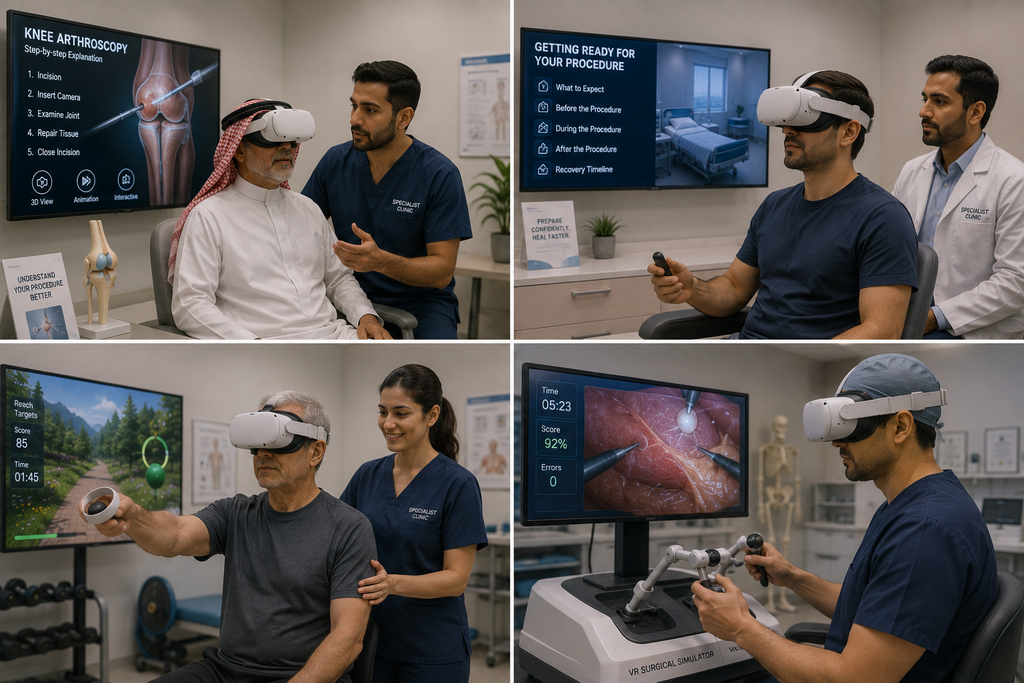
A specialist clinic does not necessarily need a large VR platform.
A smaller deployment might focus on one high-value use case:
- Procedure education
- Patient preparation
- Specialist rehabilitation
- Surgical simulation
- Condition-specific education
This makes VR more practical for clinics with limited training budgets.
Rehabilitation & Physiotherapy Centres
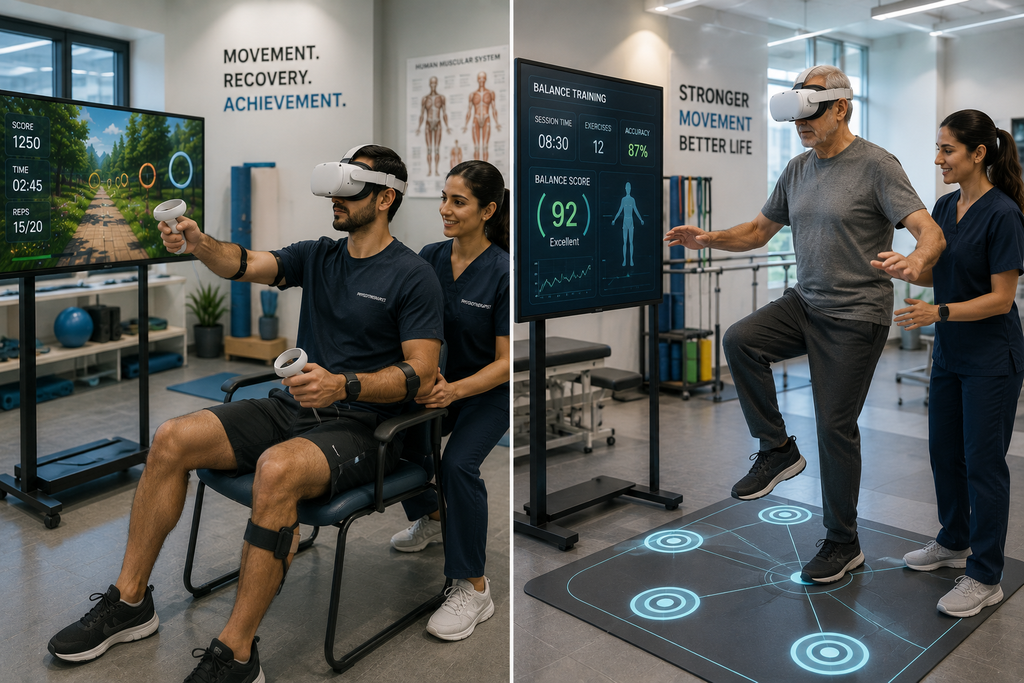
These facilities can use VR to make exercises more engaging and provide structured digital environments for repeated therapy.
The strongest candidates are programmes where VR can support measurable movement, engagement or pain-management objectives.
Mental Health Facilities & Psychiatric Services
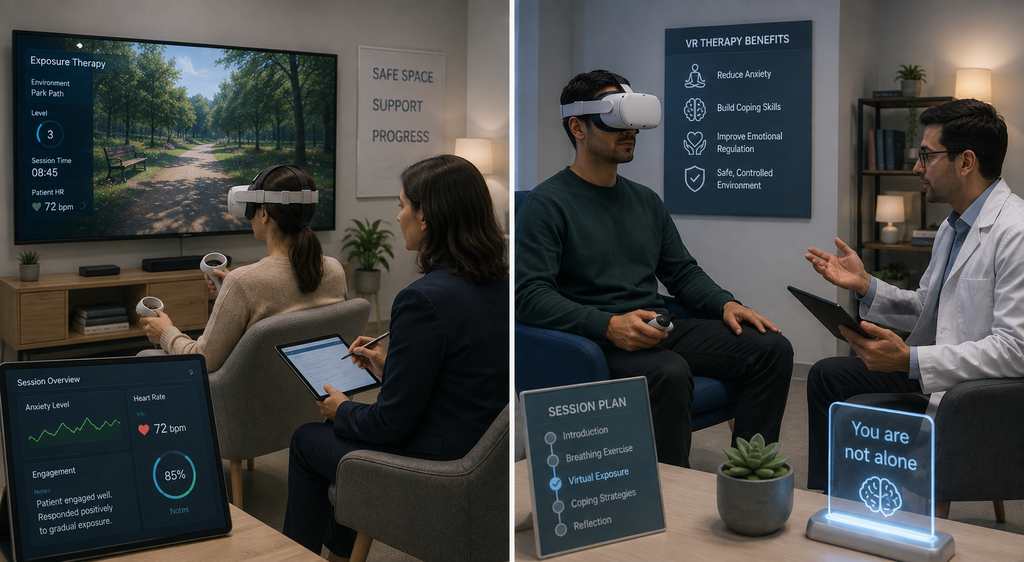
VR can support controlled exposure-based interventions and other structured therapeutic programmes.
The content needs to be clinically appropriate and supervised by qualified professionals.
Emergency Medical Services & Paramedic Training Institutions
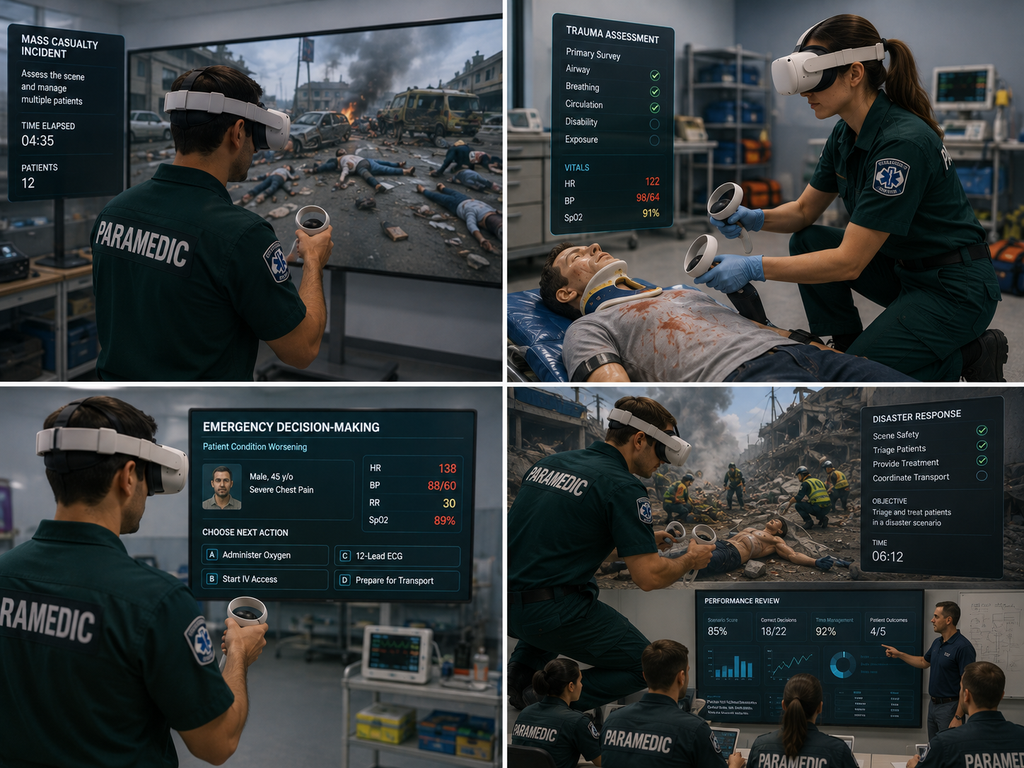
VR is particularly useful for scenarios that are difficult to recreate frequently in the real world.
A paramedic could practise:
- Mass-casualty response
- Trauma assessment
- Emergency decision-making
- Disaster response
- Patient prioritisation
- Pre-hospital procedures
The institution can then repeat the scenario and compare performance across trainees.
What Does VR Healthcare Implementation Actually Require?
Buying headsets is the easy part.
The difficult part is building a VR programme that clinicians actually use.
Clinical content development — building the medical scenarios and simulations the VR platform needs
Healthcare VR content needs more than good 3D graphics.
The scenario needs to be medically accurate.
That means involving clinical experts in:
- Scenario scripting
- Procedure sequencing
- Clinical decision points
- Patient responses
- Complication scenarios
- Assessment criteria
- Arabic terminology where required
A VR medical module should be reviewed by qualified clinical professionals before deployment.
Hardware selection for healthcare environments
The hardware depends on the use case.
Standalone headsets may be easier to deploy across classrooms and training rooms.
Higher-end systems may be appropriate for specialised simulation environments.
Healthcare institutions also need to consider:
- Device cleaning
- Infection-control procedures
- Replacement headsets
- Battery management
- Storage
- User tracking
- Network connectivity
- Physical room requirements
Shared VR hardware needs a proper hygiene protocol, particularly in clinical environments.
Platform and software development
A serious VR healthcare platform may include:
- User management
- Training modules
- Scenario selection
- Performance tracking
- Assessment
- Instructor dashboards
- Content management
- LMS integration
- Reporting
A medical college may need integration with its learning environment.
A hospital may need separate systems for training and patient-facing applications.
Clinical validation and staff training
Before launch, the institution should establish:
- Clinical review
- Technical testing
- User testing
- Safety review
- Pilot deployment
- Staff training
- Performance measurement
Start with one department or one training programme.
Do not deploy across the entire organisation before you know whether people actually use it.
Ongoing content and platform management
Medical knowledge changes.
Procedures change.
Clinical guidelines change.
Your VR platform therefore needs a content-management process.
New procedures may require new scenarios. Existing scenarios may need clinical review and updates.
If you’re planning a VR programme for your facility, contact us on WhatsApp and we’ll walk you through what your specific implementation would actually require.
What Does Virtual Reality in Healthcare Cost in Saudi Arabia?
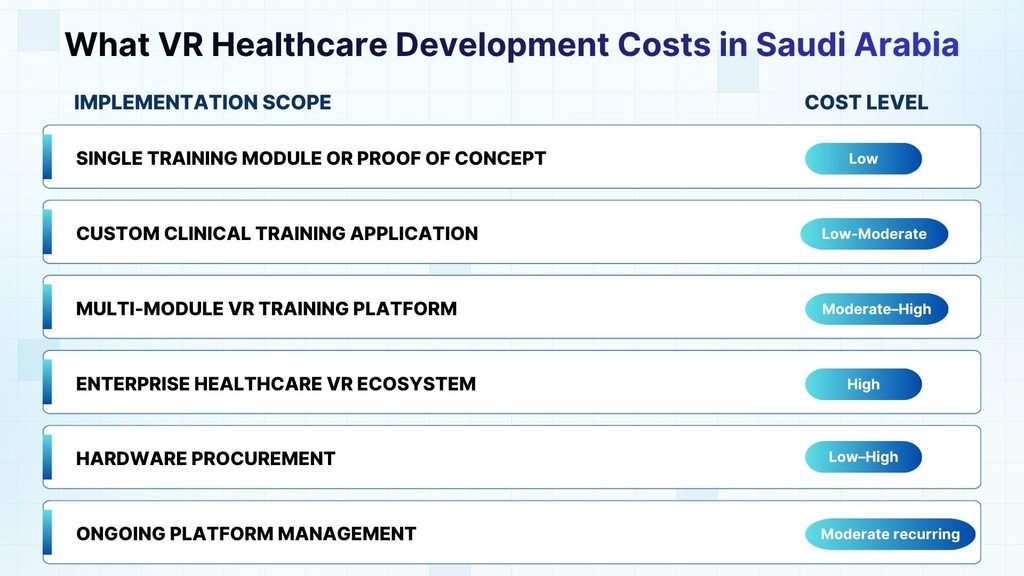
| Implementation Scope | Cost Level |
| Single Training Module or Proof of Concept | Low |
| Custom Clinical Training Application | Low–Moderate |
| Multi-Module VR Training Platform | Moderate–High |
| Enterprise Healthcare VR Ecosystem | High |
| Hardware Procurement | Low–High |
| Ongoing Platform Management | Moderate recurring |
What Are the Most Common VR Healthcare Implementation Mistakes Saudi Institutions Make?
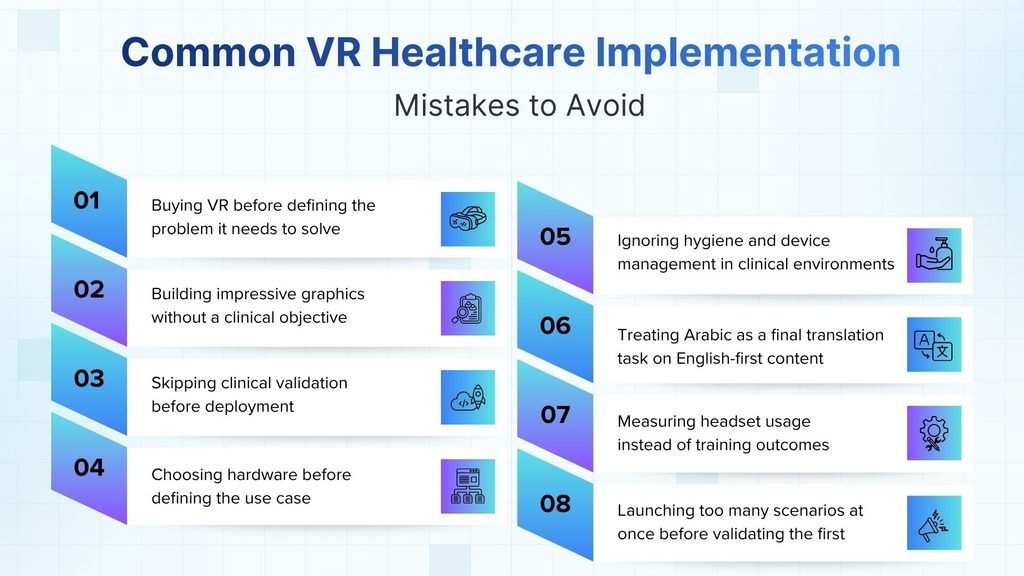
| Mistakes |
| Buying VR before defining the problem it needs to solve |
| Building impressive graphics without a clinical objective |
| Skipping clinical validation before deployment |
| Choosing hardware before defining the use case |
| Ignoring hygiene and device management in clinical environments |
| Treating Arabic as a final translation task on English-first content |
| Measuring headset usage instead of training outcomes |
| Launching too many scenarios at once before validating the first |
How Does Etihad Falcon Tech Build VR Healthcare Solutions for Saudi Medical Institutions?
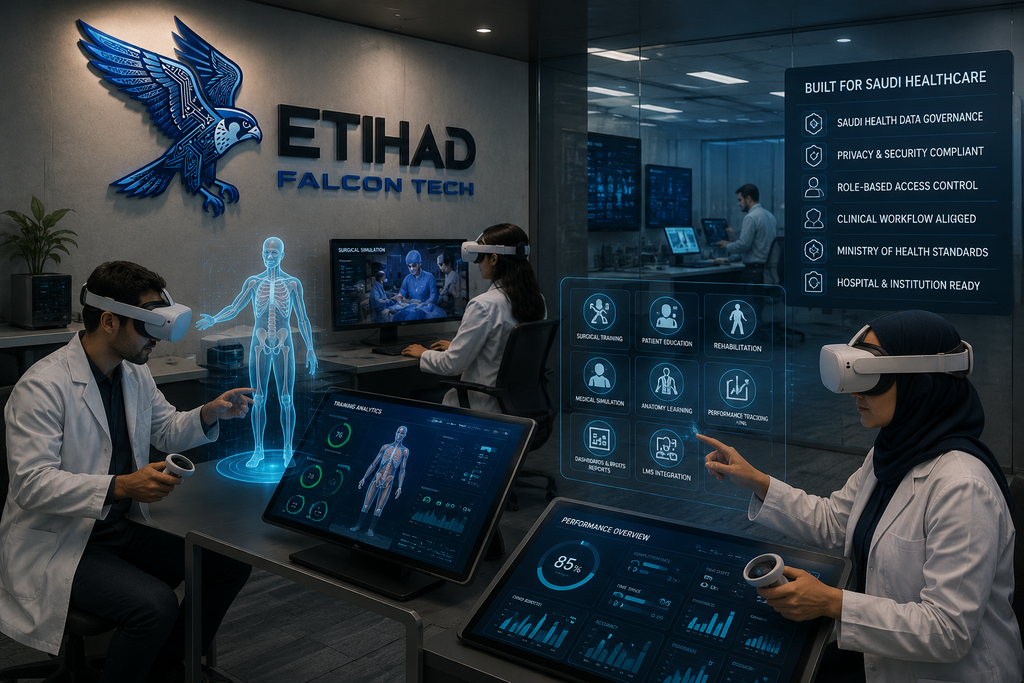
We treat healthcare VR as a clinical and operational build, not a 3D visualisation exercise, and every project starts with your actual objective: surgical training, medical education, rehabilitation, patient education, or clinical simulation.
What We Build Into the Platform
The build works backward from your objective. That covers VR application development, 3D environment design, interactive medical scenarios, and hardware integration where a headset needs to connect with existing lab or clinical equipment. We also build performance tracking and training dashboards so your department can see whether the programme is actually changing outcomes, plus LMS integration when training needs to plug into systems you already run.
Compliance and Arabic From Day One
Patient data, clinical information, and access controls need governance before a platform goes live, not after. We build PDPL and MOH-relevant requirements into the architecture from the start, not as a review step at the end. Arabic gets the same treatment: training interfaces, patient education screens, voice instructions, and clinical terminology are built for RTL navigation from the ground up, not translated onto an English-first build later. That matters most when the same platform serves both Saudi staff and multilingual clinical teams.
Where to Start
Start with a use-case assessment: pick the department or training problem you want to solve, decide how you’ll measure success, and check what infrastructure you already have. Prove it in one department before you scale it across the institution.
FAQs
VR allows trainees to practise inside repeatable digital scenarios and can track actions, errors and performance. It does not automatically produce better outcomes in every training situation, but systematic reviews show meaningful benefits in several areas of surgical skills training. VR works best as a complement to supervised clinical and simulation training rather than a replacement for it.
No. VR should complement supervised operative training, not replace it. Its main advantage is allowing trainees to practise procedures and difficult scenarios repeatedly before and alongside real clinical experience.
Cost depends on scope, not the VR itself. A single-use proof of concept sits at the lowest tier. Full clinical platforms move higher once medical accuracy, PDPL-compliant data handling, and validation testing come in. Enterprise programmes with hospital-system integrations sit at the top, since every integration and every hour of validated content adds cost.
If the system processes patient or other personal data, Saudi privacy and data-governance requirements need to be considered. The PDPL contains specific provisions concerning health data processing and access.
Yes. Arabic voice instructions, RTL interfaces, Arabic medical terminology and bilingual experiences can be incorporated into the design. Arabic should be considered during content and UX development rather than added only after the English version is complete.
The requirement depends on the application. Standalone headsets may be sufficient for many training modules, while high-fidelity simulation may require more powerful hardware and additional peripherals. Institutions should also budget for cleaning, charging, storage, device management and replacement equipment.
A simple proof of concept may take a few weeks to a few months. A multi-module healthcare platform can take several months or longer because clinical content development, 3D modelling, testing and validation add significant time.
A properly designed VR platform should support content updates so new procedures, scenarios and clinical guidance can be added without rebuilding the entire system.
Mixed reality is more appropriate when users need to see and interact with the physical environment while also receiving digital information. VR is generally better when the institution needs a fully simulated environment for training, education or therapy.
Yes. A healthcare VR programme can be designed around specific specialties such as cardiology, oncology, orthopaedics, surgery or rehabilitation, with the content and patient journey developed around the institution’s clinical requirements.