
Saudi Arabia’s extended reality market: augmented reality, virtual reality, and mixed reality combined, reached USD 1,640.9 million in 2025 and is projected to hit USD 25,109.6 million by 2034, according to IMARC Group. Manufacturing is one of the industries driving that growth, alongside education, healthcare, real estate, and many more.
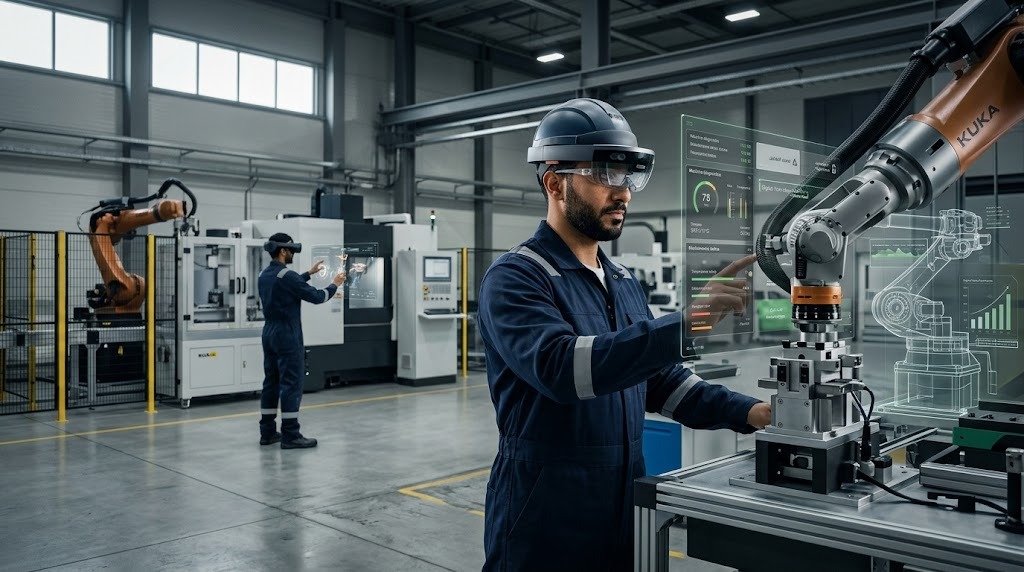
So, what does AR and VR actually mean for a manufacturing company? AR and VR are not screens you look at separately from your work. Augmented Reality overlays digital guidance directly onto the real equipment, component, or workstation in front of your worker: the next assembly step, the correct torque value, the inspection tolerance, all visible on the actual part while their hands are still on it. Virtual Reality replaces the environment entirely, putting a trainee inside a full simulation of your equipment and process before they ever touch the real thing.
That distinction matters because manufacturing errors rarely come from workers not knowing the procedure. They come from the gap between reading the procedure and performing it: a torque spec read off a sheet and held in memory while reaching for the fastener, an emergency sequence learned from a slide deck instead of the equipment itself, a part checked against a specification document one measurement at a time while eyes move between page and part. That gap is where rework, downtime, and missed defects come from, and it is what AR and VR are built to close.
This guide covers how AR and VR are being deployed across Saudi manufacturing operations, which applications produce the clearest commercial return, what the technology requires to implement, and what separates implementations that change production outcomes from those that produce impressive demonstrations with no operational impact.
AR vs VR in Manufacturing: Which One to Choose?
| Approach | What It Is | Best Used When |
| Augmented Reality (AR) | Digital guidance layered on the real machine, part, or workstation your worker is already in front of | The worker needs information during real production activity |
| Virtual Reality (VR) | A full simulation replacing the real environment, no physical equipment involved | The worker needs to learn or practice before touching real equipment |
Most manufacturers assume AR and VR are two versions of the same thing, immersive tech you pick based on budget or preference. That’s not the case; they solve different problems, and using one where the other is needed produces a system that does not work for the floor it was built for.
AR keeps your worker on the real floor, in front of the real machine, holding the real part. It adds a layer of guidance on top of what’s already there: the next assembly step shown on the actual component, the correct measurement displayed on the part being checked, the next maintenance step highlighted on the actual machine being serviced. When a technician looks at a control panel and sees the exact valve to shut off highlighted in front of them, that is AR.
VR takes the worker off the floor entirely. It puts them inside a full copy of your equipment and process, with no real machine, no real component, and no real production risk. When a new hire runs through an emergency shutdown twenty times in a simulated environment before they are ever near the actual equipment, that is VR.
The practical rule: AR for real production activity, VR for learning before real production activity. Saudi manufacturers get the most value from both, used at different points, not one instead of the other.
Augmented Reality (AR) in Manufacturing
Not every application delivers the same return right away. What matters most depends on where your floor is actually losing time and money right now. Here’s what AR does, broken down by where it touches your operation.
Assembly Guidance & Work Instruction Overlay
This is the one to prioritise first if complex assembly is where your errors are coming from. Instead of your worker cross-referencing a paper manual or trying to hold a torque value in memory while their hands are on the part, the next step is shown directly on the component in front of them.
- The next assembly step highlighted on the actual part, not on a separate sheet
- Torque values and fastener positions shown exactly where the worker’s hands already are
- Instructions that switch language automatically, so an Arabic, Hindi, Tagalog, and English-speaking crew can work the same line without separate documentation
Quality Control & Inspection Overlay
This is where you stop losing time to inspectors mentally translating between a spec sheet and the part in their hands. The tolerance and the measurement point sit on the same surface your inspector is already looking at.
- Tolerance boundaries and acceptable ranges shown directly on the part being inspected
- Defects logged with the exact component location, not a written description
- Inspection time compressed without loosening your quality standard
Remote Expert Assistance via AR
This is for the moment a machine goes down and the specialist who can fix it isn’t on site. Instead of a phone call where your engineer describes what they’re seeing and hopes it’s enough, the remote expert sees exactly what your engineer sees and points them straight to the fix.
- A remote specialist sees your engineer’s exact field of view in real time, not a verbal description of it
- Support resolution that used to take days brought down to hours
- No specialist travel needed for issues that can be resolved by sight
Augmented Reality for Maintenance & Equipment Servicing
This is where a missed step or wrong sequence on complex equipment turns into a safety incident or an equipment failure. AR puts the procedure on the machine itself instead of on a document your technician is flipping back to.
- The isolation point, the fastener, and the torque value all shown on the actual equipment, not a manual
- A timestamped, photographed maintenance record generated automatically, no paperwork after the job
- Missed or out-of-sequence steps caught before they become a safety issue
Virtual Reality (VR) in Manufacturing
Same idea as AR, applied earlier in the process. Where AR guides your worker during real production, VR gets them ready before they’re anywhere near it.
VR Training for Complex & Hazardous Processes
This is for the processes where a mistake during training isn’t an option, hazardous equipment, high-consequence errors, anything a classroom or a paper procedure can’t safely prepare a worker for. Your trainee works through the real process on a virtual version of your actual equipment, including the fault conditions and emergency scenarios, with zero real risk.
- A worker who has run through a simulated gas release or equipment failure multiple times reacts on instinct when the real emergency happens, not for the first time
- Every new hire gets the same quality of process training, not whatever the busiest experienced worker had time to show them
- Full competency reached before anyone touches real equipment, not during their first weeks on it
VR for Plant Design & Factory Layout Planning
This is for catching a layout problem while it’s still a floor plan edit, not a demolition. A 2D drawing can’t tell you the aisle is too narrow for a loaded forklift, or that a workstation height will strain most of your operators, or that your visual flow forces a blind turn between stages.
- Spatial problems caught at full human scale, before the first wall goes up
- Layout fixes that cost a floor plan edit now instead of reconstruction later
- A direct, calculable return against the cost of the post-construction changes it prevents
VR Simulation for Process Optimisation
This is for testing a process change without gambling your live production line on it. Instead of implementing a change on the floor and hoping it works while output takes the hit, you model it, test it, and refine it in a virtual version of your production environment first.
- Process changes proven out before they touch a single real shift
- Zero production disruption during testing and refinement
- Optimisation gains realised without the delivery and contract-penalty risk of testing live
AR and VR Applications in Manufacturing
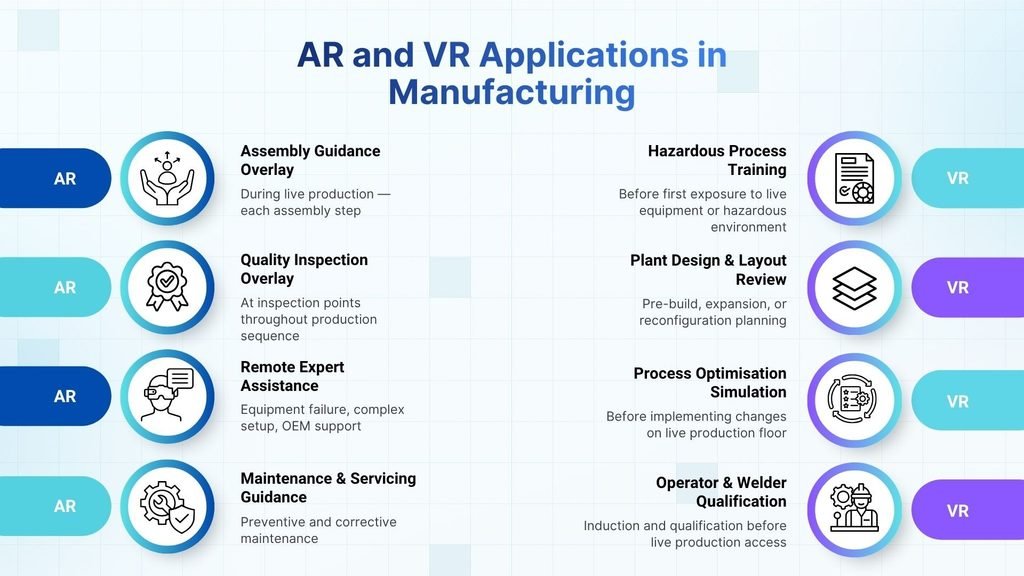
| Application | Tool | When It’s Used |
| Assembly Guidance Overlay | AR | During live production — each assembly step |
| Quality Inspection Overlay | AR | At inspection points throughout production sequence |
| Remote Expert Assistance | AR | Equipment failure, complex setup, OEM support |
| Maintenance & Servicing Guidance | AR | Preventive and corrective maintenance |
| Hazardous Process Training | VR | Before first exposure to live equipment or hazardous environment |
| Plant Design & Layout Review | VR | Pre-build, expansion, or reconfiguration planning |
| Process Optimisation Simulation | VR | Before implementing changes on live production floor |
| Operator & Welder Qualification | VR | Induction and qualification before live production access |
How AR and VR in Manufacturing Needs Differ Across Saudi Industries
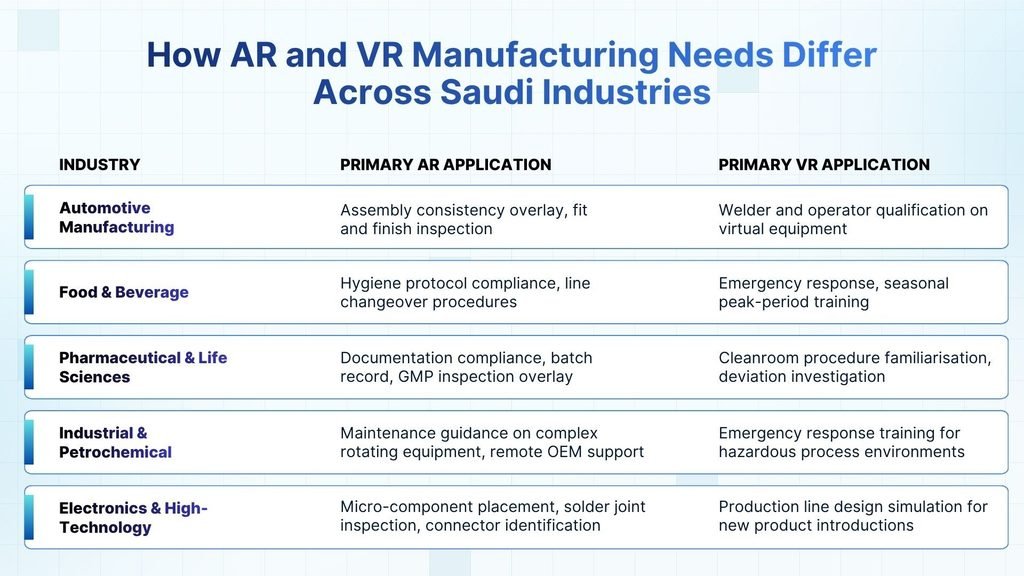
| Industry | Primary AR Application | Primary VR Application |
| Automotive Manufacturing | Assembly consistency overlay, fit and finish inspection | Welder and operator qualification on virtual equipment |
| Food & Beverage | Hygiene protocol compliance, line changeover procedures | Emergency response, seasonal peak-period training |
| Pharmaceutical & Life Sciences | Documentation compliance, batch record, GMP inspection overlay | Cleanroom procedure familiarisation, deviation investigation |
| Industrial & Petrochemical | Maintenance guidance on complex rotating equipment, remote OEM support | Emergency response training for hazardous process environments |
| Electronics & High-Technology | Micro-component placement, solder joint inspection, connector identification | Production line design simulation for new product introductions |
AR and VR are not deployed the same way twice. What a facility needs depends on what it makes, what it’s regulated by, and where its errors actually happen. Here’s how it applies across the main manufacturing sectors in Saudi Arabia:
Automotive Manufacturing
Automotive production runs on two pressure points at once: keeping a mixed-experience assembly line consistent, and catching fit-and-finish issues before a vehicle moves to the next stage. Vehicle assemblers, component manufacturers, and auto parts suppliers operating under Vision 2030 industrial development are using AR and VR to handle both.
What AR and VR handle for automotive manufacturing:
- Assembly overlay keeping every worker on the line consistent, regardless of experience level
- Inspection overlay verifying fit-and-finish parameters before the vehicle advances
- Welders and operators qualified on virtual equipment before touching a production vehicle
- Welding defects prevented at the training stage instead of caught at end-of-line inspection
Food & Beverage Manufacturing
Hygiene certification depends on cleaning and changeover procedures being executed in the exact right sequence, and a missed equipment issue during Ramadan or peak season carries a real commercial cost. Packaged food producers, beverage bottlers, and dairy and meat processing facilities are using AR to keep both under control.
What AR handles for food and beverage manufacturing:
- Cleaning and changeover procedures guided step by step to protect hygiene certification
- Quality inspection at packaging and filling stations shown directly on the line
- Remote expert support for equipment issues needing international supplier knowledge
- Downtime avoided during Ramadan and peak seasonal periods when it costs the most
Pharmaceutical & Life Sciences Manufacturing
Every procedural step has to happen in the correct sequence and be documented correctly, and when a batch fails specification, the investigation needs visual evidence of what was actually happening on the floor. Pharmaceutical manufacturers, medical device producers, and biologics and vaccine facilities operating under SFDA and GMP requirements are using AR for both.
What AR handles for pharmaceutical manufacturing:
- Every procedural step guided and documented automatically, no manual record-keeping
- Batch record completion built into the workflow instead of done after the fact
- Deviation investigations backed by documented visual evidence of process conditions
- Quality inspection guided at every critical process point
Industrial & Petrochemical Manufacturing
Hazardous environments and remote sites create two separate problems: workers need emergency response competency they can’t safely get on the job, and specialists can’t always reach the facility in time. Petrochemical plants, refineries, and heavy industrial processing facilities are using VR for one and AR for the other.
What VR and AR handle for industrial and petrochemical manufacturing:
- Emergency response competency built through VR before any real exposure
- Rotating equipment and process system maintenance guided to prevent incorrect sequencing
- Remote specialist support without the delay of helicopter or vehicle travel to site
- Safety incidents and equipment damage prevented at the maintenance step, not after
Electronics & High-Technology Manufacturing
Micro-component placement and solder joint inspection need a level of precision no printed documentation can give a worker, and frequent line reconfiguration for new products makes every layout change a potential production hit. Circuit board assemblers, consumer electronics manufacturers, and semiconductor-adjacent production facilities are using AR for the first and VR for the second.
What AR and VR handle for electronics manufacturing:
- Micro-component placement and connector identification guided at a level of detail sheets can’t match
- Solder joint inspection overlaid directly on the circuit assembly
- New production line layouts tested in VR before reconfiguration disrupts output
- Downtime cost during layout changes quantified and reduced before it happens
How an AR and VR Manufacturing Deployment Is Implemented
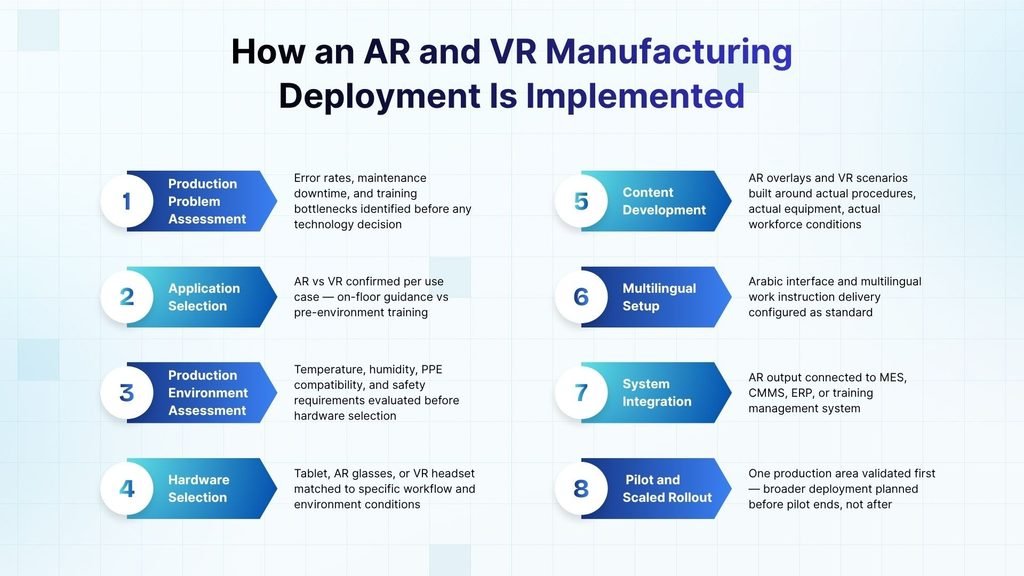
| Stage | What Happens |
| 1. Production Problem Assessment | Error rates, maintenance downtime, and training bottlenecks identified before any technology decision |
| 2. Application Selection | AR vs VR confirmed per use case — on-floor guidance vs pre-environment training |
| 3. Production Environment Assessment | Temperature, humidity, PPE compatibility, and safety requirements evaluated before hardware selection |
| 4. Hardware Selection | Tablet, AR glasses, or VR headset matched to specific workflow and environment conditions |
| 5. Content Development | AR overlays and VR scenarios built around actual procedures, actual equipment, actual workforce conditions |
| 6. Multilingual Setup | Arabic interface and multilingual work instruction delivery configured as standard |
| 7. System Integration | AR output connected to MES, CMMS, ERP, or training management system |
| 8. Pilot and Scaled Rollout | One production area validated first — broader deployment planned before pilot ends, not after |
What is the hardware required for AR VR in Manufacturing
Your hardware choice decides which use cases you can actually deploy and which stay stuck on paper. Not every option works on every floor, here’s how to pick the right one for yours.
Tablets & Smartphones
This is where you start if your budget and timeline are tight. If your workers can hold a device while inspecting a part or checking guidance, you can deploy this immediately on hardware you likely already own.
- Fastest and cheapest option to get running, no new hardware to procure
- Works well for inspection and consultation tasks where one hand is free
- Not viable for assembly or maintenance, where your worker needs both hands on the task
AR Glasses
This is what you need once both of your worker’s hands have to stay on the job. Guidance sits in their field of view while their hands stay free for the actual work.
- Frees both hands for assembly, maintenance, and any task a tablet would interrupt
- Has to work with your existing PPE, not force a choice between compliance and functionality
- Needs to hold up to your floor’s heat, humidity, or chemical exposure, and last a full shift on one charge
Matching Hardware to Your Environment
Your production conditions decide your hardware spec, not the other way round. A clean-room electronics line needs different glasses than a steel fabrication shop or a chemical processing plant. If you specify hardware before assessing your floor, you’ll end up correcting an expensive mismatch after deployment instead of before it.
VR Headsets
This is the easier hardware decision, your training space doesn’t carry the same constraints as your production floor. If your trainees train in a dedicated space rather than on the line, go with a standalone headset that doesn’t need a connected PC. It’s the practical choice for most Saudi manufacturing training deployments.
What Does AR and VR in Manufacturing Cost for Saudi Operations?
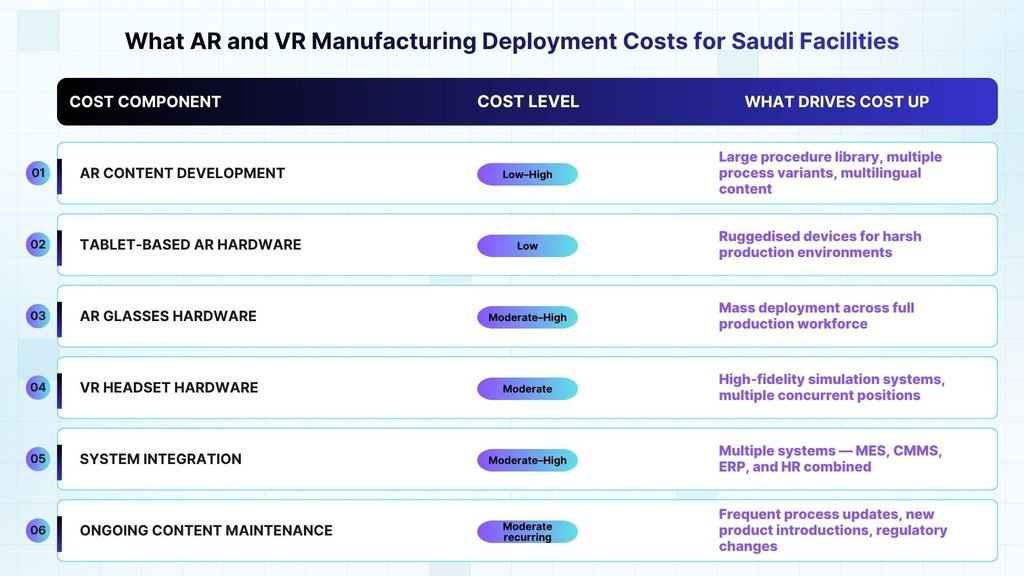
| Cost Component | Cost Level | What Drives Cost Up |
| AR Content Development | Low–High | Large procedure library, multiple process variants, multilingual content |
| Tablet-Based AR Hardware | Low | Ruggedised devices for harsh production environments |
| AR Glasses Hardware | Moderate–High | Mass deployment across full production workforce |
| VR Headset Hardware | Moderate | High-fidelity simulation systems, multiple concurrent positions |
| System Integration | Moderate–High | Multiple systems — MES, CMMS, ERP, and HR combined |
| Ongoing Content Maintenance | Moderate recurring | Frequent process updates, new product introductions, regulatory changes |
AR and VR manufacturing deployment cost is driven by the complexity of the specific application, the hardware requirements, the volume of content development needed, and the integration with existing production management systems.
Software and content development for AR work instructions
Converting your existing work instructions, quality specifications, and maintenance procedures into AR overlay content is the primary content development cost. The effort scales with the number of distinct procedures, the complexity of the visual guidance required, and the number of languages needed for your Saudi manufacturing workforce. A facility with ten standardised assembly procedures costs significantly less to deploy than one with two hundred process variants requiring individual guidance content.
Hardware procurement and deployment
Tablet-based AR deployment for inspection and consultation applications is the lower hardware cost option. AR glasses for manufacturing hands-free applications carry higher unit cost and should be sized to the specific use cases and the number of workers who need simultaneous access. VR headsets for training programmes are a fixed hardware cost per concurrent training position.
Integration with production management systems
AR quality inspection that logs results into your MES, AR maintenance records that integrate with your CMMS, and VR training completion records that sync with your HR or training management system all require integration development beyond the AR or VR application itself. The integration cost depends on the current state of your production management systems and how they are configured.
Ongoing content maintenance
When your processes change, your AR content needs to change with them. Facilities that treat AR content as a one-time production project and do not budget for ongoing maintenance discover that their AR guidance becomes outdated as processes evolve, undermining the accuracy that makes the system trustworthy. Content maintenance is an operational cost of running AR in manufacturing, not a project cost. If you want a clearer picture of what your specific deployment would cost, message us on WhatsApp and book a free consultation now.
Common AR VR Mistakes to Avoid in the Manufacturing Industry
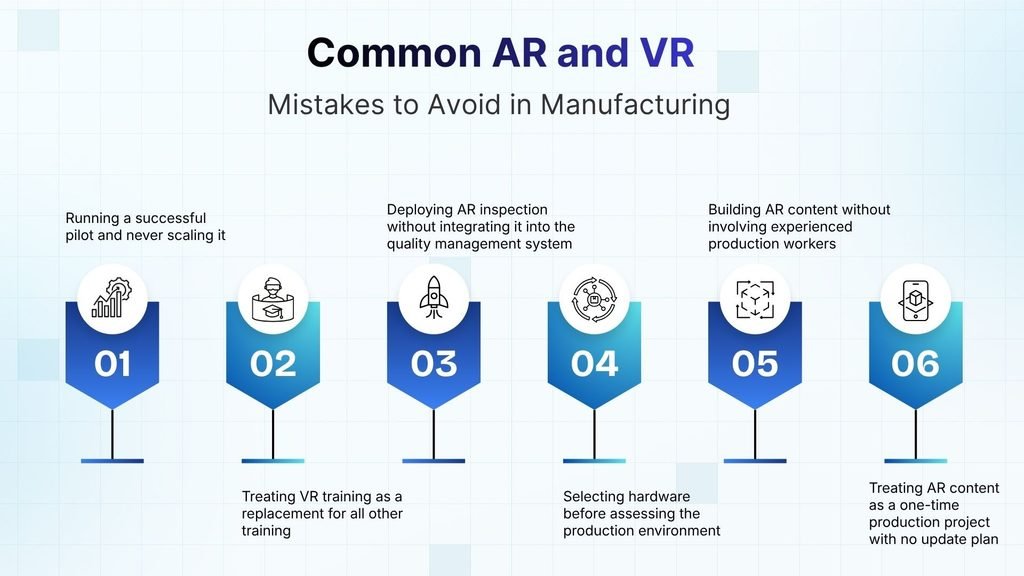
| Mistakes |
| Running a successful pilot and never scaling it |
| Treating VR training as a replacement for all other training |
| Deploying AR inspection without integrating it into the quality management system |
| Selecting hardware before assessing the production environment |
| Building AR content without involving experienced production workers |
| Treating AR content as a one-time production project with no update plan |
How Etihad Falcon Tech Deploys AR and VR in Manufacturing for Saudi Operations
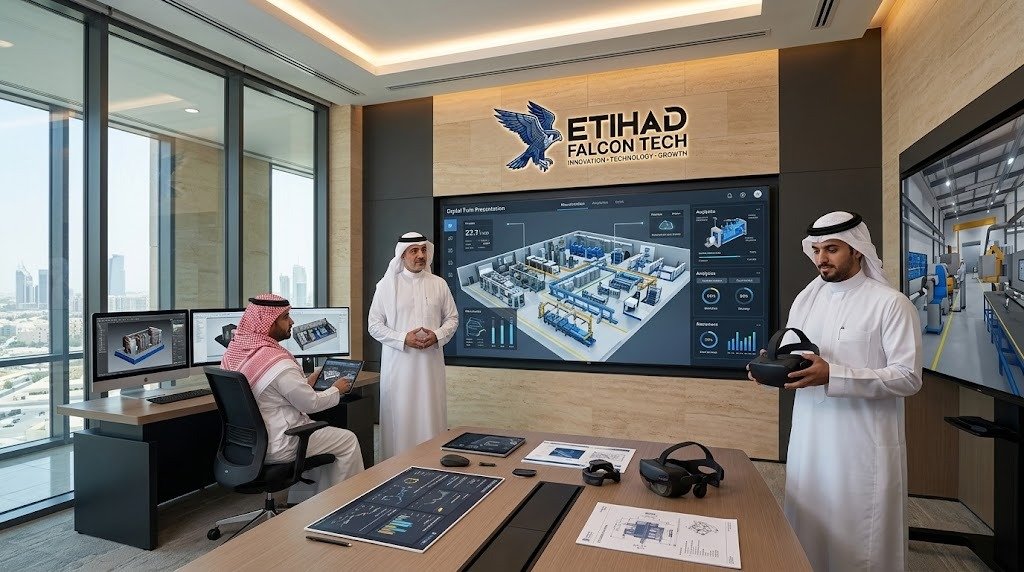
Most manufacturing errors don’t happen because a worker doesn’t know the procedure. They happen in the gap between reading it and performing it: a torque spec held in memory while reaching for the fastener, a part checked against a spec sheet one measurement at a time while eyes move between page and part. That gap is what we build AR and VR deployments to close.
We Start With Your Production Problem
Before we talk about AR or VR, we ask where your actual losses are. Which operations carry your highest error or rework rates? Where does maintenance downtime consistently overrun? Which processes are bottlenecking your training output? Those answers tell us whether the right fix is Augmented Reality overlaying guidance onto the equipment in front of your worker, Virtual Reality simulating the full process before anyone touches the real thing, or neither yet. We’re not deploying technology for its own sake. If a use case doesn’t produce a measurable improvement, we tell you that instead of building it.
What We Build for Saudi Manufacturing Conditions
We build AR overlays that put the next assembly step, the correct torque value, and the inspection tolerance directly on the part your worker is holding, not on a separate screen they have to look away to check. We build VR simulations that let a trainee run your actual equipment and process end to end before they’re on the floor, so the first time they perform a procedure isn’t on production equipment with a live part in their hands. Every deployment is built around your specific equipment, your specific processes, and the operational conditions of running a Saudi manufacturing facility, not a generic template retrofitted to fit.
Book a free consultation with us, and we’ll walk your operation, identify where AR or VR actually pays off for you, and tell you honestly where it doesn’t.
Frequently Asked Questions
AR works with your real production environment by overlaying digital information on physical components, machines, and workstations. It is the right tool when workers need guidance, inspection support, or expert assistance during live production activity. VR replaces the real environment with a simulation and is the right tool for training before workers are in the live environment, and for design and layout review before physical construction. Most Saudi manufacturing facilities benefit from both, used at different points in the operational lifecycle.
AR assembly guidance delivers work instructions as an overlay on the actual component being assembled, at the exact moment each step is performed. The worker sees the next action highlighted on the actual part rather than reading it from a document and holding it in memory while performing the task. The error rate reduction is directly traceable to eliminating the memory step between reading an instruction and applying it. On Saudi production lines with multilingual workforces, AR also delivers guidance in each worker’s language through the same system without separate documentation.
Tablet-based AR is the most accessible starting point for inspection and consultation applications where the worker can hold a device. Augmented reality glasses for manufacturing are needed for hands-free applications where both hands are required for the task. Hardware selection must account for the specific production environment conditions, PPE compatibility requirements, and the durability requirements of the production floor. Selecting hardware before assessing the production environment is the mistake that produces incompatible deployments.
VR manufacturing training places the worker inside a virtual reproduction of the actual facility and equipment. The trainee works through the process, operates virtual equipment, and encounters simulated fault conditions and emergency scenarios in a fully controlled environment with no real hazard or production risk. For Saudi industrial and petrochemical facilities, VR training for emergency response procedures is particularly valuable because the practiced response it develops cannot be replicated by classroom instruction alone.
Significantly. When a specialist is not physically present, AR remote assistance allows the on-site engineer to share their exact field of view with a remote expert who can annotate what the on-site engineer sees in real time. The specialist sees exactly what the engineer sees, highlights the specific component or adjustment point, and guides the resolution visually. For Saudi facilities in remote locations or those with international OEM relationships, this collapses support resolution time from days to hours.
Cost is driven by the number and complexity of procedures being converted to AR content, the hardware requirements of the specific production environment, and the integration work needed to connect AR output to existing production management systems. A focused deployment covering a small number of high-value procedures costs significantly less than a facility-wide rollout across all assembly, inspection, and maintenance operations. Ongoing content maintenance as processes evolve is an operational cost that should be planned for alongside the initial deployment.
A focused deployment covering a defined set of assembly or maintenance procedures typically takes eight to twelve weeks from content development to operational deployment. That timeline assumes existing procedures are documented accurately and that the production environment assessment and hardware selection are completed before content development begins. Broader deployments covering multiple production areas take longer proportionally, and facilities with complex multilingual content requirements or significant MES integration work should plan for additional time accordingly.