
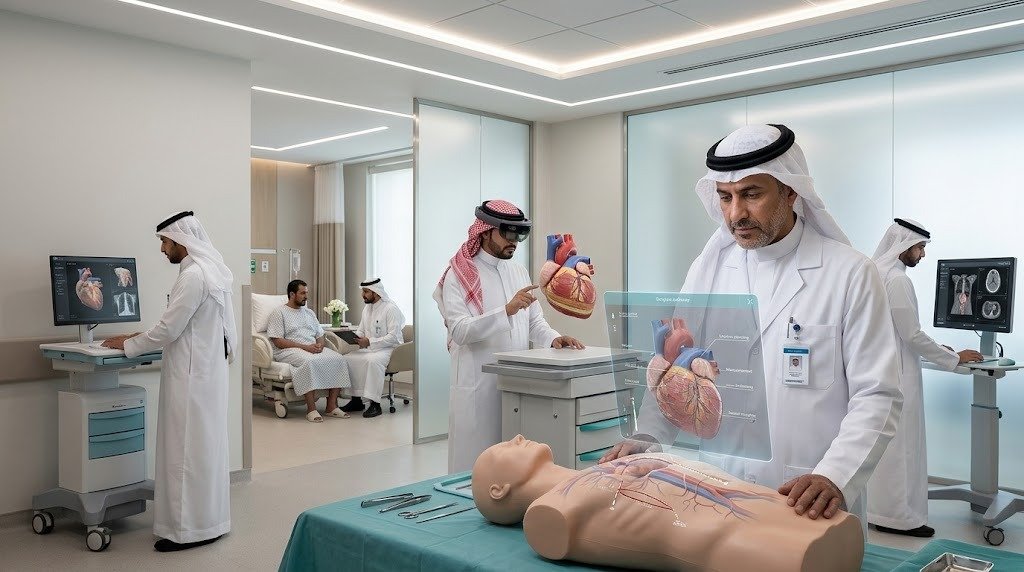
Augmented reality in healthcare is changing how doctors, students and patients interact with medical information. Instead of looking at a scan on a separate screen, a surgeon can work with patient-specific visual information in the context of the procedure. Instead of studying anatomy from a textbook or flat image, a medical student can explore a three-dimensional model. And instead of explaining a procedure using diagrams alone, a healthcare provider can use an AR experience to help a patient understand what is going to happen.
For Saudi hospitals, medical colleges and healthcare institutions, this matters because the Kingdom is already investing heavily in digital health and workforce development. The Ministry of Health identifies digital health as an important part of healthcare transformation under Vision 2030, with goals around improving quality, efficiency, patient experience and clinical decision-making.
Augmented Reality is not a replacement for doctors, surgeons or established clinical training. It is another layer of information and simulation that can help them work, learn and communicate more effectively.
What Does Augmented Reality in Healthcare Actually Cover?
Augmented reality in healthcare means placing digital information, 3D models or interactive instructions over the user’s view of the real world.
The technology can be used in several different ways depending on the institution and its clinical objectives.
Surgical AR & Operative Guidance
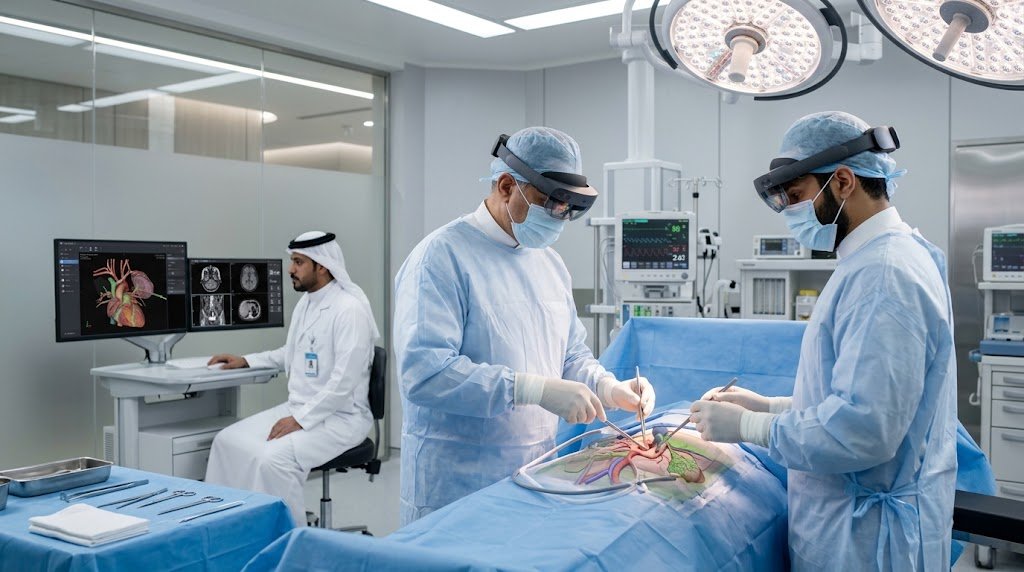
In surgical applications, AR can connect digital information with the physical operating environment. This can include patient imaging, anatomical models, surgical plans or guidance information displayed through an AR device.
For example, patient-specific CT or MRI information can potentially be used as part of an overlay to help clinicians understand anatomical structures during planning or procedures. Research into image-overlay surgery has explored how patient-specific virtual images can be transferred from preoperative planning into the operating environment.
The important point is that AR guidance should support the clinician rather than replace clinical judgement.
AR Medical Imaging & Diagnostic Overlay
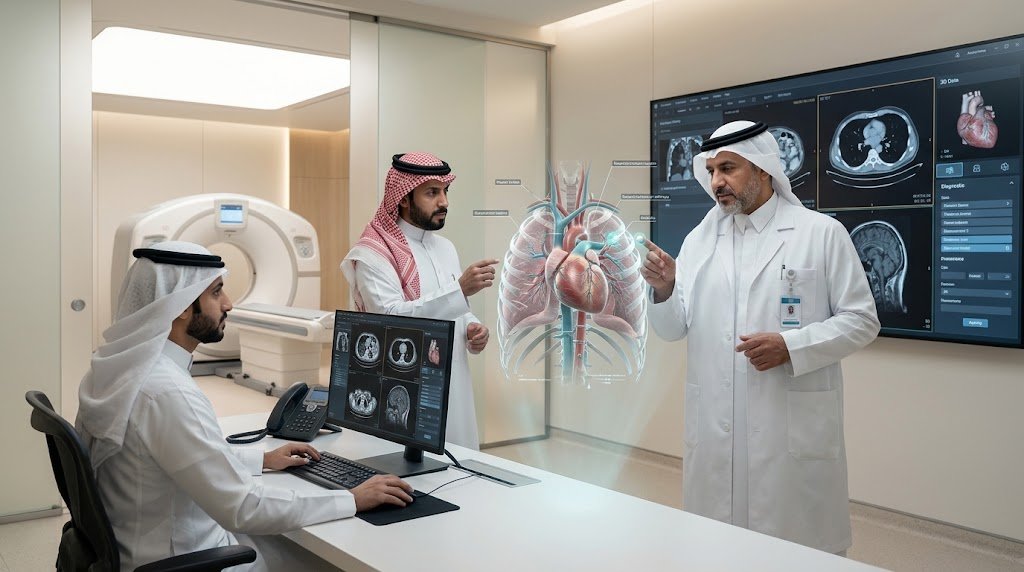
Medical imaging produces enormous amounts of information, but clinicians still need to interpret that information within the context of the patient.
AR can provide a way to visualise 3D anatomical information alongside the physical patient or a physical anatomical model. This can be useful for education, planning, clinical review and communication.
For more advanced applications, AR systems may need to connect with existing imaging infrastructure such as PACS and DICOM-based workflows. That makes the project considerably more complex than building a standalone AR application.
AR Clinical Training & Simulation
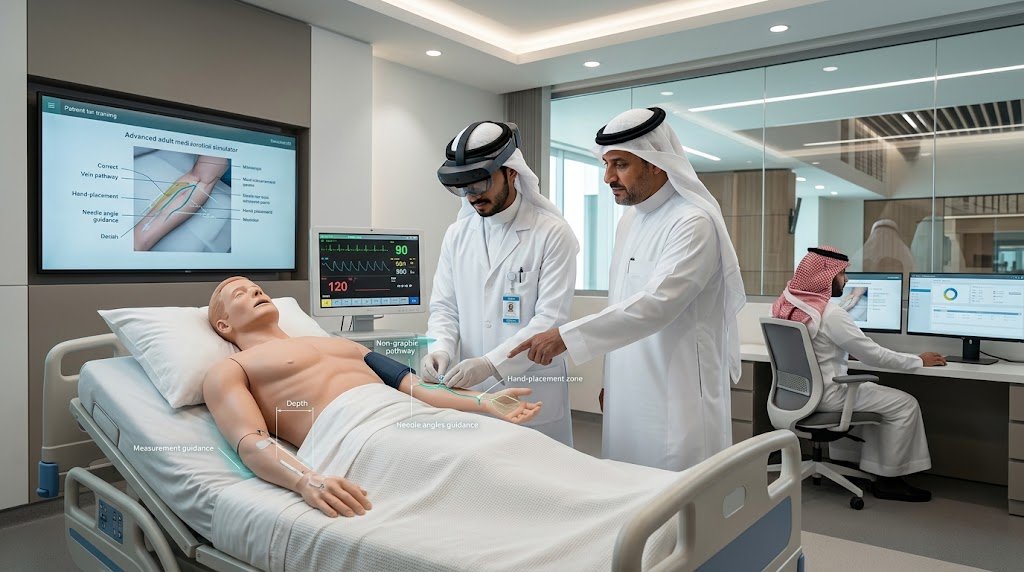
AR can turn clinical training into an interactive experience where learners practise procedures while receiving visual guidance.
A training application could show the correct position of an instrument, identify anatomical structures, provide procedural instructions or record learner performance.
Research supports the potential of AR in surgical education. A 2026 systematic review of 11 studies involving 347 participants found that nine studies reported improvements in at least one objective technical metric, with consistent error reduction reported across the studies that measured it. The researchers also noted differences in hardware, study design and outcome measures, meaning the results should not be treated as a guarantee for every AR training system.
AR Medical Education
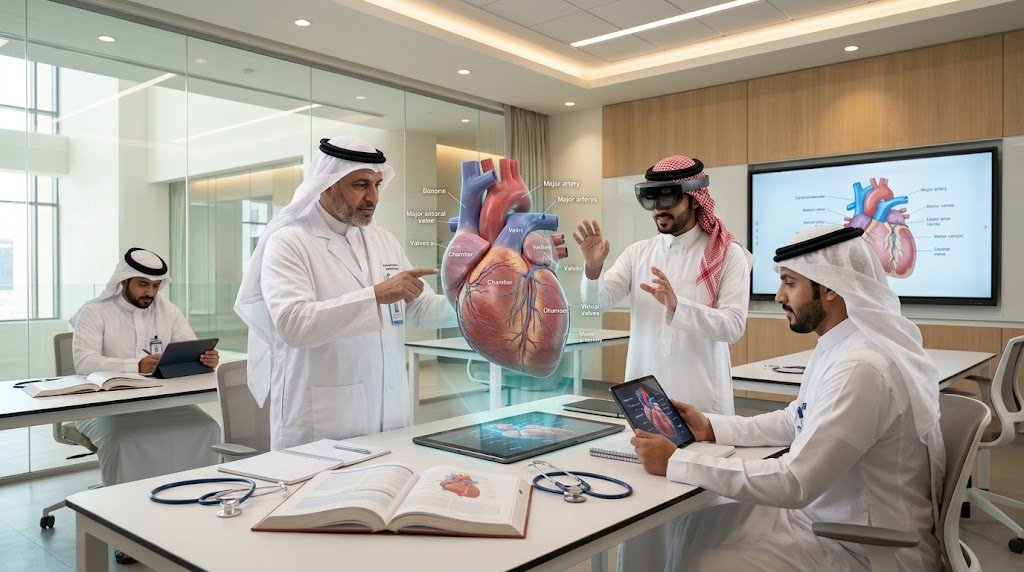
Medical students can use AR to explore anatomy, pathology and clinical scenarios through interactive 3D content.
Instead of memorising the location of an anatomical structure from a diagram, students can manipulate a model, examine it from different angles and connect individual structures to the wider body.
Saudi institutions are already exploring immersive technologies in medical education. For example, research conducted at King Saud bin Abdulaziz University for Health Sciences in Jeddah found that students using 360-degree VR achieved higher post-test and OSCE scores than the conventional teaching group. While this study used VR rather than AR, it demonstrates the interest in immersive learning within Saudi medical education.
AR Patient Education & Communication
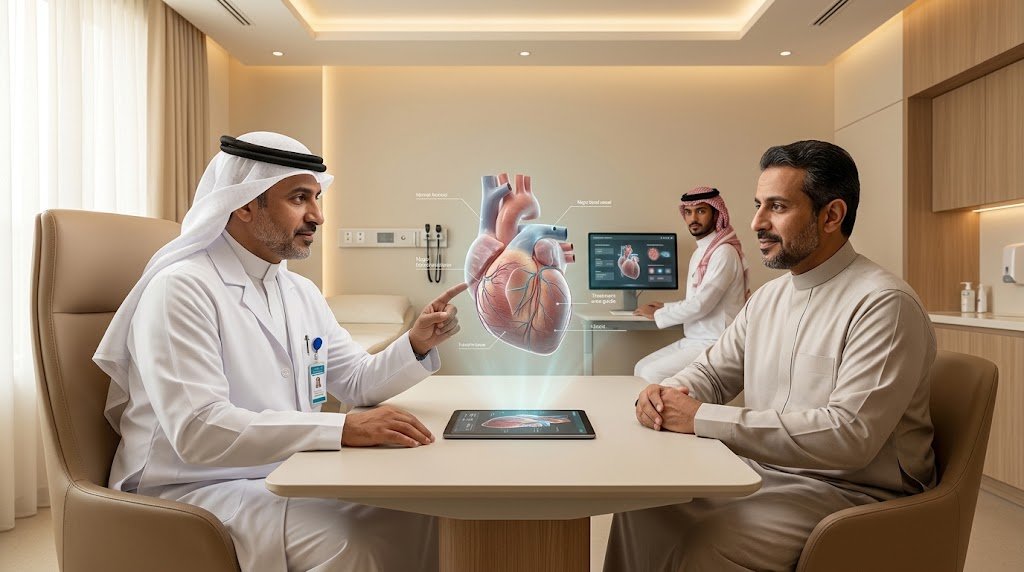
Medical information is often difficult for patients to visualise.
AR can help providers explain a procedure, anatomical condition or treatment pathway using a three-dimensional visual experience. A patient could see a model of the relevant anatomy or understand where a procedure will take place rather than relying entirely on verbal explanations.
This does not replace informed consent or clinical communication. It simply gives healthcare professionals another way to explain complex information.
Mixed Reality & Extended Reality in Healthcare
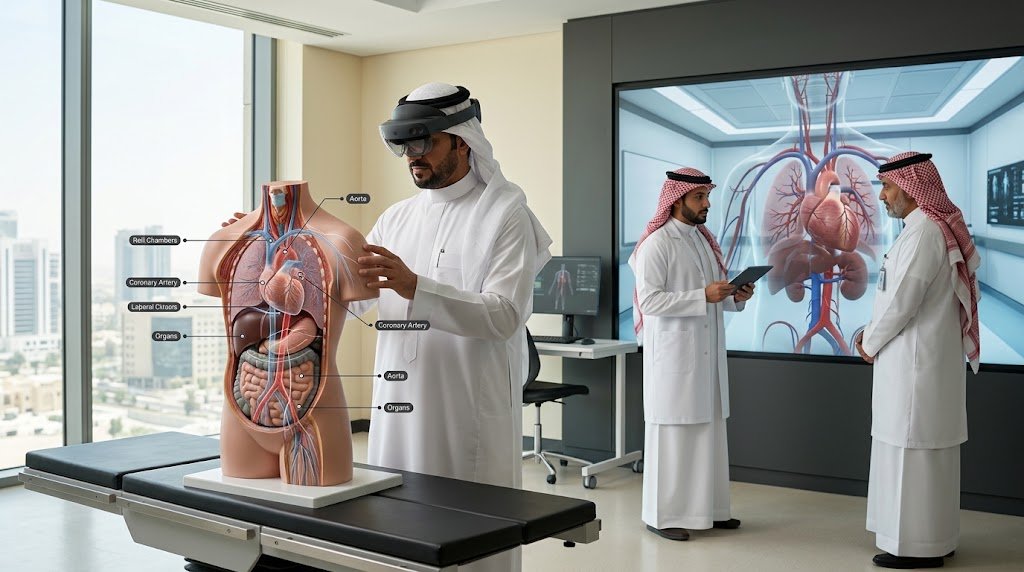
AR, VR and mixed reality are often discussed together, but they do different jobs.
AR keeps the real environment visible and adds digital information to it. VR places the user inside a fully simulated environment. Mixed reality goes further by allowing digital objects to interact more naturally with the physical environment.
Saudi healthcare institutions may use one technology or combine several depending on whether their priority is surgical guidance, training, education, rehabilitation or patient communication. See Virtual Reality healthcare guide for a closer look at where VR specifically fits into that decision.
What Is the Difference Between AR, Mixed Reality and Extended Reality in Healthcare?
The easiest way to understand the difference is to look at what happens to the real world.
AR adds to reality. A clinician can continue seeing the physical environment while viewing digital information.
VR replaces the real environment. This makes it useful for simulations where the learner needs to enter a controlled virtual scenario.
Mixed reality combines physical and digital environments more interactively. Digital objects can appear anchored to the physical environment and respond to it.
Extended reality (XR) is the broader category that includes AR, VR and MR.
For a Saudi medical institution, the choice should start with the use case rather than the technology.
If the goal is to practise a procedure repeatedly without using a patient, VR may be more appropriate.
If the goal is to view digital information while working in a real clinical environment, AR may be the better fit.
If the institution needs both immersive training and real-world digital guidance, an XR strategy may make more sense.
What Can AR Actually Deliver for a Saudi Hospital or Medical Institution?
Surgical AR Guidance
Surgical AR is one of the most technically demanding healthcare applications because the system may need to work with patient-specific information and real clinical workflows.
A solution can potentially support:
- CT and MRI data visualisation
- Anatomical structure identification
- Surgical planning
- Patient-specific 3D models
- Operative guidance
- Remote expert annotation
- Procedure documentation
The evidence is promising, but clinical deployment requires much more than an attractive 3D overlay. Accuracy, registration, latency, usability, safety and clinical validation all matter.
A systematic review of AR surgical training found that several studies reported benefits in competency and surgical performance, but also highlighted significant variation between studies and limitations in the available evidence.
That is why AR surgical systems should be developed around a clearly defined clinical problem, validated with clinical experts and evaluated before being introduced into routine care.
AR Medical Imaging
AR can make medical imaging easier to interpret outside a traditional 2D screen.
A radiologist, surgeon or medical educator could work with a 3D representation of anatomical structures. In more advanced systems, patient imaging can be connected to an AR interface so that the information is available in a relevant physical context.
This is where integration becomes important.
If your AR system needs access to patient imaging, the development team may need to work with PACS, DICOM and other hospital information systems rather than treating the AR application as an isolated product.
AR Clinical Training
Training is one of the more practical starting points for healthcare AR because it does not necessarily require live patient data.
A hospital or medical college could build AR modules for:
- Clinical procedures
- Instrument identification
- Anatomy
- Emergency scenarios
- Injection and procedural skills
- Equipment operation
- Infection-control procedures
- Clinical workflow training
AR can also provide performance feedback so educators can see where learners struggle.
A 2024 systematic review involving researchers from Saudi medical institutions reported improvements in technical performance, accuracy and procedural knowledge in the AR surgical-training studies it examined. The review also noted small sample sizes and short follow-up periods, so more research is needed before treating those findings as universal clinical outcomes.
AR Medical Education
Medical colleges can use AR to make difficult concepts easier to visualise.
A 3D anatomy application, for example, can allow students to isolate organs, examine structures from different angles and explore relationships that are difficult to understand from a textbook.
AR can also support pathology education, clinical cases and practical skills training.
For Saudi universities, this can be particularly useful where large groups of students need access to consistent educational content without depending entirely on physical models or limited laboratory resources.
AR Patient Education
Patients do not always understand medical information simply because a doctor explains it clearly.
AR can provide another communication layer.
A specialist could use an interactive model to show:
- Where a condition is located
- What a procedure involves
- Which part of the body will be treated
- How a device or implant works
- What a treatment pathway looks like
For a Saudi healthcare provider serving both Arabic- and English-speaking patients, the interface can also be designed around Arabic and bilingual communication.
Mixed Reality Clinical Guidance
Mixed reality becomes more relevant when clinicians need information while keeping their hands available for the procedure.
Potential applications include:
- Hands-free clinical instructions
- Real-time patient information
- Remote expert guidance
- Procedure annotations
- Equipment instructions
- Training overlays
- Collaborative clinical simulation
These systems require careful consideration of device ergonomics, data security, connectivity and clinical workflow.
How Do AR Healthcare Needs Differ Across Saudi Medical Institution Types?
Large Hospitals & Health Systems
Large hospitals can potentially use AR across multiple departments.
Possible applications include:
- Surgical planning and guidance
- Medical imaging visualisation
- Clinical training
- Patient education
- Medical staff onboarding
- Simulation programmes
The main challenge is integration. A hospital-wide AR platform may need to work with existing clinical systems, identity management, data governance and training infrastructure.
Medical Colleges & Universities
Medical colleges are natural candidates for AR because education is easier to separate from live clinical systems.
Possible applications include:
- 3D anatomy
- Pathology
- Surgical skills
- Clinical case simulation
- Procedure training
- Laboratory learning
- Interactive medical education apps
The institution can begin with a focused educational module and expand the platform as faculty and students become familiar with the technology.
Private Specialist Clinics & Surgical Centres
A specialist clinic does not necessarily need a hospital-scale AR platform.
A focused application may be more useful.
For example, a surgical centre could use AR for procedure planning or clinician training, while a specialist clinic could use an interactive AR experience to explain a treatment to patients before a procedure.
Radiology & Diagnostic Imaging Centres
Radiology environments create opportunities for AR-based 3D visualisation.
Potential applications include:
- 3D scan visualisation
- Anatomical overlays
- Clinical review
- Imaging presentation
- Education and training
If patient data is involved, security and regulatory requirements become central to the project.
Rehabilitation & Allied Health Institutions
AR can also support rehabilitation by giving patients visual instructions during exercises or helping therapists track movement and progress.
Possible applications include:
- Guided physical therapy
- Exercise visualisation
- Motor rehabilitation
- Movement feedback
- Patient progress tracking
The exact clinical role should be defined with healthcare professionals before development.
Medical Training & Simulation Centres
Simulation centres can use AR to create repeatable clinical scenarios without exposing patients to unnecessary training risk.
This could include multi-disciplinary emergency scenarios, procedural training, equipment instruction and competency assessment.
Saudi Arabia already has institutions investing in advanced simulation infrastructure. KFSHRC, for example, has highlighted simulation and AR/VR as part of its approach to advanced surgical training.
What Does AR Healthcare Implementation Actually Require?
Building an AR healthcare solution is not simply a matter of developing a 3D application.
Healthcare requires clinical accuracy, reliable integration and regulatory planning from the beginning.
Clinical Content & Scenario Development
Every training or patient-facing scenario needs a clear purpose.
The development process may include:
- Clinical scenario design
- Medical content development
- Anatomical modelling
- Arabic voiceover and instructions
- Clinical expert review
- Usability testing
- Content approval before deployment
For surgical applications, the validation requirements are much higher than for a general educational application.
Medical Imaging & Data Integration
If the application needs patient imaging, the architecture must account for existing hospital systems.
Depending on the use case, this may involve:
- PACS
- DICOM
- Hospital information systems
- Electronic medical records
- Secure APIs
- Identity and access management
Patient information also needs to be handled according to applicable Saudi data protection requirements.
SDAIA’s Personal Data Protection Law materials specifically address additional controls for processing health data, including limiting access and processing to the minimum number of people necessary for healthcare services.
Hardware Selection
The right hardware depends on the application.
AR glasses may make sense where clinicians need hands-free interaction. Tablets or smartphones may be more practical for patient education or classroom applications.
Shared devices in hospitals also create hygiene and infection-control considerations.
Hardware selection should therefore consider:
- Clinical environment
- Device comfort
- Battery life
- Processing capability
- Connectivity
- Cleaning requirements
- Number of simultaneous users
- Software compatibility
Platform & Application Development
The software layer may include:
- AR experience development
- 3D model management
- User accounts
- Clinical content management
- Performance tracking
- Analytics
- Hospital-system integration
- Arabic and English interfaces
For training systems, assessment and reporting can be particularly valuable because educators need to know whether the technology is actually improving learning.
Clinical Validation & Institutional Onboarding
Healthcare software needs clinical involvement.
A strong implementation process should include clinical specialists, educators, IT teams, compliance stakeholders and the actual users of the system.
The project should be tested in stages rather than introduced across an entire institution immediately.
Start with one use case. Validate it. Measure the outcome. Then expand.
Ongoing Content Management & Platform Support
Medical knowledge does not stay still.
Clinical guidelines, procedures and institutional protocols change.
An AR platform should therefore allow content to be updated without rebuilding the entire application every time a procedure changes.
What Does Augmented Reality in Healthcare Cost in Saudi Arabia?
There is no reliable single price for an AR healthcare platform because the scope can range from a standalone educational application to a regulated clinical system connected to hospital imaging infrastructure.
The biggest cost factors are usually:
- Number and complexity of AR modules
- 3D modelling requirements
- Clinical content development
- AR hardware
- PACS/DICOM or hospital-system integration
- Patient data handling
- Arabic localisation
- Clinical validation
- Analytics and assessment
- Ongoing maintenance
Market research also identifies hardware, specialised infrastructure, integration and custom application development as major cost drivers for AR healthcare deployment in Saudi Arabia.
As a practical planning framework, a focused educational or patient-information AR application may sit in a very different budget category from a multi-department clinical platform.
For a Saudi healthcare organisation, it is better to price the project after defining the clinical use case than to rely on a generic “AR development cost” figure.
There is also an important regulatory distinction.
The Saudi Food and Drug Authority’s 2025 guidance specifically includes VR and AR within digital health products. It explains that AR/VR applications used solely for medical education, clinical training or general wellness may not be classified as medical devices, while applications intended for medical purposes such as surgical planning, intraoperative navigation, pain management or rehabilitation can fall within the medical-device regulatory framework.
That distinction can significantly affect the development, validation and compliance work required. If you’re not sure which category your use case falls into, message us on WhatsApp and we’ll help you figure out the right classification and scope before pricing anything.
What Are the Most Common AR Healthcare Implementation Mistakes Saudi Institutions Make?
The biggest mistake is starting with the technology instead of the clinical problem.
A hospital does not need AR simply because AR is available.
Common mistakes include:
- Building a visually impressive demo without a defined clinical objective
- Using poor-quality or outdated medical content
- Treating clinical validation as an afterthought
- Ignoring integration with existing hospital systems
- Choosing hardware before understanding the workflow
- Underestimating Arabic localisation
- Failing to plan for patient-data protection
- Assuming an educational AR application and a clinical AR system have the same regulatory requirements
- Launching across multiple departments before completing a focused pilot
- Measuring user excitement instead of learning, workflow or clinical outcomes
The last point is particularly important.
A healthcare AR project should have measurable objectives before development begins.
How Does Etihad Falcon Tech Build AR Healthcare Solutions for Saudi Medical Institutions?
Healthcare AR needs to be built around the actual clinical environment rather than treated as a standalone visual experience.
Etihad Falcon Tech develops AR healthcare solutions around specific institutional requirements, including surgical guidance, medical imaging visualisation, clinical training, medical education and patient education.
AR Healthcare Development Capability
The development approach can cover AR applications, 3D medical content, interactive training scenarios, clinical interfaces and performance tracking.
For larger programmes, the platform can also be designed around multiple departments or use cases rather than building disconnected applications.
Saudi Healthcare Compliance Considerations
Healthcare technology in Saudi Arabia requires compliance to be considered early.
Depending on the intended use of the solution, the project may need to account for PDPL and health-data requirements, SDAIA governance considerations, MOH digital-health requirements and SFDA requirements where the software qualifies as a medical device.
Arabic Language AR
AR interfaces for Saudi healthcare teams and patients can be designed for Arabic from the beginning.
That includes RTL layouts, Arabic clinical instructions, bilingual interfaces and Arabic educational content rather than simply translating an English application after development.
How to Start Your AR Healthcare Project with Etihad Falcon Tech
The best starting point is not choosing a headset.
Start by defining the problem.
What are you trying to improve — surgical planning, clinical training, medical education, patient understanding or another workflow?
From there, the project can be scoped around the users, clinical content, hardware, integrations, regulatory requirements and measurable outcomes.
A focused pilot can then be developed before expanding the solution across departments or facilities.
Frequently Asked Questions
AR adds digital information to the real environment, making it useful for applications where clinicians, students or patients need to remain aware of their physical surroundings. VR places the user inside a simulated environment, making it more suitable for immersive training and controlled simulations. The right choice depends on the clinical or educational objective.
AR surgical guidance can display digital information such as anatomical models or patient imaging in relation to the physical surgical environment. Depending on the system, this can require integration with imaging infrastructure such as PACS and DICOM, accurate data processing, reliable tracking and extensive clinical validation.
There is no standard price. A simple medical education application will require a very different budget from an AR surgical platform connected to hospital imaging systems. Hardware, 3D content, clinical validation, integrations, regulatory requirements and the number of users all affect the final cost.
Healthcare AR projects need to assess the applicable Saudi requirements based on their intended use and the data they process. PDPL includes additional controls for health data, while SFDA guidance addresses digital health products and explains when AR/VR applications can fall within medical-device regulation.
Yes. Arabic support can be incorporated into the interface, instructions, voiceovers and educational content. For Saudi deployments, Arabic should be considered during the initial UX and content design rather than added after the English version is complete.
The hardware depends on the application. Tablets and mobile devices can work well for education and patient-facing applications, while head-mounted AR devices may be more appropriate for hands-free clinical workflows. Hardware selection should consider hygiene, battery life, connectivity, comfort, processing requirements and the clinical environment.
A focused educational pilot can be significantly faster than a hospital-wide clinical platform. Projects involving patient imaging, hospital integrations, clinical validation or regulated medical-device functionality generally require more planning and testing. A realistic timeline should be established after the use case and technical scope are defined.
AR healthcare systems can be designed to integrate with existing clinical infrastructure where the required interfaces and access are available. The exact integration approach depends on the hospital’s systems, data architecture, security controls and the intended AR use case.
Mixed reality is useful when digital information needs to interact more closely with the physical environment. It can be considered for applications such as hands-free clinical guidance, collaborative training and remote expert support. An institution may use MR alongside AR and VR as part of a broader extended-reality strategy.
An AR platform should be designed with content management in mind so that clinical scenarios, instructions and educational modules can be updated without rebuilding the entire application. The exact update process depends on how the platform and clinical content are structured.