
Saudi Arabia had 38.6 million social media users in October 2025, equal to 111 percent of the population, according to DataReportal. That number is higher than the population because most Saudi users run active accounts on more than one platform, checking Instagram, Snapchat, TikTok, and X throughout the same day. That’s why social media marketing in Saudi Arabia isn’t optional anymore. It’s the layer where your customer forms their first opinion of your business, often before they ever visit your website or pick up the phone.
A Saudi customer researching your category, a clinic, a real estate developer, a retail brand, is almost certainly seeing content about it on social media first. They catch a competitor’s Reel, a friend’s Story mentioning a product, a review circulating on Snapchat, and by the time they reach out to you, they’ve already decided who they trust.
The businesses not showing up in that moment are invisible to a large share of the customers who were about to become theirs.
Most Saudi business owners already sense this. You post consistently, your followers climb, engagement moves around week to week, but you can’t draw a straight line from what you’re spending on social media to what’s landing in your account. That gap almost never comes from picking the wrong platform. It comes from not having a strategy behind what you’re posting and why, as part of a wider digital marketing approach.
This guide covers what social media marketing actually involves for your business: which platforms your Saudi customers are really on, what organic content needs to look like on each one, how paid advertising should work alongside it, what a properly structured program costs, and how to choose an agency that builds a social media presence around your specific business outcomes, not just your follower count.
Which Social Media Platforms Should Your Saudi Business Actually Be On?
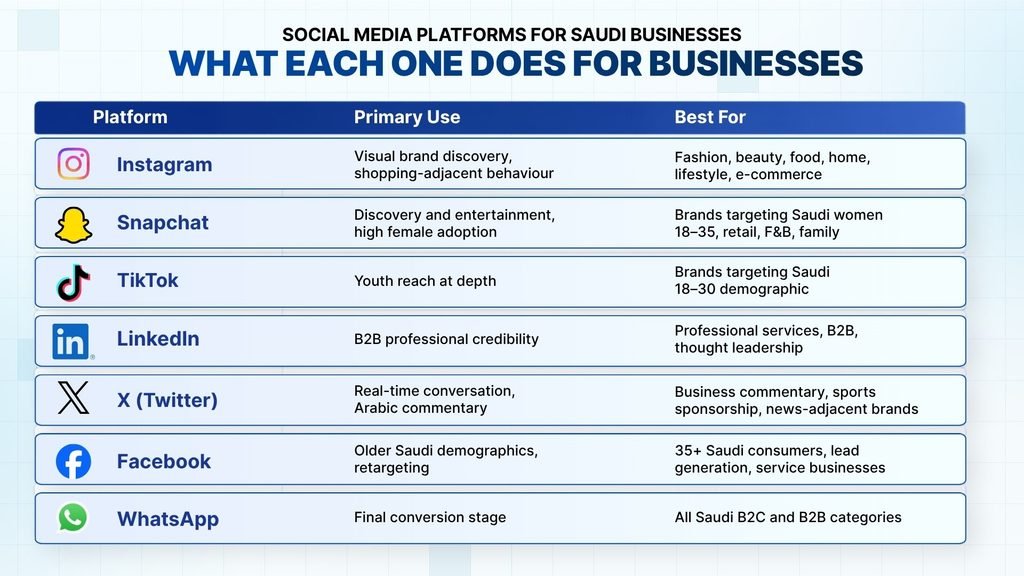
| Platform | Primary Use | Best For |
| Visual brand discovery, shopping-adjacent behaviour | Fashion, beauty, food, home, lifestyle, e-commerce | |
| Snapchat | Discovery and entertainment, high female adoption | Brands targeting Saudi women 18–35, retail, F&B, family |
| TikTok | Youth reach at depth | Brands targeting Saudi 18–30 demographic |
| B2B professional credibility | Professional services, B2B, thought leadership | |
| X (Twitter) | Real-time conversation, Arabic commentary | Business commentary, sports sponsorship, news-adjacent brands |
| Older Saudi demographics, retargeting | 35+ Saudi consumers, lead generation, service businesses | |
| Final conversion stage | All Saudi B2C and B2B categories |
Not every platform is worth your time and budget. Which ones are depends on who you’re selling to and what they’re doing on their phone. Here’s what actually works on each one, and where paid advertising fits alongside it.
This is where most Saudi B2C buying decisions start. Your customers follow brands they intend to buy from, save products before they’re ready to purchase, and use Instagram like a search engine for fashion, beauty, home, and food. If your content isn’t showing up in that search, a competitor’s is.
- Reels reach people who don’t already follow you, so this is your main tool for growing a new audience organically
- Arabic captions written the way your customers actually speak outperform anything translated from English
- Reels ads and Stories ads with one clear call-to-action beat static images across most categories
- Instagram Shopping for e-commerce, click-to-WhatsApp lead ads for service businesses, both put buyers one tap from talking to you
Snapchat
Snapchat’s daily usage in Saudi Arabia is among the highest in the world, and its audience skews young and heavily female. If women make the purchase decision in your category, fashion, beauty, food, home, family, this is often your easiest access to them.
- Polished, ad-like content gets ignored here; behind-the-scenes and real moments outperform it
- Snap Ads, Collection Ads, and Story Ads reach audiences at scale with strong targeting by age, location, and interest
- For retail and food brands, Snapchat ads often cost less per result than Instagram for a comparable audience
TikTok
TikTok reaches audiences aged eighteen to thirty deeper than any other platform here. But it only works if the content is built for TikTok, not repurposed from Instagram.
- Posting your Instagram Reels straight to TikTok is the most common mistake we see; the pacing, audio, and editing style all need to change
- Spark Ads let you boost content that’s already performing organically, including creator content, and usually outperform standard in-feed ads because they look native
- TikTok Business Manager also offers In-Feed Ads, TopView, and Branded Effects once you’re ready to scale beyond organic
If you’re selling to other businesses, this is the platform where the people who actually sign off on the purchase spend their time.
- Thought leadership written by someone who genuinely has the expertise performs best; ghostwritten posts that sound hollow lose credibility fast
- LinkedIn ads let you target by job title, seniority, industry, and company size, useful when you need one specific decision-maker, not a broad audience
- Cost per click runs higher than other platforms, but the audience quality justifies it for B2B
X/Twitter
X works when your brand has something to say about what Saudi audiences are already talking about, news, sports, business commentary, not when it’s used as another feed for promotional posts.
- Saudi X users disengage quickly from brands that treat it as a broadcast channel instead of joining the actual conversation
- Works well for B2B, financial services, media, and brands connected to Saudi sports culture, the Saudi Pro League, Formula E, golf
- Advertising performs best around moments of high attention, when the conversation is already happening
Facebook’s audience here skews older than Instagram or Snapchat, typically 35 and up, which makes it useful if that’s who you’re trying to reach.
- Strongest for retargeting, lead generation forms, and click-to-WhatsApp campaigns
- Works best paired with Instagram through Meta’s shared ad platform rather than run on its own
- Less efficient than Instagram or Snapchat if your audience skews younger
Instagram, Facebook, and WhatsApp all sit within the Meta ecosystem. For a full breakdown of how paid advertising works across them in Saudi Arabia, see our full guide on Meta Ads.
Organic Social Media Marketing vs Paid Social Media Advertising
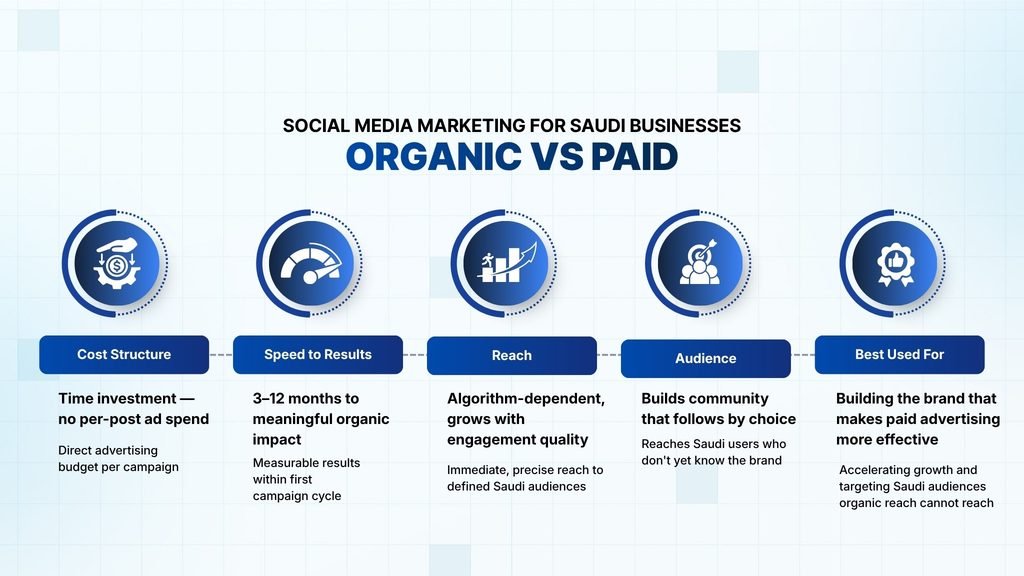
| Organic Social Media | Paid Social Media Advertising | |
| Cost Structure | Time investment — no per-post ad spend | Direct advertising budget per campaign |
| Speed to Results | 3–12 months to meaningful organic impact | Measurable results within first campaign cycle |
| Reach | Algorithm-dependent, grows with engagement quality | Immediate, precise reach to defined Saudi audiences |
| Audience | Builds community that follows by choice | Reaches Saudi users who don’t yet know the brand |
| Best Used For | Building the brand that makes paid advertising more effective | Accelerating growth and targeting Saudi audiences organic reach cannot reach |
Yes, and they’re not competing for the same job. Organic and paid social are two channels within a broader digital marketing strategy, and when both are running correctly, each one makes the other more effective. The brand you build organically lowers what you pay for paid results. The paid reach you buy accelerates what organic takes months to build on its own.
What Organic Social Media Actually Does For Your Business
Organic social media builds your brand over time without a media spend attached to each post. Every Reel, Story, and post you publish stays part of your brand’s presence, content Saudi customers find through discovery, in-platform search, and visits to your profile. It does three things for you specifically. It builds the familiarity that makes your paid ads work harder: a customer who’s already seen your brand twice organically converts at a noticeably higher rate than someone seeing your ad cold. It builds the content library that shows up in search, since Instagram and TikTok both function as search engines in Saudi Arabia, so a restaurant with real content about its food and space turns up in local searches without spending a riyal on ads. And it builds the community that lowers your acquisition cost over time, because followers who genuinely stick around because your content serves them buy again, refer others, and extend your reach for free.
What Paid Social Media Advertising Actually Does For Your Business
Paid social media advertising gets you immediate, precise reach that organic can’t match on speed. You’re not hoping the algorithm shows your content to the right person. You’re choosing exactly who sees it, when, and how often. Paid works across three stages of your customer’s journey, and each one needs a different goal.
Awareness Campaigns
These put your brand in front of people who don’t know you yet. You measure these by reach and frequency, not conversions, because their payoff shows up later, in how much better your conversion campaigns perform.
Consideration Campaigns
These reach people who already have some familiarity with you and are still deciding, through landing page traffic, video views, or lead forms.
Retargeting Campaigns
These go after people who’ve already shown interest, past site visitors, video viewers, profile visitors, and lookalikes of your existing customers. They convert at the highest rate of the three because the intent is already there.
Social Media Marketing By Industry: What Works For Your Business
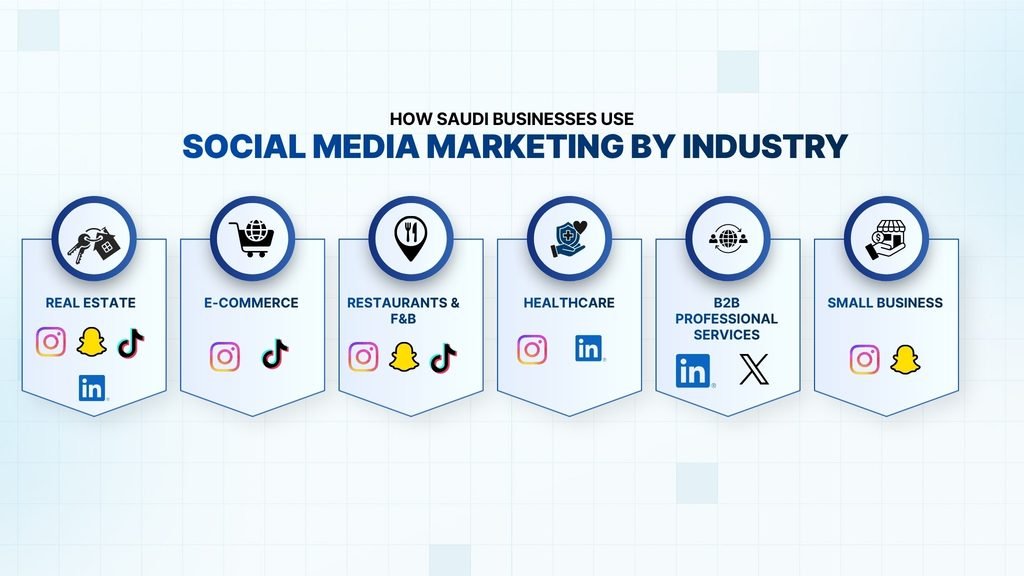
| Industry | Primary Platforms |
| Real Estate | Instagram, Snapchat, LinkedIn, X |
| E-Commerce | Instagram, TikTok |
| Restaurants & F&B | Instagram, TikTok, Snapchat |
| Healthcare | Instagram, LinkedIn |
| B2B Professional Services | LinkedIn, X |
| Small Business | Instagram, Snapchat |
What works on social media changes by industry, sometimes drastically. A real estate developer and a restaurant are not fighting for attention the same way, and using the same content playbook for both is why so many Saudi businesses feel like they’re posting into a void. Here’s how the approach shifts by industry, and what actually moves the needle for each one.
Real Estate
Real estate social media has to work for two very different people at once, and mixing up the messaging costs you both. Residential buyers deciding where to live, local investors weighing a purchase, and international investors tracking Vision 2030 opportunities are all watching your content, but they’re looking for different things from it.
What social media marketing handles for real estate:
- Instagram and Snapchat content that helps families picture themselves living in the space, not just seeing it
- Video that shows real scale, ceiling heights, natural light, outdoor space, because buyers can tell a render from reality
- LinkedIn content built for investors: market analysis, development updates, the numbers that make a conversation worth having before it starts
- Virtual tours and 3D visualisation for off-plan units, so you can sell what isn’t built yet without asking buyers to imagine it blind
E-Commerce
Your job on social media is short: get the product noticed and get the buyer to purchase without losing them along the way. Fashion and beauty brands relying on visual discovery, home goods sellers needing context shots, and any store still losing sales to return rates all need this handled slightly differently.
What social media marketing handles for e-commerce:
- Instagram Shopping and TikTok Shop tags that keep the customer inside the platform through checkout
- Product content shot in real use, real environments, real customers, not just white-background catalogue shots
- Influencer and user-generated content that gets your product discovered by people who aren’t you
- Content that shows true colour, proportion, and fit, cutting the expectation gap that drives most returns in fashion, home, and beauty
Restaurants
Food sells itself on social media if the content is good enough to make someone hungry looking at their phone. Dine-in restaurants building foot traffic, delivery-first kitchens competing on Talabat and Hunger Station, and seasonal spots leaning into Ramadan all need slightly different plays.
What social media marketing handles for restaurants:
- Plating and kitchen content built for TikTok and Reels format specifically
- Iftar and suhoor content timed to when Saudi restaurant discovery peaks
- Location tags and neighbourhood-specific content that gets you found in local search
- A clear link from your content to Talabat, Hunger Station, or direct ordering, so appetite turns into an order
Healthcare
Trust is the entire sale here, and it’s built differently than in any other category. Clinics educating patients before a decision, dental practices with visible treatment results, and hospitals managing multiple specialties at once each need a slightly different approach to earn it.
What social media marketing handles for healthcare:
- Educational content that answers the questions patients actually have, positioning you as knowledgeable, not promotional
- Before-and-after treatment content, shown with proper consent, doing what written credentials can’t
- Content built around Saudi privacy and dignity norms, never generic global healthcare marketing templates
B2B
Nobody on LinkedIn is buying on impulse. They’re checking whether you actually understand their industry before they’ll take your call. Professional services firms building authority, consultancies proving Saudi market expertise, and any B2B brand tired of ghostwritten posts that read hollow all need the same fix.
What social media marketing handles for B2B:
- LinkedIn content written by someone who genuinely has the expertise being claimed, not a ghostwriter guessing at it
- Real client outcomes and honest engagement with the problems your Saudi buyers actually have
- X used for market commentary and conversation, not as a second promotional feed
Small Business
You have one advantage large brands can’t buy back: people can see the actual person behind the business. Owner-led brands, service providers with a personal specialty, and any small business competing against bigger marketing budgets should be leaning into that, not hiding it behind polished corporate content.
What social media marketing handles for small business:
- Content led by the owner, their story, their process, their reasoning for starting the business
- Organic content as the primary investment, since it costs time rather than ad budget
- Small, tightly targeted paid campaigns, retargeting site visitors and boosting posts that are already performing, instead of broad campaigns that burn budget fast
Automotive
Car buyers research heavily before they ever visit a showroom, and social media is where that research starts. Dealerships selling new inventory, service centers building repeat customers, and auto accessory and detailing businesses competing on visual appeal all need social media doing different work for them.
What social media marketing handles for automotive:
- Instagram and TikTok video showing vehicles in real Saudi conditions, not just showroom lighting
- Snapchat content reaching younger buyers early in the research phase, before they’ve picked a brand
- Service and maintenance content that keeps existing customers coming back instead of shopping around
- Click-to-WhatsApp campaigns that move a serious buyer straight into a conversation with your sales team
Education
Parents and students research a school or program long before they ever fill out an application, and what they find on social media shapes whether they apply at all. Private schools competing on reputation, universities recruiting across the Kingdom, and training centers and academies selling specific skills each need this handled differently.
What social media marketing handles for education:
- Instagram and Snapchat content showing real campus life, real classrooms, real outcomes, not stock photography
- LinkedIn content for universities and training centers targeting working professionals considering further study
- Parent-focused content on Facebook, where the decision-makers for younger students actually spend their time
- Enrollment-season campaigns timed to when Saudi families are actively comparing options
Fitness, Beauty & Wellness
This category sells a result the customer can’t fully picture until they see it, which makes visual proof the entire strategy. Gyms and fitness studios competing on member retention, salons and spas built on repeat bookings, and clinics offering aesthetic or wellness treatments all need slightly different content built around trust and results.
What social media marketing handles for fitness, beauty and wellness:
- Before-and-after and transformation content, shown with proper consent, that does the convincing words can’t
- Instagram and Snapchat content built around real client experiences, not stock wellness imagery
- Booking-focused click-to-WhatsApp and lead ads that turn interest into an appointment instead of a saved post
- TikTok content for studios and salons targeting younger clients who are discovering, not yet searching
Other Industries We Work With
If your business isn’t listed above, that doesn’t mean social media works any differently for you, it just means the specific approach hasn’t been spelled out here yet. We build social media programs for logistics and delivery companies, legal and financial professional services, hospitality and hotels, wedding and event planning businesses, home services and contractors, fashion and apparel retailers, and fintech and financial products, among others. The platforms and content format change by category, but the same principle holds across all of them: your customer is already researching you on social media before they ever contact you, and the businesses winning that research window are the ones getting the calls.
What Does Social Media Marketing Cost for Saudi Businesses
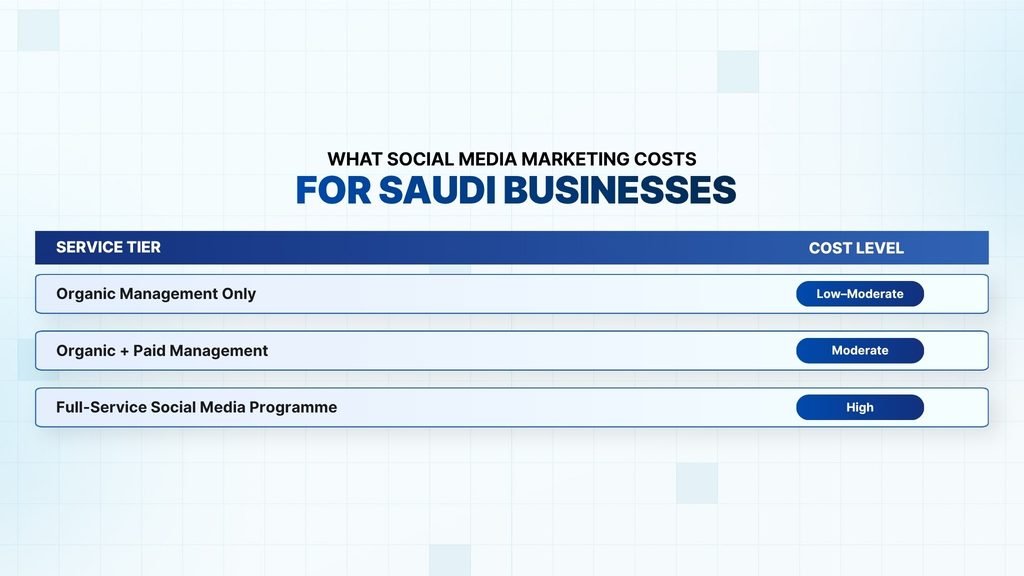
| Service Tier | Cost Level |
| Organic Management Only | Low–Moderate |
| Organic + Paid Management | Moderate |
| Full-Service Social Media Programme | High |
Social media management pricing in Saudi Arabia is driven by platform scope, content production requirements, paid advertising management, and whether Arabic and English are both covered as distinct content workstreams.
Organic social media management only
The lower cost tier — covering content strategy, Arabic and English content production, scheduling, and basic community management across two to three platforms. Appropriate for Saudi businesses that are building organic presence before investing in paid advertising, or that need to establish platform foundations before running campaigns.
Organic plus paid social media management
The mid-range tier — adding paid advertising campaign management across one or two Saudi platforms to organic content management. Includes campaign setup, audience targeting, creative production for ads, and ongoing optimisation. This is where most growing Saudi businesses sit when social media is a primary customer acquisition channel.
Full-service social media marketing packages
The highest investment tier — comprehensive organic management across multiple Saudi platforms, paid advertising management with full Arabic creative production, influencer coordination, community management, and strategic reporting that connects social activity to business outcomes. Appropriate for Saudi brands where social media is a primary commercial channel and where Arabic content production at scale is required.
What drives social media marketing cost up
Platform count increases management complexity significantly — each additional platform requires distinct content production. Arabic content production adds cost when it is genuinely native rather than translated. Paid advertising management costs scale with the number of platforms, campaign complexity, and advertising budget being managed. Community management cost scales with the volume of Saudi audience interaction requiring response.
If you’re still confused about which tier fits your brand or want an exact plan built around your business, message us on WhatsApp and we can walk you through which tier fits your business and what it would actually cost to get there.
Common Mistakes Saudi Businesses Make With Social Media Marketing
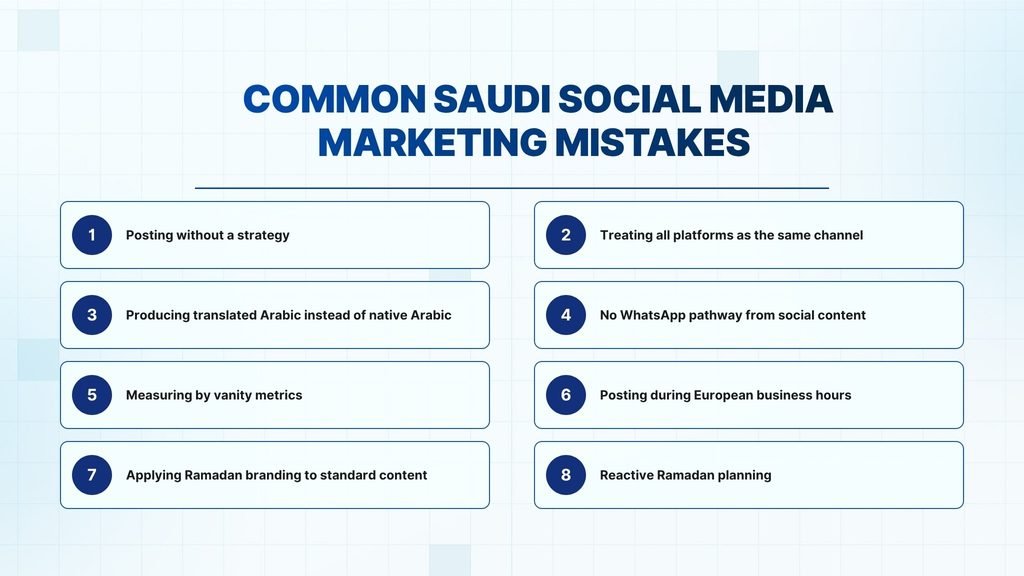
| Mistakes |
| Posting without a strategy |
| Treating all platforms as the same channel |
| Producing translated Arabic instead of native Arabic |
| No WhatsApp pathway from social content |
| Measuring by vanity metrics |
| Posting during European business hours |
| Applying Ramadan branding to standard content |
| Reactive Ramadan planning |
How Etihad Falcon Tech Delivers Social Media Marketing Services for Saudi Businesses
Every growing Saudi business hits the same wall eventually. Your accounts are active but the content isn’t converting; your Arabic posts underperform your English ones, or there’s no real path from a social media conversation to a WhatsApp lead. Those are the three situations we get called in for most.
What We Build
Platform-specific strategies for Instagram, Snapchat, TikTok, LinkedIn, and X, built around how Saudi audiences actually use each one. Arabic content that’s written natively, not translated, with Ramadan planned into the calendar from January, not scrambled together three weeks out. Paid and organic run as one connected program, not separate campaigns with no relationship to each other, backed by community management, WhatsApp integration, and reporting tied to actual business outcomes.
Who This Is For
Saudi businesses in real estate, e-commerce, restaurants, healthcare, B2B, and retail, across Riyadh, Jeddah, and beyond. Book a free consultation with us, and we’ll help you figure out exactly what social media strategy will work for your brand and where the gaps in your current approach are costing you.
Frequently Asked Questions
It depends on your audience. Instagram is your main platform for fashion, beauty, food, home, and lifestyle. Snapchat is your best route to Saudi women at scale. TikTok if you’re targeting Saudi youth. LinkedIn for B2B and professional services. X works for business commentary, sports, and news-adjacent brands. Most businesses need more than one platform, each with its own content, not the same post distributed everywhere.
It depends on how many platforms you’re on, whether Arabic and English are both covered as separate workstreams, and whether paid advertising is included. A focused organic program for two to three platforms costs less than a full-service setup with paid management and community management layered in. Judge the cost against the outcomes you’re getting, not just the monthly fee.
It’s the single biggest lever you have. Native Arabic content, written for Arabic from the start, consistently outperforms translated content on engagement, reach, and conversion across every platform. If your Arabic content is just your English content translated, it’s underperforming its potential.
Consumption and competition for attention both spike. Content that genuinely reflects the season, family, generosity, iftar, community, outperforms standard promotional content with Ramadan branding slapped on. Start planning sixty to ninety days out, with Arabic creative and campaigns locked before the month begins.
Organic builds familiarity, community, and discovery over time without a media spend attached to each post, and it compounds. Paid gets you immediate, precise reach to a specific audience. We run them together: organic builds the content quality that makes your paid ads convert better.
Saudi customers who discover you on Instagram or Snapchat often move to WhatsApp before buying. Your program needs a clear WhatsApp call-to-action, click-to-WhatsApp ads, and a response process ready to convert that conversation. Without it, you’re losing the most important stage of the journey.
Paid shows measurable results within your first campaign cycle. Organic takes three to six months for real growth in followers and engagement, and six to twelve months before it becomes a real source of leads. Paid covers that gap while organic builds.