
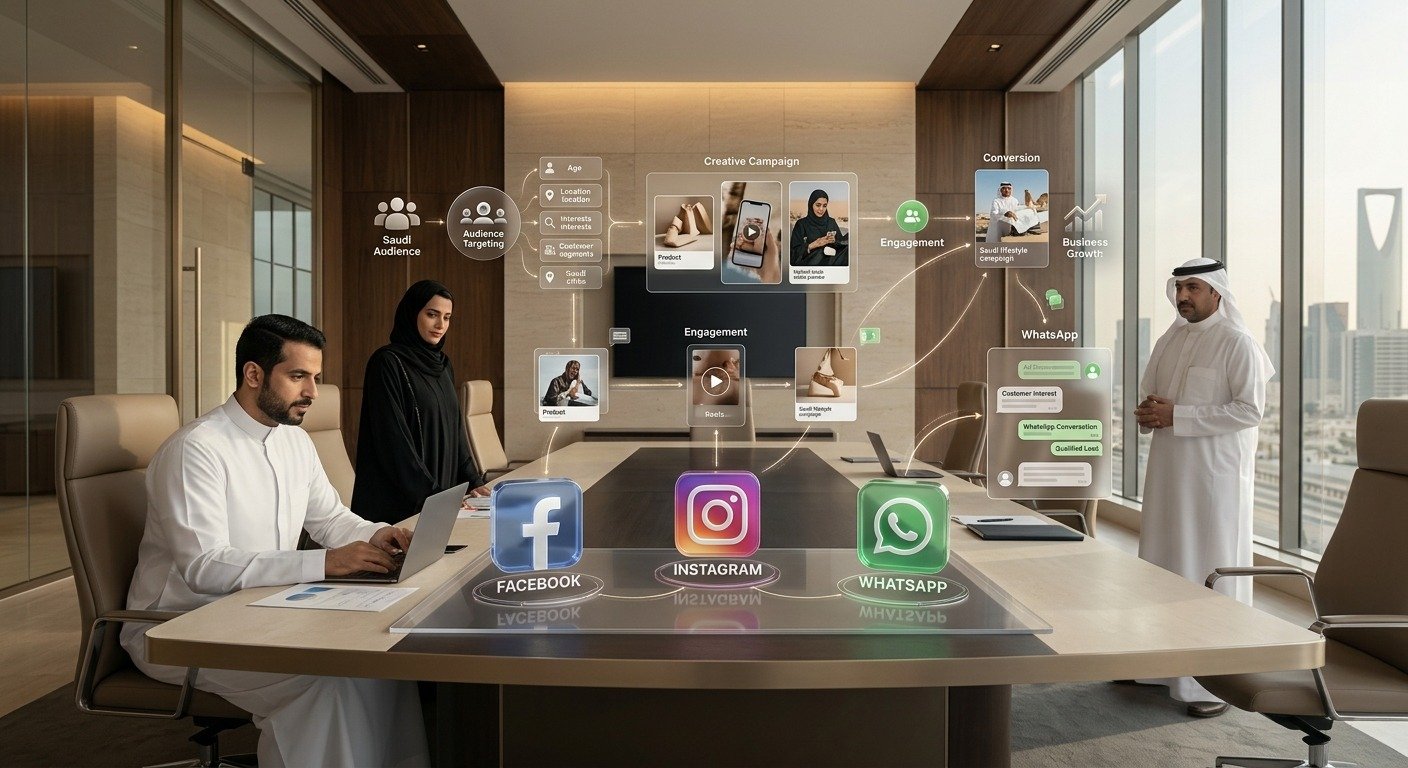
Saudi Arabia has some of the highest social media engagement rates in the world. Saudi users spend more time on Facebook, Instagram and WhatsApp than almost any other audience globally. That attention is real, it is measurable, and it is accessible to any Saudi business willing to advertise on Meta platforms.
The problem is that access and results are not the same thing. Most Saudi businesses running Meta Ads are spending budget. Some are generating impressions. Fewer are generating leads and sales at a cost that makes the investment worthwhile. The gap between a Meta Ads campaign that produces activity and one that produces revenue is not the platform. It is the strategy, the creative, the audience targeting and the campaign structure behind it.
This guide covers everything Saudi businesses need to know about Meta Ads in 2026: how Facebook, Instagram and WhatsApp advertising works in the Saudi market, what each campaign type delivers, how Meta Ads differ across Saudi industries, what Arabic and bilingual advertising requires, what it costs, and what separates a Meta ads agency that produces results from one that produces reports. Meta Ads is one of the most powerful channels within a broader digital marketing strategy, and for Saudi businesses where social media attention is already there, it is often the fastest way to turn that attention into revenue.
What Does Meta Advertising Actually Cover for a Saudi Business?
Meta Ads isn’t one thing, it’s three platforms working together, plus the strategy that connects them. Here’s what each one actually does, and what it offers your business.
Facebook Advertising
Facebook gives you the widest range of ad formats on Meta, and the most mature targeting tools. It handles the full campaign lifecycle in one place: setup, targeting, creative, bidding, optimisation, reporting, all managed through Meta Business Ads Manager.
- Lead ads, carousel ads, video ads, collection ads, and dynamic product ads all run natively on Facebook
- Detailed targeting by interests, behaviours, location and custom audiences puts your ad in front of the exact customer profile you’re after, whatever that profile looks like
- Facebook’s lead generation tools, in-platform forms that capture enquiries without sending someone to an external page, are some of the strongest on Meta
Instagram Advertising
Instagram is built around visual discovery, and that shapes what it offers. Feed, Stories, Reels and Explore placements each do a different job in your funnel, and between them you can run everything from a five-second Reel to a full shopping catalogue.
- Reels ads use Meta’s discovery algorithm to reach people who don’t follow you yet but match your targeting
- Stories ads work well for a single, direct call to action
- Instagram Shopping and collection ads let people browse your full catalogue without leaving the app
- The creative bar here is genuinely higher: content that looks native to the platform, video-first, well-produced, outperforms anything that reads as an obvious ad
Turning Facebook and Instagram Ads Into WhatsApp Conversations
Click-to-WhatsApp isn’t a separate platform, it’s a conversion action you can add to either the Facebook or Instagram ads covered above. Same placements, same targeting, same campaign setup. The only thing that changes is the destination: instead of sending someone to a website, the click opens a WhatsApp conversation with your business directly.
- Works with Facebook carousel, video and collection ads, or Instagram Feed, Stories and Reels, whichever format fits your campaign
- WhatsApp Business API integration lets you automate first responses and route conversations so no lead sits unanswered
- A tap into a conversation is a stronger intent signal than a website click, someone who opens a chat has committed to talking, not just looking
- Runs on the same objective, audience and budget structure as any other Meta campaign, just pointed at a conversation instead of a landing page
What Goes Into Building a Meta Ads Campaign for Your Business
A Meta Ads campaign isn’t one decision; it’s five: which ad format you run, how you bid, who you target, whether you retarget, and how you measure your campaign results.
Get one of these steps wrong and your whole Meta Ads campaign isn’t properly optimized.
Which Ad Format Fits Your Objective
| Ad Format | What It Does |
| Facebook carousel ads | Shows multiple products, features or steps in a single scrollable ad |
| Instagram Reels ads | Places your ad inside Meta’s discovery feed, built for reach beyond your existing followers |
| Instagram Story ads | Full-screen, single-action format, built for one clear next step |
| Facebook lead ads | Captures contact details through an in-platform form, no external page needed |
| Facebook video ads | Built for longer-form storytelling or product demonstration |
| Dynamic product ads | Auto-generates personalised creative straight from your product feed |
| Facebook collection ads | Mobile-first format for browsing a full product catalogue inside the ad |
| Meta instant experience | Full-screen, immersive experience that opens after the initial tap |
Format is a functional decision, not a creative preference, and not an audience decision either. Every format here works across every industry and every age group; what determines the right one is the objective. A carousel format serves a “show multiple products” objective regardless of who’s buying. A lead ad format serves an “in-platform enquiry capture” objective regardless of the category. Match the format to what the campaign needs to do, not to who you assume is on the other end.
Bidding & Budget Strategy
Format decides what the ad looks like. Bidding decides how Meta spends your budget to deliver it. Meta’s auction runs on a handful of bid strategies, and each one optimises for a different outcome:
- Lowest cost lets Meta spend your full budget to get the most results possible, without a cap on what each result costs
- Cost cap keeps average cost per result at or under a number you set, useful once you know what a result should cost you
- Bid cap gives you direct control over what you’re willing to bid in each auction, the most manual and most demanding option
- Return on ad spend (ROAS) goal optimises specifically for revenue per riyal spent, built for e-commerce and conversion campaigns
The right bid strategy depends on what stage your account is at and what you’re optimising for, not on your industry or company size. A new account with no conversion history usually needs lowest cost to gather data first; an account with established data can move to cost cap or ROAS goal once it knows its numbers.
Audience Targeting & Custom Audiences
Every campaign draws from three audience types: cold audiences reached through interest and behaviour targeting, warm audiences built from your own customer data, and lookalikes that extend reach to new users who resemble your best customers.
Detailed targeting, age, city, interests, behaviour, filters your reach to people relevant to what you’re advertising. But custom audiences carry the real value. Your website visitors, email list, app users, existing customers, this is signal data the algorithm can actually use, and it’s the single most valuable targeting asset you can build. It also tells you what your best customers have in common, which sharpens every cold campaign that follows.
Generic targeting doesn’t work here. Segmenting by city, Riyadh, Jeddah, Dammam, by cultural interest, and by local behaviour needs real market knowledge, not a template pulled from a different country. That’s true whether you’re targeting a niche B2B audience or a broad consumer base.
Retargeting & Remarketing
Retargeting reaches people who’ve already engaged, visited your site, watched a video, viewed your page, but didn’t convert the first time. They convert at a far higher rate than cold audiences, because you’re not introducing the brand, you’re re-engaging someone who was already interested. This holds true across every category Meta serves, the mechanism is identical whether the product is a sofa or a service contract.
For e-commerce specifically, dynamic product ads take this further: the ad shows the exact item someone browsed or left in cart, personalised automatically once your feed and pixel are set up. That personalisation is why dynamic retargeting consistently outperforms static ads for catalogue-based businesses.
Performance Reporting & Analytics
Reach, impressions and CPM tell you how many people saw the ad. Click-through rate and cost per click tell you whether they engaged. Neither tells you if the campaign made money. Cost per lead, cost per purchase and return on ad spend are the numbers that actually answer that, and they’re the same numbers that matter regardless of format, bid strategy or audience used to get there.
A Meta Ads programme should hand you monthly reporting tied back to the objective each campaign was built for, what’s working, what’s being adjusted, and what next month is focused on. A spreadsheet with no explanation isn’t reporting. It’s just data delivery.
Meta Ads is one channel within a broader digital marketing strategy, and the reporting that comes out of it feeds every other channel you run. What your Meta campaigns tell you about your Saudi audience, their behaviour, their cost to convert, and what creative they respond to, sharpens everything else you spend on.
How Do Meta Ads Work Differently From Google Ads and Other Paid Channels?
Google Ads catches someone at the moment they’re already looking. Someone typing “dentist near me Riyadh” has already identified the need and is actively searching for a provider. Google puts you in front of that decision as it’s being made.
Meta reaches people before they’ve searched anything. Someone scrolling Instagram isn’t hunting for a provider, they’re browsing, discovering, being entertained. Meta’s job is to build familiarity now, so that when the search happens later, your name is already recognisable.
That’s not a weaker version of what Google does, it’s a different job entirely. Someone who’s seen your clinic’s ads three times before they search “dentist Riyadh” converts at a higher rate on that search, because Meta already did the familiarity work.
When Should Meta Be Your Primary Channel?
Meta earns its place as your primary channel when the goal is awareness before intent has formed, when the product needs to be seen to be understood, when your audience is easier to define by interests than by search terms, or when WhatsApp conversation is how your leads actually convert.
Fashion, beauty, food and beverage, and property brands usually see Meta as their highest-volume channel for exactly this reason, people discover them visually before they ever type a search.
How Do Meta Ads Work Differently Across Saudi Industries?
| Industry | Businesses That Benefit |
| Real Estate | Developers, brokers, off-plan projects, property investment firms |
| E-Commerce and Retail | Fashion, home goods, beauty, electronics, marketplaces |
| Restaurants and F&B | Dine-in restaurants, cloud kitchens, cafes, catering |
| Healthcare and Dental | Clinics, hospitals, dental practices, specialist providers |
| B2B and Professional Services | Consultancies, legal firms, financial services, IT and software |
| Education | Schools, training centres, exam prep, online courses |
| Small and Medium Business | Home services, salons, local retail, neighbourhood businesses |
Every industry runs on the same three tools, Facebook, Instagram and click-to-WhatsApp. What changes is what the buyer wants to see before they act, and how the campaign needs to be built to give it to them. Here’s how that plays out industry by industry.
Real Estate
In real estate, buyers want to see the property before they’ll take a single step further, the actual unit, the location, the masterplan, what’s around it. Investors want a different set of details entirely: expected returns, payment plans, handover timeline. Neither group moves forward on a floor plan and a price tag alone.
This is where video does the heavy lifting, walkthroughs, drone shots of the community, real footage instead of renders. Pair that with a lead ad or click-to-WhatsApp so a buyer can ask about a specific unit the moment they’re interested, property questions are naturally conversational, and WhatsApp handles that better than a contact form ever will. For investors, retargeting is what brings them back after that first website visit, this time with the investment numbers front and centre instead of the lifestyle content that hooked a residential buyer.
E-Commerce and Retail
In e-commerce, what a shopper wants depends entirely on what they’re buying. Someone looking at clothing wants to see the material, the colours, how it fits. Someone looking at electronics wants specifications, exact ones, not marketing copy. Someone buying furniture wants dimensions and how it looks in a real room. Get that specific detail wrong or missing, and the sale stops right there.
Catalogue-style ads let shoppers browse those specifics before they ever click through, so the ad is already doing some of that filtering. Once someone’s viewed a product without buying, retargeting brings that exact item back to them on their next scroll, and dynamic product ads do this automatically once your feed is set up. Click-to-WhatsApp fits too, for shoppers who want to confirm stock, sizing, or delivery before they commit. The landing or product page needs to answer that same category-specific question fast, and get to “add to cart” in as few steps as possible.
Restaurants and F&B
In F&B, people are deciding with their eyes first. What makes someone stop scrolling is seeing the food itself, plating, texture, steam coming off a dish, not a menu graphic with a price next to it. For a dine-in spot, the setting matters too, people want a feel for the space before they book a table.
That visual has to lead straight into an action, because food decisions happen fast. A delivery order button, a reservation link, or click-to-WhatsApp for takeaway and table bookings, whichever matches how that customer actually eats. Offer-led campaigns work especially well here, a Ramadan iftar promotion or a weekend brunch deal timed right converts faster than a generic brand awareness push, because the decision window for food is measured in minutes, not days.
Healthcare
In healthcare, patients are looking for reassurance before anything else, who’s treating them, how experienced they are, what the facility actually looks like, and if it’s appropriate to show, real results from real patients. A generic “book now” ad skips past all of that, and patients notice.
Credentials and facility content build that trust, and compliant before-and-after content does more than any credential alone. Once a patient is ready to act, click-to-WhatsApp works especially well because booking an appointment is a conversation, patients want to ask about availability or a specific concern before they commit to anything. Lead ads work too, for patients who’d rather leave their number for a callback. And because most patients don’t book on their first visit to your page, retargeting is what brings them back once they’ve had time to decide.
B2B and Professional Services
In B2B, the buyer isn’t deciding from a single ad, they’re forming an impression over several. What they want to see is proof: case studies, results you’ve delivered, expertise that holds up, not a sales pitch. A procurement manager or a decision-maker doesn’t respond to urgency, they respond to credibility built over time.
That’s why lead ads here should ask for company name and role, not just an email, so you’re capturing people who can actually make the call. And retargeting does most of the real work in B2B, someone who’s engaged with your content once needs to see you again before a real conversation starts. The buying cycle runs weeks or months, so the campaign structure needs to be built for that pace, not for a one-tap conversion.
Education
In education, parents and students want proof before they’ll enquire, exam results, accreditation, facilities, what past students actually went on to achieve. A course description alone doesn’t answer “is this worth it,” they want to see the classroom, the campus, or the course content itself.
Video showing that real experience builds more trust than text ever will. Lead ads work well for capturing enrolment enquiries once that trust is there, and click-to-WhatsApp suits the back-and-forth questions about fees, schedules, or entry requirements that a form can’t handle. For seasonal enrolment periods, retargeting keeps your programme in front of a parent or student who looked once but hasn’t decided yet.
Small Businesses
A small business, whatever it sells, competes on trust. A neighbourhood restaurant, a home services company, a boutique retail shop, a salon, a freelance consultant, a small B2B supplier, all of them win the same way: by showing a real person and a real product behind the ad. Authenticity matters for small businesses because that’s who the potential client wants to connect with. A visible owner, an honest look at the product or service, content that sounds like how the business actually talks to its customers, not a national brand’s campaign scaled down.
Local audience targeting keeps the spend inside the area the business can actually serve, so a small business isn’t paying to reach people three cities away. And click-to-WhatsApp is often the easiest way to close the loop here, since many customers already expect to message a small business directly rather than fill out a form.
Small & Medium Enterprises (SMEs)
Once a business grows past the single-owner, single-location stage, whether it’s a multi-branch retail chain, a growing e-commerce brand, or a regional service provider, the approach shifts from pure authenticity to a mix of brand consistency and local relevance. These businesses can run broader campaigns across multiple cities while still tailoring creative and offers to each location, and they typically have enough customer data to build real custom audiences and retargeting pools, something a single-location small business is still working toward.
The campaign structure also gets more layered at this stage: awareness campaigns to build recognition across a wider footprint, retargeting to bring back people who’ve engaged with more than one branch or touchpoint, and lead or conversion campaigns tuned to each city or region rather than one blanket audience.
What Do Meta Ads Cost in Saudi Arabia?
| Meta Ads Management Model | Cost Level | Best For |
| Percentage of ad spend | Scales with budget | Saudi businesses with growing Meta budgets |
| Flat monthly management fee | Fixed regardless of spend | Saudi businesses with stable monthly ad spend |
| Campaign-based project fee | Per campaign | Saudi businesses with seasonal or one-off campaigns |
Meta ads cost in Saudi Arabia depend on campaign objective, audience competition in the target Saudi category, creative quality, and the time of year. There is no fixed CPC or CPL for Saudi Meta campaigns. Cost per result is the output of the interaction between these variables.
Saudi categories with high advertiser competition — real estate, healthcare, financial services, education — carry higher CPMs and CPCs than categories with fewer Saudi advertisers competing for the same audience. Creative quality directly affects cost through Meta’s ad auction: higher-quality creative that generates stronger engagement signals reduces CPM because Meta’s algorithm rewards ads that Saudi users respond to positively.
What Drives Meta Advertising Cost Up or Down
Creative quality is the single most controllable cost factor in Saudi Meta campaigns. Meta’s auction rewards ads that Saudi users engage with — higher CTR, longer video watch time, more saves and shares — with lower delivery costs. Investing in better Arabic creative quality reduces CPM and CPL across the campaign without changing the budget.
Meta advertising cost in Saudi Arabia is never one number — it moves with your category, your creative quality, and how your campaigns are managed. Contact us on WhatsApp now and book a free meeting with our team to discuss your Meta advertising goals, budget, and what a well-managed Saudi campaign looks like for your specific business.
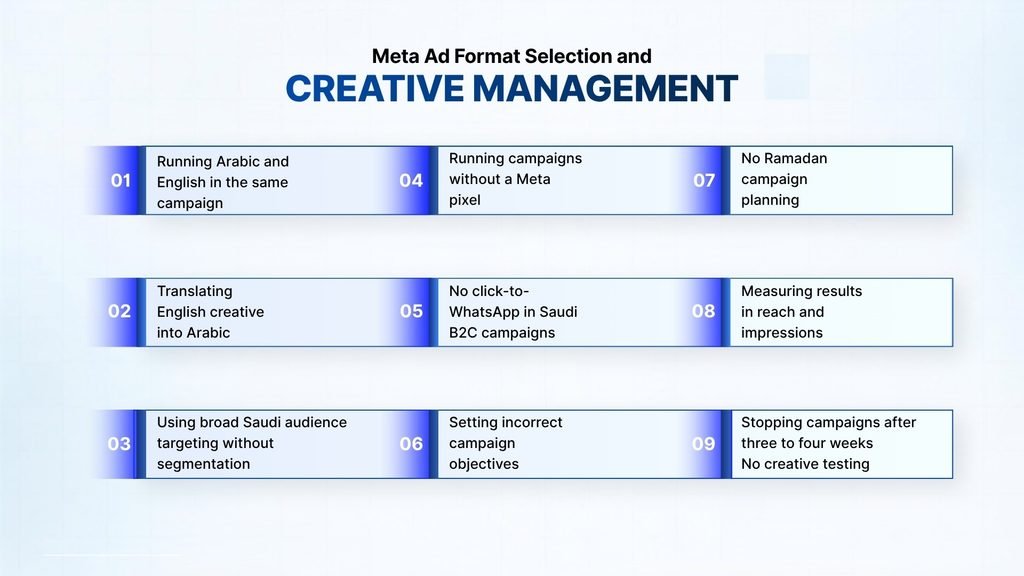
What Are the Most Common Meta Ads Mistakes Saudi Businesses Make?
| Mistakes |
| Running Arabic and English in the same campaign |
| Translating English creative into Arabic |
| Using broad Saudi audience targeting without segmentation |
| Running campaigns without a Meta pixel |
| No click-to-WhatsApp in Saudi B2C campaigns |
| Setting incorrect campaign objectives |
| No Ramadan campaign planning |
| Measuring results in reach and impressions |
| Stopping campaigns after three to four weeks |
| No creative testing |
How Does Etihad Falcon Tech Manage Meta Ads for Saudi Businesses?
Etihad Falcon Tech manages the full Meta stack in-house, Facebook, Instagram, click-to-WhatsApp, audience development, creative, retargeting, and reporting. The same team that builds your strategy builds your campaigns, manages your creative, and monitors performance daily. Nothing gets lost between departments.
Built for the Saudi Market
Arabic creative isn’t translated here, it’s written natively for how Saudi audiences actually read Facebook and Instagram. RTL design is built from the concept stage, not bolted onto English layouts. Targeting decisions are grounded in how Saudi demographics actually behave on each platform, not assumptions borrowed from other markets.
Ramadan planning happens months ahead, not during the first week when competition and costs are already at their peak. And when you’re targeting Riyadh, Jeddah, or any specific Saudi city, you get campaigns built for that city, not a national campaign with a location filter applied.
Start Your Meta Ads Programme
Generating impressions but not leads. Arabic campaigns underperforming. Broad targeting with no retargeting structure to catch the people who showed interest but didn’t convert. These are the three problems we see most.
Frequently Asked Questions
Facebook Ads covers just the Facebook platform. Meta Ads covers Facebook, Instagram and WhatsApp together. The distinction matters because each platform reaches a different audience, Instagram skews younger and visual, Facebook skews older and converts well for leads, WhatsApp converts best for buyers who prefer conversation before purchase.
Two costs: your ad budget paid to Meta, and the management fee. Both depend on category competitiveness, audience size, and creative quality. Competitive categories like real estate, healthcare, and financial services carry higher costs. The right budget is based on what cost per result you can justify against customer lifetime value, not an industry average.
Yes. As two separate campaigns, not one bilingual campaign. Arabic gets native copy, Arabic-first creative, and its own targeting. English runs separately for bilingual and expat audiences. Performance for each is tracked independently.
Campaigns produce activity from day one, but consistent results take longer. New campaigns need roughly fifty conversion events per ad set to exit Meta’s learning phase. Proper setup, pixel, seeded audiences, tested creative, shortens that phase. Most programmes show real improvement from month two.
Lead ads keep the user on Meta, lower friction, more volume, lower average lead quality. Website conversions send users to a landing page, higher friction, fewer leads, stronger intent. Choose lead ads if volume matters most and you can qualify leads after the fact. Choose website conversions for e-commerce or when lead quality matters more than volume.
Yes, real estate, healthcare and dental, e-commerce, restaurants, B2B services, education, and SMBs. Each gets a campaign structure built for its own compliance requirements and audience behaviour, MOH-compliant copy for healthcare, product feed integration for e-commerce, and so on.
Yes, as part of the standard programme wherever WhatsApp is the primary conversion channel. Runs on the same Facebook and Instagram placements, with WhatsApp Business API handling automated responses and routing so no lead goes cold.
Monthly reporting tied to each campaign’s objective, reach for awareness, cost per lead for lead gen, ROAS for e-commerce, cost per conversation for WhatsApp. Every report explains what changed and what’s next, not just numbers.
An audience built from your own data, website visitors, email lists, app users, engaged followers. It gives Meta’s algorithm real signal to work with, which converts better than cold targeting. It also powers lookalike audiences built from your best customers.
Yes, as one connected strategy instead of two disconnected accounts. Audience data flows between them, Google Analytics feeding Meta retargeting, Meta audiences informing Google remarketing, with one unified report showing how each channel contributes.