
Google handles 95.81% of all internet searches in Saudi Arabia, according to StatCounter’s June 2026 data. That is not a small figure. That is nearly every Saudi internet user, on any device, typing what they need, comparing what is available, and deciding which business to trust, visit, or buy from.
The way your Saudi business shows up in your potential clients’ search results is through Google Ads services. For any business that is trying to generate leads or sales, showing up in Google searches is no longer optional. However, you should know that showing up is not enough. It is common for campaigns to underperform because the account structure, keyword targeting, or landing pages were never properly optimised, and that gap quietly eats budget without producing the results a business actually needs. The more control you have over how your ads are set up, targeted, and structured, the better they perform, and that control is exactly what separates a campaign that produces leads from one that just spends budget.
This guide covers what Google Ads management actually means for a Saudi business, how each campaign type works, what Arabic and bilingual campaigns require, what it costs, and where it fits within your broader digital marketing strategy, and how to choose a Google Ads agency that can turn your ad spend into leads and sales instead of just clicks.
What Do Google Ads Services in Saudi Arabia Actually Cover?
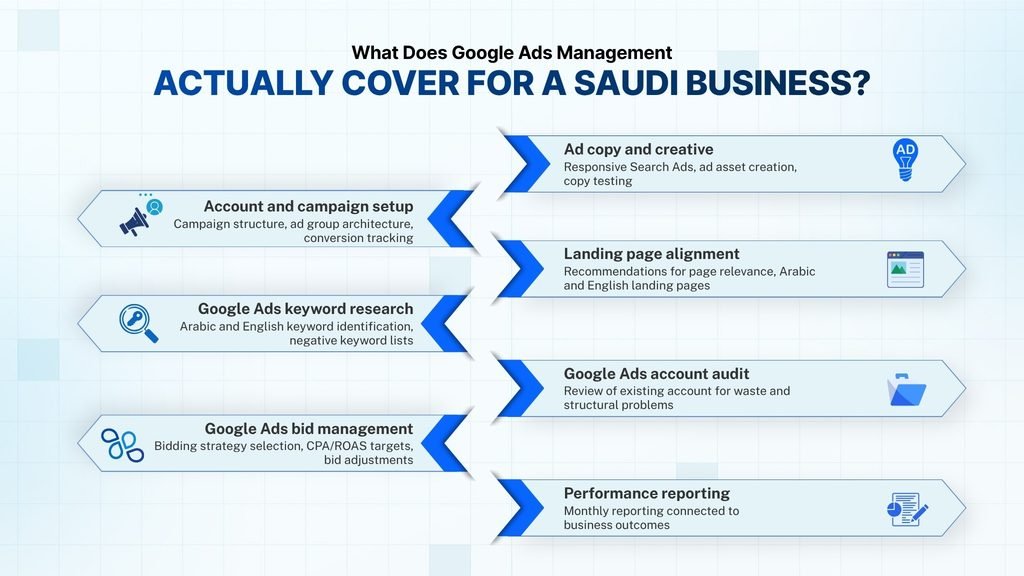
| Management Component | What It Involves |
| Account and campaign setup | Campaign structure, ad group architecture, conversion tracking |
| Google Ads keyword research | Arabic and English keyword identification, negative keyword lists |
| Google Ads bid management | Bidding strategy selection, CPA/ROAS targets, bid adjustments |
| Ad copy and creative | Responsive Search Ads, ad asset creation, copy testing |
| Landing page alignment | Recommendations for page relevance, Arabic and English landing pages |
| Google Ads account audit | Review of existing account for waste and structural problems |
| Performance reporting | Monthly reporting connected to business outcomes |
Google Ads Campaign Management
Campaign management starts with understanding what the business needs Google Ads to produce. If you’re running a clinic in Riyadh, you need appointment bookings. If you’re running an e-commerce store, you need product purchases. If you’re running a B2B software company, you need demo requests. Each of these needs a different campaign setup, and using the same one for all three is why so many Saudi accounts underperform.
Your account should be structured around your actual objectives, not a generic template. That means separate campaigns for each service, each Saudi city, and each stage of buyer intent. Without that separation, your performance data gets lumped together, and you lose the ability to tell which part of your account is actually working.
Ongoing Google Ads campaign management is not a set-and-monitor function. It is active weekly work: reviewing search term reports to identify new negative keywords, testing new ad copy against control, adjusting bid strategies as conversion data accumulates, and expanding or restricting audience targeting as campaign data reveals where the most valuable traffic is coming from.
Google Ads Bid Management
Your bidding strategy determines how your campaigns compete in Google’s auction, and the right one depends on what data you have and what you’re trying to achieve. Manual bidding gives you direct control over what you pay per click, which works well while an account is still building up conversion data. Automated strategies like Maximize Conversions or Target CPA use Google’s algorithm to adjust bids in real time, and they can start delivering useful results early on too, as long as conversion tracking is set up correctly and the account is monitored closely while the data builds.
Bid management for an established account is about keeping that bidding within limits that reflect your actual business economics: what a lead is worth, what an acquisition cost the business can sustain, and what ROAS target reflects real margin after fulfilment.
Google Ads Account Audit
If your Google Ads account has been running for more than three months and you cannot clearly explain what each campaign is producing and at what cost, that is a signal worth taking seriously. At that point, the right move is to bring in a Google Ads specialist or agency to look at the account properly before spending another riyal, rather than continuing to guess at what is and is not working.
A proper account audit checks your campaign structure against best practice, your keyword match types and negative keyword coverage, and your search term reports for wasted spend, since this is usually where the most obvious leaks show up. It also looks at your placement reports for Display and video campaigns, because ads can end up running on unrelated apps or websites that technically match your targeting but never produce a real customer, quietly eating budget the whole time. Beyond that, a proper audit checks whether your bidding strategy fits your data, your conversion tracking accuracy, your quality score, how your Arabic campaigns are structured and performing, and whether your landing pages actually match the ads sending traffic to them.
Google Ads is one of the most measurable channels within a broader digital marketing strategy, and a properly audited, correctly structured account gives you cleaner data across every other channel you run alongside it.
Google Ads Campaign Types: What Each One Does and When to Use It
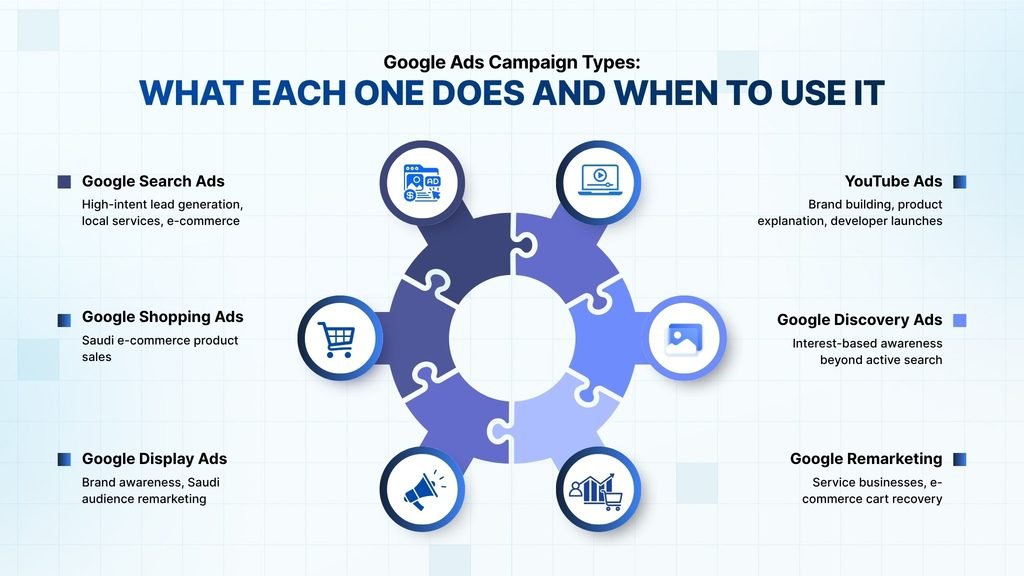
| Campaign Type | Best Use Case |
| Google Search Ads | High-intent lead generation, local services, e-commerce |
| Google Shopping Ads | Saudi e-commerce product sales |
| Google Display Ads | Brand awareness, Saudi audience remarketing |
| YouTube Ads | Brand building, product explanation, developer launches |
| Google Discovery Ads | Interest-based awareness beyond active search |
| Google Remarketing | Service businesses, e-commerce cart recovery |
Google Search Ads
Google Search Ads are the foundation of most Google Ads services programmes. They appear when Saudi users search for specific terms, placing your business in front of people who have already expressed intent through the query they typed.
The search moment is the highest-intent moment in digital advertising. When someone searches “dentist near me Riyadh,” they’ve already identified what they need, chosen how to find it, and started comparing their options. The business that appears with the most relevant ad, matched closely to that exact search query, gets the click. But winning the click is only the first step. What happens after matters just as much: the landing page needs to answer the same question the ad promised, and the call to action needs to match how that specific customer actually wants to act.
For businesses running ads in Saudi Arabia. Arabic and English Search Ad campaigns can be structured a few different ways: run as one combined campaign, or split into two separate campaigns by language. Either approach can work. What actually determines performance is how well the whole setup is built around it: accurate tracking for each language, ad copy and landing pages that match the query, and a structure Google’s own systems can read cleanly.
Google Shopping Ads
Google Shopping Ads put your product image, title, price, and store name directly in the search results, before anyone clicks. For Saudi e-commerce businesses, this often makes Shopping a cost-efficient campaign type, since the buyer already knows the product and the price before they land on your site.
Managing Shopping Ads well starts with your Google Merchant Center feed, the product data source Shopping Ads pull from directly. That feed needs to be bilingual: product titles in both Arabic and English, accurate pricing in SAR, correct Google product categories, and descriptions that match how people actually search. Get any of that wrong, and Shopping performance takes the hit no matter how well the rest of the account is managed.
Your website is directly tied to your Shopping Ads results. A well-structured site, clear categories, subcategories, and product pages that load correctly, matters just as much as the ad itself, because that’s what a customer lands on right after clicking. A customer can click a perfectly targeted Shopping Ad, land on your site ready to buy, and still leave if the category structure is confusing or the product page doesn’t match what the ad showed. Getting more sales from Shopping Ads means treating the Merchant Center feed and the website structure as one connected system, not two separate things.
Google Display Advertising
Google Display advertising puts visual banner ads in front of your audience on news sites, apps, and content platforms. It’s often used to build brand familiarity, but it isn’t limited to that; a well-targeted Display ad campaign can drive real conversions as well, depending on the audience, the creative, and how the campaign is set up.
One of the most effective uses of Display is remarketing, showing ads to people who have already visited your website or landing page. Because you already know something about their behaviour, what they looked at, how far they got, the creative and messaging can speak directly to that instead of running a generic ad. That level of targeting is part of what makes Display remarketing one of the more commercially efficient uses of this campaign type for most businesses.
YouTube Ads
YouTube is the most-watched video platform in the world, and it’s also Saudi Arabia’s second-largest search engine. Running ads here puts you in front of Saudi audiences through several ad formats: skippable in-stream ads (which viewers can skip after five seconds), non-skippable in-stream ads, bumper ads (short, unskippable clips), and in-feed ads that appear in search results and suggested videos.
If your product or service needs to be shown rather than explained, a property developer showing a community, a tech company explaining what its product does, a healthcare provider demonstrating clinical expertise, YouTube gets that across in a way text ads can’t. But YouTube Ads aren’t limited to branding and awareness. With the right setup, conversion tracking in place, remarketing lists built from previous viewers, and a clear next step for the viewer to take, YouTube can drive direct conversions too. It performs particularly well for industries like real estate, where seeing the development matters, but it isn’t limited to that. Any business that wants to connect with a viewer on a deeper level before asking them to act can use YouTube the same way.
Google Discovery Ads
Google Discovery Ads put you in front of users across specific placements: YouTube’s home feed, the Gmail promotions tab, and the Google Discover feed, based on their interests rather than what they’re actively searching for. Each of these placements works differently: the Discover feed shows up while someone is scrolling for content, Gmail promotions shows up inside their inbox, and the YouTube home feed shows up alongside videos they’d normally browse. Understanding where the ad will actually appear matters when building the creative, since content built for a feed environment needs to earn attention differently than content built to answer a search.
Use Discovery campaigns when you want to reach the right audience before they’ve started actively searching, with creative built to stop someone mid-scroll rather than answer a direct query.
Google Performance Max
Performance Max runs across Search, Display, YouTube, Discovery, Gmail, and Maps from a single campaign, using Google’s automation to find where your best customers actually are. It’s used strategically across e-commerce, remarketing, and almost any industry, like real estate, B2B, healthcare, and financial services, because it isn’t limited to one type of business.
That reach is also where the risk sits. Performance Max relies heavily on the signals you feed it: accurate conversion tracking, clear audience signals, search themes that reflect what your actual customers type, and first-party data from your website. Get those wrong, and Performance Max spends across all of those channels without knowing what a good result actually looks like, which can waste budget in a lot of directions at once instead of just one. A Performance Max campaign needs to be checked and tested across every one of these inputs regularly.
Google Remarketing & Retargeting Ads
Most website visitors do not convert on their first visit. Google Ads remarketing re-engages these users, and it isn’t limited to one part of the account. It runs across the Display Network, YouTube, Search (through RLSA), and Gmail, and it can also work from a customer list you upload directly, not just from website visits.
Search remarketing (RLSA) is one specific example: it allows bid adjustments for users who have previously visited specific pages of your website, bidding more aggressively for searches from users who have already demonstrated interest. A user who visited your clinic’s appointments page and then searches “dentist Riyadh” a week later is a more valuable click than a cold searcher.
But remarketing on its own doesn’t fix every conversion problem. If a visitor isn’t converting, the issue might sit earlier in the journey, the wrong call to action for that type of customer, a form where a WhatsApp button would convert better, or the reverse. Sometimes the visitor simply hasn’t built enough trust yet, and that’s better solved with Display and branding content that earns it over time, rather than a harder push to convert immediately. The right remarketing approach depends on identifying where the actual drop-off is happening, in the ad, the landing page, the conversion path, or the website structure itself, and building the retargeting around fixing that specific gap rather than repeating the same message that didn’t work the first time.
Arabic and Bilingual Google Ads Management for Campaigns
Running Google Ads in Saudi Arabia usually means managing two languages at once, Arabic and English. Arabic campaigns work differently from English ones. The keyword research, the ad copy, and how people actually search all shift depending on the language, so a bilingual account needs a plan for handling both properly.
Why Arabic Keyword Research Differs From Translation
Saudi Arabic search queries often look nothing like a direct translation of your English keywords. Someone searching for a clinic might use colloquial Gulf Arabic terms, transliterated English words, or a hybrid of Arabic and English that would never show up in a formal Arabic translation of your English keyword list.
Your Arabic keyword research needs to happen as its own independent process, using Google’s Keyword Planner with Arabic language settings, Saudi Arabia as the target geography, and native Arabic speakers who understand how Gulf dialect actually searches.
How to Structure Arabic and English Campaigns
Arabic and English campaigns can be structured a few different ways: two fully separate campaigns, separate ad groups inside one campaign, or a combined setup, each with its own tracking. There is no single correct structure that applies to every business. Separate campaigns are often suggested because they make it easier to track each language cleanly, but a combined structure can also produce strong results when it’s tracked properly.
What actually determines performance is the plan behind it, not which structure you pick. Some keywords convert better in Arabic, some convert better in English, and that split isn’t the same from one business to the next. Figuring that out takes a proper plan, along with tracking that shows you which language and which keywords are actually producing results. This is where a lot of Google Ads management goes wrong for businesses, not because the wrong structure was chosen, but because whoever set it up didn’t understand enough about how Saudi search behaviour and the Saudi market actually work to build a plan around it.
Arabic and English Ad Copy and Landing Page Alignment
Google Ads lets you provide up to 15 headlines and 4 descriptions for a single ad, and its system tests different combinations automatically to find what performs best for each search. That flexibility matters just as much for Arabic ads as it does for English ones, since it gives you room to test different phrasings rather than relying on one fixed version.
Arabic ad copy works best when it matches how Saudi users actually search, not a formal Arabic version of an English sentence. The same goes for English: the closer your ad and landing page match what someone typed, the better your quality score, in either language.
Writing Arabic ad copy natively is one way to get that alignment right. Translating from English can work too, but it takes more than a direct word-for-word translation. Using AI translation tools well means giving them the full context, your campaign, your objective, and what you’re actually trying to say, rather than pasting in English text and translating it literally. Done properly, that process can get close to how a native Arabic speaker would phrase the same search intent, identifying the actual function of key terms rather than just their literal translation.
The real comparison here isn’t which language performs better. It’s that Arabic and English need to be handled with their own strategy, tested and tracked on their own terms, since what works for one Saudi business’s Arabic campaign won’t necessarily work the same way for another’s.
How Google Ads Work Differently Across Saudi Industries
| Saudi Industry | Types of Businesses |
| Real Estate | Off-plan developers, real estate brokerages, master-planned community developers, property marketing agencies |
| Healthcare and Dental | Hospitals, private clinics, medical training centres, dental practices |
| E-Commerce and Retail | Online retailers, wholesalers, multi-channel brands |
| SaaS | Software companies, SaaS platforms, tech startups |
| B2B | Professional service providers, enterprise vendors, wholesale suppliers |
| Education and Training | Universities, private schools, training institutes, exam-prep platforms |
| Hospitality and Tourism | Hotels, resorts, tour operators, event venues |
| Legal and Professional Services | Law firms, accounting practices, consulting firms, notarial services |
| Automotive | Car dealerships, auto service centres, vehicle rental businesses |
| Financial Services and Fintech | Banks, insurance providers, investment platforms, payment service providers |
| Logistics and Supply Chain | Freight companies, last-mile delivery operators, courier aggregators |
Google Ads works differently depending on what a business is selling and who is searching for it. A property developer chasing off-plan sales needs a completely different campaign setup than a dental clinic booking appointments or an online store selling products directly. Here is how it applies across the main industries running Google Ads in Saudi Arabia:
Google Ads for Real Estate
A real estate buyer cares about the actual property. The location, the master plan, how developed the surrounding area is, what amenities are nearby, whether the unit itself looks modern and well-built. These are the things they’re comparing before they ever pick up the phone to contact the real estate agency.
You need to speak to exactly what they’re looking for, at every stage they’re looking for it:
- Search Ads match the specific area or project a buyer is typing in, not a generic “real estate” term
- YouTube Ads show the development itself, the master plan, the finished units, the neighbourhood
- Discovery Ads reach investors and early-stage buyers browsing Gmail and their Discover feed before they’ve started actively searching
- Display Ads keep the project visible while a buyer is still comparing other options
- RLSA (Search Remarketing) bids more aggressively when someone who already visited a listing searches again
- Performance Max pulls Search, Display, YouTube, and Discovery together into one campaign for full-funnel coverage
Google Ads for Healthcare
A healthcare patient is looking for more than just a provider who can perform a treatment. They care about the facility itself, whether it looks clean and properly equipped, the experience and expertise of the doctors treating them, and clear information about the condition or treatment they’re dealing with.
They also want to know this is a place that will look after them properly, not just handle one appointment and move on, and reviews from other patients often matter as much as anything on the clinic’s own website. By the time they search, most patients already know the treatment they need. They’re not browsing, they’re deciding who to trust with it.
You need to be there with the right answer the moment they search, and stay visible if they hesitate:
- Search Ads built around the specific treatment (implants, orthodontics, paediatrics) catch a patient who already knows what they need
- Call extensions on a Search ad let a patient with an urgent need reach you by phone directly, without visiting the site first
- Local Campaigns put you in front of patients searching nearby, which matters more here than almost anywhere else
- Display Ads build the kind of visible, trustworthy presence a patient wants to see before choosing a provider, not just after they’ve already decided
- YouTube Ads let a provider explain a procedure or show the facility to a patient still deciding who to trust
- Discovery Ads stay in front of patients researching a condition before they’ve settled on a specific provider to book with
- Remarketing re-engages anyone who visited your booking page but didn’t complete it
- Performance Max pulls all of this together into one campaign once conversion tracking is solid enough to support it
Every ad type here can convert a patient. What determines whether it does is whether the ad, the offer, and the booking path all match the urgency the patient is already feeling.
Google Ads for E-Commerce
An online shopper cares about the product itself: what it looks like, what it costs in SAR, whether it’s actually in stock, and whether the store looks trustworthy enough to hand over payment details to. Reviews, clear return policies, and delivery timelines often matter as much as the product photos themselves. Some shoppers are ready to buy the moment they search. Others are still comparing across a few stores before deciding.
Different ad types catch each of these buyers at a different point:
- Shopping Ads show the product, the price, and your store name directly in search results, before anyone clicks
- Search Ads catch buyers searching by category or need rather than a specific product name
- Discovery Ads put products in front of shoppers browsing their Discover feed or Gmail, before they’ve started actively searching
- Display Ads keep a product visible to shoppers still comparing elsewhere
- YouTube Ads show a product in use, which matters for anything a photo alone can’t fully explain
- Remarketing brings back anyone who viewed a product and left, which is most shoppers on their first visit
- Performance Max runs Search, Shopping, Display, YouTube, and Discovery together from a single campaign
None of this works without a clean product feed behind it. Arabic and English titles, accurate SAR pricing, and descriptions that match how people actually search, get that right, and every ad type above can pull its weight.
Google Ads for SaaS
A SaaS buyer is evaluating more than just what the software does. They’re checking whether it integrates with the tools they already use, how it handles data security, whether the pricing tiers actually fit their team size, and how it stacks up against the two or three competitors they’re probably also looking at. The decision often runs through a free trial or a demo before it ever reaches a salesperson.
- Search Ads catch the buyer once they start searching for a solution by category or by the specific problem they’re trying to solve
- YouTube Ads demonstrate the product in a way a static ad can’t, which matters for software people need to see working
- Display Ads keep the product visible while a buyer compares it against alternatives
- Discovery Ads reach potential buyers browsing their feed before they’ve started actively searching for a solution
- Remarketing re-engages anyone who visited your pricing or demo page but didn’t sign up
- Performance Max, with lead form extensions, captures a trial or demo request directly from the ad
Google Ads for B2B
A B2B buyer is sourcing a service or supplier for their business, not evaluating a single product feature by feature. They’re comparing quotes, checking references or past work, and vetting how reliable this supplier actually is before committing. The decision usually involves more than one person on their side, runs on a longer timeline, and often continues through calls or meetings once the first enquiry is made.
- Search Ads catch the buyer once they start searching for a solution by category, not just by your brand name
- Display Ads keep you visible through a research phase that can run for weeks
- YouTube Ads let you explain a more complex offering in a way a search ad alone can’t
- Discovery Ads reach decision-makers browsing their feed before they’ve started actively searching
- Remarketing re-engages anyone who visited your site during that research but didn’t convert
- Performance Max pulls all of this together into one campaign once there’s enough conversion data behind it
Track every touchpoint with data-driven attribution once these are running, so you can see which one actually started the decision, not just the one that closed it.
Google Ads for Education & Training Institutes
A parent researching a school cares about admissions, curriculum, and fees. A student researching college or university cares about the certification, the career outcome, and whether the training is worth their time. These are two different audiences with two different questions, even when they’re searching for the same programme.
- Search Ads, run separately for parent-facing and student-facing terms, so the ad copy actually matches who’s reading it
- Call extensions on a Search ad let a parent or learner reach admissions directly by phone, which matters when a decision has a deadline attached
- Discovery Ads stay visible with parents and students still comparing options before they’re ready to apply
- YouTube Ads explain a programme or show the campus in a way a text ad can’t
- Display Ads keep your institution visible during enrolment windows, when search volume spikes hard
- Remarketing brings back anyone who started an application enquiry and didn’t finish it
- Performance Max covers all of this together once enrolment data gives it enough to work with
Timing matters as much as targeting here. An always-on budget spread evenly through the year misses most of the volume that shows up right before application deadlines.
Google Ads for Hospitality and Tourism
A traveller comparing hotels or trips is checking whether the place is clean and safe, whether the photos actually match reality, whether the price hides extra fees, and what the cancellation policy looks like if their plans change. This happens fast, often on a phone, often close to the date they actually need it.
- Search Ads built around specific dates and occasions (weekend getaways, Eid breaks, corporate retreats) catch a traveller mid-decision
- Call extensions let a traveller call to book or ask a question directly from the ad, useful for last-minute plans
- YouTube Ads show the property or venue itself, which matters when travellers are choosing between similar-priced options
- Discovery Ads reach travellers still browsing ideas before they’ve picked a destination
- Local Campaigns put you in front of nearby travellers searching last-minute
- Display Ads and Remarketing bring back a traveller who checked your rates and left, since most bookings don’t happen on the first visit
- Performance Max brings all of this together once there’s enough booking data behind it
Once they’re ready to commit, send the click straight to your booking engine. Every extra step before booking loses a share of that traffic.
Google Ads for Legal & Professional Services
A legal or professional services client is often under some pressure, a deadline, a dispute, a compliance issue, and wants to know quickly whether you’ve actually handled a situation like theirs before, not just whether you offer the service in general.
- Search Ads built around specific practice areas (commercial law, family law, tax advisory) match a specific need instead of a generic “legal services” search
- Call extensions let an urgent client reach you by phone directly from the ad, before they even browse your site
- Display Ads keep your firm visible to a client still comparing options before they decide
- Discovery Ads reach potential clients researching a legal or compliance issue before they’ve settled on who to contact
- Remarketing re-engages a visitor who read your services page but didn’t enquire
- Performance Max covers this full range once there’s enough enquiry data to support it
- Separate Arabic and English campaigns keep the entire experience, ad through landing page, in the language the client actually searched in
A broad match keyword strategy burns budget fast in this category. Precision matters more than reach.
Google Ads for Automotive
A car buyer researches heavily before ever visiting a showroom: specific makes, specific models, prices, and reviews. A service customer is looking for something entirely different, an appointment, not a purchase.
- Search Ads built around specific makes and models catch a buyer who’s already close to deciding
- Shopping-style vehicle ads show the car, the SAR price, and the dealership directly in results
- Call extensions let a buyer or service customer call the showroom directly from the ad
- YouTube Ads show the vehicle in a way photos and specs can’t
- Display Ads keep a dealership visible while a buyer compares models elsewhere
- Local Campaigns send nearby buyers straight to your showroom
- Remarketing keeps you visible through a research cycle that often runs long
Service and maintenance searches need their own path entirely, sent straight to a booking form, not a sales page. A customer booking a service appointment isn’t shopping for a new car.
Google Ads for Financial Services & Fintech
A financial services customer is comparing specific products, a savings account, an investment plan, an insurance policy, and every claim your ad makes is being read carefully, because money decisions carry weight.
- Search Ads built around specific products (savings accounts, investment plans, insurance types) match what the customer is actually comparing
- Display Ads work for awareness, never for guaranteed-return claims, since performance claims here carry real regulatory risk
- YouTube Ads work the same way, useful for building trust and explaining a product, not for making promises about returns
- Discovery Ads reach customers researching financial products before they’ve started actively searching
- Remarketing re-engages a visitor who started a product enquiry and didn’t finish it
- Performance Max covers this range once conversion tracking is solid enough to support it
Route leads into a qualification form before a call, so your team isn’t chasing unqualified enquiries. Every ad in this category needs to be checked against SAMA guidelines before it goes live, since a single disapproved ad can put the whole account at risk.
Google Ads for Logistics & Supply Chain
A logistics buyer is almost always a business, not a consumer, and they’re vetting something specific: reliability, delivery windows, tracking visibility, and whether you can actually handle their shipment type, bulk, same-day, or cross-border, not just whether you’re “a logistics company.”
- Search Ads built around specific shipping needs (bulk shipping, same-day delivery, cross-border freight) catch a decision-maker who already knows what they’re looking for
- Display Ads, using LinkedIn audience data, keep you visible to logistics decision-makers during their research
- YouTube Ads can demonstrate tracking systems or fulfilment capability in a way a text ad can’t
- Discovery Ads reach decision-makers browsing their feed before they’ve started actively searching
- Remarketing re-engages a visitor who requested a quote and didn’t follow through
- Performance Max pulls this together once there’s enough quote-request data behind it
Route clicks to a quote-request form that captures shipment volume and destination up front, and track leads by shipment type, not just by form fill. A business shipping nationally and one shipping cross-border need completely different follow-up.
Google Ads for Small Businesses and SMEs
A small business or SME customer usually wants one thing fast: to know if you do what they need, whether you’re trustworthy enough for the money involved, and how quickly they can reach you. They are not running a multi-week evaluation the way a bigger purchase involves, and the budget behind the campaign is tighter too, so every riyal needs to earn its place.
Small businesses and SMEs are not a separate industry. They are the smaller-scale version of every industry already covered here, a boutique real estate agency, a single clinic, a small retailer, a growing startup still proving its numbers. The same principles apply, just with a shorter list of priorities and a tighter sequence for rolling campaigns out.
Local Service Businesses
A customer searching for a local service, a plumber, a salon, a repair shop, wants to know you are nearby, available, and reachable right now, and often checks reviews before calling to make sure you’re actually reliable.
- Search Ads, focused tightly on your core service and your city, do most of the work here
- Call extensions added to your Search ad let a customer reach you by phone straight from the ad, which matters when speed is the deciding factor
- Local Campaigns put you in front of nearby customers actively searching for what you offer
- Display Ads keep you visible to people in your area even when they’re not actively searching yet
- Remarketing brings back anyone who visited your site but did not book
- Performance Max is worth testing once there’s enough booking or enquiry data behind it to give the system something to work with
Small Retailers
A small retailer’s customer is comparing your product against bigger stores with bigger budgets, checking price, reviews, and whether the store looks legitimate enough to trust with payment details, so the ad needs to earn that trust fast, not just visibility.
- Search Ads catch customers searching for your specific product, not a broad category a bigger competitor already dominates
- Shopping Ads put your product, price, and store name in front of a buyer who has already decided what they want
- Discovery Ads put your product in front of shoppers browsing their feed before they’ve started actively searching
- Remarketing brings back anyone who viewed a product and left, since most first-time visitors do not buy immediately
- Performance Max runs Search, Shopping, Display, and Discovery together once there’s enough purchase data to support it
Startups and Small B2B or Professional Businesses
A startup or small professional business is not selling to someone walking past a shop. Its buyer is another business or a client evaluating whether this company can be trusted with something specific, a service, a subscription, a project, often comparing a few other options and checking for any track record or proof of past work before deciding.
- Search Ads built around the specific service or solution catch a buyer already searching by category, not by your brand name
- Display Ads keep the business visible through a longer decision process than a local service business ever deals with
- YouTube Ads work well when the service or product needs a bit of explaining before a buyer takes it seriously
- Remarketing re-engages a visitor who came close to enquiring but did not follow through
- Performance Max, with lead form extensions, is worth adding once there’s enough conversion data to justify it
The principles from the industries above still apply here too, a small real estate agency still needs Arabic Search built around neighbourhood, a small clinic still needs to be found by nearby patients. The difference for a small business or SME is sequencing: start with the one or two ad types producing the clearest return, then expand once the budget supports it.
Every business type covered here has a different starting point, a different budget ceiling, and a different sequence for rolling campaigns out correctly. Contact us on WhatsApp and get expert guidance on which campaign types to start with, how to sequence your budget, and what a properly structured Google Ads account looks like for your specific business and industry.
What Do Google Ads Services Cost in Saudi Arabia?
| Cost Component | Cost Level |
| Search Ads (Arabic and/or English) | Moderate–High |
| Multi-Campaign Setup (Search + Shopping or Display) | Moderate |
| Full-Funnel Google Ads Programme | Moderate–High |
| Conversion Tracking & Tag Setup | Low–Moderate one-off |
| Landing Page Development & Optimisation | Moderate |
| Google Shopping Feed Optimisation | Moderate |
| Ongoing Campaign Management | Moderate–High monthly |
Advertising Budget
Cost per click in Google Ads varies significantly by category, keyword, and campaign quality. There is no meaningful average CPC that applies across different industries. Competitive categories, real estate, healthcare, financial services, and education, carry significantly higher CPCs than less competitive categories, because multiple advertisers with substantial budgets are competing for the same high-intent search queries.
Quality score is the one factor in your CPC that you actually have control over. It reflects how relevant your ad and landing page are to the keyword someone searched, and a higher quality score means you pay less per click for the same ad position. Better keyword-to-ad-copy alignment, stronger landing page relevance, and a higher expected click-through rate all improve it. It is the most efficient way to reduce cost without cutting into how much reach your campaign gets.
Management Cost Structure
Management cost scales with the amount of work the account requires, not a fixed rate applied to all businesses. There is no single answer that fits every business here, it depends on your specific setup and goals. A business running one focused campaign in one city needs far less management than one running dozens of ad groups across multiple regions, several campaign types at once, or a full Arabic and English structure spanning different industries and objectives. The number of campaigns, how many ad groups sit inside them, how many regions or cities are being targeted, and what the business is actually trying to achieve all factor into how much ongoing management an account genuinely needs.
Common Google Ads Mistakes Saudi Businesses Make
| Mistakes |
| Broad match keywords with no negative keyword list |
| Sending all traffic to the homepage instead of a page that matches the ad |
| Treating every website action as an equal conversion |
| Setting up a campaign and leaving it unmonitored for weeks at a time |
| Ad copy that doesn’t match the landing page or what the searcher actually typed |
| Ignoring quality score, and paying more per click as a result |
| Making major changes to a campaign before there’s enough data to judge them |
| Skipping ad extensions like sitelinks and callouts that improve visibility |
| Judging performance by click volume instead of actual leads or sales |
What Should You Look for When Choosing a Google Ads Agency in Saudi Arabia?
Not every agency that says it manages Google Ads services in Saudi Arabia can actually manage it for a Saudi audience. Here is what to check before you hand over your budget.
Saudi Market Experience, Not Just Google Ads Experience
An agency that has only worked with UK or US clients will not automatically know how Ramadan affects your search volume, how your Saudi customers actually phrase what they search for, or what MOH or SAMA restrict in your category’s ad copy. Ask for Saudi campaigns they have actually managed, not a general portfolio.
Coverage Across Every Campaign Type, Not Just Search
Some agencies only know how to run Search, so that is what they sell you, regardless of what your business needs. Ask how they decide between Search, Shopping, Display, YouTube, and Remarketing for a business like yours. If every answer comes back to “we will start with Search,” they are fitting your business into their one solution.
Reporting That Tells You What Your Budget Actually Produced
A report full of impressions and clicks does not tell you anything about your business. Ask what their monthly report actually looks like. It should show leads generated by campaign, what you paid per lead by city, and where your money went, not a spreadsheet you need to interpret yourself.
How Etihad Falcon Tech Manages Google Ads for Saudi Businesses

Whether you’re thinking about running Google Ads for the first time, already spending without the leads your sales team can work with, or managing a campaign that’s been live for months without a clear read on what it’s actually producing, these are the situations we build our Google Ads services in Saudi Arabia to fix.
Google Certified Experts With Over 13 Years of Experience
Our team is Google Certified and has worked across Saudi brands, regional organisations, and global names, not just one type of client or one industry. That range means we’ve built campaigns for businesses just starting out and for accounts with years of existing data, so wherever your business is in that process, we’ve built for it before.
We Run Every Campaign Type Your Business Actually Needs
We do not default to Search because it is easiest to sell. If Shopping fits your product, we build it. If YouTube fits your sales cycle, we build that too. Your campaign mix is built around what generates leads and sales for your business, not around what is quickest for us to set up.
We Report What Your Budget Actually Produced
Every month, you get leads by campaign, cost per lead by city, and what changed since last month and why. We do not send you an export of numbers and leave you to work out what happened.
We have managed Google Ads campaigns for businesses across multiple major industries, including real estate, healthcare, e-commerce, B2B, education, and hospitality, and our expertise goes well beyond these few industries and business types. Your business can get the same structured approach.
Frequently Asked Questions
Google renamed AdWords to Google Ads in 2018. If you see “AdWords” anywhere, it means the same platform.
It is an auction. Your position depends on your bid and your quality score, so a higher bid does not always win the top spot.
There is no fixed number. Work out what a lead is worth to you, then budget backward from the lead volume you need.
Traffic starts on day one. Most accounts need 60 to 90 days of data before performance stabilises.
It is a review of your account for wasted spend and structural problems. If your account has run for three months and you cannot explain what it is producing, you need one.
Search reaches you when someone is actively looking. Display reaches you while people browse other sites and are not searching.
Ecommerce runs on Shopping Ads and is measured by ROAS. Service businesses run on Search and are measured by cost per lead.
Search, Shopping, Display, YouTube, Discovery, and Remarketing. Google Ads services in Saudi Arabia typically combine two or three of these depending on your business and customer journey.
Yes. We run them as two separate campaigns with separate keywords, ad copy, and reporting, so you can see how each one performs.
You get a monthly report on leads, cost per lead, and what changed and why. We do not just hand you numbers and leave you to interpret them.