
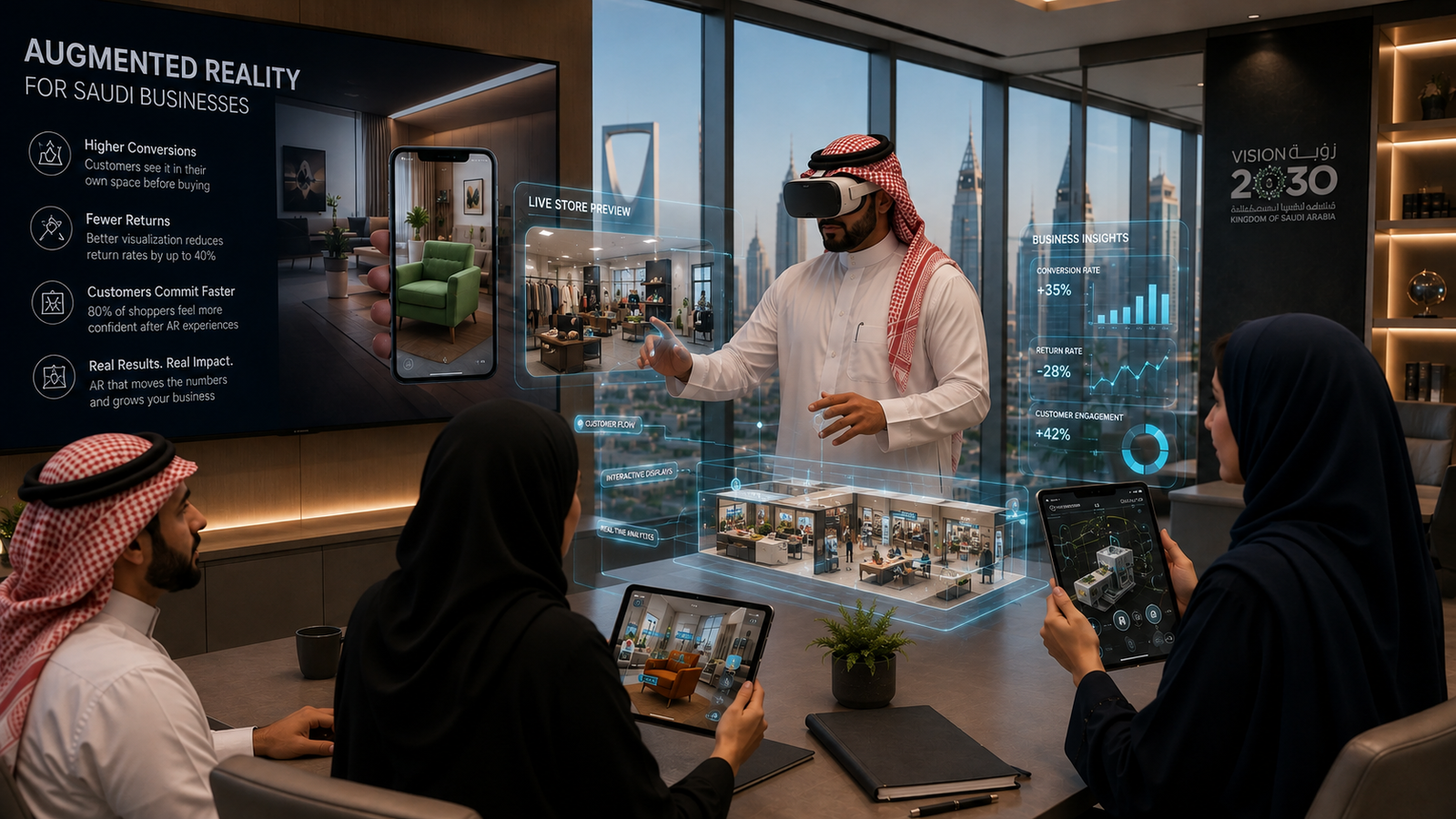
Saudi Arabia’s immersive technology is projected to reach USD 754.5 million by 2030, growing at a compound annual growth rate of 28.6 percent from 2025 to 2030, according to Grand View Research; the highest growth rate in the entire Middle East and Africa region. Retail, corporate, real estate, healthcare, education, construction, and many other sectors are driving that growth right now.
So, why is every sector investing in AR? AR does what an image or video cannot: it puts the product, the space, or the information directly into the customer’s real environment. A photo shows a sofa. AR places it in the customer’s living room at actual scale. A render shows a property interior. AR lets a buyer walk through it before a wall exists. A training manual explains a procedure. AR overlays the instructions onto the actual equipment a technician is working on. That shift, from showing to placing, is what businesses are investing in, because it changes how customers decide.
The results back it up. AR experiences reduce return rates by up to 40 percent, and 80 percent of shoppers report greater purchase confidence after interacting with a product through AR, according to Banuba’s 2024 research. Businesses deploying AR are not doing it for novelty. They are doing it because it is moving numbers that static content was leaving behind.
This guide covers where augmented reality is being applied across Saudi industries, what it solves at each stage of the customer journey, what implementation looks like in practice, and what it takes to deploy AR in a way that produces measurable outcomes for your business.
What Saudi Business Owners Get Wrong About Augmented Reality (AR)
AR gets dismissed for reasons that sound practical on the surface but don’t hold up once you look at what’s actually happening in the market. Some business owners think it requires a dedicated app and a development budget they don’t have. Some think it’s a marketing feature that looks good in a demo but doesn’t move real numbers.
Some don’t see the difference between AR and VR and assume the hardware barrier is the same. None of that is accurate anymore, and these assumptions are exactly what’s letting your competitors close sales, reduce returns, and retain customers while you wait.
Here are the most common misconceptions, and what you actually need to know:
“AR and VR are the same thing, and we can’t afford the hardware”
If you’ve looked at VR headset costs and assumed AR works the same way, that’s a misconception. AR and VR are different technologies solving different problems. VR replaces the real world; it requires a headset and puts the user inside a fully simulated environment.
AR enhances the real world; it overlays digital content onto what the user is already looking at, through the phone they already have.
Here’s what that means for your business:
- AR does not require specialist hardware; your customer uses their existing smartphone
- The barrier to entry for AR is a browser link or an app, not a headset purchase
- Confusing the two means writing off a technology your customers can access right now with zero additional equipment
“AR requires a dedicated app and customers won’t download it”
This was true a few years ago. It is not true now. Web AR runs directly in a mobile browser, no download, no installation, no friction. A customer taps a link on a product page and the AR experience opens immediately in their browser. For Saudi businesses where app download rates are a known drop-off point, web AR removes that barrier entirely.
Here’s what you should actually be comparing:
- Web AR reaches every customer with a smartphone and a browser link; no app required
- App-based AR delivers stronger performance and deeper checkout integration for businesses with an existing active app base
- The choice between web and app AR follows from where your customer already is, not from a default assumption that an app is required
“AR is a marketing gimmick, it gets attention but doesn’t change the numbers”
AR built around a specific business problem works differently than AR built just for visuals. A furniture retailer that lets customers place a sofa in their actual room before buying is not running a campaign; they are giving the customer an experience that removes the doubt stopping them from committing. When doubt is removed, customers buy faster.
That applies across retail, real estate, automotive, and any other business where the gap between seeing a product and experiencing it is where sales are lost. If used correctly, AR is not a marketing feature; it is a sales tool.
Here’s what the difference looks like in practice:
- AR that lets a customer place a product in their real environment before buying reduces the expectation gap that drives most returns; that is a commercial outcome, not a marketing metric
- AR that guides a field technician through a maintenance procedure with overlay instructions reduces errors and training time
- The businesses reporting the strongest AR results are not the ones that deployed the most features; they are the ones that identified one specific problem and built AR to address exactly that
Which Saudi Businesses Need Augmented Reality Right Now
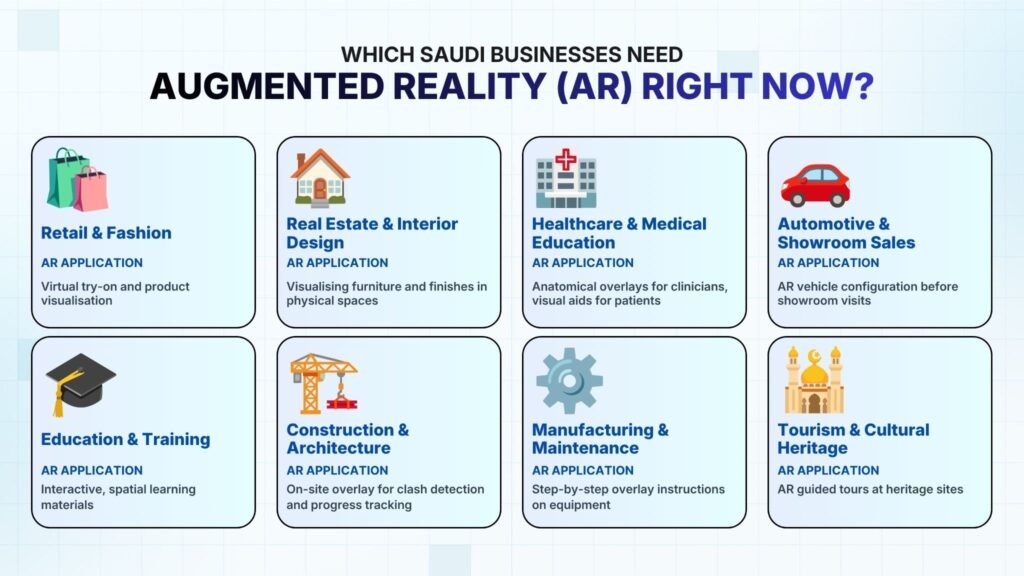
| Industry | Key AR Application |
| Retail & Fashion | Virtual try-on and product visualisation |
| Real Estate & Interior Design | Visualising furniture and finishes in physical spaces |
| Healthcare & Medical Education | Anatomical overlays for clinicians, visual aids for patients |
| Automotive & Showroom Sales | AR vehicle configuration before showroom visits |
| Education & Training | Interactive, spatial learning materials |
| Construction & Architecture | On-site overlay for clash detection and progress tracking |
| Manufacturing & Maintenance | Step-by-step overlay instructions on equipment |
| Tourism & Cultural Heritage | AR guided tours at heritage sites |
Retail and Fashion
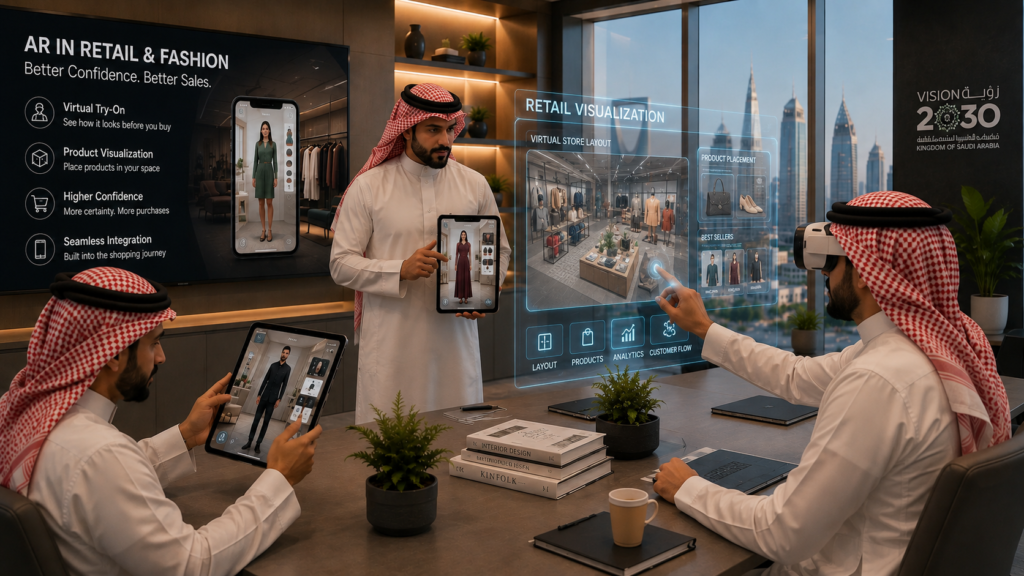
Clothing retailers, furniture stores, and home décor brands lose sales not because customers don’t want the product, but because they can’t picture it on themselves or in their space. AR solves that before the customer leaves the page. Virtual try-on and product visualisation are embedded directly in the purchase flow, closing the uncertainty that was turning browsers into abandoned carts.
What AR does that product photography cannot:
- Shows how a garment looks on the customer’s own body before they order
- Places furniture, décor, or appliances in the customer’s actual room at real scale
- Lets customers compare colour and finish options without switching between product pages
- Turns a hesitant browser into a confident buyer before they reach checkout
Real estate and Interior Design
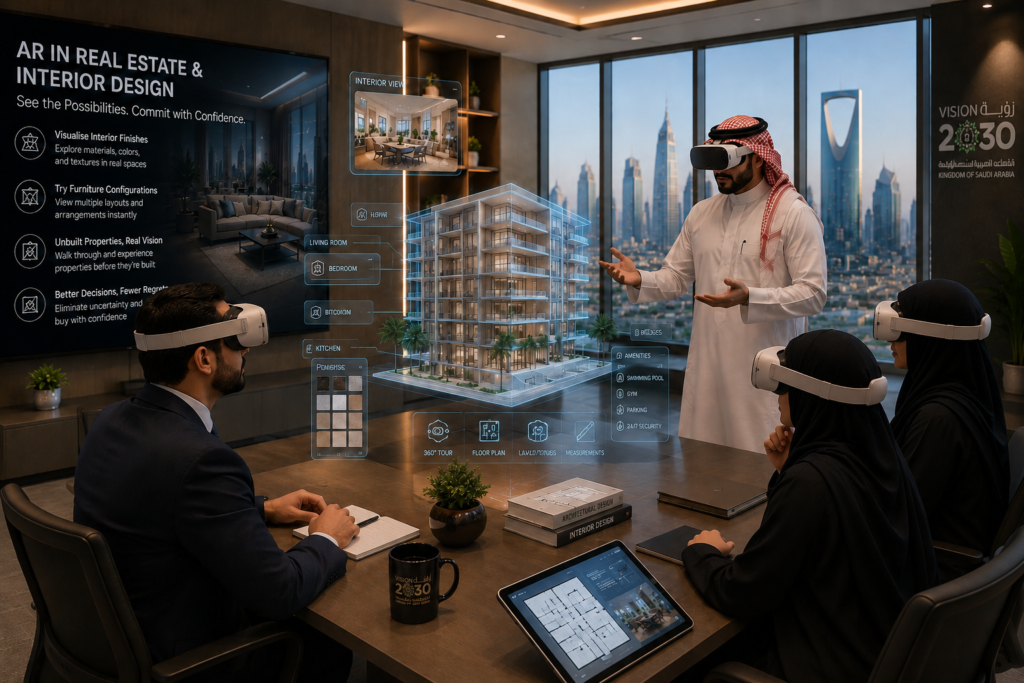
Real estate developers, brokers, and interior designers are asking buyers to commit to spaces that are empty, unfinished, or not yet built. The gap between what a buyer imagines and what they are actually committing to is where hesitation and post-purchase regret come from. AR closes that gap before the commitment is made.
What AR shows a property buyer that a render cannot:
- Furniture configurations and interior finishes inside the actual space, at actual scale
- Multiple layout options explored inside the same unit without a staging budget
- A spatial walkthrough of an off-plan property before a single wall exists
- Remote viewings for international or out-of-city buyers who cannot visit in person
Healthcare and Medical Education
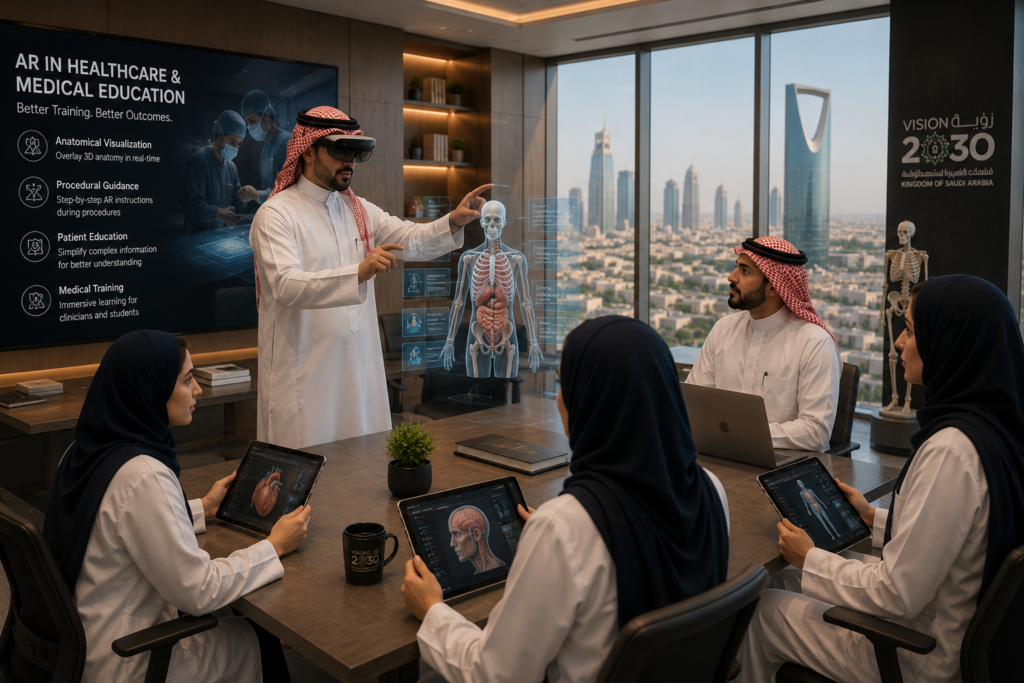
Hospitals, medical training centres, and private clinics deal with two distinct problems AR addresses differently. For clinicians and medical students, AR overlays anatomical information and procedural guidance onto physical environments — building procedural knowledge in a way that diagrams and mannequins cannot. For patients, AR turns complex procedures into visual formats that support informed consent and reduce pre-procedure anxiety, one of the fastest-growing AR application areas under Saudi Vision 2030 healthcare expansion.
What AR makes possible in a clinical setting that a briefing or diagram cannot:
- Procedural overlays on actual anatomy that students interact with, not just observe
- Patient education walkthroughs that show what a procedure involves before consent is signed
- Training content delivered consistently across multiple hospital branches without flying instructors between sites
- Pre-procedure anxiety reduced through visual preparation rather than verbal explanation
Automotive and Showroom Sales
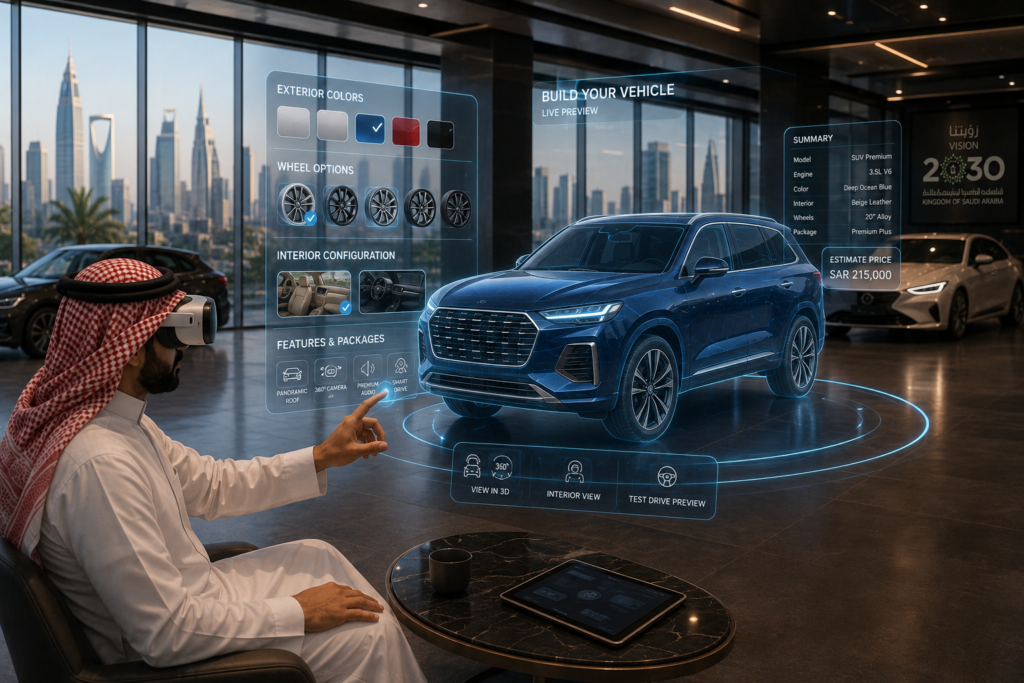
Car dealerships and automotive brands face a specific problem: Saudi buyers expect a high degree of personalisation, but showing every colour, trim, and configuration combination on a physical showroom floor is not possible. AR moves configuration out of the showroom and into the buyer’s hands before they arrive — so the showroom visit becomes confirmation of a decision already made, not the start of it.
What AR gives an automotive buyer before they visit a showroom:
- Full vehicle configuration at real-world scale, explored from their phone
- Colour and trim comparisons without needing every variant on the floor
- A purchase intent already formed before the first conversation with sales
- Remote configuration for fleet buyers who are not visiting in person
Education and Training
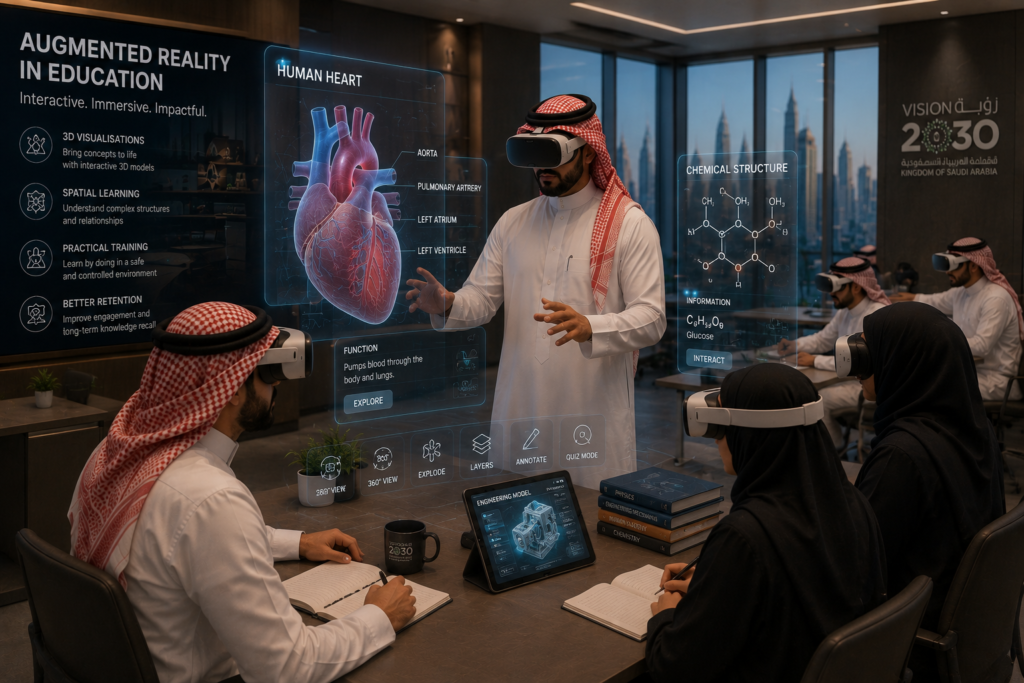
Universities, technical institutes, and corporate training academies teaching subjects with strong spatial or procedural components: science, engineering, medicine, vocational skills face a consistent problem: static materials do not transfer to application. AR adds a dimension that textbooks and digital slides cannot, letting students interact with the physical relationships that determine whether learning sticks.
What AR adds to a curriculum that a textbook or slide cannot:
- 3D models of anatomical structures, machinery, or physical systems students can interact with
- Procedural overlays on actual equipment before students touch the real thing
- Spatial learning for engineering and architecture students without lab or workshop capacity limits
- Consistent delivery of the same practical content across multiple campuses
Construction and Architecture
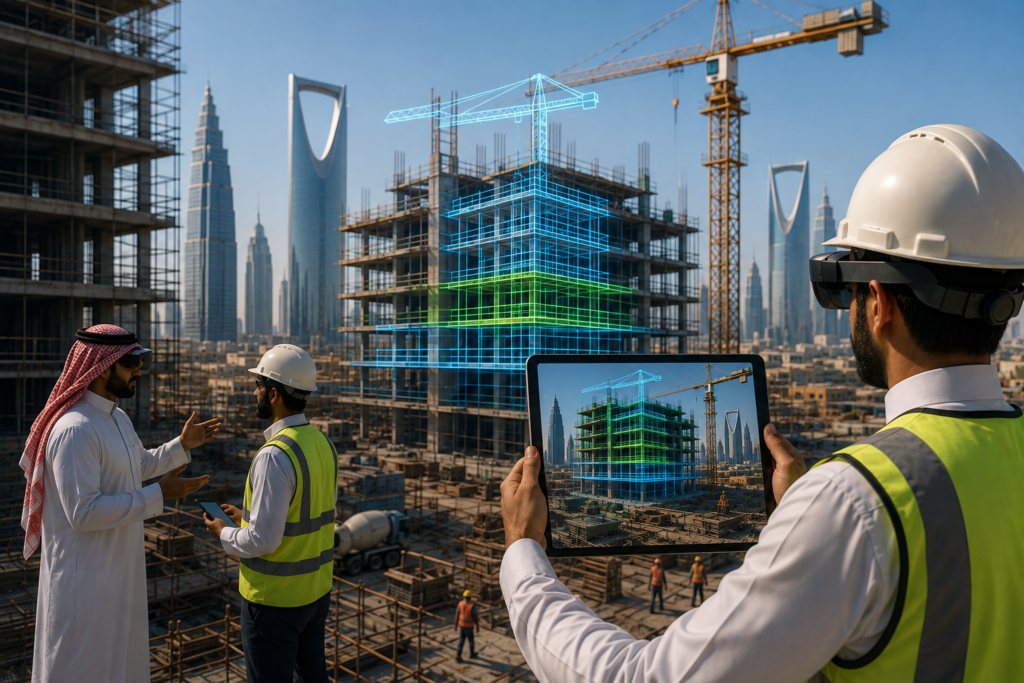
General contractors, civil engineering firms, and project managers deal with a coordination gap between design and site that is a recurring source of delay and cost overrun on Saudi construction projects. AR closes that gap by letting engineers and project managers see planned infrastructure overlaid on real site conditions through a tablet or phone; not a 2D drawing reviewed in a meeting room.
What AR catches on site that a drawing review cannot:
- Design conflicts detected against real site conditions before groundbreaking
- Construction sequencing reviewed on site with the actual environment as reference
- Progress tracked against original design without switching between documents and physical checks
- Safety hazards identified in the real environment before crews encounter them
Manufacturing and Maintenance
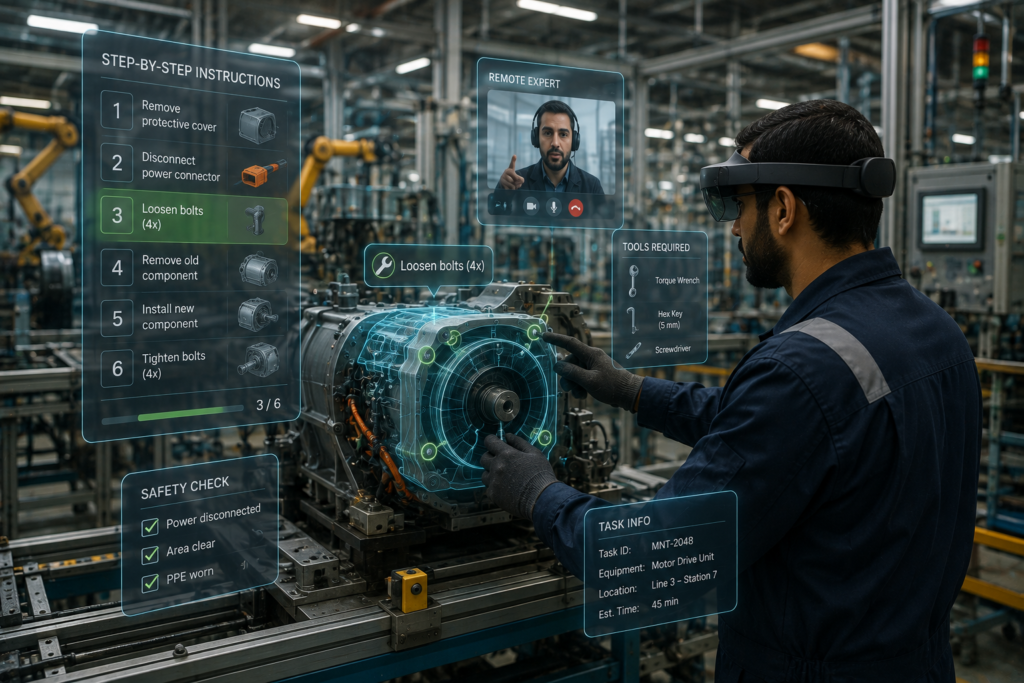
Industrial operators, assembly line managers, and maintenance teams running complex procedures where errors are costly and training time is long need more than a manual. AR overlays step-by-step instructions directly onto the equipment an operator is working on; so new operators follow guided procedures from day one, and experienced operators handling unfamiliar equipment do not need to stop and search for guidance.
What AR gives an operator that a manual or classroom training cannot:
- Step-by-step overlay instructions tied to the actual equipment in front of them
- Guided procedures for complex or infrequent tasks without requiring a specialist on site
- Remote expert guidance overlaid in the operator’s field of view when on-site support is unavailable
- Consistent procedure execution across shifts and locations without retraining each time
Tourism and Cultural Heritage
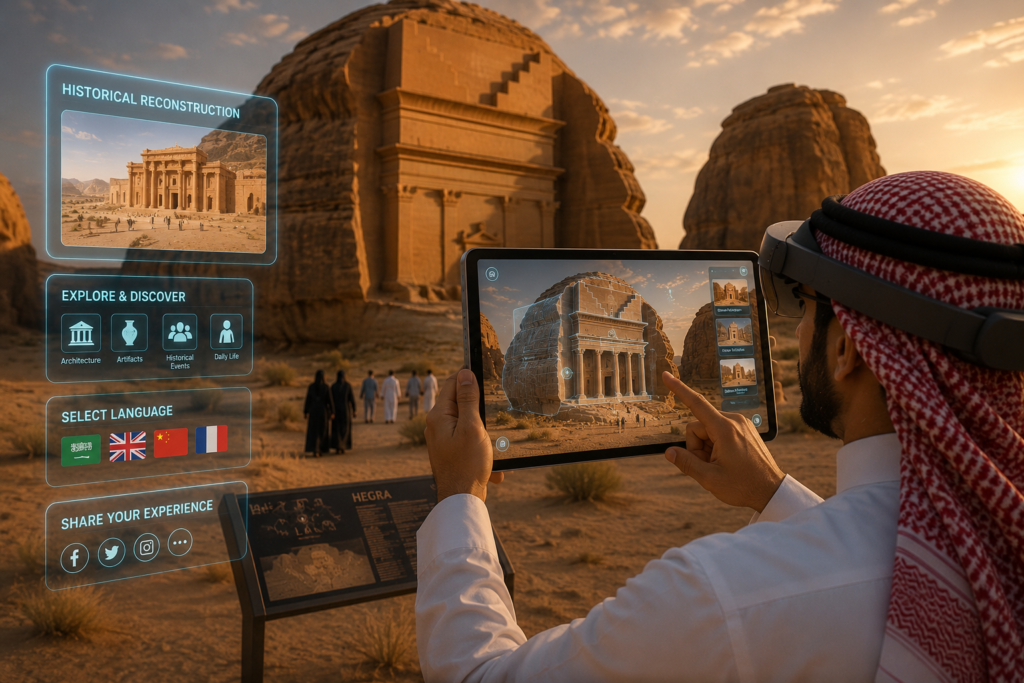
Heritage site operators, tour companies, and destination marketing organisations running Vision 2030 tourism destinations: AlUla, Diriyah, Hegra face a limit that physical interpretation alone cannot get past: a sign or audio guide tells a visitor what they are looking at, but it cannot show them what it looked like, what happened there, or give them something worth sharing. AR does all three.
What AR gives a visitor that a physical sign or audio guide cannot:
- Historical reconstruction of a site overlaid on what exists today
- Interactive content layers visitors can explore at their own pace
- Multilingual delivery without separate physical infrastructure for each language
- Shareable experiences that extend the destination’s reach beyond the visitors who were there
What Are the Common AR Platforms and How Do They Work
AR uses a device camera to capture the real world, then places digital content, 3D models, text, video, or interactive elements on top of that view in real time. An anchoring system keeps digital objects positioned correctly as the user moves, so a virtual sofa stays in the corner of the room as the customer walks around it.
There are two main technical approaches to how AR is triggered. Marker-based AR is triggered by a specific image, a product code, a page in a catalogue, or a physical marker placed at a location. Markerless AR uses environment detection to place objects in real space without requiring a trigger, the user points their camera at the floor and a piece of furniture appears at the correct scale. For most consumer-facing applications, markerless AR produces a better user experience.
Marker-based AR is more appropriate for controlled environments like showrooms, exhibitions, and printed materials where the trigger can be reliably placed.
Web AR vs App-Based AR vs AR Glasses: Choosing the Right Platform
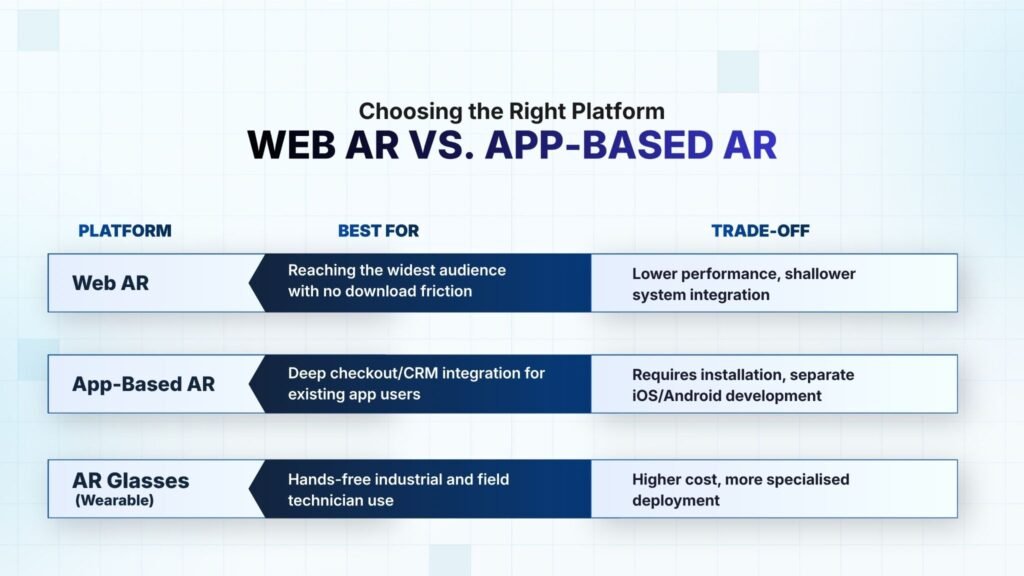
| Platform | Best For | Trade-Off |
| Web AR | Reaching the widest audience with no download friction | Lower performance, shallower system integration |
| App-Based AR | Deep checkout/CRM integration for existing app users | Requires installation, separate iOS/Android development |
| AR Glasses (Wearable) | Hands-free industrial and field technician use | Higher cost, more specialised deployment |
Web AR runs directly in a mobile browser with no download required. A customer taps a link from a product page, an email, or a WhatsApp message and the AR experience opens immediately. For Saudi businesses where download friction is a real barrier to customer engagement, web AR reaches the widest possible audience — no installation, no extra step.
App-based AR sits inside an existing mobile application, giving businesses deeper checkout integration, stronger performance, and more sophisticated interaction design. For businesses with an active app user base, embedding AR directly into the purchase flow produces stronger commercial outcomes because the feature sits where the customer is already transacting. One cost factor to scope explicitly: Apple AR via ARKit and Android AR via ARCore require separate optimisation work — this is not included in a single development estimate by default.
AR glasses are the platform for industrial, construction, and maintenance environments where hands-free operation is a requirement. Field technicians following guided overlay instructions while working cannot use a phone or tablet — AR glasses deliver the overlay directly in their line of sight. This is a higher-cost, more specialised deployment than mobile AR, appropriate for environments where hands-free is not a preference but a necessity.
The AR Development and Implementation Process
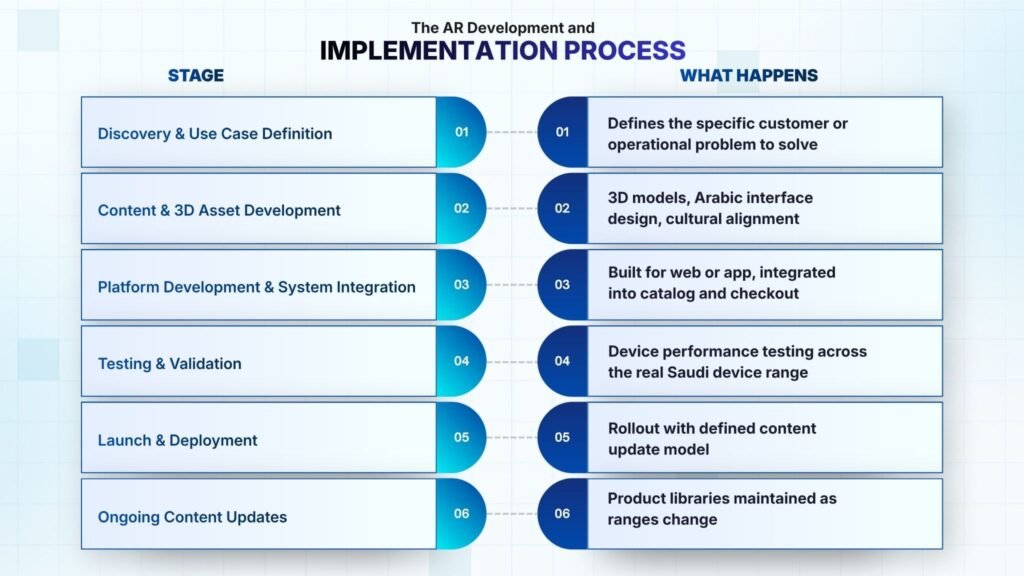
| Stage | What Happens |
| 1. Discovery & Use Case Definition | Defines the specific customer or operational problem to solve |
| 2. Content & 3D Asset Development | 3D models, Arabic interface design, cultural alignment |
| 3. Platform Development & System Integration | Built for web or app, integrated into catalog and checkout |
| 4. Testing & Validation | Device performance testing across the real Saudi device range |
| 5. Launch & Deployment | Rollout with defined content update model |
| 6. Ongoing Content Updates | Product libraries maintained as ranges change |
Discovery and Use Case Definition
Before any development starts, you need one thing defined clearly: the specific problem your AR deployment is solving and exactly where in your customer’s journey it sits. Every decision that follows — platform, 3D asset scope, integration requirements — comes from this. If you skip this step or leave it vague, you will pay for it in rework.
Content and 3D Asset Development
Every product or object that appears in your AR experience needs a high-quality 3D model — accurately dimensioned, correctly textured, and optimised for mobile performance. If you have a large product range, this is your biggest cost item and needs to be scoped honestly before your budget is finalised. Arabic interface design and Saudi cultural alignment are built here too — not added later as a localisation pass.
Platform Development and System Integration
Your AR experience needs to connect directly to your product catalog, live inventory, and checkout. AR that engages your customer but cannot convert them inside the same experience adds a navigation step that loses the sale you just worked to close. Add to cart, live pricing, real-time stock availability — these need to be inside the AR experience, not a separate page the customer has to find.
Testing and Validation
Test across the actual range of smartphones your Saudi customers carry — not just flagship devices. AR that performs well on a premium handset and breaks on a mid-range Android effectively excludes a large portion of your customer base. Test your Arabic interface with real Saudi users. Technical QA in a development studio does not catch what real users catch in five minutes.
Launch, Deployment, and Ongoing Content Updates
Before you go live, define how your AR product library will be maintained. An AR experience showing discontinued products or incorrect pricing damages trust faster than having no AR at all. Decide before launch how new 3D assets get added, how removed products get taken down, and how performance gets monitored. This is not something to figure out after the first update is needed.
What Augmented Reality Development Costs in Saudi Arabia
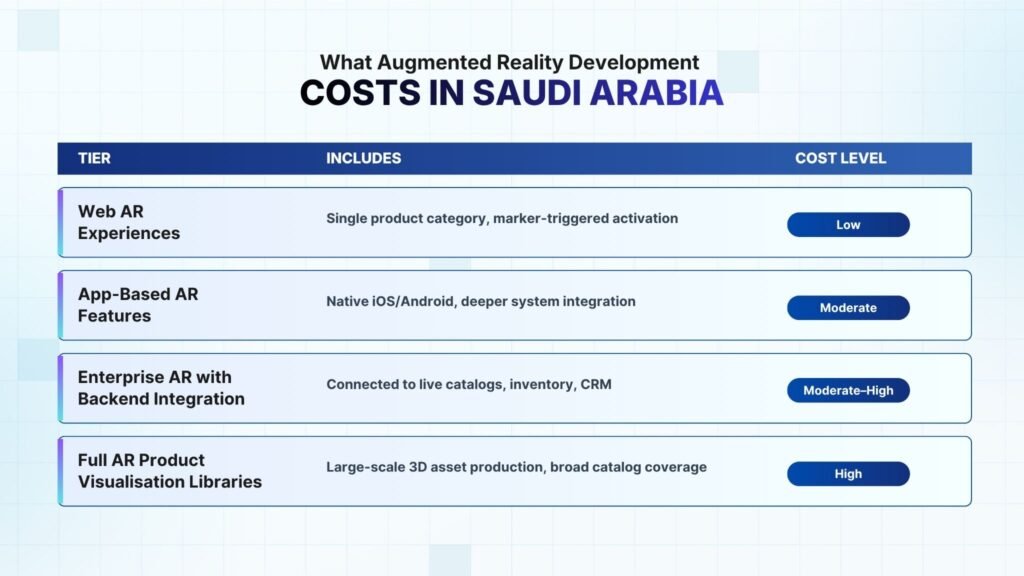
| Tier | Includes | Cost Level |
| Web AR Experiences | Single product category, marker-triggered activation | Low |
| App-Based AR Features | Native iOS/Android, deeper system integration | Moderate |
| Enterprise AR with Backend Integration | Connected to live catalogs, inventory, CRM | Moderate–High |
| Full AR Product Visualisation Libraries | Large-scale 3D asset production, broad catalog coverage | High |
Cost in augmented reality development is driven by content volume and integration complexity, not platform sophistication. Two AR deployments with the same interface complexity can cost very differently depending on how many 3D assets need to be created and how deeply the experience needs to connect to existing systems.
Web AR experiences
The lowest cost entry point. Browser-based AR for a focused use case — single product category visualisation, marker-triggered brand activation, or a specific customer decision point. Appropriate for Saudi businesses starting with a bounded problem before committing to broader AR deployment.
App-based AR features
Higher cost than web AR due to native development requirements for both iOS and Android, deeper integration with e-commerce and operational systems, and more sophisticated interaction design. Apple augmented reality and Android AR require separate platform optimisation that should be explicitly scoped.
Enterprise AR systems with backend integration
AR connected to live product catalogs, inventory systems, CRM, and operational databases. The integration work often exceeds the AR development work at this tier. Appropriate for Saudi businesses where AR needs to function as an operational system rather than a standalone customer experience.
Full AR product visualisation libraries
Large-scale 3D asset production for broad catalog coverage. The highest cost tier, driven by the volume and complexity of 3D models required. Most Saudi businesses approach this in phases — building the 3D library for the highest-return product categories first and expanding coverage based on performance data from the initial deployment.
Augmented Reality Development: Quick Decision Guide
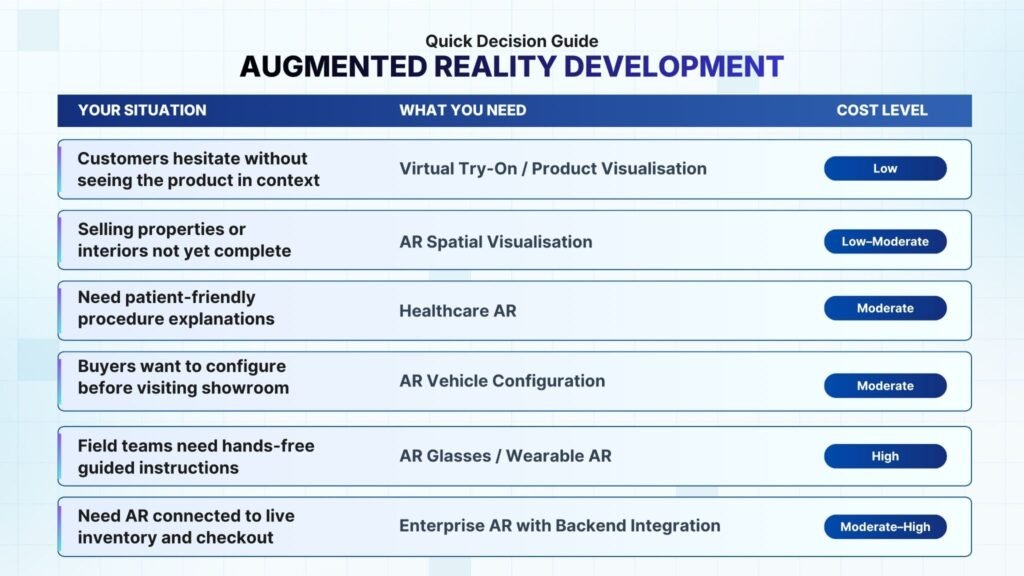
| Your Situation | What You Need | Cost Level |
| Customers hesitate without seeing the product in context | Virtual Try-On / Product Visualisation | Low |
| Selling properties or interiors not yet complete | AR Spatial Visualisation | Low–Moderate |
| Need patient-friendly procedure explanations | Healthcare AR | Moderate |
| Buyers want to configure before visiting showroom | AR Vehicle Configuration | Moderate |
| Field teams need hands-free guided instructions | AR Glasses / Wearable AR | High |
| Need AR connected to live inventory and checkout | Enterprise AR with Backend Integration | Moderate–High |
Common Mistakes Saudi Businesses Make When Deploying AR
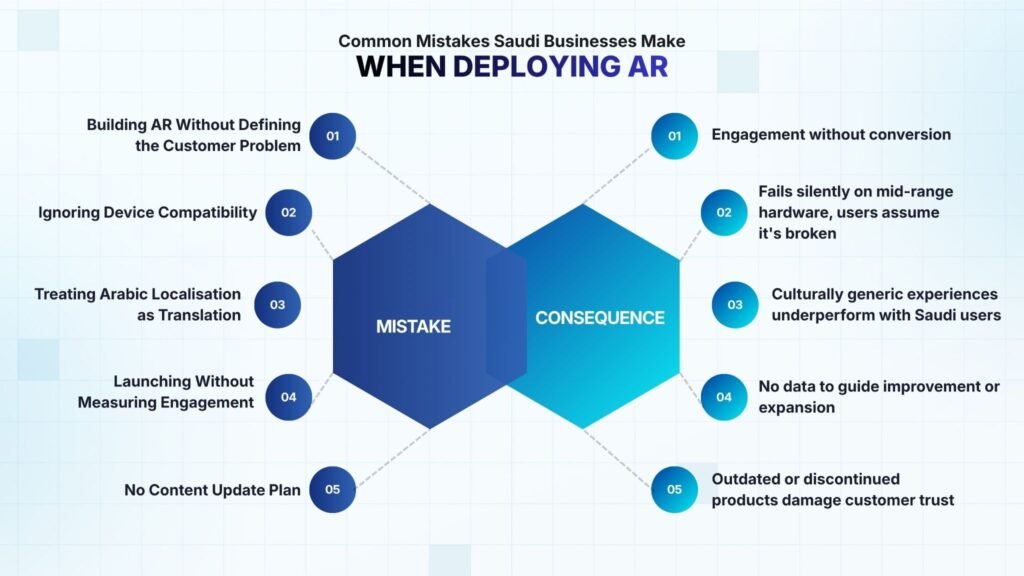
| Mistake | Consequence |
| Building AR Without Defining the Customer Problem | Engagement without conversion |
| Ignoring Device Compatibility | Fails silently on mid-range hardware, users assume it’s broken |
| Treating Arabic Localisation as Translation | Culturally generic experiences underperform with Saudi users |
| Launching Without Measuring Engagement | No data to guide improvement or expansion |
| No Content Update Plan | Outdated or discontinued products damage customer trust |
Why Etihad Falcon Tech Is the Best AR Development Company in Saudi Arabia
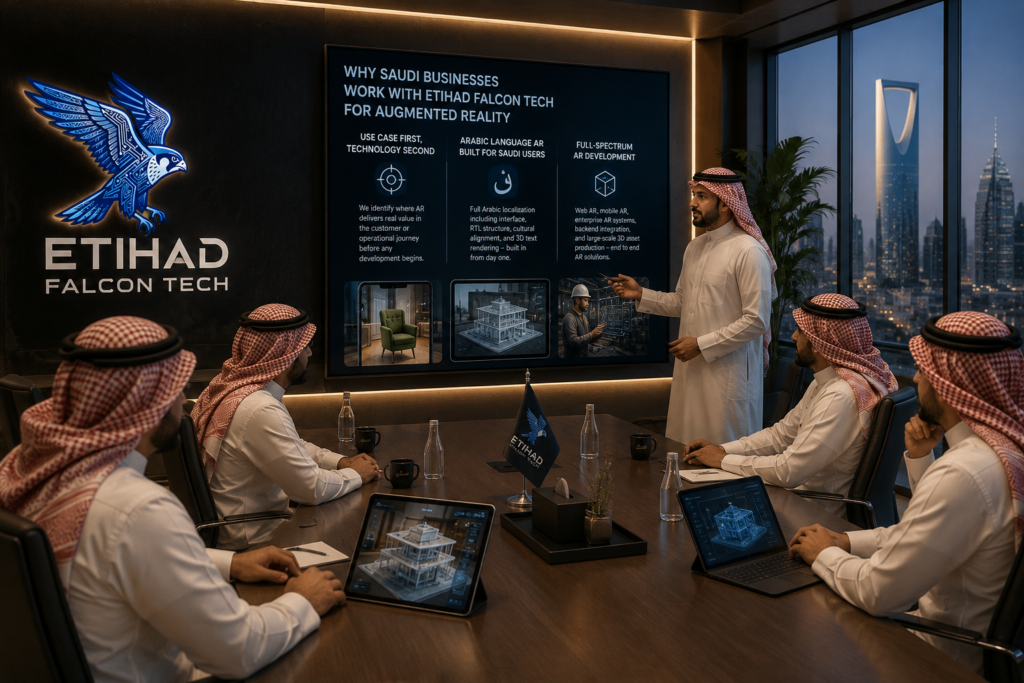
We start with your business problem, not a technology brief. Before any development begins, we identify exactly where in your customer’s journey AR produces measurable value — what decision point it needs to address, what outcome it needs to move, and what that means for platform choice, 3D asset scope, and system integration. That clarity determines everything that gets built. Without it, you get an AR experience that looks good in a demo and does nothing for your numbers.
Arabic-First AR Built for Saudi Users
Arabic localisation in our AR solutions covers interface language, RTL interface structure, cultural alignment in visual content and scenarios, and Arabic text rendering in 3D environments. We build this in from the first design phase. If you have worked with developers who treat Arabic as a translation pass added after the English version is complete, you already know what that produces. We do not work that way.
Full-Spectrum AR Development
Web AR, app-based AR, enterprise AR systems with backend integration, and large-scale 3D asset production for product visualisation libraries — we deliver the full range. Whether you need a focused web AR experience for a single product category or an enterprise AR system connected to your live inventory, CRM, and checkout, we build and integrate it end to end. One team handles all of it, so nothing gets lost between your brief and your final deployment.
Proven Experience With Saudi Businesses
We have delivered AR solutions for Saudi businesses in retail, real estate, healthcare, and construction. That experience means we recognise faster which use cases produce the strongest return for your sector, we scope 3D asset production honestly so your budget does not run over mid-project, and we build AR systems for real market conditions — not controlled demonstrations that fall apart in the field.
If you are ready to bring augmented reality into your business, message us on WhatsApp and we will walk you through what your AR project actually needs.
Frequently Asked Questions
What is augmented reality and how is it used in business?
Augmented reality overlays digital content onto the real world through a device camera. Your customers use it to see products in their own space before buying. Your field teams use it to follow guided overlay instructions on actual equipment. Your medical staff use it for training and patient education. The common thread is this: AR adds information or experience to a real environment that would otherwise require imagination or assumption.
How much does AR development cost in Saudi Arabia?
Cost is driven by three things: how many 3D assets need to be created, which platform you are building for, and how deeply the experience needs to connect to your existing systems. Web AR for a focused use case sits at the lower end. App-based AR with e-commerce integration and Arabic localisation sits higher. Large-scale product visualisation libraries sit at the top. We give you an accurate number once we have scoped your use case, not before.
What is the difference between AR and VR?
AR adds digital content to the real world through a device your customer already has. VR replaces the real world entirely through a headset. AR is the right choice for customer-facing applications where real-world context matters. VR is the right choice for simulation and training in environments that are dangerous, unavailable, or not yet built.
Do Saudi customers need to download an app to use AR?
Not always. Web AR runs directly in a mobile browser with no download required. Your customers tap a link and the experience opens immediately. App-based AR delivers stronger performance and deeper checkout integration but requires installation. The right platform depends on where your customers are in their journey and how much friction they will accept to access the experience.
Which industries benefit most from AR in Saudi Arabia?
Retail, real estate, healthcare, automotive, education, construction, and manufacturing see the strongest results. The common factor across all of them is one specific decision point where uncertainty is costing the business, whether that is a customer hesitating before purchase or an operator making errors on complex equipment.
How long does it take to develop an AR solution?
Web AR for a focused use case takes six to ten weeks from scoping to launch. App-based AR with e-commerce integration and Arabic localisation takes twelve to eighteen weeks depending on complexity and 3D asset volume. Large-scale product visualisation libraries are delivered in phases, starting with the highest-priority product categories first.
Does AR content need to support Arabic?
Yes. Arabic localisation covers interface language, instructional content, cultural alignment in visual design, and RTL interface structure. We build Arabic in from the first design phase. It is not a translation layer added to an English-first build.
How does Etihad Falcon Tech approach AR development?
We start by identifying the specific problem your AR deployment needs to solve and where it sits in your customer’s journey. That defines the platform, 3D asset requirements, and integration scope. From there we handle 3D asset creation, Arabic-first interface design, platform development, system integration, and device performance testing across the Saudi smartphone range. Deployment starts with your highest-impact use case and expands from there.