
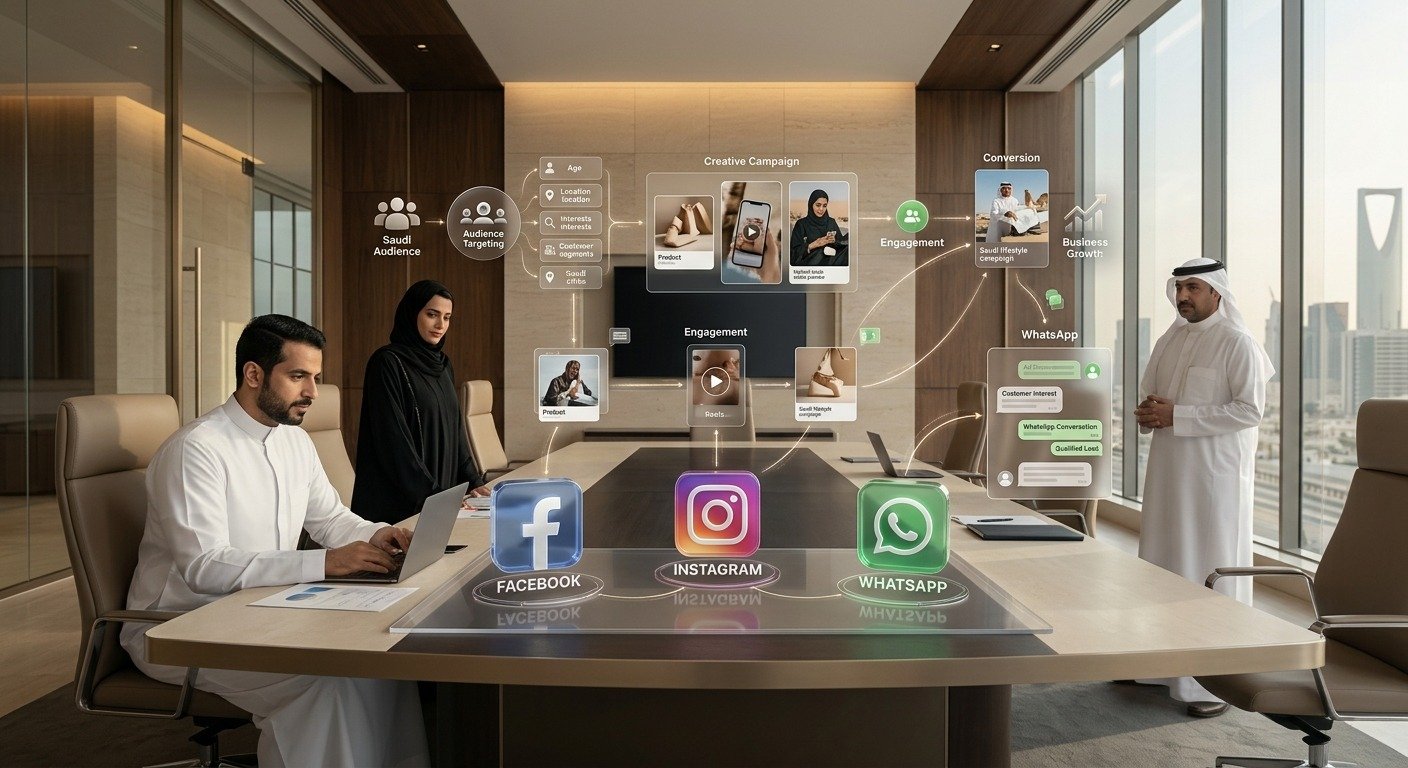
According to DataReportal’s Digital 2026 report, Facebook’s ad reach in Saudi Arabia covers 70% of adults aged 18 and above, and Instagram’s covers 71%. What does that mean for your business? This number suggests that the majority of the Saudi population is within reach of your ads on these two platforms. However, there are many businesses competing for the same customer base in Saudi Arabia, which means running Meta ads without a strategy can cost you money without bringing you customers.
Running Meta Ads puts your business in front of most of your potential clientele. But getting seen isn’t enough. You need to turn that visibility into growth for your business, and that only happens with the right marketing plan behind your ads: the strategy, the creative (the images, videos, and text people see), the targeting (choosing who sees your ad by age, location, interests, and behavior), and how the campaign is structured around a marketing funnel. A marketing funnel is the path a person follows with your business, from first hearing about it, to considering it, to becoming a customer, to coming back again. When your campaign is built around that full path, each person sees the ad that fits where they are in it, instead of the same ad shown to everyone. Conversion rate optimization (CRO) then works alongside the ads, improving the page or step each ad leads to so that more of the people who click go on to take the action you want.
In this guide, we cover how Facebook and Instagram advertising works in the Saudi market, what each campaign type does for your business, and how Meta Ads apply across Saudi industries. We also explain how we build Meta Ads that grow your business as part of a broader digital marketing strategy.
What Does Meta Advertising Actually Cover for a Saudi Business?
Meta Ads lets your business advertise on Facebook and Instagram from one place, Meta Ads Manager, the tool where you set up, target, run, and track every campaign. Both platforms use the same campaign objectives (the goal you choose for a campaign, such as awareness, traffic, leads, or sales), the same targeting, and the same ad formats: single image or video ads, carousel ads (several images or videos in one ad that people swipe through), collection ads (a cover image or video with your products listed underneath), and lead ads (a form that opens inside the app). What changes is where your ad appears, so here’s what each platform gives your business.
Facebook Advertising
Facebook lets you reach people who have a need your business can solve, and you choose who sees each ad by interests, behavior, location, and custom audiences (people who already visited your website or engaged with your business). Your ad can appear in:
- Feed Ads: shown as people scroll their Facebook feed, and suited to anything from introducing your business to sharing an offer.
- Stories Ads: full-screen vertical ads between people’s Stories, built around one clear message and one action.
- Reels Ads: short video ads between Reels, which can reach people who don’t follow your business yet.
- Marketplace Ads: shown where people browse to buy, so they reach people who are already looking for products.
Instagram Advertising
Instagram lets you build a brand people recognize and trust, and reach people whether they’re scrolling for entertainment, already follow your business, or seeing it for the first time. It runs on the same objectives and targeting as Facebook, and gives you these places to show your ad:
- Feed Ads: shown in the main feed, where your image or video sits alongside everything else people follow.
- Stories Ads: full-screen ads between Stories, for one clear message and one action.
- Reels Ads: short video ads that can reach people who don’t follow you yet but match your targeting.
- Explore Ads: shown where people browse content from accounts they don’t follow yet.
- Instagram Shopping Ads: let people browse your products and view details without leaving the app.
What Goes Into Building a Meta Ads Campaign for Your Business
Building a Meta Ads campaign means making five decisions, in this order: what you want the campaign to achieve, who should see it, what the ad looks like, how Meta spends your budget, and how you measure the result.
Choose Your Campaign Objective
The objective is the result you want Meta to work toward. Meta offers six: awareness (more people seeing your business), traffic (visits to your website or page), engagement, leads (enquiries), app promotion, and sales. Meta shows your ad to the people most likely to take the action you choose, so the objective decides who sees the ad before you set any targeting. If you pick traffic when you want enquiries, you get visits and not enquiries.
Choose Your Audience
Audience targeting means choosing who sees your ad. Every campaign draws from three audience types, and each matches a stage of your marketing funnel:
- Cold audiences: people who haven’t interacted with your business yet, reached by age, city, interests, and behavior. They’re your first introduction.
- Warm audiences: people who already visited your website, watched your video, engaged with your page, or are on your customer list. Showing them ads is called retargeting, and it lets the ad continue a conversation that already started instead of introducing you again.
- Lookalike audiences: new people Meta finds who resemble an audience you provide, such as your existing customers.
Warm and lookalike audiences depend on your own data, collected through the Meta Pixel (a small piece of code on your website that reports what visitors do back to Meta) and your customer lists. Without that data, every campaign starts cold. The same three types apply whether your customers are individuals or other businesses, and a city like Riyadh, Jeddah, or Dammam can be a targeting choice on any of them.
Match the Ad Format to the Objective
| Ad Format | What It Does and When to Use It |
|---|---|
| Single image or video ads | One image or video with one message, for introducing your business or making one clear offer |
| Carousel ads | Several images or videos in one swipeable ad, for showing multiple products, features, or steps |
| Collection ads | A cover image or video with a product catalogue underneath, for letting people browse without leaving the app |
| Dynamic product ads | Ads built automatically from your product catalogue, for showing each person the products that suit them |
| Lead ads | A form that opens inside the app, for collecting enquiries without sending people to a page |
| Instant Experience | A full-screen page that opens after the tap, for telling a fuller story about your business or products |
The ad format is the layout your ad uses, and the objective decides which one fits. A carousel shows several products or steps in one ad, a lead ad collects enquiries through a form inside the app, a video explains or demonstrates, a collection ad lets people browse a catalogue, and dynamic product ads build each person’s ad automatically from your product catalogue. Any format works for any business and any audience, so the choice depends on what the ad needs to do and not on who you assume is watching. A format that doesn’t fit the objective makes the next step harder for the person, like sending someone to a long page when a short form would have captured their enquiry.
Retargeting & Remarketing
Retargeting reaches people who’ve already engaged, visited your site, watched a video, viewed your page, but didn’t convert the first time. They convert at a far higher rate than cold audiences, because you’re not introducing the brand, you’re re-engaging someone who was already interested. This holds true across every category Meta serves, the mechanism is identical for all types of businesses.
For e-commerce specifically, dynamic product ads take this further: the ad shows the exact item someone browsed or left in cart, personalised automatically once your feed and pixel are set up. That personalisation is why dynamic retargeting consistently outperforms static ads for catalogue-based businesses.
Performance Reporting & Analytics
Reporting tracks what your Meta Ads campaigns deliver and explains what those results mean for your business. It shows you what’s working and what to change, so your budget goes to the ads that deliver instead of the ones that don’t.
Reporting should also match the objective each campaign was built for. A campaign built to reach more people is measured by reach, and one built to bring in enquiries is measured by how many it brought in and what each cost. When the numbers match the objective, every report shows whether the campaign is doing the job you set for it.
Meta Ads is one channel within a broader digital marketing strategy for your business, and the reporting that comes out of it feeds every other channel you run. What your Meta campaigns tell you about your Saudi audience, their behaviour, their cost to convert, and what creative they respond to, sharpens everything else you spend on.
How Do Meta Ads Work Differently Across Saudi Industries?
| Industry | Businesses That Benefit |
| Real Estate | Developers, brokers, off-plan projects, property investment firms |
| E-Commerce and Retail | Fashion, home goods, beauty, electronics, marketplaces |
| Restaurants and F&B | Dine-in restaurants, cloud kitchens, cafes, catering |
| Healthcare and Dental | Clinics, hospitals, dental practices, specialist providers |
| B2B and Professional Services | Consultancies, legal firms, financial services, IT and software |
| Education | Schools, training centres, exam prep, online courses |
| Small and Medium Business | Home services, salons, local retail, neighbourhood businesses |
Meta ads can work for any business in Saudi Arabia. Every ad type is open to every industry. What changes is what your customer needs to see before they act, and how the campaign is built to show it. A Reel can bring in enquiries for a clinic and sales for a fashion store, but only when the audience, message and follow-up are planned around that buyer. That planning is the strategy, and it is what separates ads that get views from ads that get results.
Meta Ads for Real Estate
Real estate buyers research thoroughly before they commit, because the property will be their home or office. They want to see the unit design, the location, the masterplan, the amenities and the landmarks nearby. Investors think differently. They may not plan to live in the property at all, so they look for expected returns, payment plans and handover dates. When you run Meta ads in this industry, keep both groups in mind, because a home buyer and an investor need different information before they enquire.
Businesses in this industry use several types of ads, and each one does a different job. Here is a simple breakdown of what you can do with each.
- Image Ads: Good for putting one strong property photo, the location or a launch offer in front of people as they scroll.
- Video Ads: Take viewers through a show unit, show drone footage of the community or share a message from the developer.
- Carousel Ads: Handy when you want to cover unit types, floor plans and payment options in one ad, with a swipe for each.
- Collection Ads: Open with a project video and show several available units underneath, so people can browse without leaving the ad.
- Stories Ads: A quick way to announce a launch event, a limited-time payment plan or the last few units.
- Reels Ads: Short tours of a unit or a neighbourhood can reach people who are still exploring areas.
- Lead Ads: Buyers can register for a launch, a price list or a viewing without leaving Facebook or Instagram.
- Catalog Ads: Match listings from your inventory to the properties a person has already looked at.
- Advantage+ Campaigns: Meta’s automation looks for likely buyers and investors for you, and it works best when you track lead quality, not only lead volume.
Meta Ads for E-Commerce and Retail
Online shoppers look for different things depending on what they are buying. Someone buying clothes wants to see the fabric, the colours and the fit. Someone buying electronics wants exact specifications. Someone buying furniture wants dimensions and a look at how it sits in a real room. Payment options like Mada, Tabby and Tamara, and a clear delivery time, also affect whether a shopper goes ahead. Before you run Meta ads in this industry, make sure the ad and the product page both answer these questions quickly, because a missing detail is often where the sale stops.
Ecommerce brands can use every ad type, and each one supports a different part of the shopping journey. Here is a simple breakdown of what each can do for your store.
- Image Ads: Show your hero product, its price or a current offer in one clear visual.
- Video Ads: Great for products that need to be seen in use, like fabric moving or a device running.
- Carousel Ads: Put a full collection, size range or colour set into one ad, with a card for each.
- Collection Ads: Start with a lifestyle video and let shoppers browse the products underneath.
- Stories Ads: Suit flash sales, new arrivals and limited-time offers.
- Reels Ads: Use short videos for styling ideas, unboxings and product demos.
- Lead Ads: Collect sign-ups for launches, waitlists and offers before a product goes live.
- Catalog Ads: Pull products straight from your store feed, so the ad already carries the price and details.
- Advantage+ Campaigns: Let automation test audiences and creative to find buyers, which works best with accurate purchase tracking.
Seasonal moments like White Friday and Ramadan sales suit every one of these ad types. Timing and offer decide which ones carry the campaign.
Meta Ads for Restaurants and F&B Brands
People choose food with their eyes first. A photo of a well-plated dish or a short clip of food being made stops a scroll far better than a menu graphic with prices. Guests who plan to dine in also want a feel for the space before they book a table, and cloud kitchens and caterers need to show reliability as much as taste. Food decisions are also quick, often made within minutes. So before you run Meta ads for a restaurant, decide what action you want: an order, a booking or a catering enquiry. Then make sure the ad leads straight to it.
Restaurants and food businesses can use every ad type. Here is a simple breakdown of what each one can do for you.
- Image Ads: Feature a signature dish, a new menu item or a set-menu offer.
- Video Ads: Show a dish being prepared or the atmosphere of the dining space.
- Carousel Ads: Give menu highlights, the dining area or a catering package a card each.
- Collection Ads: Open with a food video and list several dishes or deals below it.
- Stories Ads: Work well for daily specials, weekend brunch and iftar offers.
- Reels Ads: Short clips of food being made or served can catch people mid-scroll.
- Lead Ads: Take enquiries for events, corporate catering and private dining.
- Catalog Ads: Show menu items or meal packages to people who viewed your menu.
- Advantage+ Campaigns: Automation can look for people likely to order or book, once those actions are tracked.
An iftar offer, a weekend brunch deal or a National Day menu often suits this industry better than a general brand push, because the decision window is short.
Meta Ads for Healthcare
Patients look for reassurance before anything else. They want to know who will treat them, how experienced that person is, what the facility looks like and how the clinic handles their kind of concern. Most patients also take time to decide, and they often visit a clinic’s page more than once before they book. Before you run Meta ads in healthcare, keep the content informative and honest, and avoid promising outcomes. Healthcare ads must also follow Meta’s health advertising policies and Saudi healthcare advertising rules.
Healthcare providers can use every ad type. Here is a simple breakdown of what each can do for a clinic, hospital or dental practice.
- Image Ads: Show your facility, your doctors and your specialties.
- Video Ads: Introduce a doctor, tour the clinic or explain what a visit involves.
- Carousel Ads: List services, specialties or doctors, one card each.
- Collection Ads: Lead with a facility video and list several services beneath it.
- Stories Ads: Fit check-up packages, health awareness days and limited-time offers.
- Reels Ads: Answer common questions about a treatment or a visit in short educational clips.
- Lead Ads: Patients can leave their details for a callback or an appointment request.
- Catalog Ads: Present packages, such as health check-ups or dental plans, once they are set up in a catalog.
- Advantage+ Campaigns: Automation searches for patients likely to book, once bookings are tracked.
B2B and Professional Services
A B2B buyer rarely decides from a single ad. They form an impression over several touchpoints and look for proof: case studies, delivered results and expertise that holds up. Decision-makers such as procurement managers respond to credibility built over time, not to urgency. So before you run Meta ads for a B2B business, plan for a buying cycle that can take weeks or months, and focus on reaching people with the authority to decide, not just on getting the most clicks.
B2B businesses can use every ad type. Here is a simple breakdown of what each one can do.
- Image Ads: Put a key result, a client outcome or a clear statement of what you do in front of decision-makers.
- Video Ads: Share a leadership message, a short explainer or a client testimonial.
- Carousel Ads: Walk through a case study with one result per card.
- Collection Ads: Open with a company video and link to services or case studies underneath.
- Stories Ads: Promote a webinar, an event or a new report.
- Reels Ads: Short insight clips keep your expertise visible between longer content.
- Lead Ads: Ask for company name and role, so you reach people who can make the decision.
- Catalog Ads: List service packages or software plans, once they are set up in a catalog.
- Advantage+ Campaigns: Automation finds likely prospects, and it works best when you track lead quality, not only lead count.
Meta Ads for Education Institutes
Parents and students want proof before they enquire. They look at exam results, accreditation, facilities and where past students went next. A course description alone does not tell them whether the fees are worth it, so they want to see the classroom, the campus or the course itself. Education also runs on a calendar, with admission deadlines, exam seasons and new intakes. Before you run Meta ads in this industry, plan your campaigns around those dates and make sure your proof is easy to find.
Schools, training centres and course providers can use every ad type. Here is a simple breakdown of what each one can do.
- Image Ads: Highlight results, accreditation or a key deadline.
- Video Ads: Take viewers on a campus tour or share a teacher introduction or a student story.
- Carousel Ads: Show courses, results or facilities one card at a time.
- Collection Ads: Open with a campus video and list several programmes below it.
- Stories Ads: Suit admission deadlines, open days and new intakes.
- Reels Ads: Give a taste of your teaching with sample lessons or study tips.
- Lead Ads: Collect enrolment enquiries for a specific programme or intake.
- Catalog Ads: List courses or programmes, once they are set up in a catalog.
- Advantage+ Campaigns: Automation looks for likely applicants, once enquiries and enrolments are tracked.
How Do Small Businesses and SMEs Use Meta Ads?
Small businesses are not a separate industry. They are a smaller-scale version of every industry above. A neighbourhood clinic, a home bakery and a two-person consultancy face the same buyer questions as their larger competitors, with a smaller budget and a smaller area to serve. The ad types stay the same. The scale and the setup change.
Local Service Businesses
People who hire a salon, a home services company or a repair shop want to trust someone they have not met. They look for a real face, real work and real reviews close to home. Before you run Meta ads for a local service, set your targeting to the areas you can actually serve, so your budget does not reach people too far away to book you.
Local service businesses can use every ad type. Here is a simple breakdown of what each can do.
- Image Ads: Show finished work, your team or a service offer.
- Video Ads: Share a message from the owner or footage of the team at work.
- Carousel Ads: Present your services, price tiers or results, one card each.
- Collection Ads: Open with a video of your work and list your main services beneath it.
- Stories Ads: Fit seasonal offers and open booking slots.
- Reels Ads: Short clips of a job in progress or a finished result build trust quickly.
- Lead Ads: Take booking requests or quote enquiries in a short form.
- Catalog Ads: List service packages or products, once they are set up in a catalog.
- Advantage+ Campaigns: Automation finds local customers likely to enquire, and it works best when enquiries are tracked.
Small Retailers and Online Sellers
Shoppers compare a small store with bigger brands. They look for real product photos, clear prices, honest delivery details and a reason to trust a seller they may not know. Before you run Meta ads for a small store, make sure the product photos are your own and the delivery and return details are easy to find.
Small retailers can use every ad type. Here is a simple breakdown of what each can do.
- Image Ads: Show real product photos with a clear price and offer.
- Video Ads: Let the seller hold the product and explain it, which helps new customers trust you.
- Carousel Ads: Lay out a range of products, sizes or colours in one ad.
- Collection Ads: Open with a lifestyle video and let shoppers browse a set of products.
- Stories Ads: Suit a new arrival, a low-stock item or a short sale.
- Reels Ads: Use short clips for styling ideas, order packing or product demos.
- Lead Ads: Collect sign-ups for offers, restock alerts and new launches.
- Catalog Ads: Even a small store catalog can show each shopper the products they viewed.
- Advantage+ Campaigns: Automation finds buyers for you, and it improves as your purchase data grows.
Startups and Small B2B
A newer name has to earn trust quickly. Buyers want proof that the product or service works, and a clear reason to choose a supplier they do not know yet. Before you run Meta ads as a startup, decide what proof you can show, such as a demo, an early client result or a founder message, and build the campaign around it.
Startups and small B2B companies can use every ad type. Here is a simple breakdown of what each can do.
- Image Ads: State clearly what you do and who it is for.
- Video Ads: Share a short explainer or product demo in under a minute.
- Carousel Ads: Present use cases or early client results, one card each.
- Collection Ads: Lead with a demo video and link to several offerings below it.
- Stories Ads: Promote a launch, a demo day or a webinar.
- Reels Ads: Founder messages and quick product tips fit well in short videos.
- Lead Ads: Collect qualified enquiries with company and role fields.
- Catalog Ads: List plans or packages, once they are set up in a catalog.
- Advantage+ Campaigns: Automation finds likely prospects, once lead quality is tracked.
Growing SMEs
A multi-branch retail chain, a growing e-commerce brand or a regional service provider needs a consistent brand and offers that fit each city. These businesses usually hold enough customer data to run more advanced campaigns. Before you run Meta ads at this stage, decide how much of the campaign stays the same across branches and how much changes by city.
Growing SMEs can use every ad type. Here is a simple breakdown of what each can do.
- Image Ads: Keep your brand visuals consistent while changing the offer for each city.
- Video Ads: Tell your brand story or introduce each branch.
- Carousel Ads: Show products, services or branch locations, one card each.
- Collection Ads: Open with a brand video and list products or services beneath it.
- Stories Ads: Suit city-specific offers and store openings.
- Reels Ads: Short clips from each branch or region keep local audiences engaged.
- Lead Ads: Collect enquiries and send them to the right branch.
- Catalog Ads: Show products from a larger catalog, matched to each viewer’s interests.
- Advantage+ Campaigns: Automation has more customer data to learn from across cities.
Every ad type in this section can work for your business, but ad types alone do not create results. Results come when there is a strategy behind them: the right audience, the right marketing funnel from first ad to final enquiry, and tracking that shows what is working. If you want to know how Meta ads can generate results for your business, message us on WhatsApp. Our experts have run successful campaigns for businesses in Saudi Arabia that contributed to their growth.
What Do Meta Ads Cost in Saudi Arabia?
Meta ads have two costs. The first is your ad spend, which is the money Meta charges to show your ads. The second is a management fee, which is what you pay a team to plan, run and improve your campaigns. Neither has a fixed price, because both depend on your goals and how your campaigns are set up.
What affects your ad spend
Nobody can promise a fixed cost per click or cost per lead in advance. The cost of each result comes from the factors below working together.
| Factor | How It Affects Your Cost |
|---|---|
| Campaign objective | Getting leads, sales or video views each cost differently, because Meta finds a different type of person for each goal |
| Industry competition | Real estate, healthcare, financial services and education have many advertisers going after the same audience, so costs often run higher than in categories with fewer advertisers |
| Audience size | A very narrow audience can cost more per result than a wider one |
| Creative quality | Meta favours ads that people respond to, so ads that get stronger engagement can cost less to show |
| Time of year | Ramadan, White Friday and National Day bring more advertisers, which can push costs up |
How Meta ads management is priced
Management fees are usually set in one of three ways. The right one depends on how you plan to spend.
| Management Model | How the Fee Works | Best For |
|---|---|---|
| Percentage of ad spend | The fee is a share of your ad spend, so it grows as your budget grows | Businesses planning to increase their Meta budget over time |
| Flat monthly fee | The fee stays the same each month, whatever you spend on ads | Businesses with a steady monthly ad spend |
| Per-campaign fee | You pay one fee for each campaign | Businesses running seasonal or one-off campaigns |
There is no one-size-fits-all price for management. The fee depends on how many campaigns you run, how many ad types and audiences you need, how many cities or regions you cover, how much creative work is involved and what you want to achieve. The goal is the lowest cost per result that still brings the right customers, not the lowest cost per click.
What Are the Most Common Meta Ads Mistakes Saudi Businesses Make?
| Mistakes |
| Choosing the wrong campaign objective |
| Not being clear about who the ad is for |
| Using weak or generic creative |
| Judging results by reach, likes and impressions |
| Stopping campaigns too early |
| Not testing different creatives |
| Sending people to a page that doesn’t match the ad |
| Replying slowly to enquiries |
How Does Etihad Falcon Tech Manage Meta Ads for Saudi Businesses?
Whether you’re thinking about running Meta ads for the first time or already spending money without getting results, we can help with both. We build the strategy from scratch for businesses that have never run ads, and we find what’s holding back the results for businesses whose ads haven’t worked. We have the knowledge, expertise and experience to handle each situation.
Meta Ads Experts With Years of Hands-On Experience
Our team has managed Meta campaigns for Saudi brands, regional organisations and global names, not just one type of client or one industry. We write Arabic creative for Saudi readers from the start, plan right-to-left design at the concept stage, and build each Riyadh, Jeddah or other city campaign for that city, not as a national campaign with a location filter. That range means we’ve built campaigns for businesses just starting out and for accounts with years of existing data, so wherever your business is in that process, we’ve built for it before.
We Run Every Ad Type Your Business Actually Needs
We do not default to one format because it is easiest to sell. If Reels fit your audience, we build them. If Lead Ads or Catalog Ads fit your sales process, we build those too. Where your customers prefer to message a business, we set up campaigns that lead straight into a WhatsApp chat with your team. We also set up the Meta Pixel and Conversions API before any ad goes live, so your leads and sales are counted from day one. Your ad mix is built around what generates enquiries and sales for your business, not around what is quickest for us to set up.
We Report What Your Budget Actually Produced
Every month, you get leads by campaign, cost per lead by city, and what changed since last month and why. We do not send you an export of numbers and leave you to work out what happened.
We have managed Meta ads for businesses across many industries, including real estate, healthcare, e-commerce, restaurants, B2B, education and small businesses, and our experience goes well beyond these few business types.
Frequently Asked Questions
Facebook Ads covers just the Facebook platform. Meta Ads covers Facebook, Instagram and WhatsApp together. The distinction matters because each platform reaches a different audience, Instagram skews younger and visual, Facebook skews older and converts well for leads, WhatsApp converts best for buyers who prefer conversation before purchase.
Two costs: your ad budget paid to Meta, and the management fee. Both depend on category competitiveness, audience size, and creative quality. Competitive categories like real estate, healthcare, and financial services carry higher costs. The right budget is based on what cost per result you can justify against customer lifetime value, not an industry average.
Yes. As two separate campaigns, not one bilingual campaign. Arabic gets native copy, Arabic-first creative, and its own targeting. English runs separately for bilingual and expat audiences. Performance for each is tracked independently.
Campaigns produce activity from day one, but consistent results take longer. New campaigns need roughly fifty conversion events per ad set to exit Meta’s learning phase. Proper setup, pixel, seeded audiences, tested creative, shortens that phase. Most programmes show real improvement from month two.
Lead ads keep the user on Meta, lower friction, more volume, lower average lead quality. Website conversions send users to a landing page, higher friction, fewer leads, stronger intent. Choose lead ads if volume matters most and you can qualify leads after the fact. Choose website conversions for e-commerce or when lead quality matters more than volume.
Yes, real estate, healthcare and dental, e-commerce, restaurants, B2B services, education, and SMBs. Each gets a campaign structure built for its own compliance requirements and audience behaviour, MOH-compliant copy for healthcare, product feed integration for e-commerce, and so on.
Yes, as part of the standard programme wherever WhatsApp is the primary conversion channel. Runs on the same Facebook and Instagram placements, with WhatsApp Business API handling automated responses and routing so no lead goes cold.
Monthly reporting tied to each campaign’s objective, reach for awareness, cost per lead for lead gen, ROAS for e-commerce, cost per conversation for WhatsApp. Every report explains what changed and what’s next, not just numbers.
An audience built from your own data, website visitors, email lists, app users, engaged followers. It gives Meta’s algorithm real signal to work with, which converts better than cold targeting. It also powers lookalike audiences built from your best customers.
Yes, as one connected strategy instead of two disconnected accounts. Audience data flows between them, Google Analytics feeding Meta retargeting, Meta audiences informing Google remarketing, with one unified report showing how each channel contributes.