
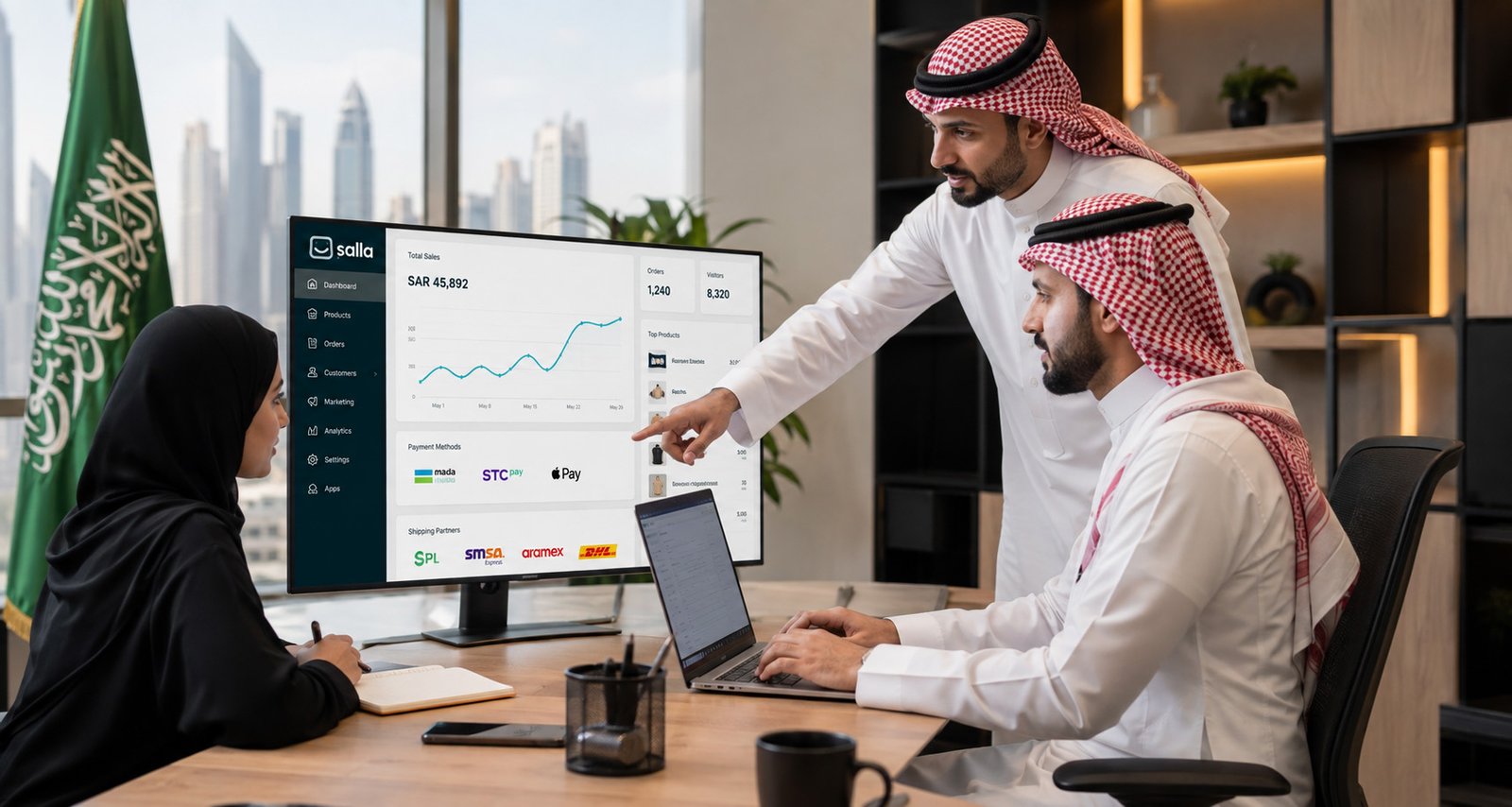
Did you know that Salla is the biggest e-commerce platform in Saudi Arabia right now? More than 19,600 active online stores in KSA are running on Salla, according to AfterShip, a global e-commerce data and shipment tracking platform that monitors store activity across major platforms worldwide.
Salla was built specifically for the KSA market. Arabic-first design, Mada and STC Pay native integrations, ZATCA-compliant invoicing, and logistics connections to Saudi couriers all come built into the platform.
However, launching on Salla requires a strategy tailored to your business. Every business has a different product catalogue, different marketing strategy, and a different sales process. Your store needs to reflect all that from the moment it is launched.
Moreover, your store theme, payment setup, and checkout flow all need to be optimized as well, because that’s what turns a visitor into a paying customer.
This guide covers everything on Salla e-commerce development. What to plan before you launch, how to structure the store to meet compliance requirements, what it costs, and how to choose a Salla development company in Saudi Arabia.
How Has Salla Grown Saudi Arabia’s E-Commerce Ecosystem?
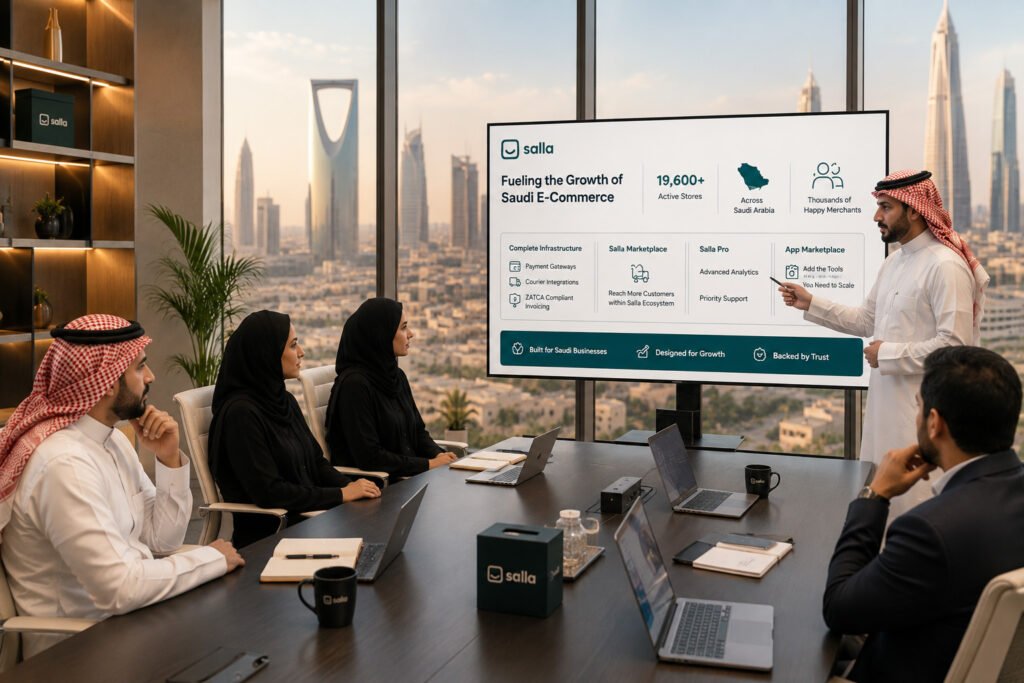
Salla did not just build a store builder. It built the infrastructure Saudi e-commerce now runs on. With almost twenty thousand stores already live on the platform, Salla has become the backbone for merchants selling everything from fashion wear to electronics across the Kingdom.
What Does Salla’s Infrastructure Actually Give You?
If you are still deciding to launch on Salla, you should know that it is a complete e-commerce platform that gives you payment gateways, courier connections, and ZATCA invoicing that have already handled data for thousands of Saudi merchants. That’s why it is a proven infrastructure for all your business needs.
How Does the Salla Marketplace Bring You Customers?
Beyond the store itself, Salla gives you multiple ways to grow. The Salla Marketplace puts your products in front of shoppers browsing inside the Salla ecosystem, so you can pick up customers before your own SEO and digital marketing ad campaigns start delivering results.
How Do Salla Pro and the App Marketplace Help You Scale?
Once your store starts getting real order volume, Salla Pro gives you the tools to manage that growth: deeper analytics to see what is actually selling, and priority support when something needs fixing fast. Alongside that, the Salla App Marketplace lets you add the specific tools your business needs, whether that is a loyalty program, better logistics tracking, or marketing automation. These two turn Salla from a simple storefront into a full growth system for your business.
Why Saudi Businesses Are Choosing Salla Over Other E-Commerce Platforms
Saudi businesses have plenty of e-commerce platforms to pick from, but Salla keeps winning the decision for one simple reason: it was not built as a global platform and adapted for Saudi Arabia. It was built for Saudi Arabia first. Here is what that actually means for your store.
What Saudi Buyers Expect, and How Salla Delivers
Saudi consumers expect quick & reliable checkout experiences. Arabic RTL interfaces, fast local delivery options, and trusted Saudi payment methods. Salla aligns with these expectations by offering integrated payment gateways, mobile-optimised storefronts and a user experience tailored to local shopping behavior.
How Vision 2030 is Accelerating Salla Adoption
Saudi Arabia’s Vision 2030 initiative is driving digital transformation across all sectors. With increased support for SMEs and digital commerce infrastructure, platforms like Salla are benefiting from a surge in adoption. Businesses are encouraged to go online quickly, and Salla provides the fastest compliant route to do so.
What Can You Actually Build on the Salla Platform?
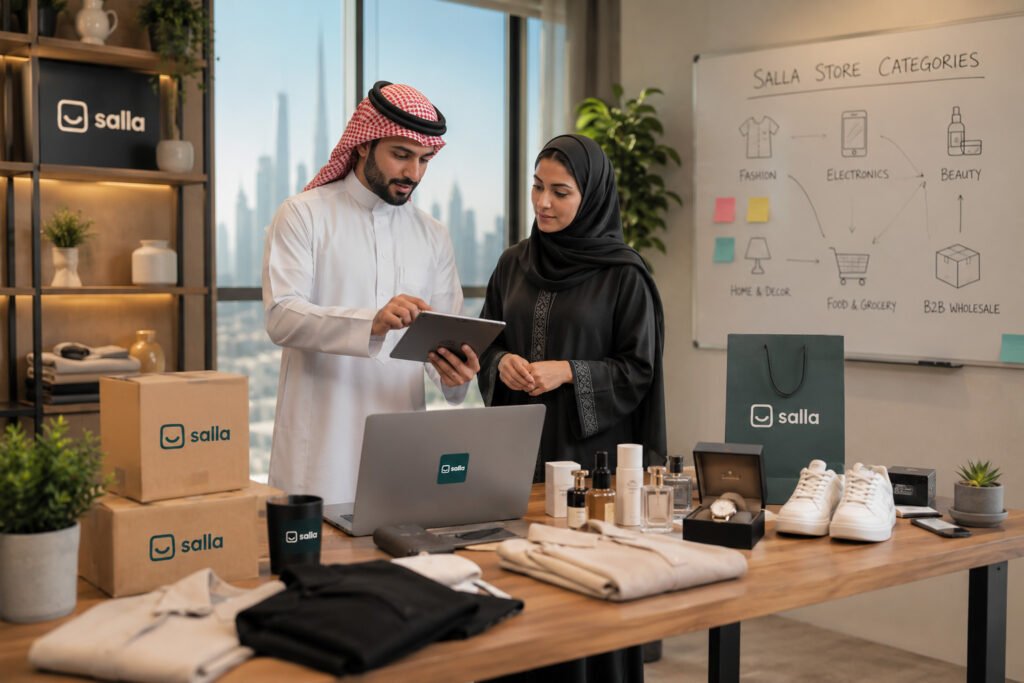
Salla is not a one-size-fits-all store builder, even though the platform underneath is the same for every merchant. What a fashion brand needs from its Salla store is not what an electronics merchant needs, and what works for a beauty brand will not work for a B2B wholesaler. The features, the theme decisions, and the development priorities all shift depending on what you are selling and who you are selling to.
Here is what that looks like across the categories doing the most business on Salla today.
Retail and Fashion Brands
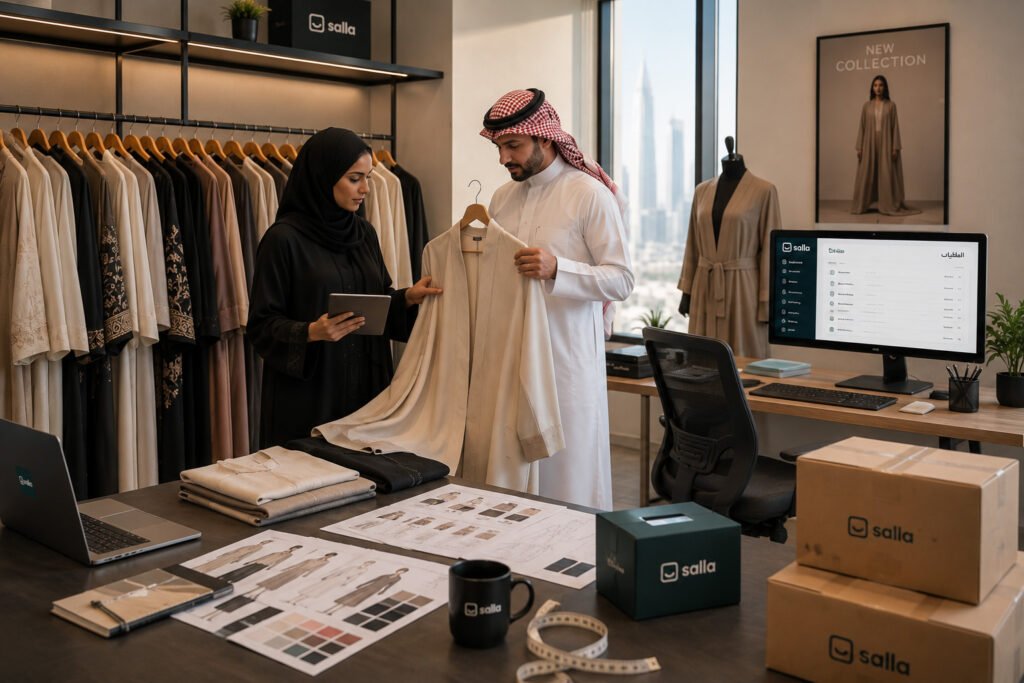
Fashion is one of the categories where Salla stores are winning on browsing experience, not just catalogue size. If you’re building a fashion brand on Salla, collections matter more than single products. Your customers aren’t hunting for one specific item; they’re flipping through your store the way they’d flip through a lookbook. Your whole store should be built around that: organised by collection and season, not just by category.
Collection-led navigation and lookbook-style product presentation are what keep that browsing behaviour working in your favour. Your size, colour, and style variants need to be set up clearly so your customer can pick her exact combination without landing on a page for something out of stock in her size. And because fashion return rates run high in Saudi Arabia, your return policy and a self-service return request need to sit directly in your post-purchase flow, or a return turns into a support ticket on top of the margin you already lost.
Modest Wear & Traditional Clothing Brands
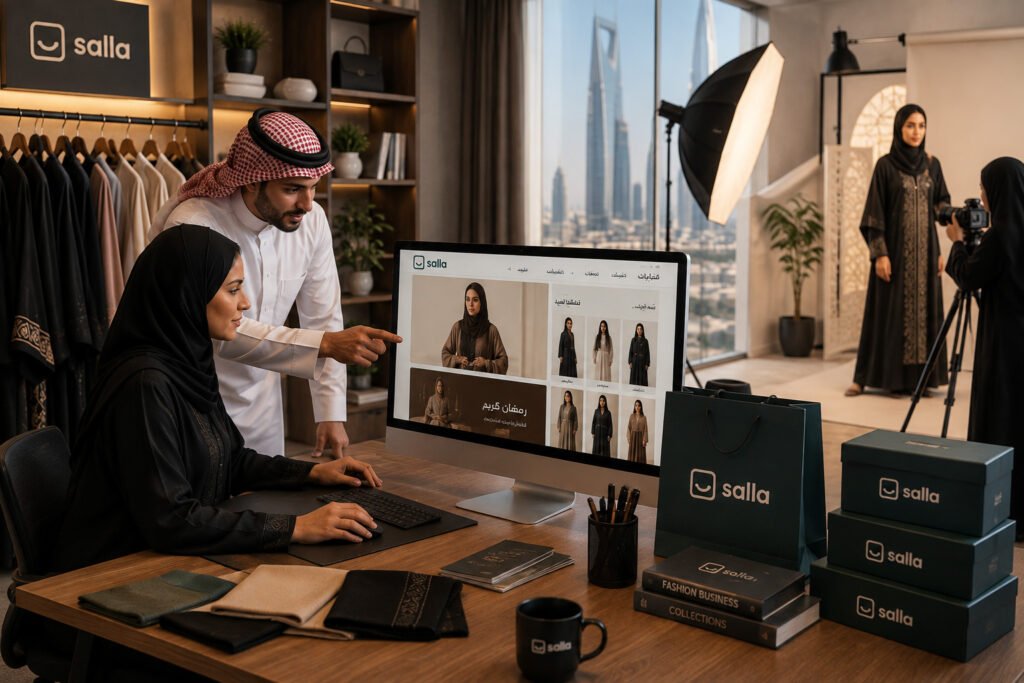
This is one of Salla’s strongest and most established categories, so if you’re building here, your customer already knows what a good modest wear store looks like. A generic template won’t impress your clients.
Arabic-first design matters more here than almost anywhere else on the platform, since this is the language your customer is actually shopping in, not translating from. Your product photography needs proper modest styling context, and your size guides need to be built specifically around abaya and modest wear proportions, not a generic international sizing chart.
Ramadan and Eid are where your demand spikes hardest in this category. If your promotional pricing and campaign calendar are set up before the season starts, you’re the one capturing that spike, not scrambling to configure pricing while orders are already coming in.
Jewelry and Accessories Brands
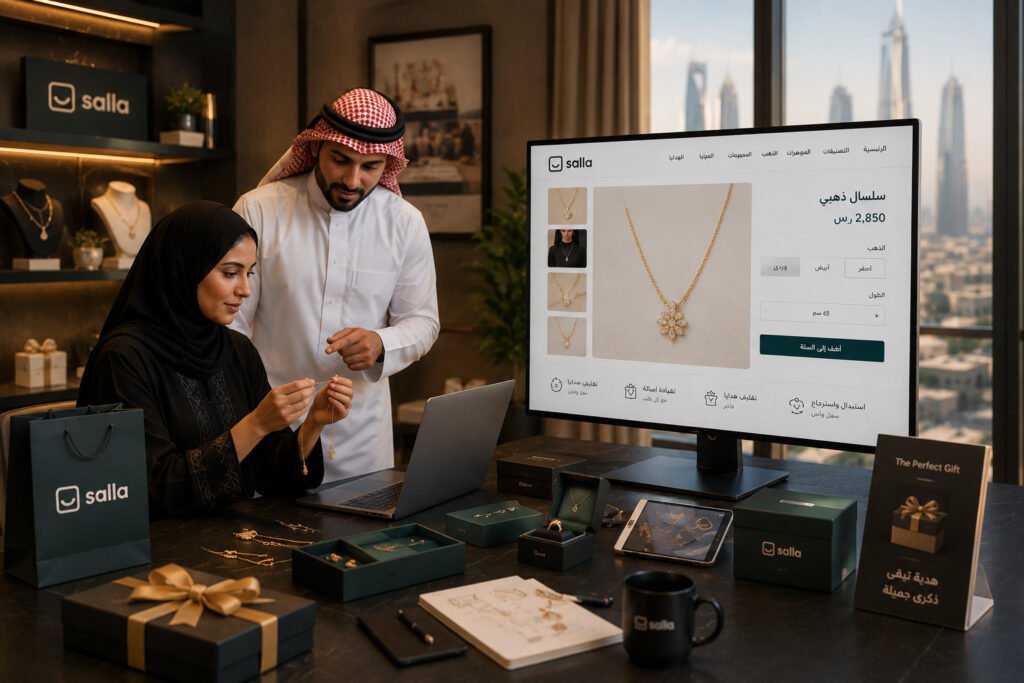
If you sell jewelry on Salla, your buyer is making a high-consideration decision, not an impulse purchase, and she needs to see exactly what she’s buying before she trusts you with the payment.
Zoom capability, multi-angle views, and scale reference on your product photos let her judge size, finish, and detail without holding the piece in her hand. Gift wrapping and occasion-based messaging at checkout matter here too, since a large share of your buyers are shopping for a gift, and that directly affects what they spend per order. Trust signals around authenticity and materials on your product page, rather than buried in an FAQ, are what move a hesitant buyer to actually complete the purchase with you.
Food & Grocery Brands
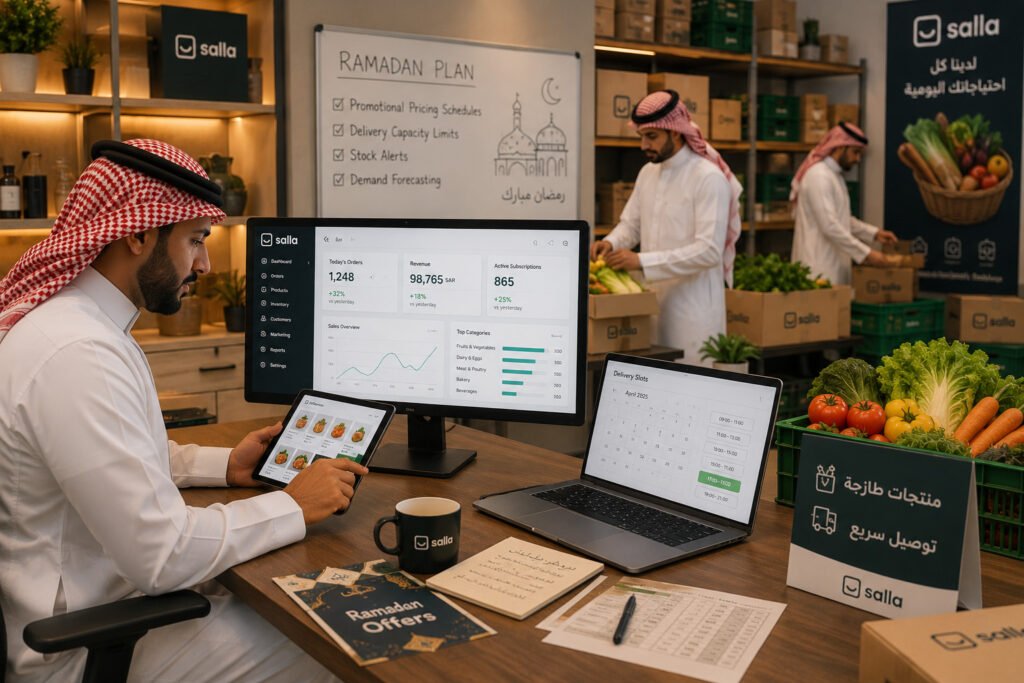
If you’re selling food or groceries on Salla, standard configuration hits its limits fast for you. Your customers expect a delivery window, not a vague “processing” status, and your inventory has a shelf life most other categories don’t deal with.
Delivery slot booking and perishable inventory tracking are typically extension development beyond default Salla setup, built around how your operation actually runs. Subscription ordering fits naturally if your customers reorder the same items regularly.
Ramadan is your highest-demand period, and it isn’t a season to react to. Your promotional pricing, delivery capacity limits, and low-stock alerts need to be in place before the season starts, so your popular lines don’t sell out on you without warning mid-Ramadan.
Beauty & Personal Care Brands
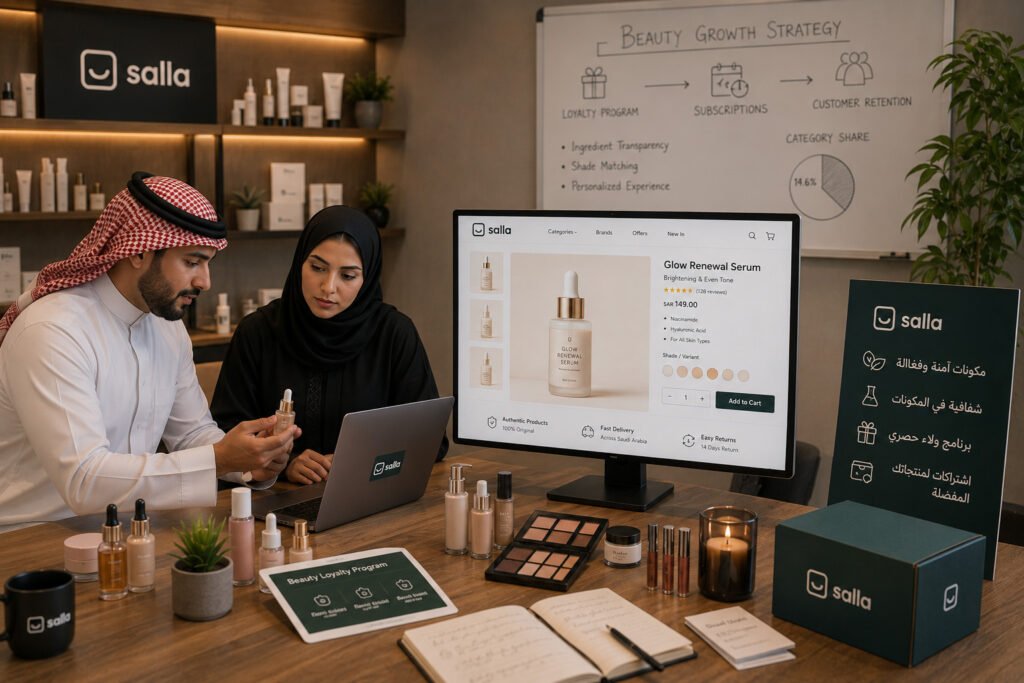
Beauty and personal care is the single largest category on Salla in Saudi Arabia, at 14.6 percent of all stores. If you’re in this category, that scale cuts both ways for you: it’s a huge market, and it’s also the most crowded one, with your customer keeping several other beauty stores open in another tab. If you’re just starting out in this space, see our blog on Business Ideas for Women at Home for how to approach it at a smaller scale before committing to a full storefront build.
Loyalty programs and subscription ordering for regularly repurchased products are what separate the beauty stores that keep customers from the ones that lose them. Shade and variant matching, along with ingredient transparency on your product page, address the exact uncertainty that drives most returns in this category, since answering that question before purchase is far cheaper for you than processing the return after.
Salla Store for Furniture & Home Goods
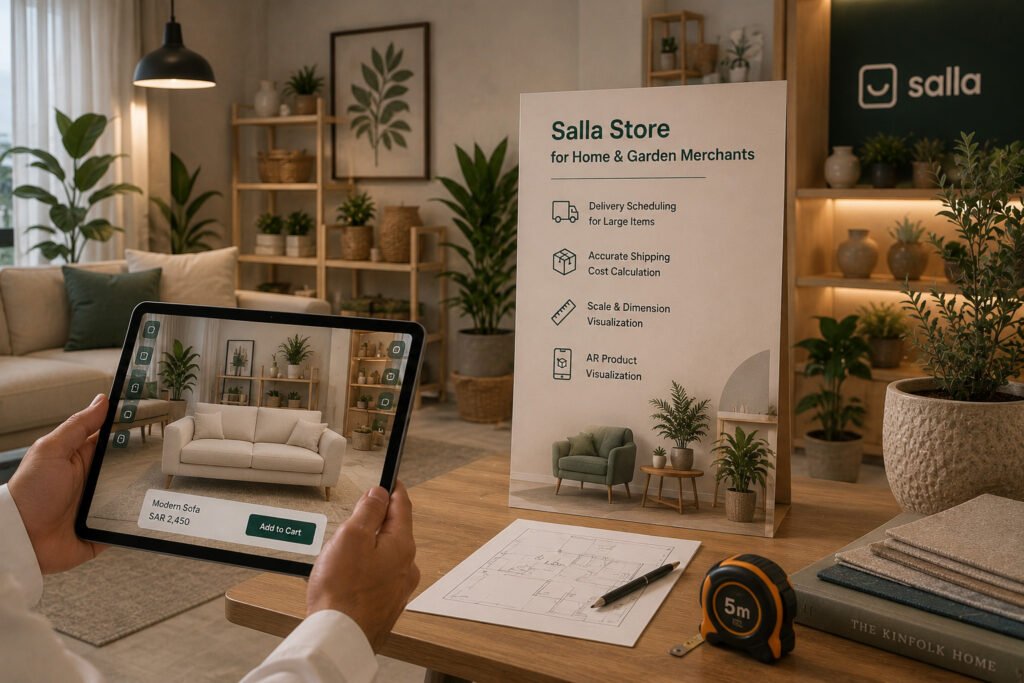
If you sell furniture or home goods, scale is the hardest thing for you to communicate online, and it’s the leading reason your customers hesitate or return large items.
Accurate weight and dimension data keeps your shipping costs calculating correctly at checkout instead of surprising your customer afterward, and delivery scheduling for large or bulky items keeps your fulfilment from becoming a logistics problem after the sale. AR product visualisation, where your customer can preview a piece in their own space, is increasingly used in this category specifically to cut down the hesitation that drives your return rate.
Salla Store for Electronics & High-consideration Products
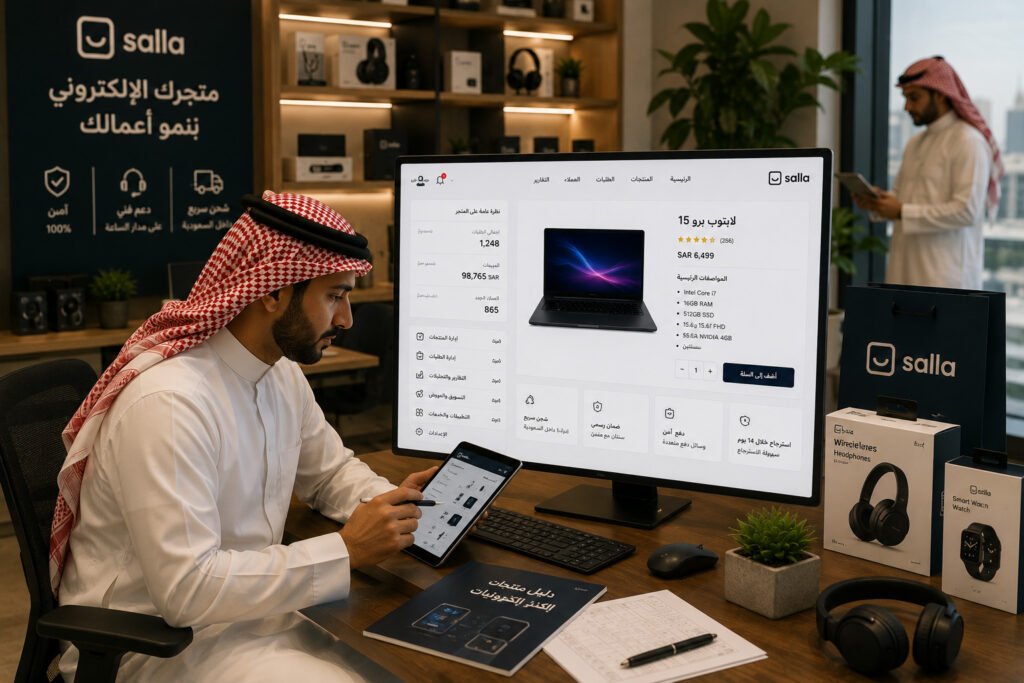
If you sell electronics, your buyer is comparing specs and warranty terms before committing, because at your price points, a wrong decision feels expensive to them.
Detailed specification displays, side-by-side comparison features, and warranty information visible before checkout are what keep that buyer deciding on your store instead of leaving to verify the details elsewhere. Your average order values are high enough that even a one-percent lift in conversion from better product page structure translates into meaningful revenue for you, which is why your product page architecture needs to be treated as a commercial decision, not a cosmetic one.
Health & Supplements Brands
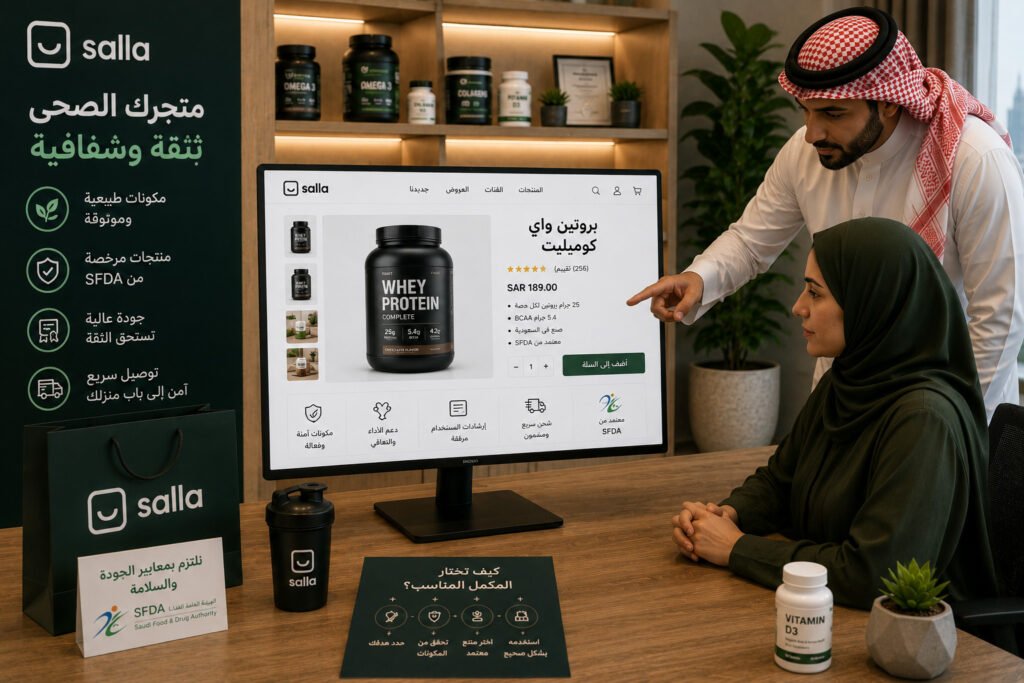
Health and supplements is a growing Salla category, driven by rising awareness of nutrition and fitness in Saudi Arabia, and if you sell here, your buyer researches carefully before purchasing.
Clear display of ingredients, certifications, and usage guidance on your product page keeps that research on your store instead of sending your buyer elsewhere to verify. Subscription ordering fits naturally if your product is something taken regularly, turning a one-time buyer into a recurring one for you. Where it applies, communicating SFDA compliance clearly is often the deciding factor for your more cautious buyers.
Salla Store for Gifts & Seasonal Products
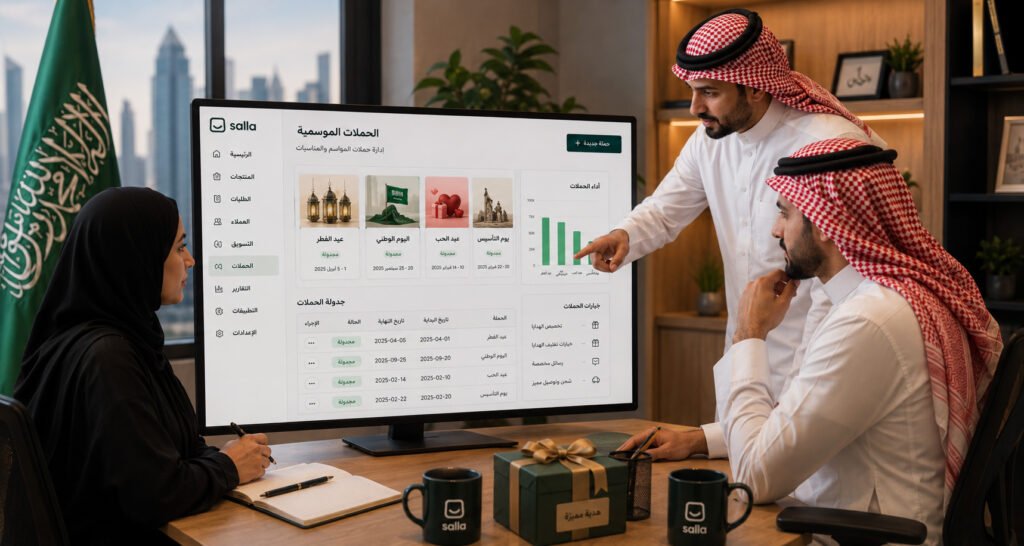
If you sell gifts, your demand doesn’t arrive evenly through the year. It spikes hard around Eid, National Day, and Valentine’s Day, and if your store isn’t ready before those dates, you’re leaving that spike on the table.
Occasion-based navigation lets your customers shop by who the gift is for instead of digging through your general catalogue, and gift packaging at checkout turns gifting into part of the purchase decision itself rather than an afterthought. Campaign scheduling that turns your promotional pricing on and off automatically for each seasonal window matters here too, since manually managing pricing during your busiest week is exactly when things go wrong.
Digital Products & Online Courses
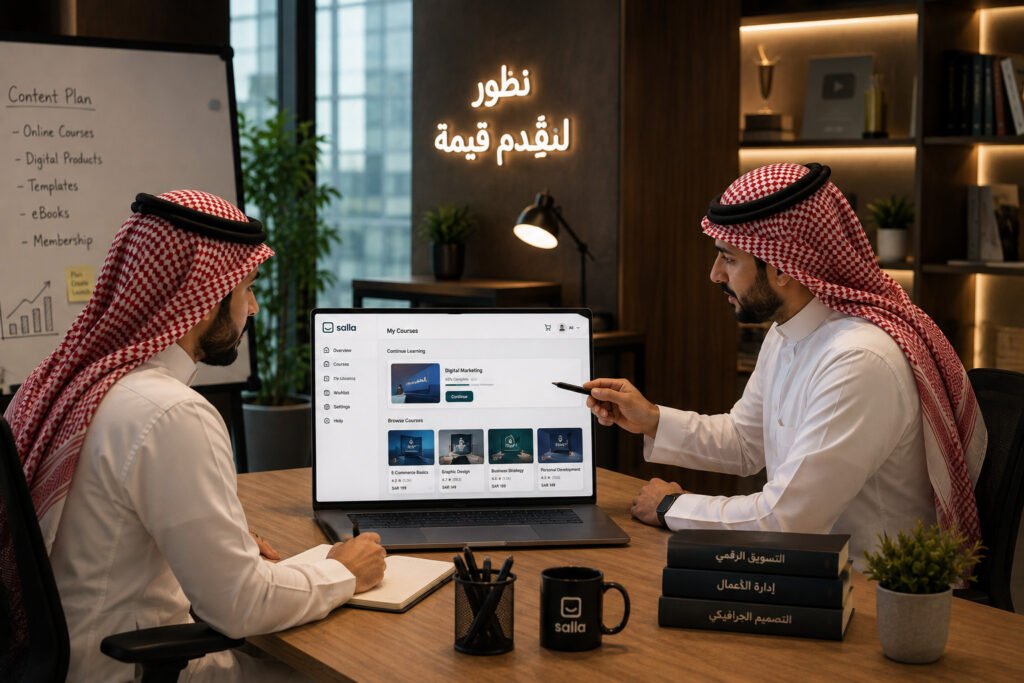
Digital products have been a fast-growing category on Salla recently, and if you’re an entrepreneur or educator moving courses, templates, e-books, or training content online, this is where you’d build.
Automated digital delivery, access control, and subscription management for ongoing content are your core requirements here, and they’re different from what a physical product merchant needs. You don’t need logistics integration, but your digital delivery automation and content access management need to be configured correctly from the start, since that’s the entire product experience for your customer.
Salla Store for B2B & Wholesale Merchants
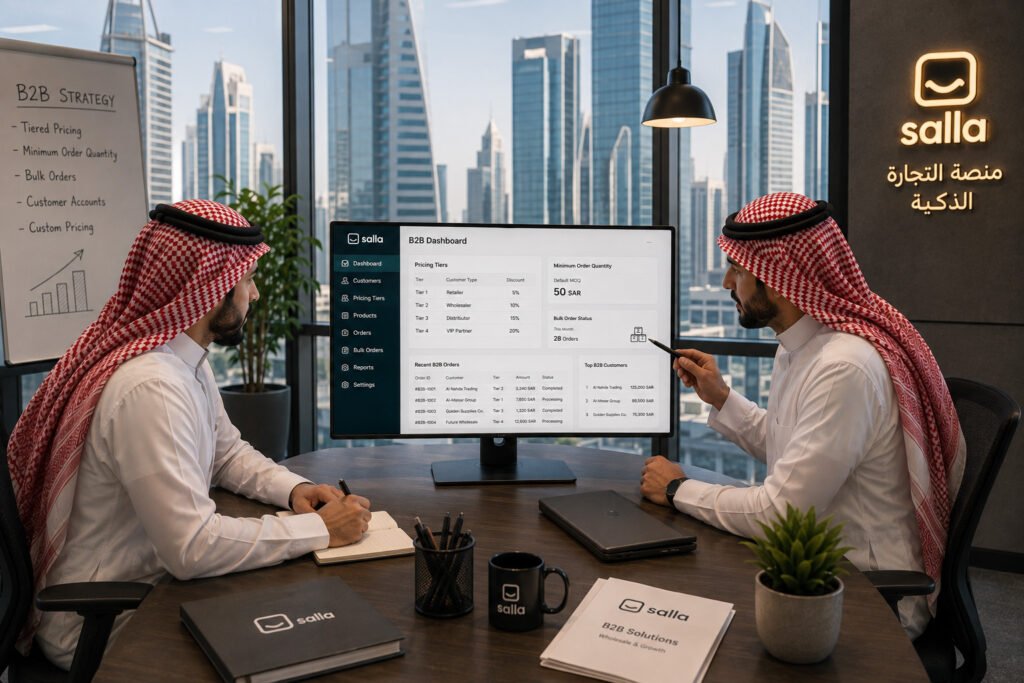
If you run a B2B or wholesale operation, Salla covers some of what you need natively and needs custom development for the rest. Tiered pricing by customer account, minimum order quantities, and bulk order workflows are partially covered out of the box.
Where your model goes beyond that, you need custom app development rather than a workaround. The honest assessment worth making upfront is whether Salla’s native B2B capabilities actually cover your model, or whether you need more built on top, since finding that out after you’ve already launched is the expensive way to learn it.
If Salla’s native B2B tools plus custom app development still don’t get you where your business needs to be, that’s usually a sign the constraint isn’t the apps, it’s the platform. A custom website development approach removes that ceiling entirely. Instead of working around what Salla’s architecture allows, your pricing logic, account permissions, and order workflows get built to match your business exactly, with no platform rules dictating what’s possible. It costs more upfront than staying on Salla and layering on custom apps, but for wholesale operations with genuinely complex B2B requirements, it’s often cheaper than the accumulated cost of custom development against a platform that wasn’t built for your model in the first place.
Service-based Businesses
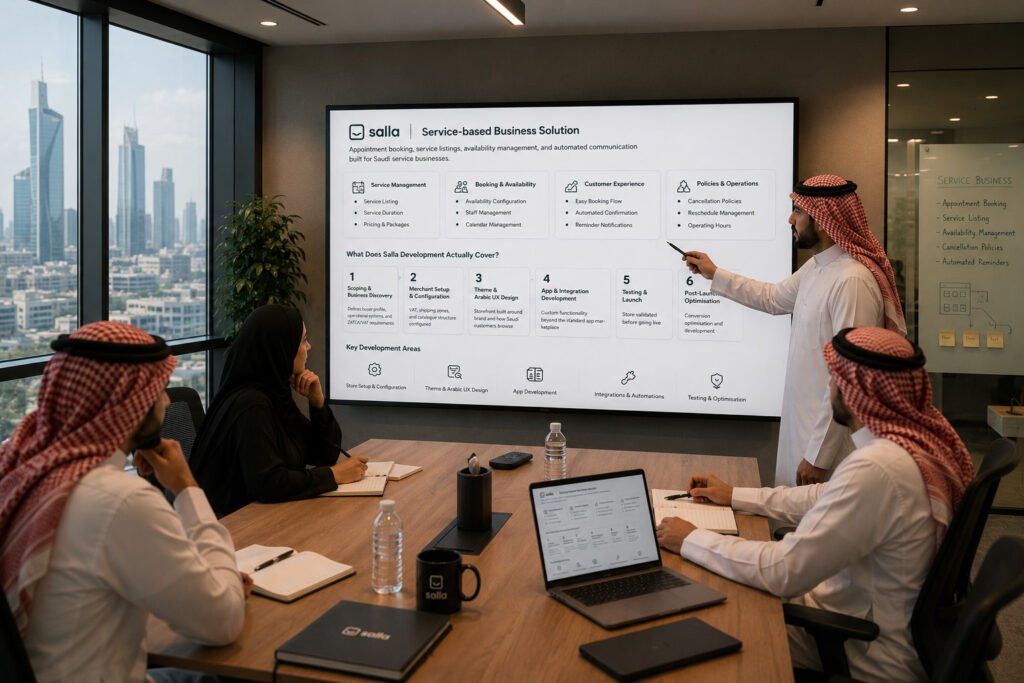
If you run a salon, a clinic, a consultancy, or a home service business, your sale on Salla isn’t a product, it’s a booking, and that changes what your store needs to prioritise.
Your availability configuration needs to reflect your actual schedule rather than a generic calendar template, and your service durations need to be set correctly so double-bookings don’t happen to you. A cancellation policy built into your booking flow enforces itself automatically instead of you chasing no-shows manually, and automated confirmation and reminder messages are what cut down on the no-shows costing you real revenue every week.
What Does Salla Development Actually Cover?
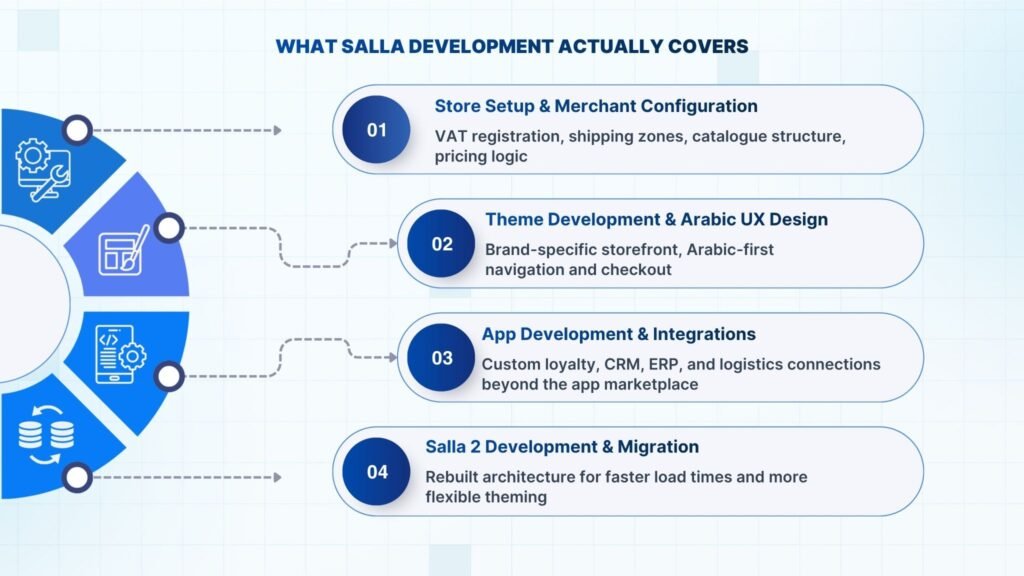
| Service | What It Covers |
| Store Setup & Merchant Configuration | VAT registration, shipping zones, catalogue structure, pricing logic |
| Theme Development & Arabic UX Design | Brand-specific storefront, Arabic-first navigation and checkout |
| App Development & Integrations | Custom loyalty, CRM, ERP, and logistics connections beyond the app marketplace |
| Salla Development & Migration | Rebuilt architecture for faster load times and more flexible theming |
Salla development is not a single service. It covers everything from initial store setup and configuration through custom theme development, app and integration work, and ongoing conversion optimisation. Understanding what each stage includes is necessary for you to launch the first time correctly, instead of rebuilding later.
Store Setup & Merchant Configuration
A properly set up Salla merchant account is the foundation everything else is built on. This covers the merchant profile, VAT registration details, currency configuration, shipping zone definitions, and the product catalogue structure.
Getting the catalogue structure right before the store goes live matters a lot. A poorly structured Salla store where products are uploaded without clear categorization, variants configured inconsistently, and pricing logic that does not reflect the business’s actual pricing model creates a store that is difficult for customers to navigate and expensive to fix once it is live and indexed.
Theme Development & Arabic UX Design
Salla’s theme marketplace offers templates that provide a starting point. The difference between a template and a properly developed Salla website is the difference between a store that looks generic and one that communicates the brand’s positioning from the first scroll.
Custom Salla theme development builds the storefront around the brand’s visual identity and the specific way Saudi customers in that product category browse and buy. For a Saudi fashion brand, that means collection-led navigation and visual storytelling that drives browsing. For an electronics merchant, that means specification-led product pages and comparison features that support high-consideration purchase decisions. The same Salla platform, different development, different commercial outcome.
Arabic UX design on Salla is not applying RTL to an existing layout. It is designing the information hierarchy, navigation flow, and checkout structure around how Arabic-primary Saudi users read and interact with a page — which is different enough from English-first UX that a design built for English and reversed for Arabic consistently underperforms against a design that started Arabic.
App Development & Third-party Integrations
The Salla app marketplace covers standard e-commerce requirements. Custom salla development becomes necessary when the business has specific operational needs that the standard app ecosystem does not cover: a custom loyalty system with specific tiering logic, a CRM integration with a system that Salla does not natively connect to, an ERP connection for businesses that need order data flowing automatically into their operational infrastructure, or a custom reporting dashboard that surfaces the specific metrics the business needs to manage performance.
Third-party integrations on Salla also include logistics connections beyond what the platform provides natively — connecting Saudi courier networks for real-time rate calculation, delivery slot booking systems for food and grocery merchants, and multi-carrier management for businesses that need to route orders to different couriers based on delivery zone or product type.
ZATCA Compliance on Salla: What It Means and Why It Matters
Saudi businesses operating e-commerce stores above the mandatory ZATCA threshold need every transaction to generate a ZATCA-compliant e-invoice — cryptographically signed, formatted to ZATCA specification, and transmitted to the Fatoorah platform.
This is not optional and the consequences of non-compliance are real: regulatory penalties and the operational cost of retroactively producing compliant invoice records for transactions that were not processed correctly.
On Salla, ZATCA compliance is built into the order processing flow natively. Every completed order generates an e-invoice that meets ZATCA requirements automatically. The merchant does not need to configure this separately or manage a third-party integration to achieve compliance.
What a Salla developer needs to verify during store setup is that the merchant’s VAT registration details are correctly entered, that the tax configuration reflects the correct VAT rate for each product category, and that the invoice output matches what the business needs for its own financial records alongside ZATCA compliance. This is a setup verification task rather than a development challenge — but getting it wrong produces incorrect invoices that require correction under regulatory scrutiny.
For Saudi merchants launching a new Salla store, ZATCA setup verification should be part of the initial configuration before the first order is processed. Fixing incorrect VAT configuration on a store that has already processed orders requires retroactive correction that the correct setup from day one avoids entirely.
Salla vs Zid vs Shopify: Which one to Choose for your business?
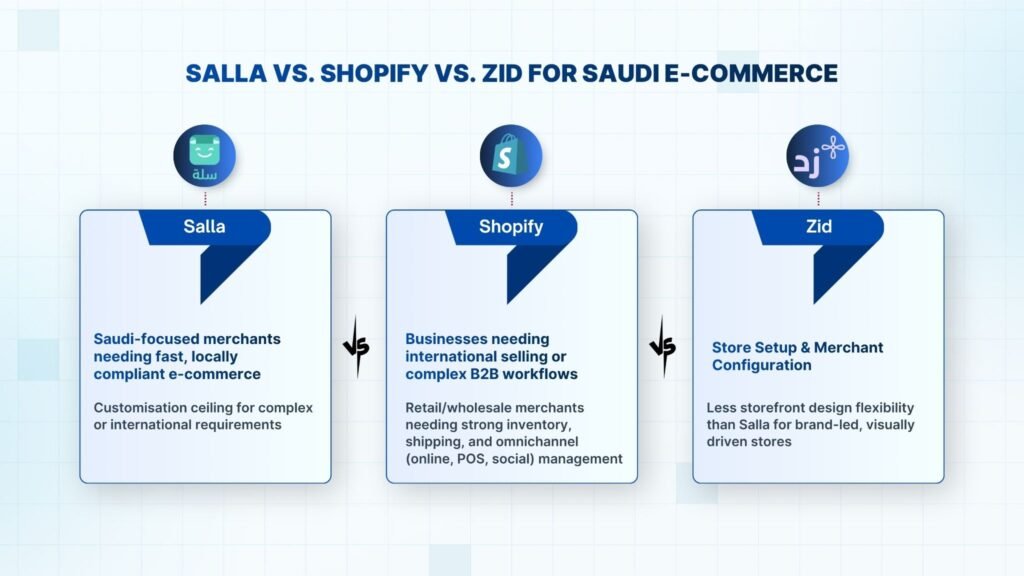
| Platform | Best For | Trade-Off |
| Salla | Saudi-focused merchants needing fast, locally compliant e-commerce | Customisation ceiling for complex or international requirements |
| Shopify | Businesses needing international selling or complex B2B workflows | Requires custom development for Arabic, Mada, and ZATCA compliance |
| Zid | Retail/wholesale merchants needing strong inventory, shipping, and omnichannel (online, POS, social) management | Less storefront design flexibility than Salla for brand-led, visually driven stores |
Salla
Salla is built for Saudi merchants who want to launch fast with local compliance already handled. It’s the right fit if you’re running a straightforward store and don’t need heavy customization, but it starts to feel limited once your requirements get more complex or you’re selling beyond Saudi Arabia.
Shopify
Shopify fits businesses selling internationally or running more complex operations, retail and wholesale merchants who need strong inventory, shipping, and omnichannel management across online, POS, and social selling. What you gain in flexibility and scale comes at the cost of the local compliance work Salla handles for you out of the box.
Zid
Zid covers the same ground as Salla, fast store setup and merchant configuration built for the Saudi market. Where it falls short is storefront design flexibility. If your brand depends on a highly visual, custom-designed store, Zid gives you less room to work with than Salla does.
Salla vs Other Platforms for E-Commerce Development
Salla, Shopify, and Zid all put you inside a SaaS platform, which means faster setup but rules you don’t control. If your business needs something none of the three can flex around, the option worth knowing about is WooCommerce development, which runs on WordPress and gives you full ownership of your code, hosting, and design instead of building inside someone else’s platform.
That control comes with a trade-off. Salla hands you ZATCA compliance, Mada integration, and hosting out of the box. On WooCommerce, you’re setting all of that up deliberately. It’s the right call once your catalogue, pricing logic, or B2B requirements have outgrown what Salla and its app marketplace can support, and the wrong call if you just need a straightforward store live fast.
Message us on WhatsApp and book a free consultation, so we can get you on the right platform for where your business actually is, not where a generic comparison says it should be.
What Does It Actually Cost to Launch a Salla Store in Saudi Arabia?
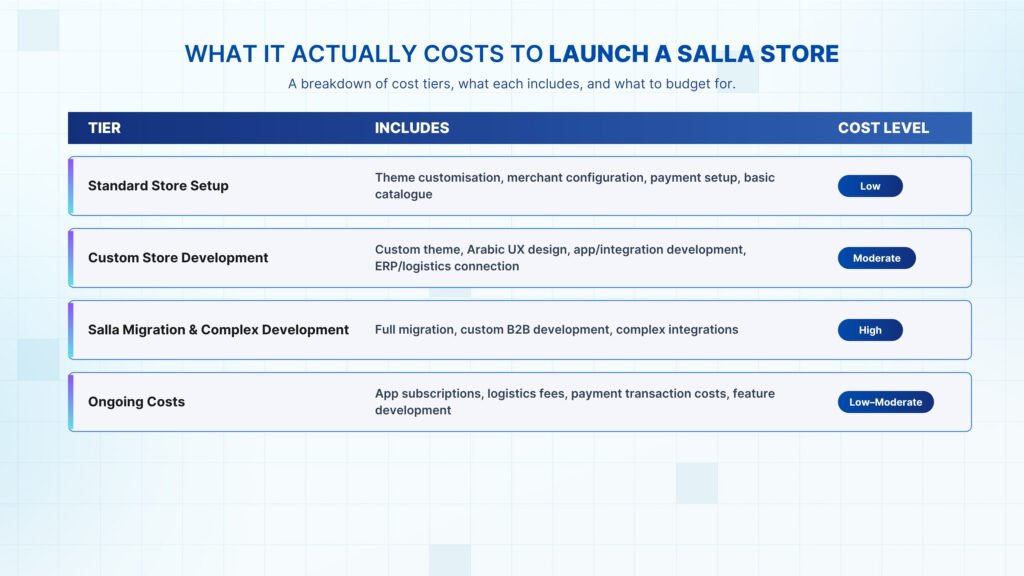
| Tier | Includes | Cost Level |
| Standard Store Setup | Theme customisation, merchant configuration, payment setup, basic catalogue | Low |
| Custom Store Development | Custom theme, Arabic UX design, app/integration development, ERP/logistics connection | Moderate |
| Migration & Complex Development | Full migration, custom B2B development, complex integrations | High |
| Ongoing Costs | App subscriptions, logistics fees, payment transaction costs, feature development | Low–Moderate |
Common Salla E-commerce Development Mistakes To Avoid
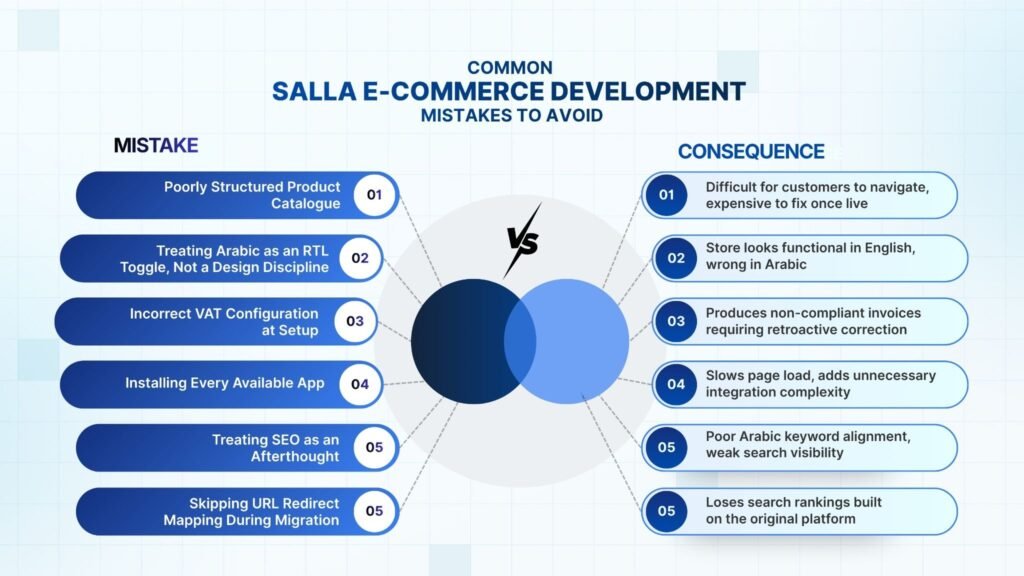
| Mistake | Consequence |
| Poorly Structured Product Catalogue | Difficult for customers to navigate, expensive to fix once live |
| Treating Arabic as an RTL Toggle, Not a Design Discipline | Store looks functional in English, wrong in Arabic |
| Incorrect VAT Configuration at Setup | Produces non-compliant invoices requiring retroactive correction |
| Installing Every Available App | Slows page load, adds unnecessary integration complexity |
| Treating SEO as an Afterthought | Poor Arabic keyword alignment, weak search visibility |
| Skipping URL Redirect Mapping During Migration | Loses search rankings built on the original platform |
Quick Decision Guide to Salla E-commerce Development in Saudi Arabia
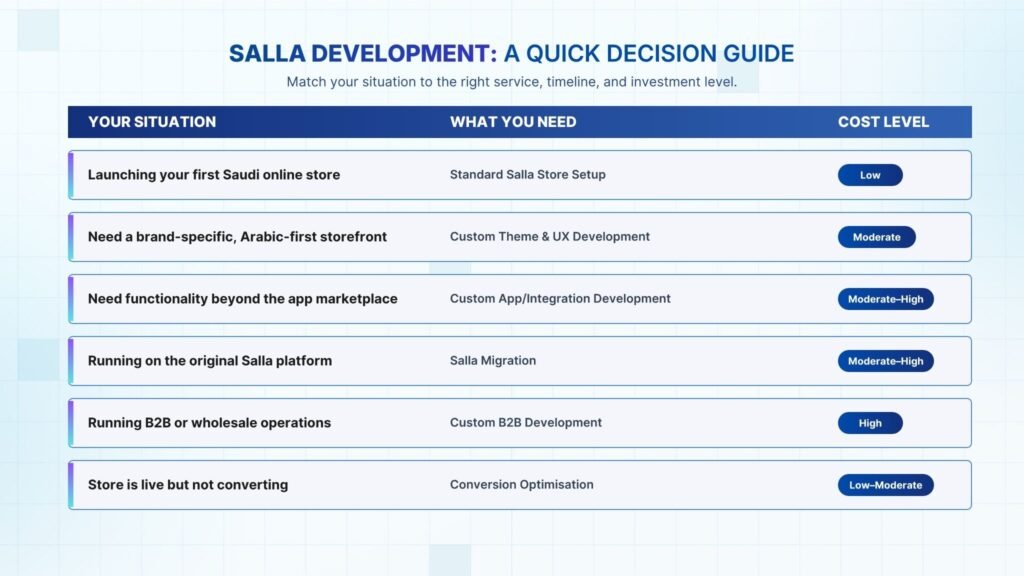
| Your Situation | What You Need | Cost Level |
| Launching your first Saudi online store | Standard Salla Store Setup | Low |
| Need a brand-specific, Arabic-first storefront | Custom Theme & UX Development | Moderate |
| Need functionality beyond the app marketplace | Custom App/Integration Development | Moderate–High |
| Running on the original Salla platform | Salla Migration | Moderate–High |
| Running B2B or wholesale operations | Custom B2B Development | High |
| Store is live but not converting | Conversion Optimisation | Low–Moderate |
How to Choose a Salla Development Company in Saudi Arabia
Demonstrated Salla portfolio, not general e-commerce experience
General e-commerce development experience does not transfer automatically to Salla. The platform has specific development conventions, an Arabic-first architecture, and a technical ecosystem that most general web development work never encounters.
Arabic UX and Saudi market understanding
The salla e-commerce platform exists specifically for the Saudi market. A development partner without genuine Arabic UX experience — who treats RTL as a CSS toggle rather than a design discipline — will produce a store that looks functional in English and wrong in Arabic. Ask specifically for Arabic-first store examples.
Scope clarity before development starts
A salla developer who provides a quote without understanding catalogue structure, integration requirements, and operational needs is quoting a vague project that will either disappoint or generate scope changes. A proper Salla development engagement starts with a scoping session that defines what is being built, in what timeline, with what post-launch support.
Post-launch capability
A Salla store is not a completed project at launch. It needs ongoing development as the business changes, the product catalogue grows, and conversion optimisation identifies where the store is losing customers it should be keeping. A salla developer who only does builds and not ongoing development leaves the merchant finding a new partner every time something needs to change.
How Does Etihad Falcon Tech Build Salla Stores for Saudi E-commerce?
Etihad Falcon Tech’s Salla development starts the same way every development engagement does — with the commercial outcome rather than the platform configuration. Before any theme work or catalogue setup begins, the store’s architecture is planned around what the merchant needs to achieve: who the Saudi buyer is, how they browse and buy in that product category, what operational systems the store needs to connect to, and what ZATCA and VAT configuration the business requires.
What is handled in-house
Etihad Falcon Tech handles the complete Salla development scope internally — custom theme development in Salla’s Arabic-first environment, Salla 2 builds and migrations, custom app development for requirements the Salla marketplace does not cover, ERP and logistics integration, ZATCA setup verification, and post-launch conversion optimisation. There is no handoff between separate design and development teams.
Saudi market built into the process
Arabic RTL UX design, Mada and STC Pay configuration, ZATCA compliance verification, and Saudi logistics integration are part of every salla store Etihad Falcon Tech builds — not additions made at client request after the store is otherwise complete. We have delivered salla stores for Saudi merchants across fashion, FMCG, electronics, beauty, and B2B wholesale, which means the specific requirements of each category in the Saudi market are understood before the development brief is written.
Post-launch support
Every Salla project includes a defined post-launch arrangement — update cycles, response times for issues, and how ongoing development is scoped — agreed before the store goes live. Saudi merchants who want their Salla store to remain a maintained, optimised commercial asset rather than a launched project will find that maintenance planning is part of the engagement from the first conversation.
If your current Salla store is live but not converting at the rate the traffic should support, or you are building a new store and want it done correctly from the start rather than rebuilt in twelve months, that is where the conversation starts.
Frequently Asked Questions
What is Salla development in Saudi Arabia?
Salla development covers building, customising, and optimising e-commerce stores on the Salla platform for Saudi merchants. It includes merchant setup and configuration, custom theme development with Arabic RTL design, app and integration development for specific operational requirements.
How long does it take to launch a Salla store?
A standard Salla store with theme customisation and full merchant configuration takes three to five weeks when product content is ready.
A custom theme built from scratch takes eight to ten weeks. Custom app development or ERP integration adds an additional three to six weeks depending on integration complexity.
Is Salla better than Shopify for Saudi businesses?
Salla offers better options for Saudi-focused merchants with Arabic RTL, Mada integration, and ZATCA compliance. Shopify offers more to Saudi businesses that need international selling capability, custom functionality, or complex B2B e-commerce.
Can Salla handle large e-commerce businesses?
Yes. Salla Pro architecture support established Saudi merchants with large product catalogues, significant order volume, and complex operational requirements.
Does Salla support full Arabic language and RTL design?
Yes. Arabic RTL is Salla’s native design orientation, the platform was built Arabic-first and English support was added to it, not the other way around. This is the opposite architecture of global platforms that add Arabic as a localisation layer. The practical difference is that Arabic layout, navigation flow, and checkout design on Salla are structurally correct rather than approximated.
How do I start a Salla development project with Etihad Falcon Tech?
The process starts with a scoping conversation, what the business sells, who the Saudi customer is, what operational systems the store needs to connect to, and what the commercial targets are for the store.
From there, Etihad Falcon Tech proposes a development scope that covers the store architecture, Arabic UX design, integration requirements, and post-launch support arrangement. Development starts once the scope is agreed and the brief is clear. Contact us to begin that conversation.