
Saudi Arabia’s e-commerce market is projected to reach USD 36.6 billion by 2032, growing from an estimated USD 16.3 billion in 2025, according to PS Market Research. Behind that growth are thousands of Saudi retail brands moving online, and Shopify is where most of them are building their e-commerce stores now.
Shopify changed what launching an online store actually requires. Hosting, security, payment integration, shipping logic, and checkout infrastructure that used to take months of custom development now come built into the platform from day one. But the platform being ready doesn’t mean the store builds itself; getting a Shopify store to actually outperform the competition still comes down to how well it’s built: the theme, the app choices, and whether all of it is handled by one Shopify development company that understands the Saudi market from the start.
This guide covers what Shopify development actually involves for Saudi brands, what to decide before starting, what it costs, and how to choose a development company that understands the Saudi market as well as the platform.
Why Most Saudi Brands are Moving to Shopify
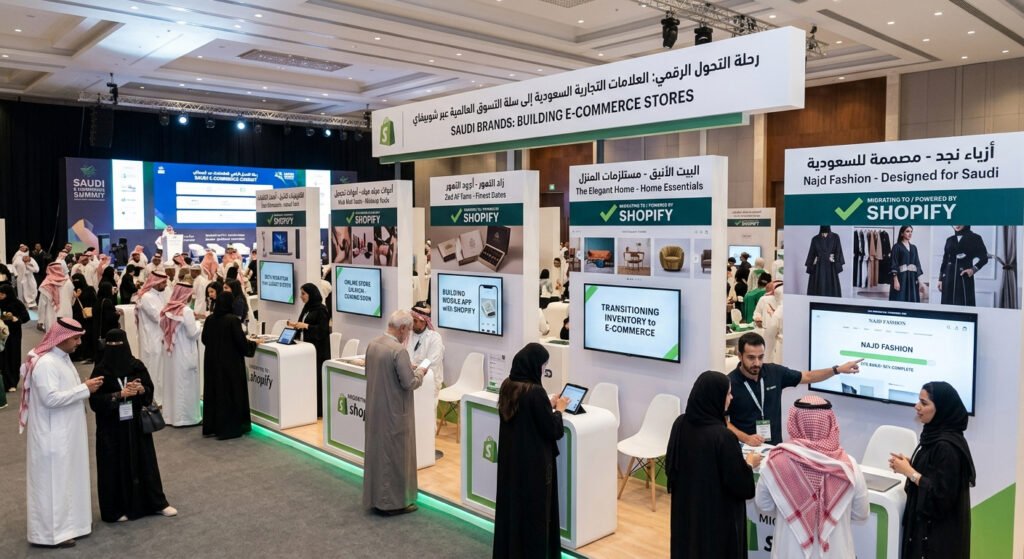
Shopify has become the default choice for Saudi brands building an online store. Hosting, security, checkout infrastructure, and platform updates are handled by Shopify itself, so the team’s time and budget go into the store, not into keeping a platform running underneath it.
Custom website development can still make sense for your business, but it comes with a different commitment: someone has to maintain that platform indefinitely, a developer on call when checkout needs attention, a rebuild scheduled when a browser update changes how the site behaves
Shopify puts that time back where it belongs. For Saudi brands moving fast, that shows up directly in how quickly the business can launch a campaign, add a product line, or respond to a competitor, because the team is spending its time running a store, not managing the platform it sits on.
What Every Saudi Brand Should Decide Before Building on Shopify
Shopify solves the platform problem. It doesn’t solve the business problem underneath it. You have to answer four questions before development starts, or the store gets built around guesses instead of how your business actually operates.
What is this store actually meant to sell?
A ten-SKU premium catalogue and a two-thousand-SKU FMCG operation need different architecture, different app stacks, and different theme complexity. Scoping the build around the wrong assumption means rebuilding navigation and product structure once the real catalogue shows up.
Who owns the store after launch?
Content updates, seasonal campaigns, app management, and ZATCA-related order flow changes all need an owner. Without one defined before launch, the store runs on whoever is available that week, and things that should take an hour start taking days.
Will your store be able to handle a traffic spike on special occasions like Eid, Ramadan, or a big sale day?
On special days, traffic on your store can shoot up fast, and if you’ve never tested how it handles a sudden spike like that on Eid, Ramadan, or National Day, your store can break down. Checkout can freeze mid-order, payments can fail to go through, or the whole site can just go down right when the most people are trying to buy. That’s why this has to be planned for from day one, not fixed after it’s already cost you sales.
How will this store actually win the customer against every other tab they have open?
A Saudi shopper comparing options isn’t choosing between stores that don’t work, every Shopify store technically functions. They’re choosing based on trust signals, price clarity, delivery expectations, and how fast the page answers their question before they move to the next tab. A store that hasn’t planned for that comparison loses customers to a competitor with the exact same platform underneath it.
What Does Shopify Development Actually Cover?
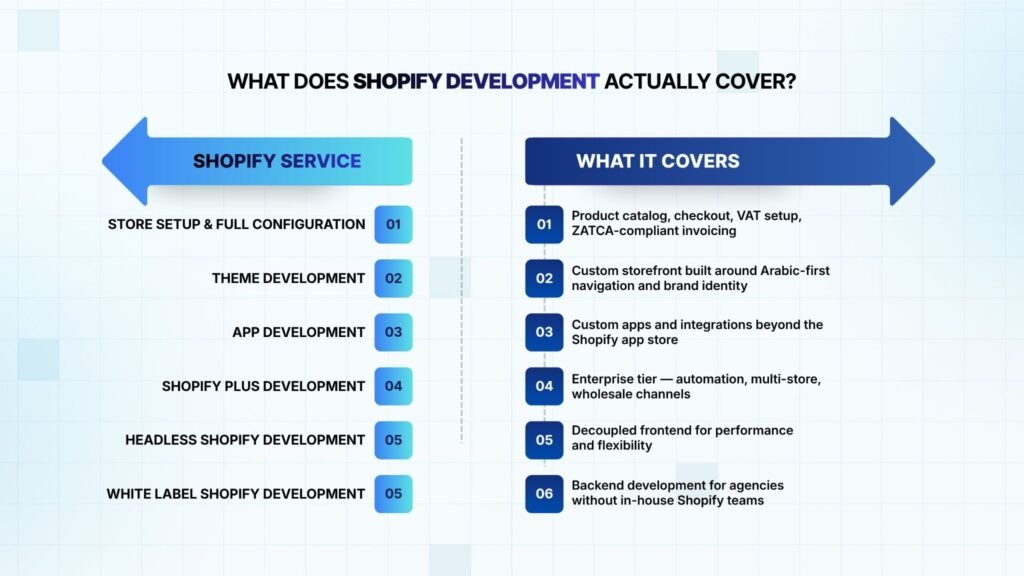
| Service | What It Solves |
| Store Setup & Configuration | Catalog, checkout, tax, and ZATCA logic built correctly from day one |
| Custom Theme Development | Brand-specific storefront, Arabic-first design |
| App & Integration Development | Operational logic the app store doesn’t cover |
| Shopify Plus | High-volume, multi-store, automation-heavy operations |
| Headless Shopify | Custom frontend performance on Shopify’s commerce backend |
| White Label Development | Agency-branded Shopify capability without an in-house dev team |
Store Setup and Configuration
This is the foundation every store needs before it goes live: product catalog, collections, navigation, shipping rules, tax settings, and checkout. For a Saudi store, that also means local payment configuration, VAT setup, and ZATCA-compliant invoicing built in from day one, not added after launch. Get the catalog structure wrong here and it’s expensive to fix once your SKU count grows. Get checkout wrong and you’re losing sales on day one, before the store’s even had a real chance.
Custom Theme Development
Shopify’s default themes work, but they look like everyone else’s. Custom theme development builds a storefront around your actual brand and how your customers actually shop, not a template built for a business that isn’t yours. For a Saudi store, that means Arabic RTL planned in from the first design decision, not bolted onto an English layout as an afterthought.
App and Integration Development
Shopify’s app store covers the common stuff. What it doesn’t cover is the way your business specifically runs, a loyalty program with your own rules, delivery zone logic for your area, a connection to the ERP system you already use. That’s what custom app development is for: built to connect Shopify to the systems you’re already running, so your data moves on its own instead of someone re-entering it by hand every day.
Shopify Plus
This is the tier for businesses running real volume, Saudi brands doing high transaction numbers, running multiple currencies, or running B2B and retail side by side. It comes with automation tools, wholesale features, and multi-store management that a standard Shopify plan doesn’t have, and a store at this level gets built differently from day one to actually use them.
Headless Shopify
This separates what your customer sees from what runs Shopify underneath it; you keep Shopify’s checkout, inventory, and payments, but a custom-built frontend handles speed and design. It’s the right call if your store needs faster load times or a design standard that theming can’t deliver. It’s the wrong call if your business can’t support the extra technical upkeep that comes with it.
White label development
For Saudi marketing agencies that want to offer Shopify without building a technical team of their own. Etihad Falcon Tech builds and maintains the store, and it runs entirely under the agency’s brand, your client never has to know who’s behind it.
Industry-Specific Shopify Development for Saudi Businesses
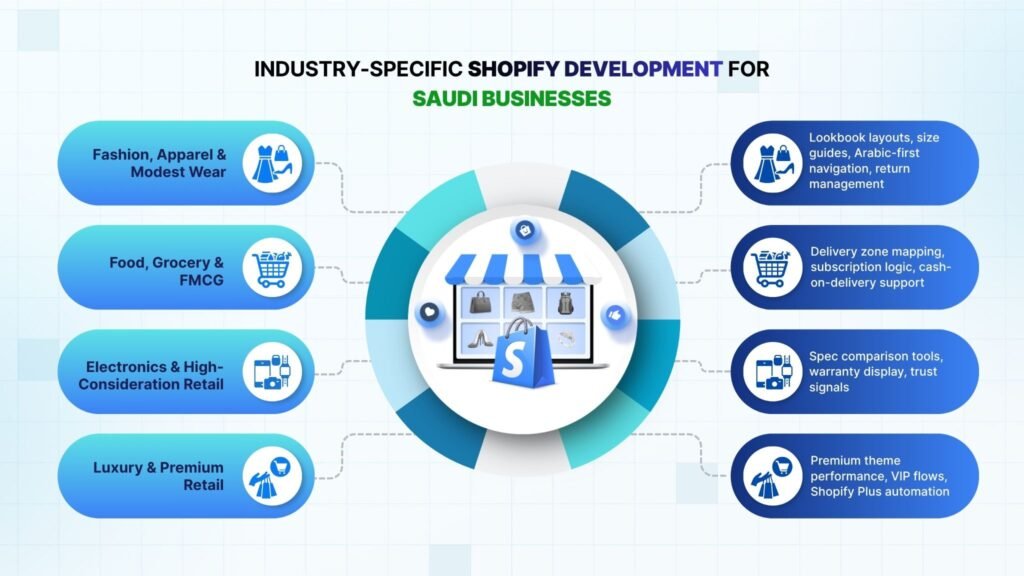
| Business Type | Development Focus |
| Fashion, Apparel & Modest Wear | Lookbook layouts, size guides, Arabic-first navigation, return management |
| Food, Grocery & FMCG | Delivery zone mapping, subscription logic, cash-on-delivery support |
| Electronics & High-Consideration Retail | Spec comparison tools, warranty display, trust signals |
| Luxury & Premium Retail | Premium theme performance, VIP flows, Shopify Plus automation |
Every Saudi industry approaches web development with a different starting point, a jewellery brand and a grocery delivery service aren’t solving the same problem, even though both need a store live and selling. Shopify’s flexibility is what makes it possible to build for that difference instead of forcing every business into the same structure.
Fashion, Apparel, and Modest Wear
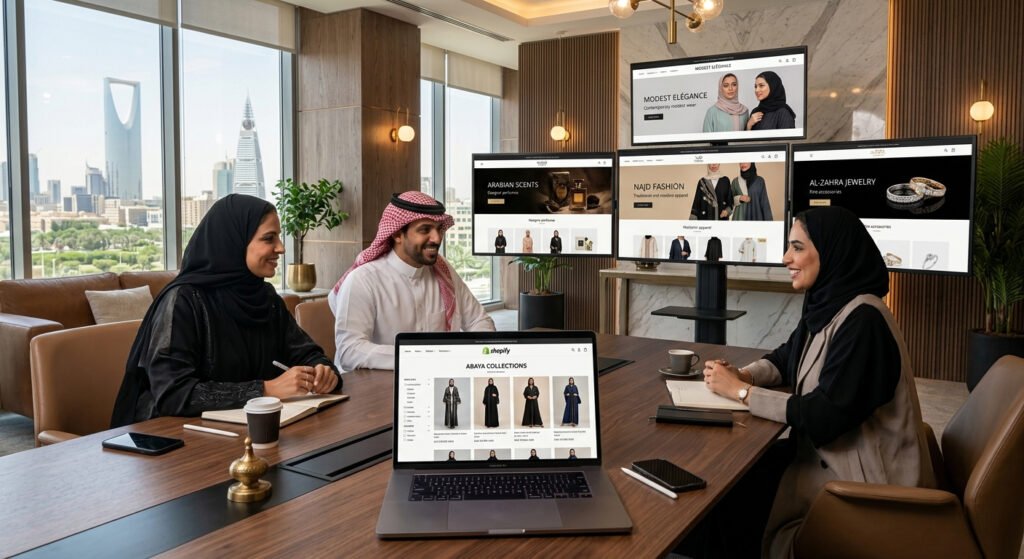
Fashion sells on how it looks before anything else, and Shopify’s theme flexibility is built for exactly that kind of visual-first store. That’s why it’s become the default platform for:
- Modest wear and abaya brands
- Footwear retailers
- Streetwear and youth fashion labels
- Boutique and designer clothing stores
- Accessories and jewellery brands
- Activewear and sportswear retailers
- Multi-brand fashion marketplaces
The build for this category needs lookbook layouts, size guides, real variant photography, and navigation built for someone browsing by style, not scrolling a plain product list. Arabic-first design has to reflect how the customer actually browses, not an English layout with the text flipped around. Return management matters more here than most categories, return rates run higher in fashion, and friction at checkout costs a repeat customer directly.
Food, Grocery, and FMCG
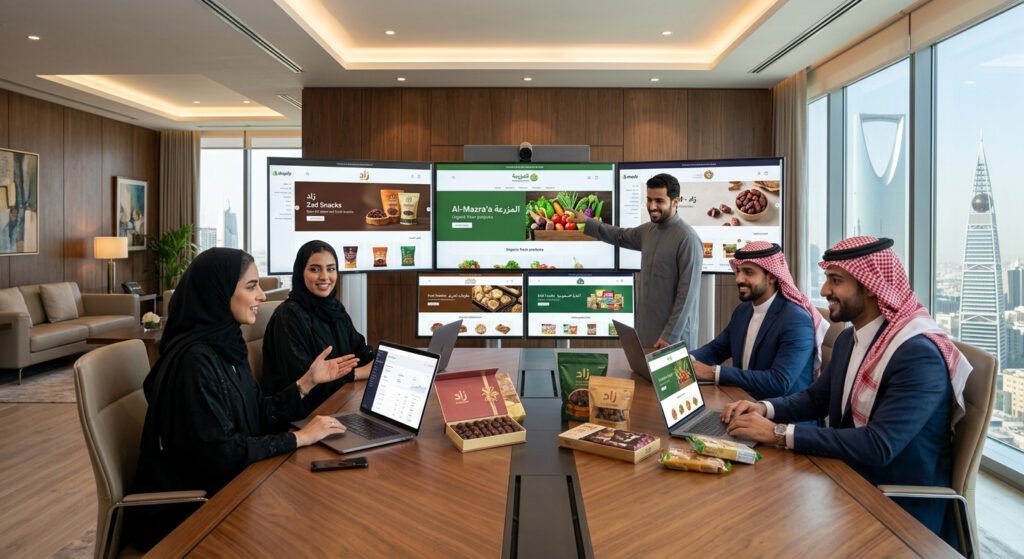
This category runs on logistics as much as product, and Shopify’s app ecosystem is what makes delivery zones, cash on delivery, and recurring orders manageable without custom-building all of it from scratch. That’s why Shopify has become the platform of choice for:
- Grocery delivery services
- Restaurant and cloud kitchen brands
- Bakeries and specialty food producers
- Beverage and supplement brands
- FMCG distributors selling direct to consumer
- Meal kit and subscription box services
- Local farms and produce sellers
Delivery zones and recurring orders are what standard Shopify handles least well out of the box, which is where custom app development earns its cost, subscription management, delivery slot booking, and a direct connection to the delivery system. Payment setup also needs to account for cash on delivery, still significant for grocery and FMCG in Saudi Arabia, alongside Mada and digital wallets.
Electronics and High-Consideration Retail
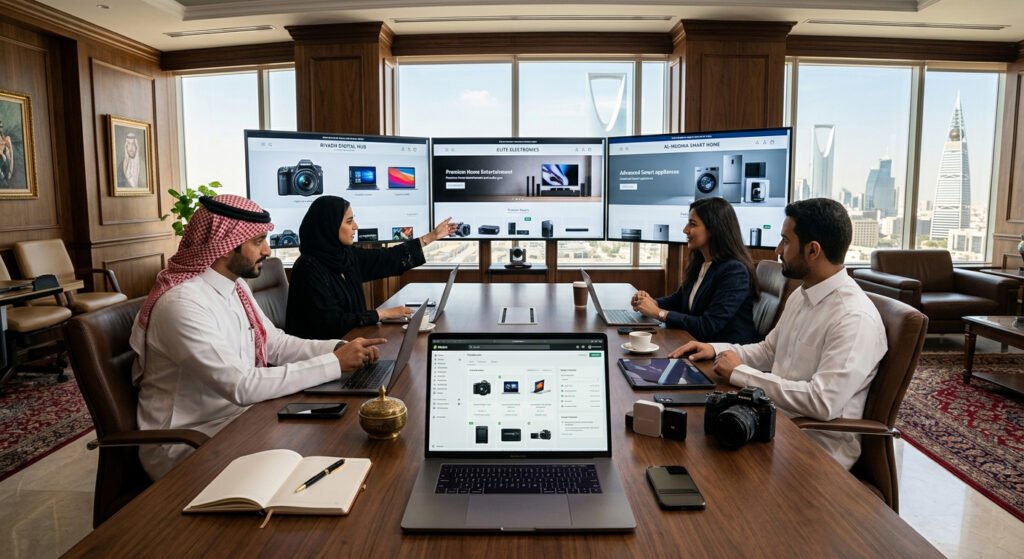
These are purchases customers research heavily before buying, and Shopify’s product page flexibility is what lets a store actually support that research instead of rushing past it with a plain listing. That’s why it’s the platform behind:
- Consumer electronics retailers
- Mobile phone and accessory stores
- Home appliance brands
- Computer and gaming hardware sellers
- Smart home and security equipment retailers
- Camera and photography equipment stores
- Furniture and home fixture retailers
The build needs to prioritize spec comparison tools, warranty visibility, and clear return policy — because the buyer is doing real homework before they commit. Trust signals decide conversion here more than how the store looks.
Luxury and Premium Retail
At this level, the store itself is part of the product, and Shopify Plus is what gives a premium brand the load speed and automation to actually perform like one. That’s why it’s the platform of choice for:
- Luxury fashion and accessory houses
- High-end jewellery and watch retailers
- Premium beauty and skincare brands
- Designer home goods and interior brands
- Exclusive fragrance houses
- Premium gifting and hamper brands
- Invitation-only or membership retail brands
Load speed and visual quality come before anything else, the store can’t look like a standard build with different colours, because animation, typography, and image treatment are part of what’s actually being sold. Shopify Plus is typically where the VIP experience lives: personalised flows, invitation-only collections, and access controls a standard checkout can’t handle. If your brand needs full creative control beyond what Shopify’s platform allows, you can consider WooCommerce development for more customised design and functionality, though it comes without Shopify Plus’s built-in automation and infrastructure.
The Shopify Development Process
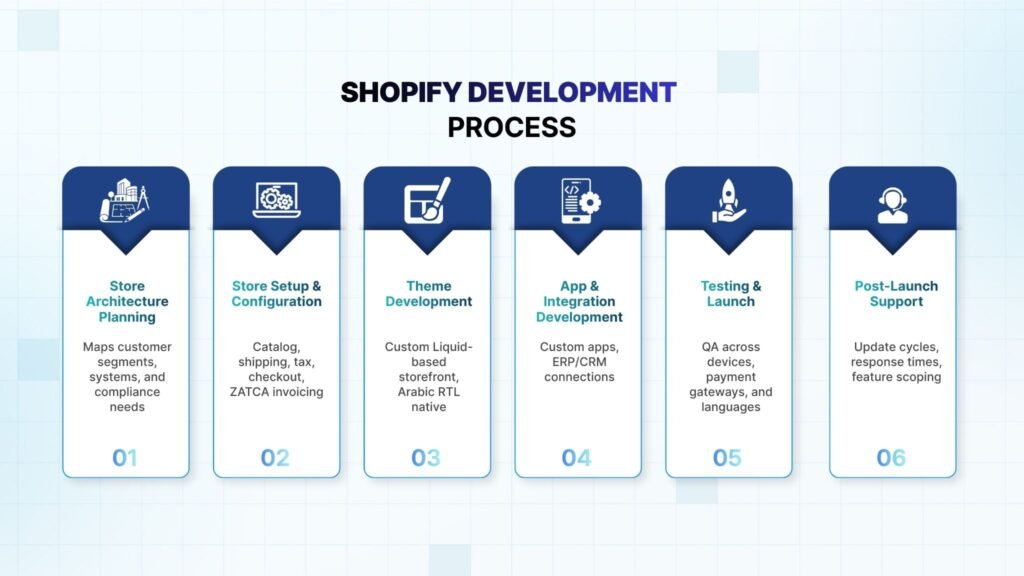
| Stage | What Happens |
| 1. Discovery & Scoping | Defines catalog complexity, integrations, and compliance needs |
| 2. Theme & UX Design | Arabic-first layout planned before visual design begins |
| 3. App & Integration Build | Custom apps and system connections built in parallel with theme |
| 4. QA Across Devices | Functional, payment, and real-device testing |
| 5. Launch & Compliance Checklist | ZATCA, VAT, payment gateway checks before go-live |
Discovery and scoping
This stage defines what your store actually needs to do: catalog size, the systems it connects to, compliance requirements, and where the business is headed next. Skip it, and nothing gets faster. It just moves the disagreements about scope into the middle of the build, where fixing them costs more and pushes launch back.
Theme and UX design
Arabic RTL layout gets planned before any visual design starts, because it’s a structural decision, not a styling one, it affects navigation, spacing, and how content reflows on different screens. Testing a prototype with real Saudi shoppers before development begins costs a fraction of what design changes cost once the theme is already coded.
App and integration build
Custom apps, ERP connections, and payment integrations get built and tested alongside the theme, not bolted on afterward. Milestone-based delivery means you see what’s actually working at each stage — not one single reveal at the very end.
QA across devices
Functional testing confirms the store works exactly as specified. Payment testing confirms Mada, STC Pay, and cash-on-delivery all go through correctly. Device testing covers the actual spread of hardware Saudi shoppers use, mid-range Android at volume, iOS concentrated at the premium end. A simulator doesn’t catch everything a real phone does.
Launch and compliance checklist
Going live is where the real work starts, not where it ends. Before any traffic moves to the new store: ZATCA invoice generation, VAT calculation, payment gateway confirmation, and redirect mapping for anything migrated all get checked and confirmed.
KSA-Specific Requirements Every Saudi Shopify Store Needs
| Requirement | Why It Matters |
| Arabic RTL & Bilingual Navigation | Primary experience for most Saudi shoppers, not a translation layer |
| Local Payment Methods & COD | Mada, STC Pay, and cash on delivery are baseline expectations |
| ZATCA E-Invoicing | Compliant invoicing must run from the first live order |
| VAT Configuration | Correct tax calculation at checkout, not adjusted after the fact |
| Mobile-First Performance | Majority of Saudi purchases happen on a phone |
Arabic RTL and bilingual navigation
Right-to-left layout is a structural decision, not a setting you switch on. It changes navigation flow, button placement, and how your content reflows on mobile. Add Arabic as a plugin on top of an English-first build, and it breaks in ways your customers notice immediately — buttons out of place, icons pointing the wrong way, a store that reads as built for someone else, not them.
Local payment methods and cash on delivery
Mada, STC Pay, and cash on delivery aren’t nice-to-haves for a Saudi store, they’re what your customer expects to see at checkout. Bury them behind international cards, and you lose the sale at the exact moment the customer had already decided to buy.
ZATCA e-invoicing
If your business is above the mandatory threshold, every transaction needs a ZATCA-compliant e-invoice: correctly formatted, signed, and sent to the Fatoorah platform. This isn’t something you install from the app store; it has to be built into your order processing from day one. Skip it, and you find out the gap exists at the worst possible time: when you actually need to produce compliant records.
VAT configuration
Shopify’s tax tools handle the calculation, but only if they’re set up correctly for Saudi VAT from the start. Get it wrong at launch, and you’re stuck manually correcting order records after the fact, a fix that’s slow, error-prone, and entirely avoidable with the right setup.
Mobile-first performance
Most of your Saudi customers are shopping from a phone, on a wide range of devices and connection speeds. Image size, app load time, and checkout speed all directly decide whether they buy or leave. A store that looks fine on mobile but loads slowly isn’t actually mobile-first; it just looks like it is.
How to Migrate an Existing Store to Shopify
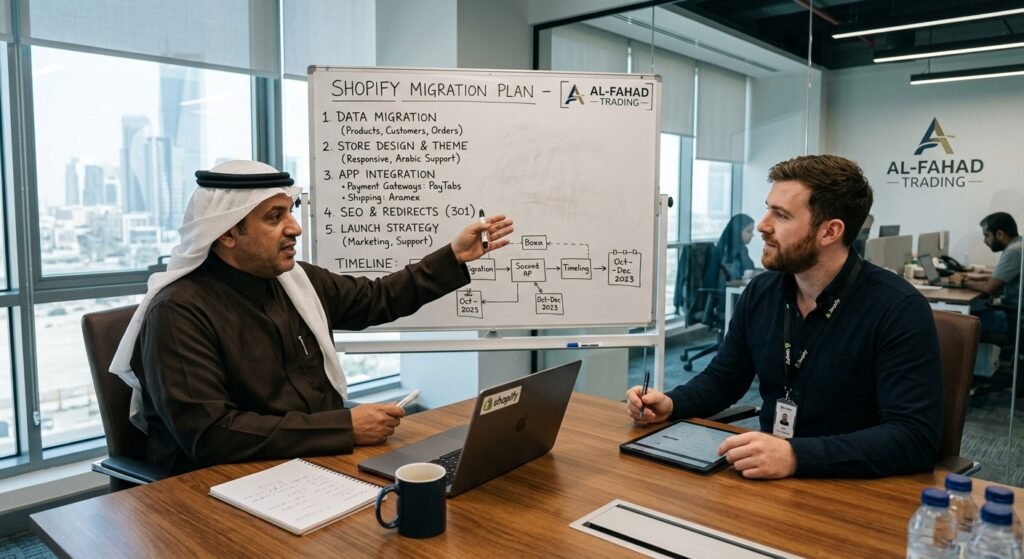
Migrating your existing store from any platform to Shopify is not a copy-paste job, it is far more complicated than that. Product data and variants, customer accounts, order history, and discount codes all have to move across correctly, and every old URL needs a 301 redirect to its new Shopify equivalent, or Google drops the rankings that page already earned.
Redirect mapping is where migrations lose the most value, and where most agencies cut corners. Skip a portion of it, and you’re telling Google those old URLs are gone, and years of rankings drop with them. WooCommerce and Salla add another layer: WooCommerce’s variant attributes need to be rebuilt manually to match how Shopify structures variants, and Salla stores bring their own product and shipping setup that doesn’t export directly either; both have to be rebuilt to match Shopify, not moved as-is.
Migrating from Zid carries its own version of this problem. Zid’s catalogue and shipping configuration are built around its own platform logic, the same way Salla’s is, which means product data and delivery rules need to be rebuilt to fit Shopify’s structure rather than exported as-is. Treat a Zid migration as a straight transfer and you’ll find broken variant data and missing shipping rules after the store is already live, not before. The same complexity works in reverse too, moving from Shopify back to Salla requires the same rebuild logic, which is why Salla development experience matters on either side of a migration, not just the Shopify side.
What Shopify Development Costs in Saudi Arabia
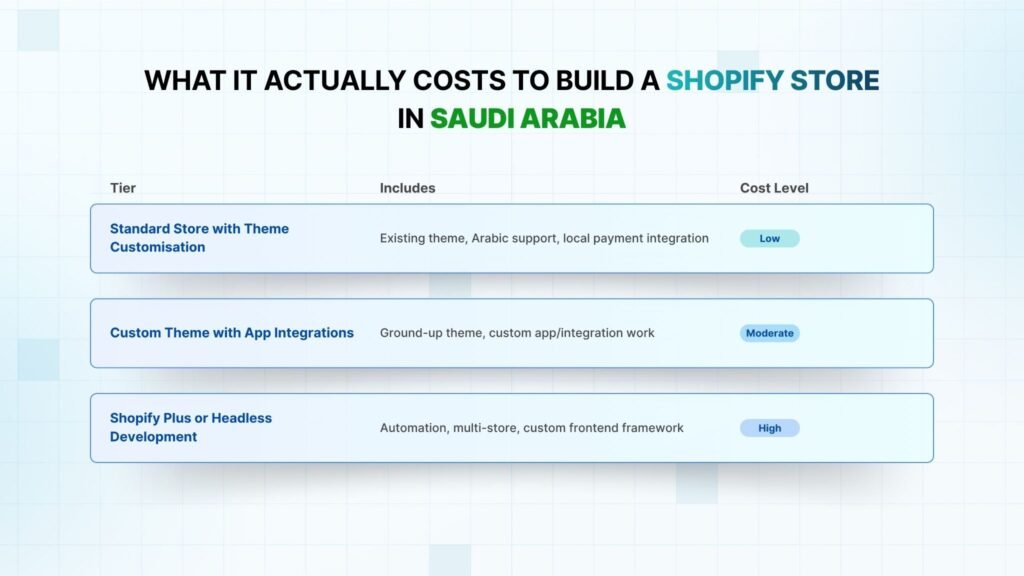
| Tier | Includes | Cost Level |
| Standard Store with Theme Customisation | Existing theme, Arabic support, local payment integration | Low |
| Custom Theme with App Integrations | Ground-up theme, custom app/integration work | Moderate |
| Shopify Plus or Headless Development | Automation, multi-store, custom frontend framework | High |
Cost is driven by four things: the type of store, the level of custom development, the integrations required, and the ongoing Shopify plan and app costs. Scope clarity is the most effective cost control on any Shopify project.
Standard store with theme customisation
The entry tier: an existing theme customised to the brand, Arabic language support, local payment integration, and standard configuration. Right for brands launching their first Shopify store with a defined product range and straightforward operations.
Custom theme with app integrations
A custom theme built from the ground up, plus app development or integration work connecting Shopify to existing systems. Most Saudi retail and fashion brands sit here, once they need a store that genuinely reflects the brand and handles specific operational requirements.
Shopify Plus and headless development
The highest tier. Plus adds platform cost on top of more complex automation and multi-store work. Headless adds the cost of building and maintaining a custom frontend on top of that. Neither makes sense until standard Shopify is actually holding the business back.
What drives cost up
App subscription costs are the most commonly underestimated line item. A store running ten to fifteen apps carries real monthly overhead that rarely makes it into the original budget. Updates, new features, and performance work after launch aren’t part of the build cost either, they’re ongoing, and need to be planned for separately.
Shopify Development: A Quick Decision Guide
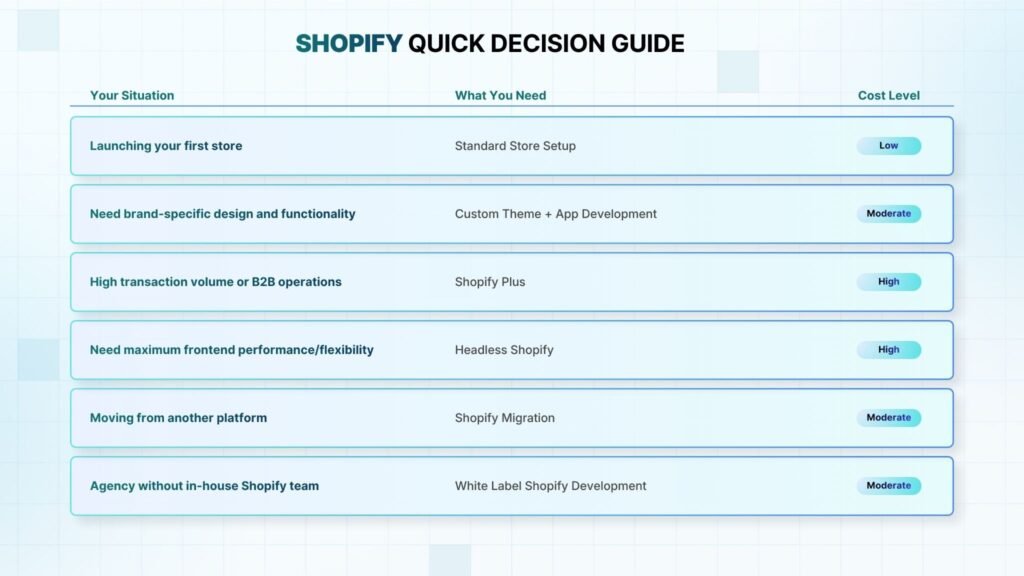
| Your Situation | What You Need | Typical Timeline | Cost Level |
| First store, straightforward catalogue | Standard Setup + Theme Customisation | 3–5 weeks | Low |
| Brand identity and operational systems both matter | Custom Theme + App Integrations | 8–14 weeks | Moderate |
| High transaction volume, multi-store, or B2B + retail | Shopify Plus | 12–20 weeks | High |
| Specific frontend performance requirements | Headless Shopify | 12–20 weeks | High |
| Agency without in-house dev capability | White Label Development | Scoped separately | Moderate |
Common Shopify Development Mistakes Saudi Brands Make
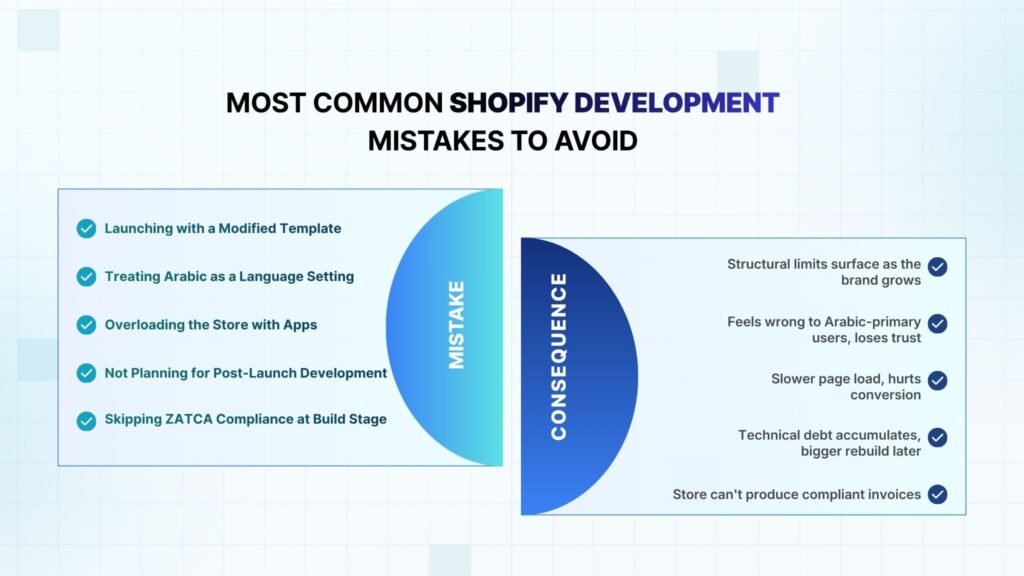
| Mistake | Consequence |
| Launching on a Modified Template | Structural limits surface as the brand grows |
| Treating Arabic as a Setting, Not a Design Requirement | Store feels wrong to Arabic-primary shoppers, trust drops instantly |
| Overloading the Store With Apps | Page load time and conversion both suffer |
| Skipping ZATCA at the Build Stage | Store can’t produce compliant invoices when it needs to |
| No Post-Launch Development Plan | Technical debt accumulates until a rebuild is unavoidable |
How to Choose a Shopify Development Company in Saudi Arabia
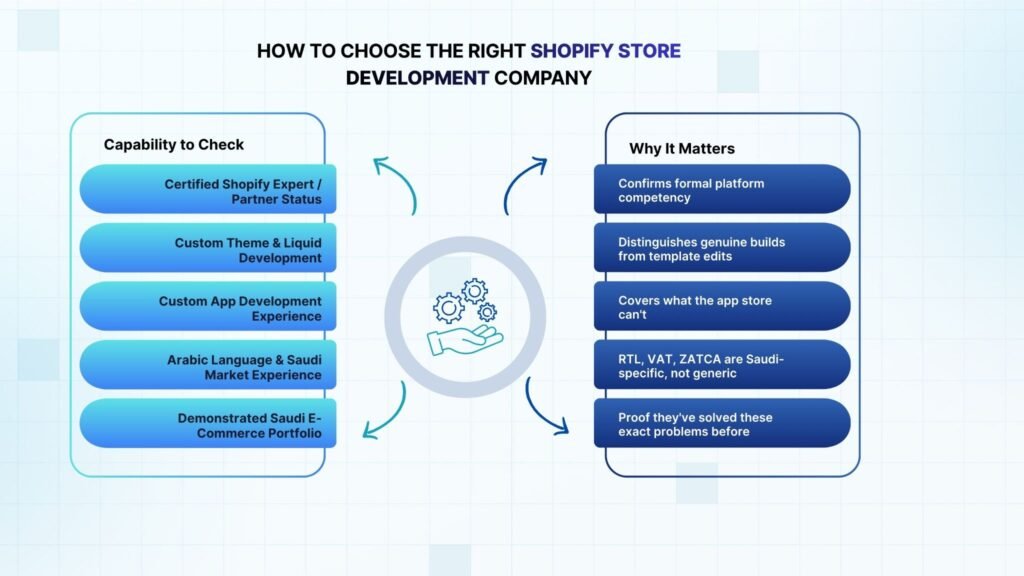
| Capability to Check | Why It Matters |
| Certified Shopify Expert / Partner Status | Confirms formal platform competency |
| Custom Theme & Liquid Development | Distinguishes genuine builds from template edits |
| Custom App Development Experience | Covers what the app store can’t |
| Arabic Language & Saudi Market Experience | RTL, VAT, ZATCA are Saudi-specific, not generic |
| Demonstrated Saudi E-Commerce Portfolio | Proof they’ve solved these exact problems before |
Certification and partner accreditation
A certified Shopify expert or Shopify Partner has demonstrated technical knowledge through Shopify’s own assessment process. It’s a baseline, not a guarantee of execution quality, but an agency operating without either credential is building on self-reported expertise.
Custom theme and Liquid capability
There’s a real difference between a team that modifies existing themes and one that builds them from the ground up in Liquid. For Saudi brands that need genuinely custom storefronts, template modification isn’t enough. Ask to see custom theme work, not modified templates presented as custom development.
Custom app development experience
The app store covers common requirements. It doesn’t cover the specific operational logic of an individual business. A company that can only configure existing apps has a hard ceiling on what it can deliver.
Arabic language and Saudi market experience
RTL design, local payment integration, VAT configuration, and ZATCA compliance aren’t generic Shopify knowledge; they’re Saudi-specific requirements a team without local experience learns on the client’s project, at the client’s cost.
Demonstrated portfolio in Saudi e-commerce
Past work is the most reliable signal. Ask specifically for Arabic-English bilingual stores, local payment integration, and ZATCA implementation examples, not just generic Shopify builds.
Why Etihad Falcon Tech is Saudi Arabia’s Leading Shopify Development Company
Full Shopify stack
Etihad Falcon Tech handles custom theme development in Liquid, custom app development, backend configuration, payment integration including Mada and STC Pay, ZATCA compliance, and bilingual design internally. There’s no handoff between separate design and development teams, which is where most Shopify project quality problems start.
Saudi market capability built into the process
Arabic RTL design, local payment methods, VAT configuration, and ZATCA e-invoicing are part of the architecture from the first planning session, not additions made at the end. We’ve delivered Shopify stores across fashion, FMCG, electronics, and luxury retail in Saudi Arabia.
Shopify Plus and headless capability
Plus development and headless architecture sit within our standard project scope, not a specialist engagement that needs a different team. If you’re scaling into automation, multi-store management, or custom frontend performance, you don’t need to go find a second vendor.
Post-launch support defined upfront
Every project includes an agreed post-launch support arrangement before development starts. Update cycles, response times, and how new feature requests get scoped and priced are all settled before your store goes live, not negotiated reactively when something breaks. If you’re planning a Shopify build and want to see how we’d approach it, contact us on WhatsApp.
Frequently Asked Questions
What is the difference between a Shopify expert and a Shopify development agency?
A certified Shopify expert usually works alone and suits focused tasks like theme customisation, app configuration, or troubleshooting. An agency gives you full-service capability: strategy, custom development, systems integration, and ongoing support. If you’re building or scaling a serious e-commerce operation, an agency gives you the continuity an individual expert can’t.
Can you build a Shopify store with full Arabic and right-to-left support?
Yes. We build Arabic RTL design into every Saudi Shopify store from the start, not as a plugin added after an English-first build. That covers layout, navigation, button placement, reading flow, and Arabic content throughout, including checkout.
Do you develop custom Shopify apps, or only use existing ones from the app store?
Both. We use existing apps where they cover what you need and build custom ones where they don’t. If you have specific operational needs, ERP connections, loyalty programs, delivery zone logic, ZATCA integration, you’ll likely need some custom app work the app store can’t provide.
What is Shopify Liquid and why does it matter for custom theme development?
Liquid is the templating language that controls how your storefront renders products, collections, customer data, and cart logic. Working at the custom theme level means building the logic behind how your store behaves across users, languages, and devices, not just editing colours and fonts. Without real Liquid capability, “custom theme development” is template modification wearing a different label.
How much does a custom Shopify store cost in Saudi Arabia?
It depends on what your store needs to do. A standard setup with theme customisation and local payment integration costs significantly less than a fully custom theme with ERP integration and custom apps. Shopify Plus and headless sit at the highest tier. Factor in ongoing plan and app subscription costs from the planning stage, don’t wait to discover them after launch.
Can you migrate an existing store to Shopify?
Yes. Migration covers your product data and variants, customer records, order history, discount codes, and SEO: redirect mapping, metadata transfer, and indexing to protect your rankings. If you’re moving from WooCommerce, Salla, or a custom platform, this needs to be scoped carefully, treating it as a simple copy-paste is where you lose data and rankings.
What is Shopify Plus and when do you need it?
Shopify Plus is the enterprise tier for high-volume operations, multi-store management, and advanced automation. You’ll need it once standard Shopify’s checkout customisation, automation capacity, or multi-store architecture starts holding you back, typically at high transaction volume or when B2B wholesale runs alongside retail.
Do you offer ongoing Shopify support after launch?
Yes. We define post-launch support before your store goes live: update schedules, response times for critical issues, and how new feature requests get scoped and priced. Treating your store as a live operational system, not a finished project, keeps it performing and cuts down on reactive fixes.