
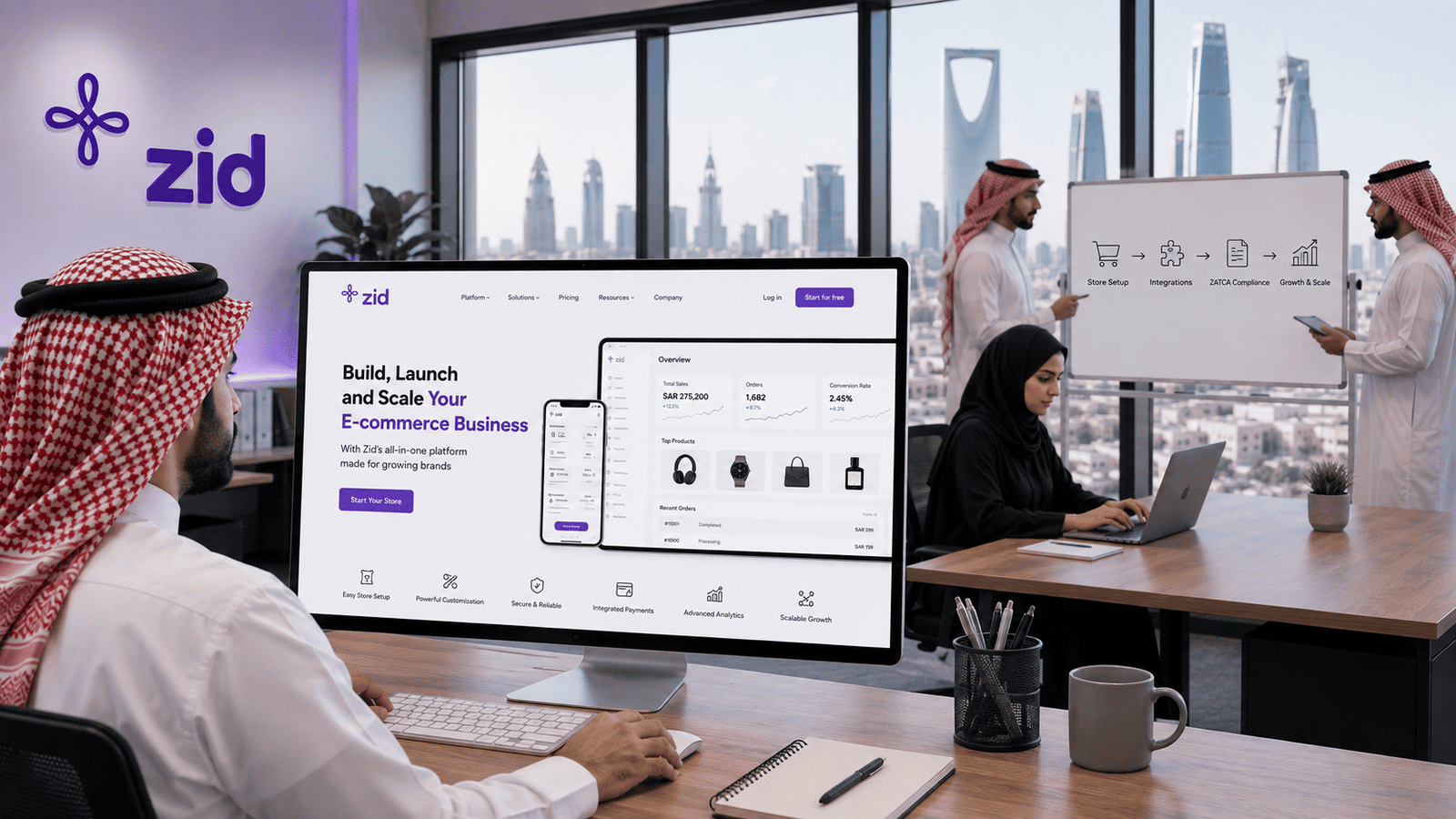
Zid now runs more than 5,590 active online stores in Saudi Arabia, according to AfterShip, a global e-commerce data and shipment tracking platform that monitors store activity across major platforms worldwide, which makes it one of the biggest e-commerce platforms in KSA.
Zid was built for merchants who’ve outgrown other smaller platforms. On Zid, Native ERP integrations keep inventory and orders in sync without manual workarounds, built-in marketplace channels let you sell across multiple storefronts from one backend, and ZATCA-compliant invoicing runs natively instead of being bolted on. Whether you’re moving up from a simpler platform or starting fresh with a business that needs real operational depth from day one, inventory, ERP, multi-channel selling; Zid is built to handle it.
However, keep in mind that Zid isn’t a plug-and-play decision. You need a proper development company that can figure out the right plan for your Zid launch. Your product catalogue, your fulfilment setup, and the systems your business needs all have to be built in a way that aligns well with the Zid platform. Get the theme, the integrations, or the marketplace configuration wrong, and Zid’s extra capability just sits there unused; your store ends up performing like any other basic setup.
This guide covers what a proper Zid e-commerce development actually takes: what to plan before development starts, how to structure it for compliance and scale, what it costs, and how to choose the right Zid e-commerce development partner to launch your business the right way.
What Makes Zid’s Infrastructure Different From Fast-Launch Platforms?
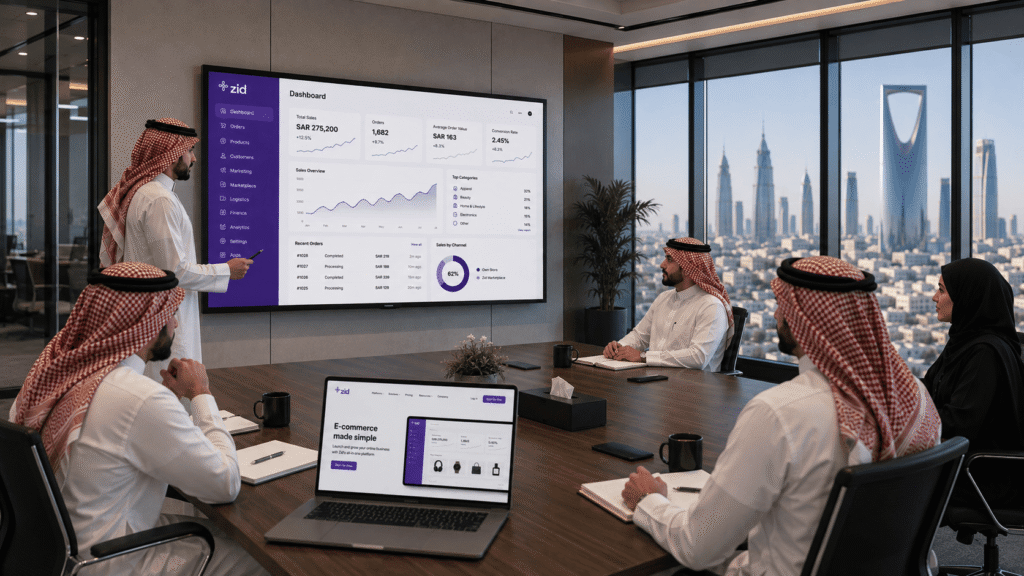
Zid’s infrastructure was built to handle the complexities that other platforms cannot. For example, if you’re managing hundreds of SKUs across multiple categories, routing orders to different couriers by delivery zone, and generating ZATCA-compliant invoices on every transaction, you’re already running an operation that basic or fast-launch platforms can’t handle. This is where Zid comes in; it’s built to carry that complexity from the start.
If your business already runs on an ERP system, a CRM, or an analytics stack, connecting Zid to it is a supported development path, not a custom engineering problem you’re solving from scratch. Zid’s API layer gets your e-commerce operation talking to the rest of your business with less friction than comparable Saudi platforms.
ZATCA, Marketplace, Logistics: Zid’s Three E-commerce Pillars
You can’t scale e-commerce efficiently if compliance is still a manual process, your marketplace reach is limited to your own store traffic, and your every courier partner needs custom integration work.
Manual processes, limited marketplace reach, and fragmented courier integrations stop you from scaling in e-commerce. Zid solves this because ZATCA e-invoicing runs inside the order flow; every transaction generates a compliant invoice automatically. The Zid marketplace gives you a discovery channel beyond your direct store. Aramex, SMSA, and Naqel are part of the platform’s logistics layer, not third-party elements you configure separately.
What Can You Actually Build on the Zid Platform?
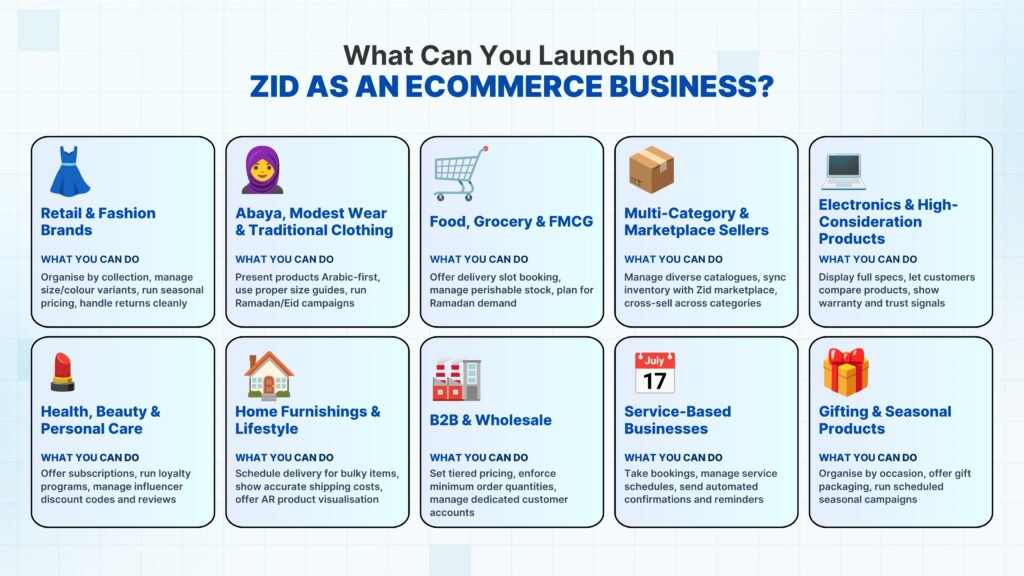
| Business Type | What You Can Do on Zid |
| Retail & Fashion Brands | Organise by collection, manage size/colour variants, run seasonal pricing, handle returns cleanly |
| Abaya, Modest Wear & Traditional Clothing | Present products Arabic-first, use proper size guides, run Ramadan/Eid campaigns |
| Food, Grocery & FMCG | Offer delivery slot booking, manage perishable stock, plan for Ramadan demand |
| Multi-Category & Marketplace Sellers | Manage diverse catalogues, sync inventory with Zid marketplace, cross-sell across categories |
| Electronics & High-Consideration Products | Display full specs, let customers compare products, show warranty and trust signals |
| Health, Beauty & Personal Care | Offer subscriptions, run loyalty programs, manage influencer discount codes and reviews |
| Home Furnishings & Lifestyle | Schedule delivery for bulky items, show accurate shipping costs, offer AR product visualisation |
| B2B & Wholesale | Set tiered pricing, enforce minimum order quantities, manage dedicated customer accounts |
| Service-Based Businesses | Take bookings, manage service schedules, send automated confirmations and reminders |
| Gifting & Seasonal Products | Organise by occasion, offer gift packaging, run scheduled seasonal campaigns |
Zid runs across a wide range of industries in Saudi Arabia. Apparel and fashion lead the platform, followed closely by beauty, fitness, and personal care, then home and lifestyle brands. These are the categories where inventory complexity, high return rates, or repeat-purchase behaviour outgrow what a fast-launch platform can handle. Food and grocery, electronics, B2B, and gifting niches cover the rest, each with its own operational demands that shape how the store needs to be built.
What you can build on Zid depends less on the category itself and more on what that category actually needs to convert and scale. Here’s how that breaks down by industry.
Apparel and Fashion
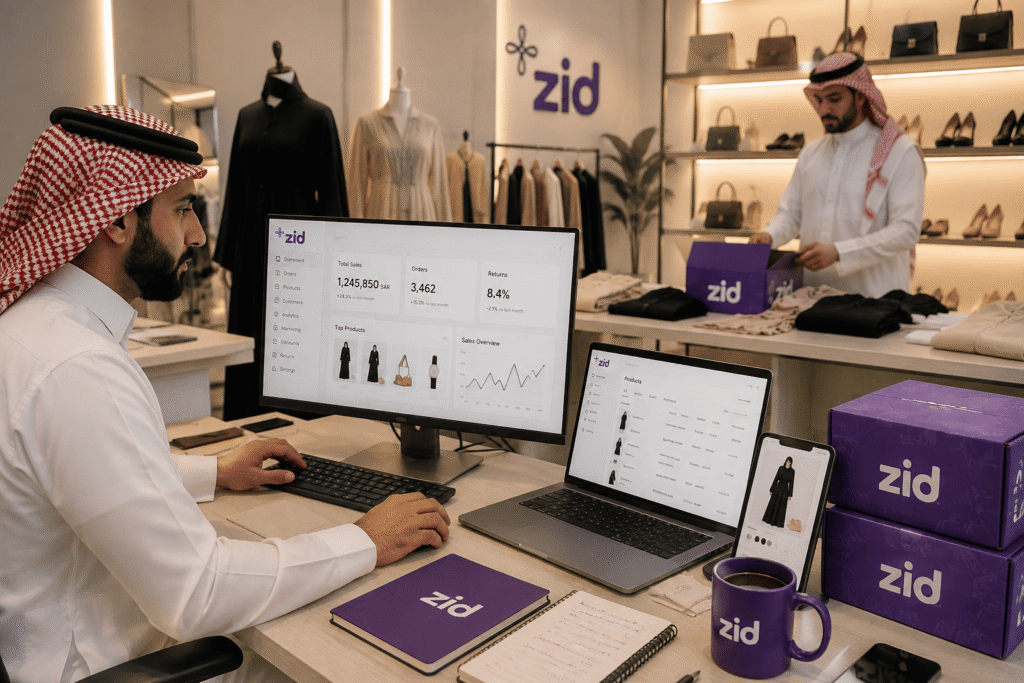
Apparel is the biggest category on Zid, and it’s a category built on variety and volume. Customers filter by size, colour, and style, seasonal collections rotate in and out, and sales need to go live on schedule. If you’re building here, plan for returns from day one. Saudi fashion return rates run high enough that a weak returns process quietly eats into your profit, sale by sale, until it shows up in your numbers.
Businesses that are building in this category on Zid:
- Clothing and apparel brands
- Abaya and modest wear stores
- Footwear and accessories
- Traditional and occasion wear
Beauty, Fitness and Personal Care
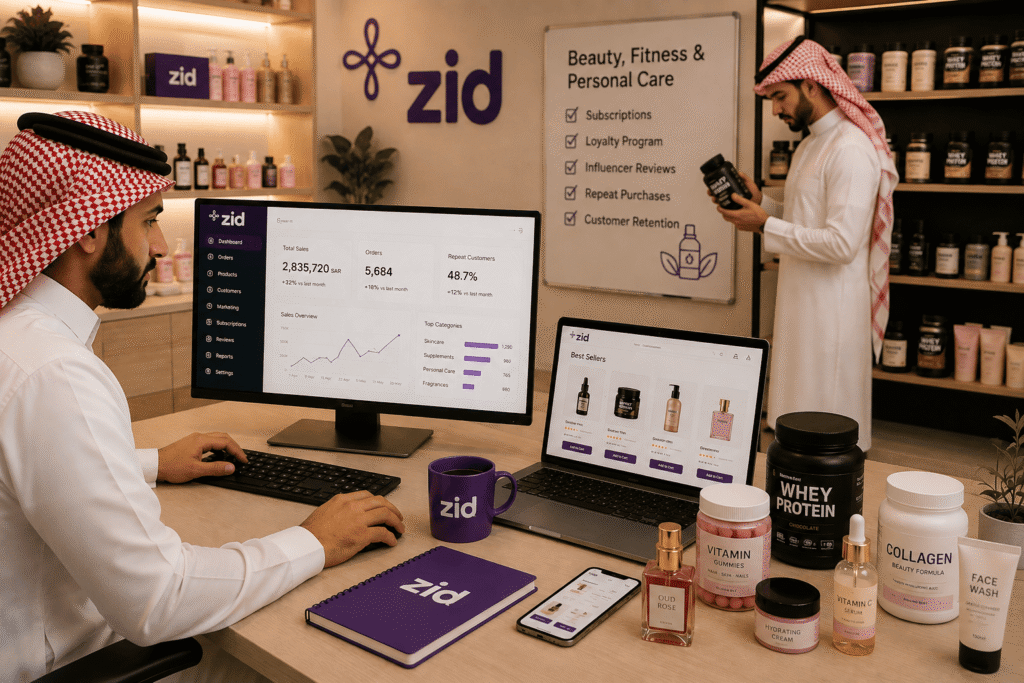
This is the second-biggest category on Zid, and it runs on repeat customers rather than one-time buyers. Someone reordering their moisturiser every month, a supplement subscription renewing itself, a loyalty reward waiting on their next visit. That’s what drives revenue here. If you’re building in this space, make sure repeat-purchase flows and influencer discount codes work cleanly at checkout, not as something bolted on after launch.
Businesses that are building in this niche on Zid:
- Skincare and cosmetics brands
- Fitness and supplement stores
- Personal care and grooming products
- Fragrance and perfume retailers
Home, Garden and Lifestyle
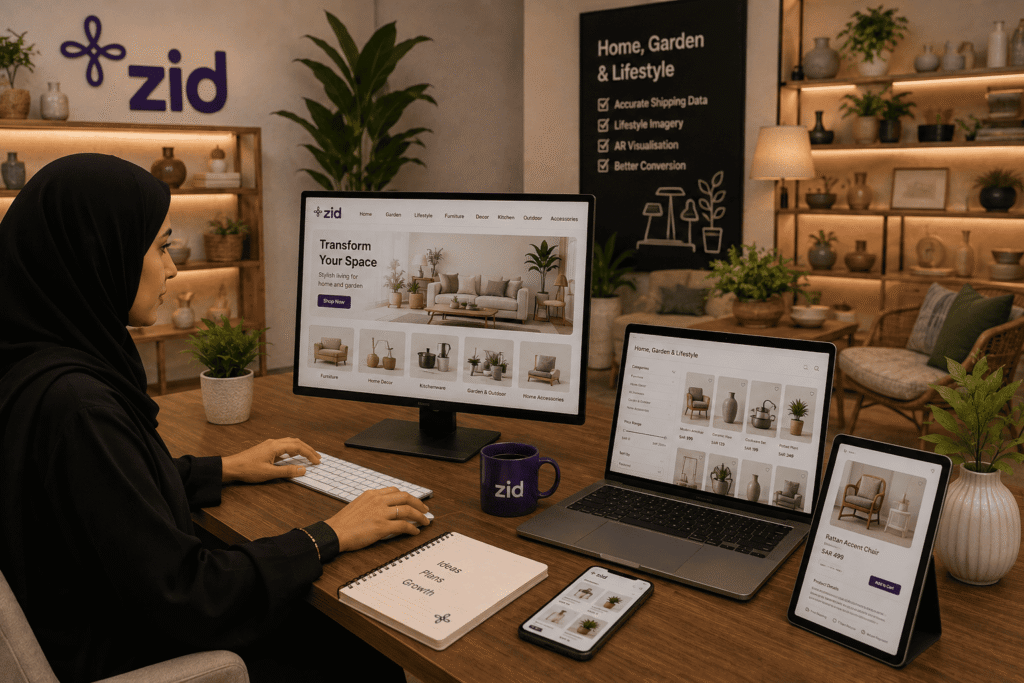
A large share of Zid stores sell into this category, and the challenge here doesn’t change. The customer can’t touch the sofa or measure the shelf before they buy. If you’re building here, real photos with a sense of scale, accurate shipping costs based on actual weight and size, and AR visualisation that lets buyers see the piece in their own room are what close the sale instead of losing it to hesitation.
The stores that get the most out of Zid in this category:
- Furniture and home décor stores
- Kitchenware and household goods
- Garden and outdoor living brands
- Interior design and home accessories
Food, Grocery and FMCG
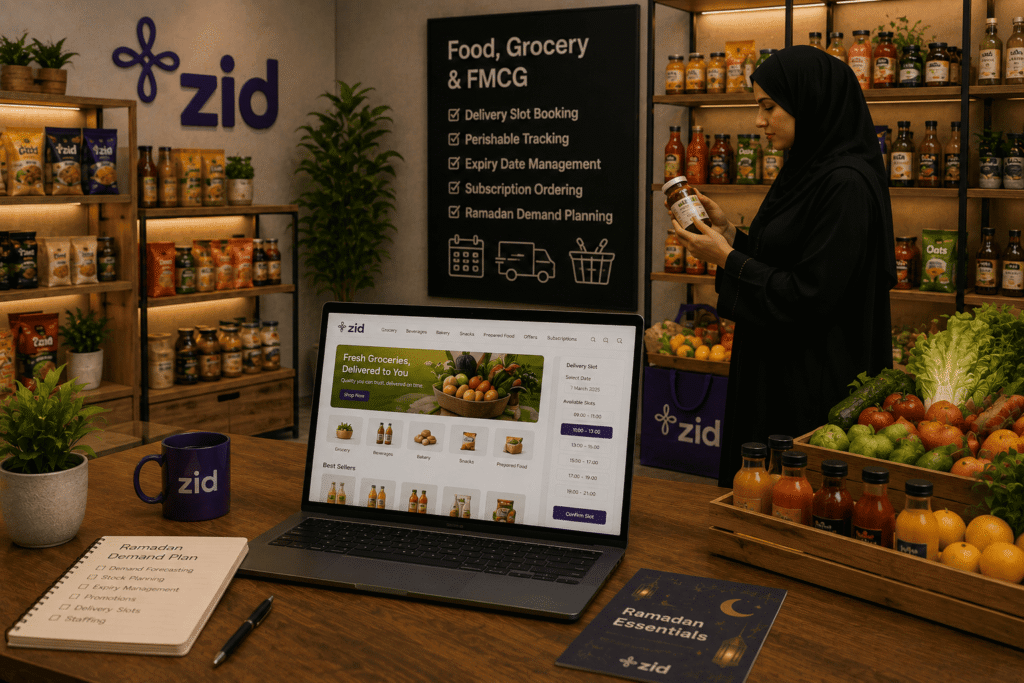
If you’re selling consumables, your requirements are different from every other category on this list: delivery slot booking, perishable SKU tracking with expiry dates, and subscription ordering for repeat purchases are what actually matter. Ramadan demand planning needs to be a system you configure ahead of the season, not something you manage by hand once it arrives.
If you’re in this space, these are the businesses Zid is built for:
- Grocery and specialty food stores
- Bakeries and prepared food brands
- Beverage and drink companies
- Subscription snack and meal boxes
Electronics and Computers

Nobody buys a laptop on impulse. Buyers in this category compare specs, check warranty terms, and look for a reason to trust the store before committing real money. If you’re building here, clear spec sheets, an easy way to compare products side by side, and visible trust signals like secure checkout and a real return policy are what get hesitant buyers to actually commit.
Zid’s setup works especially well for:
- Consumer electronics retailers
- Computer and laptop stores
- Mobile phones and accessories
- Smart home and gadget brands
Business, Industrial and B2B
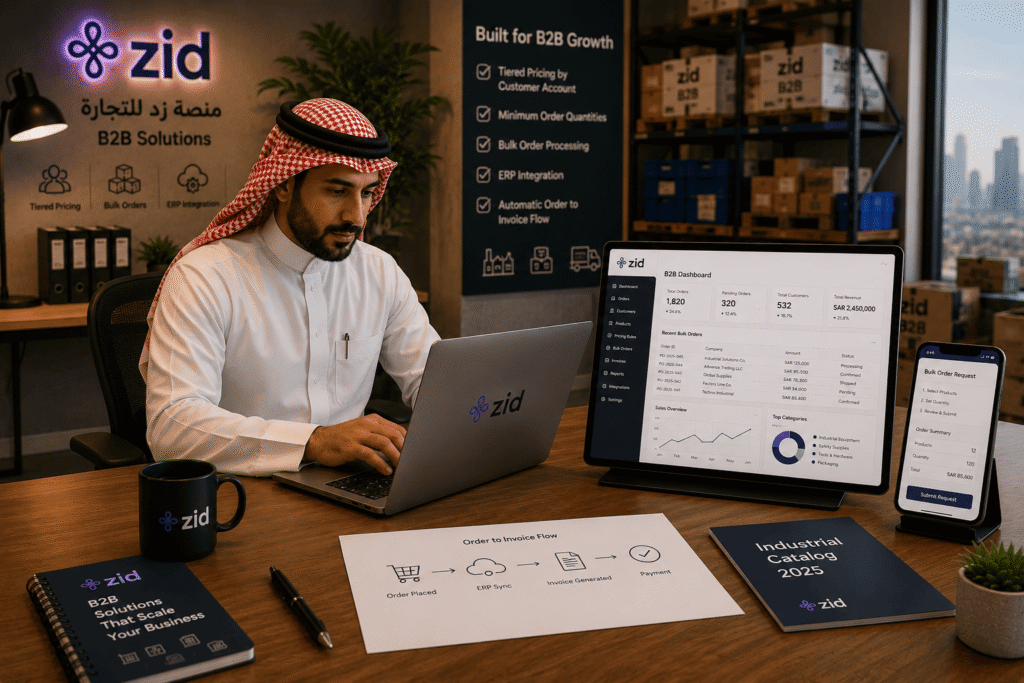
This is where Zid pulls ahead of Salla. B2B buyers don’t want a retail price list. They want their negotiated rate, a sensible minimum order quantity, and an invoice that lands in their accounting system without anyone typing it in by hand. If you’re building here, get the ERP connection right early. It’s what makes the operation run itself instead of running through your inbox.
This is where B2B sellers like these benefit most:
- Wholesale and distribution businesses
- Industrial supply and equipment
- B2B trading companies
- Manufacturer direct-to-business stores
Store for Gifts and Special Products

A smaller but consistent category on Zid, built around timing: occasion-based navigation, gift packaging options at checkout, and campaign scheduling for Eid, National Day, and other Saudi gifting moments. If you’re building here, set up your seasonal campaign tooling ahead of time. Manual handling during peak season is one busy week away from something breaking.
Businesses that make the most of this on Zid include:
- Gift shops and hamper businesses
- Flower and occasion delivery
- Personalised and custom gift brands
- Seasonal and holiday retailers
What Does Zid Development Actually Cover?
| Stage | What Happens |
| 1. Operational Mapping | Defines what the business sells, who the buyer is, and what systems the store needs to connect to |
| 2. Store Setup & Configuration | VAT/ZATCA, payment gateways, shipping zones, catalogue architecture |
| 3. Theme & Arabic UX Design | Storefront built Arabic-first, mobile-first checkout designed |
| 4. Integration Development | ERP, CRM, and marketplace channel connections built and tested |
| 5. Launch | Store goes live, potentially in phases for complex builds |
| 6. Scaling & Optimisation | Conversion optimisation and performance work as the business grows |
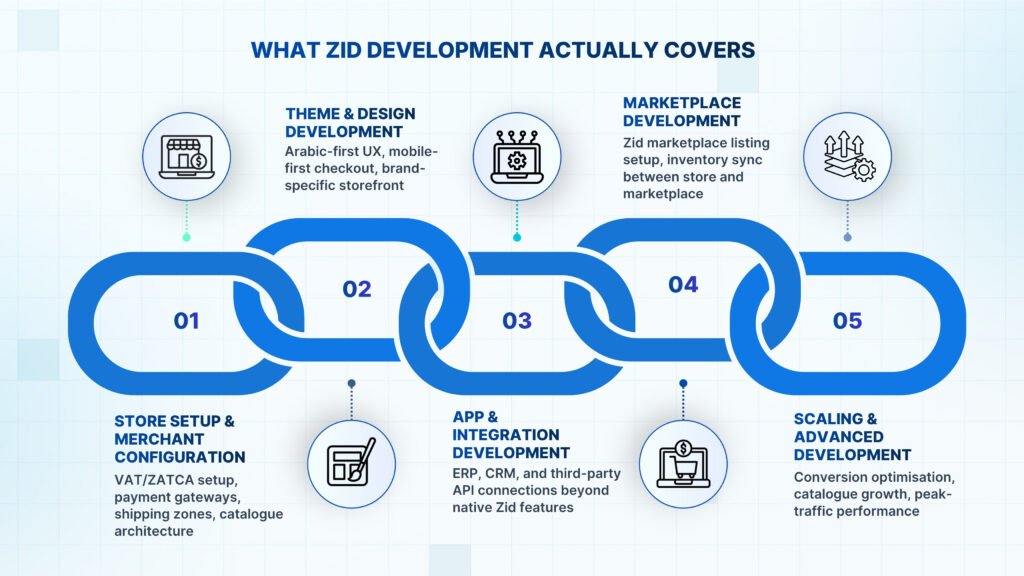
Zid development isn’t a single service. It spans initial store setup, custom theme development, app and integration development, marketplace configuration, and ongoing scaling work. Each stage carries different requirements depending on your business model.
Store Setup & Merchant Configuration
A properly configured store starts with your merchant account: VAT registration, ZATCA setup, payment gateways, shipping zones, and catalogue architecture. Getting this right before you process a single order matters more than most merchants expect.
A catalogue structure that works for fifty products becomes a navigation problem at five hundred. Shipping zones built for Riyadh-only delivery need rework the moment you expand into Jeddah and the Eastern Province. Set ZATCA up wrong at the start, and you’re generating non-compliant invoices that need retroactive correction. This is where the structural decisions get made.
Theme & Design Development
Zid’s default themes give you a functional starting point. The gap between that and a store that reflects your brand, converts for your specific category, and feels right to the Saudi buyer landing on it — that gap is custom theme development.
Arabic RTL on Zid isn’t a CSS override bolted onto an English-first layout. It’s designing your information hierarchy, navigation, and checkout around how Arabic-primary users actually move through a page. A Saudi buyer spots a translated-feeling store immediately, and the conversion difference shows up in your data within days of launch.
Mobile-first isn’t a responsive tweak on a desktop design either. Most of your Saudi traffic arrives on mobile. Build the mobile experience as the primary one — tap targets, checkout field density, payment presentation, load speed — all optimised for how your customers actually shop.
App & Integration Development
When your business model needs something the platform doesn’t cover natively — a loyalty system with specific tiering logic, an ERP connection to your Saudi accounting system, a CRM integration for retention campaigns, a custom reporting dashboard — that’s custom app development.
ERP connection changes your operation the most. When orders flow from Zid into your ERP automatically, inventory updates in real time, and financial records get created without manual entry, you stop running e-commerce and accounting as two separate systems. If you’ve done that sync by hand before, you already know exactly how much time it eats every day.
Third-party API connections extend Zid into the rest of your stack — marketing automation, analytics tools, loyalty systems, and logistics APIs for couriers outside Zid’s standard integration library.
Marketplace Development
Most Zid merchants underuse their marketplace channel. Setting up as a seller, optimising listings for marketplace search, and syncing inventory between your direct store and the marketplace so stock stays accurate across both — that’s the work that separates merchants who actually get the reach benefit from those who switch it on and forget about it.
Selling multi-channel means unified inventory isn’t optional. A product that sells out on the marketplace but stays listed on your direct store creates oversells and customer service headaches. Get the sync right from the start.
Scaling and Advanced Development
Once your store is live, development shifts to optimisation — conversion work through user journey analysis, catalogue management as your range grows, upsell and cross-sell logic, and the performance infrastructure that keeps working under real traffic.
If you’re running high volume, especially around Ramadan and Eid, standard configuration won’t hold. Page speed under load, checkout stability during spikes, and inventory accuracy during high-velocity selling are what separate stores that survive peak season from stores that fail publicly right when it matters most.
How Is Zid Different From Salla, Shopify and WooCommerce?
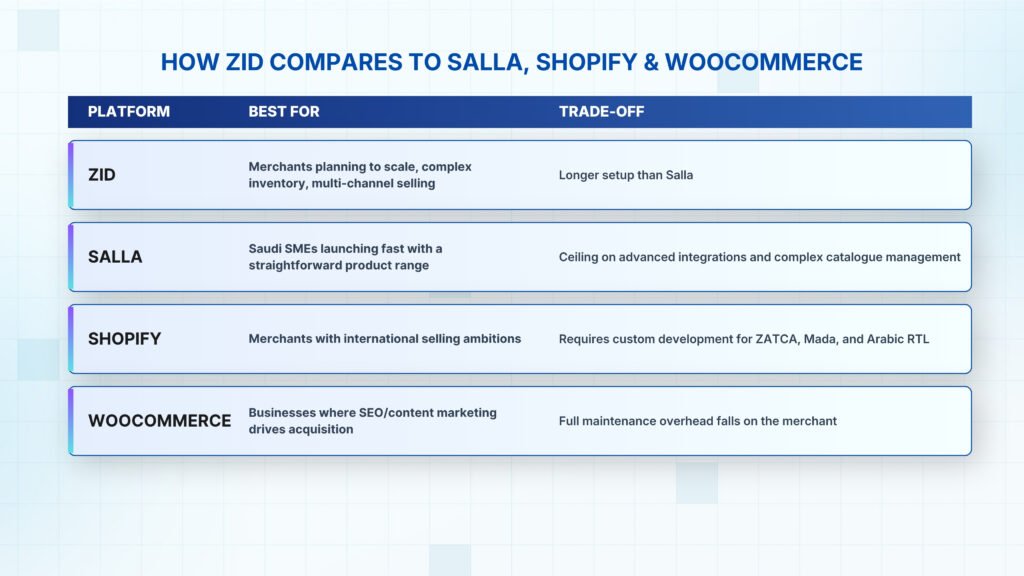
| Platform | Best For | Trade-Off |
| Zid | Merchants planning to scale, complex inventory, multi-channel selling | Longer setup than Salla |
| Salla | Saudi SMEs launching fast with a straightforward product range | Ceiling on advanced integrations and complex catalogue management |
| Shopify | Merchants with international selling ambitions | Requires custom development for ZATCA, Mada, and Arabic RTL |
| WooCommerce | Businesses where SEO/content marketing drives acquisition | Full maintenance overhead falls on the merchant |
Zid vs Salla
Both platforms are Saudi-built and share the same compliance advantages — Arabic-first design, ZATCA e-invoicing, Mada and STC Pay. The real difference is operational depth.
If you’re launching your first store with a straightforward catalogue, Salla’s lower-friction setup is a genuine advantage. The ceiling shows up the moment you need advanced integrations, complex catalogue management, or multi-channel selling that Salla doesn’t fully support. Custom Salla development can extend that ceiling somewhat through app-marketplace integrations and store customisation, but it won’t fully close the gap with Zid’s built-in operational depth.
Zid takes longer to set up correctly — and that extra time buys you more integration options, more catalogue flexibility, more room to scale. If you already know you’re building toward real volume, starting on Zid saves you the migration most Salla merchants eventually have to make.
Zid vs Shopify
Shopify’s global ecosystem — app marketplace, developer network, multi-currency, international shipping — is more mature than Zid’s. If you have international ambitions, that’s a genuine edge.
If your market is Saudi, though, Shopify means custom development to reach what Zid gives you natively: ZATCA needs building, Mada needs a third-party gateway, Arabic RTL needs a compatible theme or custom work. Zid absorbs those costs inside the platform itself.
Run the numbers honestly: the development spend to localise Shopify to Saudi standards closes most of the perceived cost gap between the two platforms.
Zid vs WooCommerce
WooCommerce gives you more flexibility: full control over hosting, an open codebase, deep WordPress content integration. If SEO and content are your primary acquisition channel, that’s a real advantage.
The trade-off is maintenance. Hosting management, security monitoring, plugin upkeep, that’s ongoing development spend just to keep the lights on. If selling is your business, not managing infrastructure, that overhead usually costs you more than the flexibility is worth.
When Zid Is the Right Choice
Planning to scale, manage complex multi-category inventory, sell across store and marketplace at once, and connect e-commerce to the rest of your business systems? Zid is built for that. Simpler, Saudi-only needs may be well served by Salla. International expansion plans deserve a hard look at whether Shopify’s global reach is worth the localisation cost.
If you’re not sure which platform fits your specific situation, book a free consultation with our experts, message us on WhatsApp.
What Does It Actually Cost to Build a Zid Store in Saudi Arabia?
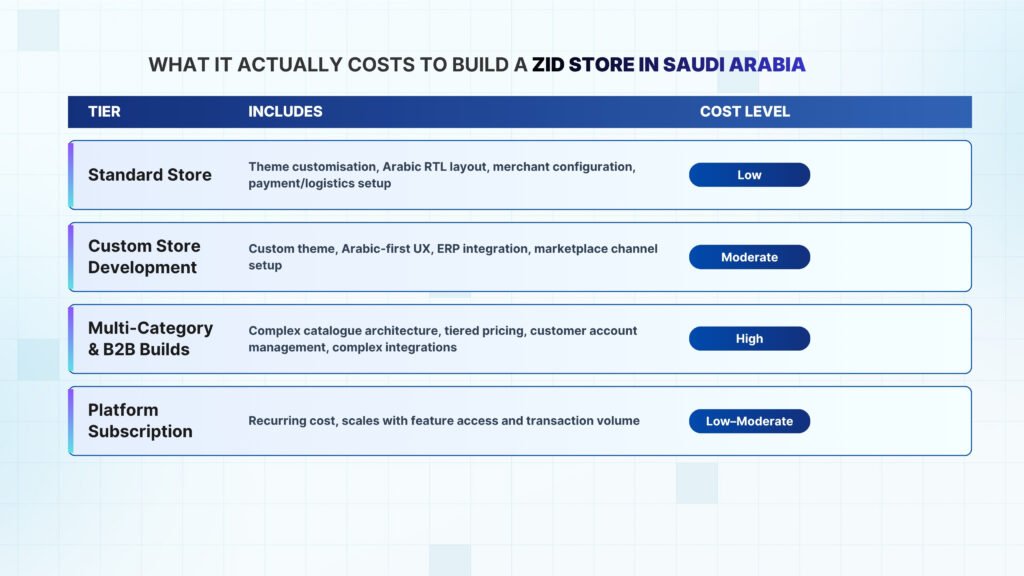
| Tier | Includes | Cost Level |
| Standard Store | Theme customisation, Arabic RTL layout, merchant configuration, payment/logistics setup | Low |
| Custom Store Development | Custom theme, Arabic-first UX, ERP integration, marketplace channel setup | Moderate |
| Multi-Category & B2B Builds | Complex catalogue architecture, tiered pricing, customer account management, complex integrations | High |
| Platform Subscription | Recurring cost, scales with feature access and transaction volume | Low–Moderate |
What to Look for When Choosing a Zid Developer in Saudi Arabia
Arabic UX Experience That Goes Beyond RTL Configuration
The difference between a developer who adds RTL support and one who designs Arabic-first shows up in how the final store feels to your Saudi buyer. Stores where Arabic was configured rather than designed consistently show higher mobile bounce and lower checkout completion than stores built Arabic-first from the wireframe.
Integration Capability Matched to Your Requirements
If your project needs ERP connection, CRM integration, or custom app work, confirm your developer has actually built these before — not that they’re technically capable of it. First-time integration work on an unfamiliar system takes longer and breaks more than work on a system they’ve connected to Zid previously.
ZATCA and Saudi Compliance Verification
A developer who treats ZATCA configuration as a standard setup step, not something to figure out mid-project, understands the Saudi compliance environment well enough to get it right the first time. Ask specifically how they handle VAT category configuration and invoice output verification before your store goes live.
Post-Launch Development Commitment
Your Zid store at launch is the start of an operational system, not a finished project. Your catalogue grows. Integrations need maintenance. Marketplace listings need optimisation. Conversion work needs ongoing development based on your analytics. A developer who only builds and doesn’t stick around leaves you finding a new partner every time something needs to change — and for a growing operation, that’s often.
Zid Development: A Quick Decision Guide
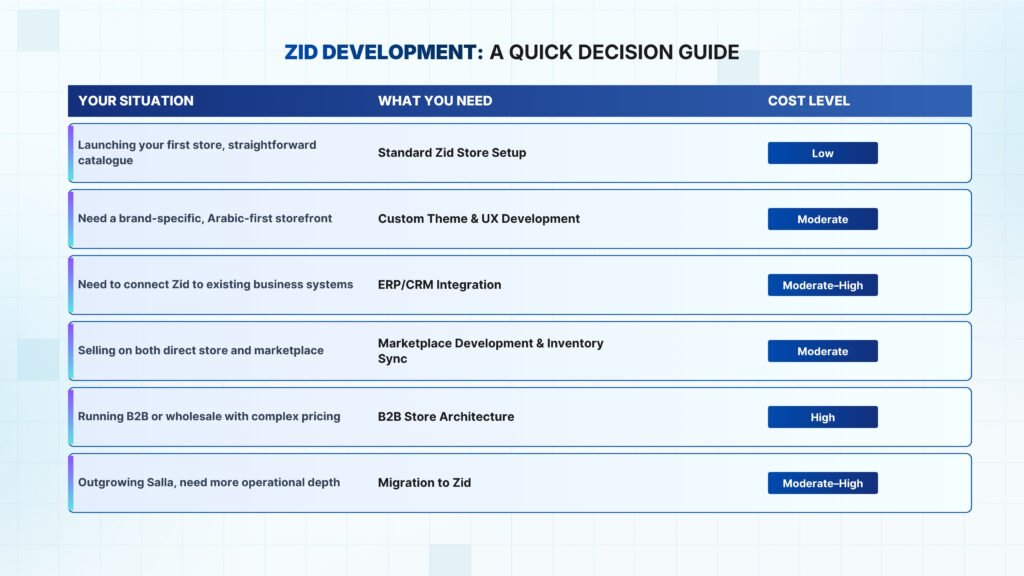
| Your Situation | What You Need | Cost Level |
| Launching your first store, straightforward catalogue | Standard Zid Store Setup | Low |
| Need a brand-specific, Arabic-first storefront | Custom Theme & UX Development | Moderate |
| Need to connect Zid to existing business systems | ERP/CRM Integration | Moderate–High |
| Selling on both direct store and marketplace | Marketplace Development & Inventory Sync | Moderate |
| Running B2B or wholesale with complex pricing | B2B Store Architecture | High |
| Outgrowing Salla, need more operational depth | Migration to Zid | Moderate–High |
How Does Etihad Falcon Tech Build Zid Stores for Saudi Merchants?

Etihad Falcon Tech’s Zid development starts with understanding your business model. Before any theme decision or catalogue structure gets planned, we map your operational model: what you sell, who your Saudi buyer is, what systems your store needs to connect to, which marketplace channels matter, and what compliance configuration your category requires.
What’s Built In-House
Custom Zid theme development with Arabic-first UX, merchant configuration and ZATCA compliance verification, marketplace setup and inventory sync, ERP and CRM integration, custom app development for what the platform doesn’t natively cover, and Arabic content architecture, all handled internally, no handoff between separate design and development teams. Quality problems in e-commerce development almost always start at handoff points between teams working from separate briefs.
Saudi Market Built Into Every Build
Arabic-first UX, Mada and STC Pay configuration, ZATCA e-invoicing verification, marketplace channel setup, and Saudi logistics integration are part of every Zid store we build — not additions bolted on after you ask for them. We’ve delivered Zid stores across fashion, food and grocery, electronics, home furnishings, and B2B wholesale. The specific requirements of your category are understood before your project brief is even written.
Integration Depth
Our Zid development includes ERP connections if you need order data flowing into your operational systems, CRM integration for post-purchase retention, marketplace configuration with unified inventory management, and third-party API connections for analytics and marketing platforms. If you need your Zid store working as part of a broader business operation, not a standalone channel, planning that integration from the start gets you a cleaner result than bolting it on after launch.
Post-Launch Support Defined Before Development Begins
Every Etihad Falcon Tech Zid project has a post-launch support arrangement agreed before development starts: update schedules, response times for critical issues, ongoing development for new features, and how marketplace and conversion optimisation work gets scoped. Merchants who plan for ongoing development alongside the build run their Zid stores more effectively than those who treat launch as the finish line.
If your current platform is limiting where your business can go, or you’re launching a new Zid store and want it built right from the start instead of rebuilt when the first limitation shows up, that’s the conversation to start.
Frequently Asked Questions
How long does it take to build a Zid store in Saudi Arabia?
A standard store — theme, Arabic setup, payment and logistics — takes 4–6 weeks with content ready. Custom builds with ERP integration and marketplace setup take 8–10 weeks. B2B builds with complex integrations take 10–16 weeks. Note: missing Arabic content or photography delays every stage.
Is Zid better than Shopify for Saudi businesses?
For Saudi-focused merchants, yes, ZATCA compliance, Mada payments, and Arabic RTL are built in. Shopify makes more sense if you need international selling and a global app ecosystem. Localising Shopify for Saudi compliance often closes the cost gap anyway.
Do I need a developer to build a Zid store?
A store built to convert: custom Arabic-first theme, ERP/logistics integration, marketplace setup, needs a developer with Zid experience.
Is Zid suitable for large businesses?
Yes. It handles large catalogues, high order volumes, and ERP/CRM/marketplace integrations. High-volume merchants (e.g. during Ramadan/Eid) may need extra performance optimisation.
Can Zid integrate with ERP and CRM systems?
Yes, Zid’s API supports ERP, CRM, analytics, and logistics integrations. Cost and timeline depend on scope, so plan integration as its own project phase.
What is Zid’s biggest advantage over other Saudi platforms?
It combines ZATCA compliance, marketplace access, logistics integration, and scalable architecture in one Saudi-native platform — no custom localisation needed.
How does Etihad Falcon Tech approach Zid development?
We start by understanding your business goals, then plan platform setup, theme development, integrations, and support as one system. Arabic-first design, ZATCA compliance, and Saudi logistics are standard in every build.