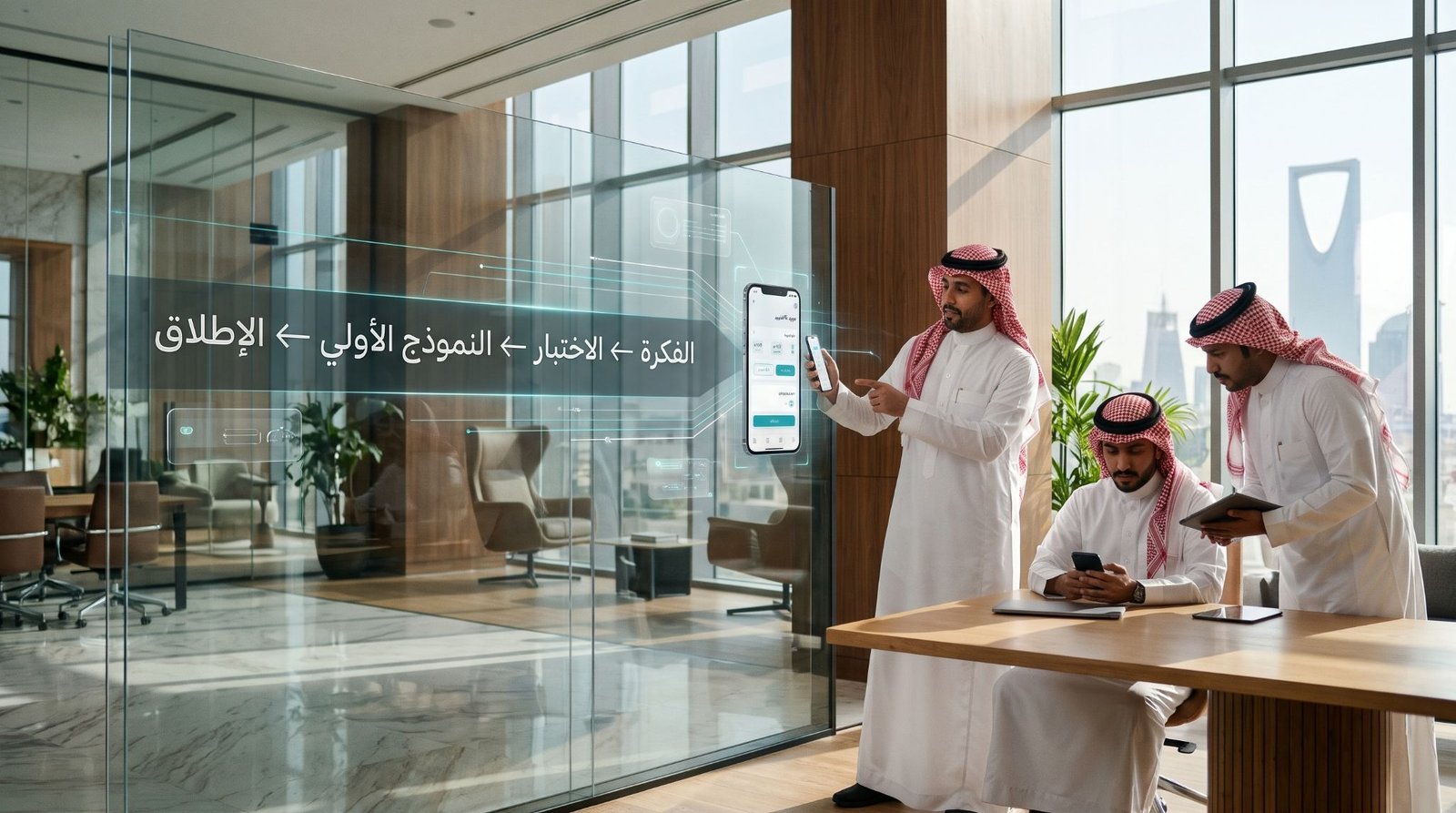
An MVP app is the first working version of your app, with only the features you need to test your main idea on real users. MVP stands for minimum viable product. “Minimum” means just the core features go in. “Viable” means those features have to work well enough that people can actually use them. And “product” means a real app that people download or open in a browser, not a design file or a slide deck.
Why does this matter for a startup? A full app takes months and a big part of your budget, and you don’t find out whether anyone wants it until it’s live, which is a pretty late time to find out. An MVP turns that order around. You build the smallest useful version, put it in front of real users and watch what they do, and what they do tells you what to build next. Honestly, that’s a better guide than another meeting inside your own team.
Small doesn’t mean careless. Behind the screen there’s still a login system, data storage, the way the app handles personal data under PDPL, the links to the business systems you already use, and ZATCA e-invoicing if the app issues invoices. Get these right in the first version and you grow the app later; get them wrong and you’re rebuilding it, which is exactly the trouble an MVP is meant to save you from. That’s why MVP work belongs inside professional mobile app development and not in a rushed side project.
Below, we go through how an MVP differs from a full build, which Saudi startups need one, how to decide the scope, the steps to build and launch, the technology choices, web app versus mobile app, cost, common mistakes, and what to do once users arrive.
How Is MVP App Development Different From Full Mobile App Development?
Full mobile app development means building the complete product you picture at the end, with every feature, every screen and every type of user. An MVP is one slice of it, the slice that shows whether people want the app at all. If your budget is limited (and most startup budgets are), this difference decides how much money is at risk before a single user gives you feedback.
So what does an MVP look like in practice? The features are only the core ones that prove your idea. The timeline runs from a few weeks to a few months, and the budget goes on those core features and nothing else. Your first users are a small group, not the whole market. The design is clean and easy to use but not polished on every screen, because the goal is to learn what users do, not to impress them.
Is it wasted work once the full app comes along? Not if the MVP was built properly. The design, the backend and the code carry forward, so the next stage starts from something real and not from zero.
Who Needs an MVP App, and When Does It Make Sense?
If you’ve got an app idea and haven’t yet seen real users sign up, use it and come back to it, you need an MVP. First-time founders fit here, and so do startups getting ready for investor meetings. Established Saudi businesses launching a new digital product next to their main business fit too, and a company that wants to test a new service line before going all in on a full build is in the same spot.
The biggest risk in a new app isn’t the technology. It’s building something people don’t use. An MVP shows you that risk early, while changing direction is still cheap.
There’s one case where it makes less sense: an internal tool with fixed requirements, like an app that replaces a paper process your team already follows. The users and the workflow are known already, so you can plan the full build straight away.
Which Saudi Startup Industries Build MVP Apps First?
Every sector in the Saudi startup scene tests something a little different in its first version, but the rule stays the same everywhere: one core job, done well, for a small group of users.
For example, fintech startups begin with sign-up, identity checks and one core money feature. E-commerce starts with product browsing, a cart and checkout for a small range. Food and grocery delivery starts with ordering, order tracking and delivery status for one area. Health tech usually opens with appointment booking and secure patient records.
Education apps tend to start with lesson access, progress tracking and enrollment. Logistics needs shipment booking and live tracking for one route type, real estate needs listings, search and agent enquiries, and travel and tourism need trip search and booking for one type of experience. On-demand services begin with service booking and provider matching in one area, fitness and wellness with workout plans, progress tracking and class booking, and HR and recruitment with job posting, candidate profiles and applications. Events and entertainment? Event discovery and ticket booking.
Find the industry closest to your idea, then cut its list down to the one feature your users can’t live without.
How Do You Decide What Goes Into Your MVP App?
Deciding matters more than building here, because every feature you add delays the launch and pushes the cost up. Four questions get you to a clear scope.
Who’s the one user? Pick the single type of person the app is for. A delivery app might serve customers first and leave restaurant dashboards for later. What’s the one problem? You should be able to write it in one sentence, and if it takes two, you’ve probably got two apps on your hands. Then comes the one action, whether that’s ordering, booking, paying or matching, since everything in the MVP is there to help the user finish it. Last, what can wait? Sort every other idea into must have, nice to have and later, and only the must haves go in.
Take a grocery delivery startup. It needs browsing, ordering, payment and delivery tracking. Loyalty points, referral codes and ratings can wait until users have shown they’ll order a second time.
How Do You Build an MVP App Step by Step?
Skip the first step and you’ll spend the rest of the budget guessing. Here are the seven steps, in order.
- Talk to people who have the problem. Ask how they solve it today and what annoys them most. If nobody feels the problem, you’ve just saved your whole budget.
- Fix the scope with the four questions above and write down the final feature list. Once it’s agreed, new ideas go on a later list, not into the build.
- Design the main flow. Sketch the screens as wireframes, turn them into a clickable prototype, and test it with five or six people before any code is written. Changing a drawing costs far less than changing an app, and that’s the whole point of doing it first.
- Choose the technology, based on your users, your budget and where you want the app to go. The next section compares the main options.
- Develop the core and test as you go. Build only the scoped features, and test on real phones along the way, not only at the end.
- Launch to a small group through Apple’s TestFlight and Google Play’s testing tracks, or just share a link if it’s a web app.
- Measure and decide. Three numbers matter: how many people sign up, how many finish the main action, and how many come back within a week.
Which Technology Should You Use to Build an MVP App?
The best technology for an MVP is the one that gets a working app to users fast without trapping you later. Four options cover most startups, and each fits a different situation.
Flutter MVP: One Codebase for iOS and Android
Flutter is Google’s toolkit for building iOS and Android apps from a single codebase, so you pay for one build instead of two. It suits startups that need both phone types from day one and want a custom-looking interface without a big budget. A change is made once and shows up on both platforms, so testing cycles stay short, which really helps when you’re iterating every week. The catch is that you need a developer with real Flutter experience, since it runs on the Dart language.
MVP in React Native: Built on JavaScript
React Native is Meta’s framework for the same job, iOS and Android from one JavaScript codebase. It’s a natural pick if you already have JavaScript developers, or if you plan to build a web version with the same skills. So which is better, Flutter or React Native? For an MVP, both work well. Choose the one your team knows best, because their experience will decide your speed more than the framework will.
Bubble MVP App Development: No-Code Speed
Bubble is a no-code platform, mainly for web apps, where you arrange elements on a screen instead of writing code. Non-technical founders like it because they can test a business idea quickly and cheaply. Growth is where it hurts. Bubble apps can slow down as users increase and you can’t export the code, so a rebuild is the usual next step once the idea works. Use it if you already plan to rebuild after the idea is proven. Don’t use it if you expect to scale on it.
Django MVP: A Backend That Grows With You
Django is a Python framework for the server side of an app, the part users never see: the database, user accounts and business rules. In a Django MVP, the backend runs on Django while the screens run on Flutter, React Native or the web. It fits startups whose app will store user data, orders or content that has to grow. Login and an admin panel come built in, so there’s less to build before launch, and the backend moves into the full app afterwards, no starting over.
Should Your MVP Be a Mobile App or an MVP Web App?
Not every MVP has to live on a phone. A web MVP opens in a browser, so users download nothing and you don’t wait for app store review. It suits startups whose users work on laptops, like business teams, and apps that are mostly forms, dashboards and bookings. It’s also the quickest way to put an idea in front of people and change it the next day.
A mobile MVP makes more sense when the app needs the phone itself, meaning the camera, GPS, push notifications or offline use. It also fits consumers who’ll open the app every day, and an app store listing can add trust to your idea. Business users who only visit when they need the service are usually better off with the web version.
There’s a middle option too, the progressive web app. It’s a web app users install on their home screen, so it feels like a mobile app without going through the app stores. Still not sure? A web MVP built through web development is the lower-cost first test, and you can build the mobile app once the idea proves itself.
How Much Does MVP App Development Cost?
An MVP costs less than a full app because you’re paying for fewer features, not for lower quality. If you’re comparing MVP app development services, the first thing to check is the scope behind every quote, since two quotes only compare if they include the same things. Here’s how the cost levels sit when you create an MVP app:
| Type of MVP | Cost Level |
| No-code MVP on a platform like Bubble | Low |
| Single-platform MVP with basic accounts | Low-Moderate |
| Cross-platform MVP (Flutter or React Native) with an admin panel | Moderate |
| MVP with payments, maps or system integrations | Moderate-High |
| MVP with AI features, real-time features or many user roles | High |
What Drives Your Cost Up or Down
- Number of features: each one adds design, build and testing time.
- User roles: an app with customers, providers and admins costs more than one with a single user type.
- Integrations: payment methods (mada, Apple Pay, STC Pay) if your app takes payments, ERP and business systems, maps, messaging and ZATCA e-invoicing each need setup and testing.
- Platforms: one platform costs less than iOS, Android and web together.
- Design depth: clear, simple screens cost less than custom animation and heavy branding.
What Mistakes Do Startups Make When They Build an MVP App?
| Mistakes |
| Adding every feature to the first version |
| Skipping user interviews |
| Choosing technology by trend |
| Launching to everyone at once |
| Ignoring PDPL and data handling |
| Skipping Arabic and RTL testing |
| Tracking nothing after launch |
| Treating a no-code build as permanent |
What Should You Do After Your MVP Launches?
Once real users are in, your three numbers start telling you something. If people sign up, finish the main action and come back, the idea works and you can plan the next features. If they sign up but never finish, something in the main flow is wrong and needs fixing first. If very few people sign up at all, the problem may be the idea or the people you’re reaching, and it’s much better to learn that now than after a full build.
Those numbers also give you something real to show investors, accelerators and early partners. Moving to the full product then becomes a normal next stage of mobile app development, built on the design and code you already have.
Why Work With Etihad Falcon Tech for MVP App Development in Saudi Arabia?

Maybe you’ve got an idea and no technical team. Maybe you’ve received a quote for a full app and you’re not sure you should spend that much before testing. Or maybe a no-code build is already hitting its limits. Those are the situations we build MVP apps for at Etihad Falcon Tech.
Scoped Around What You Need to Learn
We don’t start with a feature list. We start with the question your first users need to answer, and then we cut the scope until only the features that answer it remain. It’s meant for startups with more ideas than budget, which is most of them. You leave the first conversation with a clear list of what goes into the MVP, what waits, and why.
One Team, From Idea to First Users
Design, development, testing and launch sit with one team, so nothing gets lost between a designer, a developer and a tester who’ve never spoken. We recommend the technology that fits your test, whether that’s a cross-platform mobile app, a web app or a no-code build, and we’ll tell you honestly if a simpler option is enough. Arabic and English layouts are part of the build from the first screen, not something added after launch.
Compliant From Day One
Your MVP collects real user data from its very first user, so the foundations have to be right from the start. We build around PDPL requirements, connect the app to your ERP and other business systems where you need it, follow the rules of your sector, and set up ZATCA e-invoicing wherever the app issues invoices. If your app takes payments, we set up mada, Apple Pay, STC Pay, Tabby or Tamara, whichever your model needs. That way the MVP you launch is one you can grow.
Built to Grow Into the Full App
We don’t build throwaway MVPs. We build the first version so the design, the backend and the code carry into the full app, whether that’s six months from now or two years. If you later need a full mobile app, a web platform or software development for the systems behind it, the work continues from where the MVP stopped.
Got an app idea and wondering what belongs in the first version? Message us on WhatsApp and tell us what your app does, who it’s for and what you want to learn from your first users. We’ll tell you honestly what belongs in your MVP, what should wait, and whether you need a mobile app or a web app first.
Frequently Asked Questions
What is MVP in app development?
It’s the first working version of an app, built with only the core features needed to test the idea with real users.
How long does it take to build an MVP app?
A focused MVP takes a few weeks to a few months, depending on the features, platforms and integrations. A full app takes much longer.
Can I build an MVP app without coding?
Yes. No-code platforms like Bubble let you test an idea quickly, but you’ll need to rebuild with custom code once you outgrow them.
Is Flutter or React Native better for an MVP?
Both build one app for iOS and Android. Pick the one your developers know best, since that decides your speed more than the framework does.
How much does MVP app development cost?
It depends on your features, user roles, integrations and platforms, and it sits well below the cost of a full app. Compare quotes by what each one includes.
Do I need an MVP if I already have funding?
Yes. Funding lets you build more, but it doesn’t tell you what users want. An MVP does, before you spend it.
Does my MVP need to follow PDPL?
Yes, if it collects personal data like names, phone numbers or locations. Set up consent and data storage properly from the first version.
Can an MVP become the full app later?
Yes, if it was built with a clean structure. A rushed MVP needs a rebuild instead.
Should my MVP launch on iOS and Android at the same time?
Not always. Launching on one platform or as a web app first costs less, and Flutter or React Native can cover both when you’re ready.