
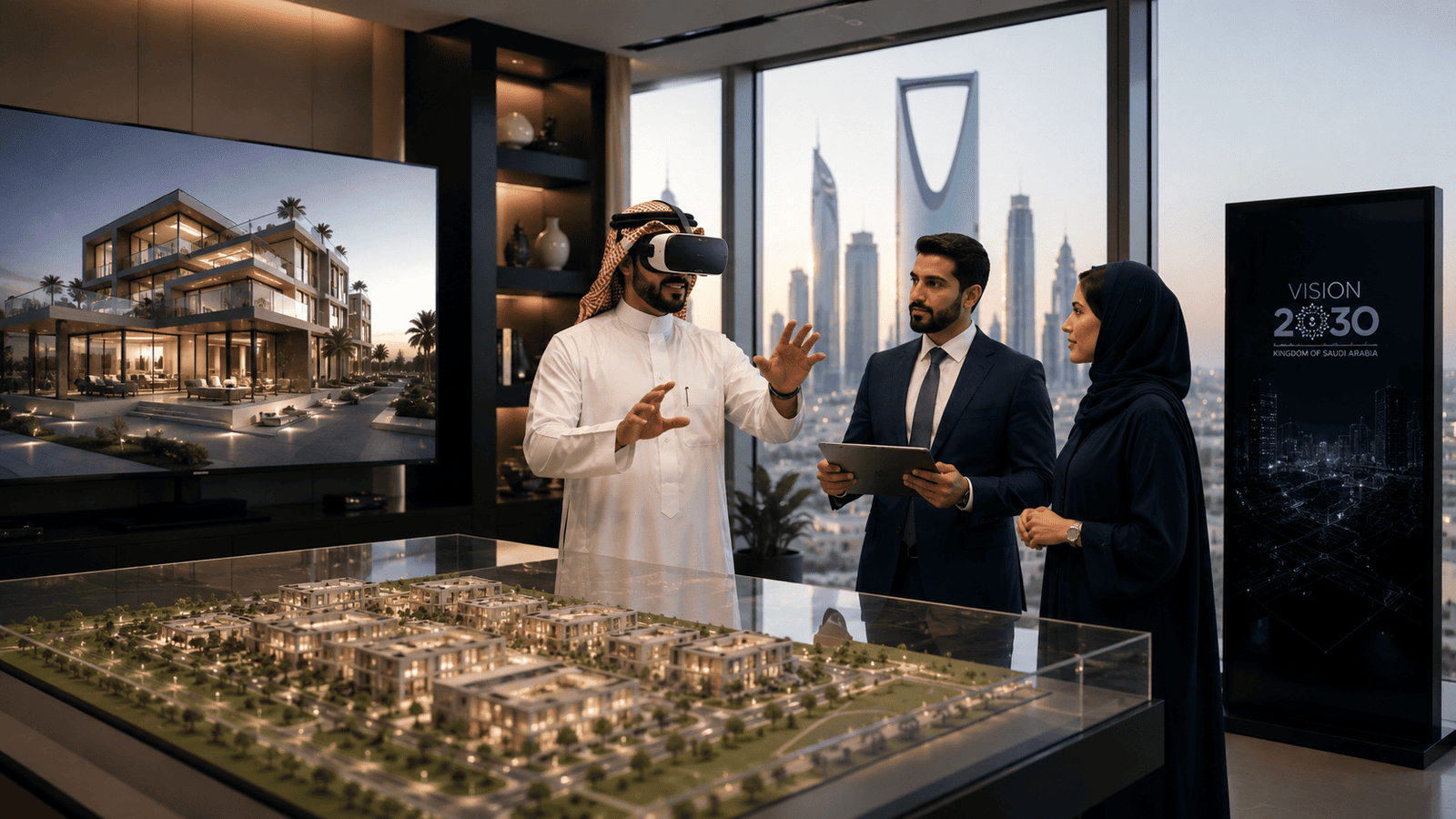
Saudi Arabia’s real estate market was valued at USD 77.2 billion in 2025 and is projected to reach USD 141.6 billion by 2034, according to IMARC Group. New residential developments, commercial expansions, giga-project infrastructure, and an influx of international buyers are all entering the KSA market simultaneously.
That level of investment demands a more advanced way to sell projects. And VR in real estate is exactly what Saudi developers are turning to. It removes the doubt in a buyer’s mind because VR helps them experience the property before it is built, walk through the space at full scale, and make a confident decision without guessing.
Buying a property is one of the biggest financial decisions a person makes. And yet most buyers are still being asked to commit based on a floor plan, a render, and a sales agent’s description. That gap between what they are shown and what they need to feel sure is exactly where sales slow down. Virtual Reality closes this gap. The buyer sees the space, feels the scale, and gets the answers they needed before they walk out the door. The decision that would have taken two more meetings now happens in one.
This guide covers how VR is being used across Saudi real estate, what it does at each stage of the buyer journey, what implementation involves, and what it takes to deploy it in a way that produces real commercial outcomes.
What Is the Difference Between a 360 Tour and a Full VR Walkthrough?
A 360 tour is a series of panoramic photographs stitched together. The buyer stands in pre-set spots inside the property and rotates their view from each fixed position. It is a useful tool for early-stage digital marketing and gives remote buyers a general sense of the space. But the buyer is always an observer. They are looking at the property, not moving through it.
A full VR walkthrough is a different experience entirely. The buyer moves through the unit the way they would move through a completed apartment. They choose where to walk, where to look, and how long to spend in each space. They stand in the bedroom and understand whether the dimensions work for how they live. They look out the window at the actual view the floor will have. The space is experienced at full human scale, which is the only scale that tells a buyer whether a property actually works for them.
That difference in experience produces a measurable difference in outcome. Which is exactly why VR in real estate improves sales in ways that 360 tours and renders cannot.
How VR in Real Estate Can Help You Improve Sales
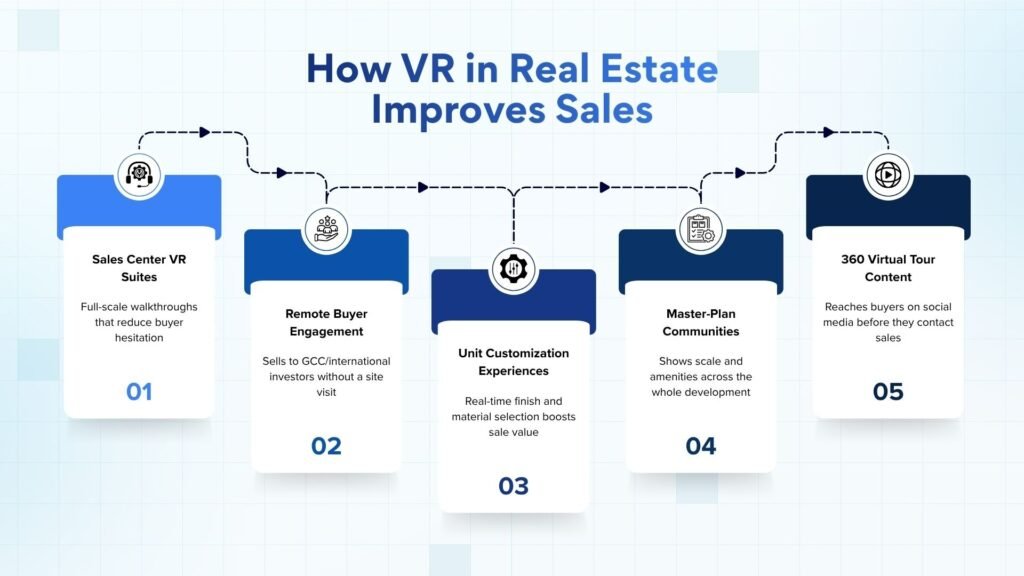
| Channel | What It Does |
| Sales Center VR Suites | Full-scale walkthroughs that reduce buyer hesitation |
| Remote Buyer Engagement | Sells to GCC/international investors without a site visit |
| Unit Customization Experiences | Real-time finish and material selection boosts sale value |
| Master-Plan Communities | Shows scale and amenities across the whole development |
| 360 Virtual Tour Content | Reaches buyers on social media before they contact sales |
VR delivers commercial value through five channels, and each one solves a different problem in how you sell, market, or lease property in Saudi Arabia.
Close Buyers in the Sales Center
If you’re running a sales center, you already know the pattern: a buyer looks at the scale model, flips through the brochure, and tells you they need to think about it. What they actually mean is that they can’t picture themselves in the space yet, and no floor plan is going to fix that.
A VR suite changes that conversation because it replaces the model with the real thing. The buyer puts on a headset and walks through the unit at full scale instead of imagining it from a drawing. They stand on the balcony and see the actual view. They move from the bedroom to the living room and feel whether the layout works, not just whether it looks like it should on paper.
When a buyer has already lived in the unit before they’ve signed anything, they leave your sales center with a decision instead of a reason to come back a third time.
Sell to Buyers Who Never Visit the Site
A meaningful share of your buyers, whether they’re purchasing off-plan or an existing property, aren’t standing in front of you when they actually decide. GCC investors in Kuwait, the UAE, and Bahrain. Saudi nationals living abroad. International buyers watching what Vision 2030 is building and deciding where to put their money.
Flying these buyers in for a site visit is expensive, and it rarely happens to line up with the moment they’re actually ready to commit. Sending a VR link solves that problem directly. The buyer opens it on a laptop, phone, or headset from wherever they are, and walks through the property and its surroundings the same way they would in person.
That’s what lets you run buyer campaigns across the GCC without needing a sales team standing in every market you’re targeting. Your reach stops being limited by who can physically get to your office.
Turn Finish Selection Into Extra Revenue
This is the most commercially useful thing VR does for a property sale, and it’s also one of the least used features in the Saudi market.
When a buyer can stand inside the unit and change the flooring, swap the kitchen finish, or adjust the cabinet color and watch it update in real time, two things happen at once. They start treating the unit as theirs before they’ve even signed, because they’ve already made decisions about how it looks. And they pick upgrades they’d never have chosen off a printed finish schedule, simply because now they can actually see and compare the difference instead of imagining it.
Skip this feature, and you’re leaving upgrade revenue on the table that would otherwise cover a meaningful part of what the VR build cost you in the first place.
Show the Whole Property, Not Just the Unit
A unit rarely sells on its own. Buyers need to understand what’s around it too: the waterfront, the park, the retail strip, the school and clinic within walking distance, because that context is often what justifies the price. A brochure can’t communicate scale, and a render can’t make someone feel what living inside a two-kilometer community actually feels like.
VR can close that gap. Let a buyer fly over the development, see how their specific unit connects to what surrounds it, and experience the property as one complete place instead of a list of amenities on a sales sheet.
That’s usually the difference between a buyer who genuinely understands what they’re paying for and one who can’t connect the price to the product in front of them.
Warm Buyers Up Before They Ever Call You
The VR content you build for your sales center and remote buyers doesn’t have to stay locked inside those channels.
Put a 360 tour on Instagram, YouTube, or your website, and a buyer experiences your property before they’ve spoken to anyone on your team. By the time they walk in or pick up the phone, they’re already warmer, more informed, and closer to a decision than someone seeing your property for the first time in person.
It also reaches buyers your regular property ads tend to miss, especially buyers between twenty-five and forty who research property online long before they contact anyone. That’s not a marketing experiment. That’s how you build a pipeline of qualified buyers before you’ve even opened the doors.
The VR Real Estate Development Process
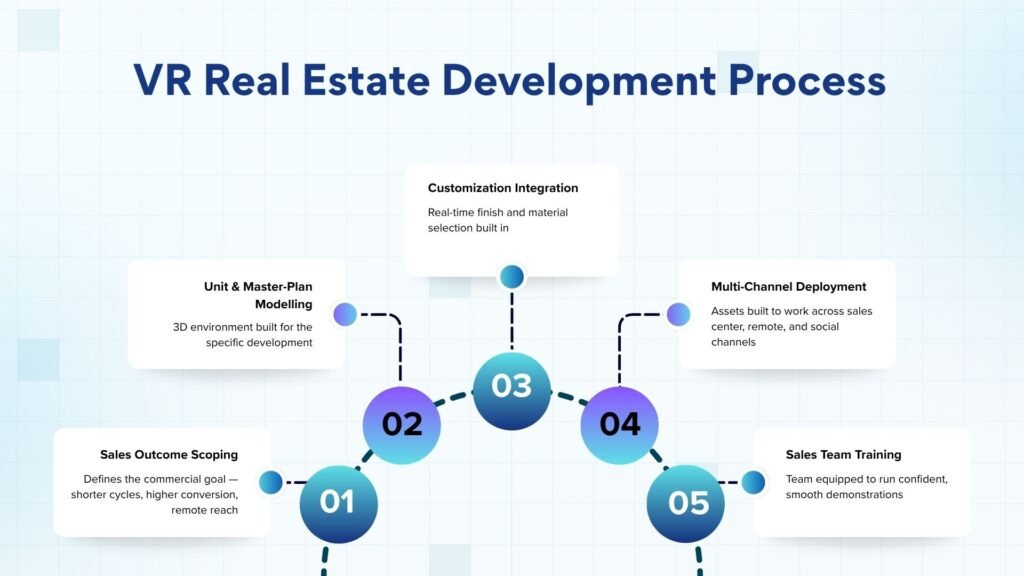
| Stage | What Happens |
| 1. Sales Outcome Scoping | Defines the commercial goal — shorter cycles, higher conversion, remote reach |
| 2. Unit & Master-Plan Modelling | 3D environment built for the specific development |
| 3. Customization Integration | Real-time finish and material selection built in |
| 4. Multi-Channel Deployment | Assets built to work across sales center, remote, and social channels |
| 5. Sales Team Training | Team equipped to run confident, smooth demonstrations |
A VR experience built to move buyers through a decision is a different project from a walkthrough built just to look impressive. The seven stages below reflect the process EFT follows when building VR real estate sales tools for Saudi developers, agencies, and brokers.
Sales Outcome Scoping
Every project starts with the commercial goal, not the design. What outcome do you actually need: shorter sales cycles, higher conversion in the sales center, remote reach into GCC markets, or higher transaction value through upgrade selection? That goal decides the scope of the build. If GCC reach is your main problem, you need different VR capabilities than a developer trying to close hesitant buyers standing in front of them.
Property & Environment Modelling
The 3D environment is built to match your actual property, not pulled from a generic template. That’s true whether you’re selling off-plan or showing a completed, existing unit. Dimensions, ceiling heights, window positions, material specifications, and view angles are modelled from the real architectural drawings or the real space itself. If you’re selling into a master-plan community, the site layout, amenity positioning, and the relationship between individual units and shared spaces get built into the environment too. The closer the virtual version is to what a buyer will actually get, the more confident they are committing to it.
Customization Integration
If you’re including real-time finish selection, this is where the material library and switching logic get built, letting buyers change flooring, wall treatments, kitchen configurations, and other finishes inside the VR environment and see the result instantly. The material library has to match the finish specifications you actually offer, not generic textures, so buyers are choosing between real options rather than approximations.
Testing & Buyer Validation
Before this goes anywhere near a live buyer, your sales team and a handful of test users walk through it first. This catches the problems a development studio never sees: a headset that’s uncomfortable after ten minutes, a navigation control that confuses someone who’s never worn VR before, an Arabic label that doesn’t read naturally. Skipping this step means your sales team finds these problems live, in front of a buyer who’s deciding whether to trust you with a major purchase.
Multi-Channel Deployment
Assets are built to work across the sales center headset experience, the remote browser-based tour buyers access from anywhere, and 360 content optimised for social distribution. A well-scoped production creates all three from a single build instead of three separate projects, which is where most of the commercial return comes from. The same budget delivers sales center capability, remote reach, and marketing content at once.
Sales Team Training
A VR headset sitting unused in the corner of your sales center because your agents don’t know how to run a smooth demonstration is a common, entirely avoidable problem. The technology only pays off when the person presenting it is confident and knows how to use the walkthrough, the customization tool, and the remote link to actually move a buyer toward a decision, not just show off the technology. Training isn’t a courtesy step tacked onto the end of the project. It’s what decides whether the investment pays off in the first week you launch.
Ongoing Content Updates
Your property environment doesn’t stay accurate on its own. Units sell out, prices change, new phases launch, finish options get discontinued or replaced. If you treat VR as a one-time project instead of something you maintain, your buyers eventually start walking through a version of your property that no longer matches reality, and that gap costs you credibility exactly when a buyer is deciding whether to trust what they’re seeing.
How VR Real Estate Requirements Differ by Development Type in Saudi Arabia
Not every property sells the same way, and VR shouldn’t be built the same way for all of them either. What convinces a luxury buyer is different from what convinces someone buying into a government housing scheme, and what an agent needs from VR is different from what a commercial developer needs.
Here’s how VR changes depending on what you’re actually selling.
Residential Towers and Villa Communities
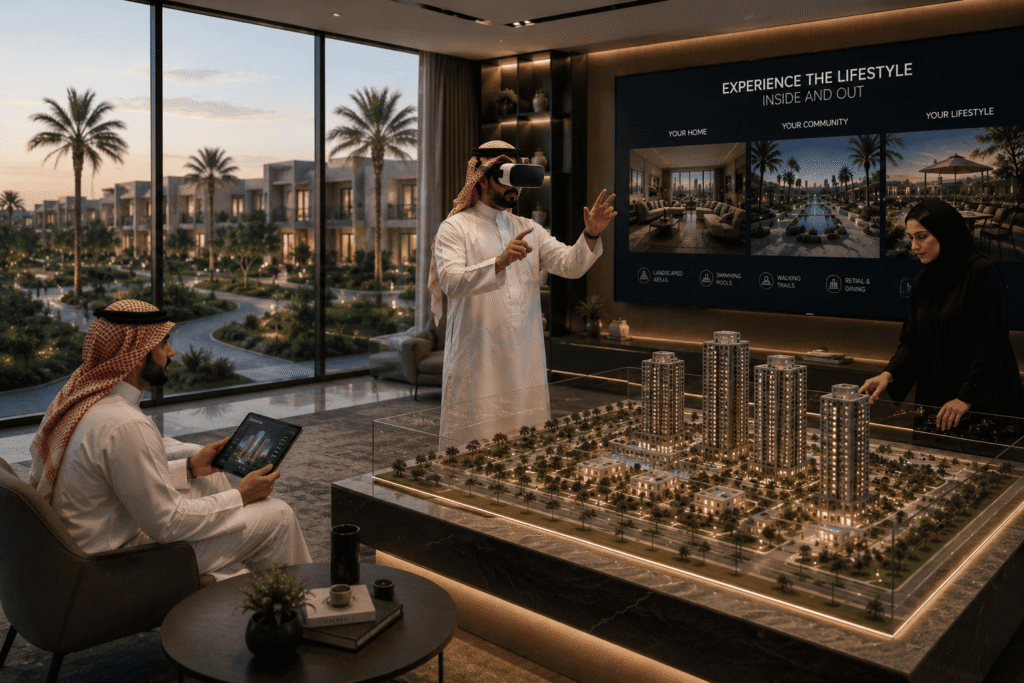
If you’re selling into a residential community, VR needs to do two jobs at once: sell the unit and sell the lifestyle around it. Developers, brokerages, and marketing agencies working residential towers and villa communities are using VR because buyers here aren’t just buying square footage, they’re buying into what life looks like once they move in.
What VR shows a buyer that a brochure can’t:
- The unit itself, alongside the amenities, landscaping, and shared spaces that come with it
- How private outdoor space connects to the wider community, not just floor plan dimensions
- A sense of what daily life actually feels like there, not a list of features on a sales sheet
Mixed-Use and Commercial Developments
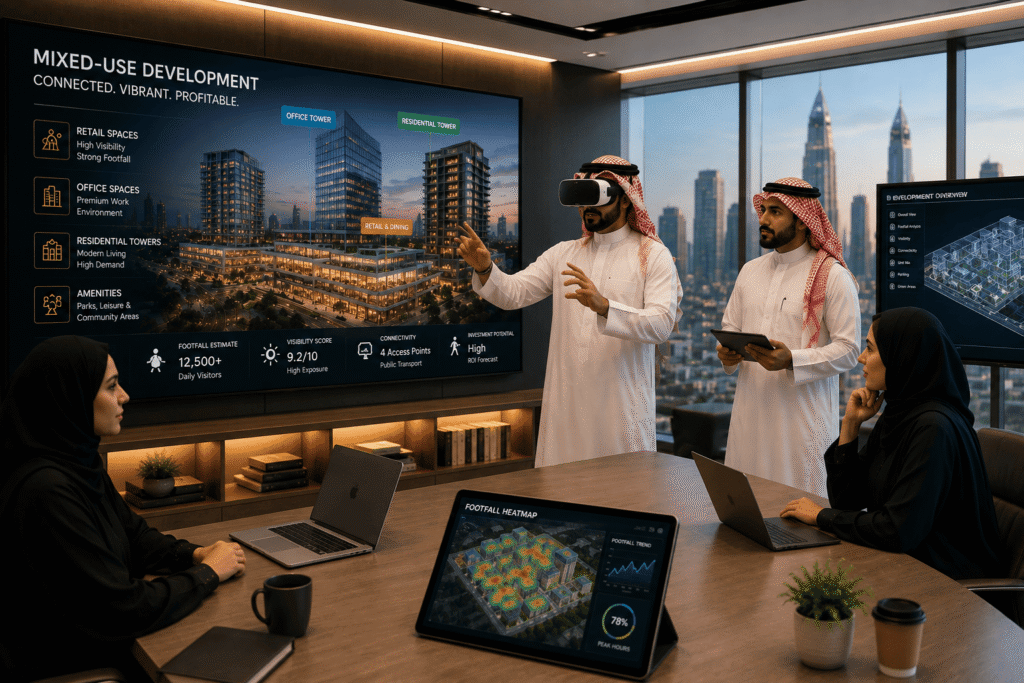
If you’re selling or leasing commercial space, your buyer isn’t deciding on aesthetics, they’re deciding on whether the space will perform. Developers, leasing agents, and commercial brokerages are using VR because investors and business owners need to understand footfall, visibility, and how a mixed-use environment functions once it’s fully occupied, and none of that comes across in a floor plan.
What VR makes clear that traditional sales materials can’t:
- Footfall patterns and visibility from key access points before the space exists
- How different components of a mixed-use development relate to each other
- What the commercial environment will actually feel like once it’s operating at full occupancy
Luxury and Ultra-Luxury Projects
If you’re selling at the top of the market, your VR walkthrough is doing double duty: it’s selling the property and signaling what kind of developer you are. Luxury developers and high-end brokerages are using VR because a low-resolution or generic-feeling walkthrough tells a luxury buyer your attention to quality has a ceiling, and that’s a conversation-ender before it starts.
What luxury buyers expect that a standard build can’t deliver:
- Material textures that actually match the real specification, not approximations
- Lighting that reflects the true quality of the finished space
- Detail resolution sharp enough to communicate premium, not just “nice”
Affordable Housing and Government-Linked Schemes
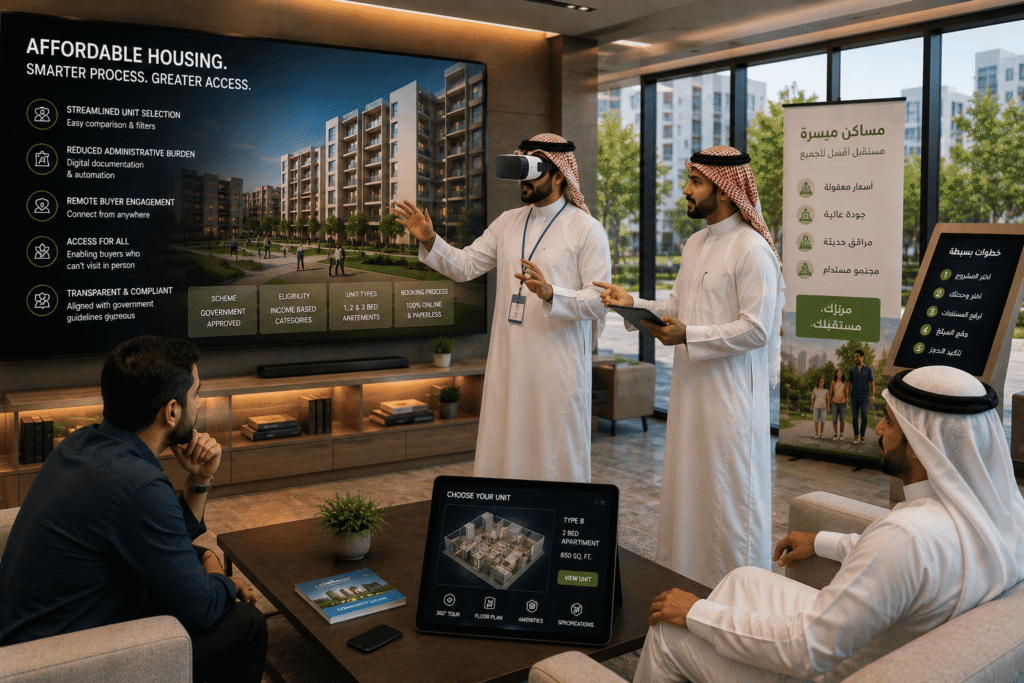
If you’re selling into this segment, your buyer usually isn’t chasing an experience, they’re trying to get through a process efficiently. Developers and agencies running affordable and government-linked housing schemes are using VR here for a different reason than luxury developers do: speed and scale, not spectacle.
What VR solves for you in this segment:
- Letting buyers compare units remotely instead of visiting each one in person
- Cutting the administrative load on sales teams handling high volumes of similar buyers
- Giving buyers who can’t easily travel to a central sales center a real way to choose
Estate Agents and Real Estate Brokers
If you’re an agent working the resale or rental market, VR isn’t just a developer’s tool, it works just as well for you. Estate agents and brokers working existing properties are using VR to let buyers narrow their shortlist before ever stepping through a door.
What VR does for your day-to-day business:
- Cuts wasted time on physical viewings for properties that were never going to be a fit
- Increases the conversion rate of the site visits you do run, since buyers who show up are already interested
- Extends your reach to buyers outside your city, which matters most when you’re working GCC buyers who can’t view in person
Other Property Types
Residential, commercial, luxury, affordable housing, and the resale market are the biggest slices of the Saudi real estate pie, but they’re not the whole pie. Industrial and logistics developers, hospitality and hotel groups, land and plot sellers, and short-term rental operators are all using VR to solve the same core problem in their own segment: helping someone commit to a space they haven’t physically stood in.
What VR does across these property types:
- Industrial and warehouse developers use it to show tenants ceiling heights, loading bay access, and floor layout before a lease is signed
- Hotel groups and hospitality developers use it to preview rooms, suites, and event spaces to corporate clients and travel buyers before booking
- Land and plot sellers use it to show boundaries, terrain, and surrounding development in a way a survey map never communicates
- Short-term rental and holiday home operators use it to let a guest or investor experience a property remotely before they book or buy
Across every one of these segments, alongside VR, Augmented Reality (AR) is often used on-site once the sale is closer to final, letting a buyer overlay furniture, finishes, or renovation options onto the actual physical space during a real visit.
What Does VR Real Estate Development Cost in Saudi Arabia?
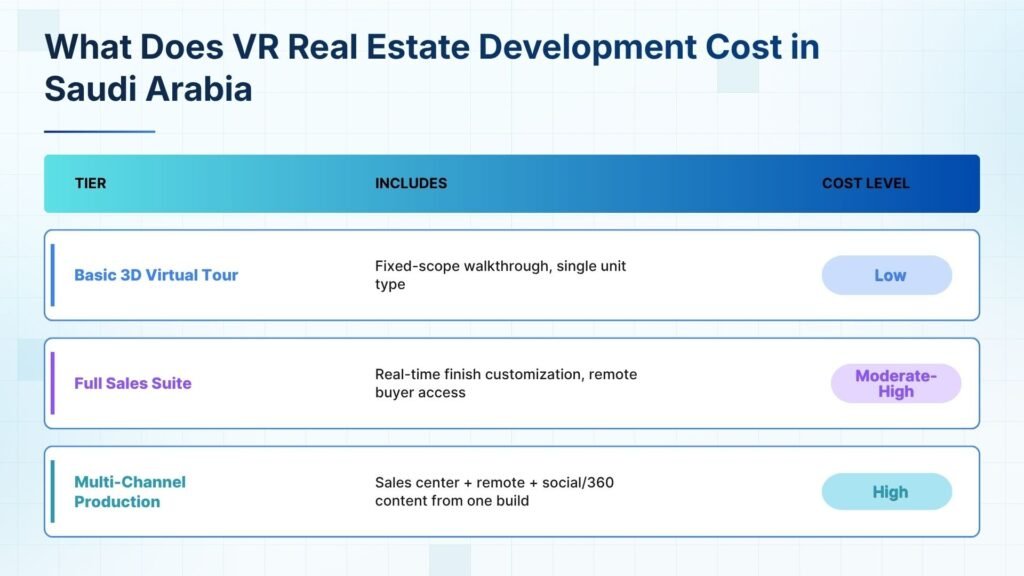
| Tier | Includes | Cost Level |
| Basic 3D Virtual Tour | Fixed-scope walkthrough, single unit type | Low |
| Full Sales Suite | Real-time finish customization, remote buyer access | Moderate–High |
| Multi-Channel Production | Sales center + remote + social/360 content from one build | High |
What you pay comes down to three things: how many unit types you need modelled, whether customization is included, and how many channels the assets need to serve.
Basic 3D Virtual Tour: Low cost
A fixed-scope walkthrough covering a single unit type. The buyer walks through the space and gets a clear sense of what they’re buying. Right for a first VR project on a defined budget, or for properties where one representative unit covers most buyer enquiries.
Full Sales Suite: Moderate to high cost
The walkthrough plus real-time finish customization, plus remote access for GCC and international buyers who can’t get to your sales center. This tier covers the three highest-value applications of VR in real estate: sales center conversion, upgrade revenue, and remote engagement, from one production investment. Most developers and agencies running serious sales campaigns operate at this tier.
Multi-Channel Production: High cost
The full sales suite plus 360 content built for social and digital distribution, delivered as one asset package. Sales center VR, remote access, and social content all come from a single build, so you get commercial value across every channel without commissioning three separate projects. The per-channel cost here runs significantly lower than building each piece on its own.
What Drives Your Cost Up or Down
- Unit variety — the more distinct unit types you need modelled, the higher the cost
- Customization complexity — a bigger finish and material library takes more build time
- Environment size — community or master-plan environments cost more than a single unit
- Production quality — the visual standard your market position demands, especially at the luxury end
Common VR Real Estate Mistakes Saudi Developers Make
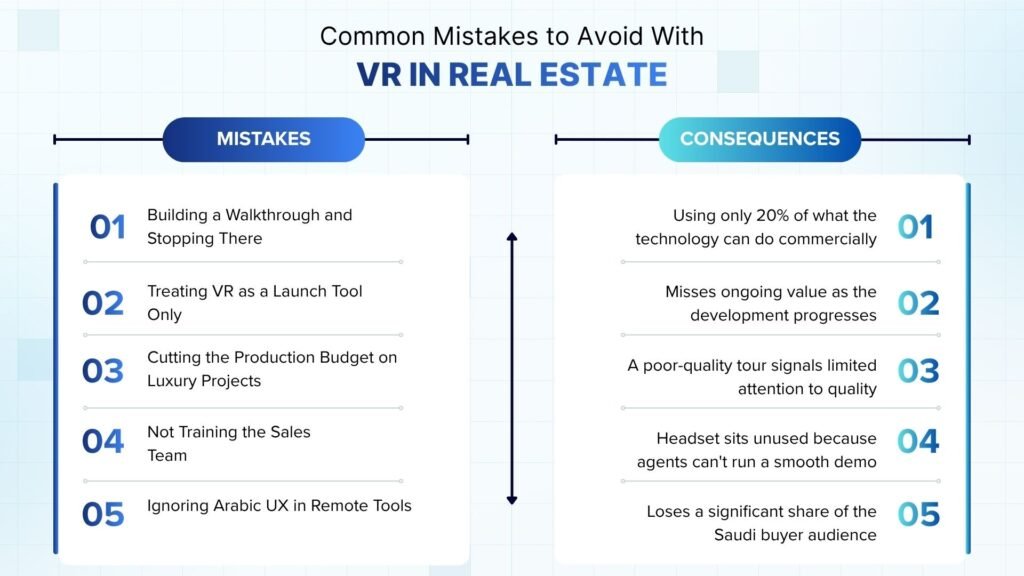
| Mistake | Consequence |
| Building a Walkthrough and Stopping There | Using only 20% of what the technology can do commercially |
| Treating VR as a Launch Tool Only | Misses ongoing value as the development progresses |
| Cutting the Production Budget on Luxury Projects | A poor-quality tour signals limited attention to quality |
| Not Training the Sales Team | Headset sits unused because agents can’t run a smooth demo |
| Ignoring Arabic UX in Remote Tools | Loses a significant share of the Saudi buyer audience |
How Etihad Falcon Tech Builds VR Real Estate Experiences for Saudi Developers
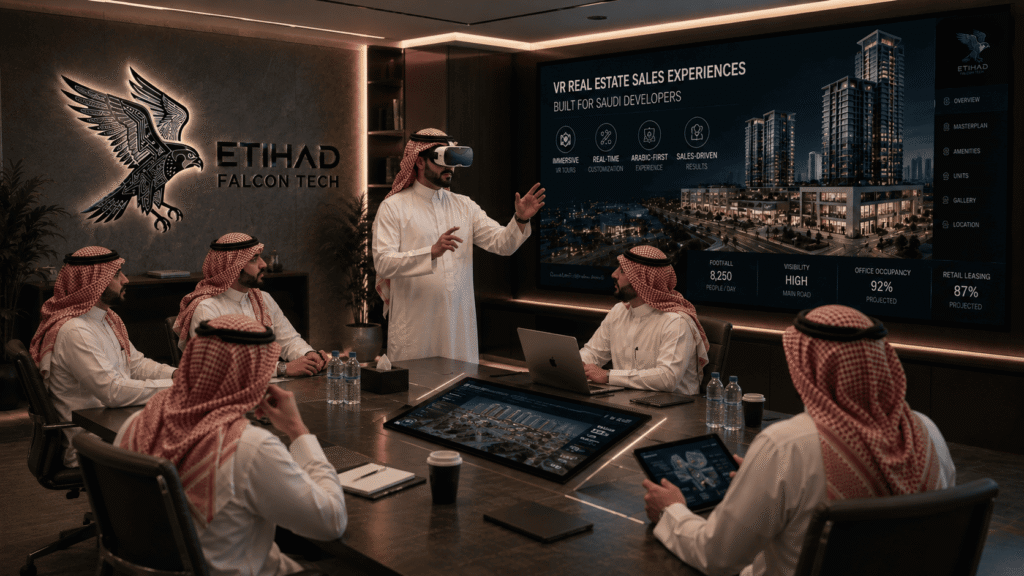
Most VR production companies build experiences. We build sales tools. That’s a commercial distinction, not a technical one.
A visually impressive walkthrough that doesn’t move your buyers through a decision faster isn’t delivering value, no matter how good it looks in a demo. Every VR real estate experience we build is scoped around the outcome you actually need, whether that’s shorter sales cycles in your sales center, higher conversion on upgrade selections, remote engagement with GCC buyers who can’t travel, or 360 content that builds you a qualified pipeline through social channels before you even launch.
Arabic-First, Built for the Saudi Buyer
We build every VR real estate experience Arabic-first: interface language, navigation, finish selection labels, and every piece of instructional content. The visual environment is built around what Saudi buyers expect spatially and aesthetically, not adapted from a generic template built for a different market. Your customization options reflect what buyers in your specific segment actually value and are willing to pay for.
One Build, Every Channel
We structure every production so your sales center headset experience, your remote browser-based tour for GCC buyers, and your 360 content for social channels all come from a single production process. That means you get more commercial value per riyal spent than you would commissioning each channel separately.
Your Team, Trained to Close
We don’t hand over the technology and walk away. Every deployment includes training your sales team, not just how to operate the headset, but how to use the walkthrough, the customization tool, and the remote link to actually move a conversation toward a decision. The sales experience only works as a two-part system: the technology and the people using it to close.
Experience Across Every Property Type
We’ve built VR real estate experiences for residential towers, master-plan communities, luxury villa developments, mixed-use commercial projects, and off-plan launches targeting GCC buyers. That range means faster, more accurate scoping, a modelling process calibrated to what each segment actually requires, and a clear read on what a buyer in your category needs to see before they’re ready to sign.
If you’re ready to understand what a properly built VR real estate experience would do for your sales cycle and conversion rate, message us on WhatsApp and we’ll start scoping what your project actually needs.
Frequently Asked Questions
VR puts you inside a fully built virtual version of a property before you ever visit it in person. You walk through the space at full scale, checking the layout, the view, and the finishes as if you were standing there.
It answers the questions that usually make buyers hesitate: space, light, view, and finish quality. When a buyer has already experienced the property, they need fewer follow-up visits to decide.
Yes. A buyer in Kuwait, Dubai, or Bahrain can open a link on their phone or laptop and walk through your property without traveling. It’s how you run buyer campaigns across the GCC from one office.
It depends on scope: how many unit types, whether you need customization, and whether you want remote and social content included. We’ll scope it around your budget and your commercial goal.
A 360 tour lets you look around from fixed points, like a panoramic photo. A full VR walkthrough lets you move freely through the space, which builds far stronger buyer confidence.
All of them, just differently. Residential sells the lifestyle, commercial sells the performance of the space, luxury sells the production quality, and resale lets agents cut wasted viewings.
A basic walkthrough for one unit type takes four to six weeks. A full sales suite takes eight to twelve, and a multi-channel production takes twelve to sixteen.