
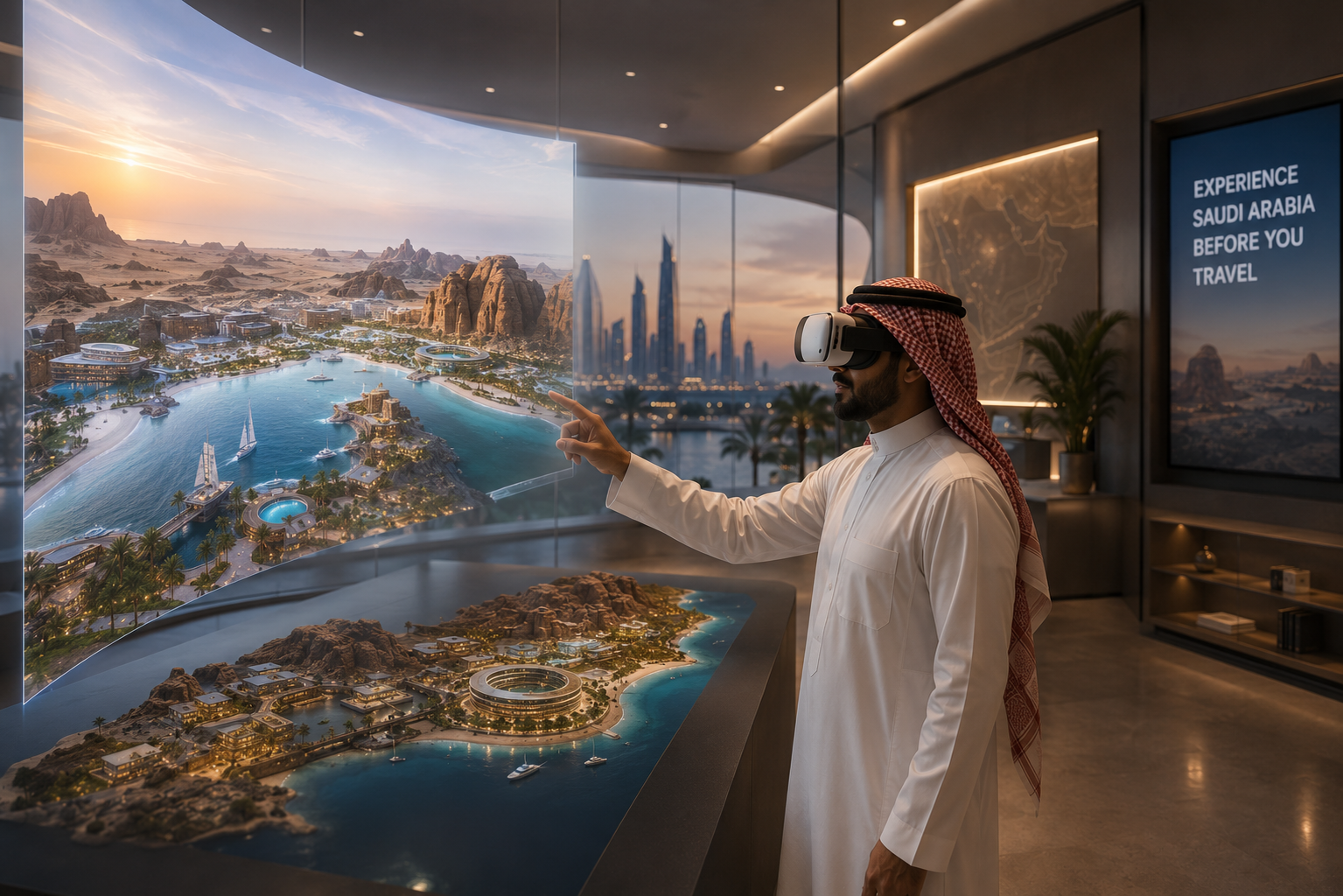
Saudi Arabia welcomed 122 million visitors in 2025, a 5 percent rise on the year before, according to preliminary data from the Ministry of Tourism. That number arrived ahead of the original Vision 2030 schedule, and the target has since been raised to 150 million by 2030. The infrastructure is being built. The destinations are opening.
That growth is not landing evenly across every destination. Every site in the region is now fighting for the same international visitor, and most of that fight is happening on a phone screen, before anyone books a flight. Saudi destinations are using VR tourism to let visitors experience a place before they book it. This matters because a trip costs real money and real time, and no traveller wants to spend both on a place that turns out different from what they imagined. Virtual Reality development in tourism removes that doubt before it becomes a reason to choose somewhere else. It gives the traveller more than a photo or a video ever could. It gives them the feeling of already being there.
This guide covers what VR tourism in Saudi Arabia means for destinations specifically: how it works across heritage sites, luxury resorts, religious routes, and business venues; what it costs; how a VR system actually gets built and deployed; the mistakes that burn budget without result; and how Etihad Falcon Tech builds VR systems that move visitors from undecided to committed.
Why Saudi Arabia’s Tourism Sector Needs Virtual Reality More Than Most
Saudi Arabia is in the middle of the most ambitious tourism expansion in its history. Vision 2030 tourism targets, NEOM, the Red Sea Project, Diriyah Gate Development Authority, the AlUla development programme, these are not incremental additions to an existing tourism sector. They are new destination categories being built for audiences that have never previously considered Saudi Arabia as a travel destination at all.
Selling a familiar destination is straightforward. Selling one that most of your target audience has never visited, cannot place on a mental map, and has no personal reference point for is a different marketing problem entirely. How do you convince someone to book a trip to a place they cannot picture? VR tourism in Saudi Arabia gives destinations a direct answer: an immersive preview that builds the spatial understanding and emotional connection a photo gallery cannot.
This is what virtual reality in the tourism industry does that traditional marketing structurally cannot. A brochure describes a place. VR tourism puts a visitor inside it, standing in the courtyard, looking up at the scale of a canyon wall, hearing what the space actually sounds like. That difference matters more in Saudi Arabia than in most markets, because the destinations themselves are newer to global audiences.
Virtual reality in travel and tourism is not just a demo at a conference anymore. Destinations now use it at every stage of the visitor journey, before a booking decision, on-site during the visit, and afterward as content the visitor takes home.
The International Visitor Challenge
An international tourist choosing between Santorini and a Saudi heritage site is not comparing two unknowns. They have seen hundreds of images of Santorini. They have watched dozens of videos about Bali. They may have a friend who has been to both. But when it comes to Saudi Arabia sites like AlUla, most travellers have nothing to compare. No photos they remember. No videos they have watched. No friend who has already been.
VR tourism content closes that gap directly. It gives the traveller the sense of physical scale, the quality of light, the feeling of standing inside a Hegra tomb or looking out across the Hejaz mountains. Once someone has experienced that in VR, the destination stops being abstract. It becomes somewhere they have already, in part, been.
The Domestic Tourism Opportunity
Saudi Arabia’s domestic tourism market is the largest and fastest-growing segment of the Vision 2030 tourism agenda. Saudi families are exploring the Kingdom in ways previous generations did not, and they are making destination decisions based on what they can discover digitally before committing to a trip.
VR tourism applications that let a Saudi family preview a resort in NEOM, explore the activities available at AlUla, or walk through a Red Sea Project property before booking convert digital discovery into booking intent more effectively than static content does. The preview answers the specific questions a photo gallery leaves open.
What Can VR Actually Do for Saudi Tourism?
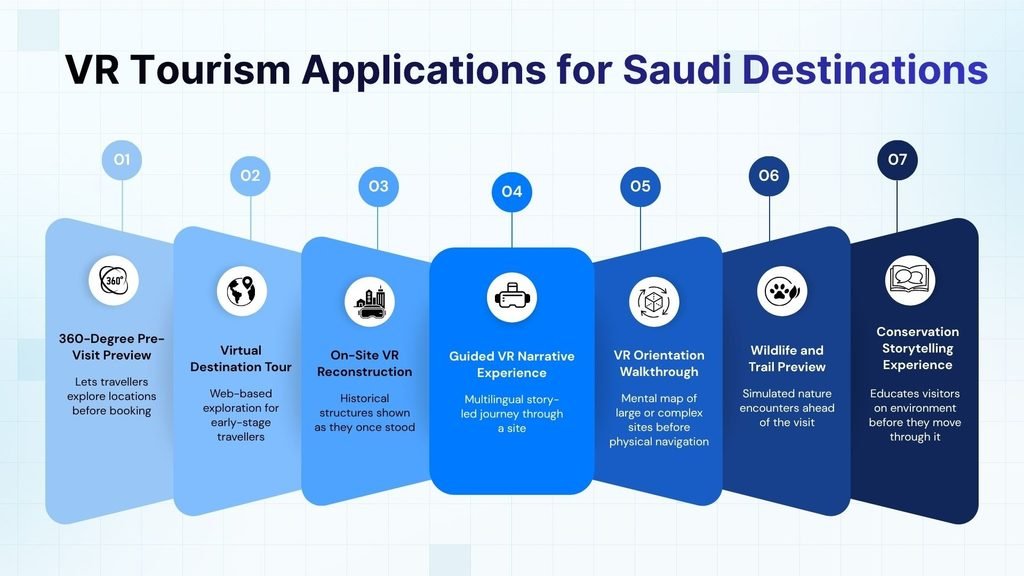
| VR Application | What It Does |
| 360-Degree Pre-Visit Preview | Lets travellers explore locations before booking |
| Virtual Destination Tour | Web-based exploration for early-stage travellers |
| On-Site VR Reconstruction | Historical structures shown as they once stood |
| Guided VR Narrative Experience | Multilingual story-led journey through a site |
| VR Orientation Walkthrough | Mental map of large or complex sites before physical navigation |
| Wildlife and Trail Preview | Simulated nature encounters ahead of the visit |
| Conservation Storytelling Experience | Educates visitors on environment before they move through it |
VR tourism does not sit next to your marketing. It replaces the guesswork a traveller does in their head before they ever contact you. When someone is deciding between your destination and one they already know, they are running a mental comparison with almost no real information on your side. VR gives them that information directly: scale, light, distance, atmosphere, instead of asking them to imagine it from a photo. Here is what that actually looks like at each stage of the visitor’s decision.
360-Degree Pre-Visit Previews
A 360-degree preview, one of the most common forms of VR tourism, lets someone standing in the middle of Hegra, or inside a Red Sea Project villa, look around in every direction from their own phone screen. You are not showing them a curated shot chosen to flatter the location. You are giving them the same field of view they would have standing there, which is exactly what a static photo cannot do. A traveller comparing your destination to Santorini or Bali is comparing your best photos against their own lived memory of somewhere else. A 360 preview closes that gap because it puts them inside the space, not in front of an image of it. Once someone has looked around a room or a courtyard themselves, they stop treating the destination as unfamiliar.
Web-Based Virtual Destination Tours
Not everyone looking at your destination is ready to book, which is exactly where web-based VR tourism does its work. Some are three months out, still deciding between three or four countries. A web-based virtual tour reaches that person while they are still in research mode, embedded on your own site or distributed through a travel platform, without asking them to download anything or commit to anything. This is the layer that keeps your destination in consideration during the long window before a booking decision actually happens. Without it, that early-stage traveller forms their impression from whatever competitor content shows up first in their search, and by the time they are ready to book, your destination has already lost the comparison.
On-Site Historical Reconstruction & Guided Narrative
At a heritage site, the physical structure in front of a visitor is often a fraction of what it once was, walls without roofs, foundations without the buildings that stood on them. A VR reconstruction rebuilds At-Turaif or a Hegra tomb as it existed at its peak, and a visitor can hold that image in mind while they walk the actual ruins. Pair that with a guided narrative delivered through an on-site headset station, in the visitor’s own language, and you have replaced the need for a live multilingual guide at every hour the site is open. A visitor who understands what they are looking at engages with a site differently than one reading a placard, and that difference is what determines whether they leave with a story or just a photo.
VR Orientation Walkthroughs
Large or multi-zone sites, think AlUla’s full footprint or a resort spread across an island, create a specific kind of visitor anxiety before anyone gets confused: not knowing what’s where. A VR orientation walkthrough solves this before the visitor sets foot on-site, giving them a mental map of the zones, the distances between them, and what to prioritise if their time is limited. Without it, you are relying on physical signage and printed maps to do a job that a two-minute walkthrough could have done before the visitor even arrived, and signage never fully replaces knowing where you’re going.
Wildlife, Trail, & Conservation VR
In a nature or eco-tourism setting, VR tourism has one job: prepare the visitor without replacing what they came to actually experience outdoors. A trail preview shows the terrain and difficulty before someone commits to a hike they may not be fit for. A simulated wildlife encounter sets realistic expectations, since real sightings are never guaranteed, and a visitor who expected a guaranteed encounter and didn’t get one leaves disappointed regardless of how good the trail was. A conservation storytelling module, walked through before entering a protected area, gives visitors context for why certain behaviour matters there specifically, which changes how they behave once they’re actually inside it.
Staff & Guide Training Simulation
VR is not only visitor-facing. A destination that trains new staff, seasonal guides, or safety personnel on a physical mockup of a site loses time every season to onboarding. A training simulation puts a new hire through hazard scenarios, visitor-handling situations, and site-specific protocol before they are responsible for a real group. This matters most at sites with genuine physical risk, desert terrain, water activities, high-traffic pilgrimage routes, where a poorly trained staff member is a liability, not just an inconvenience.
Accessibility Previews
A visitor with a mobility limitation, a sensory sensitivity, or simply an older traveller planning a trip needs to know what they can realistically do at your site before they arrive, not after. An accessibility preview shows the actual terrain, the step counts, the transitions between paved and unpaved sections, so that visitor can plan with accurate information instead of guessing and being disappointed on-site, or worse, not coming at all because they assumed the worst. Destinations that skip this are quietly filtering out a visitor segment that would have come if they’d known what to expect.
Post-Visit Sharable VR Clips
The visitor journey does not end when someone leaves. A short, sharable VR or 360 clip captured from the actual visit gives a traveller something more compelling to post than a standard photo, and every share puts your destination in front of that person’s entire network with a form of proof no advertisement can produce: someone they know was actually there. Destinations that only think about VR tourism as a pre-visit tool are leaving this distribution channel on the table entirely.
How Does VR Tourism Work Across Different Saudi Destinations?
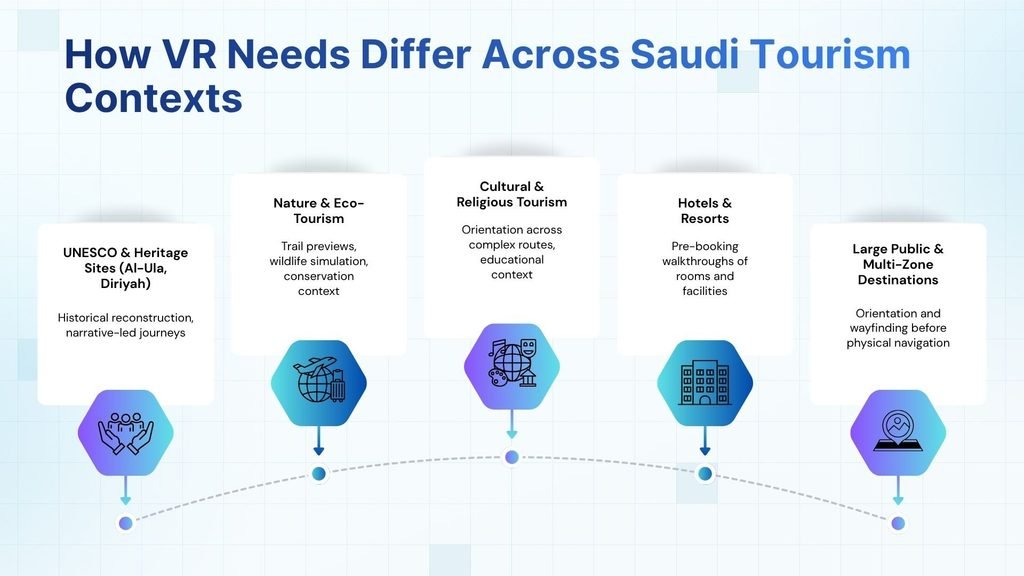
| Destination Type | VR Priority |
| UNESCO & Heritage Sites (Al-Ula, Diriyah) | Historical reconstruction, narrative-led journeys |
| Nature & Eco-Tourism | Trail previews, wildlife simulation, conservation context |
| Cultural & Religious Tourism | Orientation across complex routes, educational context |
| Hotels & Resorts | Pre-booking walkthroughs of rooms and facilities |
| Large Public & Multi-Zone Destinations | Orientation and wayfinding before physical navigation |
A generic VR experience does not work the same way at a heritage site, a resort, and a pilgrimage route. The visitor at each one is trying to solve a different problem before they show up. Build the same 360 walkthrough for all three and you will satisfy none of them properly. The clearest virtual reality tourism examples in Saudi Arabia already show this: AlUla is not solving the same problem NEOM’s Sindalah Island is, and a mosque route is not solving the same problem a desert resort is. Here is how the application of virtual reality in tourism actually changes depending on what you are running.
Heritage & Cultural Tourism Destinations
At a heritage site, your biggest risk is not that visitors skip the trip. It is that they walk through it without understanding what they are looking at. A pile of restored mud-brick walls does not tell its own story. A VR reconstruction of At-Turaif as it stood at the height of the first Saudi state does. Once a visitor has seen that reconstruction, walking the physical ruins means something different to them. Pair it with an AR overlay at the actual site through Augmented Reality (AR) development, and you reinforce that understanding while they are standing there, not just before they arrived.
Luxury & Adventure Tourism
If you run a property at Red Sea Project, NEOM’s Sindalah Island, or a luxury desert camp, your VR is doing something specific: it is proving the quality of your product before anyone books. A guest paying a premium price wants confidence, not just information. If your VR footage looks cheap, the guest assumes the property does too, and you lose the booking before you ever get the chance to prove them wrong. Get the visual quality right, and the VR itself becomes part of what justifies the price.
Religious & Pilgrimage
This one is different from the rest. You are not trying to convert a browsing visitor into a booking. You are preparing a pilgrim who is already coming. VR here should build ritual understanding, so a pilgrim arrives knowing what to expect and how to participate fully. On-site, the job shifts to AR: navigation, safety, and multilingual guidance for enormous crowds. Design this the way you would a service, not a sales tool. A pilgrimage VR experience that tries to sell you on the destination has misunderstood its own purpose.
Business & MICE Tourism
MICE stands for meetings, incentives, conferences, and exhibitions, the corporate side of tourism where the buyer is not a traveller booking a holiday, but an event planner deciding where to hold a conference. That planner does not want a cinematic flythrough. They want to check ceiling heights, stage positions, natural light, how rooms connect to each other, and whether the technical infrastructure can handle their event. Build VR that lets them actually inspect the space, not just admire it, and you are giving them what closes the booking. A beautiful walkthrough that cannot answer those questions loses to a plainer one that can.
Nature & Eco-Tourism Destinations
Here, the job is to prepare visitors, not replace what they came outdoors for. A trail preview shows the terrain before someone commits to a hike they may not be ready for. A simulated wildlife encounter sets honest expectations, since a real sighting is never guaranteed. A conservation module, walked through before entering a protected area, gives visitors a reason to follow the rules once they are actually inside it. Keep it restrained. If your VR starts to feel like a substitute for the outdoor visit itself, you have gone too far.
How a VR Tourism Experience Is Built and Deployed
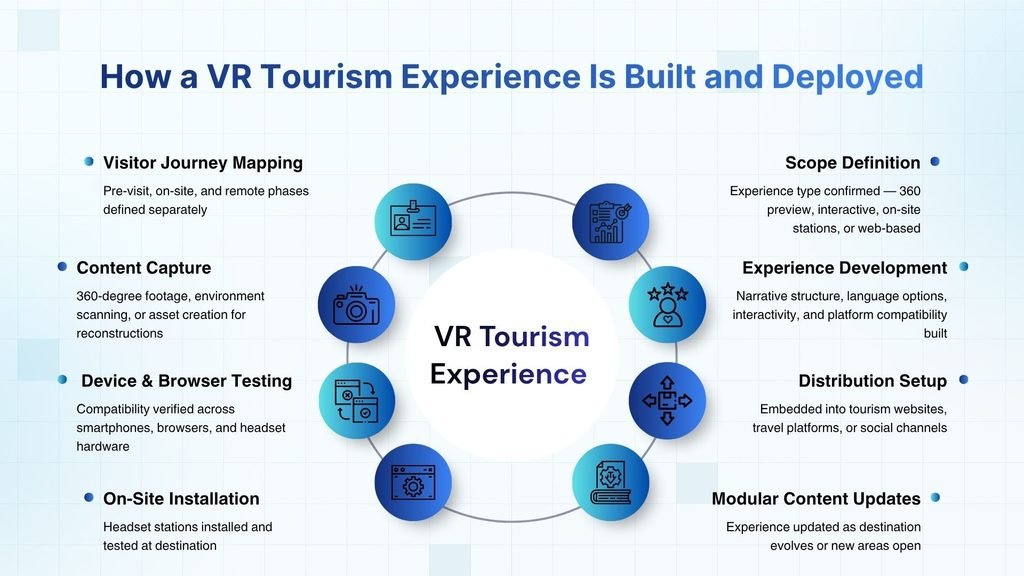
| Stage | What Happens |
| 1. Visitor Journey Mapping | Pre-visit, on-site, and remote phases defined separately |
| 2. Scope Definition | Experience type confirmed — 360 preview, interactive, on-site stations, or web-based |
| 3. Content Capture | 360-degree footage, environment scanning, or asset creation for reconstructions |
| 4. Experience Development | Narrative structure, language options, interactivity, and platform compatibility built |
| 5. Device & Browser Testing | Compatibility verified across smartphones, browsers, and headset hardware |
| 6. Distribution Setup | Embedded into tourism websites, travel platforms, or social channels |
| 7. On-Site Installation | Headset stations installed and tested at destination |
| 8. Modular Content Updates | Experience updated as destination evolves or new areas open |
A VR build that starts with the technology usually ends up as an expensive demo nobody uses after month one. Start with the visitor journey instead, and every technical decision after that has a reason behind it.
Visitor Journey Mapping & Scope Definition
Before anyone touches a camera or a headset, you need to know where each visitor actually encounters your VR. Someone researching your destination from home needs something different from someone standing at your gate. Map the pre-visit, on-site, and remote phases separately, because a single “VR experience” trying to do all three jobs at once usually does none of them well. Once the journey is mapped, scope gets easier: a browsing traveller three months out needs a web-based preview, not a headset station, and a visitor already on-site needs the reverse.
Content Capture & Experience Development
This is where the actual work happens, and where budgets get burned on the wrong things if scope was not clear beforehand. A 360 preview needs accurate footage of your site as it exists today. A historical reconstruction needs environment scanning plus asset creation for structures that no longer physically stand. Once the raw content exists, experience development is what turns it into something a visitor can actually use, narrative structure, language options for a multilingual audience, and interactivity that matches what the visitor came for. Build this without a clear scope from step one, and you end up reworking content you already paid for.
Device & Browser Testing
A VR experience that only works on the newest phones is not a tourism tool, it is a demo for people who already have money to spend on you. Your actual audience is browsing on a mix of smartphones, browser versions, and, for on-site stations, whatever headset hardware you installed. Test across all of it before launch, not after a visitor complains that the experience froze on their phone. This step gets skipped more than any other, because it does not feel like creative work, but it decides whether the previous steps were worth doing at all.
Distribution & On-Site Installation
Building the experience is not the same as getting it in front of the right person. A web-based tour needs to be embedded where a researching traveller will actually find it, your own site, a travel platform, or a national tourism campaign, not just sitting on a server somewhere. On-site, headset stations need physical installation and testing at the destination itself, including the practical realities of Saudi outdoor heat, dust, and high visitor throughput that most standard installation plans do not account for.
Modular Content Updates
A destination is never finished. New areas open, sites get restored further, resorts add facilities. A VR experience built as one fixed piece of content becomes outdated the moment any of that happens, and rebuilding from scratch every time is not a plan, it is a recurring cost you did not budget for. Build it modular from the start, and updating one section does not mean touching the rest.
What Does It Actually Cost to Build a VR Tourism Solution in Saudi Arabia?
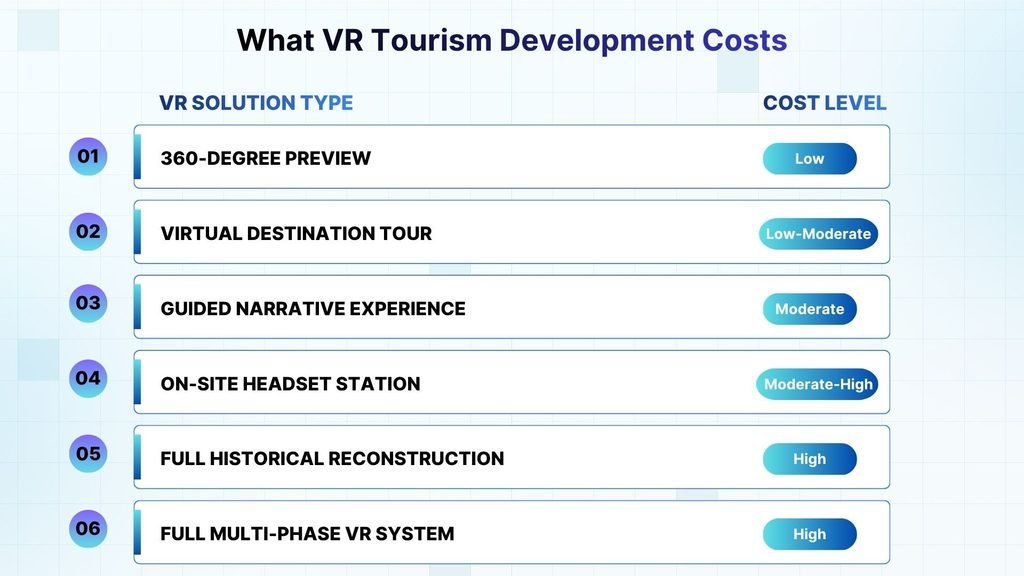
| VR Solution Type | Cost Level |
| 360-Degree Preview | Low |
| Virtual Destination Tour | Low–Moderate |
| Guided Narrative Experience | Moderate |
| On-Site Headset Station | Moderate–High |
| Full Historical Reconstruction | High |
| Full Multi-Phase VR System | High |
Costs depend on scope, but the more important factor is how the solution is planned.
A simple 360-degree preview is relatively quick to produce. A fully interactive VR experience with guided narrative branches and on-site headset stations is significantly more complex.
However, many tourism authorities underestimate ongoing needs. Content updates are one. Destinations evolve, new areas open, and experiences need to reflect that. Device compatibility is another. Web-based VR experiences must work across a range of smartphones and browsers without friction, and on-site headset stations need their own maintenance plan.
Distribution is also often overlooked. Building the experience is one step. Getting it in front of the right audience is another. Planning for these elements early avoids rework later.
Most Common Mistakes VR Tourism to Avoid
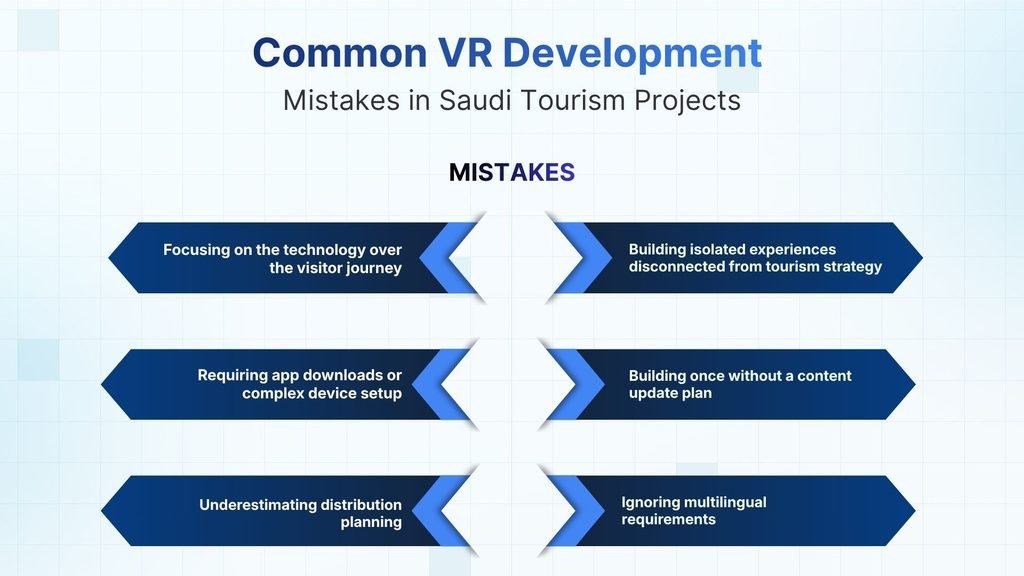
| Mistakes |
| Focusing on the technology over the visitor journey |
| Building isolated experiences disconnected from tourism strategy |
| Requiring app downloads or complex device setup |
| Building once without a content update plan |
| Underestimating distribution planning |
| Ignoring multilingual requirements |
How Does Etihad Falcon Tech Build VR Tourism Experiences?
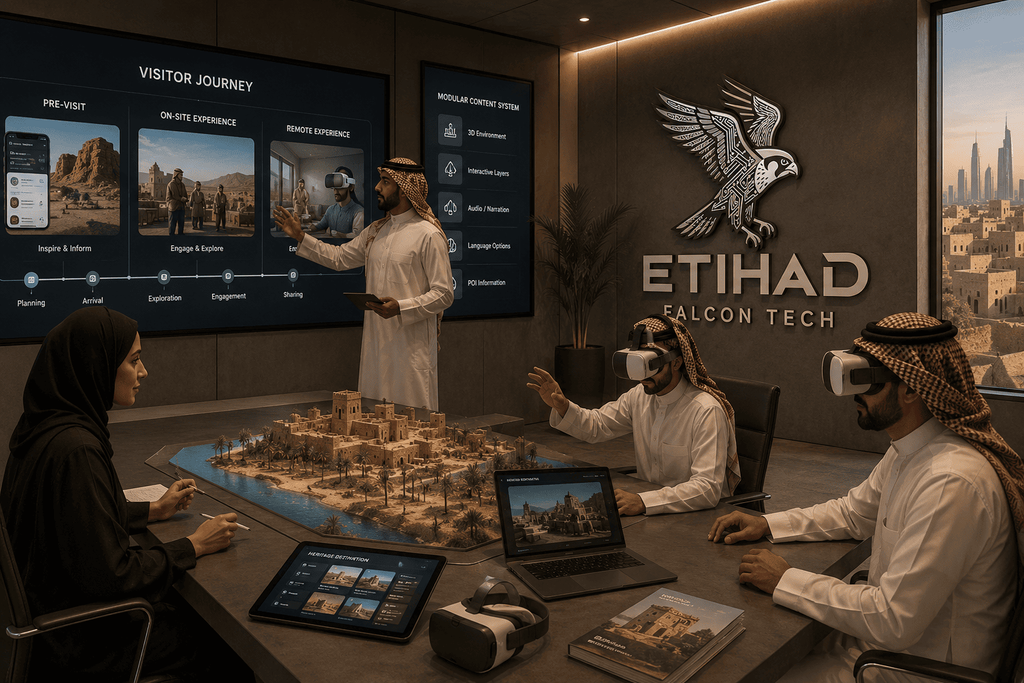
The starting point is always the visitor journey.
Where does the first interaction happen? What does the visitor need to feel at that stage? What happens when they arrive?
Etihad Falcon Tech treats each phase of VR tourism in Saudi Arabia differently. Pre-visit experiences are designed for accessibility and reach. On-site experiences focus on depth and usability. Remote experiences are structured for distribution across platforms.
Etihad Falcon Tech builds content to be modular so it can be updated as the destination grows.
The goal is not to introduce technology for its own sake, but to support the moments that influence decisions and shape experiences. For a Saudi destination weighing VR tourism in Saudi Arabia as an investment, that starting point, the visitor journey rather than the technology, is usually the difference between a system that gets used and one that gets shelved after launch.
Ready to build something for your destination? Message us on WhatsApp and tell us what you have in mind, we’ll take it from there.
FAQs
Yes. Web-based VR solutions can run directly in a browser, reducing friction and increasing usage.
Yes. VR content can be embedded, shared, and distributed across multiple platforms to reach global audiences.
Yes. Multilingual support can be built into VR experiences to ensure accessibility.
Timelines for VR tourism in Saudi Arabia vary depending on complexity. Basic experiences can be developed in weeks, while layered, interactive environments may take several months.
Yes. Well-structured systems allow ongoing updates so the experience remains aligned with the current state of the destination.