
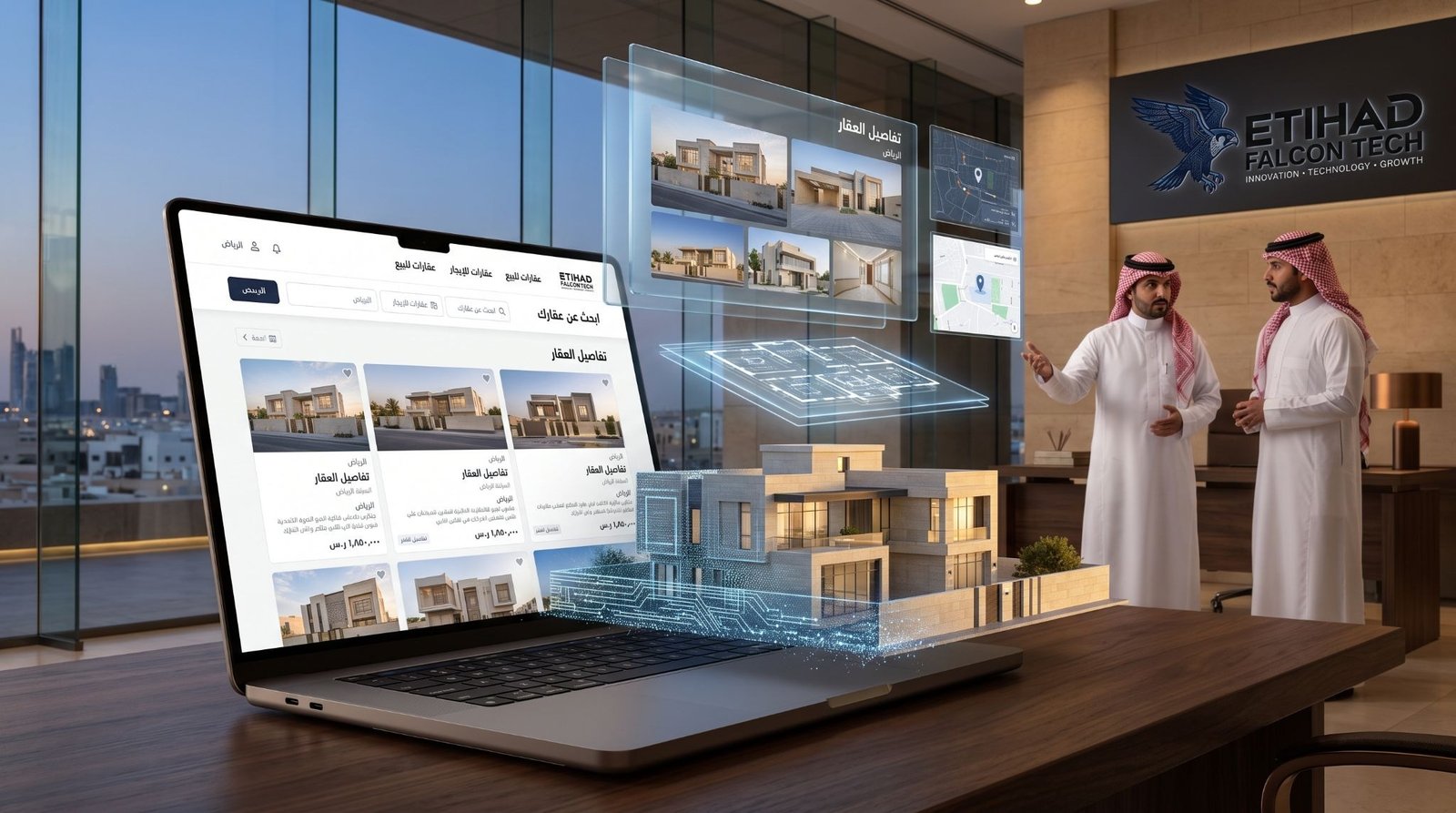
Real estate made up 14.1% of Saudi Arabia’s GDP and 26.7% of non-oil private sector output in the third quarter of 2025, according to the Real Estate General Authority (REGA), the body that regulates the sector. Every developer, brokerage and property manager in that figure competes for the same buyers, tenants and investors. The first place those people meet you is your website.
For a real estate business, the website does the work of four departments. It’s the showroom where buyers see what you have. It’s the sales desk that takes the first enquiry. It’s the records room that knows which units are available today. And it’s the service counter where existing buyers and tenants ask about payments and handover. A basic site covers the showroom. The other three get left to WhatsApp messages, spreadsheets and a sales team working from memory.
That’s where many owners get stuck. A template site looks finished on day one, so the decision feels simple. Then the business grows. Units sell and the site still shows them. Leads sit in an inbox for two days. Finance re-types reservation details into another system. At that point, design stops being the question. How the site connects to the rest of your business becomes the question.
A custom website development project answers that second question. A custom real estate website connects to a CRM that receives every lead, APIs that let your systems exchange data, REGA’s advertising licence rules, Wafi for off-plan sales, payment gateways, Arabic and RTL layouts, and PDPL data protection. All of it needs professional development. One misconfigured connection puts the wrong price or the wrong availability in front of a buyer.
You don’t need a developer-scale platform to benefit. A five-agent agency that needs one custom feature, such as a live availability sheet or a lead router, uses the same principles at a smaller scale.
This guide is for three kinds of readers: developers and large brokerages planning a full platform, agencies and mid-size firms adding custom features to an existing site, and owners still deciding whether custom is worth it. It explains what makes a real estate website custom, how the pieces connect, how the build works, and what drives the cost.
What Is a Custom Real Estate Website?
A custom real estate website is built around your inventory, systems and sales process, not around the limits of a template.
People search for custom real estate website design or custom real estate web design and expect a design job: your colours, your logo, a layout nobody else has. Design matters, but a template can be restyled in a week. What a template can’t do is know which of your 240 units sold this morning.
Three layers sit inside a real estate website. The front end is what buyers see. The engine is the search, inventory and rules behind it. The connections are the links to your CRM, payment gateway, listing portals and government platforms. A template covers the first layer. A custom build covers all three.
If your website only displays listings, a template can be enough. If it has to route leads, take reservations, update availability or serve logged-in customers, you’ve moved into custom territory, whatever the size of your firm.
Who Needs a Custom Real Estate Website in Saudi Arabia?
Some real estate businesses outgrow a template early because of how they sell. The table shows what custom adds for each type.
| Business Type | What Custom Adds |
| Developers and property development companies | Live unit inventory, reservations, buyer portal |
| Brokerages and agent networks | Agent profiles, lead routing, portal feeds |
| Commercial real estate firms | Space search, lease terms, company enquiries |
| Luxury and single property sellers | Gated documents, private viewing flow |
| Portfolio owners and investors | Multi-property data, investor document access |
| Small agencies | One or two custom features on an existing site |
Real Estate Developers & Property Development Companies
A real estate developer website sells something that often doesn’t exist yet. Buyers want to see which units are open, what the payment plan looks like and how construction is going. A property development website built for this shows unit status by building, floor and view, calculates payment plans, and displays your Wafi licence details for off-plan sales. Wafi is the platform that licenses off-plan unit sales and registers developers. If you run multiple phases or projects, one platform for all of them beats a separate site per launch.
Real Estate Agent & Brokerage Websites
Real estate agent websites serve one person’s listings. Real estate brokerage websites serve a whole team, and that’s where templates break. Each agent needs a profile and their own listings. Each enquiry needs to reach the right agent by area, language or availability. The brokerage needs one view of every pipeline. Custom lead routing and agent permissions handle that. If you run ten agents or more, the routing logic alone justifies the build.
Commercial Real Estate Websites
A company looking for a warehouse or office doesn’t search like a family looking for a villa. Commercial real estate websites need filters for floor area, ceiling height, power capacity, lease term and zoning. Enquiry forms should collect company details, not just a phone number. Floor plans, brochures and lease terms often sit behind a request. Residential templates don’t carry any of this.
Luxury & Single Property Websites
Luxury real estate websites sell privacy as much as property. Fewer listings, heavy photography, and prices or documents released only after a buyer requests access. Single property websites work differently: one tower, one villa or one launch, built fast and tied to an ad campaign. Both benefit from custom pieces such as gated documents, private viewing bookings and campaign tracking that shows which ad produced which enquiry.
Real Estate Portfolio Websites
If you own or manage many properties, a real estate portfolio website shows them as one body of assets. Owners, funds and family offices use it to present occupancy, performance and documents to investors. Custom work here means structured data across properties and role-based access, so each investor sees only their own holdings and reports.
What Custom Functionality Can a Real Estate Website Have?
This is the core of a custom build. Each feature below solves a specific operational problem, and you don’t need all of them. Pick the ones that match how you sell.
Advanced Property Search & Listing Management
Search is the part of a property site buyers touch most, and the part templates handle worst. A template offers price, bedrooms and city. A custom build adds the filters your buyers actually use: districts drawn on a map, payment plan length, handover year, floor level in a tower. Behind the search sits listing management, the screen your team uses to add, edit and expire properties. Built for your process, it lets one coordinator publish a unit in Arabic and English in minutes instead of editing two pages by hand.
Live Inventory & Unit Management
A developer with 400 units across three buildings can’t update a website by hand. Live inventory means the site reads from one source of truth, your ERP or inventory system, and shows each unit as available, reserved or sold the moment that changes. Buyers stop asking about units that are gone. Your sales team stops apologising for it. If you sell from a price list in a spreadsheet today, this is the first feature to ask about.
Lead Capture & Routing
Real estate lead generation websites win or lose on what happens after the form is submitted. Custom routing sends each enquiry to the right person on the spot: by project, by area, by language or by who’s on shift. It also records where the lead came from, so an enquiry from a Snapchat ad and one from a Google search don’t land in the same pile. Forms, WhatsApp buttons and call tracking all feed one place. Without routing, leads wait in a shared inbox. With it, the agent who knows the Al Malqa villas gets the Al Malqa enquiry within minutes.
Online Reservations & Payments
Some buyers are ready to reserve before they’ve spoken to anyone. A custom reservation flow lets them pick a unit, pay a booking deposit through a SAMA-approved gateway (mada, Apple Pay or STC Pay), and receive confirmation while the unit locks for everyone else. Developers selling off-plan and agencies taking viewing deposits both use it. The details need care: who confirms the payment, what happens if the buyer doesn’t complete the contract, how refunds are recorded. Your site has to carry that logic. No template ships with it.
Client Portals for Buyers, Owners & Tenants
Developers with hundreds of buyers on a multi-year build, and property managers with many tenants, know the pattern: the same status questions, every day, by phone. A portal is a logged-in area where customers find those answers themselves. Buyers see their payment schedule and construction progress. Owners download statements and documents. Tenants log maintenance requests and watch them move. Your team takes fewer calls and your customers feel informed. Build one only if your relationship with the customer continues after the sale.
Admin Dashboard, Roles & Reporting
Everything above needs a control room. A custom admin dashboard gives each person only what their job needs: marketing edits content, agents manage their own listings, the sales director sees every pipeline, finance sees reservations and payments. Reports come from live data, such as leads per project, response times and units reserved this week. For a brokerage with twenty agents, permissions matter as much as features, because one wrong edit on a live price is a public mistake.
How Do APIs Connect a Real Estate Website to Your Other Systems?
An API is a set way for two systems to pass information to each other automatically. Your website asks, “which units in Tower B are available?”, and your inventory system answers. Nobody types anything in between.
Most real estate firms already run several systems: a CRM, accounting software, an inventory list, a payment gateway. APIs are how the website stops being a separate island and joins them.
| Connection | What It Does |
| CRM | Sends every lead and activity to your sales team |
| ERP or accounting | Syncs units, payments and invoices |
| Listing portals | Pushes listings out where the portal offers a feed |
| Payment gateway | Takes deposits by mada, Apple Pay or STC Pay |
| Maps and National Address | Pins and verifies property locations |
| WhatsApp Business | Routes chats and sends confirmations |
| REGA licence data | Displays licence numbers and checks them against official records |
Building these connections is development work, not plugin setup. Each one has to be planned, coded, tested against real data and monitored after launch. Our web development services cover API integration for real estate firms, from a single CRM connection to a full inventory, payment and portal setup.
Not every connection is open to you, though, and this is where experienced developers earn their fee. Listing portals offer feeds or APIs on their own terms. Government platforms decide what data they expose. REGA runs a public inquiry service for verifying advertisement licences, and has said it is developing an API so marketing platforms can verify them. Your developer should confirm what’s live before the scope is fixed, not after.
What Happens When an API Connection Breaks?
Connections break. A CRM changes how it logs you in, a portal changes its feed format, a payment gateway goes down for an hour. A well-built site expects this. It logs every failed exchange, alerts your team, and keeps working in the meantime, for example by saving leads locally until the CRM is reachable again. If a developer doesn’t mention monitoring, ask about it. A lead lost in silence is the expensive kind.
How Does a CRM Work With a Custom Real Estate Website?
A CRM, short for customer relationship management, is the system where your sales team tracks every person from first enquiry to signed contract. If it isn’t connected to your website, the two never meet. Leads arrive by email, someone copies them across, and the details that matter get lost on the way: which property the buyer looked at, which budget filter they used, which ad brought them in.
With a real estate website and CRM connected, the lead lands in the pipeline with all of that attached and is assigned to an agent in seconds. Information flows back too. When an agent marks a unit reserved, the website stops offering it. Your marketing team can finally see which campaigns produce closed deals, not just enquiries.
| CRM Option | Fits When |
| Connect a ready-made CRM | Your sales team already works in one |
| Customise a ready-made CRM | You need extra fields or an off-plan pipeline |
| Build a custom CRM | No ready-made tool matches your sales process |
Zoho, HubSpot, Salesforce and Bitrix24 are common choices. The right one is the one your team opens every morning, so ask them before you ask a developer. If your agents close deals on WhatsApp, connect WhatsApp Business to the CRM as well, or half your conversations never get recorded.
Can You Build a Custom Real Estate Website in WordPress?
Yes, and for many firms it’s the right call. A real estate website in WordPress costs less to start, your team already knows the editing screen, and a large developer community supports it. The question is how far WordPress carries your requirements.
| Route | Fits When |
| WordPress with a real estate theme and plugins | Small agency, few listings, standard needs |
| WordPress with custom plugins and integrations | Mid-size firm needing CRM sync, custom search, portal feeds |
| Headless WordPress or a custom framework | Large developer or brokerage with heavy inventory logic and traffic |
The trouble starts when a plugin stack tries to do a custom job. Each plugin carries features you don’t use, they slow pages down, and an update to one can break another. When your requirements reach live inventory, several integrations or logged-in portals, custom-built functionality on top of WordPress, or a separate engine behind it, holds up better. If you’re a small agency, start on the first or second route and move up when the business does.
What Rules Apply to a Real Estate Website in Saudi Arabia?
A real estate website advertises regulated activity, so the rules reach into how the site is built. Getting them wrong costs more than getting the design wrong.
| Rule | What It Means for Your Site |
| REGA marketing and advertising regulations | Licence number on each ad, required property details, ads removed once fulfilled or expired |
| Wafi | Off-plan sales need a licence, which the site displays |
| Ejar | Leasing contracts are registered on the platform, not the website |
| PDPL | Consent and protection for buyer and tenant data |
| ZATCA | E-invoicing for any invoices the site generates |
REGA’s regulations require advertisements to display the licence number, include details such as property type, location, area and value, and be removed once fulfilled or expired. That has direct consequences for your build. Every listing needs a licence field, and every sold or leased unit needs an expiry rule so it comes down on time. Violations are penalised under the Real Estate Brokerage Law’s schedule.
PDPL matters because a real estate site collects names, phone numbers, budgets and sometimes ID documents. Decide what you collect, why, where it’s stored and who can see it before the build starts.
How Much Does a Custom Real Estate Website Cost in Saudi Arabia?
Cost follows complexity. The number of pages hardly moves it. The number of systems the site connects to, and the logic behind them, moves it a lot.
| Website Type | Cost Level |
| Single property website | Low-Moderate |
| Agent website with custom search and lead routing | Moderate |
| Brokerage website with CRM sync and portal feeds | Moderate-High |
| Developer platform with inventory, reservations and portals | High |
| Multi-project or multi-market portfolio platform | High |
What Drives Your Cost Up or Down
- Number of integrations: every system the site talks to adds build and testing work.
- Inventory complexity: hundreds of units with phases, payment plans and statuses cost more than a few listings.
- Portals and logins: buyer, owner and tenant portals are products in their own right.
- Arabic and English depth: full bilingual content and RTL layouts across every feature is its own production work.
- Data migration: moving years of listings, leads and documents from an old site or CRM adds cost.
Ongoing costs matter as much as the build: hosting, CRM licences, API fees and maintenance. A cheap build with no maintenance plan becomes an expensive one the first time a connection breaks.
If you already know which systems the site has to connect to, message us on WhatsApp with the list: your CRM, your inventory source and your payment setup. We will tell you which cost level your project falls into and what is driving it.
What Mistakes Do Real Estate Firms Make When Building a Custom Website?
| Mistakes |
| Starting with design, not systems |
| Using a plugin stack to avoid development |
| Skipping the REGA licence field |
| Entering inventory by hand |
| No lead routing |
| Translating Arabic from English |
| No maintenance plan |
Why Work With Etihad Falcon Tech for a Custom Real Estate Website?
Maybe you’re a developer launching a project and your sales team still tracks units in a spreadsheet. Maybe your brokerage site brings in enquiries that never reach the right agent. Maybe the template that served your first twenty listings is now the thing slowing you down. These are the situations we build our custom real estate website and real estate website services around.
We Start With Your Systems, Not Your Homepage
We don’t open with a design mockup, we open with a map of how your business runs: where inventory lives, how leads move, who closes them, which systems have to talk to each other. The site gets built to fit that map. That’s how a site ends up carrying your real process and not a generic one.
Compliant From Day One
REGA licence fields, expiry rules for sold and leased units, Wafi details for off-plan projects, PDPL-ready data handling and ZATCA-ready invoicing are planned into the build, not patched on after a complaint.
One Team, Start to Finish
Development, CRM integration, Arabic content, SEO and the marketing that fills your pipeline sit under one roof. Across our real estate clients, more than 75 over the past 18 months, we’ve generated over 800,000 leads, so we know what happens to a lead after it leaves the form. That’s why we build routing and CRM sync before we polish the homepage.
How Do You Choose Among Real Estate Website Companies?
Ask any real estate website company five things. Which of your systems will it connect to? Who owns the code and the data? How does it handle a failed API connection? How is Arabic built? Who supports the site after launch? Vague answers to any of them tell you how the project will go.
If you’re still weighing whether custom is the right route, our custom website development guide explains how the process works across industries. If you already know what your site has to do, contact us with your business type, your current CRM or inventory system if you have one, and the cities you sell in. We will tell you honestly whether a full custom build, a customised WordPress site or a smaller fix is the right fit.
FAQs
What is a custom real estate website?
It’s a site built around your listings, inventory, CRM and sales process instead of a template’s limits. Custom here means custom functionality and integrations, not only a unique design.
How is a custom site different from a real estate WordPress theme?
A theme gives you a ready layout with fixed features. A custom build adds the search rules, inventory logic and connections your business needs, with no limit set by a theme or plugin.
Do I need a CRM connected to my website?
If more than one person handles your enquiries, yes. A connected CRM sends each lead to the right agent with the property and source attached, and shows which campaigns close deals.
Can the website show live unit availability?
Yes, when it’s connected to your inventory or ERP system through an API. The site reads each unit’s status and updates it as it changes.
Can a small agency get custom functionality without a full custom build?
Yes. Many agencies add one or two features to an existing WordPress site, such as a lead router or an availability sheet, and stay at a low-moderate cost level.
How long does a custom real estate website take to build?
It depends on the number of integrations, not the number of pages. We give you a timeline after mapping your systems.
Does my website need a REGA advertisement licence number?
REGA’s regulations require advertisements to display a valid licence number, so we build a licence field into every listing. Marketing a whole licensed project can be treated differently, so confirm your case with REGA.
Can the site run in Arabic and English?
Yes. Arabic needs its own right-to-left layout and Arabic-written content, and hreflang tags help Google show the right language to the right reader.
Who owns the website code and data?
You should. Agree ownership of code, content and customer data in writing before the build starts, and confirm where the data is hosted for PDPL.