
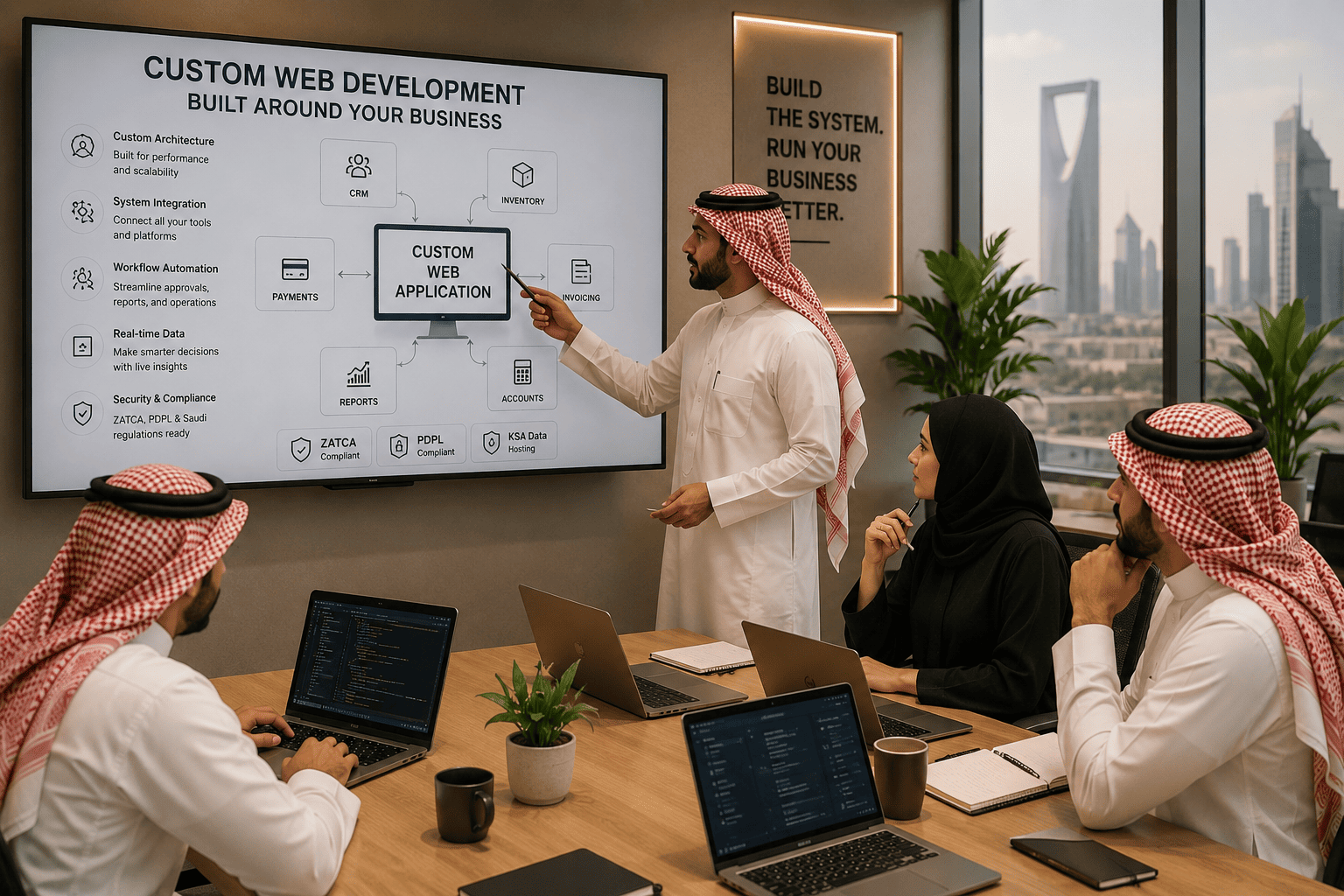
Saudi Arabia’s digital transformation market generated USD 13.9 billion in 2025 and is projected to reach USD 69.6 billion by 2033, according to Grand View Research, a global market research firm. All sectors across KSA, including retail, logistics, healthcare, real estate, and professional services, are actively rebuilding their operations as part of that transformation.
So, what is digital transformation, and what does it actually mean for businesses, corporates, SMEs, and enterprises? Digital transformation means completely restructuring how your company operates online: consolidating multiple tools into one platform, automating complex approval and reporting workflows, and giving every department real-time access to the data they need to make decisions. It is about connecting your CRM to your inventory, your inventory to your invoicing, your invoicing to your accounts, so the entire operation runs from one place, automatically.
For Saudi Businesses, that level of connectivity and depth of functionality are only possible through a custom-built website, where systems are built specifically around how a business works, with the integrations and architecture that a basic template website cannot provide.
This guide covers what custom web development actually involves for your business: what complex architecture means in practice, what API integrations look like for Saudi enterprise requirements, when dynamic web applications are the right answer, how ZATCA and PDPL compliance affects development decisions, what the build process looks like, and how to choose a development partner that builds a custom website around your business operations.
Custom Web Development vs Website Customisation: What Is the Difference?
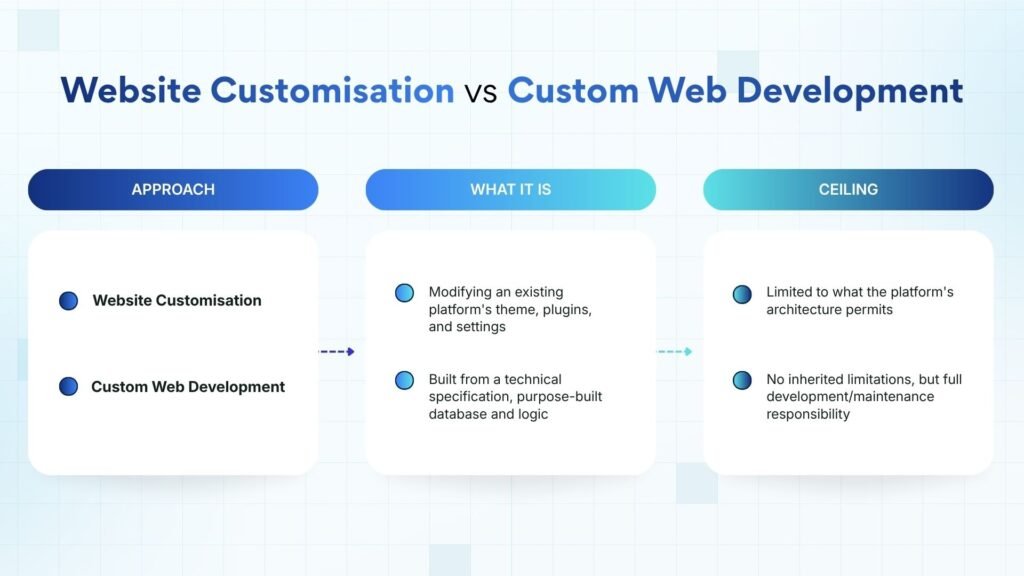
| Approach | What It Is | Ceiling |
| Website Customisation | Modifying an existing platform’s theme, plugins, and settings | Limited to what the platform’s architecture permits |
| Custom Web Development | Built from a technical specification, purpose-built database and logic | No inherited limitations, but full development/maintenance responsibility |
Most businesses assume custom web development means a unique design, a custom theme, or a layout built from scratch. But that’s not the case; it is more than that.
Custom web development means building from a technical specification. The database is designed around your business data. The application logic is written around your workflows. The API integrations connect the actual systems your business runs on: your ERP, your CRM, your payment gateways, your invoicing. When a B2B client logs into a portal and sees their specific pricing and order history, that is custom web development. When a transaction automatically generates a ZATCA-compliant invoice and syncs with the accounts system without anyone touching it, that is custom web development.
For service businesses, this means booking and workflow systems built around how the service is actually delivered. For e-commerce operations, it means order processing, inventory, and invoicing connected end to end. For enterprises, it means every department working from one platform instead of five disconnected tools.
How Does Custom Web Development Integrate Your Business Systems?
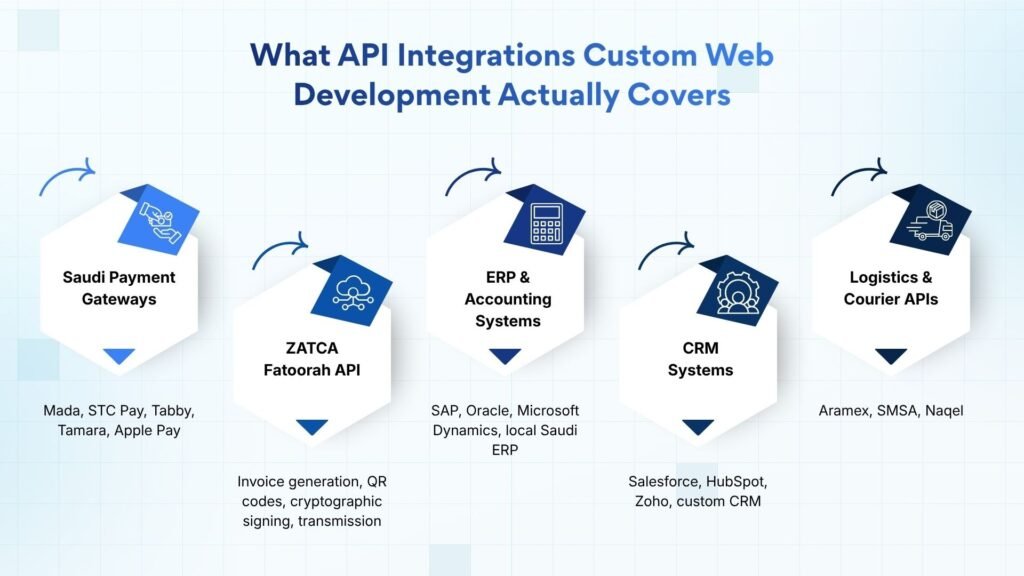
| Integration Category | What It Connects |
| Saudi Payment Gateways | Mada, STC Pay, Tabby, Tamara, Apple Pay |
| ZATCA Fatoorah API | Invoice generation, QR codes, cryptographic signing, transmission |
| ERP & Accounting Systems | SAP, Oracle, Microsoft Dynamics, local Saudi ERP |
| CRM Systems | Salesforce, HubSpot, Zoho, custom CRM |
| Logistics & Courier APIs | Aramex, SMSA, Naqel |
A custom website does not operate in isolation. It connects to the systems your business already runs on, your ERP, your CRM, your payment gateways, your invoicing, and exchanges data with them automatically. When a customer places an order, the inventory updates. When a lead fills an enquiry form, it appears in the CRM. When a transaction is confirmed, the invoice is generated and transmitted. No manual input. No re-typing data from one system into another. That is what business system integration delivers.
Here are the main integrations that go into a custom web development project for Saudi businesses:
API Integrations
An API is the interface through which two software systems exchange data and instructions. When your custom website needs to show live inventory levels, it sends a request to the ERP’s API and displays the response in real time. When a transaction completes, it calls the ZATCA Fatoorah API to generate and transmit the invoice automatically. When a lead submits an enquiry, it hits the CRM API and creates a qualified record instantly. Every integration in your custom web application works through an API, which is why API quality, reliability, and error handling are central to how well the system performs in real operations.
Saudi Payment Gateway Integrations
Mada, STC Pay, Tabby, Tamara, and Apple Pay each have their own API specifications that need to be implemented correctly inside your custom web application. This is not adding a payment plugin. It means handling authentication with each provider, managing transaction states, processing webhooks that notify the system when a payment is confirmed or fails, and handling error cases before they affect the customer. A checkout that breaks at payment loses the sale. Getting this integration right from the start is what prevents that.
ZATCA Fatoorah API Integration
Saudi businesses above the mandatory ZATCA threshold need every commercial transaction to generate a compliant e-invoice, signed with a cryptographic certificate and transmitted to the Fatoorah platform. In a custom web application, this is built directly into the order processing flow. When an order is confirmed, the system generates the invoice in ZATCA’s XML format, creates the QR code, signs it cryptographically, and transmits it to Fatoorah, all without manual involvement. Building this into the architecture from the start is significantly simpler than retrofitting it into a live system later.
ERP and Accounting System Connections
SAP, Oracle, Microsoft Dynamics, and local Saudi ERP systems all offer APIs that allow external applications to read and write data. A Saudi business whose custom website needs to display live inventory levels, post confirmed orders into the ERP, and keep financial records synchronised requires integration that understands the specific data structure of that ERP implementation. This kind of integration work sits closer to software development than website work, since it involves building logic around how two separate systems exchange and reconcile data. A retailer whose website inventory updates automatically when warehouse staff mark stock as received, without anyone updating the website separately, is running an ERP integration that eliminates an entire category of manual work.
CRM Integrations
Salesforce, HubSpot, Zoho, and custom CRM systems connect to custom web applications for lead capture and customer data management. A Saudi B2B business whose website captures an enquiry, automatically creates a qualified lead in the CRM, assigns it to the correct sales rep based on enquiry type, and triggers a follow-up sequence, all from one form submission, is operating at a level that a contact form to email cannot come close to. The sales team works faster because the system has already done the qualification and routing.
Logistics and Courier API Integrations
Aramex, SMSA, and Naqel each offer APIs for shipment booking, rate calculation, and live tracking. A Saudi e-commerce platform integrated with these APIs can automatically calculate the best courier rate based on destination and parcel size, book the collection, and give the customer a live tracking link, all triggered by order confirmation, without anyone on the operations team touching it. For businesses processing high order volumes, this integration alone removes a significant amount of daily manual overhead.
Which Saudi Industries Are Using Custom Web Development?
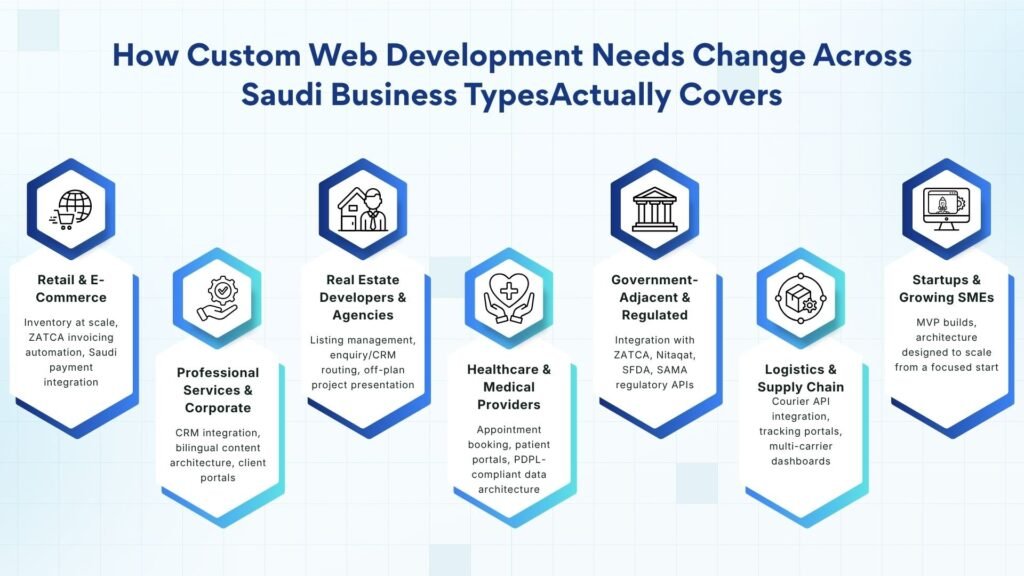
| Business Type | Key Development Needs |
| Retail & E-Commerce | Inventory at scale, ZATCA invoicing automation, Saudi payment integration |
| Professional Services & Corporate | CRM integration, bilingual content architecture, client portals |
| Real Estate Developers & Agencies | Listing management, enquiry/CRM routing, off-plan project presentation |
| Healthcare & Medical Providers | Appointment booking, patient portals, PDPL-compliant data architecture |
| Logistics & Supply Chain | Courier API integration, tracking portals, multi-carrier dashboards |
| Government-Adjacent & Regulated | Integration with ZATCA, Nitaqat, SFDA, SAMA regulatory APIs |
| Startups & Growing SMEs | MVP builds, architecture designed to scale from a focused start |
Custom web development is not limited to one business size or one sector. Any business where the operational process is too specific for a configured platform to handle, where the workflows, the integrations, or the compliance requirements go beyond what a template can support, is a candidate for a custom build.
Industries, from corporate to healthcare, all need custom builds, but the needs and the development process aren’t the same across them. For example, website development for e-commerce has to account for inventory scale, checkout flow, and ZATCA invoicing, while a healthcare provider is dealing with patient data architecture and appointment systems instead.
Here is how it applies across the main industries in Saudi Arabia:
Retail & E-Commerce

Retail is one of the highest-demand sectors for custom web development in Saudi Arabia. Growing retail businesses have to manage inventory across multiple channels, run wholesale and retail operations side by side, and generate ZATCA-compliant invoices at scale, and that is something a standard, template website simply cannot offer. Online retailers with large product catalogues, B2B wholesalers running alongside retail, and multi-channel brands selling across their own store and third-party marketplaces are among the businesses making the move to custom-built websites.
What a custom website handles for retail and e-commerce:
- Inventory that updates across all sales channels automatically when stock levels change
- ZATCA-compliant invoices generated for every confirmed order without anyone touching it
- Mada, STC Pay, Tabby, and Tamara payment integrations built at the API level, not through plugins
- Separate pricing logic for wholesale and retail customers served from the same platform
- Arabic-first storefront design built around how Saudi shoppers navigate and buy
Professional Services & Corporate Businesses

For professional services businesses, the website is the first thing a prospective client judges the business by. A simple web theme limits how much control the business has. Law firms, consulting practices, financial advisory businesses, and corporate service providers need a system that manages both client acquisition and ongoing client relationships from one place.
What a custom website handles for professional services:
- Enquiries routed to the right team member automatically based on service type
- A client portal where existing clients access documents, project updates, and invoices
- Arabic and English bilingual architecture built correctly from the start, not translated after
- Security and performance standards that match what Saudi corporate buyers expect
Real Estate Developers & Agencies
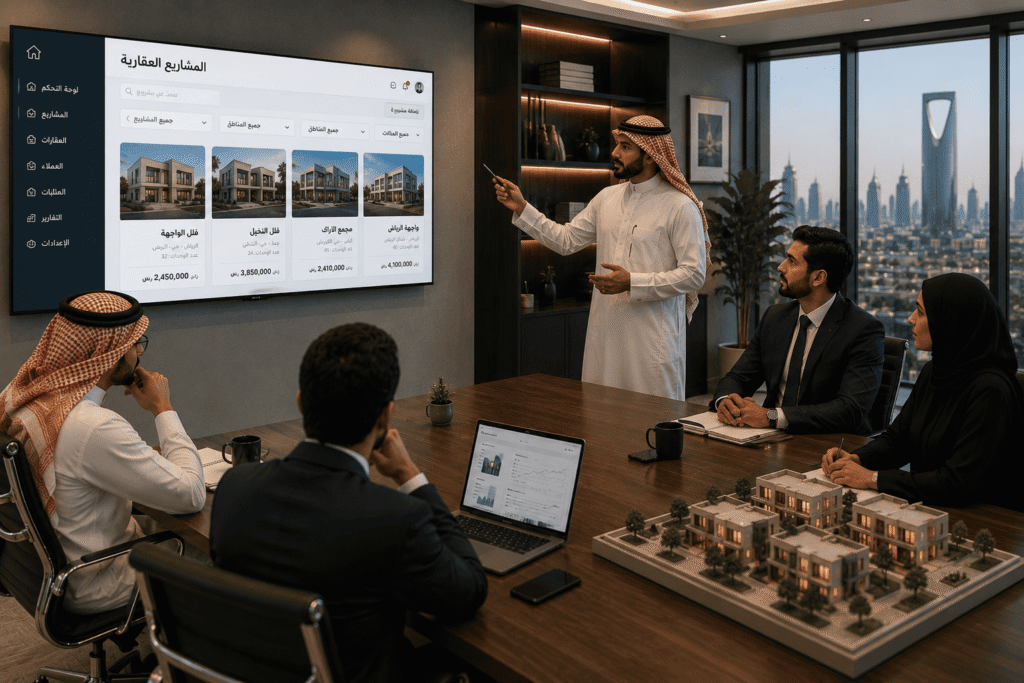
Saudi real estate operates at a scale and complexity that generic listing platforms cannot support. Off-plan sales, large listing inventories, and multi-stage buyer journeys all require a system built around the process. Off-plan developers, real estate brokerages, master-planned community developers, and property marketing agencies are using custom web development to manage the full buyer journey from first discovery through enquiry and sale.
What a custom website handles for real estate:
- Property listings managed at scale with Arabic search filters built around how Saudi buyers search
- Off-plan project pages with visual content management and downloadable documents
- Enquiries captured and routed directly into the CRM, assigned to the right sales rep automatically
- Integration with property management platforms and valuation systems at the enterprise level
Healthcare & Medical Providers
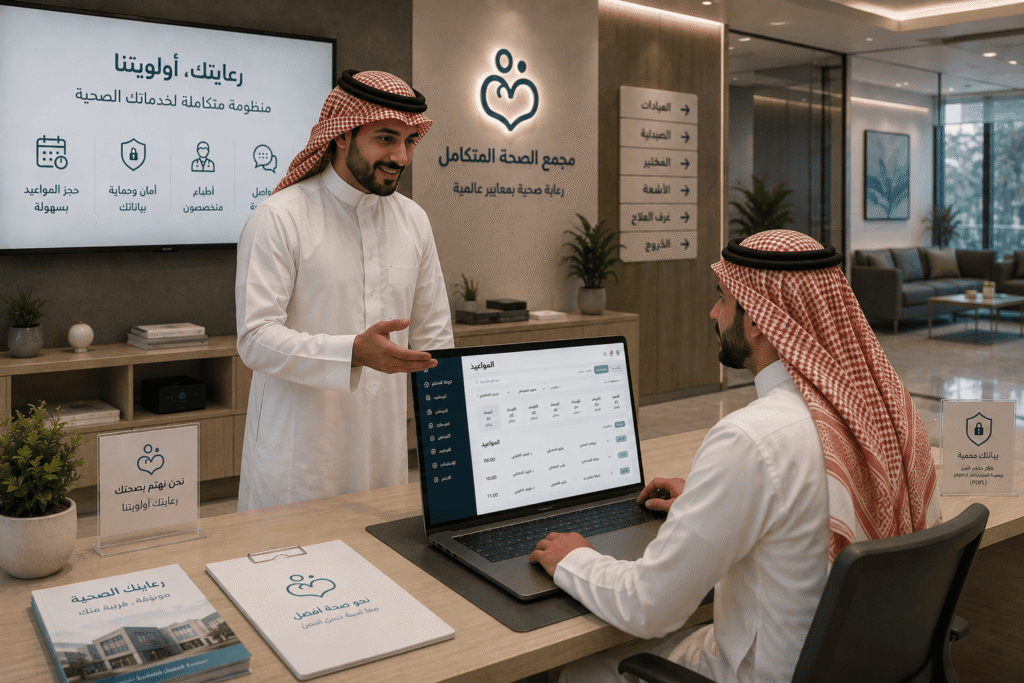
Healthcare is one of the most compliance-sensitive sectors for web development in Saudi Arabia. Patient data handling, MOH content requirements, and PDPL obligations all affect how the system needs to be built. Hospitals, private clinics, medical training centres, and dental practices require custom web development to manage bookings, patient communication, and compliance correctly in one system.
What a custom website handles for healthcare:
- Appointment booking with complex availability logic across multiple practitioners and locations
- Patient portals with data security built to PDPL standards
- MOH-compliant content structures and Arabic-language patient communication
- Integration with clinical management systems for patient record synchronisation
Logistics & Supply Chain Businesses
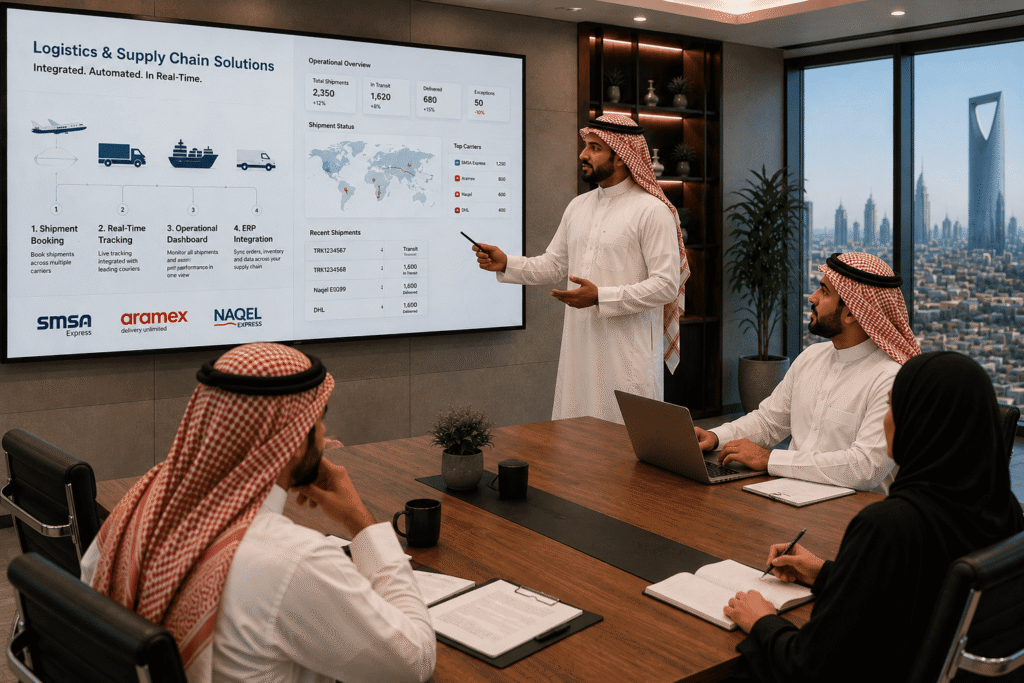
Saudi logistics businesses run on data moving between systems: courier networks, ERPs, customer portals, and operational dashboards. When that data has to be manually transferred between disconnected tools, the operation slows down and errors increase. Freight companies, last-mile delivery operators, courier aggregators, and warehouse management businesses are using custom web to bring all of that into one system.
What a custom website handles for logistics:
- Shipment booking integrated with Aramex, SMSA, and Naqel for automated collection and tracking
- Customer portals showing live order status pulled directly from courier networks
- Operational dashboards consolidating tracking data from multiple carriers in one view
- ERP integration keeping order and inventory data synchronised across the supply chain
Government-Adjacent & Regulated Industries
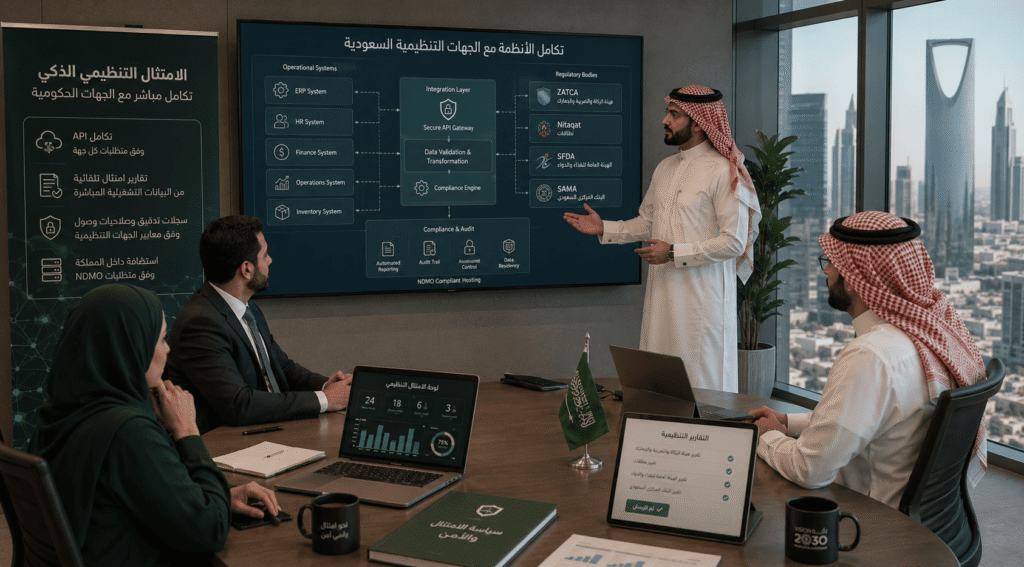
Businesses that report to or integrate with Saudi regulatory bodies have integration requirements that no configured platform is built to handle. The connection between the business’s operational data and the regulatory submission has to be built precisely to each body’s technical specification. Businesses interacting with ZATCA, Nitaqat, SFDA, and SAMA are using custom web development to automate compliance reporting and connect it directly to their operational systems.
What a custom website handles for regulated industries:
- Regulatory API integrations built to the exact specification each Saudi body requires
- Compliance reporting that pulls from live operational data and submits automatically
- Audit trails and access controls that meet the documentation standards of regulated categories
- Hosting and data architecture designed around NDMO data residency requirements where they apply
Startups & Growing SMEs
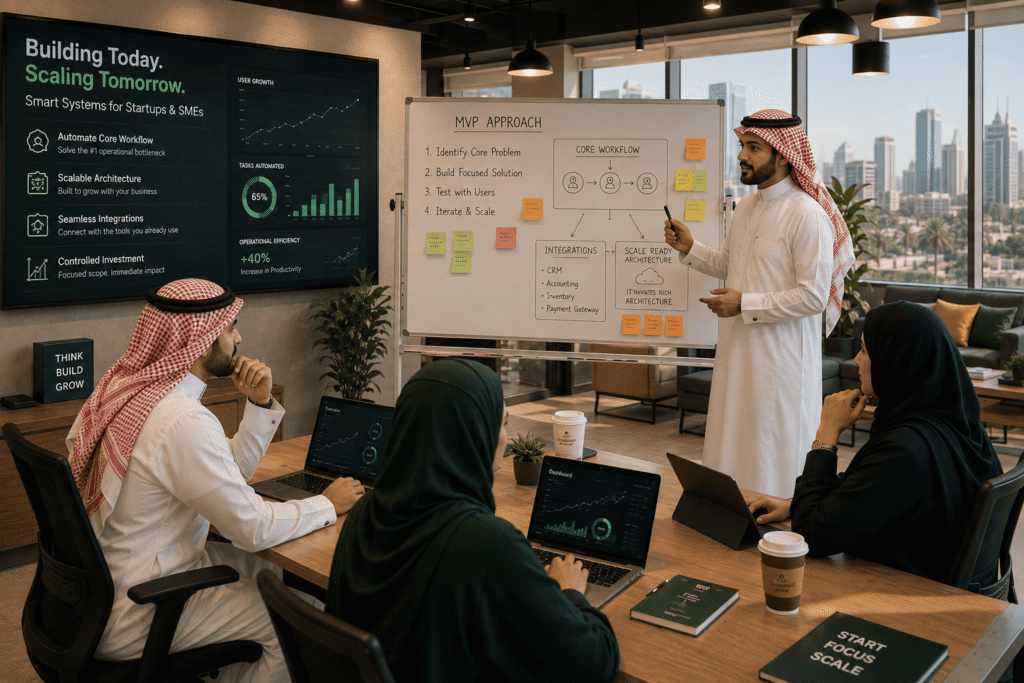
Custom web development for startups and SMEs does not mean building at enterprise scale from day one. The right starting point is a focused build that automates the one process creating the most friction in the business right now. Early-stage startups, growing SMEs, and founder-led businesses scaling their first operational system benefit most from an MVP approach that targets the highest-value functionality first and is architected to scale as the business grows.
What a custom website handles for startups and SMEs:
- A core workflow automated in a focused build rather than an attempt to cover everything at once
- Architecture designed to scale so the system grows without needing a full rebuild later
- Integration with existing tools — CRM, accounting, inventory — rather than replacing them
- A defined scope that controls the initial investment while delivering immediate operational value
Saudi Compliance Requirements in Custom Web Development
| Requirement | What It Covers | Why It Matters |
| ZATCA E-Invoicing Compliance | Invoice generation, QR codes, cryptographic signing, Fatoorah API transmission | Architectural requirement, not a plugin — retrofitting risks live order logic |
| PDPL Data Handling | Consent management, data retention logic, access controls | Applies to virtually every e-commerce, portal, or lead gen site |
| NDMO Data Residency | Where the application is hosted and where data is stored/processed | Applies to healthcare, financial, and government-adjacent applications |
ZATCA e-invoicing compliance
Every Saudi web application that processes commercial transactions above the mandatory ZATCA threshold needs to generate, sign, and transmit ZATCA-compliant e-invoices. For custom web development projects, this means the ZATCA integration is an architectural requirement, not a plugin choice. The application’s order processing logic must include invoice generation in the ZATCA XML format, QR code creation, cryptographic signing with the business’s ZATCA certificate, transmission to the Fatoorah API, and error handling for failed transmissions.
Custom web development projects that launch without ZATCA integration and add it later face the same retrofitting problem as any other late compliance addition — the integration touches the order processing core, and changing core logic in a live system carries risk that building it correctly from the start does not.
PDPL data handling requirements
Saudi Arabia’s Personal Data Protection Law defines how Saudi businesses collect, store, and process personal data. For custom web development projects that handle customer data, which includes virtually every e-commerce platform, customer portal, booking system, and lead generation site, PDPL compliance affects the application’s data architecture. Consent management, data retention logic, access controls, and the ability to respond to individual data requests are all technical implementation requirements that need to be designed into the application, not added as afterthoughts.
NDMO data residency
For custom web applications handling sensitive Saudi data categories, NDMO data residency requirements affect where the application can be hosted and where data can be stored and processed. Healthcare applications handling patient data, financial applications handling transaction records, and government-adjacent applications handling regulated data categories all need hosting decisions made with data residency requirements in mind during architecture planning.
Other Web Systems Used in Custom Web Development
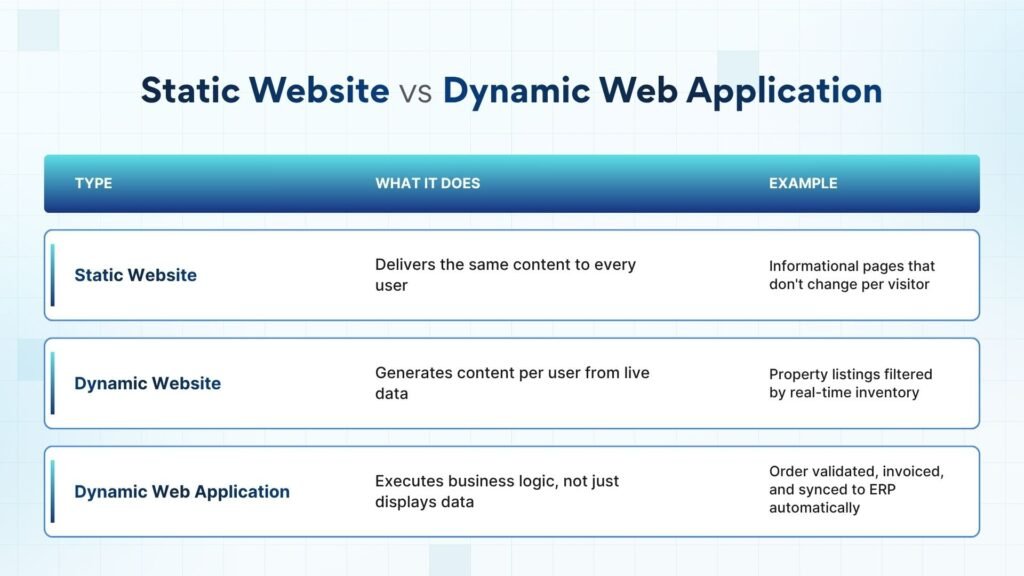
| Type | What It Does | Example |
| Static Website | Delivers the same content to every user | Informational pages that don’t change per visitor |
| Dynamic Website | Generates content per user from live data | Property listings filtered by real-time inventory |
| Dynamic Web Application | Executes business logic, not just displays data | Order validated, invoiced, and synced to ERP automatically |
Not every business needs the same type of system. The right choice depends on what the system needs to do — whether it just needs to display information, respond to live data, or actually execute business logic. Here is how the three types differ and when each one is the right answer.
Static Websites
A static website delivers the same content to every visitor. The pages are pre-built and the server returns the same file to everyone who requests it. This works for informational content that does not change based on who is viewing it — a basic company profile, a service overview page, or a landing page for a single campaign. If the business does not need the site to respond to data, manage users, or connect to external systems, a static website covers the requirement.
Dynamic Websites
A dynamic website generates content at the time of the request based on data pulled from a database. A Saudi real estate platform that shows property listings filtered by live inventory, updated automatically as properties are sold or listed, is a dynamic website. The content is different depending on what data exists in the system at that moment. A news or content platform publishing Arabic and English articles that update regularly, with category filters and search, is also a dynamic website. The system responds to data — it does not just display a fixed page.
Dynamic Web Applications
A dynamic web application goes further than displaying dynamic content. It executes business logic. A system that receives a customer order, validates it against live inventory, generates a ZATCA-compliant invoice, triggers a courier API to book a collection, and updates the ERP automatically is a dynamic web application. It is not displaying information — it is running a workflow. A Saudi B2B client portal where each client logs in and sees their specific order history, pricing tier, and outstanding invoices is a dynamic web application. A logistics dashboard consolidating real-time tracking data from multiple courier networks is a dynamic web application. If the system needs to respond to user identity, execute rules, connect to external systems, or generate documents on demand — it is a web application, not a website.
The Custom Web Development Process for Saudi Businesses
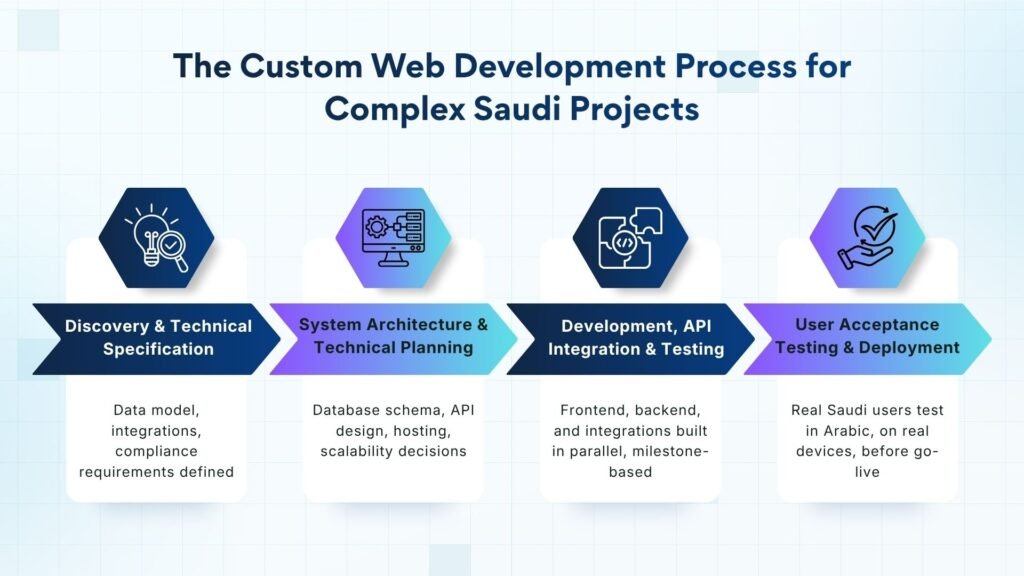
| Stage | What Happens |
| 1. Discovery & Technical Specification | Data model, integrations, compliance requirements defined |
| 2. System Architecture & Technical Planning | Database schema, API design, hosting, scalability decisions |
| 3. Development, API Integration & Testing | Frontend, backend, and integrations built in parallel, milestone-based |
| 4. User Acceptance Testing & Deployment | Real Saudi users test in Arabic, on real devices, before go-live |
Understanding how complex custom web development actually works protects Saudi businesses from agencies that overpromise on timelines, underdeliver on technical specification, and produce systems that require expensive remediation.
Discovery and technical specification
For a complex custom web development project, discovery produces a technical specification document — not a features list or a design brief. The specification defines the system’s data model, the API integrations required and their technical characteristics, the authentication and authorisation requirements, the business logic that the application must implement, the performance requirements at defined load levels, and the compliance requirements that affect architecture decisions.
Discovery for a Saudi enterprise custom web development project typically takes two to four weeks and involves technical interviews with the business’s operational teams, review of existing systems and their integration capabilities, and assessment of Saudi regulatory requirements that apply to the specific application.
A technical specification produced from proper discovery is what protects both the client and the development agency — it defines what is being built precisely enough that cost and timeline estimates are reliable rather than speculative.
System architecture and technical planning
Architecture decisions made during this phase determine how the system behaves under real operational conditions — not at launch, but twelve months later when the business has grown and the system is processing ten times the initial volume. Database schema design, API design for internal and external integrations, authentication system design, hosting infrastructure selection, and scalability planning are all defined here.
This is where compliance requirements — ZATCA integration architecture, PDPL data handling design, NDMO hosting decisions — are addressed. Retrofitting compliance requirements into a system that was not designed for them is significantly more expensive than designing for them from the start.
Development, API integration, and testing
Frontend development, backend development, database implementation, and API integration work happen in parallel against the technical specification. For complex projects, milestone-based delivery — where each milestone produces a testable, demonstrable output rather than just a progress report — gives the Saudi client visibility into the build and the ability to identify specification gaps before they become expensive corrections.
API integration testing for Saudi enterprise projects requires testing not just the happy path but the failure modes — what happens when the ERP API returns an error, how the application handles a failed ZATCA transmission, how payment webhook failures are managed. Integration reliability is what determines whether the system works in real operations rather than in controlled demonstration conditions.
User acceptance testing and deployment
User acceptance testing with actual Saudi business users — in Arabic, on the devices and network conditions they actually use — surfaces usability problems that technical QA does not catch. A workflow that passes every technical test can fail in practice because it does not reflect how the Saudi team actually does the work. UAT before go-live is where that gap is identified and closed at lower cost than post-launch remediation.
Production deployment for Saudi custom web applications includes environment configuration, performance testing under load conditions that reflect Saudi peak usage periods including Ramadan, and monitoring setup that provides visibility into system behavior after go-live.
What Custom Web Development Costs in Saudi Arabia
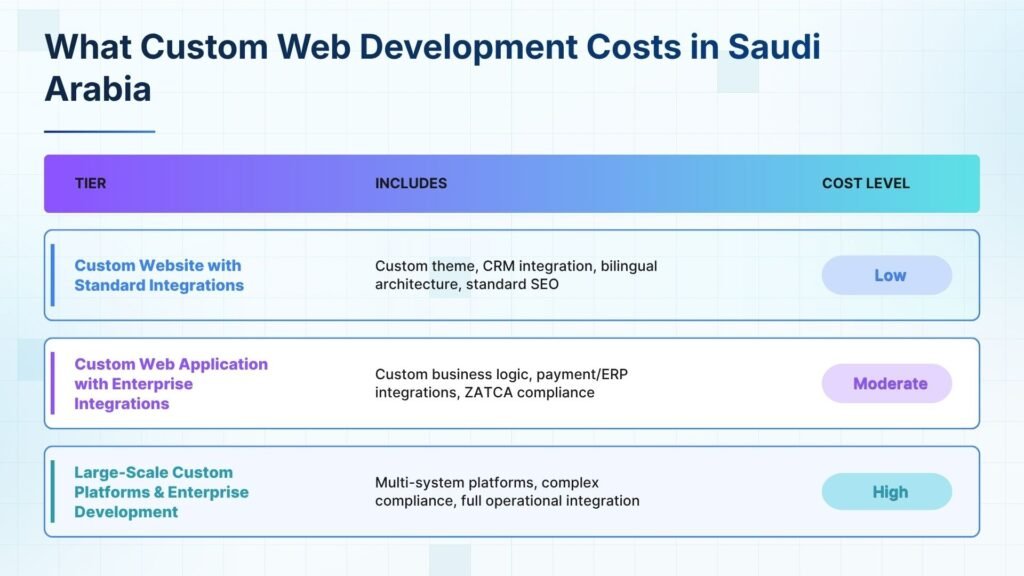
| Tier | Includes | Cost Level |
| Custom Website with Standard Integrations | Custom theme, CRM integration, bilingual architecture, standard SEO | Low |
| Custom Web Application with Enterprise Integrations | Custom business logic, payment/ERP integrations, ZATCA compliance | Moderate |
| Large-Scale Custom Platforms & Enterprise Development | Multi-system platforms, complex compliance, full operational integration | High |
Custom web development cost is driven by technical complexity, integration scope, compliance requirements, and the timeline the project needs to be delivered within. There are no fixed price points because the scope variation between a custom WordPress website and an enterprise Saudi logistics web application is enormous.
Custom website with standard integrations
A custom built website for a Saudi corporate business — custom theme development, CRM integration for lead capture, Arabic and English bilingual architecture, and standard SEO technical foundation — is the lower end of the custom web development cost range. The defining characteristic is bounded scope: the functionality requirements are defined and the integration complexity is limited to standard API connections.
Custom web application with enterprise integrations
The middle cost tier — a dynamic web application with custom business logic, multiple API integrations including payment gateways and ERP connections, authentication system with user role management, and ZATCA compliance integration. Cost at this tier is driven by integration complexity and the amount of custom business logic the application needs to implement. Saudi enterprise businesses commissioning this level of custom web development are typically replacing a manual process or a fragmented set of tools with a single system.
Large-scale custom platforms and enterprise custom web development
The highest cost tier — multi-system platforms, custom web solutions for enterprise Saudi organisations with complex compliance requirements, custom ecommerce website development at scale with full operational integration. Cost is determined by the scope of what needs to be built, the number and complexity of systems that need to integrate, and the performance and reliability requirements at enterprise scale.
What drives cost up
Integration complexity is the primary variable — the more external Saudi and international systems the application needs to connect to, and the more complex those connections are, the more development and testing time is required. Compliance architecture for ZATCA, PDPL, and NDMO adds development scope to any Saudi project in regulated categories. Timeline compression — when the business needs the system delivered faster than the natural development timeline allows — requires parallel development resources that increase cost proportionally. Arabic content production for custom web projects where Arabic copy, interface labels, and documentation need to be created adds production work beyond the development scope.
Custom Web Development: Quick Decision Guide for Businesses
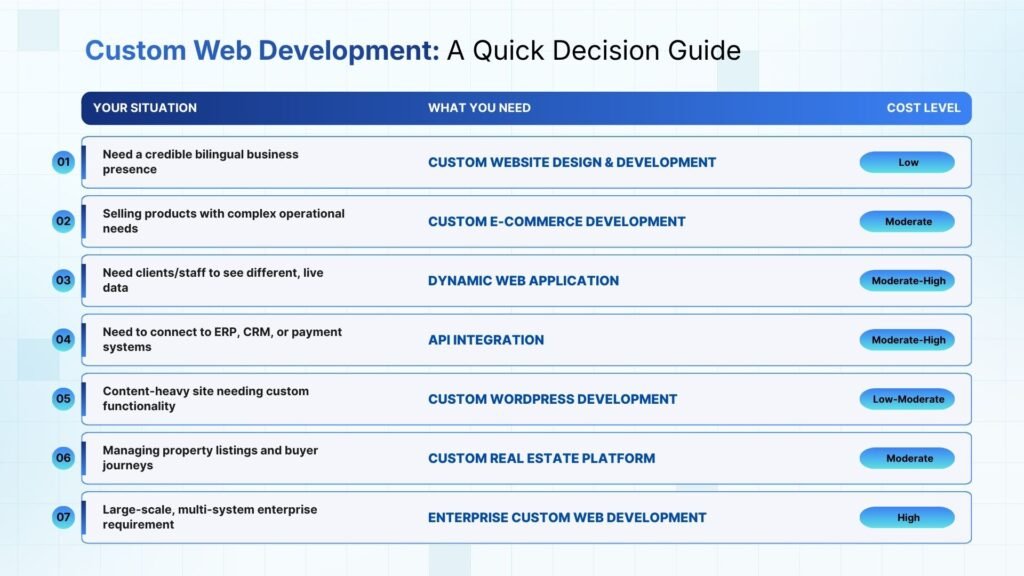
| Your Situation | What You Need | Cost Level |
| Need a credible bilingual business presence | Custom Website Design & Development | Low |
| Selling products with complex operational needs | Custom E-Commerce Development | Moderate |
| Need clients/staff to see different, live data | Dynamic Web Application | Moderate–High |
| Need to connect to ERP, CRM, or payment systems | API Integration | Moderate–High |
| Content-heavy site needing custom functionality | Custom WordPress Development | Low–Moderate |
| Managing property listings and buyer journeys | Custom Real Estate Platform | Moderate |
| Large-scale, multi-system enterprise requirement | Enterprise Custom Web Development | High |
Common Custom Web Development Mistakes to Avoid
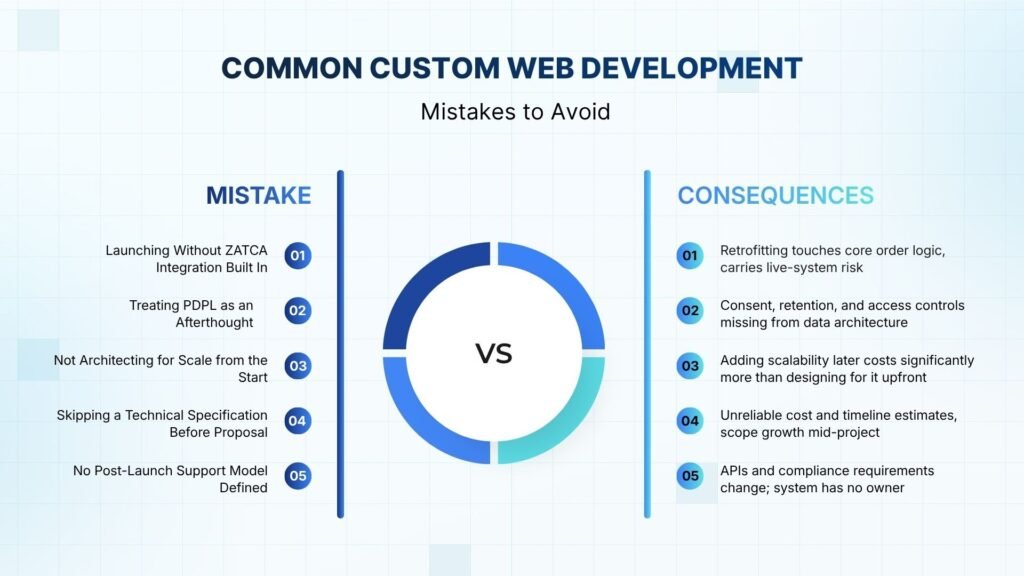
| Mistake | Consequence |
| Launching Without ZATCA Integration Built In | Retrofitting touches core order logic, carries live-system risk |
| Treating PDPL as an Afterthought | Consent, retention, and access controls missing from data architecture |
| Not Architecting for Scale from the Start | Adding scalability later costs significantly more than designing for it upfront |
| Skipping a Technical Specification Before Proposal | Unreliable cost and timeline estimates, scope growth mid-project |
| No Post-Launch Support Model Defined | APIs and compliance requirements change; system has no owner |
How to Choose a Custom Web Development Company in Saudi Arabia
Technical depth, not portfolio aesthetics
A custom web development agency portfolio that shows visually impressive websites tells you about design capability. The relevant questions for a Saudi business commissioning complex custom web development are different: can they show you a project where they built custom API integrations with Saudi payment gateways and ERP systems? Do they have experience with ZATCA integration? Have they built dynamic web applications with complex authentication requirements? Have they deployed Saudi web applications at scale and managed their ongoing performance?
Technical specification before proposal
A custom web development company that produces a detailed cost proposal from a brief conversation has not understood the project well enough to price it reliably. A reliable proposal for complex custom web development follows a discovery process that produces a technical specification — which is what the proposal is actually costing. Agencies that skip this step are either underspecifying the project (which produces scope growth and cost overruns during development) or pricing conservatively to win the work and negotiating on scope later.
Saudi compliance experience
ZATCA Fatoorah API integration, PDPL data architecture, Arabic RTL interface design, Saudi payment gateway connections, and local hosting considerations are Saudi-specific requirements that a custom web development agency without Saudi market experience encounters for the first time on the client’s project. An agency that has already built these integrations for other Saudi clients delivers them faster and with fewer problems than one learning them on the client’s budget.
Post-launch support model
A custom web application is not a completed project at launch. APIs change their specifications. Security vulnerabilities are discovered and patched. ZATCA updates its e-invoicing requirements. Business requirements evolve. The agency’s post-launch support model — who is responsible for maintenance, what the response time is for critical issues, how new feature development is scoped and priced — should be defined before the project begins. A custom web development agency that does not discuss post-launch support during the scoping conversation is delivering a build, not a maintained operational system.
How Does Etihad Falcon Tech Build Custom Web Development Solutions for Saudi Businesses?
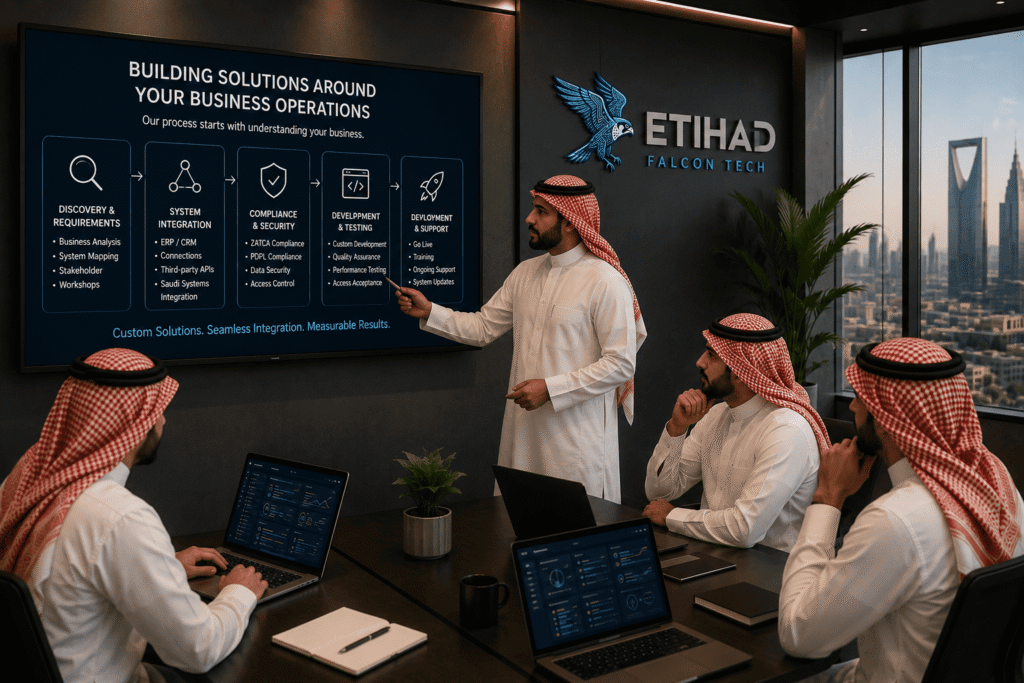
Etihad Falcon Tech’s custom web development starts with operational requirements, not design preferences or platform selection. The first engagement is a technical discovery process that maps what the business needs the system to do, what existing Saudi business systems it needs to connect to, what compliance requirements apply to the specific application category, and what the performance requirements are under realistic Saudi usage conditions including peak periods.
Technical capability across the full custom web development stack
We handle custom website design and development, dynamic web application development, API integration including ZATCA Fatoorah, Saudi payment gateways, ERP systems, and CRM platforms, authentication system design, custom WordPress website development with custom theme and plugin development, and enterprise custom web development for complex Saudi business requirements. Frontend, backend, database, and integration work are handled internally, not split between a design agency and a development team working from separate briefs.
Saudi compliance built into the architecture
ZATCA e-invoicing integration, PDPL data architecture, Arabic RTL design, and Saudi hosting considerations are part of EFT’s standard technical specification process for every relevant project, not options raised at the end of a build that was designed without them. We have implemented ZATCA Fatoorah API integration for Saudi web applications across e-commerce, services, and enterprise categories. That implementation experience means the integration is delivered correctly the first time rather than debugged against the ZATCA specification under live system pressure.
Enterprise integration experience
Etihad Falcon Tech has built API integrations with Saudi ERP implementations, CRM systems including Salesforce and HubSpot, Saudi courier APIs, and Saudi regulatory platforms. That cross-system experience means integration scope is understood accurately during discovery, which produces reliable cost and timeline estimates rather than figures that shift as integration complexity becomes clear mid-project.
Post-launch support defined before development begins
Our every custom web development engagement includes a post-launch support arrangement agreed before the project starts, maintenance schedules, response times for critical issues, and how ongoing development and new feature requests are scoped. Saudi businesses that plan for ongoing development alongside the build operate their custom web applications more effectively than those that treat launch as the project completion point.
If your current web presence or web application is limiting what the business can do operationally, if your current website is limiting what the business can do operationally, if you are building manual processes around what the system cannot handle, that is the conversation to have with our experts. Message our experts on WhatsApp to walk through your specific operational requirements and what a custom-built system would look like for your business.
Frequently Asked Questions
What is custom web development?
Custom web development builds a website or web application from a technical specification rather than configuring an existing platform. The database schema, application logic, API integrations, and authentication system are all designed around the specific business’s operational requirements. The result is a system with no inherited platform constraints — it does exactly what the business needs rather than approximating it within what a platform vendor chose to support.
What is the difference between a custom website and a template website?
A template website is a configured version of an existing platform — the design and functionality options are limited to what the platform and theme permit. A custom built website is built from a specification where every component is purpose-built. The practical difference appears when the business needs to do something the template platform does not support — custom development can build it, template configuration cannot.
When does a Saudi business need a dynamic web application rather than a website?
When the business process requires real-time data from a database, different content for different users, business logic execution, or connection to external systems through APIs. A portal where Saudi B2B clients view their specific account data is a dynamic web application. A booking system with real-time availability management is a dynamic web application. An order processing system that generates ZATCA invoices automatically is a dynamic web application. If the system needs to respond to data rather than just display content, it is a web application.
What does API integration actually involve in custom web development?
API integration connects the custom web application to external systems — Saudi payment gateways, ZATCA Fatoorah, ERP systems, CRM platforms, Saudi courier networks, or any other system with an API. Implementation covers authentication with the external system, sending and receiving correctly formatted requests, handling the responses including error cases, and managing the ongoing reliability of the connection as both systems update over time. API integration for Saudi enterprise requirements is often the largest component of a complex custom web development project.
How does ZATCA compliance affect custom web development?
ZATCA e-invoicing compliance requires that every commercial transaction generates an invoice in ZATCA’s specified XML format, signed with the business’s cryptographic certificate, and transmitted to the Fatoorah API. For custom web applications that process Saudi commercial transactions, this means the order processing logic must include ZATCA invoice generation, QR code creation, cryptographic signing, API transmission, and error handling for failed transmissions. This needs to be designed into the application architecture from the start — retrofitting it into a live system after launch is significantly more complex and disruptive.
How long does custom web development take in Saudi Arabia?
A custom corporate website with standard CRM integration and Arabic bilingual architecture takes six to ten weeks. A custom web application with multiple API integrations — payment gateways, ERP connections, ZATCA integration — takes three to six months depending on integration complexity. Enterprise custom web development projects at large scale take six months to over a year. Timeline is driven by technical specification complexity and integration scope, not by the visual design or page count.
Is custom web development more expensive than using a platform?
The upfront investment in custom web development is higher than configuring an existing platform. The correct cost comparison is total cost of ownership over three to five years — including the ongoing cost of manual processes that the platform cannot automate, the development cost of workarounds for platform limitations, the cost of eventually rebuilding when the platform ceiling is reached, and the revenue lost to poor conversion rates and operational inefficiency. For Saudi businesses with complex operational requirements, custom web development consistently costs less over this timeframe than the accumulated cost of working around platform limitations.
What should a Saudi business look for in a custom web development company?
Demonstrated experience with the specific integration types the project requires — ZATCA, Saudi payment gateways, ERP systems. A technical specification process that precedes any proposal rather than proposals produced from brief conversations. Saudi market compliance experience including PDPL data architecture and Arabic RTL implementation. A post-launch support model defined before the project begins. And a portfolio that shows operational systems delivered for Saudi businesses with comparable requirements, not just visually impressive website design.