
WooCommerce powers 5,170 active online stores in Saudi Arabia, according to AfterShip, a global e-commerce data and shipment tracking platform that monitors store activity across major platforms worldwide, making it the third-largest e-commerce platform in the Kingdom. WooCommerce runs on open-source code, which means custom pricing logic, checkout rules, and integrations can be built directly into the store from day one.
Your customer data, product catalogue, and hosting are fully yours on WooCommerce, stored where you choose and moved whenever you choose. There’s no transaction fee to a platform vendor on every sale, and no dependency on a vendor’s timeline for a feature your business needs today.
However, that flexibility comes with a trade-off. There’s no platform managing your hosting, your ZATCA setup, or your payment gateway integration for you. Every one of those has to be built correctly, which is why you need an experienced WooCommerce development company that can set your store up the right way from the start. WooCommerce is more technical to build on, but it gives you more freedom over how your store is designed, priced, and integrated than any hosted platform in the Kingdom.
This guide covers what WooCommerce development actually takes: how it compares to Salla, Zid, and Shopify, what to plan before development starts, what it costs, and how to choose the right WooCommerce development partner for your Saudi business.
What Makes WooCommerce Different From Other Saudi Platforms?
On WooCommerce, if you need customer-specific wholesale pricing, a checkout flow that behaves differently by account type, or an ERP integration that isn’t natively supported elsewhere, that’s a build your development team can deliver, not a workaround you’re stuck patching together. On Salla or Shopify, you get the features they’ve decided to build, and your business works around whatever’s there.
Why Does Compliance Matter More on a WooCommerce Store?
With a hosted platform, you’re renting infrastructure. Your customer data, order history, and product catalogue sit on someone else’s servers, under someone else’s terms. If the platform changes its pricing or drops a feature you depend on, you accept it or migrate.
With WooCommerce, you own the system. Your data lives where you decide, your hosting is chosen on performance and cost, not lock-in, and you can move to better infrastructure without rebuilding the store. That control also matters for PDPL compliance: Saudi Arabia’s data protection law puts the responsibility for how customer data is stored and processed on your business, and owning your infrastructure makes it far easier to host that data within KSA and meet PDPL’s requirements than depending on where a hosted platform’s servers happen to sit. For Saudi businesses running B2B relationships or repeat purchase models, that’s not a technical preference; it’s a decision with real revenue and compliance implications.
What Does WooCommerce Development Actually Cover for a Saudi Business?
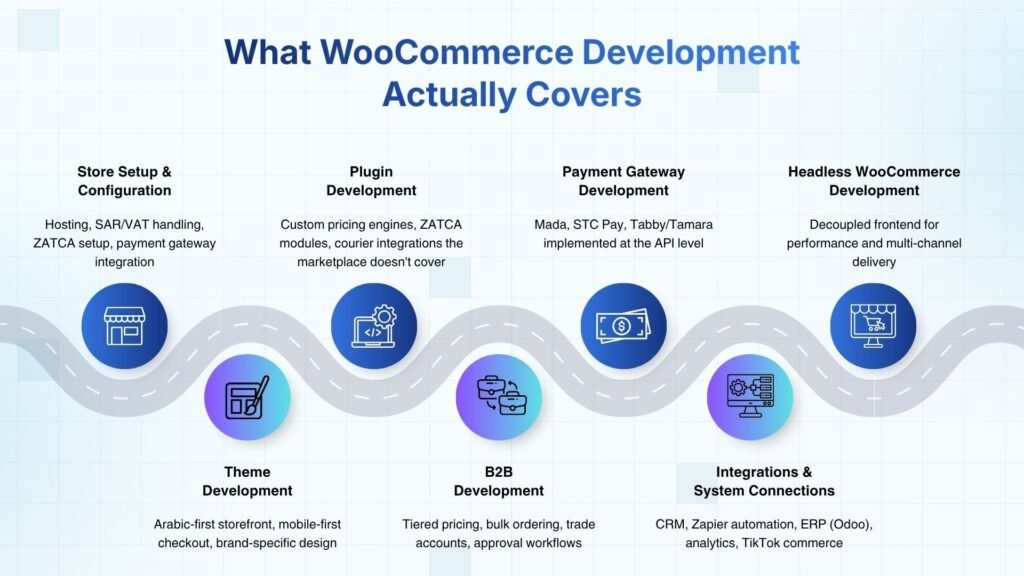
| Service | What It Covers |
| Store Setup & Configuration | Hosting, SAR/VAT handling, ZATCA setup, payment gateway integration |
| Theme Development | Arabic-first storefront, mobile-first checkout, brand-specific design |
| Plugin Development | Custom pricing engines, ZATCA modules, courier integrations the marketplace doesn’t cover |
| B2B Development | Tiered pricing, bulk ordering, trade accounts, approval workflows |
| Payment Gateway Development | Mada, STC Pay, Tabby/Tamara implemented at the API level |
| Integrations & System Connections | CRM, Zapier automation, ERP (Odoo), analytics, TikTok commerce |
| Headless WooCommerce Development | Decoupled frontend for performance and multi-channel delivery |
WooCommerce development isn’t a single service. It spans store setup, theme development, custom plugin work, payment and system integrations, and ongoing performance work. What you need depends on how your business actually operates, not on a fixed package.
Store Setup and Core Configuration
There’s no platform team managing your server on WooCommerce, so your hosting choice, your WordPress and WooCommerce installation, and your initial performance setup are decisions you have to get right yourself, or through your development partner, from day one.
For a Saudi store, that means SAR currency handling, VAT configuration, ZATCA e-invoicing from your first order, shipping zones built for your actual delivery areas, and Mada, STC Pay, Tabby, and Apple Pay integrated at the API level, not bolted on through a third-party connector. Get any of this wrong at launch, and you’re not tweaking settings later. You’re rebuilding a live store’s foundation while it’s processing orders.
Theme Development
Your theme isn’t a skin on top of the store. It’s what decides how a customer finds a product, adds it to cart, and gets through checkout, in Arabic, in English, and on whatever device they’re holding.
A theme built from scratch gives you full control over that path. A Saudi buyer spots a translated-feeling store immediately, an RTL stylesheet slapped onto an English-first layout, buttons on the wrong side, navigation flowing the wrong way, and the conversion drop shows up in your analytics within days. If you’re running B2B and different customer accounts need to see different pricing and different catalogues, that logic has to be built into the theme from the first wireframe, not patched in after launch.
Mobile matters more here than on any other platform you’d consider. Most of your Saudi traffic is on mobile, often mid-range Android devices on inconsistent networks. If your checkout was designed and tested on a laptop, you’re losing sales you’ll never see in the numbers, because a slow or clunky mobile checkout doesn’t show up as an error, it shows up as someone who left.
Custom Plugin and Extension Development
The WooCommerce plugin library covers the basics. It doesn’t cover how your business specifically prices for wholesale, routes B2B approvals, or generates a ZATCA invoice in the exact format your accounting team needs. That gap is what custom plugin development closes.
Same logic applies to integrations. If your Odoo setup has customisations the standard WooCommerce-Odoo connector can’t handle, or your courier partner has no plugin in the marketplace at all, you need something built for your setup, not a workaround stitched together from whatever’s available.
B2B and Wholesale Development
This is usually where WooCommerce’s advantage over hosted platforms becomes obvious to Saudi merchants. Standard configuration gets you partway: tiered pricing by customer group, minimum order quantities, trade accounts with credit terms instead of upfront payment, and approval workflows before an order confirms.
If your pricing is genuinely complex, different price lists per retailer tier, with volume discounts layered on top, a standard plugin usually can’t hold that logic without manual overrides on every order. That’s when you need a pricing engine built to match exactly how your business prices, not a generic tiering feature you’re working around.
Payment Gateway Development
Mada, STC Pay, Tabby, and Tamara each have their own API specifications, and a generic payment plugin from the WordPress marketplace usually handles the happy path fine but falls apart on the failure cases. Webhook handling is the usual culprit: when it’s not implemented correctly, your order status doesn’t update reliably when a payment event happens asynchronously, and you end up manually reconciling orders that should have updated themselves.
A payment integration built specifically for the gateway’s API and your order flow doesn’t have that gap.
Integrations and System Connections
Your store doesn’t run on its own. HubSpot or CRM integration keeps customer and order data flowing into your marketing and sales systems, so retention campaigns and B2B follow-up actually happen instead of relying on someone remembering to export a list. Zapier connects the store to your other tools through triggers, an order placed, a customer registered, without custom development for every single connection. Odoo or ERP integration keeps inventory and financials synced automatically instead of someone re-entering orders by hand. TikTok integration lets Saudi buyers check out from an ad without leaving the app, which matters given how much Saudi commerce now happens on that channel specifically.
What Is Headless WooCommerce Development, and Why Does It Matter?
Your store has two parts: the backend, which handles products, inventory, orders, and payments, and the frontend, what your customer actually sees and taps through. Normally, WooCommerce builds both together on WordPress. With headless WooCommerce, you keep WooCommerce running the backend, but build a separate, custom frontend on top of it, using something like React or Next.js instead of a WordPress theme.
Here’s why that matters. Say a customer opens your store on a mid-range phone with a weak connection. A standard WordPress theme loads extra code before the page even shows up. A headless frontend skips that, so your site stays fast no matter how much traffic hits it or how many products are in your catalogue.
It also helps if you’re running a mobile app alongside your website. Instead of keeping two systems updated separately, both the app and the site pull from the same WooCommerce backend. Update your stock once, and it reflects everywhere.
How WooCommerce Compares to Salla, Zid, and Shopify for Saudi Merchants
| Platform | Best For | Trade-Off |
| Salla / Zid | Saudi SMEs needing fast, locally compliant launch | B2B, custom checkout, and integration depth limited |
| Shopify | Businesses with international expansion ambitions | Requires third-party work for ZATCA, Mada, checkout customisation |
| WooCommerce | Complex B2B pricing, deep integrations, data ownership priorities | Highest development and technical management investment |
What WooCommerce Offers vs Salla and Zid
WooCommerce gives you full control over your store, no platform deciding what’s possible. You can build custom pricing by customer tier, a checkout flow tailored to how you sell, and integrations to whatever ERP or CRM your business already runs on. Your customer data, your hosting, your infrastructure, all of it stays yours.
Salla and Zid are built specifically for the Saudi market, ZATCA-compliant and ready to launch fast, with Arabic-first design and local payment integration handled natively. If you want your first store live quickly, with less for you to manage technically, they’re a strong choice. As your catalogue and pricing needs grow more specific, WooCommerce gives you more room to build around that.
What WooCommerce Offers vs Shopify
For a store focused specifically on Saudi buyers, WooCommerce lets you build ZATCA, Mada, and STC Pay natively into your store, right in your checkout and order flow, instead of layering them on through third-party work.
Shopify’s strength is its international infrastructure, strong multi-currency and cross-border selling if you’re building toward markets beyond Saudi Arabia. For a Saudi-first store, WooCommerce closes that gap with compliance and payments built directly in.
Which Saudi Industries Are Building on WooCommerce?
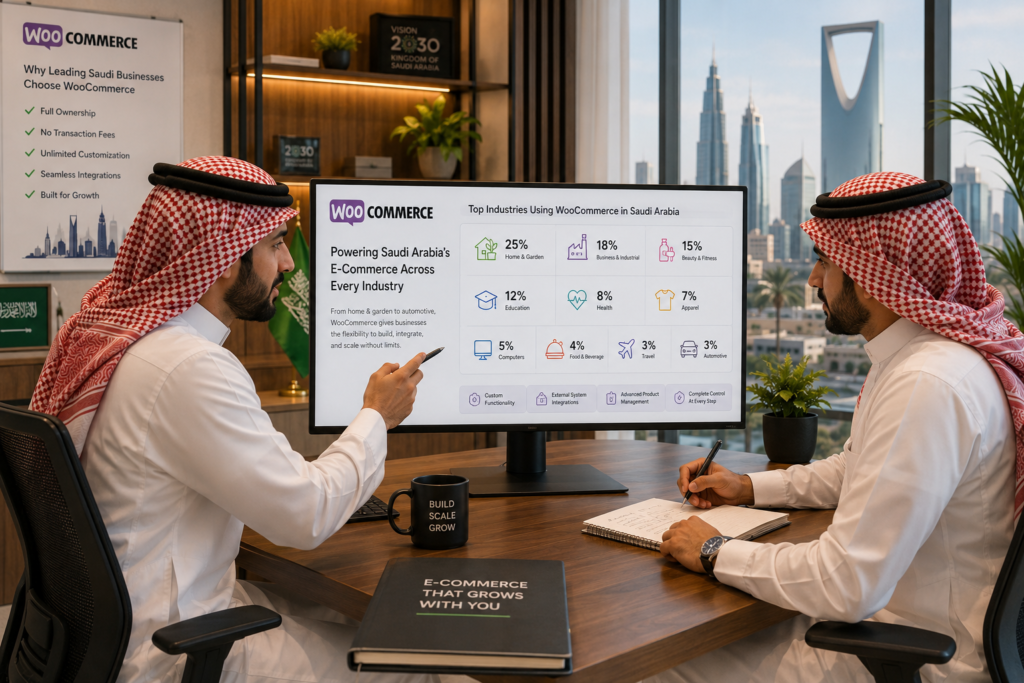
WooCommerce runs across a wide range of industries in Saudi Arabia. Home and garden leads the platform, followed by business and industrial, then beauty and fitness. These are categories that need more than a hosted platform gives them: custom pricing logic, complex product data, integration with external systems, and full control over how the store behaves at every step. Education, health, apparel, computers, food, travel, and automotive round out the rest, each with its own operational layer that WooCommerce handles where a simpler platform would hit a wall.
What you can build on WooCommerce depends less on the category and more on what that category actually needs to run properly. Here’s how that breaks down by industry.
Home, Garden and Interiors
Home and garden is the biggest WooCommerce category in Saudi Arabia. Products are heavy, bulky, or custom. Shipping costs need to calculate against real weight and dimensions. Customers can’t touch the furniture before they buy, so the store has to do the work a showroom would. Furniture and home décor retailers, building materials and fit-out suppliers, lighting and electrical fixture stores, and garden and outdoor product brands are among the businesses getting the most out of WooCommerce in this category.
What WooCommerce handles for home and garden businesses:
- Shipping cost calculation based on actual product weight and dimensions
- AR visualisation that lets buyers place products in their own space before purchasing
- Detailed spec sheets and scale photography that replace what a showroom visit would answer
- Inventory management across large and varied product catalogues
Business, Industrial and Wholesale
Business and industrial is the second-biggest WooCommerce category in Saudi Arabia, and this is where WooCommerce’s open architecture produces the clearest advantage over every hosted platform. B2B buyers don’t want a public price list. They need their negotiated rate, a sensible minimum order quantity, and an invoice that moves directly into their accounting system. Wholesale distributors and trading companies, industrial equipment and safety supply businesses, manufacturer direct-to-business operations, and construction and contracting supply stores are among the businesses building here.
What WooCommerce handles for B2B and wholesale businesses:
- Customer-tier pricing that shows each buyer their negotiated rate at login
- Bulk ordering interfaces built for high-quantity purchases
- Trade account management with credit terms and B2B approval workflows
- ERP integration that keeps order and inventory data synchronised automatically
Beauty, Fitness and Personal Care
Beauty and fitness on WooCommerce in Saudi Arabia runs on repeat customers. Someone reordering their skincare every month, a supplement subscription renewing on schedule, a loyalty reward sitting on their next visit. Skincare and cosmetics brands, fitness equipment and supplement stores, personal care and wellness products, and fragrance and perfume retailers are the businesses driving revenue in this category.
What WooCommerce handles for beauty and fitness businesses:
- Subscription and recurring billing configured for the intervals the business runs
- Loyalty mechanics that reward repeat purchases and subscriber retention
- Influencer and affiliate discount codes that work cleanly at checkout
- Arabic-first product pages built for Saudi beauty buyers
Education, Training and Certification
Jobs and education is one of the largest WooCommerce categories in Saudi Arabia, and most hosted platforms handle it poorly. Selling a course, a certification programme, a training seat, or gated content requires membership logic, enrolment management, digital delivery, and payment plans. Online course and certification providers, corporate training and L&D platforms, test prep and tutoring services, and skills academies and bootcamp operators are the businesses building in this space.
What WooCommerce handles for education and training businesses:
- Membership and access control for gated courses and content libraries
- Payment plan configuration for high-ticket programmes
- Digital product delivery and enrolment management after purchase
- Multi-currency support for Saudi businesses with international student intake
Health and Medical
Health is a growing WooCommerce category in Saudi Arabia. The range is wide: medical equipment, supplements, healthcare consumables, and clinic services. What these businesses share is a need for product data that goes beyond a description. Medical equipment and consumables suppliers, supplement and nutraceutical brands, health clinics selling products or booking services online, and homecare and rehabilitation product stores all operate under compliance requirements that need to be built into the store architecture.
What WooCommerce handles for health and medical businesses:
- SFDA-compliant product data architecture with certifications and regulatory information visible before purchase
- Appointment booking with availability logic across multiple practitioners and locations
- PDPL-compliant data handling for patient and customer information
- Detailed product documentation for regulated categories
Apparel and Fashion
Apparel sits sixth by volume on WooCommerce in Saudi Arabia, but it’s a category with specific technical demands. Variant management across size, colour, and style, Arabic-first product pages, and a returns process that doesn’t quietly drain margin are the floor. Clothing and apparel brands, abaya, modest wear, and occasion dress stores, footwear, bags, and accessories retailers, and sportswear and activewear brands are building in this category.
What WooCommerce handles for apparel and fashion businesses:
- Variant management across size, colour, style, and seasonal collection rotations
- Arabic-first store design built from the layout up, not RTL applied to an English template
- Returns management integrated into the checkout and post-purchase flow from launch
- Mobile-first shopping experience built for how Saudi fashion buyers browse and buy
Computers and Technology Products
Nobody buys enterprise hardware or a high-value device on impulse. Buyers compare specs, verify warranty terms, and look for a reason to trust the store before committing. Consumer electronics retailers, computer, laptop, and peripherals stores, mobile devices and accessories businesses, and smart home and enterprise tech suppliers are building in this category.
What WooCommerce handles for electronics and technology businesses:
- Detailed product specification displays and side-by-side comparison features
- Warranty information and return policy visible before checkout
- Trust signal design that addresses the higher purchase hesitation electronics buyers bring
- ZATCA-compliant VAT display at checkout for every Saudi order
Food, Drink and Specialty FMCG
Food and drink on WooCommerce has a different set of requirements from every other category. Delivery slot booking, perishable SKU management, subscription ordering, and Ramadan demand planning all need to be configured into the system properly. Specialty food and gourmet grocery stores, bakeries and prepared food brands selling direct, beverage and drink companies, and subscription meal box and weekly grocery delivery businesses are the businesses operating in this space.
What WooCommerce handles for food and FMCG businesses:
- Delivery slot booking and zone configuration based on actual Saudi city geography
- Perishable SKU tracking with expiry date management
- Subscription ordering for repeat purchases and weekly delivery schedules
- Ramadan campaign architecture built into the promotional system ahead of the season
Travel, Tourism and Hospitality
Travel is a significant WooCommerce category in Saudi Arabia and it’s growing with domestic tourism under Vision 2030. Booking management, availability calendars, deposit and payment schedule configuration, and bilingual confirmation flows are what this category needs. Tour operators and travel experience businesses, hotel and accommodation brands selling direct, activity and adventure providers, and Hajj and Umrah service operators are among the businesses building here.
What WooCommerce handles for travel and hospitality businesses:
- Availability calendar management and booking confirmation automation
- Deposit and multi-stage payment schedule configuration for advance bookings
- Arabic and English communication built into the confirmation and post-booking flow
- Resource and staff allocation logic for activity and service-based businesses
Automotive and Vehicle Parts
Automotive is a consistent WooCommerce category in Saudi Arabia — mostly parts, accessories, and aftermarket products. The challenge is parts compatibility: a customer needs to know whether a product fits their vehicle before they buy. Auto parts and spare parts retailers, car accessories and aftermarket upgrade stores, fleet and commercial vehicle supply businesses, and tyre and wheel retailers are building in this category.
What WooCommerce handles for automotive businesses:
- Year, make, and model compatibility filtering built into the product architecture
- Bulk ordering for fleet and commercial buyers
- Detailed fitment guides and specification data at the product level
- B2B pricing for trade accounts alongside standard retail pricing
How to Migrate to WooCommerce From Salla, Zid, or Shopify?
Migration is one of the most common WooCommerce engagements and one of the most underestimated in scope. It’s not just about exporting and importing product listings; it is way more complex than that.
What Does a Complete Migration Actually Cover?
Your product data, variants, images, and metadata. Customer records with order history and account details. Historical order data you need for reporting. Active subscriptions or memberships. Discount codes and promotional setups. And SEO migration, URL redirects, metadata, and hreflang for bilingual stores, which decides whether your new store keeps the rankings your old one built.
Why Does SEO Migration Go Wrong for Most Merchants?
This is the part with the most visible commercial cost when it’s done wrong. Change your URL structure without correct redirects, and search engines don’t automatically carry your rankings over. Your organic traffic disappears, often for weeks or months, until the new URLs build authority on their own.
What Happens to ZATCA Compliance During Migration?
Your invoicing logic doesn’t transfer from your old platform. ZATCA Fatoorah API integration has to be rebuilt into your new WooCommerce order flow from scratch, and invoice records from the migration window need to be handled correctly to keep your compliance history intact.
What Are the Essential Features Every Saudi WooCommerce Store Must Have?
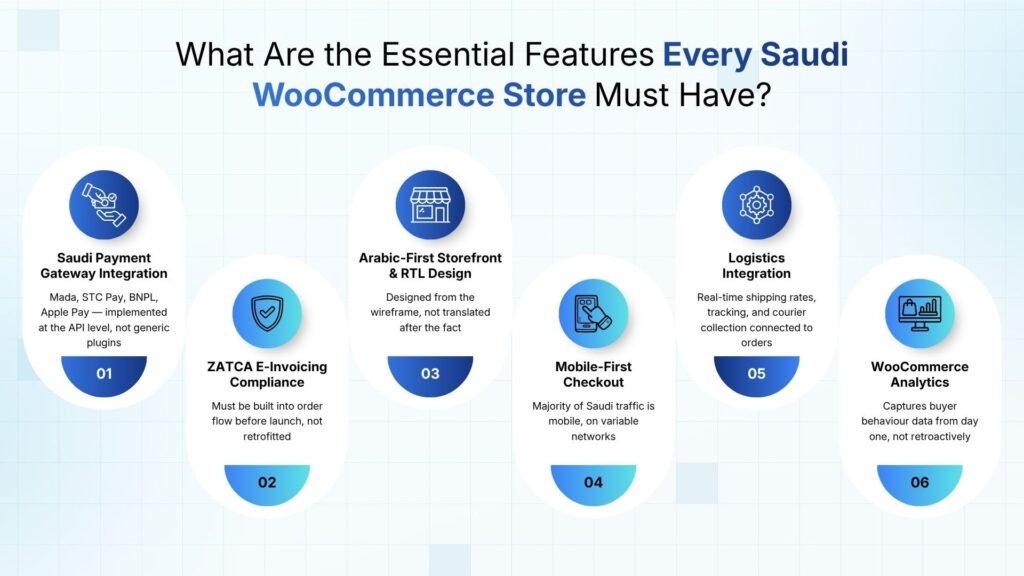
| Feature | Why It Matters |
| Saudi Payment Gateway Integration | Mada, STC Pay, BNPL, Apple Pay — implemented at the API level, not generic plugins |
| ZATCA E-Invoicing Compliance | Must be built into order flow before launch, not retrofitted |
| Arabic-First Storefront & RTL Design | Designed from the wireframe, not translated after the fact |
| Mobile-First Checkout | Majority of Saudi traffic is mobile, on variable networks |
| Logistics Integration | Real-time shipping rates, tracking, and courier collection connected to orders |
| WooCommerce Analytics | Captures buyer behaviour data from day one, not retroactively |
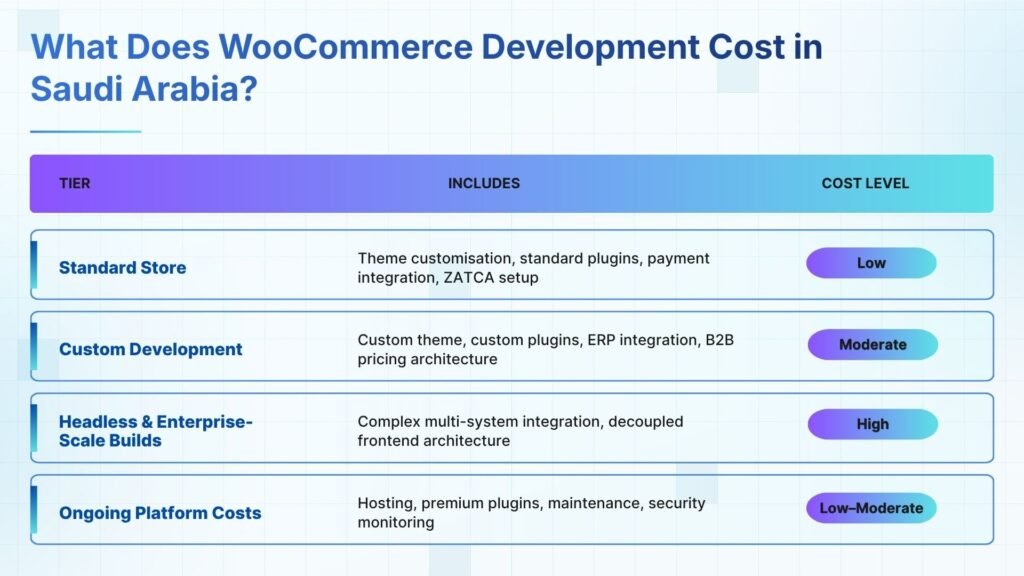
What Does WooCommerce Development Cost in Saudi Arabia?
| Tier | Includes | Cost Level |
| Standard Store | Theme customisation, standard plugins, payment integration, ZATCA setup | Low |
| Custom Development | Custom theme, custom plugins, ERP integration, B2B pricing architecture | Moderate |
| Headless & Enterprise-Scale Builds | Complex multi-system integration, decoupled frontend architecture | High |
| Ongoing Platform Costs | Hosting, premium plugins, maintenance, security monitoring | Low–Moderate |
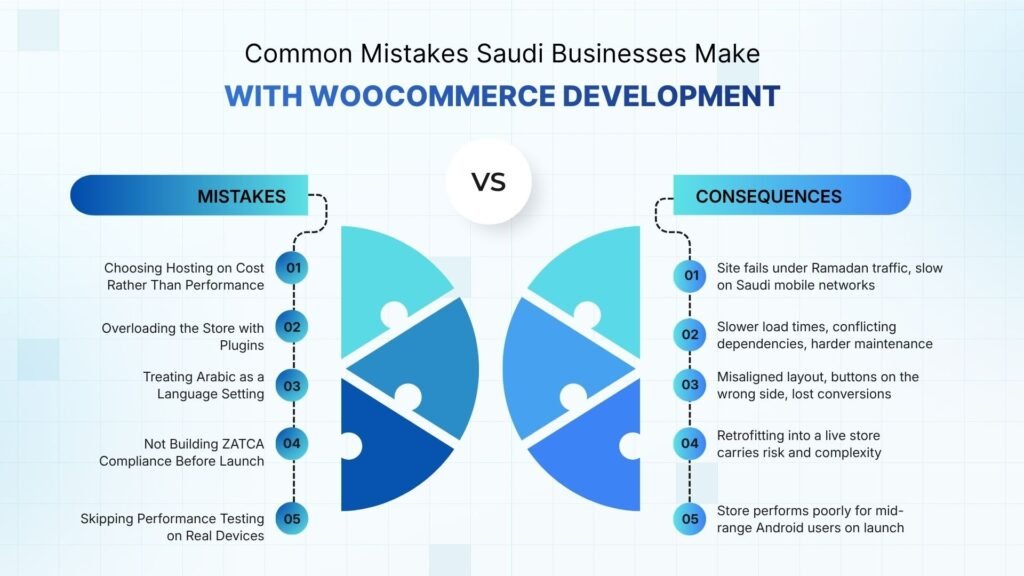
Common Mistakes Saudi Businesses Make With WooCommerce Development
| Mistake | Consequence |
| Choosing Hosting on Cost Rather Than Performance | Site fails under Ramadan traffic, slow on Saudi mobile networks |
| Overloading the Store with Plugins | Slower load times, conflicting dependencies, harder maintenance |
| Treating Arabic as a Language Setting | Misaligned layout, buttons on the wrong side, lost conversions |
| Not Building ZATCA Compliance Before Launch | Retrofitting into a live store carries risk and complexity |
| Skipping Performance Testing on Real Devices | Store performs poorly for mid-range Android users on launch |
What to Look for When Choosing a WooCommerce Development Company in Saudi Arabia
Not every WooCommerce developer builds to the same standard, and the gap between a store that’s configured and one that’s actually built for your business shows up fast, in performance, in compliance, and in how much you’re still fixing six months after launch. Here’s what to check before you commit to a team.
Custom development capability, not just plugin configuration
Look for a team that builds from scratch, custom themes, custom plugins, custom payment integrations, not one that installs and configures existing tools. If your operations have specific requirements, that distinction is what determines whether your store actually fits your business or just approximates it.
Saudi market compliance experience
ZATCA Fatoorah integration, Arabic RTL design, Mada and STC Pay gateway development, and PDPL data handling are Saudi-specific. A developer without this experience learns it on your project, and you pay for that learning curve. A team that’s already built these gets it right the first time.
B2B WooCommerce experience
If you run wholesale or distributor operations, ask for real B2B WooCommerce work, custom pricing tiers, bulk ordering, trade account management, not a general claim of capability. This is a distinct skill set from standard retail builds.
Integration experience with Saudi business systems
ERP, CRM, and courier API integrations are what turn your store into an operational system instead of a standalone site. A team that’s built these before scopes them accurately. One that hasn’t tends to underestimate the complexity, and you’re the one who deals with the fallout when it needs fixing live.
Post-launch support model
WooCommerce needs ongoing maintenance, updates, security patches, performance work. If a company delivers your store and considers the job done, that’s not enough for a store carrying real revenue. Get the support model, what’s covered, response times, how new work gets scoped and priced, agreed before the project starts.
A company like Etihad Falcon Tech is built around checking every one of these boxes: custom development, Saudi compliance experience, B2B depth, integration work, and post-launch support, so you’re not stitching that checklist together across two or three different vendors.
Why Etihad Falcon Tech is Saudi Arabia’s Leading WooCommerce Development Company
We start with your operations, not a feature list or a theme. Before we write a single line of code, we map your pricing logic, the systems you need connected, your compliance obligations, and how your store needs to perform under real traffic. That mapping tells us what to build custom and what existing WooCommerce tools already handle.
End-to-End WooCommerce Solutions
We build you a custom theme with Arabic-first RTL design, from scratch. If your operations need something the plugin marketplace doesn’t cover, we build that custom too. We integrate your payment gateways, Mada, STC Pay, and BNPL providers, and build ZATCA Fatoorah API integration directly into your order flow. We connect your ERP and CRM, including Odoo and HubSpot. If you need headless architecture for performance or multi-channel delivery, we build that too. And if you’re running B2B, we build your pricing engine and trade account management to match how you actually price. One team handles all of it, so nothing gets lost between your design brief and your dev handoff.
Compliance Built In
ZATCA, Arabic RTL, Mada and STC Pay, and VAT configuration go into every store we build from the first technical spec, not after launch. We’ve built WooCommerce stores for Saudi merchants across fashion, food and grocery, B2B wholesale, electronics, and services, so these requirements aren’t new territory on your project.
Migrations Done Right
We’ve migrated merchants to WooCommerce from Salla, Zid, and Shopify, product data, customer records, order history, and SEO redirects included. We scope migration as its own project phase, with redirect mapping, ZATCA reconfiguration, and payment gateway setup planned before we touch a live store.
Support After Launch
Every project comes with a post-launch support plan agreed before we start building, covering updates, security monitoring, and performance work. A store you maintain performs better and costs less to run a year in than one you walk away from at launch.
If your current platform is holding your business back, if you’re running manual processes around what your store can’t do, let’s talk. Message us on WhatsApp and we’ll walk through what your WooCommerce build would actually look like.
Frequently Asked Questions
What’s the difference between WordPress and WooCommerce, and do I need both?
WordPress is the content management system — it runs your site structure and content. WooCommerce is the plugin that turns it into a store: product management, cart, checkout, payments, orders. You need both. WordPress without WooCommerce is a website. WooCommerce without WordPress doesn’t exist.
Can you build a fully custom WooCommerce store with Arabic and RTL support?
Yes. We build Arabic RTL into every store from the first wireframe through checkout and post-purchase communication, not as a language setting applied at the end. That includes Arabic product content, category architecture, and bilingual URL structure with correct hreflang so both languages get indexed properly.
How much does it cost to build a WooCommerce store in Saudi Arabia?
Depends on what you need built versus configured. A store with theme customisation, payment integration, and ZATCA setup costs less than a custom theme with ERP integration and B2B pricing development. Factor in hosting, premium plugins, and post-launch maintenance too, those are ongoing, not one-time.
How long does it take to build and launch a WooCommerce store?
Five to ten weeks for a standard store with theme customisation and payment integration, once your product content is ready. Ten to sixteen weeks for custom theme and plugin development with ERP integration. Headless and complex B2B builds take longer. Content readiness, Arabic descriptions, photography, catalogue data, is usually what extends the timeline.
Do you configure Mada, STC Pay, and ZATCA compliance as part of the build?
Yes, standard on every store we deliver. We build these into the architecture from day one instead of adding them after launch, which is what makes them reliable instead of something you’re fixing later.
What’s headless WooCommerce, and when do you actually need it?
It separates WooCommerce as your backend, product, inventory, orders, payments, from a custom frontend that handles what customers see. You need it if you’re building a mobile app alongside your web store, or if you need frontend performance a standard theme can’t deliver. It costs more and takes longer to build, so it’s not the right call for every business.
Can you develop custom plugins that aren’t in the plugin library?
Yes, this is core to what we do, pricing engines for B2B, ZATCA invoice modules, courier API integrations, custom checkout logic, whatever your marketplace doesn’t cover. We build plugins to work with WooCommerce’s hook and filter architecture, not run alongside it in a way that creates maintenance headaches down the line.
Can you migrate our store from Shopify, Salla, or Zid to WooCommerce?
Yes. Migration covers your product data and variants, customer records, order history, SEO redirects, ZATCA reconfiguration, and payment gateway setup. The redirect mapping is the part that needs the most care, get it wrong and you lose the search rankings your old store built.
What’s the actual difference between WooCommerce and Salla or Zid?
Salla and Zid are Saudi-native, ZATCA-compliant, and faster to launch on, good if you want a standard B2C store with minimal technical overhead. WooCommerce takes more investment and more technical management, but removes the ceiling Salla and Zid put on B2B pricing, integrations, and customisation. If your operations are already outgrowing a hosted platform, WooCommerce is built for where you’re headed.
Does Etihad Falcon Tech offer ongoing development and maintenance after launch?
Yes. Post-launch support covers core updates, plugin compatibility, security monitoring, and ongoing feature development. We agree on what’s covered and response times before your store goes live, not after something breaks. Contact our team to talk through what post-launch support would look like for your store.