
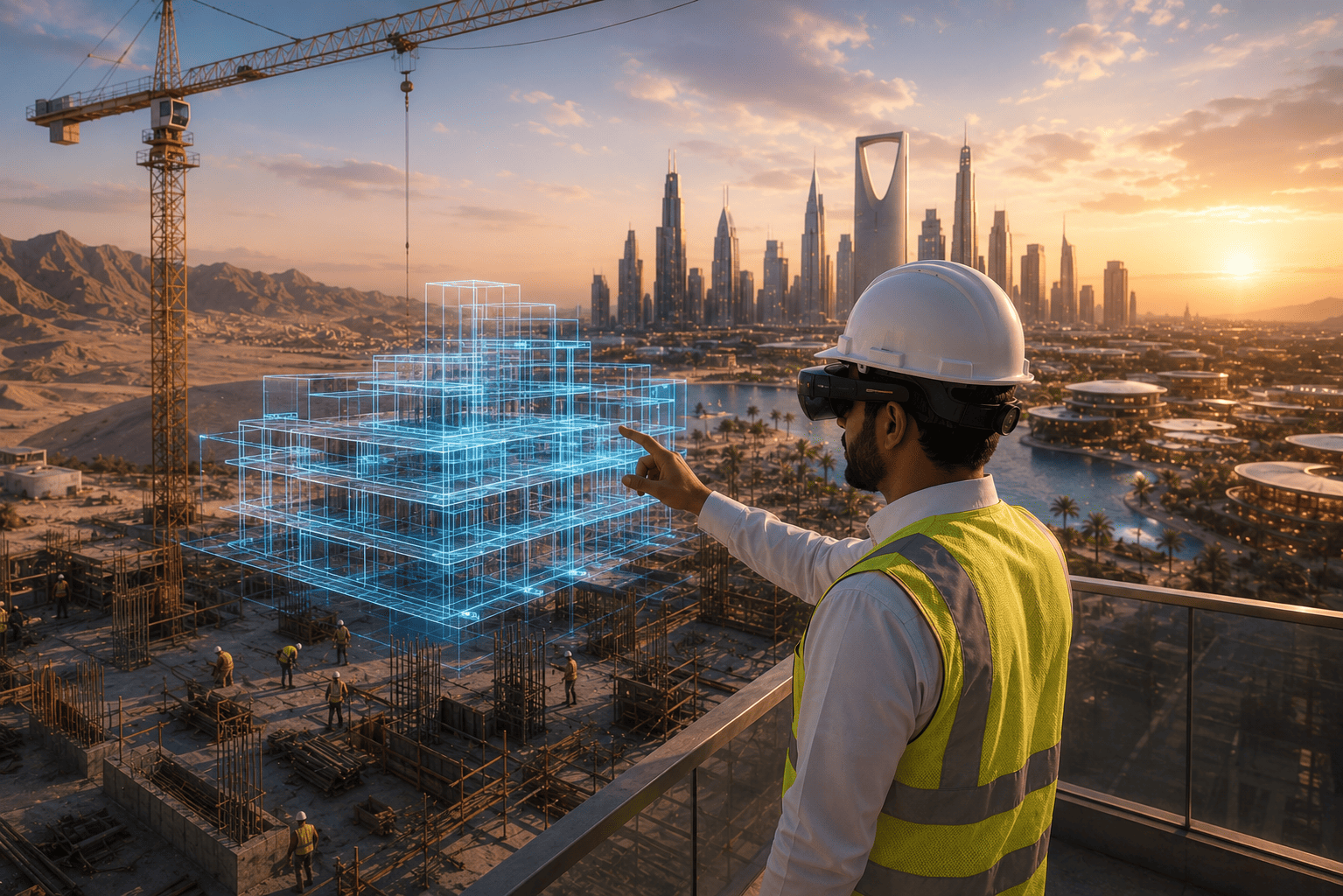
Saudi Arabia’s construction market reached SAR 232 billion in 2025 and is on track to grow to SAR 297 billion by 2029, according to a report by Research and Markets, published on Businesswire. That is thousands of projects running at once, across NEOM, Red Sea Project, Diriyah Gate, and every commercial tower going up in Riyadh or Jeddah and across the Kingdom. Every one of those projects carries the same hidden risk: the gap between what the design says and what actually gets built.
You already know this gap. Your blueprints look complete on paper. But the moment your crew starts pouring concrete and routing MEP systems, small misreads on site turn into rework, delays, and costs your client did not sign up for. Augmented reality in construction industry is the advancement that closes that gap. It puts your design and your build on the same page, literally, by overlaying the model onto the physical site your team is working on.
For developers and contractors working on tight Vision 2030 timelines, that shared picture is what gets a project built exactly how your client envisioned it. AR is becoming the standard for eliminating human error in construction execution, which is why more Saudi developers and construction firms are adopting it.
This guide covers how Augmented Reality is being deployed on Saudi construction sites, where it produces the clearest return, what it takes to implement, and what to look for in an AR development partner who understands how Saudi sites actually run.
Why Saudi Developers are Deploying Augmented Reality in Construction
Developers and construction companies in Saudi Arabia are adopting AR because it is becoming the most important tool in getting projects built on time. There are four specific areas where augmented reality saves the resources a Saudi project cannot afford to lose.
Multi-Contractor Coordination
If you are running a project anywhere near NEOM, Red Sea Project, Diriyah Gate, or Qiddiya scale, you already know the pattern: dozens of subcontractors, international design teams, and structural, mechanical, and electrical works all moving at once. Standard 2D drawings were never built to manage that much simultaneous coordination.
The more disciplines you are running in parallel, the higher the odds a clash slips past the design review and shows up on site instead, where fixing it costs far more.
Compressed Delivery Timelines
Vision 2030 delivery dates are not flexible. They are tied to investor commitments and tourism activation targets your client cannot move.
When rework eats four weeks out of a six-week float, the damage does not stop at the construction budget. Catching problems before the pour, not after, is how you keep the schedule you promised.
Remote Stakeholder Reviews
Your client, design architect, main contractor, and specialist subcontractors are rarely all in the same country. Getting them onto a Saudi site for a physical design review means flights, hotels, and a calendar that never quite lines up.
Mixed reality lets those same stakeholders walk the design at full scale from wherever they already are, so you get their sign-off without the travel bill or the delay.
Multilingual Site Communication
Your site runs on workers from dozens of countries, and a lot of them do not share a common technical language. A translated drawing still leaves room for a costly misread.
AR overlays show a worker exactly what to do in the physical space in front of them, not on a page they have to interpret. That is what closes the gap a language barrier leaves open.
Augmented Reality development addresses each of these pressure points not as a technology showcase, but as a practical answer to the coordination, time, distance, and communication challenges that define construction in Saudi Arabia today.
What is Augmented Reality BIM and why it matters for every construction project
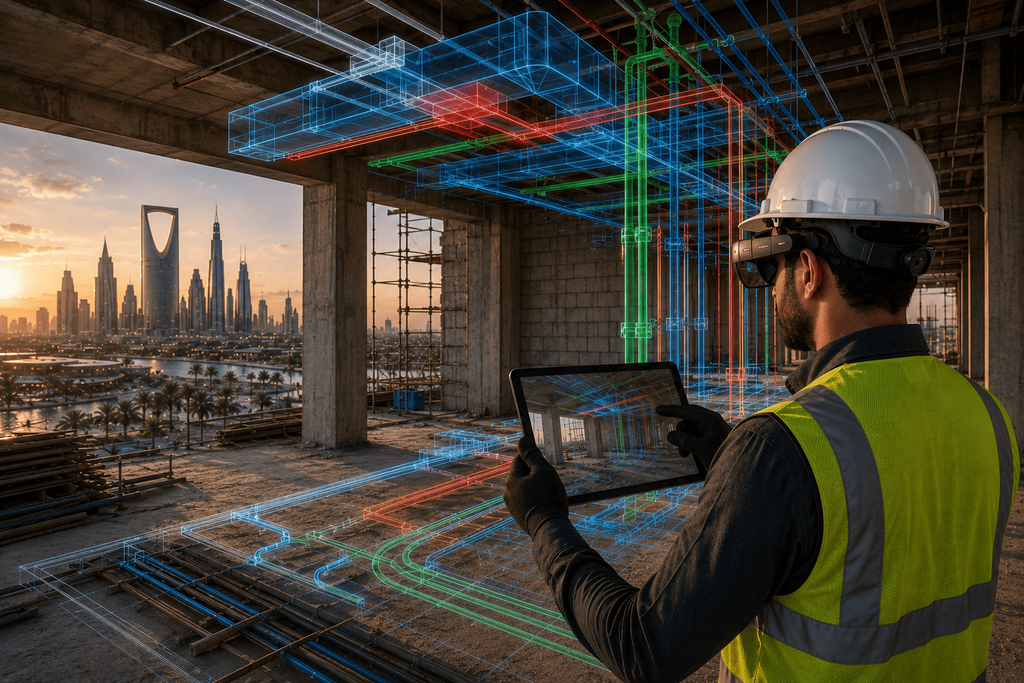
BIM (Building Information Modeling) tells you what your building is supposed to look like. AR BIM tells you whether what’s actually going up on site matches that, in real time, while it can still be fixed. That’s the whole difference.
You already have a BIM model. It holds every structural element, every MEP (Mechanical, Electrical, & Plumbing) run, every architectural component, positioned to millimetre accuracy. That’s a complete record of what the finished building should be, but your site team only sees it as flat 2D printouts or tablet screens, and has to mentally rebuild that 3D picture while standing inside a half-built structure.
AR BIM removes that step. Here is what it does better than a standard BIM model on its own.
Model Overlaid on Site
- Your site engineer holds up a tablet or wears AR glasses, and sees the BIM model placed over the real space in front of them, at true scale
- GPS and marker tracking keep the overlay lined up as they walk through the building
- They see exactly where MEP routing, masonry, and every penetration or chase should go, without reading a drawing first
Clash Detection
- A clash between a beam and a duct can slip past a BIM review buried under thousands of other checks
- On site, your engineer sees that same clash the moment they look at the overlay, no report needed
- The sooner it’s caught, the cheaper it is to fix, and AR catches it at the walkthrough instead of after the pour
As-Built Verification
- A wall sitting 150mm off design shows up as a visible gap between the wall and the overlay
- Your quality team checks this by eye, on any element, at any stage, no survey equipment needed
- A scheduled survey becomes a quick check any engineer can run with a tablet
How AR in Construction is Used for Safety and Quality Control
Not every problem on your site shows up the same way, and it doesn’t need the same fix. A worker missing a safety step and an inspector missing a deviation are two different moments, but AR catches both the same way: right where it happens, not after. Here’s what that looks like broken down by where it happens on your site.
On-Site Safety Guidance
- A worker overlays step-by-step instructions, safety checkpoints, and permit-to-work conditions directly onto the equipment or space they’re standing in
- A confined space entry shows atmospheric monitoring requirements right on the access point; an electrical isolation task confirms the correct lockout point before work starts
- Guidance runs in multiple languages at once, so a multilingual crew gets the same instruction without a translation gap
Quality Control & Inspection
- Your inspector stands next to the element and sees the design intent overlaid at real scale, no total station or manual measurement needed
- A wall or component that’s out of position shows up as a visible gap between the physical surface and the overlay
- This turns inspection into a quick visual check instead of a measure-and-compare process open to transcription error
Defect Tracking
- A defect gets logged with a photo, tagged to its exact BIM element, and routed straight to the responsible trade for fixing
- The record stays linked to the building model instead of sitting in a written list someone has to interpret later
- For large residential handovers, this cuts the time spent locating, describing, and chasing down individual defects
Applications of Augmented Reality in Constructions
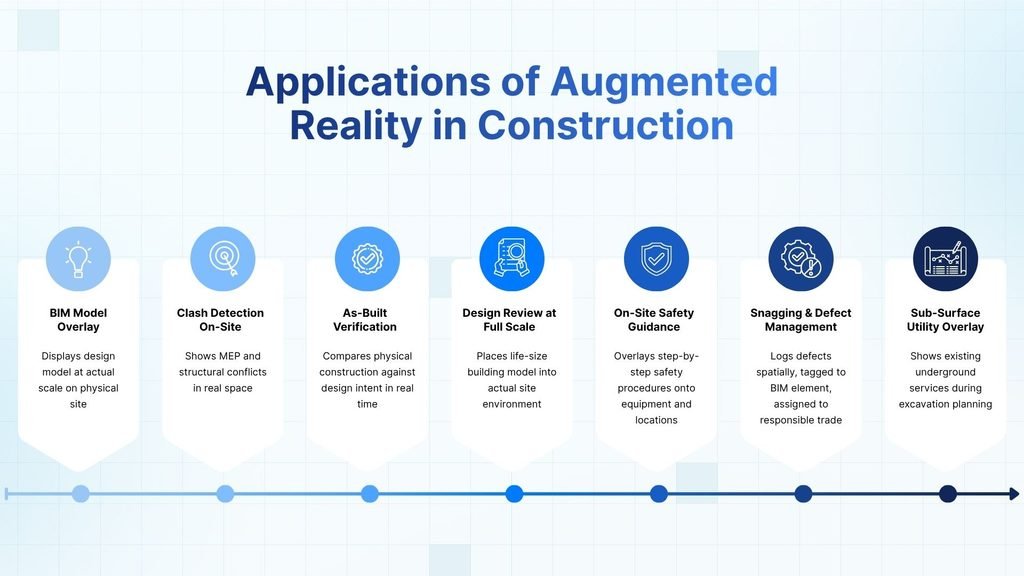
| Application | What It Does |
| BIM Model Overlay | Displays design model at actual scale on physical site |
| Clash Detection On-Site | Shows MEP and structural conflicts in real space |
| As-Built Verification | Compares physical construction against design intent in real time |
| Design Review at Full Scale | Places life-size building model into actual site environment |
| On-Site Safety Guidance | Overlays step-by-step safety procedures onto equipment and locations |
| Snagging and Defect Management | Logs defects spatially, tagged to BIM element, assigned to responsible trade |
| Sub-Surface Utility Overlay | Shows existing underground services during excavation planning |
What Hardware Do You Need for Augmented Reality in Construction?
Your hardware choice comes down to what your team is actually doing on site, not what looks most impressive in a demo. Here’s how to match the device to the work:
Tablets & Smartphones
Your site engineers already carry a tablet or phone. That is your starting point for AR, and for most Saudi projects it is all you need. The software runs on commercial hardware, the cost per user is manageable, and a tablet with a decent camera handles BIM overlay and quality inspection for the majority of use cases where your engineer holds up a device to check the overlay.
AR Glasses
Some tasks need both hands free, structural inspection during active works, precision component installs, or a safety procedure where your worker cannot be holding a device. AR glasses solve that by putting the overlay directly in their field of view. Microsoft HoloLens and similar headsets are the established option here, but battery life, weight, and cost per unit mean glasses make sense for specialist tasks and key personnel, not a full site rollout.
Network & Connectivity
AR overlay of a full BIM model needs a steady connection to stream data and hold tracking accuracy. If your site is in Riyadh or Jeddah, standard 4G or 5G coverage is enough. If you’re working a remote or desert location outside established network coverage, plan for local network infrastructure as part of your AR rollout, not an afterthought once the tablets are already on site.
For the full breakdown of AR platforms, development process, and deployment models, see our complete guide to augmented reality for Saudi businesses.
What AR in Construction Looks Like Across Different Saudi Project Types
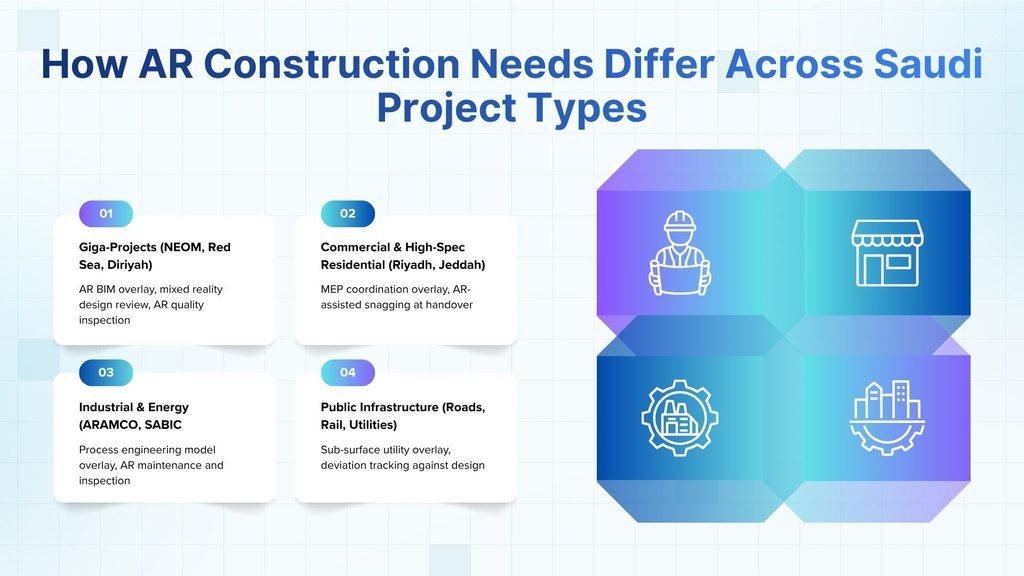
| Project Type | Primary AR Application |
| Giga-Projects (NEOM, Red Sea, Diriyah) | AR BIM overlay, mixed reality design review, AR quality inspection |
| Commercial & High-Spec Residential (Riyadh, Jeddah) | MEP coordination overlay, AR-assisted snagging at handover |
| Industrial & Energy (ARAMCO, SABIC) | Process engineering model overlay, AR maintenance and inspection |
| Public Infrastructure (Roads, Rail, Utilities) | Sub-surface utility overlay, deviation tracking against design |
What you actually need from AR depends entirely on the kind of project you’re running. Here’s how it plays out by project type.
Giga-Projects & Major Infrastructure
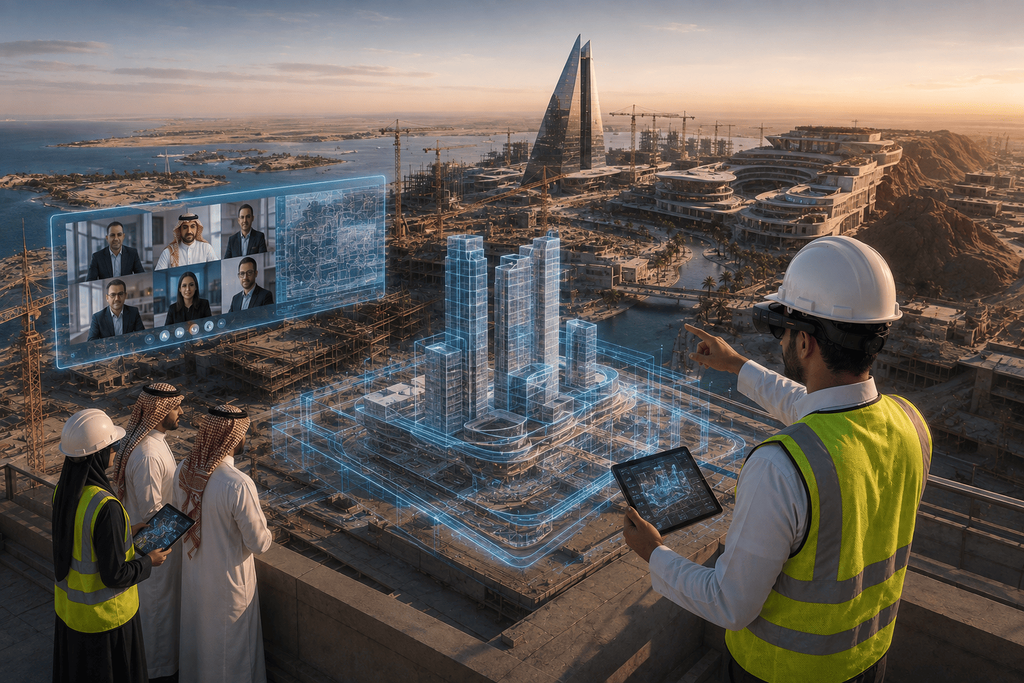
Running a project at NEOM, Red Sea Project, or Diriyah Gate scale means dozens of contractors and international design teams are all moving at once, and that is exactly where AR adds the most value here. Programme directors, main contractors, and international design teams on giga-projects use it to keep coordination and rework under control at a scale 2D drawings were never built to handle.
What AR handles for giga-projects and major infrastructure:
- BIM overlay in the hands of every site engineer, not just the coordination team back in the office
- Design reviews run with international stakeholders at full scale, without flying every reviewer onto a Saudi site
- Quality inspection run at the volume your programme actually needs, not the volume your inspection team can physically cover
Commercial & Residential Developments
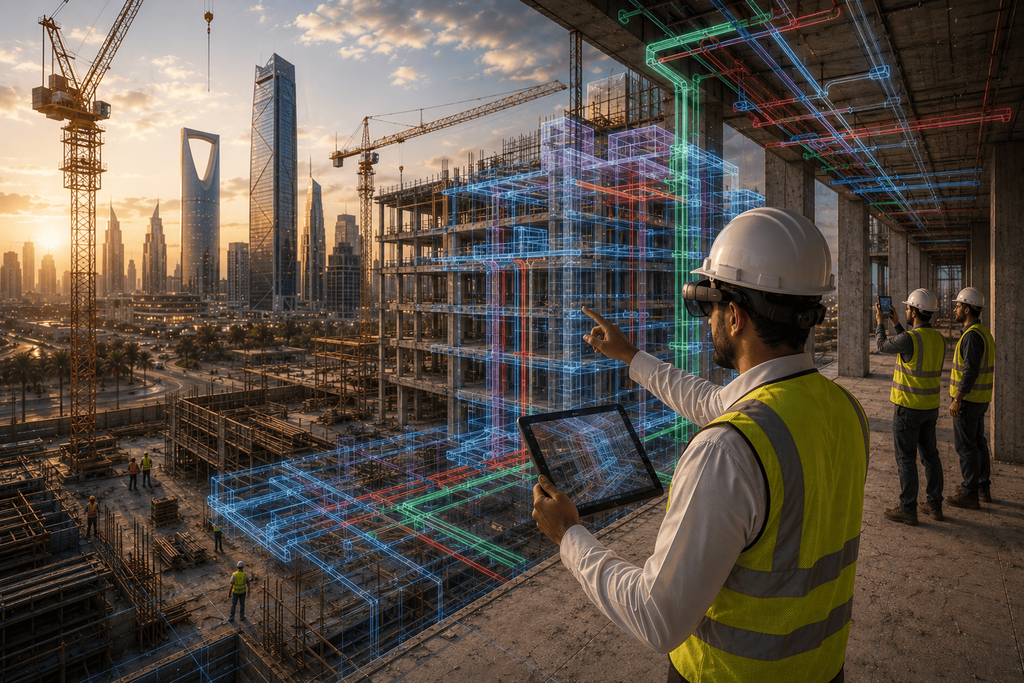
Delivering a commercial tower or a large residential community in Riyadh or Jeddah means the same rework and handover risks giga-projects face, just at a scale your budget feels more directly. Commercial developers, residential contractors, and high-specification builders use AR to protect their margin on exactly this kind of project.
What AR handles for commercial and residential developments:
- MEP coordination checked on site before your crew pours around a clash
- Snagging tracked with photos and BIM tags instead of a written list someone has to interpret later
- Handover timelines shortened because your defects are found, tagged, and routed the first time, not chased down twice
Industrial & Energy Sector Construction
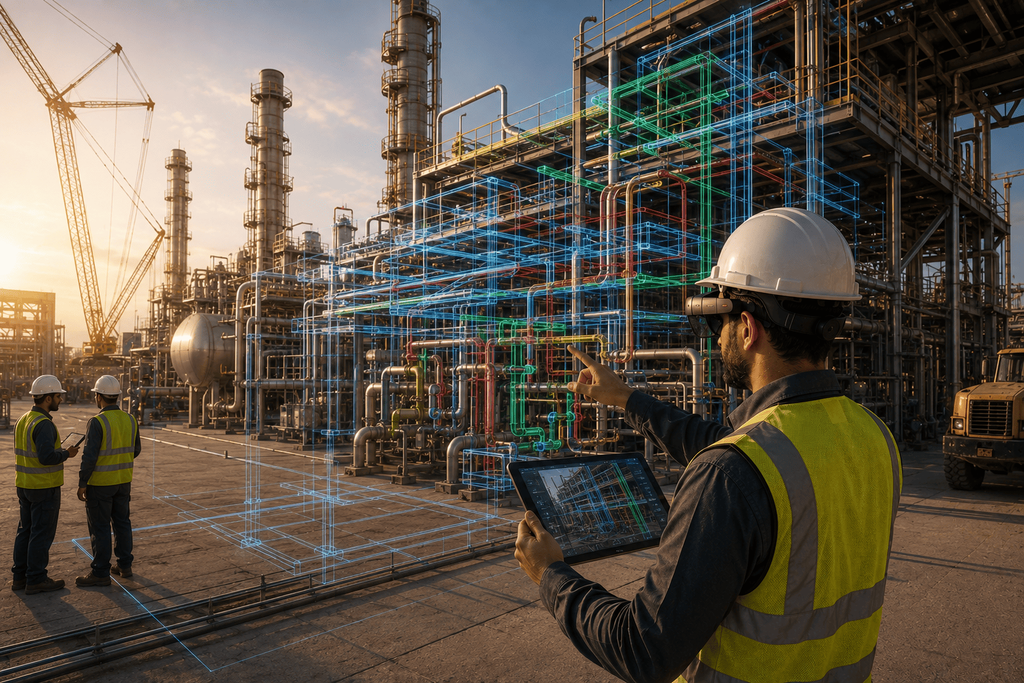
Building for ARAMCO, SABIC, or an industrial city means your spatial accuracy requirements are higher than almost anywhere else, and a single missed clash is expensive to fix after the fact. Process engineering contractors and industrial developers use AR to protect that accuracy through construction and into commissioning.
What AR handles for industrial and energy construction:
- Process engineering models overlaid on site during construction, not just checked in the design office
- Commissioning and installation guided by the overlay instead of a stack of isometric drawings
- Maintenance and inspection procedures supported by AR long after handover, so the value doesn’t stop when construction ends
Public Infrastructure Projects
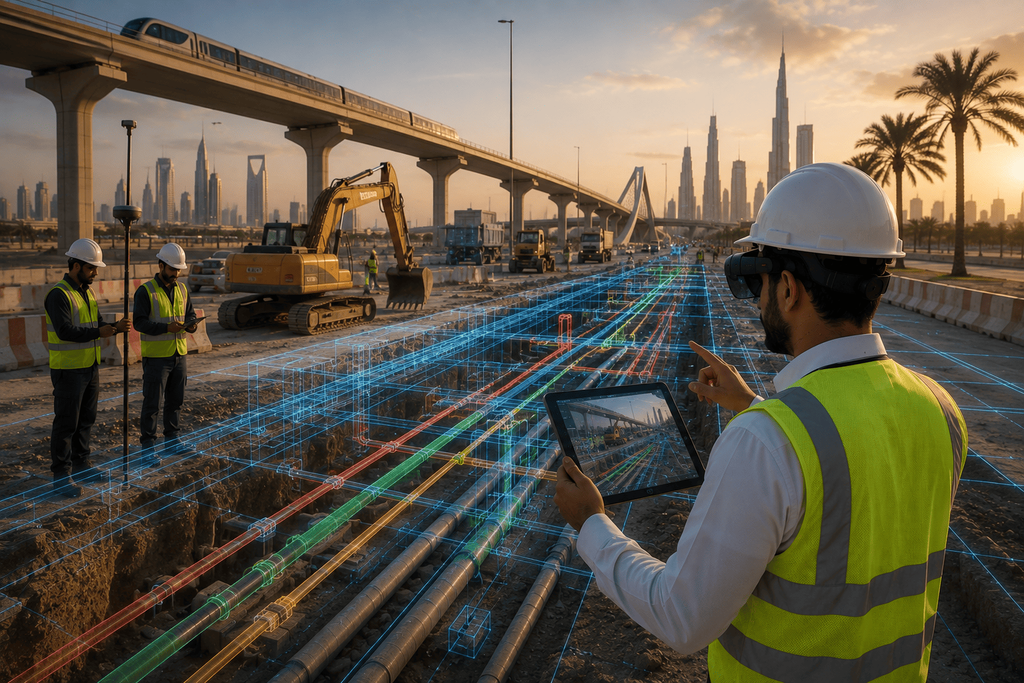
Delivering roads, rail, or utility works under a government or municipality programme means you’re often working around sub-surface services that were never mapped accurately. Government contractors and municipality-appointed developers use AR to close that gap before it becomes a safety incident.
What AR handles for public infrastructure:
- Existing sub-surface utilities overlaid on site before excavation starts, not discovered mid-dig
- On-site deviation tracked against design in real time, across long, linear project sites
- Coordination with public stakeholders handled with a shared visual reference, not a stack of drawings nobody outside your team can read
Hospitality & Tourism Developments
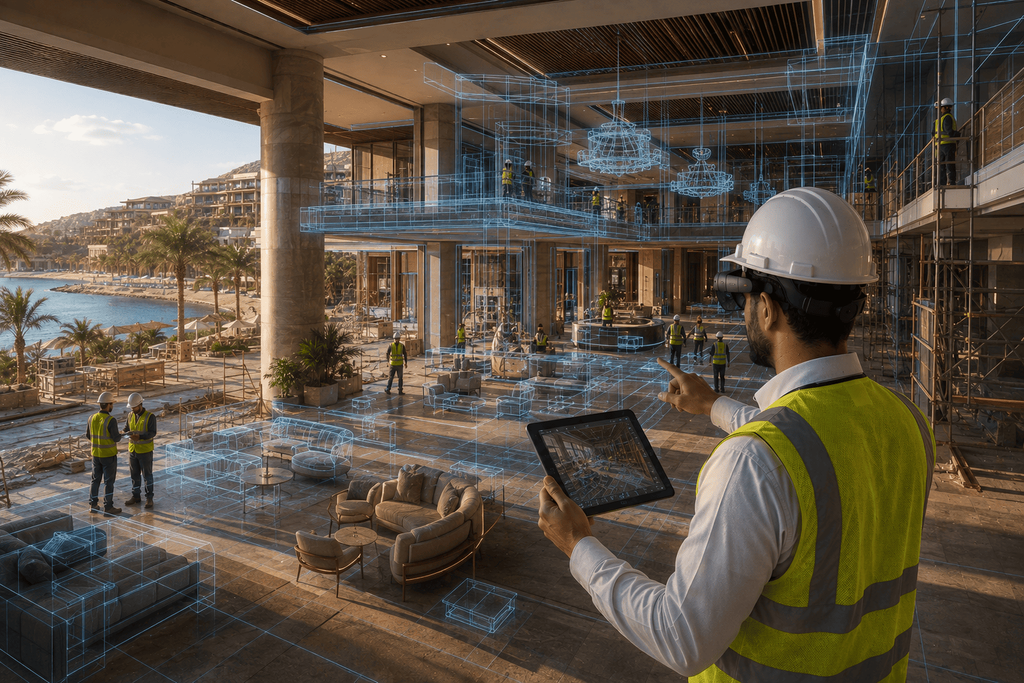
Delivering a resort or hotel build on the Red Sea Coast or a giga-project tourism site means your design intent is closely tied to guest experience, and a spatial miss shows up in the finished product, not just the drawings. Hospitality developers and resort contractors use AR to protect that design intent all the way through construction.
What AR handles for hospitality and tourism developments:
- Interior and finish coordination checked on site against the design model before installation locks it in
- Guest-facing spaces verified for scale and sightlines before a costly rework becomes the only fix
- Snagging managed across large, amenity-heavy sites without losing track of where each defect sits
Healthcare & Institutional Construction
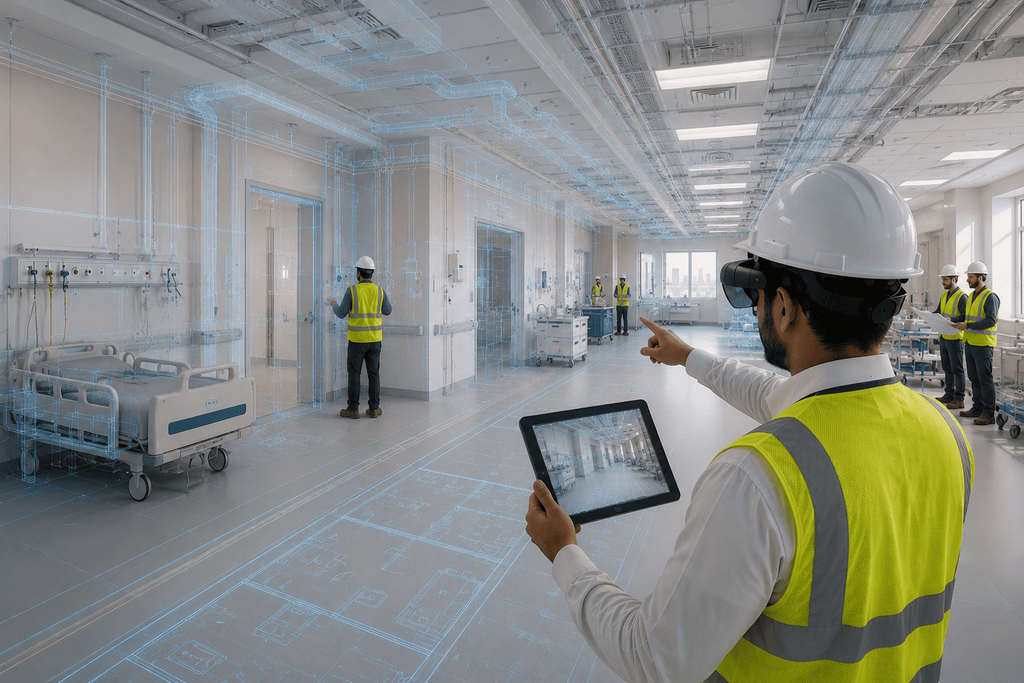
Building a hospital or an education facility means your MEP systems are more complex than almost any other building type, and a coordination miss can delay a facility your community is waiting on. Healthcare developers and institutional contractors use AR to keep that complexity under control.
What AR handles for healthcare and institutional construction:
- Complex MEP and medical gas routing checked on site against the model before it’s built in
- Compliance-critical spaces verified against design intent as construction progresses, not just at final inspection
- Handover accelerated through AR-assisted snagging, so your facility opens on the date your community expects it to
Across every project type here, AR is solving a coordination and accuracy problem specific to construction. See AR and VR solutions guide for how the same underlying technology applies to design review, training, and marketing across other Saudi industries.
How AR in Construction is Deployed & Implemented
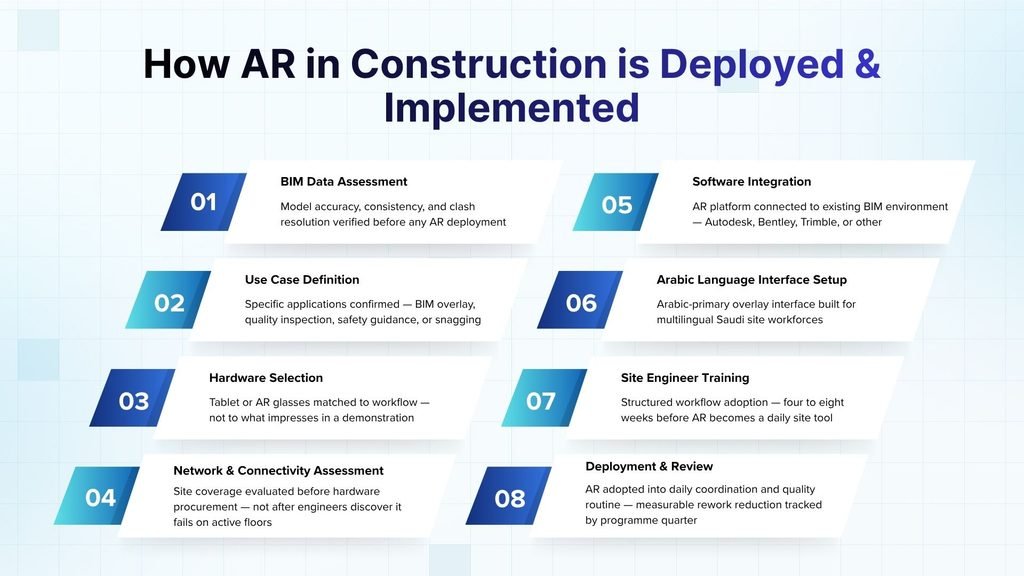
| Stage | What Happens |
| 1. BIM Data Assessment | Model accuracy, consistency, and clash resolution verified before any AR deployment |
| 2. Use Case Definition | Specific applications confirmed — BIM overlay, quality inspection, safety guidance, or snagging |
| 3. Hardware Selection | Tablet or AR glasses matched to workflow — not to what impresses in a demonstration |
| 4. Network & Connectivity Assessment | Site coverage evaluated before hardware procurement — not after engineers discover it fails on active floors |
| 5. Software Integration | AR platform connected to existing BIM environment — Autodesk, Bentley, Trimble, or other |
| 6. Arabic Language Interface Setup | Arabic-primary overlay interface built for multilingual Saudi site workforces |
| 7. Site Engineer Training | Structured workflow adoption — four to eight weeks before AR becomes a daily site tool |
| 8. Deployment & Review | AR adopted into daily coordination and quality routine — measurable rework reduction tracked by programme quarter |
What Does Augmented Reality in Construction Cost in Saudi Arabia?
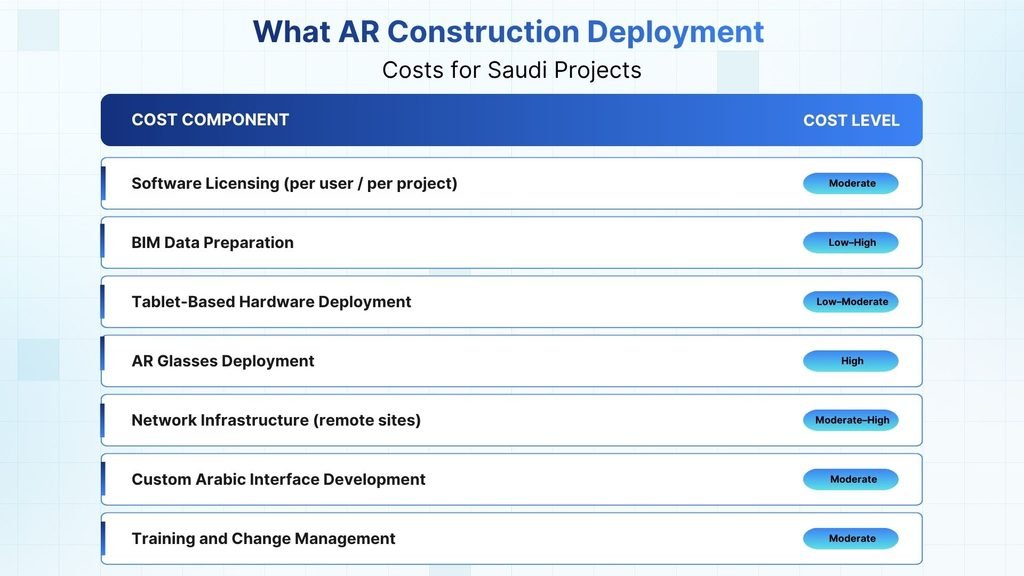
| Cost Component | Cost Level |
| Software Licensing (per user / per project) | Moderate |
| BIM Data Preparation | Low–High |
| Tablet-Based Hardware Deployment | Low–Moderate |
| AR Glasses Deployment | High |
| Network Infrastructure (remote sites) | Moderate–High |
| Custom Arabic Interface Development | Moderate |
| Training and Change Management | Moderate |
AR in construction deployment cost is driven by software licensing, hardware procurement, implementation and training, and the ongoing cost of maintaining BIM model accuracy and software updates.
Software and BIM platform integration: the foundational cost
Augmented reality construction software that connects to your existing BIM environment — Autodesk, Bentley, Trimble, or other major platforms — is typically licensed on a per-user or per-project basis. The integration cost between the AR software and your existing BIM workflow depends on how current and consistent your BIM data is. Poorly structured or inconsistently maintained BIM models require significant data preparation before AR overlay is reliable enough to be operationally useful.
Hardware procurement for Saudi site deployment
Tablet-based deployment for AR BIM is the lower cost hardware starting point. AR glasses construction deployment for specialist applications carries a higher unit cost and should be scoped for the specific personnel and use cases that justify the premium. For large Saudi construction programmes, hardware costs should be assessed against the programme value — the hardware cost of equipping a site engineering team for a SAR 1 billion project is a small percentage of the rework cost that the AR deployment is designed to prevent.
Training and change management
The technical deployment of AR in construction is straightforward. The change management required to shift site engineers and quality inspectors from drawing-based workflows to AR-overlay workflows is where the real implementation effort sits. Saudi construction programmes with structured training, clear use case definitions, and management support for the workflow change adopt AR tools effectively. Those that deploy the technology without investing in the change management process see limited adoption regardless of the technical quality of the implementation.
Custom development for specific Saudi project requirements
Standard augmented reality construction software covers the majority of BIM overlay and quality inspection requirements. Custom AR development becomes relevant when the project has specific requirements that off-the-shelf software does not address, integration with Saudi-specific project management systems, Arabic language overlay interfaces for a multilingual Saudi site workforce, or specialist applications for specific construction processes or inspection regimes. If you want a clearer estimate for your specific project setup, message us on WhatsApp and we’ll scope it out before any number gets attached.
Common Mistakes to Avoid for Augmented Reality in Construction
| Mistakes |
| Deploying AR on inaccurate or out-of-date BIM data |
| Treating AR as a technology showcase rather than a site tool |
| Skipping network assessment before hardware procurement |
| Choosing AR glasses for all applications because they look impressive |
| Deploying without structured training and workflow integration |
| Ignoring language requirements on multilingual Saudi sites |
Deploying AR without accurate, current BIM data
AR BIM overlay is only as accurate as the BIM model it is displaying. A BIM model with inconsistent data, unresolved clashes, or out-of-date revisions produces AR overlays that show incorrect information on site — which is worse than no AR at all because it creates false confidence in site engineers who are making decisions based on what they see in the overlay. Before AR in BIM deployment, your BIM data quality needs to be assessed and brought to a standard that makes the overlay reliable. This is not a software problem. It is a data governance problem that needs to be solved before the technology is introduced.
Treating AR as a technology showcase rather than a site tool
AR demonstration days that impress project owners and then produce no change in site engineering workflow are an unfortunately common pattern in Saudi construction. AR in construction delivers commercial return when site engineers use it as part of their daily coordination and quality checking routine — not when it is demonstrated once and then sits unused because the workflow change was never properly supported. Deployment without structured workflow integration and management accountability for adoption is investment with no return.
Underestimating the network and connectivity requirement
Real-time AR BIM overlay of complex models requires reliable connectivity. Deploying AR on a Saudi site without assessing and establishing the network infrastructure required to support it produces a system that works in the site office and fails on the floors where the work is actually happening. Connectivity assessment should happen before hardware is procured, not after engineers discover the overlay does not work in the areas where they need it most.
Selecting hardware for the demonstration rather than the use case
AR glasses construction deployments are genuinely impressive in demonstrations. They are also heavy, battery-limited, and expensive per unit. If your primary use case is BIM coordination by site engineers who are moving through a building reviewing work, a tablet is more practical, cheaper to deploy at scale, and less disruptive to adopt. Match the hardware to the actual workflow requirement, not to what creates the strongest impression in a project owner presentation.
How Etihad Falcon Tech Deploys Augmented Reality in Construction
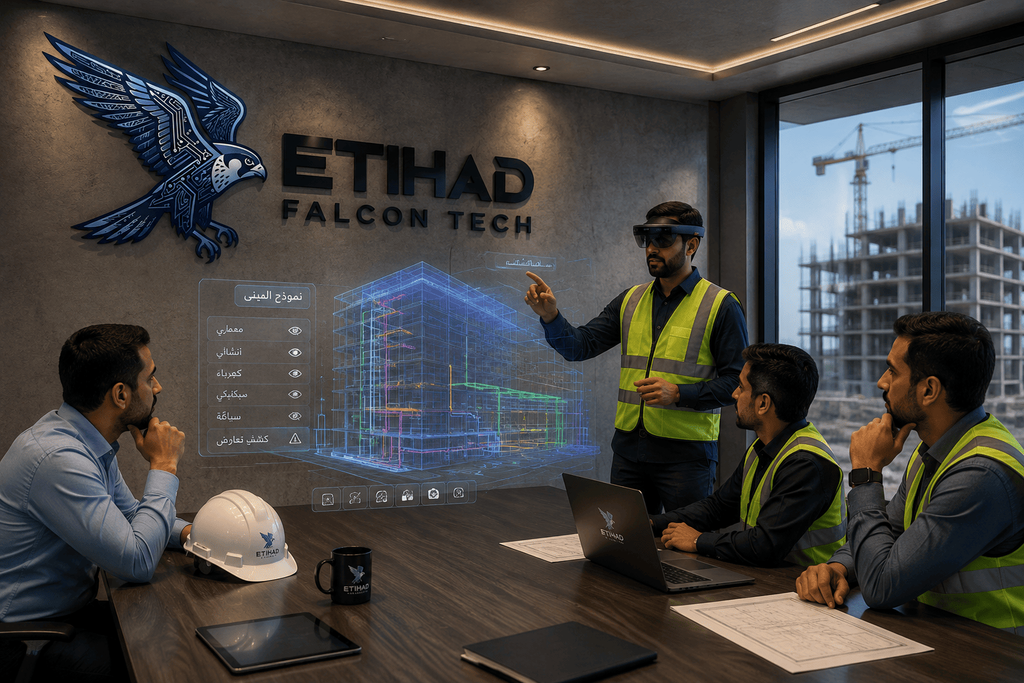
Where We Start
If rework costs are climbing on your project, coordination failures between design and site execution are causing delays, or quality inspection at scale is bottlenecking your handover, those are the three situations we start from.
We Assess Your Data Before We Deploy
We check your BIM data quality before recommending any AR deployment. The technology is straightforward, the data behind it is where the real work sits, and we will not overlay AR on a BIM model that is not accurate enough to trust on site. For projects with multilingual site workforces, we build Arabic-primary overlay interfaces as standard, not translated subtitles bolted onto English-first software.
Why Work With Us
Our team brings deep, hands-on expertise in augmented reality development, from BIM overlay to mixed reality design review to AR-guided quality inspection. We don’t hand you off-the-shelf software and hope it fits. We build AR around your project’s actual BIM environment, your workflow, and how your site team actually operates, so what you get is built for how you work, not a generic deployment you have to work around.
Frequently Asked Questions
BIM is your digital model, the 3D data behind the building’s design. AR is what displays that model as a spatial overlay on your actual site, at real scale, in the real location. BIM is the data. AR is what makes it usable on site.
It shows you the gap between your design and your build while you can still fix it without demolition. When your engineer sees MEP routing overlaid on structural elements already in place, a clash that would normally surface after the pour is visible before work starts. It also lets you verify as-built against design intent in real time, no survey equipment needed.
For most applications, BIM overlay, inspection, and on-site coordination, a tablet with a decent camera and processor is enough. AR glasses are worth it for hands-free tasks specifically. Pick your hardware based on the task, not what looks most impressive. Tablets are the practical choice for rolling AR out across your whole site team.
Accuracy comes down to two things: how accurate your BIM model is, and how precise your AR tracking is. GPS positioning with QR marker correction is accurate enough for most coordination and quality checks. For millimetre-precision work like structural alignment, we assess the AR system against your specific tolerance requirements. An overlay is only as accurate as the model behind it.
VR puts your team inside a fully simulated environment, used for safety training before site exposure or design review before anything is built. AR overlays digital information onto your real, physical site, used once construction is active. Most serious Saudi AR programmes use both, at different stages of the project.
Yes, most AR construction software integrates with major platforms like Autodesk Revit, Navisworks, Bentley, and Trimble. Integration quality depends on your file formats and data structure, so we assess your existing BIM workflow first. Fragmented BIM data across multiple software environments adds complexity, which is exactly why we check this before we start.
Basic deployment on a site with clean, current BIM data takes two to four weeks. Getting your team using it daily as a coordination and quality tool takes another four to eight weeks. If your BIM data needs cleanup first, we factor that timeline in separately, and we always weigh it against your programme to make sure AR still delivers value before the affected work is done.