
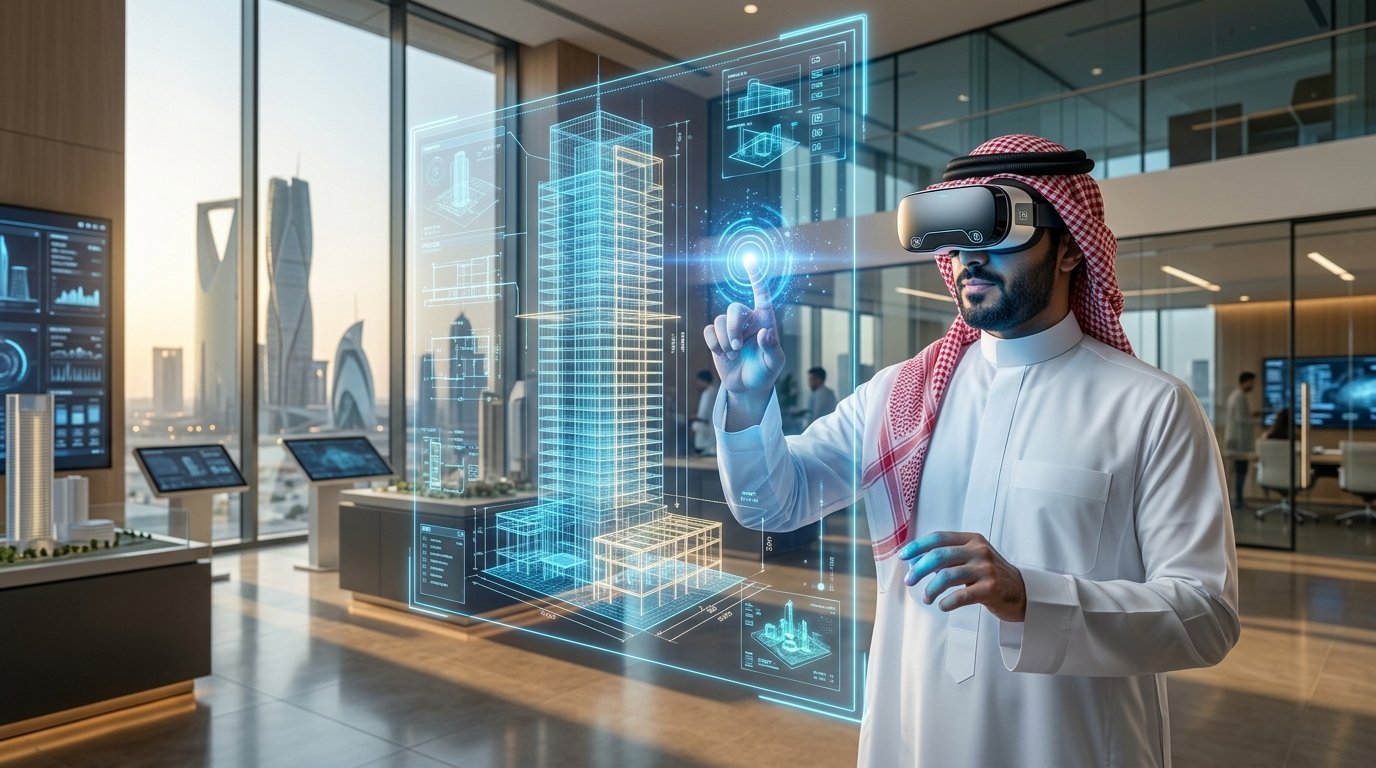
The global augmented and virtual reality market was valued at USD 129 billion in 2025 and is projected to grow from USD 164.5 billion in 2026 to USD 901.2 billion by 2033, according to Grand View Research.
Saudi Arabia’s own virtual reality market is on a similarly steep curve, valued at USD 161.7 million in 2025 and projected to reach USD 1.29 billion by 2034, according to a Research and Markets forecast. That growth is not being driven by entertainment alone. Businesses are using AR and VR to give customers something closer to a real experience than a photo or a pitch ever could.
Retail, construction, education, real estate, and every other sector is competing on experience now instead of imagery. Show a customer a furniture photo, and they hesitate. Let them place that same sofa in their actual living room through AR on their phone, and they check out faster. Show an investor a rendering of an unbuilt tower, and they ask questions. Walk them through it in VR, and the decision closes faster.
The mechanism is the same across every industry now: people commit faster and with more confidence when they experience something instead of just imagining it.
This guide covers what Augmented Reality and Virtual Reality development actually involves for Saudi businesses, which technology applies to which problem, what implementation looks like in practice, what drives cost, and how to choose an AR/VR development partner.
What is AR and How it Works for Your Business
AR overlays digital content onto the real world through a device you already have: a phone, a tablet, AR glasses. Nothing about the real environment disappears. Digital information just gets layered on top of it.
Businesses use AR to give people information exactly when and where they need it. A maintenance technician sees step-by-step repair instructions overlaid directly on the equipment in front of them. A customer points their phone at themselves and sees exactly how a pair of glasses or a jacket will look on them before buying it. A construction supervisor sees planned pipes and structural elements overlaid on the actual site, so mistakes get caught before they are built.
These are just a few examples. Logistics, retail, field services, and hospitality businesses are all finding their own uses for AR as well.
What is VR and How it Works for Your Business
Virtual Reality places the user inside a fully digital environment through a headset. Business can utilize VR when the real environment isn’t an option: too dangerous, doesn’t exist yet, or too expensive to recreate physically just for training.
A petrochemical company can’t let new hires practice an emergency shutdown on the actual plant, so they build the shutdown in VR instead, and workers run it as many times as they need before ever facing the real thing. A real estate developer can’t hand a buyer keys to an apartment that hasn’t been built, so they hand them a VR walkthrough instead. A hospital can’t let a trainee learn a surgical procedure on a live patient the first time, so VR gives them a version they can practice on repeatedly, with zero risk, until they’re ready.
The same logic applies well beyond these industries. Now the aviation industry, automotive, manufacturing, defense, and education are all building their own VR simulations for the exact same reason.
What is Mixed Reality and Why it Matters
Mixed reality goes a step further than AR or VR: it lets digital objects and physical objects interact with each other in real time, not just sit next to each other. As the user moves through a physical space, the digital content responds to it.
Businesses use mixed reality for engineering and construction review, where teams need to see how a planned digital model fits into an actual physical space before building it. A structural engineer uses a mixed reality model to check exactly where a new building system will intersect with existing pipes and wiring inside a live facility, catching conflicts before they become expensive to fix on site.
Construction is the clearest example today, but manufacturing, industrial design, and facilities management are moving in the same direction.
Why Saudi Arabia’s AR and VR Market is Growing So Fast
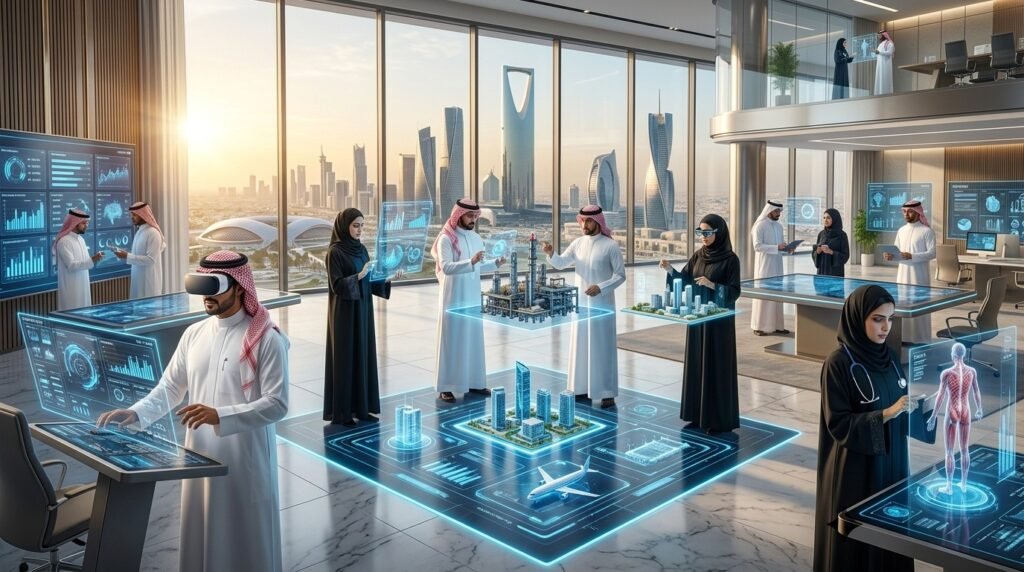
Saudi Arabia’s augmented and virtual reality market is projected to grow from USD 161.7 million in 2024 to USD 1.29 billion by 2034, according to Research and Markets. That kind of trajectory is not accidental. Saudi Arabia’s AR and VR market is growing because three things are happening at once: the technology has become more accessible, the country’s biggest development projects are now relying on augmented and virtual reality, and every industry is now competing on customer experience that can be enhanced with AR/VR.
Why Has AR and VR Become So Accessible?
Four years ago, a standalone VR headset cost several thousand dollars. Now it costs a fraction of that and performs noticeably better. Mobile AR doesn’t need special hardware at all, it runs on the phone already in your pocket. The barrier that used to keep immersive technology locked to well-funded innovation labs has more or less dissolved. What was a capital-intensive bet a few years back is now something most businesses can actually afford to try.
How Saudi Arabia’s Biggest Projects Are Driving Demand for AR/VR?
NEOM, Red Sea Project, Qiddiya, and Saudi Aramco’s industrial programs all involve environments where training complexity, pre-construction visualization, and operational safety create direct, practical demand for AR and VR. These are not theoretical use cases. They are live requirements on active projects.
How are Industries Using AR and VR to Compete?
Real estate developers are using VR walkthroughs to sell buyers on properties that are not built yet. Retailers are using AR to let customers preview products before they buy. Healthcare institutions are using AR and VR to train staff faster and give patients a clearer picture of procedures before they consent. Manufacturers are using VR to train workers on equipment without shutting down a production line, and educators are using AR to make abstract concepts something students can actually see. Across every one of these industries, the business willing to let a customer or a trainee experience something, instead of just describing it, has a measurable advantage over the one that does not.
AR, VR, or Mixed Reality: Which One Does Your Business Need?
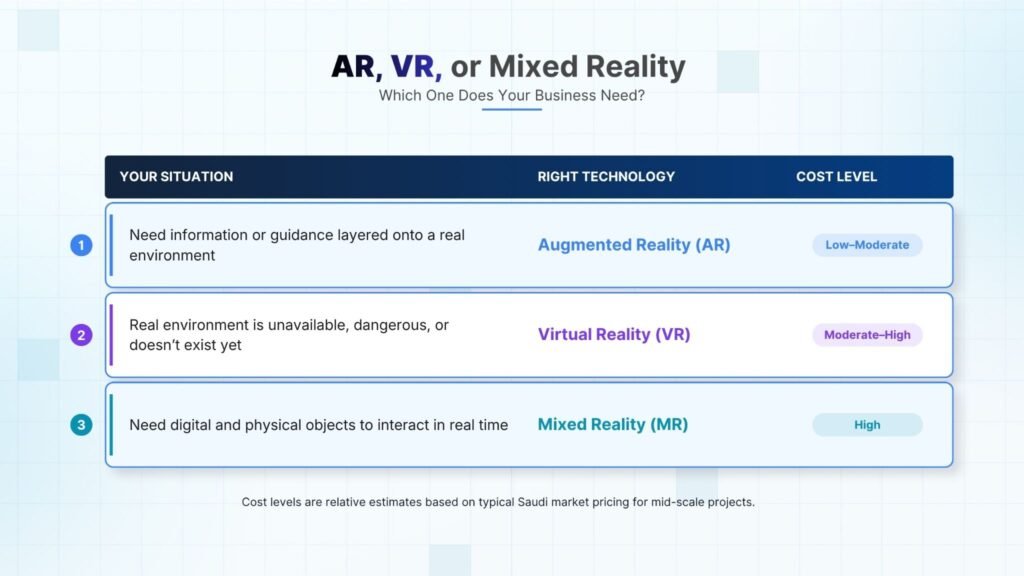
Understanding the difference between AR, VR, and Mixed Reality is important because each of them offers different features that could benefit your business.
| Your Situation | Right Technology | Cost Level |
| Need information or guidance layered onto a real environment | Augmented Reality (AR) | Low–Moderate |
| Real environment is unavailable, dangerous, or doesn’t exist yet | Virtual Reality (VR) | Moderate–High |
| Need digital and physical objects to interact in real time | Mixed Reality (MR) | High |
Industry-Specific AR and VR Applications in Saudi Arabia
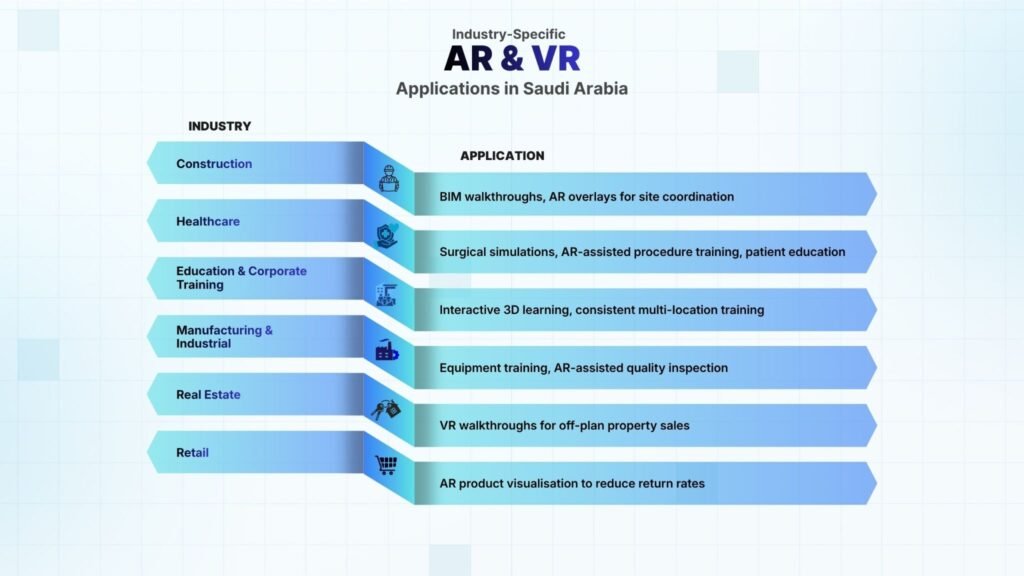
| Industry | Application |
| Construction | BIM walkthroughs, AR overlays for site coordination |
| Healthcare | Surgical simulations, AR-assisted procedure training, patient education |
| Education & Corporate Training | Interactive 3D learning, consistent multi-location training |
| Manufacturing & Industrial | Equipment training, AR-assisted quality inspection |
| Real Estate | VR walkthroughs for off-plan property sales |
| Retail | AR product visualisation to reduce return rates |
AR and VR are no longer limited to a single use case. Businesses are using them to train staff, sell products, catch costly mistakes before they happen, and give customers a clearer picture of what they are actually paying for.
The application changes from one business to the next, and here is how that plays out across Saudi Arabia’s biggest industries.
Industries That Benefit Most From Augmented Reality (AR)
AR works best where the real environment needs to stay exactly as it is, with information or a preview simply added on top. These are the industries where showing someone something, right where they are, does more than a photo, a brochure, or a slideshow ever could.
AR in Healthcare and Medical Education
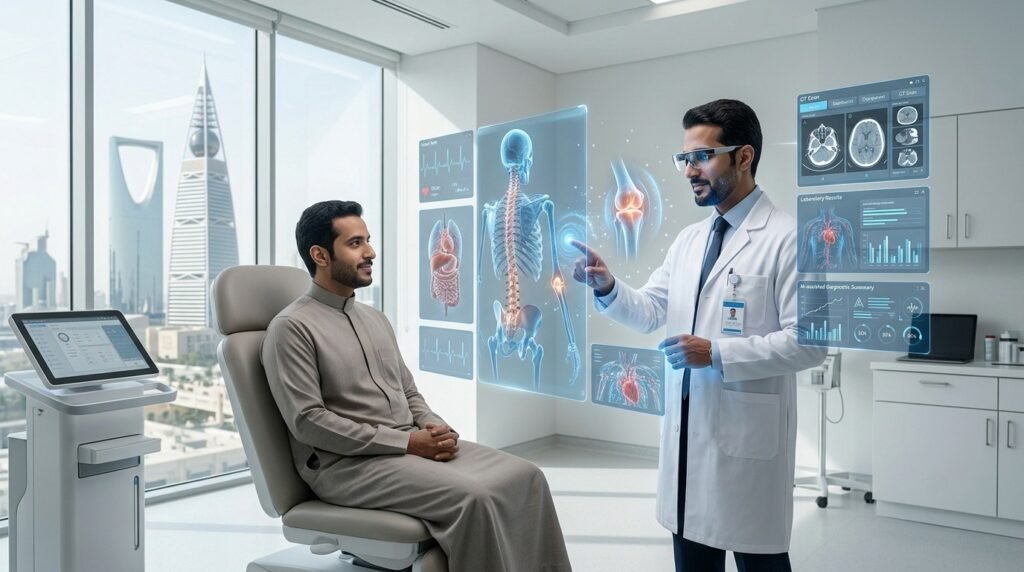
AR gives your clinical staff a way to practice procedures without ever putting a patient at risk, so you can train more people in less time. It also changes how you talk to patients: showing them exactly what a procedure involves before they consent, before they even arrive for treatment. Saudi facilities using AR for patient education report calmer patients, fewer repeat questions, and clinical staff spending less time explaining and more time treating.
AR in Retail and Customer Experience

A photo can only tell a customer so much. It can’t show them how a piece of furniture actually fits their room, how a jacket sits on their own shoulders, how a sofa looks against their actual wall color. AR closes that gap directly, let someone preview the item in their own space or on themselves, and you cut hesitation before the sale and returns after it.
For Saudi fashion brands that are looking to incorporate AR or VR into their operations, we’ve covered the full breakdown in our guide on AR and VR in Saudi Arabia’s Fashion Industry.
Saudi Industries That Benefit Most From Virtual Reality (VR)
VR works best where the real environment can’t be used at all, because it’s too dangerous, too costly, or doesn’t exist yet. These are the industries where letting someone experience a space or a scenario, before it’s built or before it’s live, closes decisions and builds skill faster than any render or manual ever could.
VR in Aviation Industry
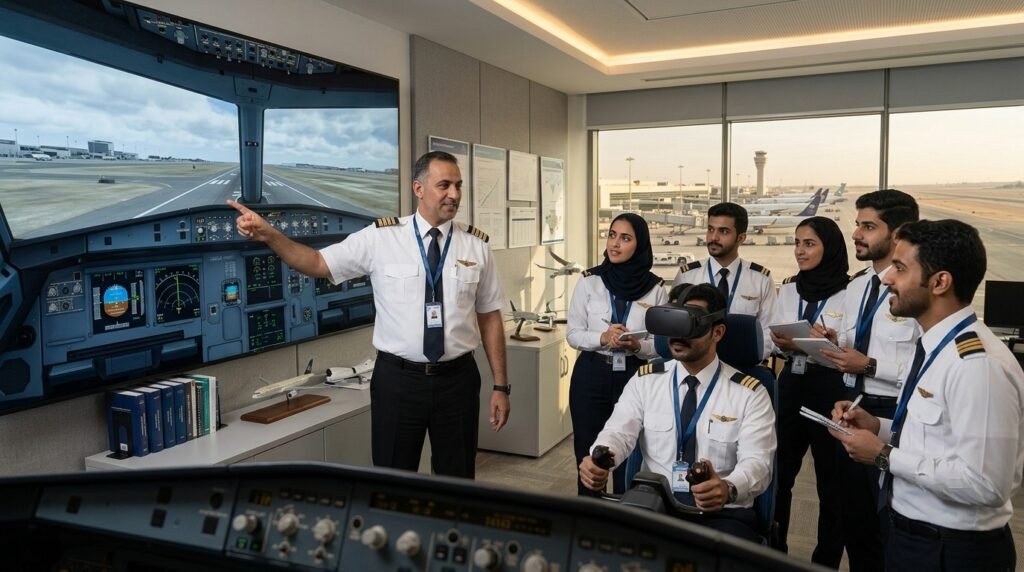
Get something wrong in a real aircraft and the cost is enormous, that’s exactly why aviation industry leans on VR so heavily. Pilots and cabin crew run through emergency procedures, equipment failures, and routine operations in simulation as many times as it takes, without ever touching a real plane or risking a real flight. For airlines and training academies, that means more staff trained to the same standard, faster, without burning actual aircraft hours on every session.
Importance of Virtual Reality in Real Estate Business Growth
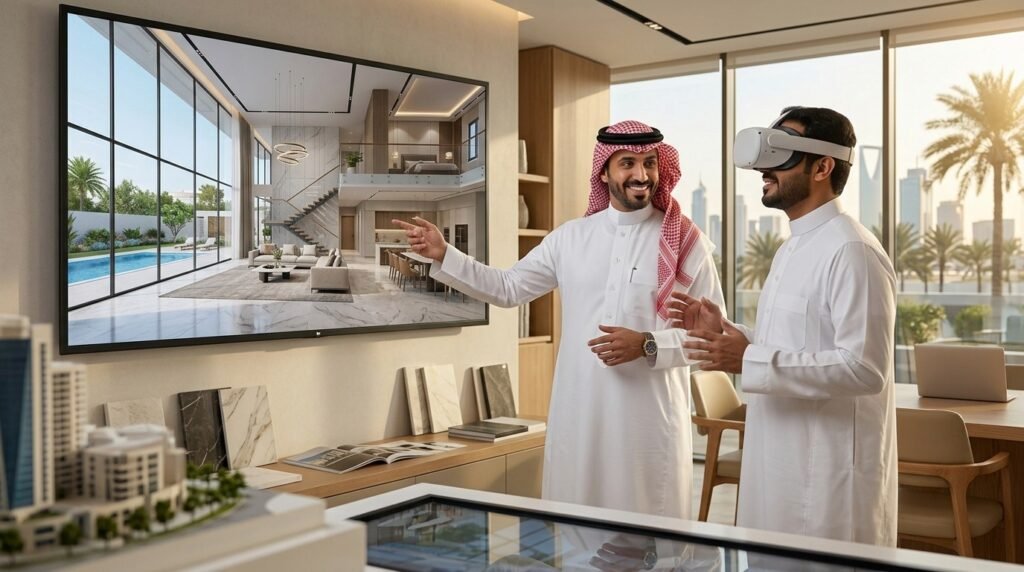
VR solves the hardest problem in real estate sales: selling something that does not exist yet. A walkthrough lets your buyer compare elevation designs, walk through the exact floor and layout they are considering, and see finishes and views before a single unit is built. Developers using VR for real estate are now in a better position to improve their sales in Saudi Arabia than those who are still thinking about it.
VR in Automotive Industry

Automotive businesses use VR to review a vehicle design and catch problems before a single physical prototype gets built, saving both the cost and the time of building something that turns out to be wrong. On the sales side, VR showrooms let a customer explore a vehicle, its features, and its finishes without needing a physical unit on the lot. For dealerships and manufacturers, that means showing more, building less, and getting to a decision faster.
VR in Tourism Industry
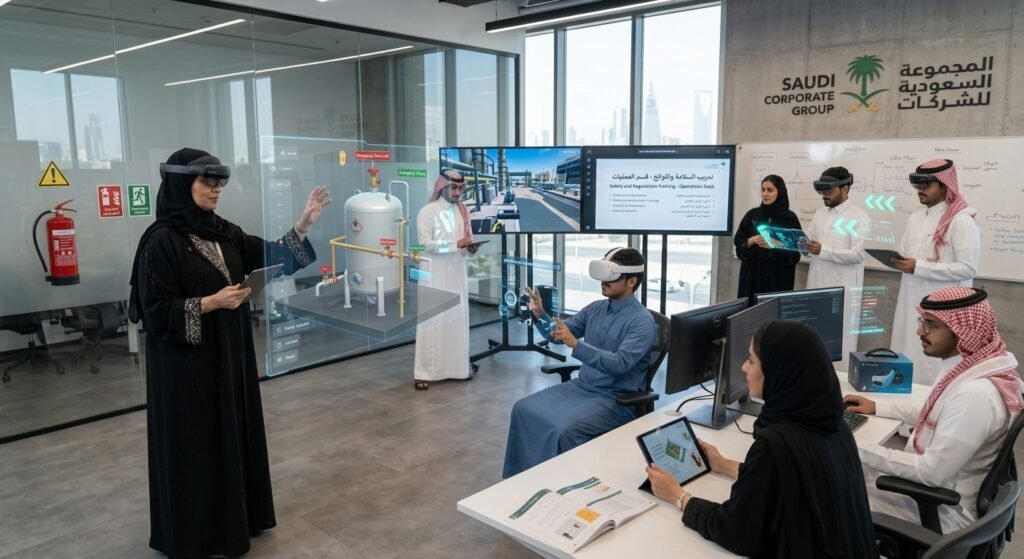
A traveler deciding on a destination is deciding on a trip they have not experienced yet. VR lets them walk through the actual sites, routes, and experiences on offer before booking, turning a brochure into something closer to a preview visit. This works well beyond a single showcase tour: a tourism board or operator can build a full VR roadmap of a trip, region by region, so a visitor sees exactly what each stop involves, including safety guidelines and what to expect on-site, before they ever leave home. For Saudi destinations using VR to convert browsers into bookings, we’ve broken this down fully in our guide on VR in Saudi Arabia’s Tourism Industry.
VR in Hospitality
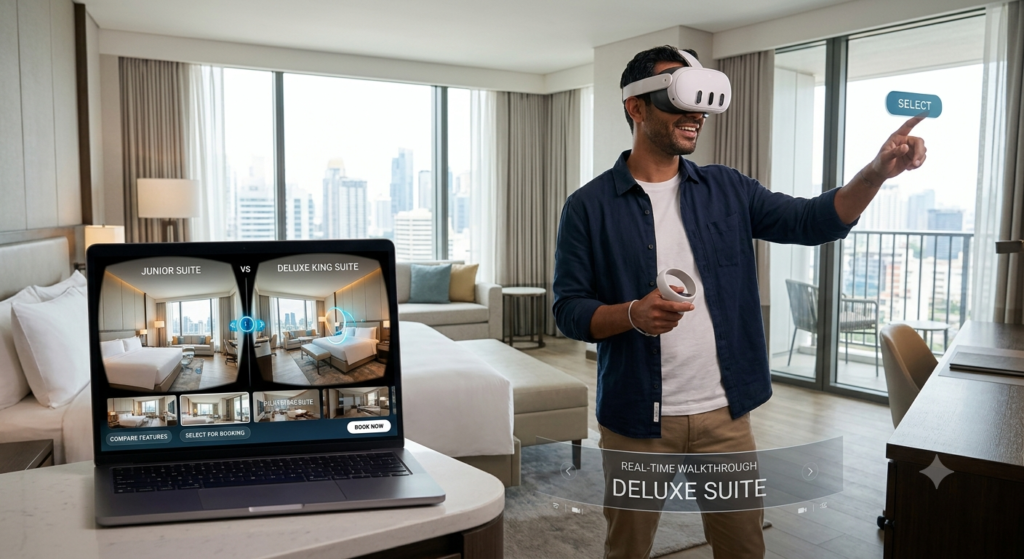
A person picking a hotel is deciding on a room they cannot actually see. VR lets them compare suites side by side, seeing exactly how a presidential suite differs from a deluxe room in space, view, and finish. On the operations side, VR also trains hospitality staff on service scenarios and hotel procedures without needing a live guest in the room to practice on. That combination sells the exact room a guest ends up in and trains the people running it, at the same time.
Industries That Benefit Most From AR and VR Combined
Some industries don’t fit neatly into one category, because the same project needs a real environment changed on-site and a scenario simulated somewhere the real environment can’t help. These are the industries running both technologies side by side, each solving a different part of the same problem.
AR and VR in Construction Industry
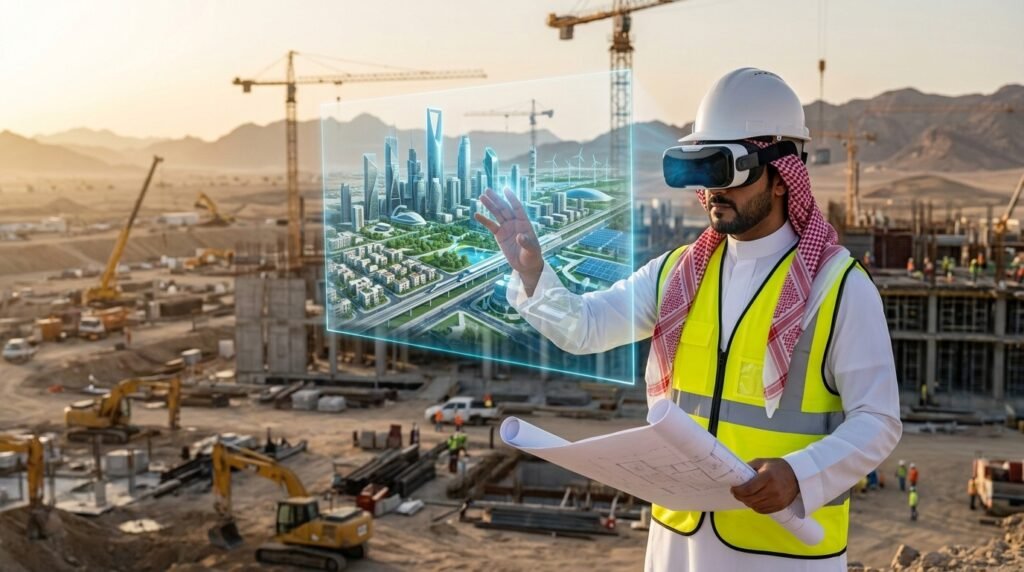
Construction is where AR and VR deliver the clearest return in Saudi Arabia right now, driven by the scale of Vision 2030 infrastructure programs. With Building Information Modeling in VR, your team can walk through the entire project before a single wall goes up, catching design conflicts while they still cost nothing to fix. On active sites, AR overlays show your crew exactly where pipes, wiring, and structural elements should go, matched against what’s already built. For contractors running multiple sites at once, this is what keeps rework off the budget.
AR and VR in Manufacturing and Industrial Operations
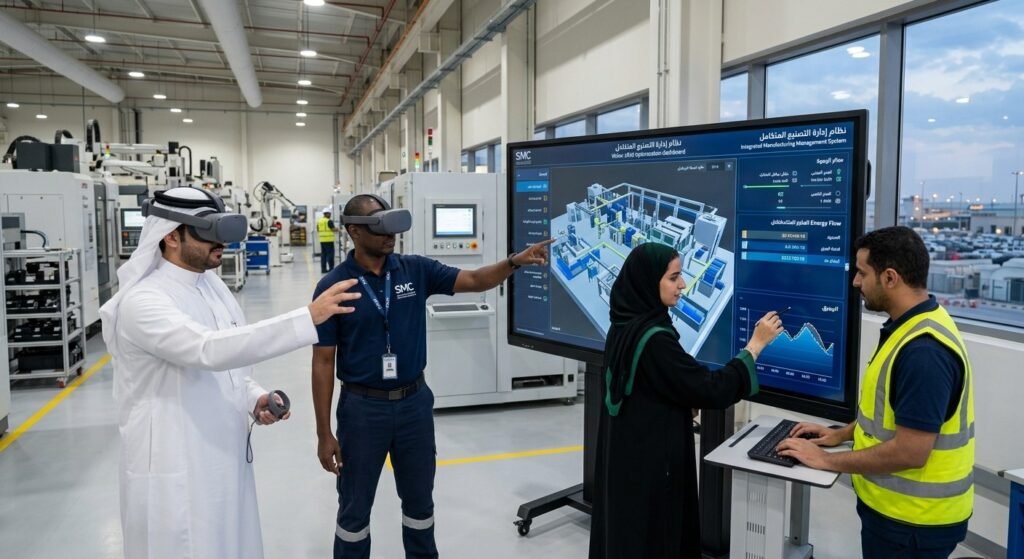
Manufacturing has two places where AR and VR pay for themselves fast: training and quality control. Put your workers inside a simulated version of your actual facility and let them run equipment drills and emergency response as many times as they need, before they’re anywhere near the real machinery. On the inspection side, AR overlays show your team the exact tolerances a component needs to meet, catching a defect faster, and catching the ones a tired human eye might otherwise miss. See the full practical guide on AR & VR development for manufacturing, how these applications get scoped and deployed on the shop floor.
AR and VR in Education and Corporate Training
There’s a ceiling on how much a diagram or a lecture slide can actually teach someone. A student who can turn a 3D model over in their hands remembers it differently than one staring at a flat image, and an employee who trains inside AR or VR gets to real competency faster than one sitting through another slideshow. There’s a consistency payoff here too, for businesses training staff across several locations: every employee goes through the exact same training experience, regardless of who happens to be running the session that day.
AR/VR in Gaming and Entertainment
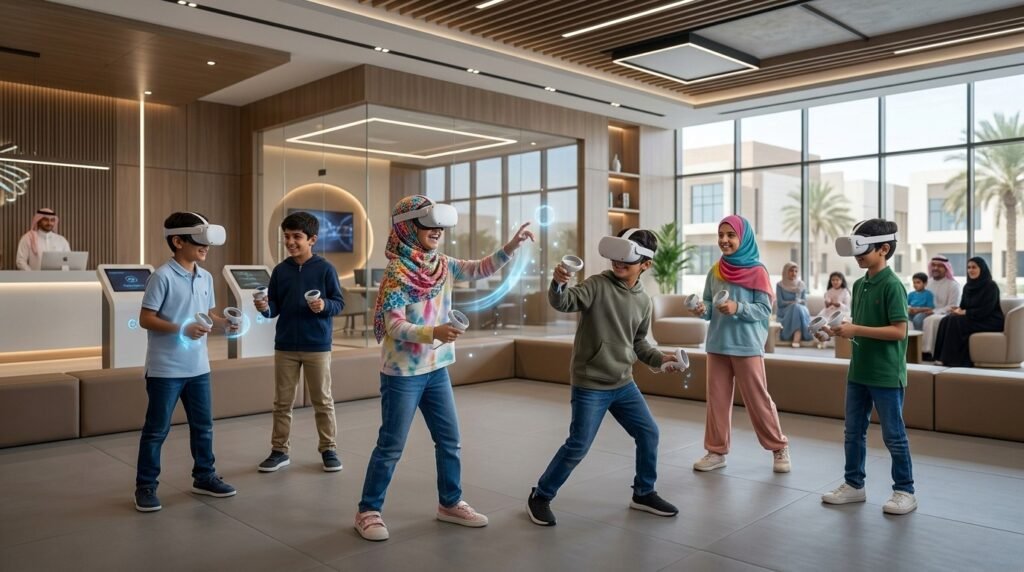
Gaming is where AR and VR started, and it’s still where the technology pushes furthest on immersion. For businesses in this space, the value is direct: AR and VR let you build experiences competitors on a flat screen simply cannot match, whether that’s a fully immersive game world or an AR layer that brings a physical venue or event to life. The businesses winning here are the ones treating AR and VR as the core experience, not an add-on to it.
VR and AR in Military Training and Combat Simulation
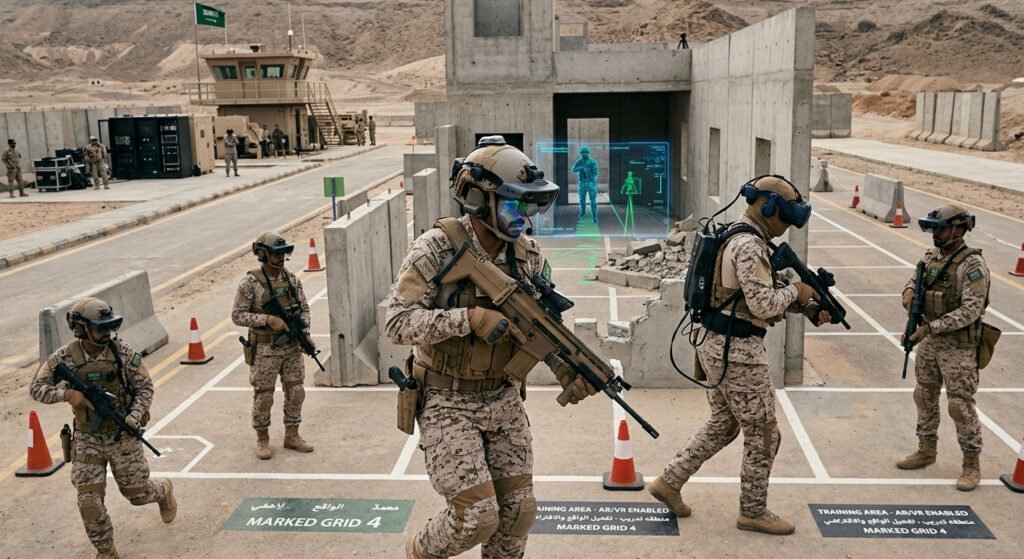
Real combat training carries a cost that no budget can absorb: injury, damaged equipment, and live ammunition used up on a drill instead of a mission. VR lets personnel run through everything from small unit tactics and checkpoint scenarios to full tank and vehicle simulations, repeating each one as many times as it takes to get it right. AR then carries that training into live exercises, overlaying target data, weapon system status, and squad positioning directly onto a soldier’s real view during an actual field drill. For defense programs across Saudi Arabia, that combination means personnel trained to a higher standard in simulation, and better supported the moment training turns real.
VR and AR in Driving Schools and Driver Training
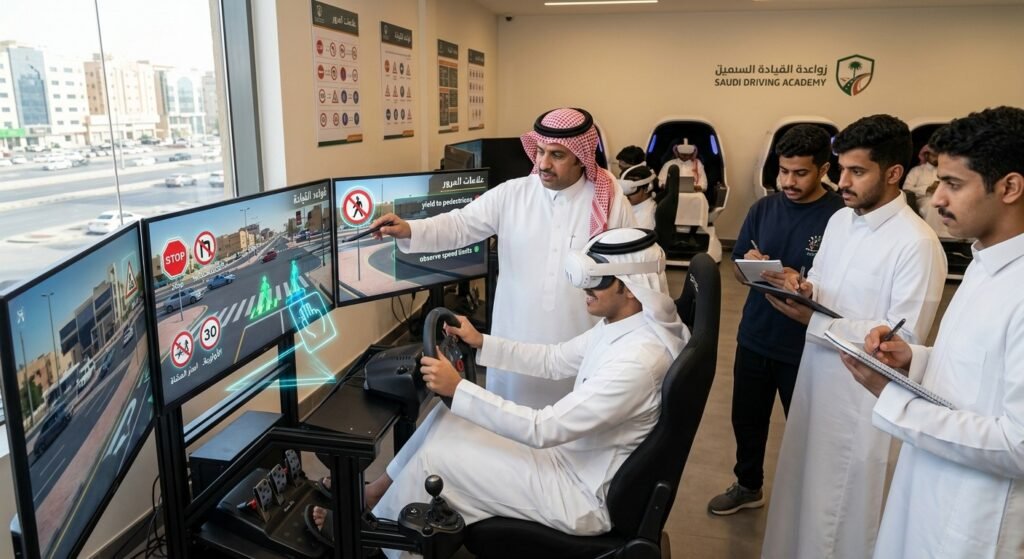
Learning to drive means making mistakes, and some mistakes are too dangerous to make on a real road with a real car. VR puts a learner behind the wheel of a realistic simulation first, covering road handling, hazard response, and night driving, before they ever sit in an actual vehicle. Once they move to supervised on-road lessons, AR overlays lane guidance, hazard alerts, and instructor prompts directly onto the real road through the windshield or dash. For Saudi driving academies training high volumes of new drivers, this cuts both the time to license and the risk across the entire learning process.
AR and VR in Simulator Development
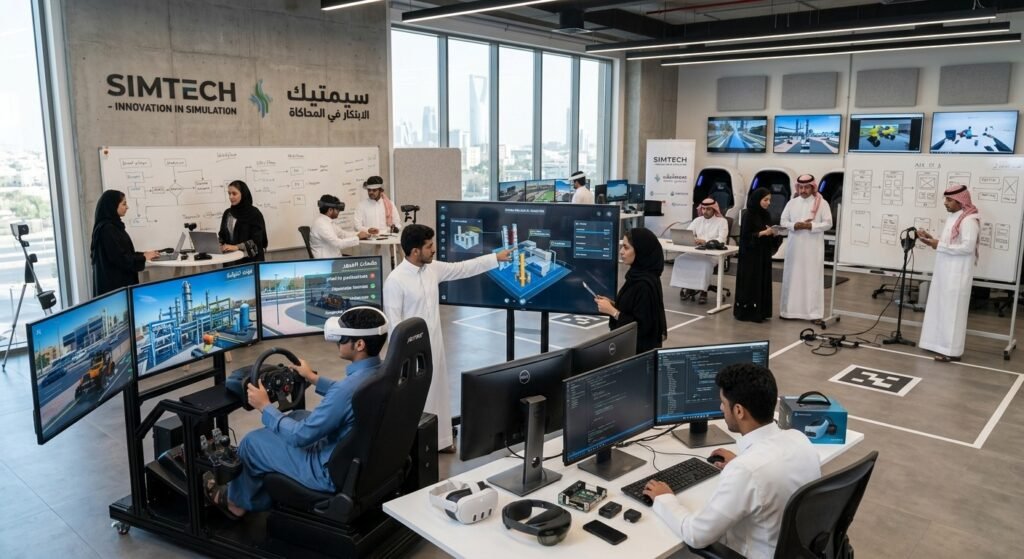
A simulator is only as good as how closely it matches the real thing, and that is exactly where AR and VR do the heaviest lifting. VR builds the environment itself, the cockpit, the vehicle, the facility, so a trainee reacts to something close to reality instead of a screen and a joystick. AR adds a layer on top of physical simulator hardware, overlaying live instrument readings, procedure prompts, or fault conditions onto the actual controls in front of the trainee. Whether the simulator is for aviation, defense, driving, or industrial equipment, this is the technology that decides whether the training actually transfers to the real environment.
AR and VR in Hajj and Umrah Preparation
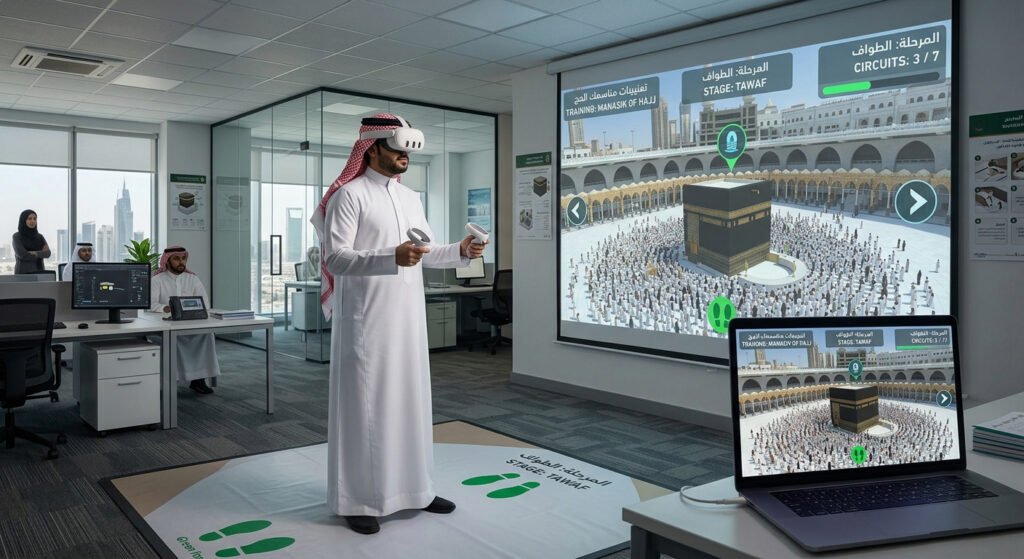
A first-time pilgrim can’t fully picture what Hajj or Umrah involves from a guidebook alone. VR walks them through the whole journey before they leave home, the Tawaf around the Kaaba, the Sa’i between Safa and Marwah, the stoning at Jamarat, each ritual in the order it actually happens. By the time they arrive, they’re not learning the Manasik for the first time, they’re recognising it. AR then carries that same guidance into the pilgrimage itself, overlaying real-time prompts on what a pilgrim is looking at so they always know what comes next and where. For Hajj and Umrah service providers managing millions of pilgrims every year, that means fewer people confused on the ground, and more of the experience spent on worship instead of logistics.
What AR and VR Development Actually Covers
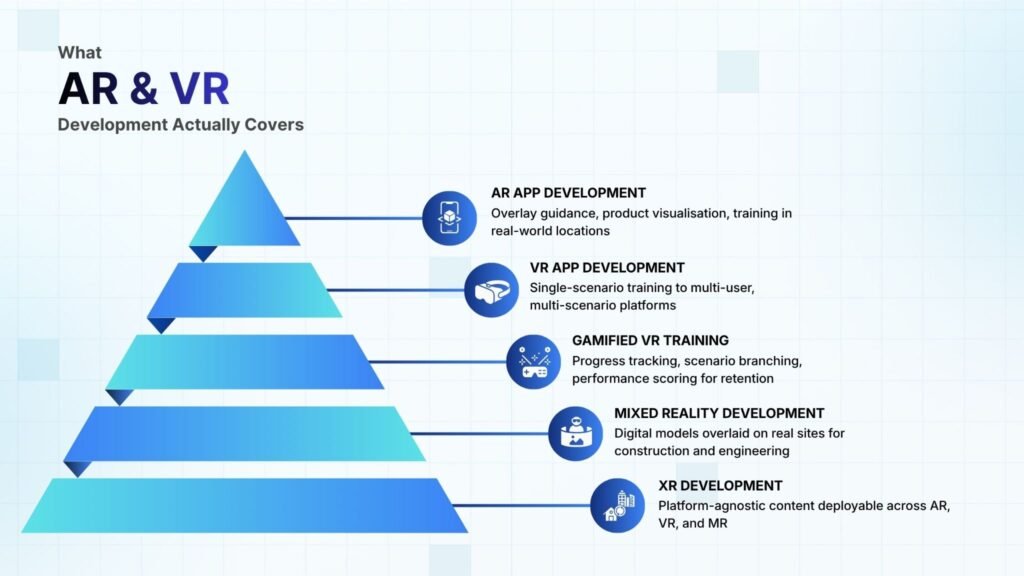
| Service | What It Covers |
| AR App Development | Overlay guidance, product visualisation, training in real-world locations |
| VR App Development | Single-scenario training to multi-user, multi-scenario platforms |
| Gamified VR Training | Progress tracking, scenario branching, performance scoring for retention |
| Mixed Reality Development | Digital models overlaid on real sites for construction and engineering |
| XR Development | Platform-agnostic content deployable across AR, VR, and MR |
Once you know which technology fits your problem, the next question is what building it actually involves.
Augmented Reality App Development
An AR app runs on a phone, tablet, or AR glasses, and layers digital content onto the real world through the camera. Building this means solving three technical problems: anchoring the digital object to a real surface so it doesn’t float or drift, tracking it accurately as the user moves the device, and adjusting how it renders under different lighting so it doesn’t look pasted on. Arabic adds another layer on top of this, since right-to-left text has to be rendered and rotated correctly in 3D space, which is a different engine problem than displaying Arabic on a flat screen.
Virtual Reality App Development
A VR project ranges from one training simulation to a multi-user platform accessed from different locations. What actually drives the engineering effort is scenario count, how much branching or variation each scenario needs, and how physically accurate the visuals and interactions have to be, since a basic safety walkthrough needs far less rendering power and physics modeling than a surgical simulator with realistic tissue response. Enterprise builds also need backend infrastructure most people don’t think about: device management across headsets, logging who completed which training, and pushing content updates when a real-world procedure changes.
Mixed Reality Development
Mixed reality takes more technical effort to build than AR or VR, because your digital content and the real objects around it have to interact with each other in real time, not just sit next to each other. The system has to constantly read the physical space it’s in, so a digital object stays exactly where it should be against a real wall, pipe, or piece of equipment, even as your user walks around it. AR only has to lock onto one spot and stay there. Mixed reality has to keep recalculating that relationship the whole time, which is exactly why the development itself takes longer and costs more to get right.
Augmented and Virtual Reality Development Process
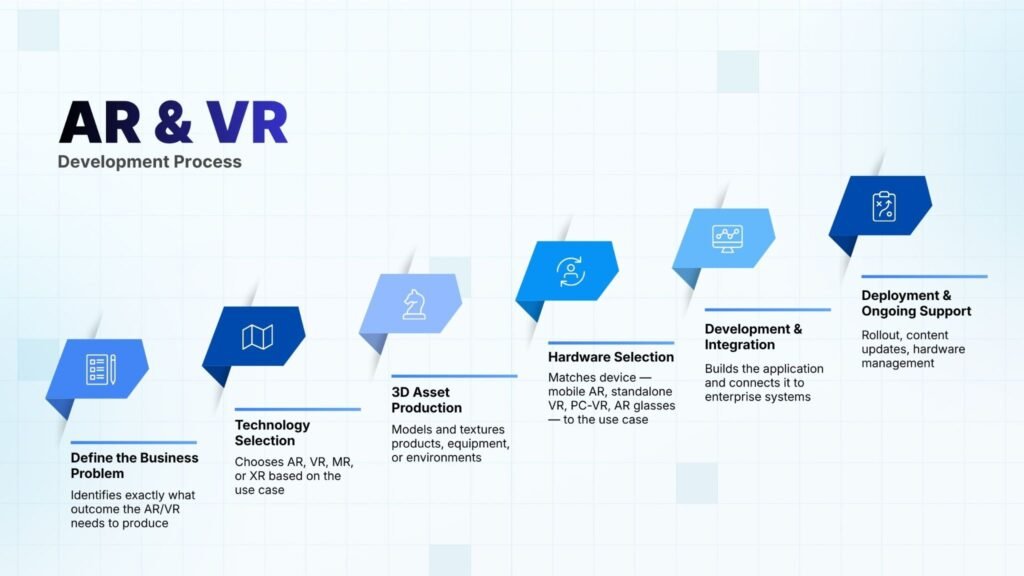
| Stage | What Happens |
| 1. Define the Business Problem | Identifies exactly what outcome the AR/VR needs to produce |
| 2. Technology Selection | Chooses AR, VR, MR, or XR based on the use case |
| 3. 3D Asset Production | Models and textures products, equipment, or environments |
| 4. Hardware Selection | Matches device — mobile AR, standalone VR, PC-VR, AR glasses — to the use case |
| 5. Development & Integration | Builds the application and connects it to enterprise systems |
| 6. Deployment & Ongoing Support | Rollout, content updates, hardware management |
3D Asset Production: What Every AR and VR Project Requires
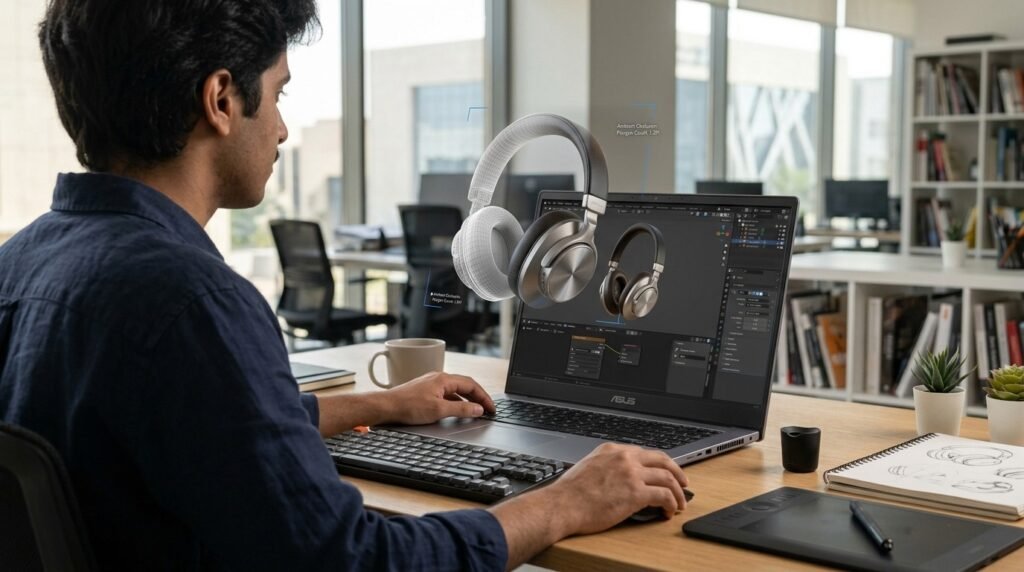
AR and VR do not run on photos or flat illustrations. Every product, piece of equipment, environment, or character that shows up in the experience has to exist as a three-dimensional model first, built, scaled, and textured to look right from every angle.
That adds up fast. A fashion brand doing AR try-on needs a 3D model of every item in the collection. An aviation training platform needs every switch, panel, and control in the cockpit modelled accurately enough that the training actually transfers to a real aircraft. The more your experience needs to show, the more it needs to be built first.
This is usually the biggest cost in your project, often bigger than the software development itself. Businesses that budget for the build and treat 3D assets as an afterthought are the ones who get hit with the surprise bill once the real scope becomes clear.
The fix is simple: scope your 3D assets before you start, not after. How many do you actually need, at what level of detail, and how often will they need updating as your products or facilities change? If you need Arabic text or labels inside the 3D environment itself, that has to be planned in at this stage too, since it’s a different job than adding Arabic to a normal screen.
Hardware Considerations for AR and VR Deployments
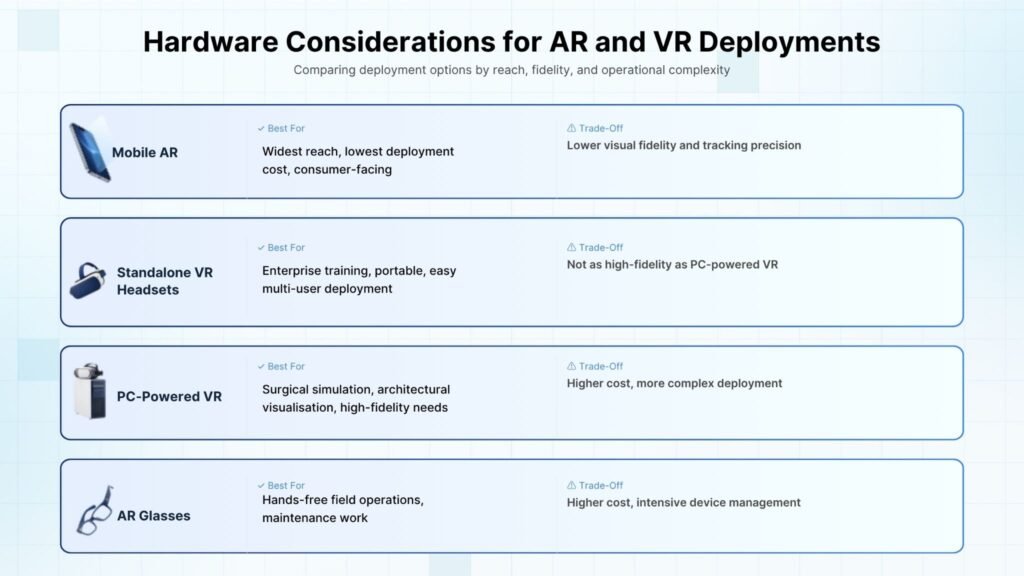
| Hardware | Best For | Trade-Off |
| Mobile AR | Widest reach, lowest deployment cost, consumer-facing | Lower visual fidelity and tracking precision |
| Standalone VR Headsets | Enterprise training, portable, easy multi-user deployment | Not as high-fidelity as PC-powered VR |
| PC-Powered VR | Surgical simulation, architectural visualisation, high-fidelity needs | Higher cost, more complex deployment |
| AR Glasses | Hands-free field operations, maintenance work | Higher cost, intensive device management |
Hardware selection affects what the AR or VR system can do, how it is deployed, and what the ongoing management requirement is.
Mobile AR
Mobile AR runs on phones and tablets that Saudi users already carry. It is the most accessible deployment model: no additional hardware procurement, no user training on new devices, and compatibility with web-based AR that requires no app download. The constraint is performance: mobile AR cannot deliver the visual fidelity or tracking precision of dedicated AR hardware. For consumer-facing applications — retail product visualisation, real estate tours on a website, mobile AR reaches the widest audience at the lowest deployment cost.
Standalone VR Headsets
Standalone VR headsets are self-contained, no PC required, no cabling, straightforward to deploy across multiple users in a facility. They are the practical choice for most Saudi enterprise VR training applications because they can be transported between locations, set up quickly, and managed through device management systems without requiring IT infrastructure at each deployment site. Performance is strong enough for training simulations and property visualisation, though not at the level of PC-powered systems.
PC-powered VR
PC-connected headsets deliver the highest visual fidelity and processing capability, appropriate for applications where environmental realism directly affects outcome quality. Surgical simulation platforms that need physiologically accurate tissue response, architectural visualisation where material quality and lighting accuracy affect client decision-making, and industrial training for facilities where equipment detail matters for recognition in real environments all benefit from PC-powered VR. The trade-off is deployment complexity: fixed installation, significant hardware cost, and more intensive IT management.
AR Glasses
AR glasses for enterprise use, Microsoft HoloLens and similar devices, are appropriate for hands-free field operations where workers need AR overlay information while their hands are occupied with the task. Saudi industrial and maintenance operations are the primary use case. Deployment costs are higher than mobile AR, and the device management requirement is more intensive, but hands-free operation in field environments is a genuine functional requirement that mobile AR cannot serve.
What AR and VR Development Actually Costs in Saudi Arabia
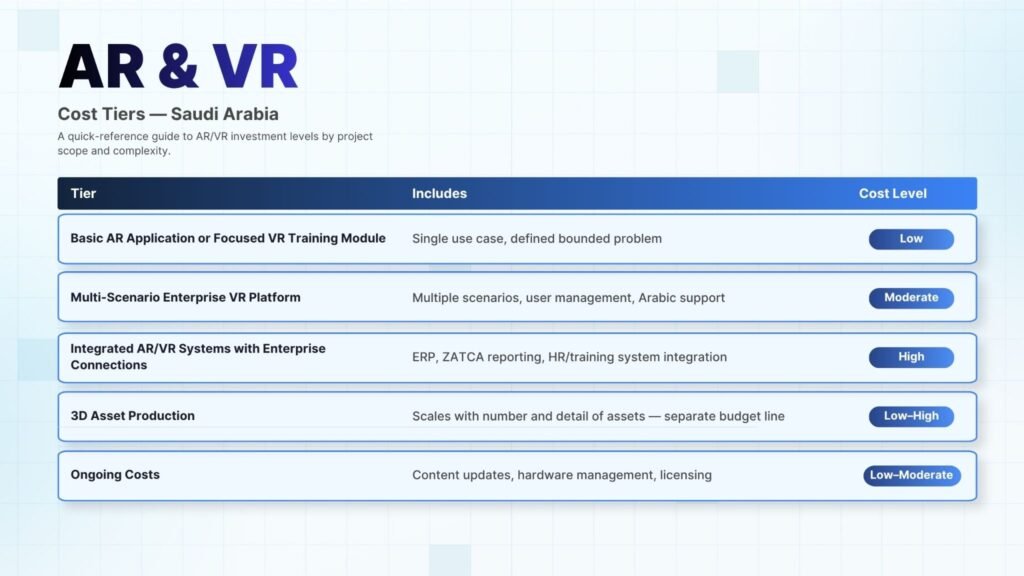
| Tier | Includes | Cost Level |
| Basic AR Application or Focused VR Training Module | Single use case, defined bounded problem | Low |
| Multi-Scenario Enterprise VR Platform | Multiple scenarios, user management, Arabic support | Moderate |
| Integrated AR/VR Systems with Enterprise Connections | ERP, ZATCA reporting, HR/training system integration | High |
| 3D Asset Production | Scales with number and detail of assets — separate budget line | Low–High |
| Ongoing Costs | Content updates, hardware management, licensing | Low–Moderate |
Three things drive your cost more than anything else: how complex the experience is, how many 3D assets it needs, and how much it has to connect with your existing systems. Here’s what that looks like at each level.
Lower Cost: A Single AR App or One VR Training Module
This is the cheapest tier because the scope is narrow: one product range for AR, or one procedure for VR training. Fewer 3D assets, no multi-user infrastructure, and no system integrations to build. This is where most businesses should start if they’re testing whether immersive technology works for them before committing further.
Moderate Cost: A Multi-Scenario VR Training Platform
Cost climbs here because you’re no longer building one thing, you’re building several. Every additional scenario adds its own 3D environment, its own logic, and its own testing. Add user management, training completion tracking, and Arabic language support, and each of those is its own line item. If you’re deploying across multiple locations, hardware management adds cost on top of the development itself.
Higher Cost: AR/VR Connected to Your Business Systems
This is the most expensive tier, and it’s rarely the immersive technology itself that drives the cost here, it’s the integration work. Connecting your AR or VR system to your ERP, your ZATCA-compliant reporting, your HR platform, or your site management systems is often more complex and more expensive than the AR or VR build it’s attached to.
A Cost That Sits Outside All Three Tiers: 3D Asset Production
Regardless of which tier you’re in, 3D asset production is billed separately from development, and it scales with how many assets you need and how detailed they have to be. A business with a small, focused catalog spends far less here than one modelling hundreds of products or an entire facility. Budget for this as its own line item, not something folded into your development cost.
What Keeps Costing You After Launch
Your content needs updating whenever your products, facilities, or procedures change, and that’s a recurring cost, not a one-time one. On top of that, factor in hardware management, software licensing, and headset maintenance as part of your total cost of ownership, not extras you’ll deal with later.
Message us on WhatsApp, and we will help you understand what your specific project would actually cost before you commit to a number.
Common AR and VR Development Mistakes to Avoid
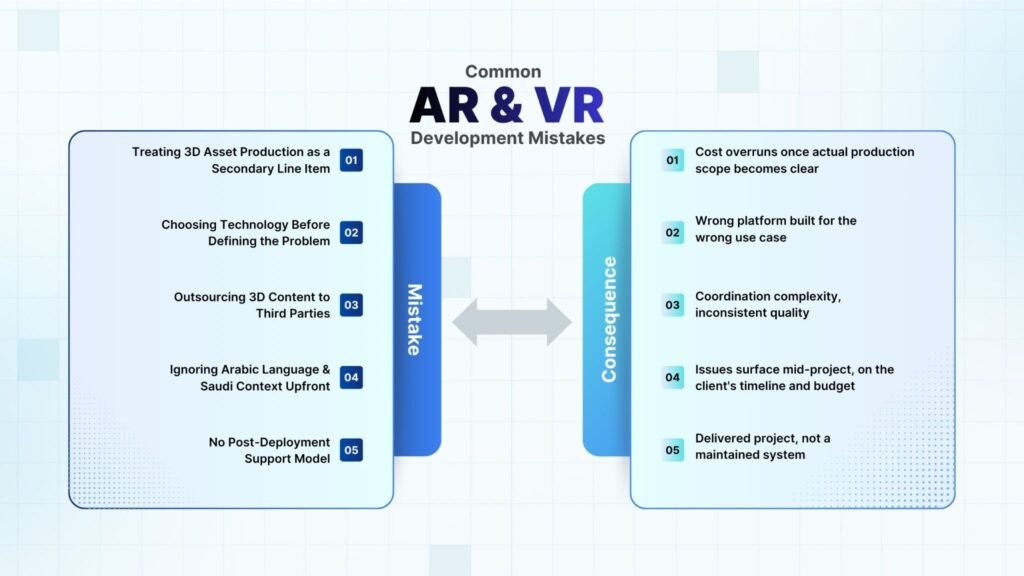
| Mistake | Consequence |
| Treating 3D Asset Production as a Secondary Line Item | Cost overruns once actual production scope becomes clear |
| Choosing Technology Before Defining the Problem | Wrong platform built for the wrong use case |
| Outsourcing 3D Content to Third Parties | Coordination complexity, inconsistent quality |
| Ignoring Arabic Language & Saudi Context Upfront | Issues surface mid-project, on the client’s timeline and budget |
| No Post-Deployment Support Model | Delivered project, not a maintained system |
How to Choose the Right AR and VR Development Company in Saudi Arabia
Industry experience over technology capability
A VR development studio that has built surgical simulations for healthcare and can demonstrate the outcome improvement is a more reliable partner for a hospital than a technically skilled team that has only built consumer VR experiences. The development challenges in enterprise Saudi applications, Arabic language requirements, specific industry workflows, integration with operational systems, are context-specific. Look for demonstrated experience in the industry category that matches your use case.
3D content production capability
Many AR and VR development companies outsource 3D asset production to third-party studios, which adds coordination complexity and cost. Augmented reality development companies that handle 3D content production in-house provide more predictable timelines and better quality control between the content and the application it runs in.
Arabic language and Saudi market experience
RTL text rendering in 3D environments, Arabic NLP for voice interaction, and Saudi cultural context in scenario design are not generic AR and VR development knowledge. Development companies without direct Saudi market experience encounter these requirements during the project and work through them for the first time on the client’s budget and timeline. Ask specifically for examples of Arabic-language immersive deployments.
Integration capability
Saudi enterprise AR and VR applications rarely exist in isolation. They connect to training management systems, ERP platforms, and operational databases. A VR development service that can only build the immersive application but cannot handle system integration leaves the integration work to be managed separately, which typically means cost overruns and timeline delays.
Post-deployment support model
AR and VR content needs ongoing maintenance as business requirements change. A development company without a defined post-deployment support model delivers a completed project rather than a maintained operational system. The support model, update schedules, response times for critical issues, and how new content is scoped and priced should be agreed before development begins.
Why Etihad Falcon Tech is the Best AR and VR Development Company in Saudi Arabia?
Etihad Falcon Tech’s AR and VR development starts with the operational problem. Before any platform decision or 3D asset production begins, the business outcome that the immersive application needs to produce is defined precisely: what does the trainee need to be able to do after completing the VR module, what decision does the AR experience need to support, what sales objection does the property walkthrough need to resolve.
In-house Capability Across the Full Stack
Etihad Falcon Tech handles augmented reality development services, virtual reality development, 3D asset production, Arabic language integration, and enterprise system integration internally.
Saudi Market Experience
Arabic text rendering in 3D environments, Gulf Arabic language considerations for voice interaction, Saudi cultural context in scenario design, and deployment requirements specific to Saudi enterprise environments are part of Etihad Falcon Tech’s standard development process. These are not discovered mid-project.
Industry-specific Experience
We have delivered augmented reality development and virtual reality development services for Saudi clients across healthcare, real estate, construction, retail, and corporate training. That cross-industry experience means faster problem identification, more accurate scoping, and AR/VR systems built for real Saudi operational environments rather than generic use cases.
Frequently Asked Questions
AR and VR development builds immersive apps: AR overlays digital content onto the real world through a device like a phone or headset, while VR puts you inside a fully digital environment through a headset, replacing the real world entirely. For Saudi businesses, these aren’t entertainment tools first, they’re used for training, sales, and improving the customer experience.
Saudi businesses are deploying AR and VR across construction for BIM integration and site planning, healthcare for surgical training and patient education, real estate for off-plan property sales, retail for product visualisation, manufacturing for equipment training and quality control, and corporate training for consistent multi-location employee development.
Cost depends on experience complexity, 3D asset volume, and integration scope. A focused single-use-case application costs significantly less than a multi-scenario enterprise platform with system integrations. 3D asset production, which scales with the number of products, environments, or equipment models required, is typically the largest cost driver and is often underestimated relative to the software development cost.
Construction, healthcare, real estate, manufacturing, education, and retail see the strongest return in the Saudi market. The common factor is a high cost or high risk associated with not having immersive capability, environments too dangerous to train in physically, properties that do not yet exist, or customer decisions that require spatial understanding that static media cannot provide.
A focused AR application or single-scenario VR training module typically takes eight to fourteen weeks. Multi-scenario enterprise platforms with Arabic language support and system integration take four to eight months. 3D asset production timelines run in parallel with development and are often the variable that most affects total project timeline.
AR overlays digital content onto the real world, the physical environment stays present. VR replaces the real environment entirely with a simulated one. Mixed reality allows digital and physical elements to interact with each other in real time. The right choice depends on whether the real-world environment should be present, absent, or interacting with the digital content.
AR runs on mobile devices Saudi users already carry, no additional hardware required for most consumer and field applications. VR requires headsets. Standalone headsets are the practical choice for most Saudi enterprise training deployments. PC-powered VR is appropriate for applications requiring the highest visual fidelity. AR glasses for hands-free enterprise field operations are a higher-cost, more specialised deployment.
The return depends entirely on whether the right problem is being addressed. For Saudi businesses where training in dangerous environments carries real risk, where sales of unbuilt properties depends on buyer confidence, or where product return rates reflect expectation gaps that AR could close, the commercial case is direct. For businesses without a clearly defined problem that immersive technology solves, the same budget applied differently produces better return.