

Starting a business from home is no longer a small or unusual step for Saudi women. According to Saudi Arabia’s Small and Medium Enterprises General Authority (Monsha’at), the Kingdom had 1.7 million active commercial registrations by the end of Q2 2025, with 47% owned by women. Meanwhile, Monsha’at’s Biban 2025 report noted that Saudi women’s participation in the workforce rose to 43.5%, reflecting the success of empowerment programs under Vision 2030.
That changes what “business ideas for women at home” actually means for you.
You don’t need to rent a shop, build a team, or invest heavily in a physical space to start. A home-based business can begin with a carefully chosen product, a defined audience, and the right online sales channel.
What was missing for a generation of Saudi women with the skills, ambition, and ideas to start a business wasn’t opportunity; it was the right entry point: a business model that fit around their lives, used their actual strengths, and didn’t require an office, a commercial licence for a physical location, or a large upfront investment.
E-commerce and online business models filled that gap. Today, you can run a boutique abaya brand, a digital marketing consultancy, a home food business, or a handmade jewellery store entirely from home, using platforms that already handle payments, logistics, and customer discovery for you.
This guide covers the business ideas for women at home in Saudi Arabia generating real income in 2026, how each one works in practice, what you need to get started, and how to think about scaling once your business is running.
Why Saudi Arabia Is a Strong Market for Women-Led Home Businesses Right Now
The infrastructure that makes home-based business ideal for Saudi women is better now than it has ever been. That is not a generic statement about digital transformation; it is a specific set of conditions that directly reduce the barriers that previously made women’s entrepreneurship difficult.
Here are 5 ways the market has shifted in your favor:
- Digital payment infrastructure removes the biggest early obstacle
Mada, STC Pay, and Apple Pay let your customers complete a purchase in seconds from their phone. If you’re selling handmade products or running an online service, you no longer need a merchant account, a POS terminal, or a separate business bank account just to accept payment. A Saudi e-commerce platform sets this up for you in hours. Your money reaches you without friction.
- Local e-commerce platforms are built for the Saudi market
Salla and Zid are built in Saudi Arabia, for the Saudi market. Arabic interface, ZATCA-compliant invoicing, local payment integration, and Saudi logistics connections all come built in. You don’t need to configure international tools to sell locally. The platform is already set up for how your customers shop and pay.
- Social Media Is Where Your Customers Are Already Buying
Saudi Arabia has some of the highest social media engagement rates in the world. Your customers are discovering products on Instagram Reels, TikTok, and Snapchat, and buying directly through those channels or a linked store page. For a home-based business, social media isn’t just marketing, it’s your main source of customers. The organic reach on these platforms means you can build an audience before you spend a single riyal on ads.
- Logistics networks reach across Saudi Arabia
Aramex, SMSA, and J&T Express deliver nationwide, with pickup straight from your home. You don’t need storage space or a fulfilment team. You prepare the order, book a courier through an app, and the delivery is out of your hands.
- Vision 2030 supports and funds women entrepreneurs
Monsha’at, the Small and Medium Enterprises General Authority, runs funding programmes, training, and business support built specifically for Saudi women entrepreneurs. The Ministry of Commerce has also simplified business registration. The environment is actively backing new businesses in a way it wasn’t a decade ago.
Best Business Ideas for Women at Home in Saudi Arabia
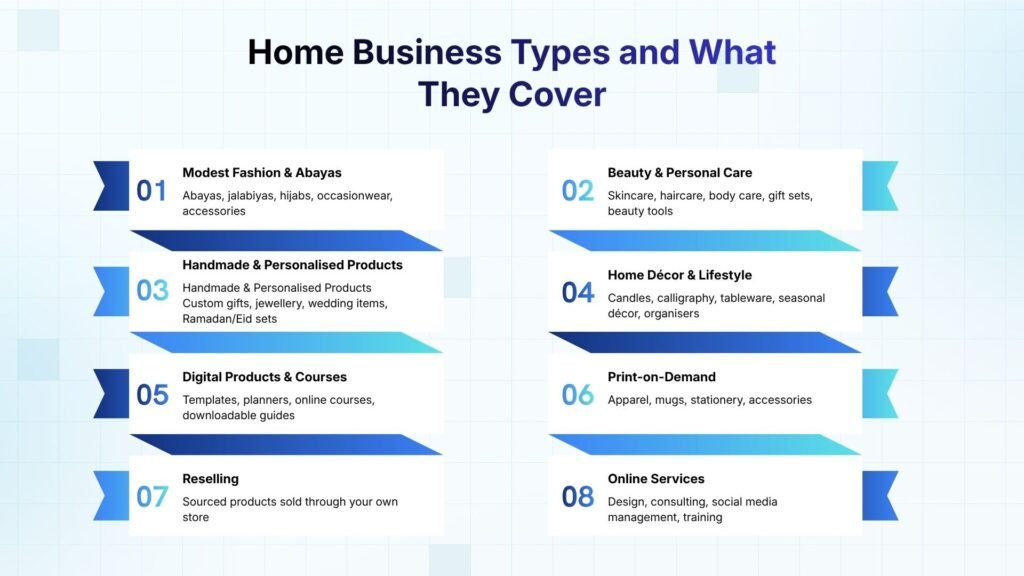
| Business Type | What You Sell |
| Modest Fashion & Abayas | Abayas, jalabiyas, hijabs, occasionwear, accessories |
| Beauty & Personal Care | Skincare, haircare, body care, gift sets, beauty tools |
| Handmade & Personalised Products | Custom gifts, jewellery, wedding items, Ramadan/Eid sets |
| Home Décor & Lifestyle | Candles, calligraphy, tableware, seasonal décor, organisers |
| Digital Products & Courses | Templates, planners, online courses, downloadable guides |
| Print-on-Demand | Apparel, mugs, stationery, accessories |
| Reselling | Sourced products sold through your own store |
| Online Services | Design, consulting, social media management, training |
E-commerce is one of the most accessible starting points because the infrastructure is already built. You don’t need to create a payment system, a logistics network, or a customer discovery platform. Those exist. Your job is choosing the right niche and building a brand that makes customers pick you over everyone else selling online.
Modest Fashion & Abayas
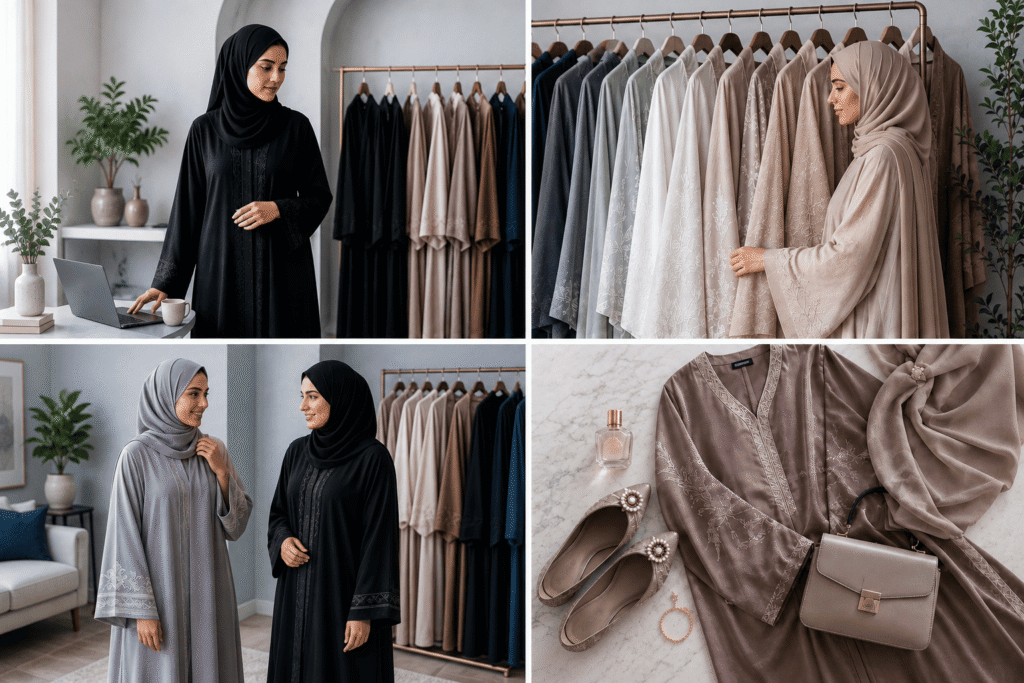
This is one of the most successful and competitive categories in Saudi women’s e-commerce, and it’s competitive precisely because it works. Saudi women buy abayas, modest wear, and Islamic fashion online consistently, and they stay loyal to brands that understand their specific aesthetic and sizing needs. Starting on Salla or Zid keeps your initial costs low, and Instagram and TikTok are where your customers will find you first.
The strongest niches within this category right now:
- Everyday abayas vs. formal or occasion-wear specialisation
- Fabric-focused collections (linen, embroidered, seasonal fabrics)
- Plus-size and inclusive sizing, an underserved segment
- Jalabiyas, hijabs, and modest occasionwear accessories
Best for: Entrepreneurs with a fashion eye, sewing or design skills, or an existing supplier relationship in textiles.
Beauty & Personal Care

Skincare, haircare, body care, and beauty tools are one of the fastest-growing home business categories in Saudi Arabia, driven by demand for clean-ingredient, locally formulated products with a genuine point of view. Private-label and white-label suppliers let you launch under your own brand without manufacturing anything yourself.
Where the demand is strongest:
- Skincare formulated for the Saudi climate
- Haircare and body care lines
- Gift sets for Eid, weddings, and National Day
- Natural or clean-ingredient positioning
Best for: Entrepreneurs interested in beauty or wellness, comfortable working with private-label suppliers or formulators.
Handmade & Personalised Products
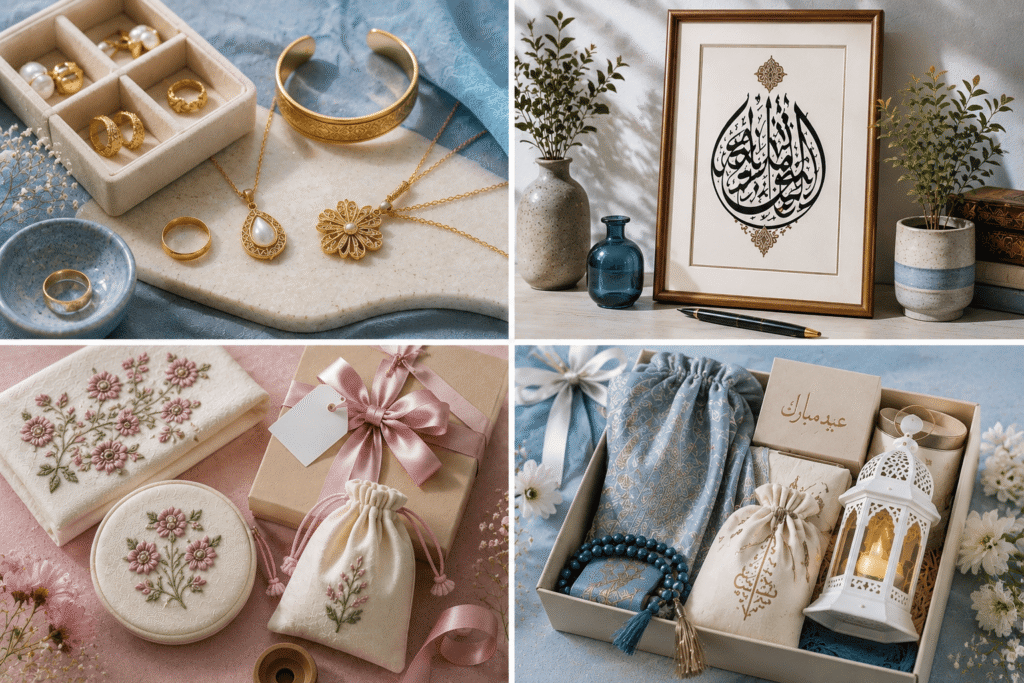
Handmade jewellery, calligraphy art, and embroidered products consistently command premium pricing because customers buying handmade aren’t looking for the cheapest option, they want uniqueness and a story. This model runs lower volume, higher margin, and depends heavily on Instagram storytelling and WhatsApp community referrals.
The categories performing best:
- Handmade jewellery and accessories
- Arabic calligraphy art and prints
- Embroidered and personalised gifts
- Ramadan and Eid custom sets
Best for: Entrepreneurs with a craft skill, an artistic eye, or the patience to build a product by hand.
Home Décor & Lifestyle
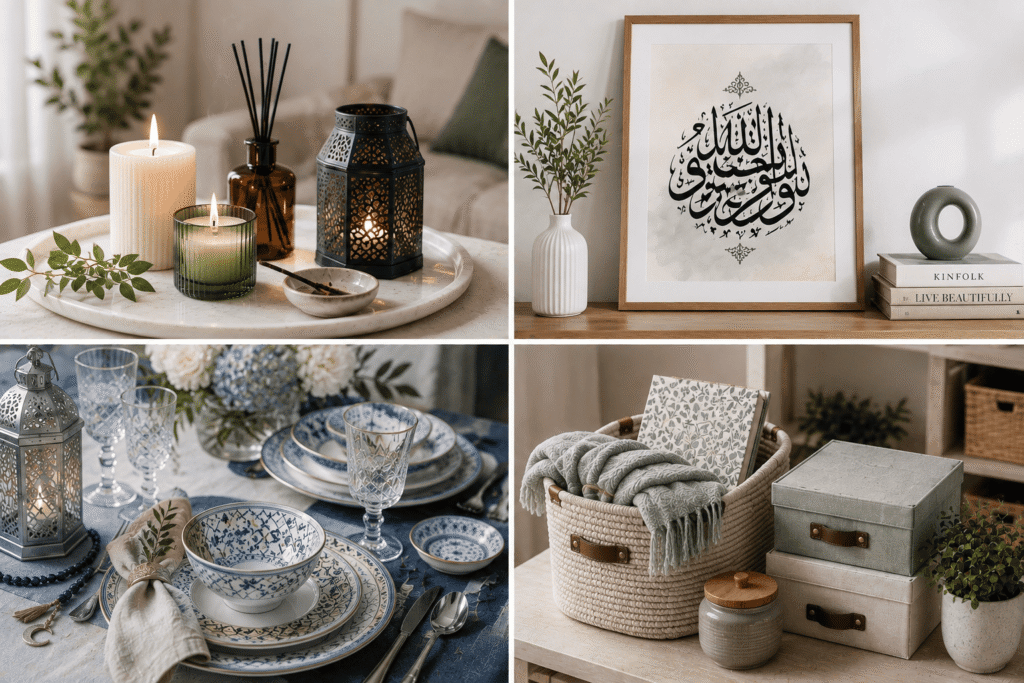
Candles, tableware, and seasonal décor see steady, repeat purchases in Saudi Arabia, especially around Ramadan, Eid, and new-home or wedding season. Because this category is gifted often, your products need to work equally well as a personal purchase and as a gift, and styled photography in real home settings converts better than studio shots.
Where to focus:
- Candles and home fragrance
- Calligraphy and wall art
- Tableware and seasonal collections
- Home organisers and storage
Best for: Entrepreneurs with an eye for styling and an interest in seasonal, gift-driven product cycles.
Print-on-Demand
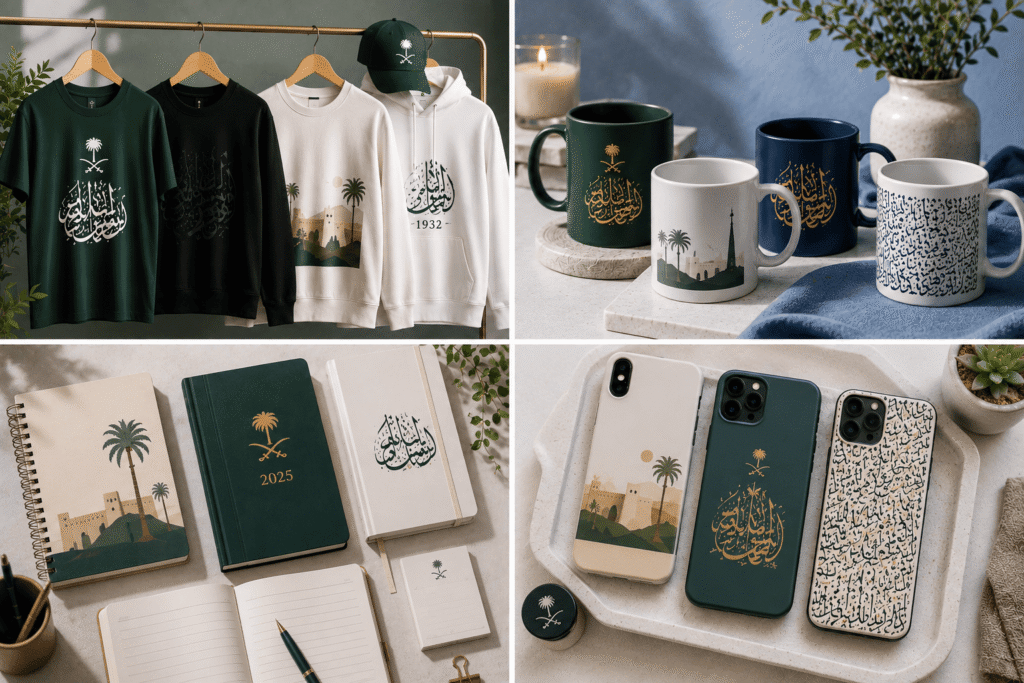
Print-on-demand lets you sell custom apparel, mugs, and stationery without holding inventory. A print partner produces and ships only when a customer orders, so there’s no upfront stock risk, though margins per item run lower than handmade or beauty products. Designs tied to Saudi culture and Arabic typography tend to outperform generic designs since they’re harder for international sellers to replicate.
Products that do well in this model:
- Apparel with Arabic typography or National Day themes
- Mugs and drinkware
- Stationery and planners
- Phone cases and small accessories
Best for: Entrepreneurs with graphic design skills who want to start with zero inventory investment.
Reselling
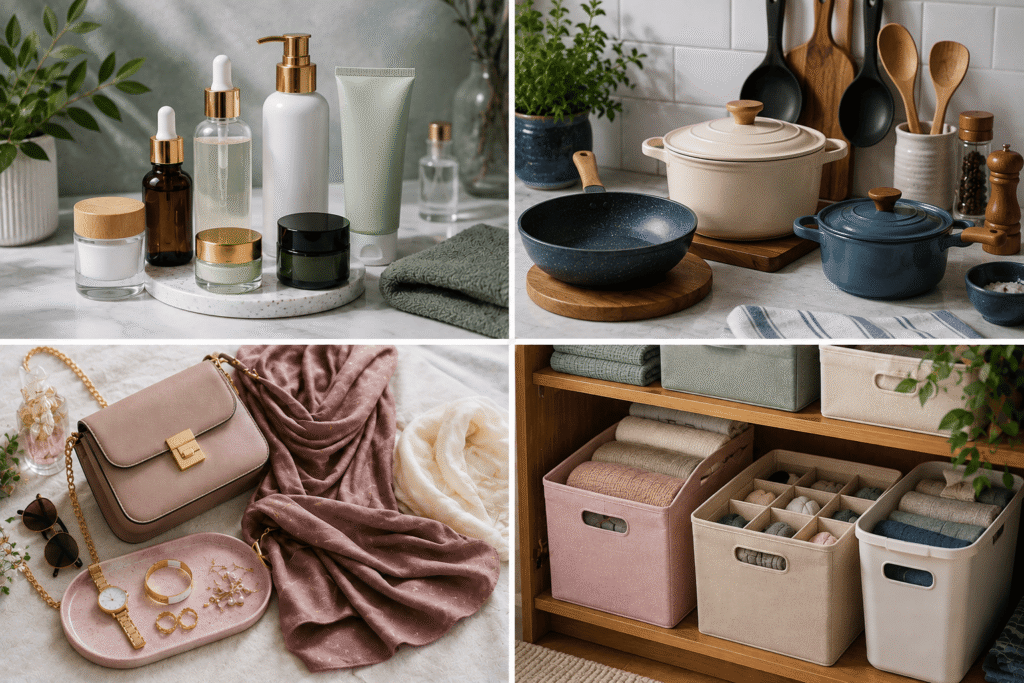
Reselling means sourcing physical products, local or imported, and selling them under your own brand and customer relationship, which means holding stock but controlling quality and delivery speed. A lower-investment version is dropshipping, where a supplier ships directly to your customer and you never hold inventory, though this depends on choosing suppliers with delivery times Saudi customers will accept.
Categories that work well here:
- Niche beauty and wellness products
- Specialised kitchen equipment
- Modest fashion accessories
- Home organisation items
Best for: Entrepreneurs who want to test a product category quickly, with either dropshipping or a small upfront stock investment.
Digital Products & Courses
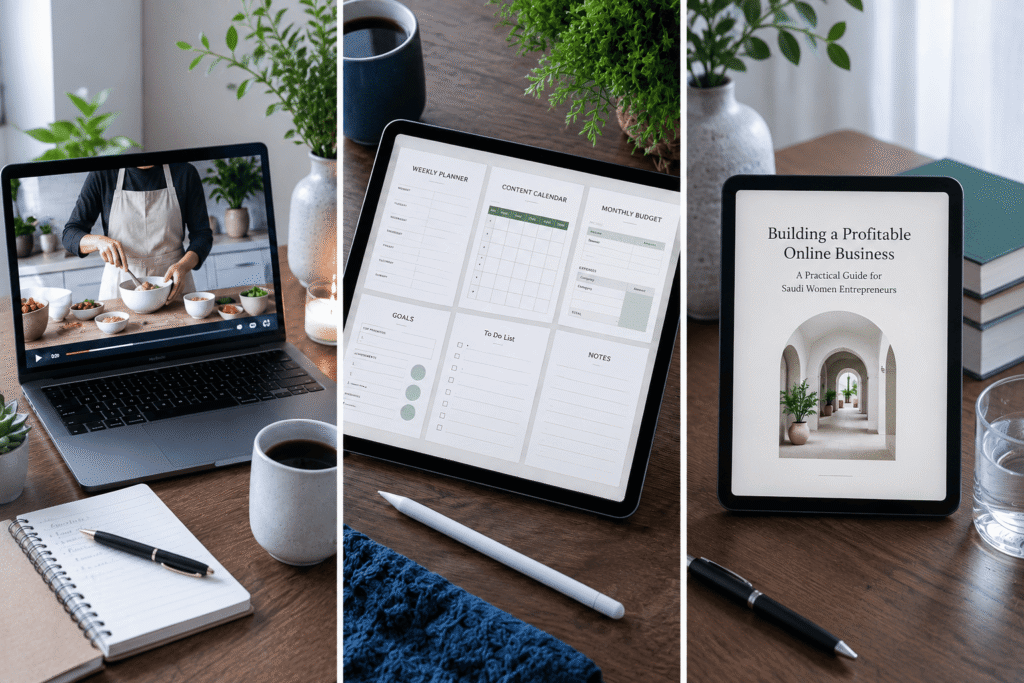
Digital products carry the highest margin of any model here because there’s no inventory, no logistics, and no ceiling on how many times you can sell the same product. Success depends on starting with a specific audience and a specific outcome. A course called “Arabic Calligraphy for Beginners” has a clear promise; generic content competes against enormous international supply with no real edge.
What sells consistently:
- Online courses (cooking, calligraphy, marketing, finance, fitness)
- Templates and planners (Canva designs, content calendars, budgeting sheets)
- E-books and digital guides on specific, practical questions
Best for: Entrepreneurs with expertise in a specific field who are comfortable teaching or writing about it.
Online Services
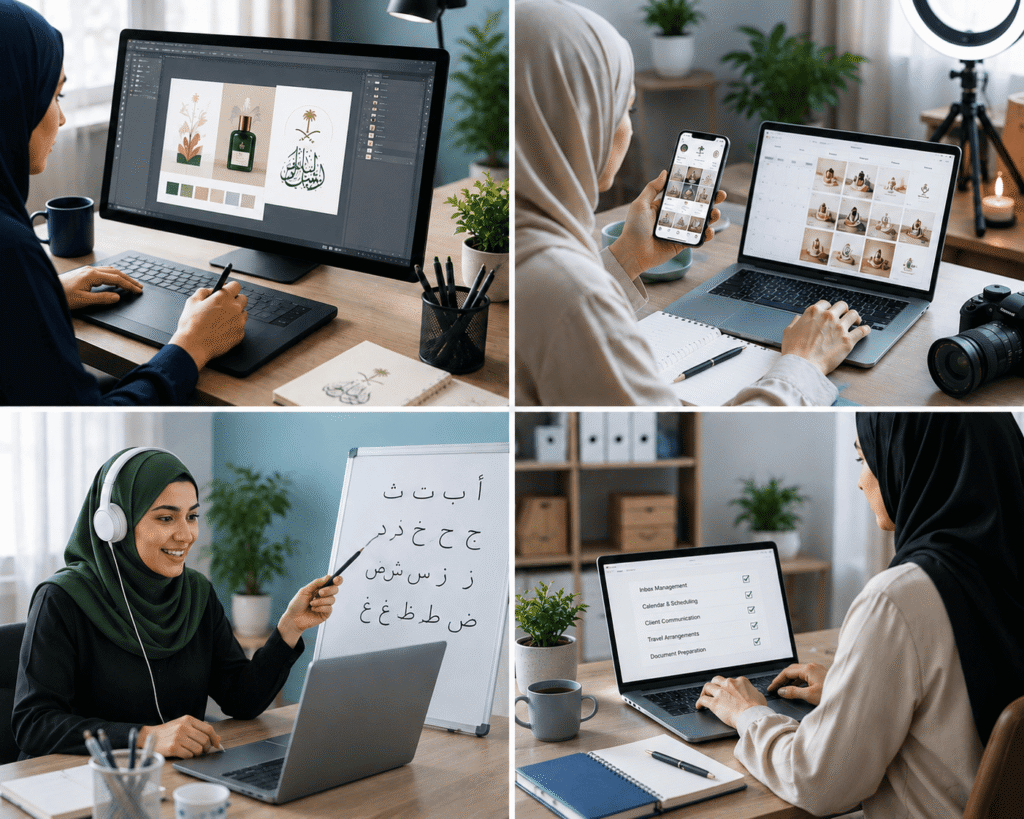
These may not look like a typical “business” at first, since you’re selling skills rather than products, but that’s exactly the point. Service businesses carry zero inventory cost and the highest margins available to you, if you have a marketable skill. What starts as freelance work can grow into a full agency built entirely around your skillset. Specialising, working specifically with Saudi e-commerce brands, or producing native Arabic content instead of translated English, lets you charge more and win clients more consistently than a generalist competing on price.
The strongest service niches:
- Graphic design and visual content
- Social media management (especially native Arabic content)
- Tutoring and coaching (certification adds credibility)
- Virtual assistant services and translation
Best for: Entrepreneurs with a professional skill, design, writing, marketing, tutoring, or admin, and no interest in managing physical products.
How to Choose the Right Business Idea for You
Most Saudi women exploring home-based business options already have a natural fit. It’s usually the idea you keep coming back to, the skill people already ask you for, or the product you keep wishing existed.
Start With What You Already Know
The most profitable businesses aren’t always in the most obvious categories. They’re run by people who know their customer deeply, often because they are that customer. If you know modest fashion from the inside, you’ll build a stronger brand in that space than someone who picked the category because the market looked big.
Match the Business to Your Current Time Situation
A housewife with young children needs different flexibility than someone working part-time or returning after a career break. Digital products and service businesses give you more schedule flexibility than product businesses that require regular packing and shipping. Be honest about the time you actually have before you commit to a model built for someone else’s schedule.
Start Before You Feel Ready
Every successful home-based business in Saudi Arabia started before its founder felt fully prepared. The Instagram store that became a real brand launched its first collection without a logo. The freelance designer who built a full client roster started with one client, at below her eventual rate. The tutor who now teaches 300 students a month started with two.
Waiting for perfect conditions is the most common reason a good business idea never becomes a real business. The tools exist. The market exists. The infrastructure exists. What’s missing is almost always the decision to start.
How to Launch Your Home-Based Business in Saudi Arabia
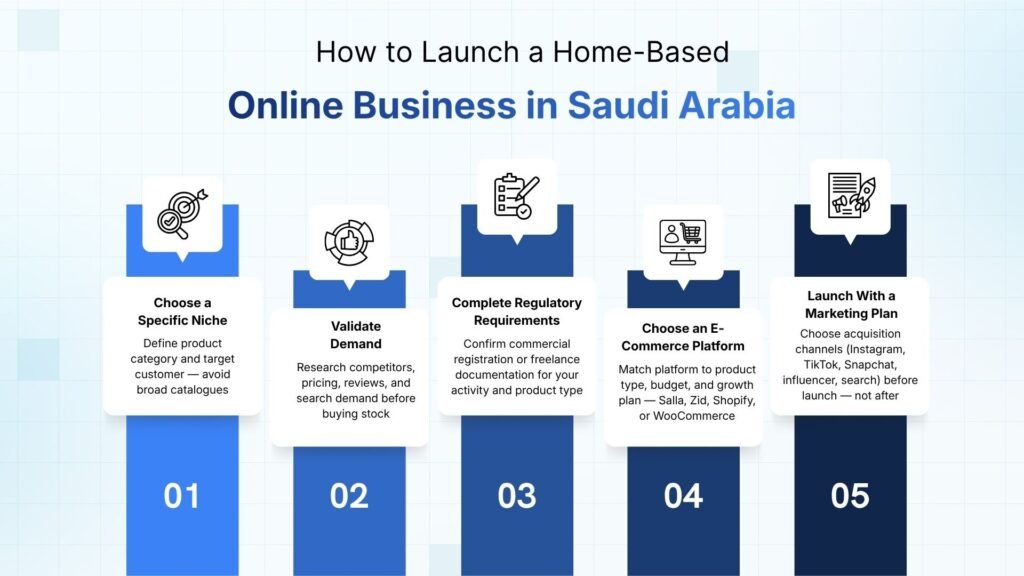
| Stage | What Happens |
| 1. Choose a Specific Niche | Define product category and target customer — avoid broad catalogues |
| 2. Validate Demand | Research competitors, pricing, reviews, and search demand before buying stock |
| 3. Complete Regulatory Requirements | Confirm commercial registration or freelance documentation for your activity and product type |
| 4. Choose an E-Commerce Platform | Match platform to product type, budget, and growth plan — Salla, Zid, Shopify, or WooCommerce |
| 5. Launch With a Marketing Plan | Choose acquisition channels (Instagram, TikTok, Snapchat, influencer, search) before launch — not after |
1. Choose a Specific Niche
Define your product category and your target customer before you do anything else. A broad catalogue trying to serve everyone converts worse than a focused store that owns one clear niche. Pick a specific angle, like plus-size modest wear or Arabic calligraphy prints, rather than “abayas” or “handmade gifts” as a category.
2. Validate Demand
Research your competitors before you buy stock or book your first client. Check what similar businesses are charging, read their customer reviews to see what buyers actually complain about, and search for your product category to see how much real demand exists. This tells you whether your niche has room for you before you’ve spent anything.
3. Complete Regulatory Requirements
Commercial registration through the Ministry of Commerce is your formal starting point, and Monsha’at has simplified this process significantly for first-time business owners. If you’re selling food, cosmetics, or anything healthcare-adjacent, confirm your SFDA requirements too. Match your registration path to your specific activity and product type before you take your first order.
4. Choose an E-Commerce Platform
Match your platform to what you’re selling, your budget, and how you plan to grow.
If you’re selling to Saudi customers, Salla and Zid are built for this market. Both handle ZATCA-compliant invoicing, local payment methods, and Saudi logistics natively, so you’re not adapting an international tool to work locally.
If you’re building an international brand or plan to sell beyond Saudi Arabia, Shopify and WooCommerce give you more flexibility. Shopify is faster to set up with less technical maintenance. WooCommerce gives you more control if you’re already on WordPress, but takes more work to configure. Neither handles ZATCA compliance or local payments the way Salla and Zid do.
If your business has outgrown a template platform, a custom e-commerce store gives you full control over the customer experience and how you scale, though it’s a bigger investment that makes sense once your product and sales are already proven. For what that build actually involves, our complete guide on custom web development covers the process from planning through launch.
5. Launch With a Marketing Plan
Choose your acquisition channels: Instagram, TikTok, Snapchat, influencer partnerships, search, before you launch. Going live without a plan for how customers will find you is the most common reason a good product doesn’t sell.
The channel that works best depends on your business. Instagram and TikTok suit product businesses. LinkedIn works for B2B services. WhatsApp Business is essential for managing client relationships once orders start coming in. Whichever channels you pick, show the person and the process behind the business, not just the product, since that’s what actually builds the trust that gets Saudi customers to buy.
Common Mistakes Women Entrepreneurs Make When Starting From Home
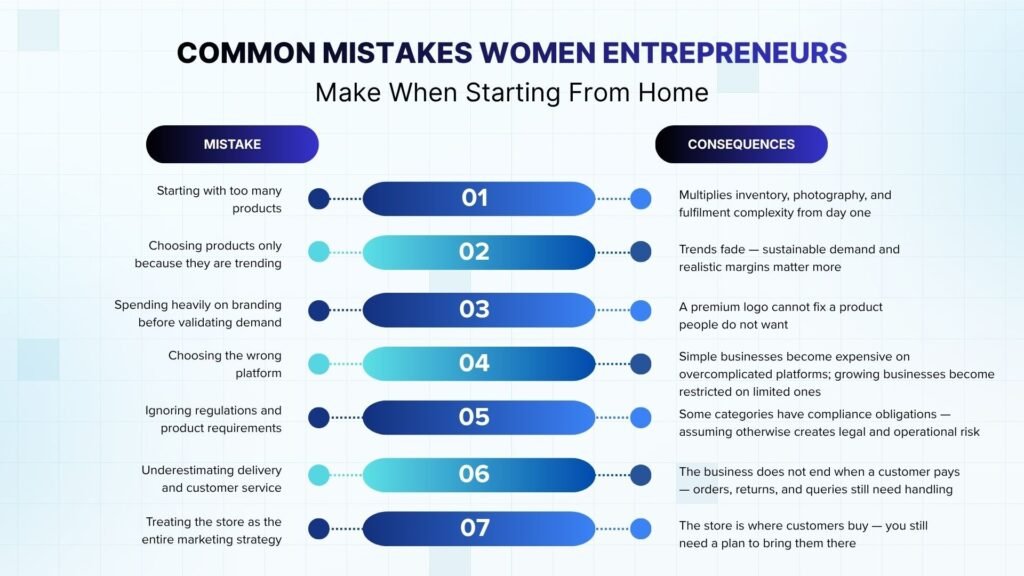
| Mistake | Why It Causes a Problem |
| Starting with too many products | Multiplies inventory, photography, and fulfilment complexity from day one |
| Choosing products only because they are trending | Trends fade — sustainable demand and realistic margins matter more |
| Spending heavily on branding before validating demand | A premium logo cannot fix a product people do not want |
| Choosing the wrong platform | Simple businesses become expensive on overcomplicated platforms; growing businesses become restricted on limited ones |
| Ignoring regulations and product requirements | Some categories have compliance obligations — assuming otherwise creates legal and operational risk |
| Underestimating delivery and customer service | The business does not end when a customer pays — orders, returns, and queries still need handling |
| Treating the store as the entire marketing strategy | The store is where customers buy — you still need a plan to bring them there |
What Does It Cost to Start a Home-Based Business in Saudi Arabia?
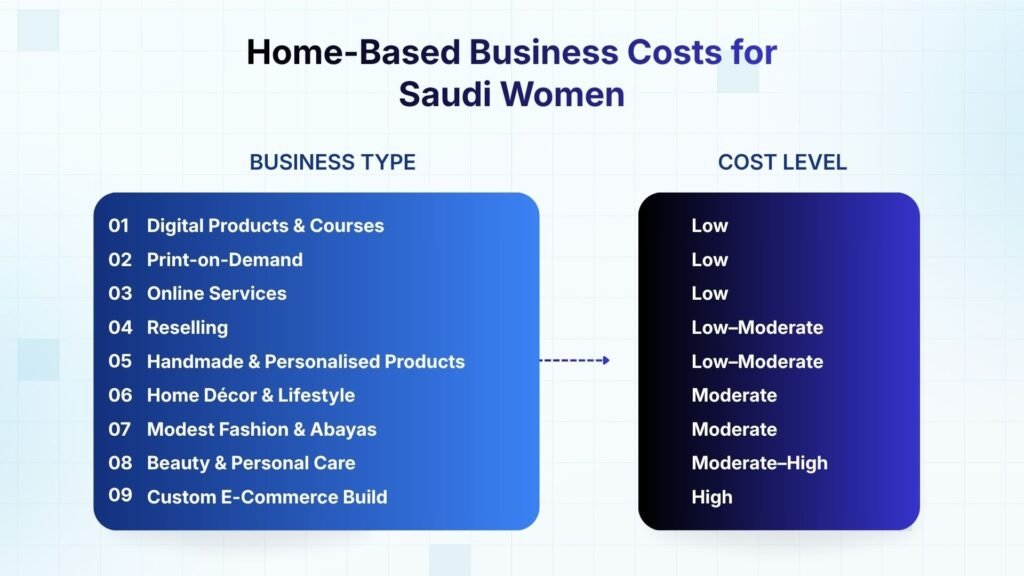
| Business Type | Cost Level |
| Digital Products & Courses | Low |
| Print-on-Demand | Low |
| Online Services | Low |
| Reselling | Low–Moderate |
| Handmade & Personalised Products | Low–Moderate |
| Home Décor & Lifestyle | Moderate |
| Modest Fashion & Abayas | Moderate |
| Beauty & Personal Care | Moderate–High |
| Custom E-Commerce Build | High |
Home business ideas for ladies at home in Saudi Arabia range from genuinely zero to moderate startup cost — lower than almost any other economy because the platform infrastructure eliminates most of the fixed costs that previously required upfront investment.
Near-zero investment starting points
Service businesses — freelance design, social media management, tutoring, virtual assistance, content writing — require no investment beyond a reliable laptop and internet connection. The product is your existing skill. The platform is LinkedIn, Instagram, or a freelance marketplace. The cost is time and the consistency of showing up.
Digital product businesses require the time to create the product and a basic account on a digital product platform. An e-book or a template pack can be listed and sold on Gumroad for free. An online course on Teachable has no upfront cost to list.
Low investment product businesses
A Salla or Zid store subscription costs a few hundred riyals per month at entry level. Initial product inventory for a handmade business depends entirely on materials cost, which can be kept minimal for the first product line. Instagram and TikTok organic reach means early marketing costs can be genuinely close to zero for Saudi product businesses with strong visual content.
What drives costs up
Inventory investment for product businesses that require holding stock before orders come in. Photography and content production if professional-quality visual assets are needed before the brand has revenue to invest. Advertising spend if the business chooses to accelerate growth beyond organic reach. And platform or fulfilment costs that scale with volume — which is a good problem to have and not something to worry about before the business is generating revenue.
The principle across all home-based business models for women in Saudi Arabia is: start lean, validate the commercial model with real customers paying real money, and invest in scaling only what is already working.
How Etihad Falcon Tech Supports Saudi Women Entrepreneurs Building Online Businesses

Every growing home-based business reaches a point where its starting tools become the constraint, not the solution. A Salla store that worked for your first 50 orders isn’t built for 500 orders a month, ERP integration, custom payment flows, or a loyalty system. An Instagram-based service business pitching corporate clients needs a proper website. A digital product creator needs a custom platform when standard tools can’t deliver the experience they’ve outgrown.
What We Build
We’ve built e-commerce stores, custom websites, mobile apps, and digital systems for Saudi businesses at every stage, including home-based businesses started by Saudi women that grew past what their original platform could support.
Who This Is For
Whether you’re thinking about starting a business from home or you’ve already started one that isn’t growing the way you hoped, our team is ready to help.
Contact us on WhatsApp, and we can walk you through the right platform, the right setup, and the right next step for where your business is right now.
Frequently Asked Questions
Service businesses, freelance design, social media management, coaching, and tutoring, tend to produce the highest margins relative to startup cost, since you’re selling expertise with no inventory or logistics involved. Among product businesses, modest fashion and handmade products in a clearly defined niche outperform generic e-commerce in both margin and customer loyalty. Digital products carry the highest long-term margin, but they need more upfront work to create.
Yes. Registration with the Ministry of Commerce is required, and Monsha’at has simplified this significantly for first-time business owners. If you’re selling food, cosmetics, or anything healthcare-adjacent, check your SFDA requirements before you sell publicly.
Salla and Zid are your best starting points. Both handle Arabic interface, ZATCA-compliant invoicing, Mada and STC Pay integration, and Saudi logistics natively, so you’re compliant from your first order without any technical setup. Add Instagram Shopping and TikTok Shop alongside your store to capture buyers discovering you through content.
Yes, if you go the service route. Freelance writing, social media management, tutoring, and virtual assistance cost you time, not capital. Digital products need time to create plus a free or low-cost listing on platforms like Gumroad or Teachable. Product businesses need some inventory investment, though handmade and dropshipping keep this far lower than traditional retail.
For services: LinkedIn for professional clients, Instagram and TikTok for creative work, and direct outreach to your target clients. For products: Instagram and TikTok content showing the product and the person behind it, micro-influencer partnerships in your niche, and WhatsApp sharing through your existing network. Your fastest first customers will almost always come from people you already know, so tell your network what you’re doing and ask for that first order or referral.
In dropshipping, you list and market products you don’t hold. When a customer orders, your supplier ships directly and you keep the margin. In a standard product business, you buy or make inventory, hold it, and ship it yourself. Dropshipping costs less to start and carries zero inventory risk, but pays lower margins with less control over quality and delivery. A branded product business, especially handmade or uniquely positioned, builds more loyalty and higher margins, but needs inventory investment and logistics management.
We build the technical infrastructure for businesses that have outgrown their starting platform: custom Salla or Zid development, custom e-commerce websites, mobile apps, ERP integrations, and loyalty systems. We work with you at the scaling stage, once your model is validated and your technology is what’s holding you back from what you want to build next.