
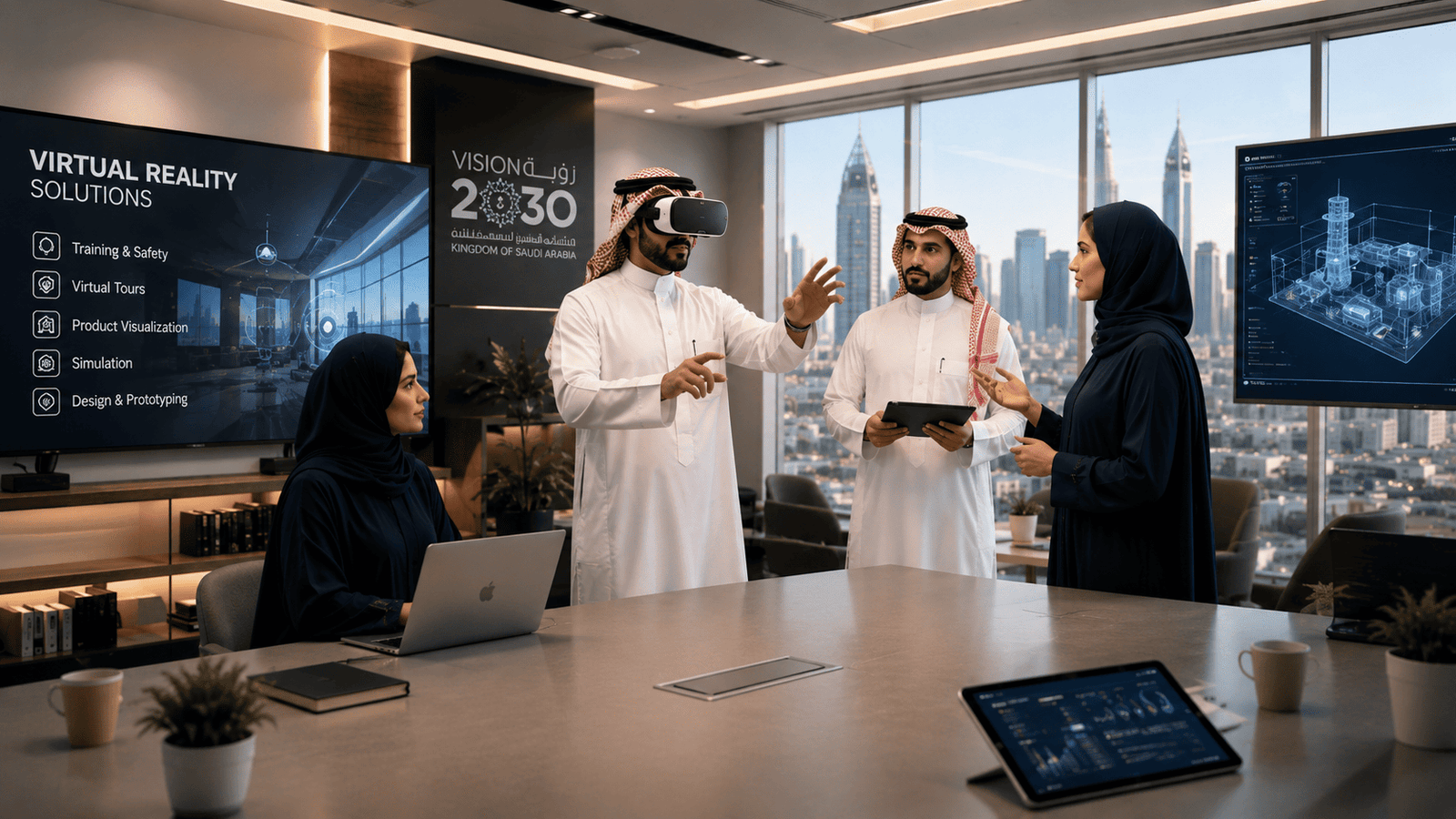
Saudi Arabia’s Virtual Reality (VR) market is on track to hit USD 927.4 million by 2034, up from USD 178.7 million in 2025, according to IMARC Group, a global market research and consulting firm. Healthcare, retail, education, construction, tourism, industrial operations, and many other business niches are already adopting VR.
They’re adopting it for one reason: VR removes the guesswork from decisions that used to depend on it. A buyer used to commit to an off-plan unit off a floor plan. A new hire used to learn a hazard from a briefing instead of the hazard itself. A trainee used to get a handful of real attempts to get a high-stakes procedure right. VR replaces that guesswork with the real experience, and the results show it: properties marketed with VR tours sell up to 31 percent faster, VR industrial training has cut lost-time injuries by 43 percent, and VR emergency training in healthcare has cut training time by 45 percent while lifting procedural accuracy by 60 percent.
This guide covers what Virtual Reality development actually does for your business, which industries are seeing the fastest return, what development costs and what drives that cost up or down, and how to choose a development partner who builds for the Saudi market instead of adapting a generic build after the fact.
Where VR Adoption Stands in the Saudi Market Right Now
VR adoption in Saudi Arabia is strongest in construction, real estate, industrial training, and healthcare. These are the sectors where the cost of physical alternatives is high, and the benefit of simulation is immediate. Corporate training across financial services, retail, and government-adjacent enterprises is growing as the consistency advantages of VR training become visible at scale.
Companies that deploy VR effectively in the next twelve to eighteen months will be operating with a trained workforce and proven sales tools while competitors are still evaluating where to start.
Types of VR Experiences Businesses Utilize
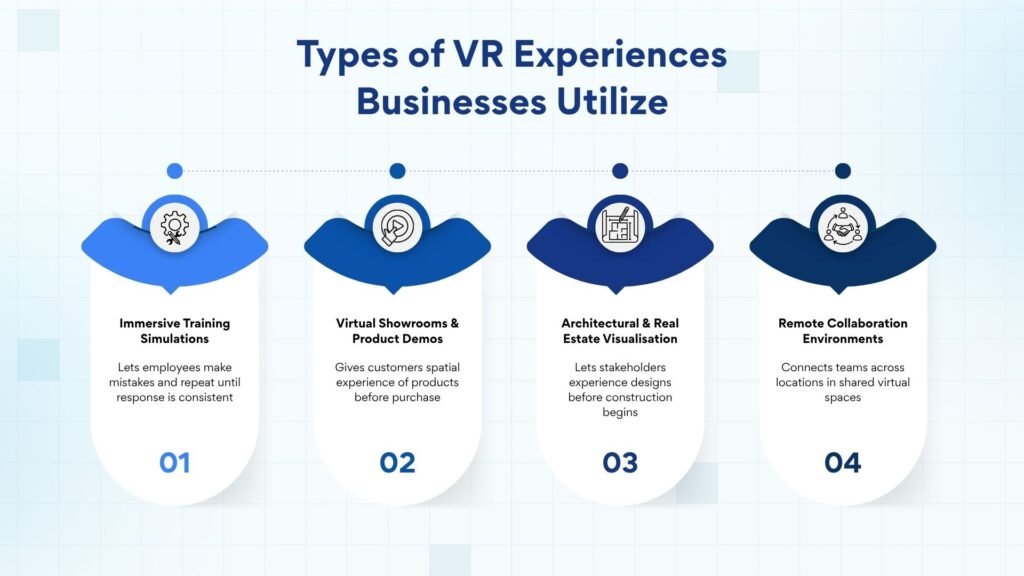
| VR Experience Type | What It Does |
| Immersive Training Simulations | Lets employees make mistakes and repeat until response is consistent |
| Virtual Showrooms & Product Demos | Gives customers spatial experience of products before purchase |
| Architectural & Real Estate Visualisation | Lets stakeholders experience designs before construction begins |
| Remote Collaboration Environments | Connects teams across locations in shared virtual spaces |
Common Misconceptions Saudi Business Owners Have About Virtual Reality (VR)
VR gets dismissed for a handful of reasons that sound reasonable on the surface but don’t hold up once you look at what’s actually happening in the market.
Some business owners think it’s a gaming toy. Some think it’s out of budget. Some think it’s not ready yet, or that Saudi vendors haven’t caught up to it. None of that is true anymore, and believing it is exactly what’s letting competitors get ahead while you wait. Here are the most common ones, and what you actually need to know about each so you don’t fall behind:
“VR is just for gaming”
If you think of VR as a gaming accessory, you’re not alone, and it’s the single biggest reason business owners write off VR before they’ve looked at what it actually does. But a training headset and a gaming headset running the same hardware doesn’t make them the same tool. A VR training simulation for a petrochemical facility isn’t judged on how fun it is. It’s judged on whether it cuts real incident rates on the job.
Here’s what’s actually true:
- Enterprise VR is built and evaluated around one thing: measurable operational results, not entertainment
- The gaming association is a branding problem with VR’s public image, not a limitation on what it can do for your business
- The same technology already training surgeons, safety crews, and sales teams has nothing to do with the games your kids play
“VR is too expensive”
If you’ve priced VR out before and walked away, you were likely comparing it to doing nothing, not to what you’re already paying. VR costs have dropped significantly in the past three years, and standalone headsets now skip the PC infrastructure that used to make enterprise VR expensive to run. But the real problem with this misconception isn’t the price tag. It’s the comparison.
Here’s what you should actually be comparing VR against:
- The cost of running physical training facilities and repeated classroom sessions, year after year
- The cost of operational disruption every time training happens in a live environment
- The cost of the incidents and errors that happen when undertrained employees make mistakes on the job
“We’ll wait until the technology gets better”
If you’re holding off because you think VR isn’t ready yet, that milestone already passed. VR hardware is stable and already proven across industrial, healthcare, real estate, and corporate training. Unity VR, the platform most enterprise VR is built on, is mature and backed by a global developer ecosystem, not an emerging tool still working out its kinks.
Here’s what waiting is actually costing you:
- Every quarter you wait, competitors who’ve already deployed VR are training faster and closing sales faster than you
- The technology gap you’re waiting to close doesn’t exist anymore, the adoption gap does
- Catching up later costs more than starting now, because you’re building from zero while competitors are already improving what they’ve built
“AR and VR are the same thing”
This is one of the most common assumptions businesses bring into their first AR or VR conversation, and it leads to scoping the wrong solution from the start. AR and VR are built on different technology, solve different problems, and are used at different points in the same workflow.
VR replaces the real environment entirely, it is what you use when the real environment is unavailable, dangerous, or does not exist yet. AR keeps the real environment present and layers digital information on top of it, it is what you use when the real world needs to stay in view and information needs to be added to it. A real estate developer using VR to walk buyers through an unbuilt unit and AR to help the construction team build it accurately is not running two separate technology projects. They are using the right tool at the right stage. Picking one because you assume they are interchangeable means you will eventually hit the problem the other one was built to solve.
Developing AR for business is a completely different approach, different technology stack, different hardware requirements, different development process, and different use cases entirely. Treating them as the same investment decision is what leads to deploying the wrong solution for the problem you are actually trying to solve.
Industry-Specific VR Applications in Saudi Arabia
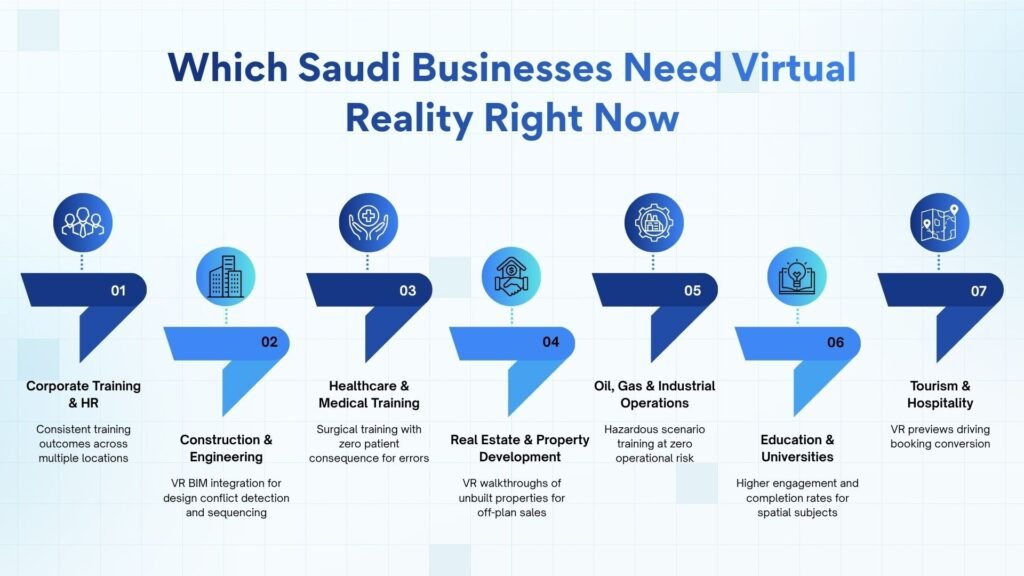
| Industry | Key VR Application |
| Corporate Training & HR | Consistent training outcomes across multiple locations |
| Construction & Engineering | VR BIM integration for design conflict detection and sequencing |
| Healthcare & Medical Training | Surgical training with zero patient consequence for errors |
| Real Estate & Property Development | VR walkthroughs of unbuilt properties for off-plan sales |
| Oil, Gas & Industrial Operations | Hazardous scenario training at zero operational risk |
| Education & Universities | Higher engagement and completion rates for spatial subjects |
| Tourism & Hospitality | VR previews driving booking conversion |
VR for Corporate Training
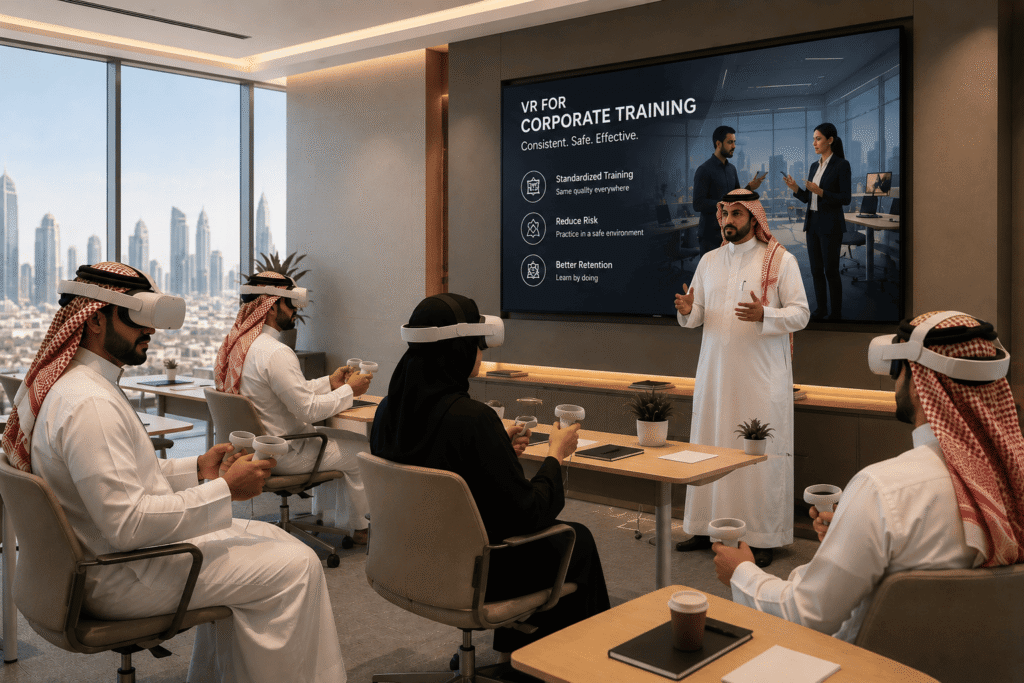
If your business runs training across multiple branches, VR solves the problem that classroom training can’t: consistency. Retail chains, banks, telecom providers, and logistics companies with locations spread across Riyadh, Jeddah, and beyond are using VR to make sure every employee gets the same training, at the same standard, regardless of who’s delivering it.
What VR training actually replaces:
- Onboarding modules that stay identical whether a new hire starts in Riyadh or a regional branch
- Compliance and procedure training that doesn’t degrade when a trainer is inexperienced or rushed
- Customer service scenarios employees can practice and repeat before facing a real customer
- Leadership and soft-skills roleplay without needing another employee to act as the counterpart
VR for Real Estate
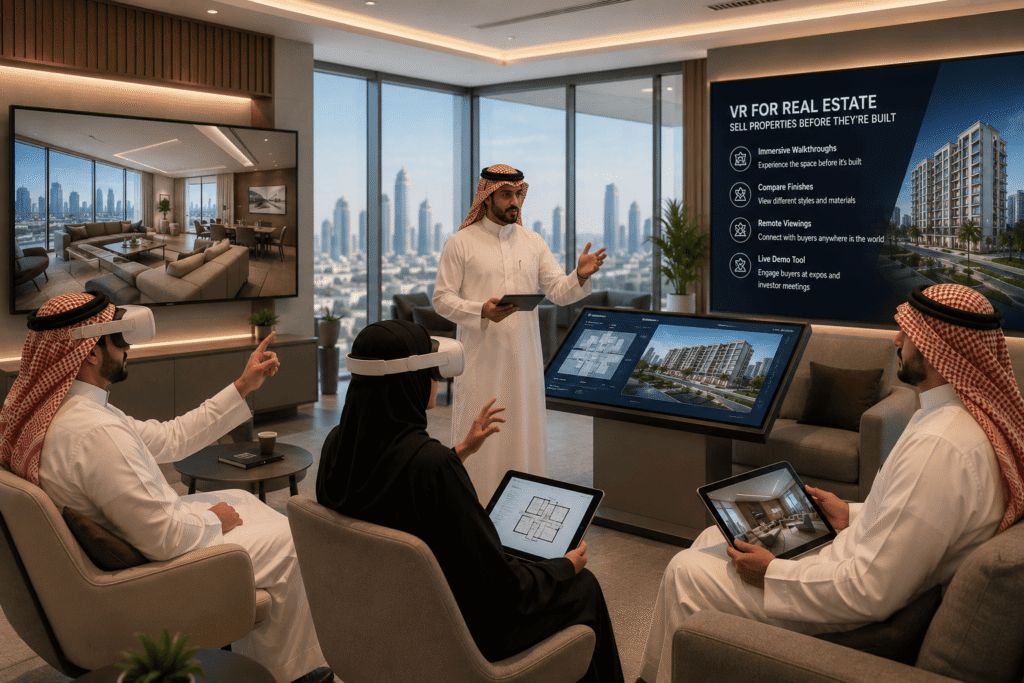
If you sell property before it exists, VR in real estate removes the biggest obstacle in your sales process: asking a buyer to commit to a floor plan instead of a space. Off-plan developers, real estate brokerages, master-planned community developers, and property marketing agencies are using VR to turn that floor plan into something a buyer can actually walk through.
What VR shows a buyer that a brochure can’t:
- A full walkthrough of the unit, including ceiling height, room flow, and window views, before a single wall exists
- Side-by-side comparisons of different finish packages inside the same walkthrough
- Remote viewings for international or out-of-town buyers who can’t visit the site in person
- A live demo tool your sales team can run at property expos and investor meetings
VR for Gaming and Esports
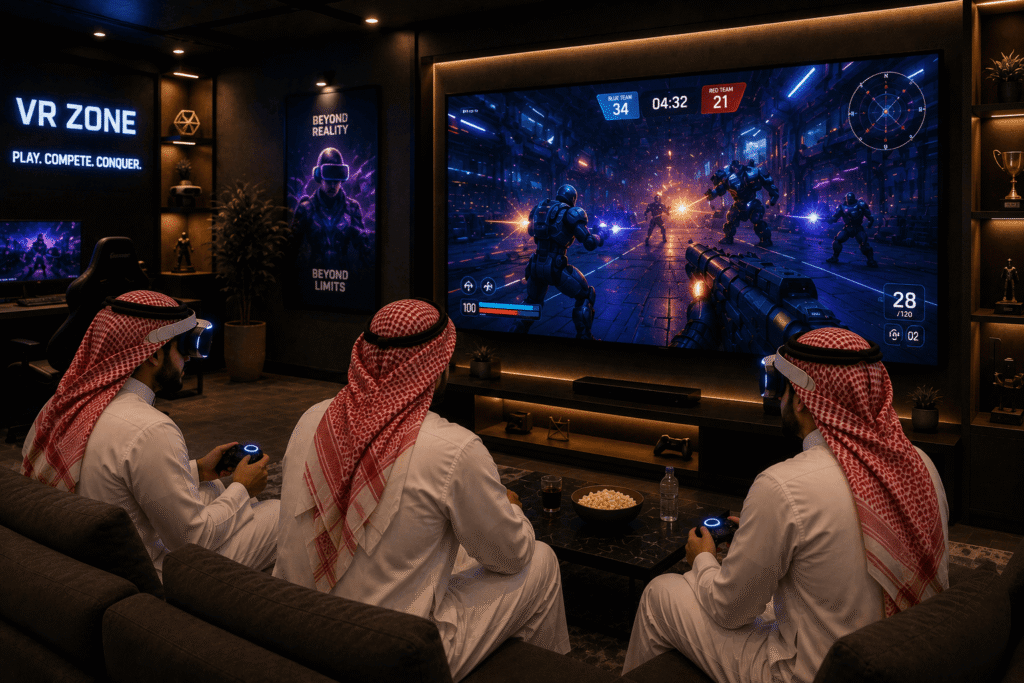
If you’re building inside Saudi Arabia’s gaming and esports sector, VR isn’t a marketing gimmick here, it’s part of the infrastructure itself. Esports arena operators, game development studios, entertainment venue developers, and event organizers are using VR as a core part of what they build and sell, not an add-on to it.
What VR is being used for inside this industry:
- Esports arenas and gaming districts building VR experience zones alongside competitive stages, as seen in Qiddiya’s gaming city development
- Domestic game development studios building VR titles as part of Saudi Arabia’s push to grow local game production
- Event organizers using VR demo stations to give attendees hands-on experience at gaming festivals and expos
- Entertainment venues combining VR attractions with esports viewing to keep visitors on-site longer
VR for Healthcare
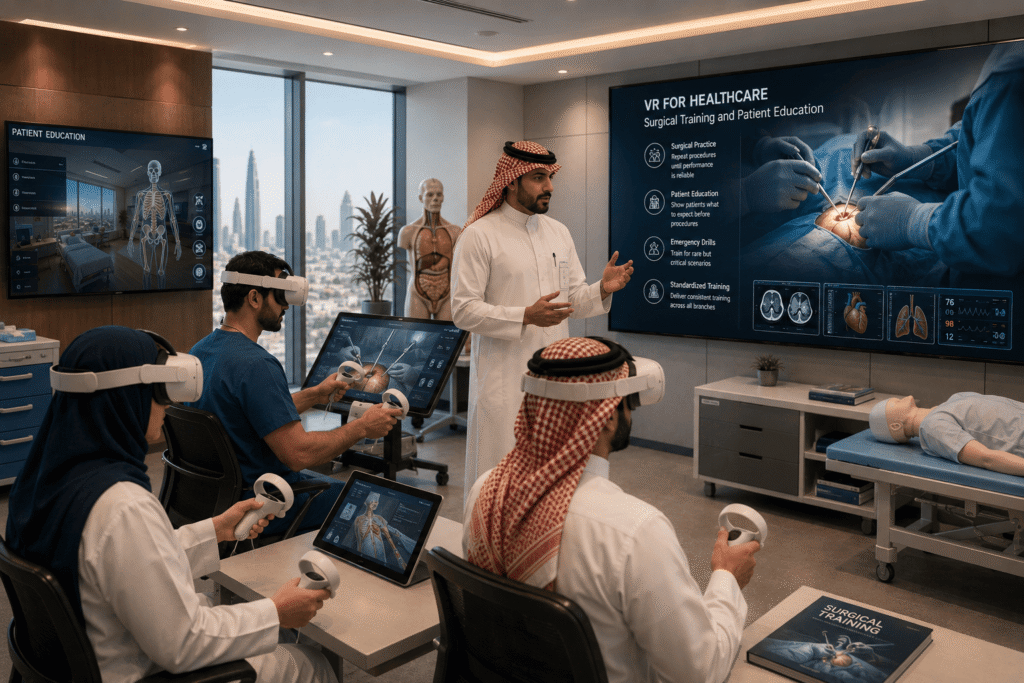
If your business trains clinicians or treats patients, VR gives you repetition that mannequins and classrooms can’t. Hospitals, medical training centers, private clinics, and dental practices are using VR to build procedural memory in a setting where mistakes carry no real consequence.
What VR makes possible in a clinical setting:
- Surgical procedures trainees can repeat until performance is reliable
- Patient education walkthroughs that show someone what a procedure involves before they consent to it
- Emergency response drills for scenarios too rare to train for physically
- Standardized training across multiple hospital branches without flying instructors between sites
VR for Construction and Engineering
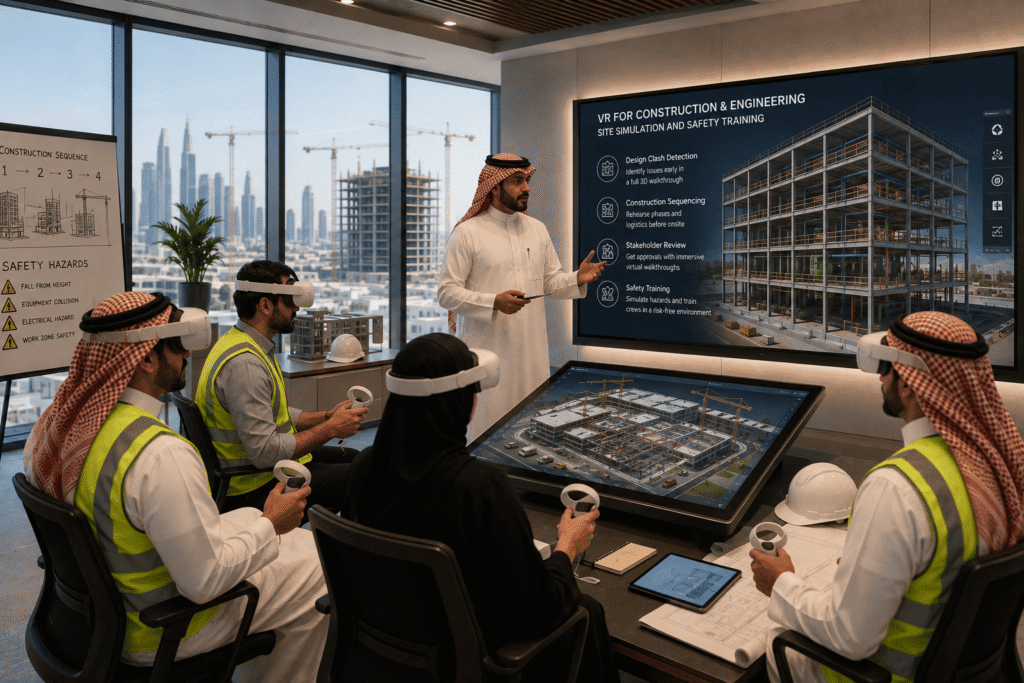
If you’re a contractor where a design change costs more the later it’s caught, VR catches it before groundbreaking instead of mid-build. General contractors, civil engineering firms, developers building complex structures, and facilities management companies are using VR-integrated BIM to walk through a building before it’s real.
What VR catches before it becomes a change order:
- Design and coordination conflicts spotted inside a full walkthrough, not a 2D drawing
- Construction sequencing rehearsed with the project team before equipment is on site
- Stakeholder reviews that get sign-off on a shared virtual walkthrough instead of a meeting room argument over renders
- Safety hazard simulations for site crews before they encounter the hazard for real
VR for Oil and Gas Industry
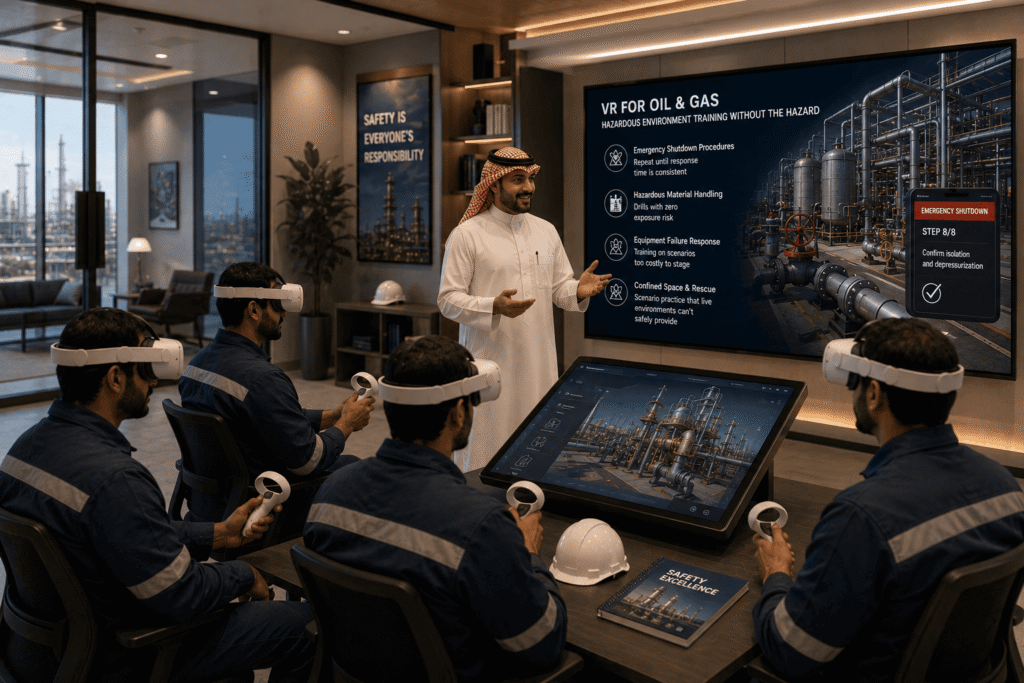
If your operation can’t afford to train inside a live hazardous environment, VR replicates the environment without the exposure. Petrochemical operators, Aramco contractors, pipeline maintenance companies, and industrial safety training providers are using VR to give crews unlimited repetitions on scenarios that are too dangerous to rehearse physically.
What VR trains without operational risk:
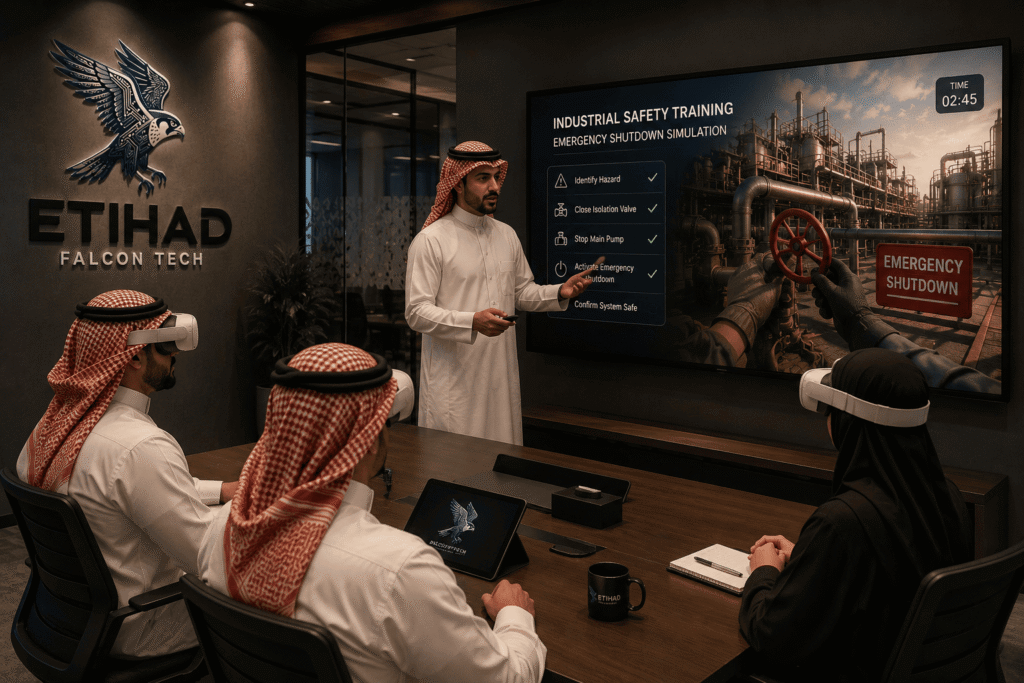
- Emergency shutdown procedures repeated until response time is consistent
- Hazardous material handling drills with zero exposure risk
- Equipment failure response training on scenarios too costly to stage physically
- Confined space and rescue scenario practice that live environments can’t safely provide
VR for Retail
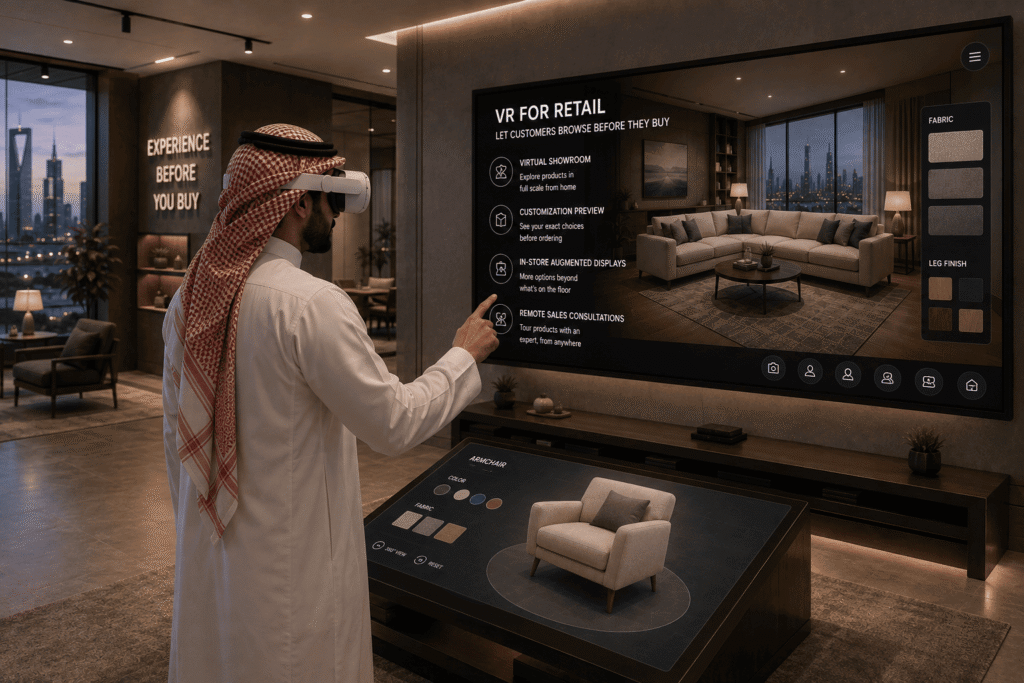
If your product is large, customizable, or hard to display in full, VR lets a customer experience it before they’re standing in your showroom. Furniture retailers, fashion brands, home goods stores, and showroom-based retailers are using VR to move the showroom experience online without losing what makes it convincing in person.
What VR gives a customer a static product page can’t:
- A virtual showroom customers browse from home, at full scale
- Product configuration previews, so a customer sees their exact customization before ordering
- In-store augmented displays that let a walk-in customer see options the physical floor doesn’t have room for. These in-store setups are where augmented reality development comes in specifically, layering digital product options onto the physical space rather than replacing it entirely the way a full VR showroom does.
- Remote sales consultations where a customer tours the product with a salesperson guiding them
VR for Education
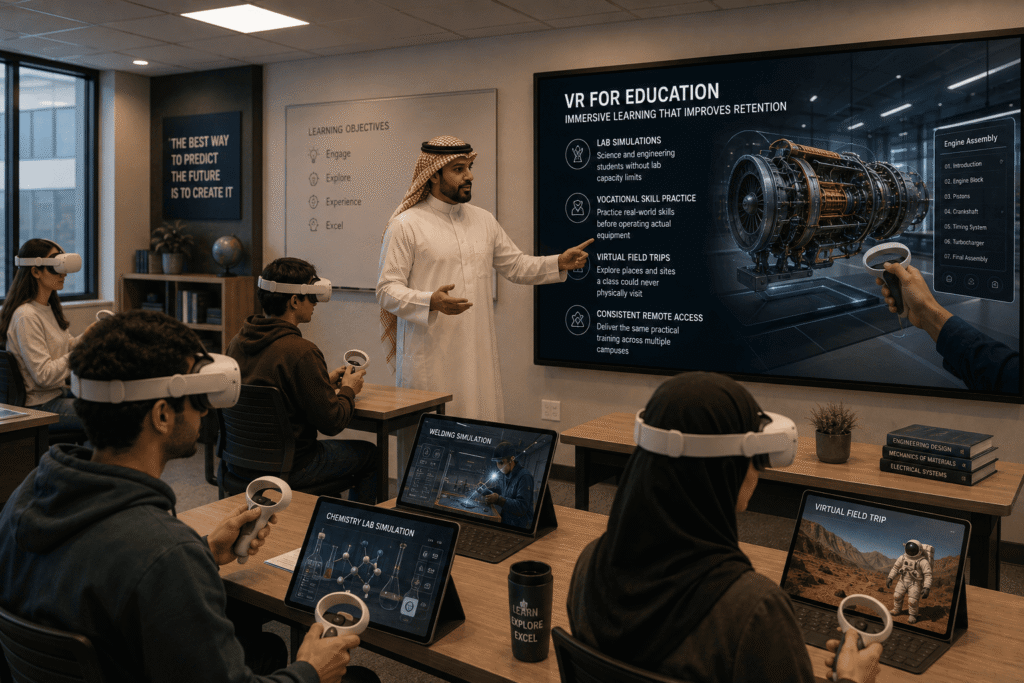
If you run an institution where a subject depends on hands-on practice, VR in education gives students the repetitions a lab or classroom can’t provide at scale. Universities, technical and vocational training institutes, corporate learning academies, and private schools are using VR to raise course completion and skill transfer.
What VR adds to a curriculum:
- Lab simulations for science and engineering students without lab capacity limits
- Vocational skill practice, welding, machinery operation, equipment handling, before students touch the real equipment
- Virtual field trips to sites a class could never physically visit
- Consistent remote access to the same practical training across multiple campuses
VR for Tourism & Hospitality
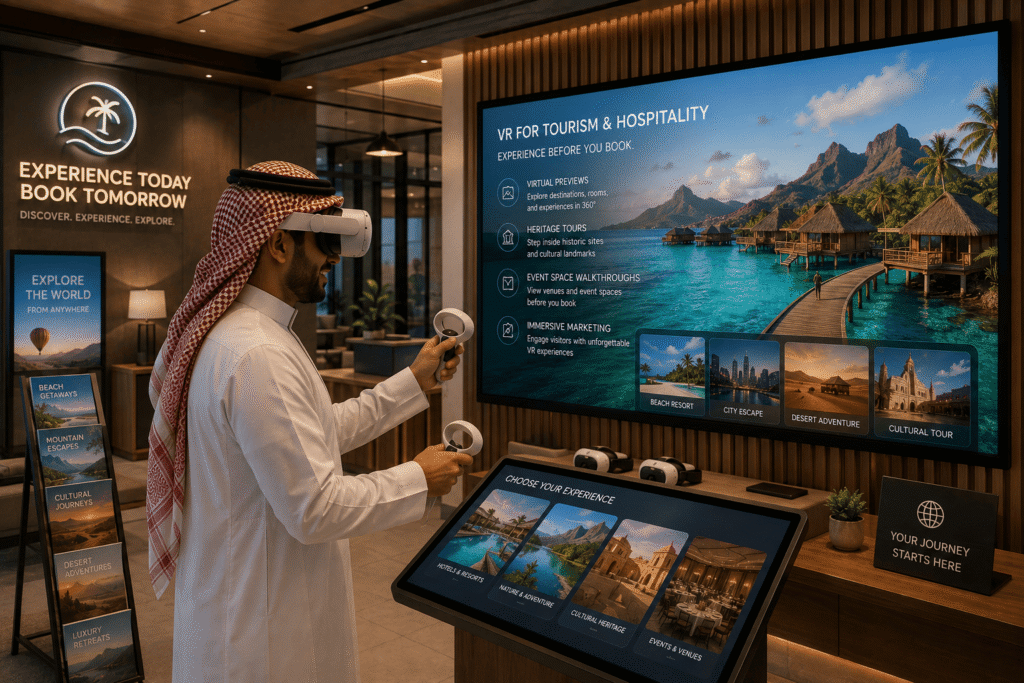
If you’re selling a destination or an experience, VR in tourism closes the gap between a photo gallery and an actual booking decision. Tour operators, hotel groups, destination marketing organizations, and cultural heritage sites are using VR to convert interest into bookings before a visitor ever leaves home.
What VR gives a traveler before they commit:
- Virtual previews of destinations, rooms, and event spaces before booking
- Cultural heritage site tours built for international audiences who may never visit in person
- Event space walkthroughs for corporate clients deciding where to book
- Immersive marketing experiences at travel expos that outperform a brochure or video
Other Industries Putting VR to Work
Healthcare, real estate, and industrial training are the clearest cases, but they’re not the only ones. Banks are using VR for branch staff training. Government service centers are using it for citizen-facing process simulations. Logistics and warehousing companies are using it for equipment and safety training. Food and beverage chains are using it for standardized staff onboarding across locations. If your business has a training, sales, or customer experience problem that depends on someone understanding something they can’t yet see or touch, there’s very likely already a VR application built for it.
The VR Development and Implementation Process
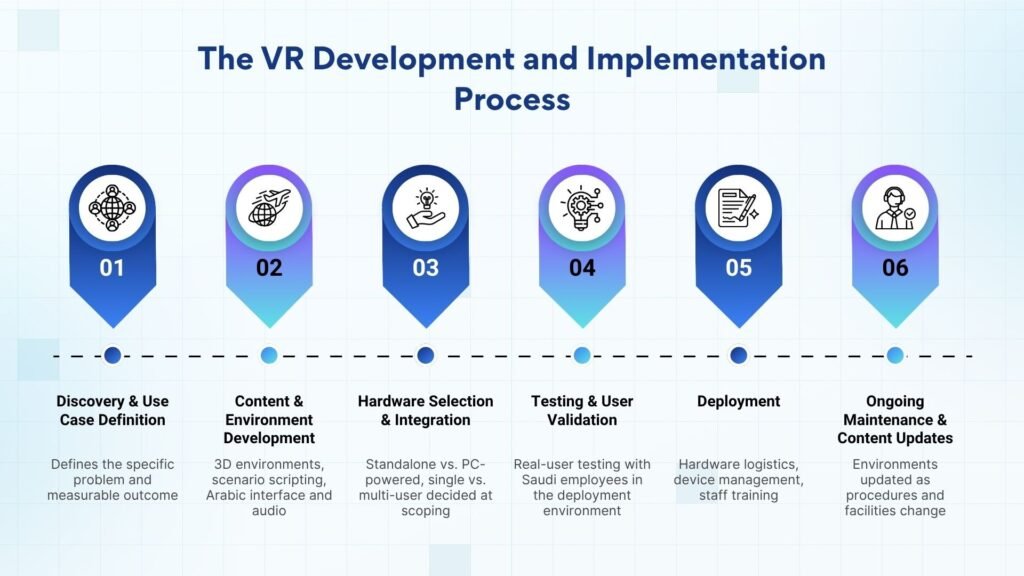
| Stage | What Happens |
| 1. Discovery & Use Case Definition | Defines the specific problem and measurable outcome |
| 2. Content & Environment Development | 3D environments, scenario scripting, Arabic interface and audio |
| 3. Hardware Selection & Integration | Standalone vs. PC-powered, single vs. multi-user decided at scoping |
| 4. Testing & User Validation | Real-user testing with Saudi employees in the deployment environment |
| 5. Deployment | Hardware logistics, device management, staff training |
| 6. Ongoing Maintenance & Content Updates | Environments updated as procedures and facilities change |
Discovery and Use Case Definition
Every successful VR deployment starts with a specific problem definition — not a technology brief. What scenario is being simulated, what the user needs to learn or experience, and what measurable outcome defines success. Clarity at this stage determines the entire development scope. Vague objectives produce environments that are technically built but operationally ineffective.
Content and Environment Development
This is where the majority of project effort and cost sits. 3D environment creation, interaction system design, scenario scripting and branching logic, Arabic language interface and audio, and cultural alignment in visual environments are all developed here. The realism of the VR environment directly affects training transfer — environments that feel generic or visually inaccurate produce weaker behavioral outcomes than environments that closely replicate the real conditions they simulate.
VR content development should not be treated as a visual production task. It is a learning design task where the decisions about what users see, hear, and do at each stage of a simulation are the primary variables that determine whether the deployment produces the intended outcome.
Hardware Selection and Integration
Standalone versus PC-powered, single-user versus multi-user, fixed installation versus portable deployment — these decisions need to be made during scoping, not after development is complete. Hardware selection affects what the VR system can do, how it is deployed across locations, and what the ongoing management requirements are. Getting this wrong at the hardware stage means the system underperforms regardless of development quality.
Testing, User Validation, and Deployment
Real-user testing with Saudi employees in the actual deployment environment catches usability problems that technical QA in a development studio does not. Arabic interface testing, comfort and ergonomics across the user population, and performance validation on the target hardware are all required before enterprise rollout.
Deployment planning for multi-location Saudi enterprises covers hardware logistics, device management, update distribution, and staff training on system operation — not just content. A VR system that employees know how to use and manage independently produces better long-term outcomes than one that requires developer involvement for basic operation.
Ongoing Maintenance and Content Updates
VR environments need to be updated when procedures change, facilities are modified, or compliance requirements evolve. Businesses that treat VR as a completed project rather than an ongoing system discover that their environments diverge from current reality over time — reducing the training transfer benefit that justified the original investment. VR content development is not a one-time project. It is an ongoing operational commitment.
What Virtual Reality Development Costs in Saudi Arabia
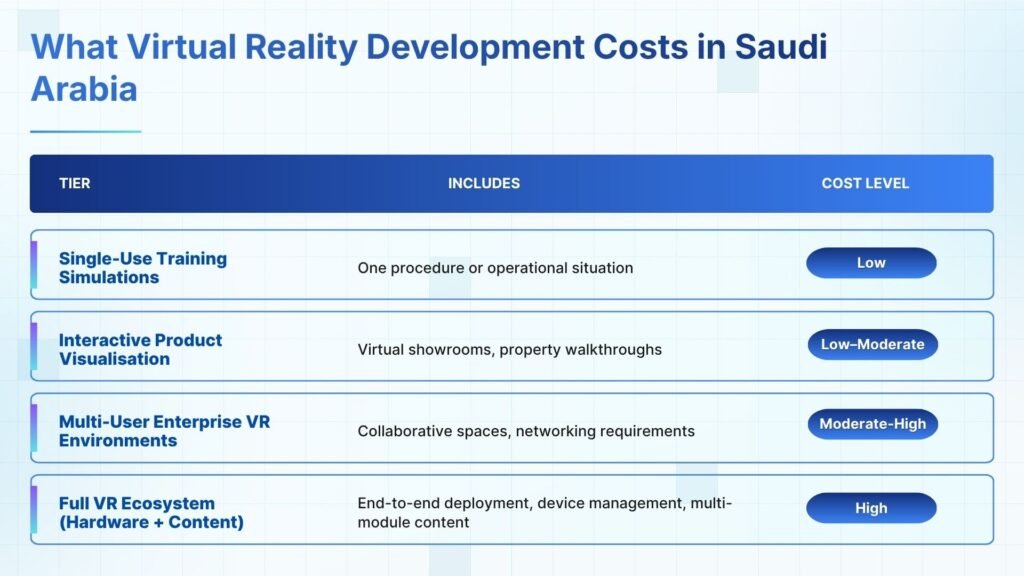
| Tier | Includes | Cost Level |
| Single-Use Training Simulations | One procedure or operational situation | Low |
| Interactive Product Visualisation | Virtual showrooms, property walkthroughs | Low–Moderate |
| Multi-User Enterprise VR Environments | Collaborative spaces, networking requirements | Moderate–High |
| Full VR Ecosystem (Hardware + Content) | End-to-end deployment, device management, multi-module content | High |
What you pay comes down to three things: how detailed the environment needs to be, how much realism the simulation needs to actually work, and how many scenarios you’re building. Hardware is a separate line item on top of development, not part of it, so factor both into your budget from the start.
Single-use training simulation
This is the lowest-cost tier, and the right place to start if you have one high-value training problem to solve before expanding further. It’s built around a single procedure or operational scenario, focused and scoped tight.
Interactive product visualization
If you’re selling something customers need to see before they buy, a showroom walkthrough or a property tour, this is your tier. Cost here comes down to how detailed the visuals need to be and how many configurations a customer can explore inside the experience.
Multi-user enterprise VR environment
If your use case needs multiple people in the same virtual space at once, a training scenario that requires team interaction, or a remote stakeholder review on a construction project, you’re in this tier. The added cost comes from the networking required to keep performance consistent across every connected headset.
Full VR ecosystem
This is the tier for businesses treating VR as a permanent part of how they operate, not a single project. It covers hardware procurement, device management, content across multiple modules, Arabic localization, and staff training, all built and deployed together.
What Drives Your Cost Up or Down
- Environment complexity – The more detail, the bigger the space, and the more interactive elements inside it, the higher the cost.
- Scenario branching – Every additional path a user can take through a simulation adds development effort, and it adds up fast.
- Arabic localization – Getting the language and cultural context right isn’t a checkbox, it’s its own production work.
- Deployment scale – Rolling out across multiple locations adds logistics and device management costs on top of the development itself.
Virtual Reality (VR) Development: A Quick Decision Guide for Businesses
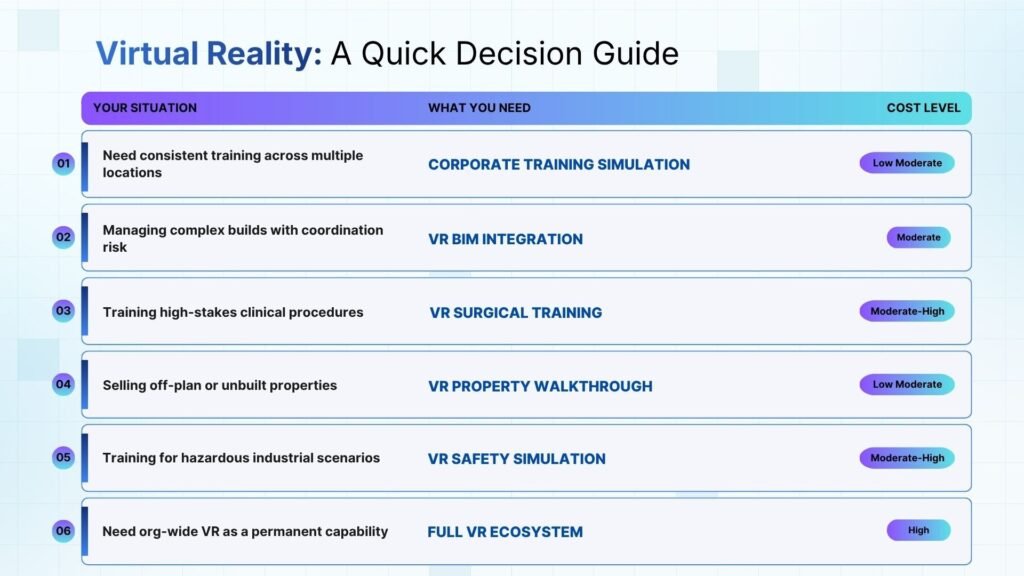
| Your Situation | What You Need | Cost Level |
| Need consistent training across multiple locations | Corporate Training Simulation | Low–Moderate |
| Managing complex builds with coordination risk | VR BIM Integration | Moderate |
| Training high-stakes clinical procedures | VR Surgical Training | Moderate–High |
| Selling off-plan or unbuilt properties | VR Property Walkthrough | Low–Moderate |
| Training for hazardous industrial scenarios | VR Safety Simulation | Moderate–High |
| Need org-wide VR as a permanent capability | Full VR Ecosystem | High |
Common Mistakes Saudi Businesses Make When Deploying VR
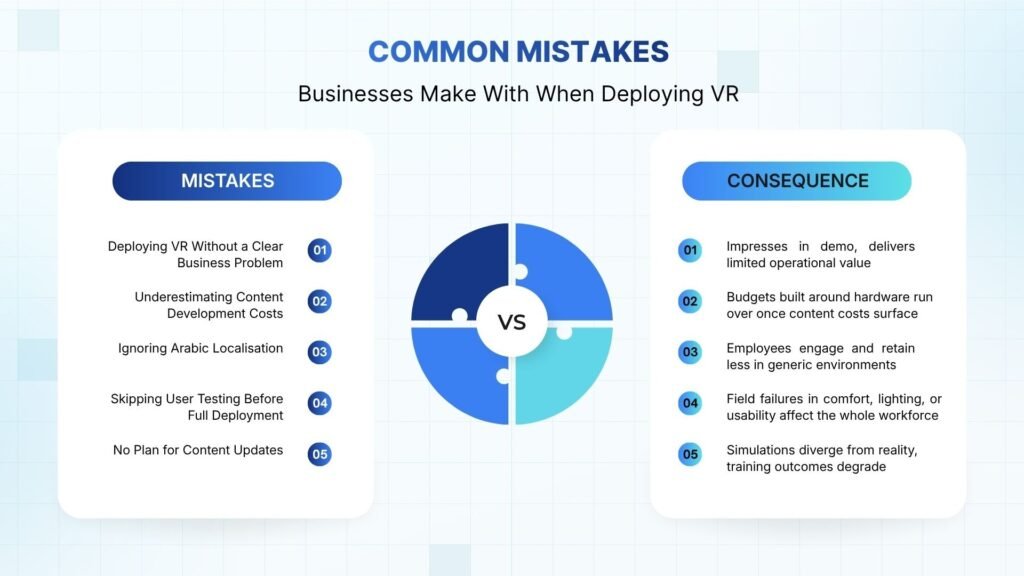
| Mistake | Consequence |
| Deploying VR Without a Clear Business Problem | Impresses in demo, delivers limited operational value |
| Underestimating Content Development Costs | Budgets built around hardware run over once content costs surface |
| Ignoring Arabic Localisation | Employees engage and retain less in generic environments |
| Skipping User Testing Before Full Deployment | Field failures in comfort, lighting, or usability affect the whole workforce |
| No Plan for Content Updates | Simulations diverge from reality, training outcomes degrade |
Why Etihad Falcon Tech is the Best VR Development Company in Saudi Arabia
Business problem first, technology second
Etihad Falcon Tech starts every VR project by defining the specific outcome the VR deployment needs to produce, in operational terms, not technical ones. That outcome definition determines environment scope, scenario design, hardware selection, and Arabic localization requirements before any development begins.
Unity VR development built for Saudi enterprise environments
Etihad Falcon Tech’s VR development is built on Unity VR development, the platform that provides the performance, cross-platform flexibility, and interaction design capability that enterprise VR applications require. Arabic language interfaces, cultural environment alignment, and optimisation for the standalone headsets most appropriate for Saudi enterprise deployment are standard in every build.
Full-spectrum virtual reality development services
From single-scenario training simulations to multi-user collaborative environments, architectural walkthroughs, and full VR ecosystems with hardware and content, we deliver the complete range of VR applications. Our virtual reality development services in Saudi Arabia cover strategy, content design, 3D environment development, hardware selection, deployment, and ongoing content maintenance.
Proven experience with Saudi businesses
Etihad Falcon Tech has delivered VR solutions for Saudi businesses in construction, gaming, healthcare, real estate, industrial training, corporate learning, and many other niches. That experience means faster recognition of what environment detail level is required for training transfer to occur, fewer hardware selection mistakes, and VR systems deployed in real operational conditions rather than controlled demonstration environments.
If your business is ready to bring virtual reality into your operations, message us on WhatsApp now, and we’ll start scoping what your VR project actually needs.
Frequently Asked Questions
Virtual reality (VR) places users inside a fully simulated digital environment through a headset. Businesses use it to train employees for high-risk or high-cost scenarios, sell properties and products before they exist, simulate clinical and industrial procedures, and deliver customer experiences static media can’t match.
Cost depends on environment complexity, scenario depth, and Arabic localization, not hardware. A single-scenario training simulation sits at the low end; a multi-user enterprise environment with heavy branching and full localization sits higher. We give you an accurate estimate once we’ve scoped your use case and outcome.
Construction, healthcare, real estate, oil and gas, corporate training, and education see the strongest results, because each one deals with environments too dangerous to train in physically, spaces that don’t exist yet, or training that needs to stay consistent across multiple locations.
A single-scenario training simulation takes ten to sixteen weeks. A multi-scenario enterprise environment takes four to six months. A full VR ecosystem, hardware included, runs six to twelve months depending on scope.
Yes. Arabic audio, interface text, and cultural alignment directly affect how well employees engage with training and how well it transfers to real performance. We build Arabic in from the design phase, not as a pass added at the end.
Standalone headsets are the practical choice for most Saudi enterprise deployments: self-contained, portable, and usable across locations without extra infrastructure. PC-powered VR comes in when a use case needs the highest visual fidelity. We settle on hardware during scoping, based on your use case and deployment scale.
Yes, and it’s one of the strongest VR applications in this market. It gives every employee the same training regardless of who delivers it, and lets them repeat high-stakes procedures until performance is reliable before they touch the real environment. For businesses training across multiple cities, that consistency alone often justifies the investment.
We start with your business problem and the outcome your VR deployment needs to produce, then scope the environment, scenario design, hardware, and Arabic localization around it.
Our process runs through use case definition, content design, development, user testing, and deployment, with content maintenance planned in from day one.
Contact our team to talk through what your project needs.